Wanna Lose Weight? Get Some Sleep!

There was some research published within the last year that you might be particularly interested in, should you be in the middle of or about to go on a diet (or you’re interested in your health in general):

This article provides an integrative review of the mechanisms by which sleep problems contribute to unhealthy food intake. Biological, cognitive, emotional, and behavioral mechanisms all underlie this relationship.

When I first came across this headline — the less you sleep, the more you eat — immediately, I was interested. After reading the source article (which I quoted from above), I’m heartened by the possibilities for progress in this area.

Naturally, the food we eat has an effect on how we sleep, but the insight that the fewer hours of sleep we get having an effect on how much we eat, is really important. While anecdotal, I’ve experienced this phenomenon firsthand. If I find myself up past my “bedtime,” I almost always am hungry. And because it’s late at night, my executive function is impaired. Put differently, my ability to make good choices might be compromised. In this case, a good choice would be to not eat a bag of chips or a tub of ice cream (or anything sugary, for that matter). A good choice might even be to reach for a handful of nuts or maybe an apple.

The thing that I wanted to mention in conjunction with this research is my suspicion that there’s a cumulative effect. If you stay up late and then pig out on snacks too close to bedtime, invariably, you’ll probably be waking up with less sleep than you need. As a result, your executive functioning (willpower, decision-making, etc.), will be impaired for the duration of the day. By the time you get to the end of the day, you may find yourself more tired than usual such that when it gets to the time when you’d rather go to bed, you might prefer to “reward” yourself or (decompress) by eating some sweets and staying up late… and then it all starts over again the next day. Once you’re out of balance, Newton’s laws have a way of keeping you there.

This reminds me of something I shared a few years ago about Aikido:

One of the exercises we would often do to practice this sense of blending involved our partner (or partners as it was usually in groups of three or more!) to approach us as if they were attacking us. It was our job to then move out of the way, whilst staying centered. The tempo of this exercise usually started out really slow (intentionally). Though, as time passed, our partners would then speed up. You can imagine how it might be challenging to stay centered in this kind of an activity.

During these times of practice, I remember having a bit of an epiphany.

As my partner would approach me and I would step out of the way, I noticed that the quicker (and the more out of balance!) I was, the more out of balance I would be when stepping out of the way for the next partner who was approaching. Think about that for a second: as I stepped out of the way of one partner and I was off-balance, I was that much more off-balance when stepping out of the way for the next partner. It’s almost akin to the Bullwhip Effect.

This idea of eating “after hours” seems to be a mirror image of the off-balance I experienced during the Aikido exercise. So, if you find yourself on the cusp of a diet, I suggest you consider setting (and keeping!) a strict bedtime for yourself. If you’re curious about how to start this new habit, I strongly suggest Duhigg’s book: The Power of Habit.

ResearchBlogging.orgLundahl A, & Nelson TD (2015). Sleep and food intake: A multisystem review of mechanisms in children and adults Journal of Health Psychology : 10.1177/1359105315573427
Looking for a Husband or a Wife? It’s Time to Learn About Altruism

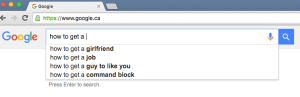
Human companionship. It’s something that we all crave. In fact, a quick look at Google’s autocomplete shows that two of the top three results for “how to get a” return “girlfriend” and “guy to like you.” It’s pretty clear that sharing our life with someone is something we’d like to do (generally, speaking). So, when I came across some research in this area, I thought I’d contribute to those Google searches with some seemingly helpful data. From the journal article:

Our results show that—among single individuals—engaging in prosocial behavior in any given year was associated with increased odds of finding a partner and entering into a romantic relationship in the following year.

I’ve written about the benefits of prosocial behaviour in a work environment (spend your bonus on your coworkers!), so it’s not entirely surprising to me to see that this same behaviour is also beneficial when it comes to increasing one’s odds of finding a romantic partner. Another way of looking at prosocial behaviour is altruism. Essentially, we’re talking about behaviour where one is attempting to help someone else without expecting something in return. Volunteering is an easy example of this.

You may be wondering about the study’s method. That is, did the researchers guard against the possibility that  the reverse is true (entering into romantic relatonships begets more prosocial behaviour). In fact, they did consider this:

We specifically examined whether those individuals who were single at the beginning of a time period and managed to find a partner at the end of the time period were more likely to experience an increase in helping behavior in the meantime than those who remained single. Our results showed that individuals who started a romantic relationship did not experience an increase in helping behavior compared with those who remained single.

So, it looks like the researchers feel pretty confident in their conclusions about volunteering helping to lead one to a romantic relationship. Before you run out to your local Red Cross or Salvation Army, I wanted to offer a different perspective on this research. In particular, I thought I’d look at some of the historical statistics around volunteerism and marriage. That is, if we accept the premise of the research, we might expect to see there to be some covariance between volunteerism and marriage. That is, as marriage goes up, we might expect that volunteerism would also go up. Similarly, as marriage goes down, we might expect that volunteerism would go down.

I had a harder time than I thought I might in trying to find data on these two subjects. However, I did come across a couple of things that gave me pause about this research. The first, volunteerism. According to some research by the US government, it looks like volunteerism is up, recently. That is, it looks like the propensity for volunteering is higher than it used to be (see graph). The second, marriage rates. If the initial research I shared about prosocial behaviour is true, we’d expect to see higher marriage rates (than there used to be). Here’s the headline from the Pew Research Center a few years ago: Record Share of Americans Have Never Married. So, it’s probably fair to say that marriage rates are down. This doesn’t bode well for our initial research on prosocial behaviour.

One last thing I wanted to share on this: millennials. There’s been plenty written about millennials, but I want to focus on the two things we’re talking about today: volunteering and marriage. Compared to previous generations at the same age, millennials are far less likely to get married. Millennials also differ from Gen X’ers when it comes to volunteering:

… higher rates of community service and volunteering. I mean, let’s face it, for Gen X, volunteering was a punishment. You know, you did something wrong at college, you do community service. (Laughter) But the Millennials — it’s more of a norm.

~

It’s quite possible that the effect realized by the initial research on prosocial behaviour is true, but that it’s not big enough to make a dent in some of these bigger statistics. It’s also possible that some of the counterpoints I’ve raised aren’t as analogous as I think they are. Either way, I think the research in prosocial behaviour is important and I certainly hope you take the chance to spend some time “giving without expecting anything in return.”

ResearchBlogging.orgStavrova, O., & Ehlebracht, D. (2015). A Longitudinal Analysis of Romantic Relationship Formation: The Effect of Prosocial Behavior Social Psychological and Personality Science, 6 (5), 521-527 DOI: 10.1177/1948550614568867

Why It’s Important to Have Diversity (in age!) in Your Work Teams

If you had to guess, would you say that younger people or older people are better at learning abstract causal principles?

When first thinking about this question, I would have thought that older people would be better at this given that they have more experience and that they might have been in analogous situations. However, the research seems to indicate that younger folks are better at things like this. Here’s a passage from the researchers that specifically address my thought that experience would be helpful:

The very fact that older learners know more may make it more difficult for them to learn something new. Once a learner has inferred a general principle (e.g., that people act because of their traits, or that individual objects, rather than combinations of objects or relations between them, have causal powers), that principle may constrain his or her interpretation of new data. Causal relationships that conflict with that principle may then be more difficult to learn.

Certainly this research is important, but the thing I want to highlight here is work teams. Specifically, this study points to the importance of having diverse w0rk teams. It’s important to remember that diversity doesn’t just mean people of different genders and different races, but people of different ages, too. If we mix in folks with different “levels of experience,” we might have a better chance of coming up with a solution to the issue than if we just used folks who were all of the same level experience.

Further to that, I was thinking about how this research comes into play when we think of top management teams or corporate boards. Recall the post I wrote recently that discussed the importance of diversity at the board-level. I don’t remember there being anything related to age in that article, but I also suspect that conducting research on age as it relates to boards or top management teams might be difficult. Usually, we find folks who’ve reached a certain level of experience before they’re considered for work on a corporate board or considered for a promotion to the top management team. Maybe we need to start thinking about considering some younger folks for positions in these roles.

ResearchBlogging.orgGopnik, A., Griffiths, T., & Lucas, C. (2015). When Younger Learners Can Be Better (or at Least More Open-Minded) Than Older Ones Current Directions in Psychological Science, 24 (2), 87-92 DOI: 10.1177/0963721414556653

Psychologists Want an Alternative to the DSM

In another life (or a different timeline, if you prefer) I didn’t change paths and continued on to become a clinical psychologist. In that life (or timeline), I, and many other psychologists are using something totally different than the DSM and the psychologists in this timeline are jealous. Confused?

Recent research published sought to see if the attitudes of psychologists, with regard to the DSM, have changed at all. It turns out, they haven’t:

The results are no different from what was found three decades ago, namely, that a significant number of psychologists are unhappy with the DSM, but almost all of them use it.

So, why do we continue to update the DSM instead of scrapping it and making something better? Well, that’s probably a can of worms for a different post, but it seems telling that in 30 years that psychologists still aren’t happy with what is supposed to be a very important source book for the profession. More than that, as 30 years have spanned, it’s fair to say that even the next generation of psychologists aren’t warming to the DSM.

In reading this study, the most troubling sentence comes from near the end of the article [Emphasis Added]:

They appreciate its help in making diagnoses and supplying reimbursable diagnostic codes, but continue to have scientific, professional, economic, and ethical concerns about it.

That’s troubling, indeed. Scientific, professional, and ethical!

It seems to me that a profession whose bedrock is based in morality and ethics should be motivated to rectify this concern. If they were to change things, what would they change it to? [Emphasis Added]

Even though they may not see the categories in the DSM as merely problems in living, psychologists are interested in alternatives not rooted in the medical model common to the DSM and ICD. Psychologists might be prepared to further develop and use psychologically focused diagnostic alternatives if conditions encouraging them to do so were in place.

That sounds congruent. I remember my time in as a doctoral candidate and many of my colleagues at the time were far more interested in modes of analysis that didn’t subscribe to medical models. There are a number of reasons for this, but for this kind of a wholesale change to occur, I think there needs to be a push from the APA. I suspect that other psychologists would agree with that, but there’s also the possibility that there’s some sort of grassroots “uprising” that starts with individual psychologists. The one hitch with that possibility that I see is that many psychologists work on their own. That is, instead of working alongside their colleagues, they have their own office space and work by themselves. I think if psychologists had something resembling a “union” like there are in some other professions, it would be far easier for them to organize and create the kind of change they’re looking for.

To be clear, I’m not advocating for or suggesting that psychologists should form something like a union, I’m merely saying that if there were this kind of infrastructure in place, I believe it might be easier for there to be a change to the way psychologists diagnose.

ResearchBlogging.orgRaskin, J., & Gayle, M. (2015). DSM-5: Do Psychologists Really Want an Alternative? Journal of Humanistic Psychology DOI: 10.1177/0022167815577897

How To Be a Better Person: Awe Yourself

Research published earlier this year seems to indicate that when we’re “awed,” we’re more likely to engage in prosocial or altrusitic behaviour. The researchers conducted five different studies:

Individuals higher in dispositional tendencies to experience awe exhibited more generosity in an economic game (Study 1). Experimentally inducing awe caused individuals to endorse more ethical decisions (Study 2), to be more generous to a stranger (Study 3), and to report more prosocial values (Study 4). A naturalistic induction of awe in which participants looked up at a grove of towering trees led to increased helpfulness, greater ethicality, and decreased entitlement (Study 5).

There’s so much to unpack in these findings. Experiencing awe can make us more generous, more ethical, more altruistic, more helpful, and less entitled. These findings have implications for a number of areas, not the least of which, is essentially, creating a roadmap for how to be a better person.

As someone who often trumpets the importance of perspective, I was pleased to read the following from the discussion section:

It would seem, as hypothesized, that awe leads to more prosocial tendencies by broadening the individual’s perspective to include entities vaster and more powerful than oneself and diminishing the salience of the individual self.

So, maybe instead of writing articles highlighting different perspectives, I should be writing fiction (or articles) that allow you to experience a sense of awe?

In thinking about the findings of this research, I’d be very interested to see how it plays out in the Prisoner’s Dilemma. I imagine that the results would probably still hold, but it’d be great to have confirmation of that. Furthermore, I’d be interested to see how economists would incorporate this into our understanding of the “rational actor.” If we’re experiencing awe and, as a result, becoming more prosocial, it would — theoretically — begin to wreak havoc on the idea that we’re acting rationally (as it takes a laboured interpretation of the rational actor to include prosocial behaviour).

Just for good measure, here’s a second picture that I hope allows you to feel a sense of awe.

ResearchBlogging.orgPiff PK, Dietze P, Feinberg M, Stancato DM, & Keltner D (2015). Awe, the small self, and prosocial behavior. Journal of personality and social psychology, 108 (6), 883-99 PMID: 25984788

Choice Architecture: Even in “Heads or Tails,” It Matters What’s Presented First

If you’re familiar with behavioural economics, then the results of this study will be right up your alley.

The researchers set out to determine whether there was a “first-toss Heads bias.” Meaning, when flipping a coin and the choices are presented “Heads or Tails,” there would be a bias towards people guessing “Heads” (because it was presented first). Through running their tests, they found something else that surprised them [Emphasis Added]:

Because of stable linguistic conventions, we expected Heads to be a more popular first toss than Tails regardless of superficial task particulars, which are transient and probably not even long retained. We were wrong: Those very particulars carried the day. Once the response format or verbal instructions put Tails before Heads, a first-toss Tails bias ensued.

Even in something as simple as flipping a coin, something where the script “Heads or Tails” is firmly engrained in our heads, researchers discovered that by simply switching the order of the choices, the frequency with which people chose one option or the other changed. That’s rather incredible and possibly has implications from policy to polling. However:

There is, of course, no reason to expect that, in normal binary choices, biases would be as large as those we found. In choosing whether to start a sequence of coin tosses with Heads or Tails, people ostensibly attach no importance to the choice and therefore supposedly do not monitor or control it. Since System 1 mental processes (that are intuitive and automatic) bring Heads to mind before Tails, and since there is no reason for System 2 processes (which are deliberative and thoughtful; see, e.g., Kahneman & Frederick, 2002) to interfere with whatever first comes to mind, many respondents start their mental sequence with Heads. However, in real-life questions people often have preferences, even strong ones, for one answer over another; the stronger the preference, the weaker the bias. A direct generalization from Miller and Krosnick (1998) suggests that in choices such as making a first-toss prediction, where there would seem to be no good intrinsic reason to guide the choice, order biases are likely to be more marked than in voting. At the magnitude of bias we found, marked indeed it was. Miller and Krosnick noted with respect to their much smaller bias that “the magnitude of name-order effects observed here suggests that they have probably done little to undermine the democratic process in contemporary America” (pp. 291–292). However, in some contexts, even small biases can sometimes matter, and in less important contexts, sheer bias magnitude may endow it with importance.

OK, so maybe these results don’t add too much to “government nudges,” but it can — at a minimum — give you a slight advantage (over the long haul) when deciding things by flipping coins with your friends. How?

Well, assuming that you are the one doing the flipping, you can say to your friend: “Tails or Heads?” (or “Heads or Tails?”) and then be sure to start the coin with the opposite side of what your friend said, facing up. A few years ago, Stanford math professor Persi Diaconis showed that the side facing up before being flipped is slightly more likely to be the side that lands facing up.

ResearchBlogging.orgBar-Hillel M, Peer E, & Acquisti A (2014). “Heads or tails?”–a reachability bias in binary choice. Journal of experimental psychology. Learning, memory, and cognition, 40 (6), 1656-63 PMID: 24773285

Understanding is Inherent to Empathy: On Paul Boom and Empathy

I came across an article in The Atlantic recently that expressed the opinion that empathy might be overrated. You’ll note that the way the headline is written: “Empathy: Overrated?” should already tell us that the answer is no (via Betteridge’s law of headlines). While from the outset, I’m already noticing my bias against the idea of empathy being overrated, I did my best to read the piece with an open mind and I’m glad I did because there are a few passages that I think are important to highlight from the “con” side of empathy:

The problem, as Bloom sees it, is that “because of its focusing properties, [empathy] can be innumerate, parochial, bigoted.” People are often more empathetic toward individuals who resemble themselves, a fact that can exacerbate already-existing social inequalities. And empathy can cause people to choose to embrace smaller goods at the expense of greater ones. “It’s because of the zooming effect of empathy that the whole world cares more about a little girl stuck in a well than they do about the possible deaths of millions and millions due to climate change,” Bloom said.

Empathy can also make people do evil. “Atrocities are typically motivated by stories of suffering victims—stories of white women assaulted by blacks, stories of German children attacked by Jewish pedophiles,” Bloom said. It also can lure countries into violent conflicts based on relatively small provocations, and researchers have shown that people who are more empathetic are more likely to want to impose harsh punishments on people. “The more empathy you have, the more violent you are—the more ready and willing you are to cause pain,” Bloom said.

Bloom raises some really good points here, but I don’t know if it’s fair to lay the blame for climate change at the feet of empathy. There’s been an extremely strong misinformation movement that I’d “blame” before I’d blame empathy.

The point about empathy exacerbating social inequalities is also a bit curious to me. While we may be more inclined be to empathetic to people who look like us, that doesn’t preclude us from being empathetic to people who don’t look like us and to that end, wouldn’t being at least marginally more empathetic to people who don’t look like us be better than not being empathetic to them at all (if we’re to look at it from a cold, calculated, and objective standpoint)?

Lastly, and most importantly, I’m worried about this point that the more empathetic you are, the more likely you are to want to impose harsh punishments on people. I looked and looked, but couldn’t find the study that Bloom is referring to in this article in the New Yorker from a few years ago, so I won’t attempt to critique the study’s methodology, but I will say this: isn’t campaigning for less empathy taking us a step back? If we’re looking at the progression of humans, I think it’s probably fair to say that empathy is something that we’ve developed along the way. It’s growth. It’s positive (I mean that it’s an addition to our species, rather than when positive is meant to indicate a judgment). Wouldn’t it be better for us — as a species — to incorporate this new phenomenon of empathy as we continue to grow?

This idea reminds me of Ken Wilber and his work. In particular, the idea that we start with x, move to y, and then find a way to integrate our understanding of x and y to move to a third stage, let’s call it xy. It seems to me that we’ve learned about this thing called empathy (stage x), and now we’re learning about how it can sometimes have a negative effect on us. As a result, there’s this backlash or movement against empathy (stage y). So now, we’ve got to move to place where we can integrate the two (stage xy).

~

Finally, I wanted to talk about one more thing that Bloom said:

At the end of the Aspen session, an audience member posed a scenario to the scientists: What if she was fired from her job, and her partner offered her a back rub and kind words but didn’t truly get why she was upset? Wouldn’t the comfort feel hollow, useless?

“What you’re really asking for is compassion plus understanding,” Bloom replied. “Suppose you feel humiliated. I don’t think it’s what you want or what you need for your partner to feel humiliated. You want your partner to understand your humiliation and respond with love and kindness. I think for your partner to feel humiliated would be the worst thing you want. Because now, you have to worry about your partner’s feelings.”

I like Paul Bloom and I’ve even written about him before, but I wonder if this is a misunderstanding of empathy. Or maybe more accurately, the way that the study defines empathy is different from the way that others may define empathy. The way that I remember empathy is that understanding is a component of empathy. I wrote a post about this a little while back and included a helpful short from the RSA:

Women and Words: Women Who Read Objectifying Words More Likely to Seek Cosmetic Surgery

I’ve tried to write about this article on a few occasions and had to stop because I simply felt terrible with the implications of the research. In short, as the headline of this post suggests, when women read words that are objectifying, they’re more likely to seek cosmetic surgery. I’ve written about the importance of words and how they can have an effect on us in the past, but this is one of the first times I’ve written about it with such awful implications. Here’s a bit more from the researchers:

Our results provide the first evidence that intentions to pursue cosmetic surgery stem (in part) from being in a state of self-objectification— a state where women are focused on how their bodies look in the eyes of others as opposed to what their bodies can do. Compared to the non-self-objectifying conditions, women primed to self-objectify reported more body shame and a greater intent to pursue cosmetic surgery.

You might consider this finding to be intuitive, but it’s really important when research like this is published and we can say with more conviction that the words we use can have a catastrophic effect on some people. In particular, impressionable young women. I should clarify that I don’t mean for that to come across as paternalistic. The study focused on women (and didn’t include look at whether this effect holds in men, too).

While the headline from the article is mostly “Bad News Bears,” there’s still a ray of hope to be found [Emphasis Added]:

In addition, we found that body shame was significantly lower among women primed with the non-self-objectifying physicality words compared to the neutral words. This finding suggests that exposure to text that emphasizes body functionality and competence without a focus on observable physical attributes may be protective against selfobjectification and body shame.

As the researchers suggested, this should be subjected to further investigation. Regardless, these findings are very important for all of us who write for consumption in any form, but probably more so for folks who write for consumption by young women. Before I end this post, I wanted to include a few more passages from the article that I think are important, with some commentary [Emphasis Added]:

Our research has a number of implications for practitioners. First, knowledge of this link between self-objectification (stemming from a sexually objectifying environment) and intentions to have cosmetic surgery should be useful to practitioners who work with girls and women. In particular, it is necessary to move beyond the understanding that sexual objectification makes women feel bad per se to identify the potentially harmful actions against themselves that women might take in response to such encounters.

For those who are in any kind of counselling profession or role, this seems very important. Understanding the actions that a client/patient may take as a result of their state can be key to offering the right kind of counsel.

Second, community members who wish to advocate for girls and women—including activists, educators, counselors, and policymakers—must raise awareness of the harms of self-objectification more consistently, including the pressure to undergo risky elective surgery.

Raise awareness. That’s why, despite my difficulty in trying to complete this post, I persevered. Persevere is probably too strong of a word, but I felt it important to write this, so that when you read this, you may consider changing your behaviour and hopefully, educate those around you in the hopes that they may change their behaviour, too.

Third, more emphasis should be placed on expanding the self and identity of girls and women to provide other domains in which they can glean social rewards and secure esteem beyond a sexualized appearance.

Please, please, please, rent/buy Miss Representation and tell your friends about it. It’s one of the most succinct (and recent) documentaries exploring the issues with how women are portrayed in the media.

Fourth, it is necessary to provide girls and women with specific actions that can be taken in the face of sexual objectification that do not require modification of one’s body in order to arm them with a greater sense of control over these largely uncontrolled and uncontrollable situations.

This goes back to that first point about those in the helping professions — it’s so important that one is able to offer a different avenue of action for one who is seeking out something like cosmetic surgery as a result of self-objectification.

Fifth, to the extent that self-objectification might be a risk factor for repeated surgery and low satisfaction with surgical outcomes, engagement with cosmetic surgery professionals to at least think about the implications of these patterns is worthwhile.

Almost as a “last resort” kind of thing, as the researchers suggested, it would be important for folk who work in cosmetic surgery offices to have knowledge of this issue of self-objectification (through the words they’ve read). While it may not be “good for business,” I would hope that for folks who work in this industry, counselling their potential clients on research like this would come first. I should clarify that I don’t mean to imply that anyone working in the cosmetic surgery industry is simply in it for the money, it’s as noble as any other medical field (consider those who work in plastic surgery, which is the umbrella that cosmetic surgery falls under, that seek to help burn victims).

Finally, it is critical that practitioners take up the challenge of changing the system of sexual objectification that perpetuates self-objectification and the concomitant consequences in the first place (Calogero & Tylka, in press). In light of the potential risks of undergoing any surgery and anesthesia, the pursuit of elective cosmetic surgery may represent another harmful micro-level consequence of selfobjectification for women, which will require our attention on many fronts.

ResearchBlogging.orgCalogero, R., Pina, A., & Sutton, R. (2013). Cutting Words: Priming Self-Objectification Increases Women’s Intention to Pursue Cosmetic Surgery Psychology of Women Quarterly, 38 (2), 197-207 DOI: 10.1177/0361684313506881

Saving For Retirement — As Simple As Counting in Days

A few years ago, I wrote a post about the problems with saying “I’ll be ready in 5 minutes.” It turns out, there’s now research that — in a way — supports the point I was trying to make.

In this study, the researchers attempted to draw closer the connection between our present selves and our future selves. In particular, they looked at how manipulating the unit used to convey time (days, months, and years) can have an effect on that connection between our present selves and future selves. In plain language, consider the time between now and when you retire. It may be, what, 30, 20, 15, or 10 years away? For those of you closer to 25 years from retirement, that might sound like a long ways away (actually, it’s really not). Have you started saving for retirement? Oh, right, retirement savings, yeah, I’ll start next year.

That attitude right there, the attitude that our “future selves” are far away (when in actuality, they’re not), that’s what the researchers were targeting. From the researchers [Emphasis Added]:

We found that people say they will start saving four times sooner if told how many days rather than how many years they have until their child goes to college or until they want to retire. […] Considering one’s retirement or one’s child’s college education in days rather than years leads people to experience more connection between their present and future selves, which makes the identities linked to these future selves (e.g., “retiree”) feel more congruent with their current self. This reduces the extent that people discount future over current rewards. Less discounting means that saving for the future may feel less painful.

So, when we think about future events in a unit that is more relevant to us (days vs. years), we’re more likely to feel a connection to those future events and by extension, our future selves.

~

Let’s circle back to my post from a few years ago about 300 seconds:

As a way around this — sometimes — I like to use the term “300 seconds.” Why 300 seconds? Well, 300 seconds is the same amount of time as 5 minutes. (Weird, eh?) But it sounds different, doesn’t it? Similarly, if I’m going to need more than 5 minutes, say 10 minutes, I might say 600 seconds.

To piggyback this research, I’d be interested to see results of a study that looked at our perception of time in an even smaller unit of measurement. For things like retirement and college savings, years to days makes sense, but what about for something that’s going to be happening in less than 5 years or something that will be happening in a few months?

Let’s say we’re hosting a conference in 3 months and we need to get things in order for it. Three months isn’t that far away, but thinking about it in months might not give us the necessary urgency. What if we thought about it in weeks? Twelve. Days? 90. Hours? 2160. Minutes? 129,600.

Ok, so minutes is probably too finite a measurement for this analogy, but I think you get the point. Changing the unit of measurement certainly has an effect on our perspective of future events.

ResearchBlogging.orgLewis, N., & Oyserman, D. (2015). When Does the Future Begin? Time Metrics Matter, Connecting Present and Future Selves Psychological Science, 26 (6), 816-825 DOI: 10.1177/0956797615572231

Want Better Group Performance? Try a Standing Meeting

In keeping with the theme of “standing” being better for us from earlier this week, I thought I’d tackle another journal article discussing the merits of standing. This time, the research included participants well-beyond the 2nd and 3rd grade, but still used students — university students, that is.

While the article from earlier this week focused on individual performance, this article looked at how standing can have an effect on group performance. In particular, how standing can have an effect on how we participate in groups. From the research:

Our findings suggest that, in addition to the physiological benefits of non-sedentary work designs, getting people out of their chairs at work may increase their capacity for collaborative knowledge work.

Of particular note in this field of research is the plethora of studies (or at least ideas) people have about how things can have an effect intrapersonally. That is, how to have an effect on an individual. There’s the idea of wall colour, nature, proximity to other workers, and on and on. But this study, as the researchers noted, seems to be the first that studied how standing can have an effect interpersonally.

Similar to the article from earlier this week, I’m interested in future or other applications for this research. One obvious application was noted by the researchers towards the end of the article: leaders of organizations usually have a choice over the setup of the office, so simply removing chairs in meeting rooms and opting for more of an open-space might be useful.

As I thought about this, I wondered about what it would be like for a Board of Directors to meet in a room without table and chairs. Would a Board of Directors scoff at the idea of not having a typical boardroom? I’m not sure. So then I thought, what if there were a bigger table in the middle, but the table wasn’t meant to be sat at and instead, it was meant to be stood at. If you can get past the odd grammar of the last sentence, consider the kinds of tables you might find at the “before” of any event. You know, if you go to a wedding or some sort of gala, they’ve got the “higher” tables where you can put your drink or maybe there’s food or what have you. What if there were a bigger table like that for Board Members (of people in the meeting) to congregate around? That might do the trick.

Thinking about Board Members getting together might be a bit off-track because they won’t be meeting daily as your group(s) probably will.

Nonetheless, the idea remains the same. In the “breakout” rooms in your office, maybe instead of having the prototypical table and chairs, it’s just an open room with… a whiteboard?

ResearchBlogging.orgKnight, A., & Baer, M. (2014). Get Up, Stand Up: The Effects of a Non-Sedentary Workspace on Information Elaboration and Group Performance Social Psychological and Personality Science, 5 (8), 910-917 DOI: 10.1177/1948550614538463