Children are Finland’s Most Precious Resource: Parenting Without Borders, Part 8

In the Introduction, we broached the idea that the way other cultures parent might be more “right” than the way that the culture in North America parents, as discussed in the book Parenting Without Borders. In Part 1, we looked at some of the different cultural thoughts around sleep. There was also that stunning example of how it’s normal for babies in Scandinavia to be found taking a nap on the terrace in the dead of winter! In Part 2, we explored “stuff” and how having more of it might not be best for our children. In Part 3, we looked at how different cultures relate to food in the context of parenting. In Part 4, we looked at how saying “good job” to our little ones might not have the effect we think it does. In Part 5, we talked about the virtues of allowing our little ones the space to work through problems on their own.In Part 6, we examined the importance of unstructured “play.” In Part 7,  we explored what education is like in East Asia and in Part 8, we’ll look at education in Finland.

There are many fascinating aspects to education in Finland, especially because they’re so counter to many of the ways we understand education in North America (and East Asia, given the last post in this series, for that matter). Here’s the underlying ideal that guides Finnish education [Emphasis Added]:

Children learn best when they are motivated and when they’re given tools to make responsible and effective choices. Teachers and other adults strive to help kids reach their potential by connecting with them, respecting them, and creating optimal conditions for learning. In Finland, children are regarded as the nation’s most precious resource.

In reading the first part of the quote, it might seem strange that other adults also strive to help kids learn, but as the quote closes, it makes sense. If children are the most important aspect to a country, of course all adults would make strive to foster the development of children.

If you’ve ever come across one of those articles that ranks the education systems of different countries, you should be quite familiar with some of the unorthodox methods used in the Finnish education system. For instance: children don’t begin “academic” education until they’re seven years old; every hour is split into 45 minutes for ‘education’ and 15 minutes for recess (even into high school!); Finnish children spend approximately 300 hours (or ~6 weeks) fewer in elementary school than their counterparts in the USA; and they often have no homework. Oh, don’t forget that there aren’t any specialized programs for gifted children, there aren’t private schools, and there aren’t any high-stakes standardized tests (like the gaokao).

When put in that context, it seems extraordinary that Finns consistently are at the top of global rankings in education. It’s not surprising then, that Gross-Loh dedicated an entire chapter to exploring some of the underlying reasons why this might be the case. She found three “secrets”:

  1. Cultivating High-Quality Teaching
  2. A Variety of Classes Enhance Creativity
  3. The Importance of Setting Up Every Kid for Success

Let’s start with the first one — high-quality teaching. Right off the bat, it’s not easy to become a teacher in Finland. Since the 1970s, all teachers were required to have a Master’s degree. Since the 1970s! If we try and equate that to today’s society, that would be like requiring a PhD. Can you imagine if every teacher in the US had to obtain a PhD before being able to teach (even primary school students!)?

If that analogy isn’t enough, how about this one: “Teachers in Finland are as highly respected as medical doctors in the United States.”

Naturally, it follows that Finland invests quite a bit in their teachers — $30 million a year on professional development. Teachers are continually renewing themselves, which kind of reminds me of the self-cultivation piece of East Asian education.

In the second “secret,” there were two pieces that I found particularly important — Finns want their children to be good at learning how to learn and the emphasis on creative study. In high schools, all Finns must take: Finnish, Swedish, English, math, chemistry, physics, biology, geography, history, social studies, handcrafts, arts, home economics, music, and sports. Not only are Finns educated in science (and foreign languages — sheesh, three languages!?), but there is time and emphasis placed on creative subjects. These topics are emphasized just as much as the sciences because, “teachers believe that creative study transfers to a child’s performance in all subjects.”

The opening sentence from the last ‘secret’: “We can’t afford to waste a brain.” Further to that, in Finland, ‘school readiness’ means that the school is ready to receive and meet the needs of the children (rather than the kids needing to be “ready for school”).

The Finnish way of setting up kids for success means trusting them with many responsibilities even in primary school, so they feel a sense of ownership over their own lives and their education.

An excellent example of this, Gross-Loh has a conversation with a student in Grade 5 who is well-versed in matters of the school budget! If I think back to when I was in Grade 5, I don’t even think I knew what a “budget” was, much less that my school had one, and that I could know about its inner workings.

Two last things I wanted to mention —

Near the end of the chapter, there’s a quote that reminded of an image I’ve seen floating around social media: “Instead of emphasizing global competitiveness, or high individual achievement, the concept guiding almost every educational reform and decision [in Finland] has been equity.”

And finally, in case you want to dismiss the achievements in Finland as being impossible to port to the USA, consider that Finland has the same population as the state of Minnesota.

Innovation Hiding in Plain Sight

A few weeks ago, Tim Harford wrote an excellent article in the Financial Timeswhat we get wrong about technology. It’s chock-full of things worth considering. For instance, in the opening paragraph, Harford reminds us of a scene from the sci-fi movie Blade Runner. In particular, he draws our attention to the disparateness of having such sophisticated technology that a robot is indistinguishable from a human [Rachael, for those that remember the 1980s classic!], but people still use payphones for communication [Emphasis Added]:

There is something revealing about the contrast between the two technologies — the biotech miracle that is Rachael, and the graffiti-scrawled videophone that Deckard uses to talk to her. It’s not simply that Blade Runner fumbled its futurism by failing to anticipate the smartphone. That’s a forgivable slip, and Blade Runner is hardly the only film to make it. It’s that, when asked to think about how new inventions might shape the future, our imaginations tend to leap to technologies that are sophisticated beyond comprehension.

Later on, Harford reviews the revolutionary invention of the printing press. As it happens, the printing press might have gone the way of the EV1, if not for another invention [Emphasis Added]:

But it would have been a Rachael — an isolated technological miracle, admirable for its ingenuity but leaving barely a ripple on the wider world — had it not been for a cheap and humble invention that is far more easily and often overlooked: paper.

The printing press didn’t require paper for technical reasons, but for economic ones. Gutenberg also printed a few copies of his Bible on parchment, the animal-skin product that had long served the needs of European scribes. But parchment was expensive — 250 sheep were required for a single book. When hardly anyone could read or write, that had not much mattered.

Paper had been invented 1,500 years earlier in China and long used in the Arabic world, where literacy was common. Yet it had taken centuries to spread to Christian Europe, because illiterate Europe no more needed a cheap writing surface than it needed a cheap metal to make crowns and sceptres. Paper caught on only when a commercial class started to need an everyday writing surface for contracts and accounts.

It has to make you wonder… what have we already invented today that will be necessary for the success of a “revolutionary” invention that’s yet to come?

Toilet paper seems a long way from the printing revolution. And it is easily overlooked — as we occasionally discover in moments of inconvenience. But many world-changing inventions hide in plain sight in much the same way — too cheap to remark on, even as they quietly reorder everything. We might call this the “toilet-paper principle”.

Harford goes on to recount many instances of the ‘toilet-paper principle’ in action. He cites barbed wire as the reason for settlers to invest in their land, where previously they had no way of cost-effectively keeping things in (or keeping things out). This quote is particularly apt:

It takes a visionary to see how toilet-paper inventions can totally reshape systems; it’s easier for our limited imaginations to slot Rachael-like inventions into existing systems.

While we’re busy imagining life with flying cars or teleportation, I wonder what innovations we’re missing that are hiding in plain sight.

Famous People Alive at the Same Time — Visualized!

One of the things that I’m passionate about when I compose new posts on here is offering some sort of new perspective or a fresh perspective. Naturally, these are my two most often used tags (perspective = 66, fresh perspective = 71). This means that, of the nearly 600 posts I’ve written, in 66 of them, one of the most apt words for describing the post is perspective. Similarly, for 71 of the posts, fresh perspective is one of the most apt phrases. Also:

The primary focus of this site is to provide readers with a new perspective. In the same vein as the “Blind Men and the Elephant,” it can be difficult to know when one is looking at the big picture or if one is simply looking at a ‘tusk’ or a ‘leg.’ Some of the topics include: psychology, business, technology, education, politics, philosophy, and even history.

In today’s post, let’s focus on that last word — history.

Within the last 6 months, I came across a post that made me think, “Yes — thank you for doing this!” The post is found on a website that is absolutely brilliant in its aim — Wait But Why. The title of the post — Horizontal History. A short excerpt:

Normally, we learn about history’s storylines in isolation. We might have a strong sense of the history of physics breakthroughs or the progression of western philosophical thought or the succession of French rulers—but we’re not as clear on how each of these storylines relate to each other. If you think of history like a tangle of vines growing upwards through time, studying one type of history at a time is like following the path of one particular vine while ignoring the other vines around it. It’s understanding history in a vertical sense.

And while vertical history has its merits, it doesn’t leave you with an especially complete picture of any one time. An econ buff in the year 2500 might know all about the Great Depression that happened in the early 20th century and the major recession that happened about 80 years later, but that same person might mistake the two world wars for happening in the 1800s or the 2200s if they’re a little hazy on the history of wars. So while an econ buff, that person would have a pretty poor understanding of what our modern times are all about. 

Likewise, I might know that Copernicus began writing his seminal work On the Revolutions of the Celestial Spheres in Poland in the early 1510s, but by learning that right around that same time in Italy, Michelangelo painted the ceiling of the Sistine Chapel, I get a better picture of the times. By learning that it was right while both of these things were happening that Henry VIII married Catherine of Aragon in England, the 1510s suddenly begins to take on a distinct personality. These three facts, when put together, allow me to see a more three-dimensional picture of the 1510s—it allows me to see the 1510s horizontally, like cutting out a complete segment of the vine tangle and examining it all together.

What an innovative way to look at history, right? If you take the time to head over to the post, you’ll see that the author has a number of helpful graphics. I’m hesitant to include any in this post because I want to make sure you take the time to patronize that website. Just to take a moment to describe some of the more important ones: on the left side, you’ll find the year and then to the right, the author has charted the births/deaths of plenty of famous people throughout history. In this way, you’re able to see when certain famous people were alive at the same time.

After the author has done that, they’ve pulled out a number of “smaller” versions of these bigger graphics to talk a bit about some examples. For instance, there’s here’s a quick example:

Every time I look at the lifespan diagram, a new interesting horizontal pops out to me. Here’s one more: People in the US associate the 1860s with Lincoln and the Civil War. But what we overlook is that the 1860s was one of history’s greatest literary decades. In the ten years between 1859 and 1869, Darwin published his world-changing On the Origin of Species (1859), Dickens published A Tale of Two Cities (1859) and Great Expectations (1861), Lewis Carroll published Alice in Wonderland (1865), Dostoyevsky published Crime and Punishment (1866), and Tolstoy capped things off with War and Peace (1869). These guys were all in their primes at the same time. So was Lincoln. . .

I’ve spent at least a couple of different occasions looking through this graphic trying to place who was alive together. One of the interesting things I found was that much of Johann Sebastian Bach (certainly one of my favourite composers) and Benjamin Franklin’s lifespan overlapped and that Adam Smith’s (economics) lifespan is almost wholly contained within Benjamin Franklin’s (save for two months at the end of Smith’s life). In the philosophy world at this time, John Locke died when Bach was a teenager, Voltaire’s life mostly overlaps with Bach’s, and Kant was in his 20’s when Bach died. Oh, let’s not forget that Isaac Newton was in his 40’s when Bach was born and lived for about another 40 more years. And since I’ve started with Bach, I might as well tell you that Pachelbel was born about 30 years before Bach and Vivaldi was born before Bach by about 20 years.

Attraversiamo: Creativity and Perspective

Chances are, when you leave the house or you leave the office, you take the same route home. All. The. Time. If you’re in a car, you may have to change your route because of construction or traffic, but it’s pretty much the same. If you’re walking (or walking to the bus/metro/subway/etc.), you’re probably looking to get there as quickly as you can, so you’ve learned which parking lots to cut across and which alleys are safe. That’s absolutely a great reason to continually take the same route — efficiency is useful when you’re in a hurry and who isn’t in a hurry these days? In fact, you’re probably so good at taking the same route that often times, you don’t even realize that you’ve passed 4 or 5 blocks. For those of you who drive, there’s the idea that you get in your car at home and all of a sudden, you find yourself at work, but you have no recollection of actually driving yourself to work.

I wonder… have you ever considered walking on the other side of the street?

I’ve written quite a bit trying to encourage you take a new perspective or to take a fresh perspective, but for some people, that’s a bit ethereal. So, I was trying to imagine some very tangible ways that I could suggest to illustrate the ‘power’ of taking a different perspective. While I think taking a different perspective is extremely important when it comes to making important decisions, training one’s self to realize the value of a new perspective seems like it might be helpful, too.

I want to propose an experiment. I’d like you to, the next time you leave the house (or work), walk on the other side of the street. You’ve probably walked down the same side of the street hundreds, if not thousands of times, and I predict that if you walk on the other side of the street, you’re going to see your environment from a new perspective. Now, categorically, of course you’ll have a different perspective because you’re occupying a different vector of space and time, but forget about that aspect for a second and take a chance. This is such a tiny ask — walking on the other side of the street will do little to inconvenience you during your day, but it could do wonders for you in highlighting a tangible example of how taking a different perspective could allow you to see things differently.

If you need more reasons to convince you to try this tiny experiment then consider that it could help you solve that problem you’ve been working on for the last few days. There’s some research that suggests [can’t seem to locate it at the moment] putting yourself in new environments is a way to spark one’s creativity. By making these new connections in your environment, it could spark new connections for the things that have been ‘keeping you up at night.’

Gasoline-Powered Cars: A New Perspective

One of my favo[u]rite things to write about (or write on?) is perspective. I really and truly believe that perspective is one of the keys to growth and by extension, acceptance (or tolerance, if you prefer). In this context, it sounds like I’m talking about the acceptance (or tolerance) of other people and their beliefs/actions, but I also mean it with regard to reality, in general.

As we take on more perspectives, we’re granted the opportunity to use a new lens to see things and as we use this new lens, we’re far more likely to see something we didn’t see when we first looked. Case and point: vehicular transportation. Specifically, cars.

Many people probably don’t give a second thought to the car they’re driving (unless something goes wrong) except for when they’re looking to buy/lease one. More importantly, though, I bet many people don’t consider the numerous decisions that went into designing and creating that car. The numerous decisions that went into that kind of car being the dominant kind of car on the road today.

Now, you may think I’m talking about the brand of car, but what I’m really talking about is the way the car works: gasoline. Many folks can and probably do grow frustrated when the price of gasoline goes up and so they’ll probably think about their gasoline-powered car in those instances, but have you ever considered what a non-gasoline car driver might think of gasoline-powered cars?

There’s an absolutely wonderful post up on the Tesla Club of Sweden’s website. It takes the reader through the steps one must undergo in order to purchase a gasoline-powered car, but from the perspective of someone with no experience with gasoline-powered cars. Here’s a couple of short excerpts:

It may sound like a bad omen to buy the car from a car repair shop that you want to visit as seldom as possible. But you apparently can’t buy the car directly from the manufacturer but must go through such intermediaries.

[…]

We asked if the constant sound of the engine -that frankly disturbed us from being able to listen to the radio- could be turned off. But it couldn’t. Very distracting.

[…]

When we came to a stop the engine continued to run and the car vibrate – even though the car was standing still! The engine continued to burn gasoline without moving the car forward. Can it really be true? Yes, the seller explained, it is so with gasoline cars: the engine is always running and burning gasoline – even when the car is stationary. Some models however switches off the engine at a red light, he explained. Well that certainly makes more sense.

[…]

With this in mind we ended up in a traffic jam and was horrified that the gasoline engine continued to burn these expensive gasoline drops even when the car was standing still or moving very little. With gasoline vehicles it is easy to run into cost anxiety – the feeling that the car literally burns up your money! No cheap home charging and no regeneration of gasoline back to the fuel tank when braking sounds like economic madness – especially given that all gasoline must be imported from abroad.

It is definitely worth your time. Whether you’re a gasoline-powered car driver or not, I imagine that reading this will allow you the opportunity to consider your choice to drive a gasoline-powered car from a new lens.


How Smartphones Can Lead to Better Parents

Over three years ago, I wrote a post about cell phone etiquette. At the time I wrote that, I wouldn’t have guessed that three years later, I’d be considering the possibility that smartphones could actually lead to better parents.

But that’s exactly what this post is about.

The stereotype goes that many parents will bring their children to the park (and/or some activity) and upon arriving, they shoo away their children only to peer down at their cell phone. Some folks do this while out to dinner with friends (even though they don’t have kids, see here). Many will cringe upon seeing parents sitting on the bench enwrapped in the goings on of their cell phone. Farhad Manjoo, however, points out how smartphones can actually make for more available parents [Emphasis Added]:

But we rarely consider how, by liberating us from the office, smartphones have greatly expanded the opportunity for certain kinds of workers to increase their involvement in their children’s lives. Because you can work from anywhere thanks to your phone, you can be present and at least partly attentive to your children in scenarios where, in the past, you’d have had to be totally absent. Even though my son had to yell for my attention once when I was fixed to my phone, if I didn’t have that phone, I would almost certainly not have been able to be with him that day — or at any one of numerous school events or extracurricular activities. I would have been in an office. And he would have been with a caretaker.

Stop and consider that for a moment: having a smartphone can actually make you more available as a parent. Now, this isn’t a commercial for smartphones, but it’s certainly something that should give you pause for consideration. I know it did for me when I read it. This idea put forth from Manjoo is exactly the kind of thing that I’m talking about when I say putting a new perspective on things. Someone who is so focused on how smartphones are bad for parents and how they keep parents from their children wouldn’t be able to see the possibility that for a small population, having a smartphone can actually allow a parent to be away from the office and with their children.

This idea isn’t meant to invalidate the idea that smartphones are changing the relationship we have with our children, but the idea that smartphones are allowing us to be with our children more is, to be hyperbolic for a moment, paradigm-altering. A key step to being a better parent is being able to be with your children. So, if smartphones can get us out of the office and next to our kids, isn’t that an important step?

~

There still might be some of you out there that unequivocally think we shouldn’t be on our phones when we’re with our kids and that’s okay, but I hope that you’ll at least consider (reflect, think about, ponder, etc.) the possibility that the opposite may be true. It’ll put you one step closer to defending against the confirmation bias.

Why Women are Better CEOs, Presidents, and Prime Ministers

New research shows that women are far better at handling stress than men. I suppose that’s not a newsflash as most people already think that’s true, but consider the way in which this study frames it [Emphasis added]:

We consistently found the same general response pattern: while stressed women showed higher self-other distinction than women in the non-stressful control condition, men showed the converse pattern. More specifically, stressed women showed reduced emotional egocentricity bias, enabling them to judge the emotions of the other person in a way that was less influenced by their own emotional state. Moreover, their response times in the cognitive perspective-taking task decreased under stress, documenting that they were able to regulate the mismatch between their own and the “director’s” perspective faster under stress. Finally, stressed women showed a reduction of automatic imitative tendencies in the imitation-inhibition task, indicating that they were able to overcome low-level social signals interfering with their own movement intentions. Note that the latter finding is crucial. It highlights that women did not simply show an increase in other-related responses under stress – as this would have resulted in increased interference from automatic imitation. Instead, they were able to flexibly increase either self- or other-related representations, depending on the task demands which either required overcoming egocentric biases, or overcoming social interference.

As the stereotype goes, women are more “emotional” than men, so it would be much better for an organization or unit if it were managed by a man. However, this research is telling us that, when under stress, it is men who are less able to distinguish their emotional state from the intentions of those around them. It is men who are more adversely affected by stress. For women, it’s the opposite. In fact, women tend to be more prosocial [behaviour intended to benefit others] when they’re stressed. Meaning, instead of retreating inward, women are actually more helpful when they’re stressed.

This research certainly makes one think about the way that many organizations and countries are run today. Most people would agree that being a CEO, President, or Prime Minister certainly comes with oodles of stress. Unfortunately, the number of women who hold these positions is far outweighed by their male counterparts. Of course, there are a number of reasons for that, which we won’t get into in this post, but consider for a moment if the numbers were flipped. That is, what if there were more women CEOs (or high-powered leaders)? Or, what even if it was 50/50! What if the number of high-powered leaders and CEOs was 50% women and 50% men? At that point, would it be easier for folks to see, understand, and digest that women are actually better leaders and better at handling the stress?

Maybe it’s the language we use.

A quick Google search showed mixed results for “women are better CEOs.” In fact, many of the results near the top indicated that women CEOs are more likely to be fired. However, when I keyed in “women are better leaders,” I got plenty of positive results. Posts on Harvard Business Review, Business Insider, and articles talking about academic research in newspapers like The Globe and Mail.

If there’s one thing I’ve learned about the world during my time in it, it’s that change (usually) happens gradually. Rarely is there a massive cultural shift overnight. So, here’s hoping that research like this contributes to the realization for some that when it comes to managers and leadership, women just might have an edge over men.

ResearchBlogging.orgTomova L, von Dawans B, Heinrichs M, Silani G, & Lamm C (2014). Is stress affecting our ability to tune into others? Evidence for gender differences in the effects of stress on self-other distinction. Psychoneuroendocrinology, 43, 95-104 PMID: 24703175

Labor is the Superior of Capital, and Deserves Much the Higher Consideration

Do you recognize those words? Scholars (and/or) American history buffs just might. They were spoken by one Abraham Lincoln on December 3rd, 1861, as part of his first State of the Union address. The quote comes from very near to the end of the speech; the beginning of the third last paragraph. The sentence on its own is worth pondering, but let’s put it in context:

Now there is no such relation between capital and labor as assumed, nor is there any such thing as a free man being fixed for life in the condition of a hired laborer. Both these assumptions are false, and all inferences from them are groundless.

Labor is prior to and independent of capital. Capital is only the fruit of labor, and could never have existed if labor had not first existed. Labor is the superior of capital, and deserves much the higher consideration. Capital has its rights, which are as worthy of protection as any other rights. Nor is it denied that there is, and probably always will be, a relation between labor and capital producing mutual benefits. The error is in assuming that the whole labor of community exists within that relation. A few men own capital, and that few avoid labor themselves, and with their capital hire or buy another few to labor for them.

As is clear, Lincoln is referring to what was a major problem at the time — slavery. While those words were initially spoken with regard to slavery, I think that they have a broader application. That is, labor really is the superior of capital and not just in the context of slavery. Without labor, there’d be no capital. Labor is the backbone of any economy — local or global. As a result, it’s frustrating to see how poorly mismanaged the workforce can be.

From a business standpoint, I can understand why managers would want to crimp on labor, both in the number of employees and their However, I see this as extremely short-sighted. Whatever short-term gains are made from this strategy, they’re lost in the longer term when one has to replace the employee because they’ve either quit or because they’re overworked (and needed time off because of stress and/or fatigue).

I wonder if treating labor as if it’s another “expense” or “liability” is endemic to the culture of work in America. If we revisit the chart about vacation from this past summer, we see that just about every country on that list is in Europe and from what we know about the culture of many European countries, there’s an air of slowness that you just don’t find in America. Maybe it’s that European businesses have already learned this lesson of treating the workforce like an expense and realizing that it’s just easier to pay up front. How different would business look like in the US if the workweek went from 40 to 30 and the number of mandatory paid vacation days went from 0 to 20? Even if the US workweek went from 40 to 37.5 as is the case in Canada, how different would things be, then?

This focus on the short-term seems to be in more places than one. It’s even present in the way public companies are structured — they have to report their earnings every quarter. That is, every 90 days — 90! — a company gives a report to their shareholders (and the public) about their earnings. Predominantly, people are looking to see whether a company “beat” estimates. If (when?) a company doesn’t meet estimates, the stock price usually takes a tumble. But what if this incessant push to meet estimates and focus on these 90-day windows doesn’t allow for an appropriate longer term strategy? What if this 90-day crunch is preventing a company from pursuing a strategy that would make it far more sustainable in the long run and if they attempted to pursue that strategy, their stock price would plummet?

I don’t have all the answers to these questions, but I believe the beginning of the answer starts with labor. Companies that honor and respect their workforce tend to perform better.

What’s the Difference Between Empathy and Sympathy?

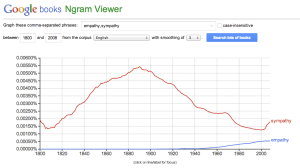
Screen Shot 2014-01-23 at 12.48.00 PMWhen you search for empathy on Google, you get almost 10,000,000 results. When you search for sympathy on Google, you get almost 25,000,000 results. I bet if we could look at historical search results in Google, I bet that we’d see a big trend where the number of search results for empathy has been increasing. The closest thing we can do to this is a search of all the books that contain the word empathy (at least the ones that have been digitized by Google). How? Using Google’s Ngram Viewer.

The chart above shows the mentions of empathy and sympathy starting in 1800 and ending in 2008. As we can see, empathy was hardly mentioned at all when compared to sympathy until the 1920s. That makes me wonder if there might have been some writings about empathy around the time of the Great Depression. What’s noteworthy though, is the steady increase in mentions of empathy. Granted, it’s still in only a fraction (0.0005%) of books, but it’s still progress.

Sympathy, on the other hand, we can see has steadily declined since the early 1900s. However, there’s been a small blip in sympathy since the mid-2000s. I would guess that this may have to do with the title question of this post: the difference between sympathy and empathy.

There’ve probably been several books written about the differences between empathy and sympathy in the last 5 or 10 years. So, do you know the difference between the two? I have to admit, even as an undergraduate in psychology, I’d often find myself googling the difference between the two terms. About a month ago, I came across a great video from the RSA that quickly explains the difference between empathy and sympathy. Of course, there’s a slight bias towards empathy in the video, but I think you’ll agree — empathetic is far better than sympathetic.

In case you’re inspired to be a champion of empathy or want some more information about programs that are helping to increase the level of empathy, I’d suggest checking out Ashoka: Empathy.

And if you want a bit more information about how empathy has shaped our society and continues to shape it, then I highly recommend checking out the RSA Animate video of Jeremy Rifkin’s book, The Empathic Civilization:

Could There Be No Poor Countries in 20 Years? Bill Gates Thinks So

Screen Shot 2014-01-21 at 1.10.10 PMThis is probably one of my favourite headlines I’ve had to write so far this year, especially on the heels of yesterday’s post about less than 100 people having more wealth than half of the world. In the Bill and Melinda Gates’ Foundation annual letter, Bill Gates is optimistic, to say the least:

I am optimistic enough about this that I am willing to make a prediction. By 2035, there will be almost no poor countries left in the world. (I mean by our current definition of poor.) Almost all countries will be what we now call lower-middle income or richer. Countries will learn from their most productive neighbors and benefit from innovations like new vaccines, better seeds, and the digital revolution. Their labor forces, buoyed by expanded education, will attract new investments.

By current definition of poor, Gates clarifies that he means that, “almost no country will be as poor as any of the 35 countries that the World Bank classifies as low-income today, even after adjusting for inflation.”

WOW!

Can you imagine a world where this happens? And Gates thinks that this could happen by 2035 — that’s 20 years from now! Twenty years!

A few months ago, I wrote a post considering what might be my generation’s version of racism:

I’ve spent a lot of time talking about my generation in comparison to generations past, but the true purpose of this post is a juxtaposition of the generations to come. As I said, it seems that past generations had a harder time than mine digesting the mix of cultures. For kids growing up today (in certain countries), it’s abundantly clear that there are people who look different from them and it’s just normal to grow up and be friends with people like this. My question, what is it that my generation will have a hard time with that future generations will see as natural?

Maybe a tangential answer to that question is poverty. Maybe in my lifetime, poverty (as we know it) will be eradicated. That’s certainly a wild idea given the current state of the world, but I for one would be thrilled to see this come to pass as I imagine others would be. With that being said, I could see how some folks might not be as accepting of this change and that’s not to say that they wouldn’t want poverty to be forever changed, but just that they might be a little less comfortable with the change.

As an example, let’s use technology. Generations before mine had technology that was quite different from what we use today. That is, the invention of TV was amazing. Now today, we can watch TV on a device that we can carry around in our pocket. Some folks from past generations are amazed by this and might still have a hard time adjusting to this reality.

That’s how I’m trying to superimpose the possibility of the eradication of poverty for my generation. Some folks might have a hard time adjusting to this reality. Regardless of the comfortability of some folks with this potential reality, I think it’s great that the Gates’ have wrote a letter helping to debunk some of the myths in developmental economics:

  1. Poor countries are doomed to stay poor.
  2. Foreign aid is a big waste.
  3. Saving lives leads to overpopulation.

I definitely recommend checking out the whole letter, which you can read here.