The Most Common Biases in Business Decisions

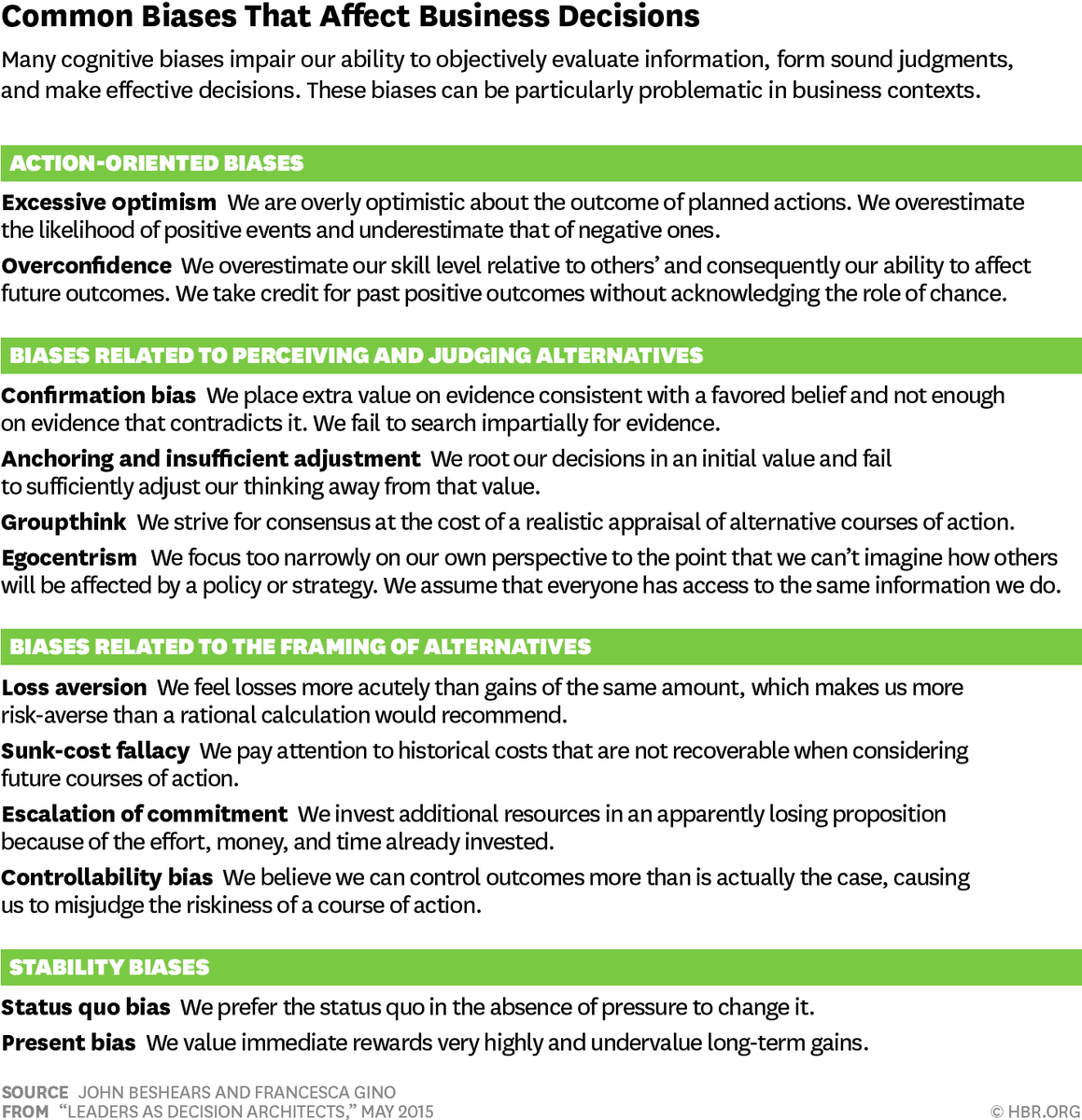
If you’ve been following me for any length of time, you’ll know that one of topics that I write about the most is cognitive biases. So, when I came across an article on the Harvard Business Review that neatly wrapped up some of the more common biases in business decisions, I just had to comment on it.

I agree with just about everything in this table (?), but I’m surprised about one thing: the endowment effect. That is, I’m surprised it’s not listed in the table. Specifically, listed under ‘stability biases’ as this is where it would fit. To refresh your memory:

In short, it means that people want more money for something than they’d be willing to pay for it. Put differently: we overvalue that which we own. You could think of a simple example of this through the course of a negotiation. When negotiation with someone, we’ll probably overvalue what we bring to the table. Someone may offer you $50 for your 25-year old keyboard (piano), but you think it’s worth at least $75. Barring any outside appraisal, the endowment effect is likely at play here.

Given the number of deal-making that takes place on a regular basis, I’m surprised that we didn’t see this as part of the table. It seems to me that in business, when money is often the thing that’s held in the highest regard (for better or for worse), you’d want to have people with the decision-making power understand that they may be overvaluing what’s theirs.

Upon further reflection, I can understand why one may not see it as a “common” bias because in today’s society, (at least in Western cultures), the common transaction is cash for stuff and not stuff for stuff (barter). If bartering were more the name of the game, then I would certainly want to see the endowment effect on that list. Either way, though, it’s certainly worth remembering that we tend to overvalue the stuff we have.

The Sunk Cost Trap on TV: Fitzgerald Grant and Olivia Pope

A few months ago on the popular TV series “Scandal,” the fictional President of the United States fell into the sunk cost trap:

We have to get Olivia back, not just because I love her, not just because having her out there is a threat to national security. There are soldiers who are never coming home because I tried to get her back. Someone’s father, someone’s husband. I have killed so many mothers’ sons trying to get her back. The flags placed on the coffins where they lay are there because they had the courage to give their lives and I did not have the courage to give Liv’s, so she has to come back because their sacrifice damn well has to mean something. They cannot have died for nothing. They cannot have gone to their death for no other reason than I asked them to.

If you’ll remember from my post about the sunk cost trap a couple of years ago:

The United States has invested much in attempting to achieve its objectives. In addition to the many millions of dollars that have been spent, many thousands of lives have been lost, and an even greater number of lives have been irreparably damaged. If the United States withdraws from Vietnam without achieving its objectives, then all of these undeniably significant sacrifices would be wasted.

Do you see the parallels?

Now, I totally get why the writers of Scandal couldn’t have the fictional President of the United States not continue to try and rescue Olivia Pope (how could there be a show without Olivia?), but I wish they didn’t have to write it in this way. In actuality, based on what he’s saying, it sounds like he’s come to the realization that sending more troops to war is a bad idea, so right there — right at the point — is when he should stop sending troops to war. Right then, he has the knowledge that continuing down the same path is the wrong thing to do, so he should stop. His rationalization for continuing is the sunk cost trap.

The thing that worries me is that by having things play out like this, it’s almost affirming that what the President is doing is the “right” thing or that it is the only choice he has. Certainly, there are plenty of other courses of actions he could have chose (many that probably wouldn’t make for good TV). Most people probably won’t find themselves in a situation where they’re forced to continue a war (or start a war, for that matter) for dubious reasons (or any reason, for that matter), but seeing stuff like this on TV, in a way, gives people an idea of how they can do things. I’d much rather popular entertainment actually err on the side of educating viewers, if it’s going to incorporate lessons of this nature.

I can already hear you yelling at me that this doesn’t make for good TV or entertainment (I know, I alluded to that earlier), but can’t we find a way to blend effective decision-making with entertainment, so that while we’re being entertained, we’re also learning something, too?

Does Everyone Want to Attend University?

There was an op-ed in the New York Times the other week that detailed some of the economic inequality in the US. It used academic data to discuss how poorly Americans estimate the level of social mobility. It’s certainly worth reading, but I wanted to highlight one section (and study):

Studies by another author of this article, the University of Illinois psychologist Michael W. Kraus, and his colleague Jacinth J.X. Tan, to be published in next month’s issue of the Journal of Experimental Social Psychology, found a similar pattern: When asked to estimate how many college students came from families in the bottom 20 percent of income, respondents substantially misjudged, estimating that those from the lowest income bracket attended college at a rate five times greater than the actual one documented by the Current Population Survey.

Now, it’s certainly worth noting how poor Americans are when it comes to estimating social mobility, (they’re certainly just as poor when it comes to estimating wealth inequality), but I’m curious about the desires of those in the bottom quintile. That is, many people espouse the values of higher education (full disclosure: I’m a professor at a higher education institution and I have two master’s degrees!), but what if everyone isn’t meant to go to university? More importantly, what if everyone doesn’t want to go to university?

Higher education is often held up as a mechanism for those in lower income quintiles to move up into a higher quintile (social mobility), but maybe people who come from the bottom quintile don’t want to go to university. I’m not in the bottom quintile nor did I grow up in the bottom quintile, so I have little to no authority to speak about the desires of those who come from the bottom quintile, but I think it’s worth asking what it is that the bottom quintile desires, specifically as it relates to higher education.

In raising this kind of question, it would, of course, be important to raise the issue of culture and how that influences one’s desires. That is, people who come from higher quintiles usually have parents (and friends) who think it natural to make the progression from high school to university. For some, attending post-secondary institutions of learning isn’t a choice — they’re forced to go. For those in the bottom quintile, attending a post-secondary institution of learning isn’t thought about in the same way. For many, it’s not “the thing you do after high school,” but instead, it’s held up as an ideal. It’s held up as a mechanism for transformation from being poor to not being poor.

Don’t get me wrong, I’m not trying to say that people in the bottom quintile shouldn’t attend university or shouldn’t want to attend university, but I think that alongside data discussing that estimates university attendance of different levels of income, there should also be data discussing the desires of those different levels of income.

ResearchBlogging.orgKraus, M., & Tan, J. (2015). Americans overestimate social class mobility Journal of Experimental Social Psychology, 58, 101-111 DOI: 10.1016/j.jesp.2015.01.005

Is “A” Really the Best Option or is it Just that It’s Better Than “B”: List of Biases in Judgment and Decision-Making, Part 18

The other day, someone was talking to me about my series on biases in judgment and decision-making and it made me realize that I was missing a rather important bias — the contrast effect! I’m not sure how this one slipped through the cracks, but I’m glad to be able to write about it for you today.

It’s been almost a year and a half since I wrote something for this series, so let me refresh your memory. Each week, I took a cognitive bias and explained it. I provided an example and then I offered some ways for mitigating that cognitive bias in your own life. So, without further adieu, the contrast effect.

What’s the contrast effect? Well, as with many of the biases, it’s exactly what it sounds like: an effect that occurs because of a comparison. That is, people are more likely to perceive differences that are bigger or smaller because of something they’ve seen first. This is something that is used in sales — all — the — time. If you’re shopping for a new car, the salesperson may show a series of cars that are way out of your price range and then show you one that’s just a little out of your price range. After having seen so many cars that are way out of your price range, the one that’s just a little out of your price range won’t seem that far out of your price range. The contrast effect.

That’s not to pick on folks who sell cars, it can even happen with smaller purchases, shoes, for instances. Let’s say you’re looking for a particular kind of footwear. The salesperson may show you a bunch of shoes that don’t quite fit your needs and happen to be priced rather cheaply. Then, the salesperson shows you a shoe that does fit your needs, but is quite a bit more expensive. As you’ve seen all these shoes that aren’t what you need and now you’ve finally come to one that meets you’re needs, you may ignore the price and buy the shoes.

One of my favourite examples of the contrast effect comes from Dan Ariely‘s book, Predictably Irrational:

One day while browsing the World Wide Web (obviously for work-not just wasting time), I stumbled on the following ad, on the Web site of a magazine, the Economist.

excerpt.gif

I read these offers one at a time. The first offer-the Internet subscription for $59 seemed reasonable. The second option-the $125 print subscription-seemed a bit expensive, but still reasonable.

But then I read the third option: a print and Internet subscription for $125. I read it twice before my eye ran back to the previous options. Who would want to buy the print option alone, I wondered, when both the Internet and the print subscriptions were offered for the same price? Now, the print- only option may have been a typographical error, but I suspect that the clever people at the Economist‘s London offices (and they are clever-and quite mischievous in a British sort of way) were actually manipulating me. I am pretty certain that they wanted me to skip the Internet- only option (which they assumed would be my choice, since I was reading the advertisement on the Web) and jump to the more expensive option: Internet and print.

But how could they manipulate me? I suspect it’s because the Economist‘s marketing wizards (and I could just picture them in their school ties and blazers) knew something important about human behavior: humans rarely choose things in absolute terms. We don’t have an internal value meter that tells us how much things are worth. Rather, we focus on the relative advantage of one thing over another, and estimate value accordingly. (For instance, we don’t know how much a six- cylinder car is worth, but we can assume it’s more expensive than the four- cylinder model.)

In the case of the Economist, I may not have known whether the Internet- only subscription at $59 was a better deal than the print- only option at $125. But I certainly knew that the print and-Internet option for $125 was better than the print- only option at $125. In fact, you could reasonably deduce that in the combination package, the Internet subscription is free! “It’s a bloody steal-go for it, governor!” I could almost hear them shout from the riverbanks of the Thames. And I have to admit; if I had been inclined to subscribe I probably would have taken the package deal myself. (Later, when I tested the offer on a large number of participants, the vast majority preferred the Internet- and- print deal.)

Before we movie into some of the ways for avoiding the Contrast Effect, I wanted to make it clear that sales isn’t the only place where this bias can creep up on us. Another good example is in evaluations (be they interviewing job candidates or marking term papers). If one doesn’t have a rubric by which one is scoring candidates (or papers), it can be easy to slip into the contrast effect: “Well, that candidate was much better than the last candidate, let’s put them through to the next round.” It could be that the latter candidate, while better than the first, still doesn’t meet your criteria to make it the next round, so putting them through would be wasting valuable resources — both yours and theirs.

Ways for Avoiding the Contrast Effect

1) Standardized Evaluation

In our most recent case involving interview candidates or term papers, creating a rubric or standardized method of evaluation prior to examining candidates/papers will go a long way to help one avoid falling into the trap of the contrast effect. This method could also be applied when it comes to shopping (i.e. sales). For instance, let’s say you’re looking for a car. Prior to arriving at the dealership, you could create a table for how you’re going to evaluate the cars you view while at the dealership. In this way, you can guard against the salesperson knowingly (or unknowingly) showing you cars at either end of the spectrum before showing you the cars you might actually purchase.

2) Are There Other Options?

Often times, when we’re succumbing to the contrast effect, we’re looking at option A versus option B. This is why it’s so important to have some sort of standardized evaluation (see #1), but short of a standardized evaluation, it’s important to remember that almost never are those two options your only two options. “Should I get this car or that car?” Well actually, you have another option — neither of those cars. And another option, you could consider buying a bike or maybe taking public transportation. Whenever you find yourself faced with a decision between two options, it can be useful to consider other options, just in case you’ve fallen into the trap of the contrast effect.

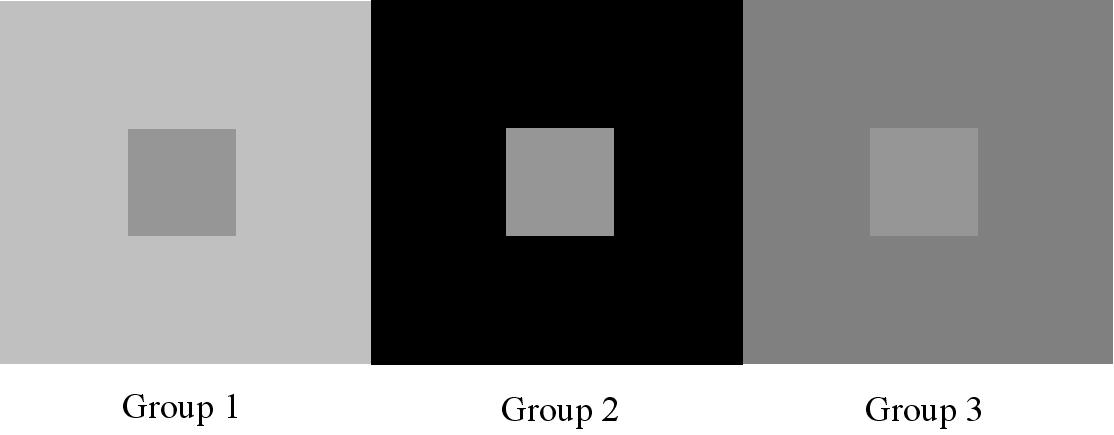
Note: the images in this post are all examples of the contrast effect.

If you liked this post, you might like one of the other posts in this series:
The Confirmation Bias in Action: “When I Looked Closer, It’s Obvious I’m Right”

Decision-making biases are challenging, to say the least. Often times, we don’t know that they’re affecting our ability to make logical and rational decisions. The first step in combating these biases is knowing what they are. The next step would then be identifying when we use these biases. On that note, I came across a funny comic that perfectly illustrated the confirmation bias in action.

The confirmation bias is just dripping from this comic. It might not always be easy to see when we’re operating under the confirmation bias, but “luckily,” we might have an easier time of seeing it in someone else.

A couple of years ago, I offered some other ways for combating the confirmation bias (once you know that it’s a thing). One of these ways is a two-pronged approach: seeking out contradictory information. It may sound easy to go out and look for information that doesn’t conform to your opinion, but it can actually be quite difficult. The difficulty is amplified by the fact that much of our social media sites are doing their best to show us content that conforms to our beliefs and opinions (in part because that’s what they think we want). As a result, it *might* be easier to seek out people with contradictory opinions.

When you’re trying to combat the confirmation bias by being exposed to different information, seeking out a person with a contradictory opinion is usually superior to seeking out contradictory information. Why? Because the person can engage with you and refute the things you might mutter under your breath as you’re reading the contradictory information. Essentially, you’d be engaging in the Socratic method.

If seeking out someone with a contradictory opinion sounds interesting to you, I’d encourage you to find someone who’s aware that you’re trying to combat your own confirmation bias. That is, you don’t want your first experience in this regard to be with someone who’s going to screech at you that your ideas are crazy.

A New Way to Use Pinterest: Financial Charts

I don’t remember when I first signed up for Pinterest, but I do remember that when I did, I had “big” plans of using the site to create a vision board. As you can see from my Pinterest page, I haven’t used it since I signed up. There are any number of explanations I could offer as to why I haven’t really done what I had initially thought I would, but this post isn’t about my usage of Pinterest, no, it’s about Josh Brown’s.

You see, many people (or at least it certainly seems like it) use Pinterest for shopping. That is, they see something they like and Pinterest is a way to bookmark that image. There are also those businesses who use Pinterest to get a better understanding of how their customers like or dislike their products. There are those hobbyists or designers who are trying to showcase their ideas. There are even people who share recipes through Pinterest. In all that I’ve heard of Pinterest, never had I heard someone use it to share financial charts.

Can anyone tell me what this is an example of? Hint: I wrote about this decision-making bias as recently as last month.

Functional Fixedness.

Josh Brown, the person I mentioned earlier, uses Pinterest to bookmark “amazing charts.” These financial charts, in a way, are breaking through that bias of functional fixedness. By using Pinterest to showcase financial charts, Brown found a way to use Pinterest that was a little out of the ordinary.

There are probably dozens of examples of these in your daily lives. On your commute this morning/afternoon (or the next time you head to work), I want you to take a wider perspective and see if you can notice anyone using something in a way that you hadn’t considered. Maybe someone’s using a skateboard as a “wagon” as they’ve tied a string to truck (where the wheels are) and is letting someone pull them down the street. Maybe by watching them participate in what some may consider a dangerous activity, it gives you that flash of an idea you’ve been looking for on a problem you’ve been having. Lateral thinking begets lateral thinking.

“Julia Lost on Jeopardy Because I Watched Live”

A few weeks ago, there was a contestant on Jeopardy that made quite a run. She didn’t break any of Ken Jennings’ records, but she certainly set a few records for females on Jeopardy. In fact, Julia Collins now has the record for the longest winning streak by a woman (and also the second longest winning streak — male or female) and the woman to have won the most money on Jeopardy. As it happens, I was lucky enough to see every episode.

Earlier this year, my son was born and one of the ways that helps him to sleep is if I bounce on an exercise ball. Since this can happen at odd hours of the day, I started watching DVR’d episodes of Jeopardy. In fact, I remember the first game that Julia won because she had to beat a Canadian. Anyway, over the course of 5 weeks, I continued to watch Julia handily defeat her competition and then when it was interrupted for the Jeopardy Battle of the Decades, I watched that.

When the regularly scheduled episodes returned with Julia, she was beginning to get some media attention. On the one hand, I thought this was great because she certainly deserved it, but it made it harder for me to avoid spoilers (really? Who needs to avoid spoilers for Jeopardy!?). I started to watch the episode a few hours after it aired on some nights because I noticed that some folks were tweeting about Julia’s streak continuing.

Julia hit her 20th win in a row on a Friday, which meant she got to come back on Monday. It just so happened that I was near the TV on Monday night, so, to avoid spoilers, I watched the episode live. As you already know (either from the title of this post or from knowing), Julia went on to lose that game. After she lost, I laughed to myself, “I shouldn’t have watched the episode live — that’s why Julia lost.”

Now, did you notice the cognitive bias?

The confirmation bias.

To be fair, I didn’t divulge all the information up front, but if you understand the confirmation bias, you’re going to think you have all the information. After watching Julia lose attempting to win her 21st game in a row, I said to myself that because I watched it live, she lost. [Note: of course, you’re going to have to suspend disbelief for a short while as my watching or not watching an episode of Jeopardy is not actually going to cause or not cause someone to win/lose. At this point, it’s science fiction.]

The thing I’m not telling you (nor was I telling myself to have said this to myself then, lest I be experiencing cognitive dissonance), was that I had also snuck a peak at a few of the episodes from wins 16 to 20. That is, even though I may not have watched a full episode live until her loss going for win 21, I did watch some bits of the other episodes live. So, at the conclusion of Julia’s streak, I selectively (though not intentionally) misremembered the number of times I’d seen Julia live and concluded that by my watching live, she lost.

How You Probably Discriminate and Don’t Even Know It

Are you a part of a group at work, school, or recreationally? Well, then you’ve probably discriminated without even knowing it. A recent theoretical review of the literature concluded “ingroup favouritism is more potent than outgroup hostility” when it comes to discrimination in the United States. Meaning, preferential treatment to the people that are on your team contributes to discrimination more than outward displays of hostility to people not part of your team.

I should say that this ingroup favouritism doesn’t simply apply to overt teams/groups. Consider your work relationships for a moment. Let’s say that your son or daughter gets along quite well with the son or daughter of one of your subordinates. This particular subordinate missed a bunch of days of work this year because they were taking care of their child who was sick. When it comes time for performance reviews and this particular subordinate’s performance falls between two possible ratings, you give the subordinate a higher rating. However, there is another subordinate, without a child who’s friends with your child. This subordinate has also missed some work this year, but instead of giving them the higher rating, you give them the lower (of the two) ratings. By giving a higher rating to the subordinate to whom there is a connection, you’d be exhibiting ingroup favouritism. You’re not openly discriminating against the other subordinate, but you are showing preferential treatment (even if it’s inadvertently!) to one subordinate over the other.

This particular bit of research seemed especially important given Ta-Nehisi Coates’ recent essay in The Atlantic. As I grew up in a fairly multicultural environment, I like to think that I don’t let a person’s race or ethnicity factor into any decisions I make. However, I, as many others have learned from Harvard’s Project Implicit Test, the culture that I live in has had an important influence on me.

~~

There are obvious streams for this kind of research, but I was thinking about it in a broader context. As it stands, there’s the idea of ingroup and outgroup. That is, “our people” are over here and I’m going to do everything I can for them, while you’re people are over there and I’m not going to necessarily do everything that I can to help them. What if there no longer was an ingroup and an outgroup? Or maybe more specifically, what if everyone was part of your ingroup?

Consider someone like the Dalai Lama. There’s the ‘obvious’ ingroups for the Dalai Lama (Tibet, Buddhism, etc.), but I’d bet that the Dalai Lama probably thinks of all humans as his ingroup. Of course, we can’t all be the Dalai Lama, but we certainly could strive for this.

Let’s simplify this example just a little bit. Americans — is an ingroup — when you put it in context of a global stage. Americans look at themselves as an ingroup when it comes to some sort of international competition. That is, at the upcoming World Cup in June, Americans will be an ingroup, especially when there are matches against other countries. What if, instead of Americans thinking of themselves as the ingroup, they, instead, thought of the ingroup as fans of soccer (or football, depending upon where you’re from — although most Americans probably say soccer). While this is still an ‘ingroup,’ it’s certainly a broader and bigger ingroup than simply American (fans of soccer).

While not perfect, this is also on the way to expanding the ingroup to all of humanity.

ResearchBlogging.orgGreenwald AG, & Pettigrew TF (2014). With Malice Toward None and Charity for Some: Ingroup Favoritism Enables Discrimination. The American psychologist PMID: 24661244

Do Public Salaries Increase Performance?

With the recent news regarding Jill Abramson and the New York Times, I wanted to take a closer look at the academic literature to see if I could find something about public salaries. There’s certainly been a lot written about whether she was fired or she quit or whether it had to do with secretive salaries or her gender. I’m not writing this post to debate any of that because I consider myself grossly uninformed on what may or may not have happened, but I am writing this post to talk about pay secrecy.

The research showed that pay secrecy adversely affected individual task performance. Meaning, the absence of public salaries led to a worse performance. Why? Pay for performance. That is, because the salaries weren’t public, workers didn’t have a perception that an increase in performance would lead to better pay.

There were a couple other important pieces that I wanted to highlight.

1. The best workers were more sensitive when it came to the perception of link between pay and performance.

This certainly makes sense as those folks who are working the ‘hardest’ would want to know that they’re being appropriately compensated for their hard work. An implication from this point is that organizations that don’t have public salaries might have a harder time retaining their top talent. We can tie this back to the situation between the New York Times and Abramson. Again, I wouldn’t say I’m informed of the situation, but from what I understand, Abramson was rather high up in the NYT hierarchy, which indicates to me that it was fair to consider her “top talent.”

2. If public salaries isn’t an option, partial pay openness could mitigate the negative effects of pay secrecy.

It might be that a firm or organization isn’t yet comfortable with releasing all data about salaries, so an intermediary step could see them gently open up the salaries by talking about ranges. This point reminded me about government salaries that often have ranges for each level that an employee reaches. One may not know exactly what their co-worker makes, but if one knows that their co-worker has reached a certain level, one would know that one’s co-worker’s salary is in a certain range.

Just before ending this post, I wanted to circle back to the point about pay for performance. In this study, the task that participants completed was a “computer matching game.” Based on what’s been written about pay for performance, this is the right kind of task to test these sorts of hypotheses. However, when it comes to more creative tasks, the pay for performance model doesn’t always fit the best. Tying this back to the situation with Abramson and the NYT — it’s not clear to me whether the “pay for performance” model fits best. Having never worked at a newspaper or publishing outlet, I don’t exactly know the role of an Executive Editor, but from what I’ve been able to read through Google searches, it sounds more like creative tasks.

ResearchBlogging.orgBelogolovsky, E., & Bamberger, P. (2014). Signaling in secret: Pay for performance and the incentive and sorting effects of pay secrecy Academy of Management Journal DOI: 10.5465/amj.2012.0937

Why Women are Better CEOs, Presidents, and Prime Ministers

New research shows that women are far better at handling stress than men. I suppose that’s not a newsflash as most people already think that’s true, but consider the way in which this study frames it [Emphasis added]:

We consistently found the same general response pattern: while stressed women showed higher self-other distinction than women in the non-stressful control condition, men showed the converse pattern. More specifically, stressed women showed reduced emotional egocentricity bias, enabling them to judge the emotions of the other person in a way that was less influenced by their own emotional state. Moreover, their response times in the cognitive perspective-taking task decreased under stress, documenting that they were able to regulate the mismatch between their own and the “director’s” perspective faster under stress. Finally, stressed women showed a reduction of automatic imitative tendencies in the imitation-inhibition task, indicating that they were able to overcome low-level social signals interfering with their own movement intentions. Note that the latter finding is crucial. It highlights that women did not simply show an increase in other-related responses under stress – as this would have resulted in increased interference from automatic imitation. Instead, they were able to flexibly increase either self- or other-related representations, depending on the task demands which either required overcoming egocentric biases, or overcoming social interference.

As the stereotype goes, women are more “emotional” than men, so it would be much better for an organization or unit if it were managed by a man. However, this research is telling us that, when under stress, it is men who are less able to distinguish their emotional state from the intentions of those around them. It is men who are more adversely affected by stress. For women, it’s the opposite. In fact, women tend to be more prosocial [behaviour intended to benefit others] when they’re stressed. Meaning, instead of retreating inward, women are actually more helpful when they’re stressed.

This research certainly makes one think about the way that many organizations and countries are run today. Most people would agree that being a CEO, President, or Prime Minister certainly comes with oodles of stress. Unfortunately, the number of women who hold these positions is far outweighed by their male counterparts. Of course, there are a number of reasons for that, which we won’t get into in this post, but consider for a moment if the numbers were flipped. That is, what if there were more women CEOs (or high-powered leaders)? Or, what even if it was 50/50! What if the number of high-powered leaders and CEOs was 50% women and 50% men? At that point, would it be easier for folks to see, understand, and digest that women are actually better leaders and better at handling the stress?

Maybe it’s the language we use.

A quick Google search showed mixed results for “women are better CEOs.” In fact, many of the results near the top indicated that women CEOs are more likely to be fired. However, when I keyed in “women are better leaders,” I got plenty of positive results. Posts on Harvard Business Review, Business Insider, and articles talking about academic research in newspapers like The Globe and Mail.

If there’s one thing I’ve learned about the world during my time in it, it’s that change (usually) happens gradually. Rarely is there a massive cultural shift overnight. So, here’s hoping that research like this contributes to the realization for some that when it comes to managers and leadership, women just might have an edge over men.

ResearchBlogging.orgTomova L, von Dawans B, Heinrichs M, Silani G, & Lamm C (2014). Is stress affecting our ability to tune into others? Evidence for gender differences in the effects of stress on self-other distinction. Psychoneuroendocrinology, 43, 95-104 PMID: 24703175