Want Better Group Performance? Try a Standing Meeting

In keeping with the theme of “standing” being better for us from earlier this week, I thought I’d tackle another journal article discussing the merits of standing. This time, the research included participants well-beyond the 2nd and 3rd grade, but still used students — university students, that is.

While the article from earlier this week focused on individual performance, this article looked at how standing can have an effect on group performance. In particular, how standing can have an effect on how we participate in groups. From the research:

Our findings suggest that, in addition to the physiological benefits of non-sedentary work designs, getting people out of their chairs at work may increase their capacity for collaborative knowledge work.

Of particular note in this field of research is the plethora of studies (or at least ideas) people have about how things can have an effect intrapersonally. That is, how to have an effect on an individual. There’s the idea of wall colour, nature, proximity to other workers, and on and on. But this study, as the researchers noted, seems to be the first that studied how standing can have an effect interpersonally.

Similar to the article from earlier this week, I’m interested in future or other applications for this research. One obvious application was noted by the researchers towards the end of the article: leaders of organizations usually have a choice over the setup of the office, so simply removing chairs in meeting rooms and opting for more of an open-space might be useful.

As I thought about this, I wondered about what it would be like for a Board of Directors to meet in a room without table and chairs. Would a Board of Directors scoff at the idea of not having a typical boardroom? I’m not sure. So then I thought, what if there were a bigger table in the middle, but the table wasn’t meant to be sat at and instead, it was meant to be stood at. If you can get past the odd grammar of the last sentence, consider the kinds of tables you might find at the “before” of any event. You know, if you go to a wedding or some sort of gala, they’ve got the “higher” tables where you can put your drink or maybe there’s food or what have you. What if there were a bigger table like that for Board Members (of people in the meeting) to congregate around? That might do the trick.

Thinking about Board Members getting together might be a bit off-track because they won’t be meeting daily as your group(s) probably will.

Nonetheless, the idea remains the same. In the “breakout” rooms in your office, maybe instead of having the prototypical table and chairs, it’s just an open room with… a whiteboard?

ResearchBlogging.orgKnight, A., & Baer, M. (2014). Get Up, Stand Up: The Effects of a Non-Sedentary Workspace on Information Elaboration and Group Performance Social Psychological and Personality Science, 5 (8), 910-917 DOI: 10.1177/1948550614538463

The Most Common Biases in Business Decisions

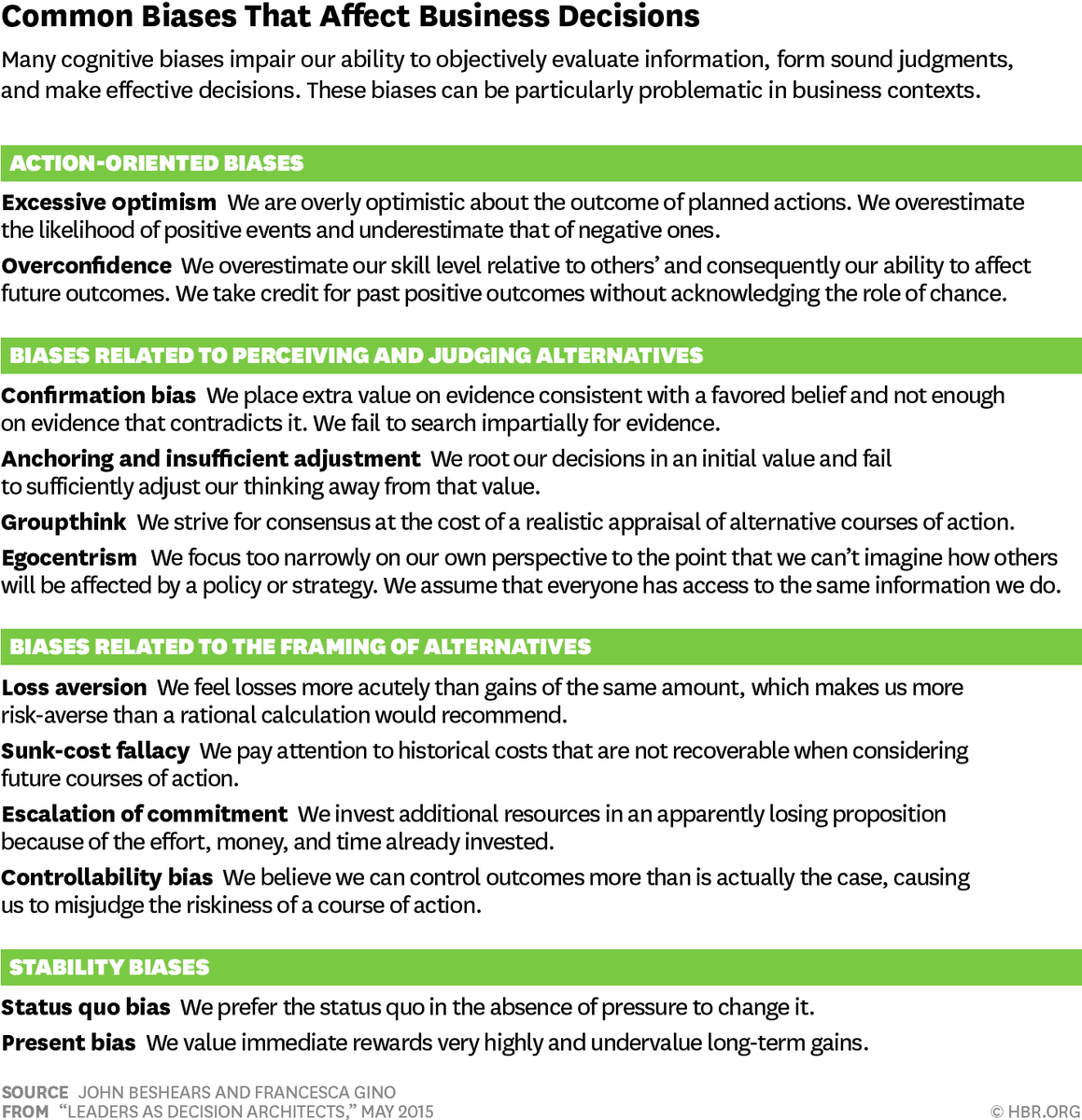
If you’ve been following me for any length of time, you’ll know that one of topics that I write about the most is cognitive biases. So, when I came across an article on the Harvard Business Review that neatly wrapped up some of the more common biases in business decisions, I just had to comment on it.

I agree with just about everything in this table (?), but I’m surprised about one thing: the endowment effect. That is, I’m surprised it’s not listed in the table. Specifically, listed under ‘stability biases’ as this is where it would fit. To refresh your memory:

In short, it means that people want more money for something than they’d be willing to pay for it. Put differently: we overvalue that which we own. You could think of a simple example of this through the course of a negotiation. When negotiation with someone, we’ll probably overvalue what we bring to the table. Someone may offer you $50 for your 25-year old keyboard (piano), but you think it’s worth at least $75. Barring any outside appraisal, the endowment effect is likely at play here.

Given the number of deal-making that takes place on a regular basis, I’m surprised that we didn’t see this as part of the table. It seems to me that in business, when money is often the thing that’s held in the highest regard (for better or for worse), you’d want to have people with the decision-making power understand that they may be overvaluing what’s theirs.

Upon further reflection, I can understand why one may not see it as a “common” bias because in today’s society, (at least in Western cultures), the common transaction is cash for stuff and not stuff for stuff (barter). If bartering were more the name of the game, then I would certainly want to see the endowment effect on that list. Either way, though, it’s certainly worth remembering that we tend to overvalue the stuff we have.

Is the “Hollywood Model” Really Something New?

There was a great article in the New York Times the other week called: “What Hollywood Can Teach Us About the Future of Work.” The author uses Hollywood to make the case that this is how work is going to be in the near future for everyone (not in Hollywood):

This approach to business is sometimes called the “Hollywood model.” A project is identified; a team is assembled; it works together for precisely as long as is needed to complete the task; then the team disbands. This short-­term, project-­based business structure is an alternative to the corporate model, in which capital is spent up front to build a business, which then hires workers for long-­term, open-­ended jobs that can last for years, even a lifetime. It’s also distinct from the Uber-­style “gig economy,” which is designed to take care of extremely short-­term tasks, manageable by one person, typically in less than a day.

This method sounds really intelligent in that it would — theoretically — save a business quite a lot of money. However, as I was reading it, two things came to mind. The first: this method also sounds eerily familiar. Remember “SWAT teams” (in business)?

“In business, it means a group of ‘experts’ (often fat guys in suits) assembled to solve a problem or tackle an opportunity” says USC’s Logan.

Or what about “Tiger teams?”

A ‘tiger team’ is also a group of experts—specifically a bunch of tech geeks entrusted with curing your computer ills.

While it doesn’t perfectly map onto the Hollywood Model, both of these business “buzzwords” already seem to account for aspects of the Hollywood Model. It may be that the Hollywood Model will become another business fad in the same way that SWAT teams or Tigers teams was/is. Or, maybe the Hollywood Model will have staying power and it will live beyond a fad and become something as normal as the idea as working in a full-time job or a part-time job.

The second thing that came to mind upon reading about the Hollywood Model: Project Management. Granted, the last time I had formal education in PM was almost three years ago, but I don’t remember hearing/reading about this idea of a short-term team. That’s not completely fair. Yes, of course we learned about teams coming together for a short period of time, but it wasn’t written about in the same way that it was in this NYT article. I’d be interested to hear from folks in the PM-academic circles on this.

Does Everyone Want to Attend University?

There was an op-ed in the New York Times the other week that detailed some of the economic inequality in the US. It used academic data to discuss how poorly Americans estimate the level of social mobility. It’s certainly worth reading, but I wanted to highlight one section (and study):

Studies by another author of this article, the University of Illinois psychologist Michael W. Kraus, and his colleague Jacinth J.X. Tan, to be published in next month’s issue of the Journal of Experimental Social Psychology, found a similar pattern: When asked to estimate how many college students came from families in the bottom 20 percent of income, respondents substantially misjudged, estimating that those from the lowest income bracket attended college at a rate five times greater than the actual one documented by the Current Population Survey.

Now, it’s certainly worth noting how poor Americans are when it comes to estimating social mobility, (they’re certainly just as poor when it comes to estimating wealth inequality), but I’m curious about the desires of those in the bottom quintile. That is, many people espouse the values of higher education (full disclosure: I’m a professor at a higher education institution and I have two master’s degrees!), but what if everyone isn’t meant to go to university? More importantly, what if everyone doesn’t want to go to university?

Higher education is often held up as a mechanism for those in lower income quintiles to move up into a higher quintile (social mobility), but maybe people who come from the bottom quintile don’t want to go to university. I’m not in the bottom quintile nor did I grow up in the bottom quintile, so I have little to no authority to speak about the desires of those who come from the bottom quintile, but I think it’s worth asking what it is that the bottom quintile desires, specifically as it relates to higher education.

In raising this kind of question, it would, of course, be important to raise the issue of culture and how that influences one’s desires. That is, people who come from higher quintiles usually have parents (and friends) who think it natural to make the progression from high school to university. For some, attending post-secondary institutions of learning isn’t a choice — they’re forced to go. For those in the bottom quintile, attending a post-secondary institution of learning isn’t thought about in the same way. For many, it’s not “the thing you do after high school,” but instead, it’s held up as an ideal. It’s held up as a mechanism for transformation from being poor to not being poor.

Don’t get me wrong, I’m not trying to say that people in the bottom quintile shouldn’t attend university or shouldn’t want to attend university, but I think that alongside data discussing that estimates university attendance of different levels of income, there should also be data discussing the desires of those different levels of income.

ResearchBlogging.orgKraus, M., & Tan, J. (2015). Americans overestimate social class mobility Journal of Experimental Social Psychology, 58, 101-111 DOI: 10.1016/j.jesp.2015.01.005

Is “A” Really the Best Option or is it Just that It’s Better Than “B”: List of Biases in Judgment and Decision-Making, Part 18

The other day, someone was talking to me about my series on biases in judgment and decision-making and it made me realize that I was missing a rather important bias — the contrast effect! I’m not sure how this one slipped through the cracks, but I’m glad to be able to write about it for you today.

It’s been almost a year and a half since I wrote something for this series, so let me refresh your memory. Each week, I took a cognitive bias and explained it. I provided an example and then I offered some ways for mitigating that cognitive bias in your own life. So, without further adieu, the contrast effect.

What’s the contrast effect? Well, as with many of the biases, it’s exactly what it sounds like: an effect that occurs because of a comparison. That is, people are more likely to perceive differences that are bigger or smaller because of something they’ve seen first. This is something that is used in sales — all — the — time. If you’re shopping for a new car, the salesperson may show a series of cars that are way out of your price range and then show you one that’s just a little out of your price range. After having seen so many cars that are way out of your price range, the one that’s just a little out of your price range won’t seem that far out of your price range. The contrast effect.

That’s not to pick on folks who sell cars, it can even happen with smaller purchases, shoes, for instances. Let’s say you’re looking for a particular kind of footwear. The salesperson may show you a bunch of shoes that don’t quite fit your needs and happen to be priced rather cheaply. Then, the salesperson shows you a shoe that does fit your needs, but is quite a bit more expensive. As you’ve seen all these shoes that aren’t what you need and now you’ve finally come to one that meets you’re needs, you may ignore the price and buy the shoes.

One of my favourite examples of the contrast effect comes from Dan Ariely‘s book, Predictably Irrational:

One day while browsing the World Wide Web (obviously for work-not just wasting time), I stumbled on the following ad, on the Web site of a magazine, the Economist.

excerpt.gif

I read these offers one at a time. The first offer-the Internet subscription for $59 seemed reasonable. The second option-the $125 print subscription-seemed a bit expensive, but still reasonable.

But then I read the third option: a print and Internet subscription for $125. I read it twice before my eye ran back to the previous options. Who would want to buy the print option alone, I wondered, when both the Internet and the print subscriptions were offered for the same price? Now, the print- only option may have been a typographical error, but I suspect that the clever people at the Economist‘s London offices (and they are clever-and quite mischievous in a British sort of way) were actually manipulating me. I am pretty certain that they wanted me to skip the Internet- only option (which they assumed would be my choice, since I was reading the advertisement on the Web) and jump to the more expensive option: Internet and print.

But how could they manipulate me? I suspect it’s because the Economist‘s marketing wizards (and I could just picture them in their school ties and blazers) knew something important about human behavior: humans rarely choose things in absolute terms. We don’t have an internal value meter that tells us how much things are worth. Rather, we focus on the relative advantage of one thing over another, and estimate value accordingly. (For instance, we don’t know how much a six- cylinder car is worth, but we can assume it’s more expensive than the four- cylinder model.)

In the case of the Economist, I may not have known whether the Internet- only subscription at $59 was a better deal than the print- only option at $125. But I certainly knew that the print and-Internet option for $125 was better than the print- only option at $125. In fact, you could reasonably deduce that in the combination package, the Internet subscription is free! “It’s a bloody steal-go for it, governor!” I could almost hear them shout from the riverbanks of the Thames. And I have to admit; if I had been inclined to subscribe I probably would have taken the package deal myself. (Later, when I tested the offer on a large number of participants, the vast majority preferred the Internet- and- print deal.)

Before we movie into some of the ways for avoiding the Contrast Effect, I wanted to make it clear that sales isn’t the only place where this bias can creep up on us. Another good example is in evaluations (be they interviewing job candidates or marking term papers). If one doesn’t have a rubric by which one is scoring candidates (or papers), it can be easy to slip into the contrast effect: “Well, that candidate was much better than the last candidate, let’s put them through to the next round.” It could be that the latter candidate, while better than the first, still doesn’t meet your criteria to make it the next round, so putting them through would be wasting valuable resources — both yours and theirs.

Ways for Avoiding the Contrast Effect

1) Standardized Evaluation

In our most recent case involving interview candidates or term papers, creating a rubric or standardized method of evaluation prior to examining candidates/papers will go a long way to help one avoid falling into the trap of the contrast effect. This method could also be applied when it comes to shopping (i.e. sales). For instance, let’s say you’re looking for a car. Prior to arriving at the dealership, you could create a table for how you’re going to evaluate the cars you view while at the dealership. In this way, you can guard against the salesperson knowingly (or unknowingly) showing you cars at either end of the spectrum before showing you the cars you might actually purchase.

2) Are There Other Options?

Often times, when we’re succumbing to the contrast effect, we’re looking at option A versus option B. This is why it’s so important to have some sort of standardized evaluation (see #1), but short of a standardized evaluation, it’s important to remember that almost never are those two options your only two options. “Should I get this car or that car?” Well actually, you have another option — neither of those cars. And another option, you could consider buying a bike or maybe taking public transportation. Whenever you find yourself faced with a decision between two options, it can be useful to consider other options, just in case you’ve fallen into the trap of the contrast effect.

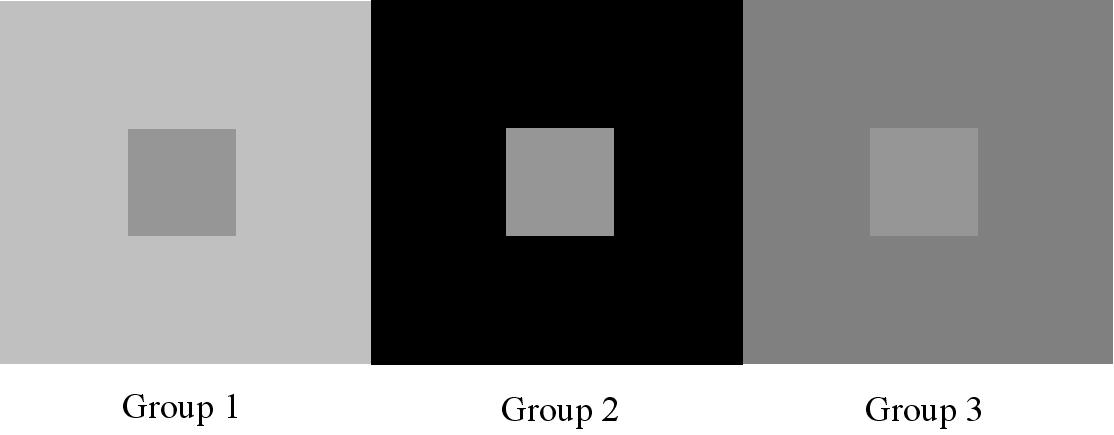
Note: the images in this post are all examples of the contrast effect.

If you liked this post, you might like one of the other posts in this series:

A Lesson in Overcomplicated: Gender-Neutral Washrooms

If you’ve ever been part of an organization, there’s a better chance than not that you’ve been involved in a meeting where at some point, you found yourself thinking, “what the heck are we doing?” Well, hopefully you’ve found yourself saying that, otherwise you might have fallen into the trap of overcomplicating something.

There was a great (and short!) post on Pacific Standard about the “problem” of a sign for a gender-neutral bathroom:

“But what would you put on the door?!” said a facility manager at an airport, his concern echoed by an administrator at a university: “When people are looking for a restroom, they look for the ‘man’ or ‘woman’ icon. It’s what we know to look for that means restroom.”

And the sign that answers this problem:

Wow, right?

This situation is a perfect example of how overthinking something can lead to a terrible and overcomplicated solution. Is this sign really necessary to signify that there’s a toilet behind the door (or around the corner, in the case of many airports)? Absolutely not.

While there are many problems we can talk about, let’s look at the key issue: false dilemma. Presumably, upon trying to to develop a solution to this problem, the people in the meeting thought that something had to be added to the existing sign. That is, the sign is usually a little man or a little woman, so we’ve got to make it resemble that little man or woman or people might be confused. There are clearly more options than creating that weird looking sign. From the post, there’s this sign offered:

That seems like a pretty good alternative to me. It’s universal in that many people know what a toilet looks like. To be sure, the person who came up with the idea of this pictorial representation took his laptop to a coffee shop to ask patrons if they could hazard a guess as to what was being the sign: 100% of participants were able to identify what would be behind a door with this sign on it. The author, obviously in jest, explained that his research was limited to a corner in Philadelphia, but I think it’s safe to say that most people would be able to perform as well as his participants.

So, the next time you’re in a meeting where your team is trying to come up with an idea that uses an existing structure/idea, double-check that it might not be better to approach the problem from a different perspective.

Do Public Salaries Increase Performance?

With the recent news regarding Jill Abramson and the New York Times, I wanted to take a closer look at the academic literature to see if I could find something about public salaries. There’s certainly been a lot written about whether she was fired or she quit or whether it had to do with secretive salaries or her gender. I’m not writing this post to debate any of that because I consider myself grossly uninformed on what may or may not have happened, but I am writing this post to talk about pay secrecy.

The research showed that pay secrecy adversely affected individual task performance. Meaning, the absence of public salaries led to a worse performance. Why? Pay for performance. That is, because the salaries weren’t public, workers didn’t have a perception that an increase in performance would lead to better pay.

There were a couple other important pieces that I wanted to highlight.

1. The best workers were more sensitive when it came to the perception of link between pay and performance.

This certainly makes sense as those folks who are working the ‘hardest’ would want to know that they’re being appropriately compensated for their hard work. An implication from this point is that organizations that don’t have public salaries might have a harder time retaining their top talent. We can tie this back to the situation between the New York Times and Abramson. Again, I wouldn’t say I’m informed of the situation, but from what I understand, Abramson was rather high up in the NYT hierarchy, which indicates to me that it was fair to consider her “top talent.”

2. If public salaries isn’t an option, partial pay openness could mitigate the negative effects of pay secrecy.

It might be that a firm or organization isn’t yet comfortable with releasing all data about salaries, so an intermediary step could see them gently open up the salaries by talking about ranges. This point reminded me about government salaries that often have ranges for each level that an employee reaches. One may not know exactly what their co-worker makes, but if one knows that their co-worker has reached a certain level, one would know that one’s co-worker’s salary is in a certain range.

Just before ending this post, I wanted to circle back to the point about pay for performance. In this study, the task that participants completed was a “computer matching game.” Based on what’s been written about pay for performance, this is the right kind of task to test these sorts of hypotheses. However, when it comes to more creative tasks, the pay for performance model doesn’t always fit the best. Tying this back to the situation with Abramson and the NYT — it’s not clear to me whether the “pay for performance” model fits best. Having never worked at a newspaper or publishing outlet, I don’t exactly know the role of an Executive Editor, but from what I’ve been able to read through Google searches, it sounds more like creative tasks.

ResearchBlogging.orgBelogolovsky, E., & Bamberger, P. (2014). Signaling in secret: Pay for performance and the incentive and sorting effects of pay secrecy Academy of Management Journal DOI: 10.5465/amj.2012.0937

Why Women are Better CEOs, Presidents, and Prime Ministers

New research shows that women are far better at handling stress than men. I suppose that’s not a newsflash as most people already think that’s true, but consider the way in which this study frames it [Emphasis added]:

We consistently found the same general response pattern: while stressed women showed higher self-other distinction than women in the non-stressful control condition, men showed the converse pattern. More specifically, stressed women showed reduced emotional egocentricity bias, enabling them to judge the emotions of the other person in a way that was less influenced by their own emotional state. Moreover, their response times in the cognitive perspective-taking task decreased under stress, documenting that they were able to regulate the mismatch between their own and the “director’s” perspective faster under stress. Finally, stressed women showed a reduction of automatic imitative tendencies in the imitation-inhibition task, indicating that they were able to overcome low-level social signals interfering with their own movement intentions. Note that the latter finding is crucial. It highlights that women did not simply show an increase in other-related responses under stress – as this would have resulted in increased interference from automatic imitation. Instead, they were able to flexibly increase either self- or other-related representations, depending on the task demands which either required overcoming egocentric biases, or overcoming social interference.

As the stereotype goes, women are more “emotional” than men, so it would be much better for an organization or unit if it were managed by a man. However, this research is telling us that, when under stress, it is men who are less able to distinguish their emotional state from the intentions of those around them. It is men who are more adversely affected by stress. For women, it’s the opposite. In fact, women tend to be more prosocial [behaviour intended to benefit others] when they’re stressed. Meaning, instead of retreating inward, women are actually more helpful when they’re stressed.

This research certainly makes one think about the way that many organizations and countries are run today. Most people would agree that being a CEO, President, or Prime Minister certainly comes with oodles of stress. Unfortunately, the number of women who hold these positions is far outweighed by their male counterparts. Of course, there are a number of reasons for that, which we won’t get into in this post, but consider for a moment if the numbers were flipped. That is, what if there were more women CEOs (or high-powered leaders)? Or, what even if it was 50/50! What if the number of high-powered leaders and CEOs was 50% women and 50% men? At that point, would it be easier for folks to see, understand, and digest that women are actually better leaders and better at handling the stress?

Maybe it’s the language we use.

A quick Google search showed mixed results for “women are better CEOs.” In fact, many of the results near the top indicated that women CEOs are more likely to be fired. However, when I keyed in “women are better leaders,” I got plenty of positive results. Posts on Harvard Business Review, Business Insider, and articles talking about academic research in newspapers like The Globe and Mail.

If there’s one thing I’ve learned about the world during my time in it, it’s that change (usually) happens gradually. Rarely is there a massive cultural shift overnight. So, here’s hoping that research like this contributes to the realization for some that when it comes to managers and leadership, women just might have an edge over men.

ResearchBlogging.orgTomova L, von Dawans B, Heinrichs M, Silani G, & Lamm C (2014). Is stress affecting our ability to tune into others? Evidence for gender differences in the effects of stress on self-other distinction. Psychoneuroendocrinology, 43, 95-104 PMID: 24703175

Corporate Culture Directly Affects Financial Performance

The question as to whether corporate culture has an effect on financial performance has been asked before and it will likely be asked again. In a study published in the Cornell Hospitality Quarterly, research demonstrated a link between corporate culture and financial performance. However, not all corporate cultures are created equal. Some corporate cultures had a positive effect, some had no effect, and some even had a negative effect.

First, let’s look at the 4 kinds of corporate culture from this study (there’s a picture above for those that prefer to see it visually):

  • Market – (External, Controlled) – Tend to be results-oriented, with a focus on competition.
  • Adhocracy – (External, Flexible) – Tend to be dynamic and entrepreneurial, with a focus on innovation.
  • Clan – (Internal, Flexible) – Tend to be family-like, with a focus on mentoring.
  • Hierarchy – (Internal, Controlled) – Tend to be structured and formalized, with a focus on efficiency.

It’s important to note that the research was conducted on a group of hotels in South Korea, so the generalizability of the findings is a bit limited. Nonetheless, this research could provide a foundation from which future studies can be conducted. Here are the findings between culture and financial performance:

  • Market – no significant effect on financial performance.
  • Adhocracy – positive effect on financial performance.
  • Clan – positive effect on financial performance.
  • Hierarchy – negative effect on financial performance.

The researcher went one step further and tested how strategic orientation effected financial performance in the context of these corporate cultures. Before we look at the effect strategic orientation had on corporate culture, we need to look at how the researcher delineated strategic orientation:

  • Leading: always trying to innovate
  • Future analytic: focusing on research for future activities
  • Aggressive: undercutting competitors
  • Defensive: maintaining careful control
  • Adventurous: risk taking
  • Conservative: avoiding risk

Some of the strategic orientations have obvious clashes with corporate culture. For instance, a Hierarchy culture would be ill-advised to try and implement a Leading strategic orientation. Likewise, we wouldn’t expect an Adhocracy culture to successfully implement a Conservative strategic orientation. The research found that Clan, Adhocracy, and Hierarchical cultures could improve their financial performance if the adopted a Leading or Defensive strategic orientation.

The one finding that I found interesting had to do with the Aggressive strategic orientation. The researcher found that this strategic orientation didn’t have a significant impact on any of the culture’s financial performance. Meaning, undercutting a competitor in an effort to gain market share was not an optimal strategy for any of the corporate cultures. Of course, as stated earlier, this study was only conducted on Korean hotels, but it would be very interesting to see if this particular finding help up when studying hotels in a different part of the world. Moreover, I’d be interested to see if this finding would also remain true across industries. That is, some folks think that competing on price is the way to go (Hi Walmart!), so if this study’s findings can be replicated in another industry, it might have an effect on the way that some firms compete. In particular, it might dissuade some from competing on price.

ResearchBlogging.orgHan, H. (2012). The Relationship among Corporate Culture, Strategic Orientation, and Financial Performance Cornell Hospitality Quarterly, 53 (3), 207-219 DOI: 10.1177/1938965512443505

An Alternative to Coffee During the Afternoon Lull — Meditation

No doubt you’ve come across articles that explain that we have a tendency to fall into an afternoon lull. There have also been a number of article that offer a solution to beating this afternoon lull. However, I’ve yet to see any of these articles offer what could be the best use of that time, yet — meditation.

The benefits of meditation are endless not the least of which is mitigating the effect of cognitive biases. So, instead of reaching for another cup of coffee, why not try doing a quick 2-, 3-, 5-, or 10-minute meditation when that afternoon lull comes along. In fact, to up the stakes, I’d be interested to see some research on this. My bet is that meditation would be more effective (and sustainable) than coffee in picking you up. Of course, researching this might prove a bit difficult, but I think it’s doable. Let’s break it down.

I’d want to see three groups: meditation, coffee, and control. Of course, we’d need to have a representative sample, controlling for people who already have a proclivity towards meditation and/or coffee. If at all possible, it’d be great to have two meditation groups, actually: one that already regularly meditates and one that doesn’t.

Initially, I hypothesized that meditation would be more effective. We’d need to determine how we were going to measure effectiveness. I suppose one could consider the remaining hours at work, as the pick-me-up during the afternoon lull is likely a way to get one to the end of the day. In that sense, we’d also want to control for the amount of hours that people continued to work after the meditation/coffee break. At a minimum, it’s something we’d need to measure to maintain internal validity.

I also hypothesized that meditation would be a more sustainable solution to the afternoon lull. Again, how are we going to measure this. My thinking would be including some sort of fatigue/health factor in the study. I suspect that those inclined to have a cup of coffee as an afternoon pick-me-up are probably already drinking coffee to start their day and as a result, might just be taxing their system by having that extra hit of caffeine in the afternoon. Conversely, plenty of research has been conducted on the health benefits of meditation. So, not only would some folks be eliminating the overtaxing nature of a second dose of caffeine, they’d also be reaping the benefits of meditation.