Quick Thoughts on “Obama’s Stealth Startup”

A couple of weeks ago, there was a great article in Fast Company about President Obama’s initiative to bring the the technology used in the US bureaucracy into the 21st century. After reading it, there were a few things that came to mind, so I thought I’d write a post with some “Quick Thoughts” as I have in past instances for other events/articles.

1. The first thing that struck me was this idea that Silicon Valley wants to change the world. In particular, the idea that they “think” they are changing the world, but that they actually aren’t. It reminded me of the penultimate episode of Season 1 of “Silicon Valley,” the HBO series. In it, the show parodies Silicon Valley startups who purport to “change the world.” You can see part of it in the beginning of this clip:

In remembering this episode, I wonder if it was like this in previous generations. Obviously, the technology in previous generations was different, especially because companies like Google, Facebook, and Microsoft weren’t even conceived. In addition, “Silicon Valley” looked very different in the ’40s and ’50s than it did in the ’70s and the ’80s. Nonetheless, I wonder if there were idealistic twentysomethings trying to create things that would revolutionize the way something worked.


2. The second thing that came to mind was this idea that lawyers spend a couple yrs in DC between jobs. When I lived in the DC area, I remember one of the jokes being that DC has more lawyers per capita than any other city in the US and part of that was because of the government. It also reminded me of scene from The West Wing in Season 7 when Josh Lyman (who has a law degree) flies to California to recruit Sam Seaborn (who is a lawyer) to come work with him at the White House.

I think it’s a fantastic idea to recruit folks who are wizards with technology into highly placed government positions to help accelerate the transition for many government agencies. Goodness knows that the VA could use a technology-upgrade. In thinking about this idea, though, it made me wonder if there are other professions that could also do with a “stopover” of sorts in the government, contributing their unique skillsets to advancing the mission of the US government. Lawyers already make the most sense as they’re position to write/interpret laws, but what other professions would be well-suited for short stints in the government?

Scientists probably also make sense. I’m reminded of Patrick Dempsey’s character from Grey’s Anatomy (Derek Shepherd) who was working on a brain initiative. I’d imagine that scientists in other fields could also do well to spend some time in a government agency, but that’s not really outside the norm. Meaning, that’s already a career path that’s identified for scientists. I wonder, are there other professions for which working in DC is not something that’s on the radar.

Attraversiamo: Creativity and Perspective

Chances are, when you leave the house or you leave the office, you take the same route home. All. The. Time. If you’re in a car, you may have to change your route because of construction or traffic, but it’s pretty much the same. If you’re walking (or walking to the bus/metro/subway/etc.), you’re probably looking to get there as quickly as you can, so you’ve learned which parking lots to cut across and which alleys are safe. That’s absolutely a great reason to continually take the same route — efficiency is useful when you’re in a hurry and who isn’t in a hurry these days? In fact, you’re probably so good at taking the same route that often times, you don’t even realize that you’ve passed 4 or 5 blocks. For those of you who drive, there’s the idea that you get in your car at home and all of a sudden, you find yourself at work, but you have no recollection of actually driving yourself to work.

I wonder… have you ever considered walking on the other side of the street?

I’ve written quite a bit trying to encourage you take a new perspective or to take a fresh perspective, but for some people, that’s a bit ethereal. So, I was trying to imagine some very tangible ways that I could suggest to illustrate the ‘power’ of taking a different perspective. While I think taking a different perspective is extremely important when it comes to making important decisions, training one’s self to realize the value of a new perspective seems like it might be helpful, too.

I want to propose an experiment. I’d like you to, the next time you leave the house (or work), walk on the other side of the street. You’ve probably walked down the same side of the street hundreds, if not thousands of times, and I predict that if you walk on the other side of the street, you’re going to see your environment from a new perspective. Now, categorically, of course you’ll have a different perspective because you’re occupying a different vector of space and time, but forget about that aspect for a second and take a chance. This is such a tiny ask — walking on the other side of the street will do little to inconvenience you during your day, but it could do wonders for you in highlighting a tangible example of how taking a different perspective could allow you to see things differently.

If you need more reasons to convince you to try this tiny experiment then consider that it could help you solve that problem you’ve been working on for the last few days. There’s some research that suggests [can’t seem to locate it at the moment] putting yourself in new environments is a way to spark one’s creativity. By making these new connections in your environment, it could spark new connections for the things that have been ‘keeping you up at night.’

Saving For Retirement — As Simple As Counting in Days

A few years ago, I wrote a post about the problems with saying “I’ll be ready in 5 minutes.” It turns out, there’s now research that — in a way — supports the point I was trying to make.

In this study, the researchers attempted to draw closer the connection between our present selves and our future selves. In particular, they looked at how manipulating the unit used to convey time (days, months, and years) can have an effect on that connection between our present selves and future selves. In plain language, consider the time between now and when you retire. It may be, what, 30, 20, 15, or 10 years away? For those of you closer to 25 years from retirement, that might sound like a long ways away (actually, it’s really not). Have you started saving for retirement? Oh, right, retirement savings, yeah, I’ll start next year.

That attitude right there, the attitude that our “future selves” are far away (when in actuality, they’re not), that’s what the researchers were targeting. From the researchers [Emphasis Added]:

We found that people say they will start saving four times sooner if told how many days rather than how many years they have until their child goes to college or until they want to retire. […] Considering one’s retirement or one’s child’s college education in days rather than years leads people to experience more connection between their present and future selves, which makes the identities linked to these future selves (e.g., “retiree”) feel more congruent with their current self. This reduces the extent that people discount future over current rewards. Less discounting means that saving for the future may feel less painful.

So, when we think about future events in a unit that is more relevant to us (days vs. years), we’re more likely to feel a connection to those future events and by extension, our future selves.

~

Let’s circle back to my post from a few years ago about 300 seconds:

As a way around this — sometimes — I like to use the term “300 seconds.” Why 300 seconds? Well, 300 seconds is the same amount of time as 5 minutes. (Weird, eh?) But it sounds different, doesn’t it? Similarly, if I’m going to need more than 5 minutes, say 10 minutes, I might say 600 seconds.

To piggyback this research, I’d be interested to see results of a study that looked at our perception of time in an even smaller unit of measurement. For things like retirement and college savings, years to days makes sense, but what about for something that’s going to be happening in less than 5 years or something that will be happening in a few months?

Let’s say we’re hosting a conference in 3 months and we need to get things in order for it. Three months isn’t that far away, but thinking about it in months might not give us the necessary urgency. What if we thought about it in weeks? Twelve. Days? 90. Hours? 2160. Minutes? 129,600.

Ok, so minutes is probably too finite a measurement for this analogy, but I think you get the point. Changing the unit of measurement certainly has an effect on our perspective of future events.

ResearchBlogging.orgLewis, N., & Oyserman, D. (2015). When Does the Future Begin? Time Metrics Matter, Connecting Present and Future Selves Psychological Science, 26 (6), 816-825 DOI: 10.1177/0956797615572231

Want Better Group Performance? Try a Standing Meeting

In keeping with the theme of “standing” being better for us from earlier this week, I thought I’d tackle another journal article discussing the merits of standing. This time, the research included participants well-beyond the 2nd and 3rd grade, but still used students — university students, that is.

While the article from earlier this week focused on individual performance, this article looked at how standing can have an effect on group performance. In particular, how standing can have an effect on how we participate in groups. From the research:

Our findings suggest that, in addition to the physiological benefits of non-sedentary work designs, getting people out of their chairs at work may increase their capacity for collaborative knowledge work.

Of particular note in this field of research is the plethora of studies (or at least ideas) people have about how things can have an effect intrapersonally. That is, how to have an effect on an individual. There’s the idea of wall colour, nature, proximity to other workers, and on and on. But this study, as the researchers noted, seems to be the first that studied how standing can have an effect interpersonally.

Similar to the article from earlier this week, I’m interested in future or other applications for this research. One obvious application was noted by the researchers towards the end of the article: leaders of organizations usually have a choice over the setup of the office, so simply removing chairs in meeting rooms and opting for more of an open-space might be useful.

As I thought about this, I wondered about what it would be like for a Board of Directors to meet in a room without table and chairs. Would a Board of Directors scoff at the idea of not having a typical boardroom? I’m not sure. So then I thought, what if there were a bigger table in the middle, but the table wasn’t meant to be sat at and instead, it was meant to be stood at. If you can get past the odd grammar of the last sentence, consider the kinds of tables you might find at the “before” of any event. You know, if you go to a wedding or some sort of gala, they’ve got the “higher” tables where you can put your drink or maybe there’s food or what have you. What if there were a bigger table like that for Board Members (of people in the meeting) to congregate around? That might do the trick.

Thinking about Board Members getting together might be a bit off-track because they won’t be meeting daily as your group(s) probably will.

Nonetheless, the idea remains the same. In the “breakout” rooms in your office, maybe instead of having the prototypical table and chairs, it’s just an open room with… a whiteboard?

ResearchBlogging.orgKnight, A., & Baer, M. (2014). Get Up, Stand Up: The Effects of a Non-Sedentary Workspace on Information Elaboration and Group Performance Social Psychological and Personality Science, 5 (8), 910-917 DOI: 10.1177/1948550614538463

Gasoline-Powered Cars: A New Perspective

One of my favo[u]rite things to write about (or write on?) is perspective. I really and truly believe that perspective is one of the keys to growth and by extension, acceptance (or tolerance, if you prefer). In this context, it sounds like I’m talking about the acceptance (or tolerance) of other people and their beliefs/actions, but I also mean it with regard to reality, in general.

As we take on more perspectives, we’re granted the opportunity to use a new lens to see things and as we use this new lens, we’re far more likely to see something we didn’t see when we first looked. Case and point: vehicular transportation. Specifically, cars.

Many people probably don’t give a second thought to the car they’re driving (unless something goes wrong) except for when they’re looking to buy/lease one. More importantly, though, I bet many people don’t consider the numerous decisions that went into designing and creating that car. The numerous decisions that went into that kind of car being the dominant kind of car on the road today.

Now, you may think I’m talking about the brand of car, but what I’m really talking about is the way the car works: gasoline. Many folks can and probably do grow frustrated when the price of gasoline goes up and so they’ll probably think about their gasoline-powered car in those instances, but have you ever considered what a non-gasoline car driver might think of gasoline-powered cars?

There’s an absolutely wonderful post up on the Tesla Club of Sweden’s website. It takes the reader through the steps one must undergo in order to purchase a gasoline-powered car, but from the perspective of someone with no experience with gasoline-powered cars. Here’s a couple of short excerpts:

It may sound like a bad omen to buy the car from a car repair shop that you want to visit as seldom as possible. But you apparently can’t buy the car directly from the manufacturer but must go through such intermediaries.

[…]

We asked if the constant sound of the engine -that frankly disturbed us from being able to listen to the radio- could be turned off. But it couldn’t. Very distracting.

[…]

When we came to a stop the engine continued to run and the car vibrate – even though the car was standing still! The engine continued to burn gasoline without moving the car forward. Can it really be true? Yes, the seller explained, it is so with gasoline cars: the engine is always running and burning gasoline – even when the car is stationary. Some models however switches off the engine at a red light, he explained. Well that certainly makes more sense.

[…]

With this in mind we ended up in a traffic jam and was horrified that the gasoline engine continued to burn these expensive gasoline drops even when the car was standing still or moving very little. With gasoline vehicles it is easy to run into cost anxiety – the feeling that the car literally burns up your money! No cheap home charging and no regeneration of gasoline back to the fuel tank when braking sounds like economic madness – especially given that all gasoline must be imported from abroad.

It is definitely worth your time. Whether you’re a gasoline-powered car driver or not, I imagine that reading this will allow you the opportunity to consider your choice to drive a gasoline-powered car from a new lens.


Stand and Deliver: We Think Better on Our Feet — Literally

Did you see the post from ScienceDaily a couple of months ago? As it turns out, we think better when we’re on our feet. Maybe more importantly though, given how much we tend to sit throughout the day, standing is a good way to change things up (and standing is actually better for us than siting).

This study looked at standing desks in the context of education. In particular, with regard to elementary school-aged children. Given the epidemic of obesity, particularly in America, it certainly seems like a good idea to try and tackle an issue at one of the roots (sitting). While we already know that as a general rule, standing is better than sitting, the researchers were interested in how this would affect the academic performance of students. The results obtained indicate that there are no adverse effects on engagement for those students who were standing. Translation: standing desks don’t negatively affect academic engagement. Wonderful!

Of course, the researchers make it clear that this applied to the sample they studied (about 300 students of 2nd-, 3rd-, and 4th-grade age, from three schools in one suburban school district), and that there’ll need to be replication. The thing that I’m most curious about moving forward is different ages. In particular, older students. I presume that there’d be similar effects found in 6th and 7th grade and for teenagers as well, but it’d be great to see this confirmed with data.

Why stop at high school, though. It’d also be great to see this for university students. I suppose you can see where I’m going with this, right?

Whenever I go to a conference or a talk somewhere, there are almost always a handful of people who can’t bear to sit through the whole thing and it’s not because of a lack of engagement from the speaker. It’s probably a combination of factors, but what if it’s also because they find that they (the audience members of the talk) can be more engaged when they’re standing in the back of the room (or off to the side)? And if, as adults, we think that we’re better engaged in what the speaker is saying when we’re standing, why don’t we also offer that same option to our kids?

ResearchBlogging.orgDornhecker, M., Blake, J., Benden, M., Zhao, H., & Wendel, M. (2015). The effect of stand-biased desks on academic engagement: an exploratory study International Journal of Health Promotion and Education, 1-10 DOI: 10.1080/14635240.2015.1029641

Travel and Sports: Timezones Used to Have an Effect on Winning Percentage in the NBA

It’s probably not surprising to you to learn that when an NBA team travels east of its “home” timezone, it’s more likely to win and when it travels west of its “home” timezone, it’s more likely to lose. However, you may be surprised that this effect only bears out for games played during the day and more importantly, not for games played at night. This finding surprised the researchers who conducted the study as they expected to find an effect for games played at night in concert with similar studies about the NFL.

It’s important to note that the time span for this research that found this effect was in the 90s. That is, this effect with regard to day games in the NBA only accounts for the time span in the 90s (1991 to 2002, to be exact). When the researchers conducted a similar study for the years between 2002 and 2013, they found no significant effect for either the day or night games. The researchers suggested that by the decade of the 2000s, teams had been better at preparing for day games (when travelling west).

~

In thinking about this research, I wonder about this effect for other sports. The researchers mentioned the work conducted on the NFL and how West Coast teams benefit when travelling east for games, but what about baseball?

MLB is different from two of the major pro sports (NBA and NHL), as it’s leagues (or conferences, if you prefer) aren’t split up between the West and the East. That is, in the NBA, there’s the Western Conference and the Eastern Conference. Similarly, in the NHL, they have a Western Conference and and Eastern Conference. In baseball (much like football), the two “conferences” are split up, but not necessarily on geographic lines. While there are divisions that are split up regionally within the conference, it’s very common for NFL teams to have to travel across the US to play another team on a semi-regular basis. And in MLB, travel from the East Coast to the West Coast (or vice versa) happens regularly.

So, I wonder, if because there’s more frequent travel to the East/West Coast for baseball teams, would we find an effect (regardless of day/night games)? If I had to hazard a guess, I suspect not. Although, I wonder, if like the researchers did with the NBA, there’d be an effect if we were able to look into the past. Maybe there’d be an effect in MLB if we went back to the 80s or maybe even the 70s.

ResearchBlogging.orgNutting, A., & Price, J. (2015). Time Zones, Game Start Times, and Team Performance: Evidence From the NBA Journal of Sports Economics DOI: 10.1177/1527002515588136

Stop Asking: “Are You OK?”

A few weeks ago, I levelled a criticism at parents who attempt to dissuade their children from feeling their feelings in the moment. That is, as soon as they begin to cry, parents usually try to quash the children’s feeling by saying, “You’re OK,” or “You’re fine.” I think that this same attitude carries on when parents (or people) are dealing with older children (or other people) and something happens.

Consider a couple of teenagers who are playing soccer. One of them falls down and ceases playing for a couple of seconds. Almost always, the teenager who hasn’t fallen will immediately say to the other, “Are you OK?” I’m sure we’ve all been the teenager who’s fallen and scraped our knee and I’m sure we’ve all been the teenager who asks our friend if they’re OK, but this is an extension of the problem that begins when we’re toddlers — we’re not allowing the person the space to feel the feelings that they’re feeling.

By quickly jumping in and asking, “Are you OK?” one probably thinks that they’re being a good friend. My friend has just hurt themselves, so I should ask and see if they’re okay. Certainly, that’s the right spirit. However, by jumping in so quickly, it’s actually demonstrating to your friend that you’re uncomfortable with their pain/feelings. Let’s say that your friend starts to cry. Forgot that, let’s say that you have just begun to cry. When you’re crying, do you really want someone to ask how you’re doing? Well, if you’ve been asked that you’re whole life, you probably do, but if you stop and think about it for a second, when you’re crying (or when you’re upset), the best thing for you is space.

I’m not saying you (or your friend) should walk away when you (or your friend) begins to cry, no. Instead, you (or your friend) should sit there with you and allow you the space to feel the feelings — let you cry. After an acceptable amount of time (this varies), then it might be appropriate to break the silence, but if it were me, I’d actually wait until the person who’s crying begins saying something. By simply being there with your friend in their time of need, you’re holding a safe space that allows them to process their emotions/feelings. And if/when you do that, you’ll be giving your friend a gift they probably haven’t had the chance to experience.

Big Government NOT Linked to Greater Corruption

You hear it all the time: “Big government is the problem.” “We need to reduce the size of the government if we want to eliminate corruption.” As it turns out, just because the government grows in size doesn’t mean that corruption will grow along with it.

From a journal article published last year [Emphasis added]:

This study’s findings suggest that anticorruption policy is regularly hindered by oversimplistic analyses suggesting that “government size” must be synonymous with “corruption,” and that by cutting its government a country is concomitantly reducing the opportunities for the abuse of public office. In contrast with such analyses, this study found no evidence that government size is directly associated with corruption. In fact, the findings presented here indicate that generally the reverse is true. Government size is inversely linked to the level of corruption across nations.

You read that right — the size of the government is inversely linked to the level of corruption across nations. Meaning, as the size of the government grows, the level of corruption seems to go down.

If you had to guess, what would you say would be the most effective way to reduce corruption? There’s a strong hint in the title of the journal article. From the article [Emphasis Added]:

This study’s analysis suggests that an increase in nonprofit sector size should have the greatest anticorruption effect.

This study was done on a global-scale. Here’s a list of some of the countries that were included (there were 50 in all): Argentina, Canada, Denmark, India, Japan, Mexico, Poland, Sweden, and South Korea. The study also looked at corruption at the national level.

Maybe this is a good time to clarify that one can’t actually measure corruption as it happens because by definition, corruption happens in secret. In order to get around this, proxies like “Black Market” activity are used. In this study, the researchers relied on the “Corruption Perception Index.”

~

Even with studies like this being published, I worry that folks hellbent on “drowning government in the bathtub” will continue to use corruption in the opening salvo. And when pressed to face the facts of studies like this, they’ll explain it away as not being “relevant” to the US. So, I’d really like to see a study that specifically looks at government corruption in the US. Again, I realize the limitations of taking on a research question like this, but I think it would be interesting to look at the level of corruption in local and state governments. In fact, I’m sure there’d be differences in the level of corruption when moving from state to state, but I wonder if the difference in corruption would be negligible or if we might find something substantial. More than that, I’d be interested to see if government corruption is more strongly linked to one party or the other.

ResearchBlogging.orgThemudo, N. (2014). Government Size, Nonprofit Sector Strength, and Corruption: A Cross-National Examination The American Review of Public Administration, 44 (3), 309-323 DOI: 10.1177/0275074012465791

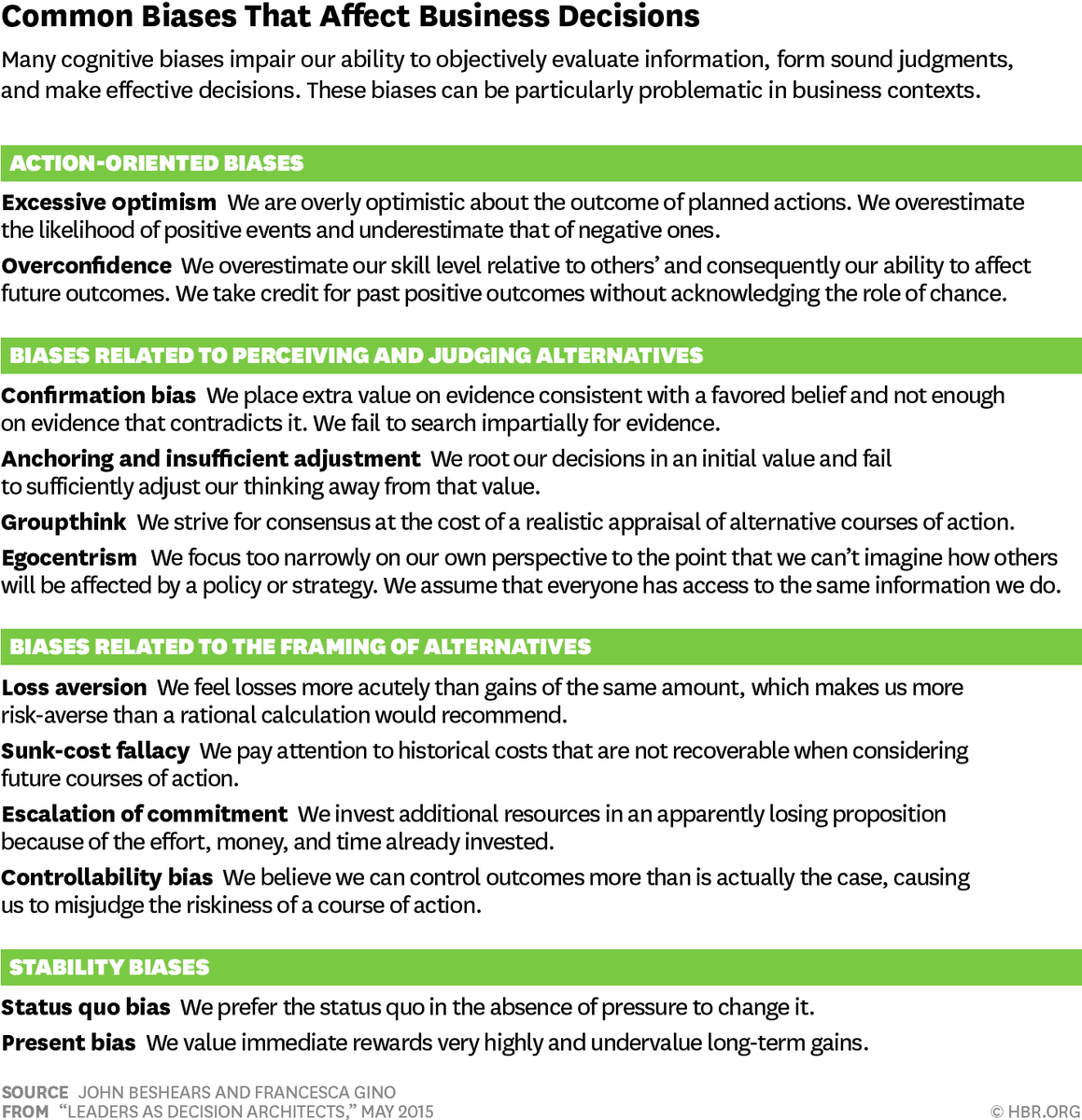
The Most Common Biases in Business Decisions

If you’ve been following me for any length of time, you’ll know that one of topics that I write about the most is cognitive biases. So, when I came across an article on the Harvard Business Review that neatly wrapped up some of the more common biases in business decisions, I just had to comment on it.

I agree with just about everything in this table (?), but I’m surprised about one thing: the endowment effect. That is, I’m surprised it’s not listed in the table. Specifically, listed under ‘stability biases’ as this is where it would fit. To refresh your memory:

In short, it means that people want more money for something than they’d be willing to pay for it. Put differently: we overvalue that which we own. You could think of a simple example of this through the course of a negotiation. When negotiation with someone, we’ll probably overvalue what we bring to the table. Someone may offer you $50 for your 25-year old keyboard (piano), but you think it’s worth at least $75. Barring any outside appraisal, the endowment effect is likely at play here.

Given the number of deal-making that takes place on a regular basis, I’m surprised that we didn’t see this as part of the table. It seems to me that in business, when money is often the thing that’s held in the highest regard (for better or for worse), you’d want to have people with the decision-making power understand that they may be overvaluing what’s theirs.

Upon further reflection, I can understand why one may not see it as a “common” bias because in today’s society, (at least in Western cultures), the common transaction is cash for stuff and not stuff for stuff (barter). If bartering were more the name of the game, then I would certainly want to see the endowment effect on that list. Either way, though, it’s certainly worth remembering that we tend to overvalue the stuff we have.