Quick Thoughts: Making a Difference and Honouring Future Ancestors

luis-alvoeiro-quaresma-VOaIhSvoCXU-unsplash.jpgIt’s kind of amazing how quickly things start to pile up and one’s good intentions, the proverbial “best laid plans,” are thrown to the wayside. When I first came back to writing here, my intention, my plan, was to write every workday. Slowly, I relaxed my goal to three days a week (as a way of going easier on myself with the fall returning — which meant things were picking up in my role as a public servant and as a professor). Then, things became so hectic that I was having a hard time carving out any time to write. Before I knew it, almost a month has passed since the last time I hit publish. Sigh.

As I said when I returned a couple of months ago, one of the reasons for writing is to get the thoughts out of my head and onto the page to make room for new thoughts. Even though it’s been about a month, that doesn’t mean the ideas haven’t stopped flowing. I’ve got a number of drafts in progress, so I thought that I’d go ahead and flush them out into a “Quick Thoughts” post.

Make a difference where you can. On Duhigg’s podcast a couple of months ago, there was a guest that had gone through severe trauma. All he can really do is focus on what’s in front of him. Listening, it made me wonder if it’s incumbent upon the rest of us to make a difference in bigger ways. I’m worried that I’m not expressing myself clearly here and part of me really wants to flesh this out into a longer article to nuance what I’m saying (i.e. anyone can make a big impact no matter their station in life), but I’m thinking about those among us who might be relatively lucky to be where they are. Are we obliged — should we feel obliged — to try to make the biggest impact we can?

Visualize and make it so. The “Meditative Story” from a few weeks back was also a good one. I struggle with stuff like this because it’s native to me. I grew up with influences like this (i.e. visualization, see it and believe it, etc.), but I recognize that it’s often written off as self-help hokum. Does that mean we should all dismiss it out of hand? Were all methods used today seen as the pantheon when they began? Am I using false equivalence? [Maybe.]

Oprah and Eckhart Tollle. Another good podcast episode (surprise!). This one is with Oprah and Eckhart Tolle. It really reminded me of that Anderson Cooper and Stephen Colbert interview from a few weeks ago. In the Oprah/Eckhart interview, Eckhart is talking about bumper stickers and how some folks will have something like, “I’d rather be fishin’,” or something like that. Then, he mentions how Ram Dass has a bumper sticker, too, that says, “I’d rather be here now.” For those unfamiliar, Dass wrote a book called Be Here Now almost 50 years ago.

Honour one’s future ancestors. I don’t remember exactly where I heard this, but I believe the context had to do with our responsibility to take care of the planet (which I’ll quibble with monetarily). The idea of us doing well by our planet as a way of honouring our future ancestors sounds lovely. Now, to quibble — there’s something about the messaging for climate change, environmentalism, etc. that just doesn’t resonate with some segments of the population. I’m not an expert here, but that part seems clear. I know that some folks try to personalize it as a way of hoping that it gets more people involved, but I don’t know that it does. Greta has certainly inspired quite a few people. I really hope that this momentum carries forward and we — as a species — are able to honour our future ancestors.

Science is Awesome: Humans Can Breathe Liquid

Depending upon one’s teachers at school when they were younger (or older), there can be an affinity for or a strong aversion from science. I remember fondly some of the teachers I had in science (and then in physics and chemistry, when I was able to pick different topics in science). Heck, I even remember the analogy my biology professor used to explain diffusion at university.

I recognize that not everyone feels this way about science and talks of “randomized controlled trials” (RCTs), experiments, studies, or anything with language like that can be intimidating. This is certainly frustrating. There is so much good that comes from science (of course, there are some not so nice externalities sometimes), but we’ll just say that science has certainly been a net positive for society through time. If you need a clear example, the life expectancy of a person born in the US at the turn of the last last century (1900), was mid-to-late-40’s. Nowadays, some people’s true career doesn’t start until they’ve turned 50!

Anyway, so yes, the subheadline of today’s post — humans can breathe liquid. Just as a brief aside, can you imagine how cool that would be if this were true? Can you imagine plumbing the depths of the Marianas trench (uh, a really deep part of the ocean) without needing to be in a vessel (OK, OK, easy before some of you write me to say that the human body couldn’t withstand that kind of pressure — let’s just imagine for a moment that that wouldn’t happen).

Right — breathing liquid. A few weeks ago, I came across an article that I thought was some sort of science fiction or at least theoretical (i.e. humans used to breathe liquid, but we don’t anymore). Turns out, it’s not. Turns out, doctors have newborns (!) breathe liquid to help stabilize their lungs (WTF!?). OK, so here’s an excerpt:

Seven years later [1995], another team using refined liquid breathing techniques tried PFC liquid ventilation on 13 premature babies suffering from severe respiratory distress who were not expected to survive. Liquid breathing resulted in an improvement for a majority of the infants, potentially by stabilizing alveoli and reducing surface tension within the nascent lungs. Put more simply, the premies’ lungs weren’t ready for a gas environment, and PFC provided a nurturing bridge been amniotic fluid in the womb and outside air. Incredibly, eight of the infants survived at four-month follow-up.

The human body is pretty cool, eh? Science is awesome.

Uncertainty: Accounting for Known and Unknown Outcomes

jayakody-anthanas-m1wFkw-Iyt8-unsplash.jpgNote: for the last few posts, I’ve been exhausting the store-house of prewritten pieces from other websites that I hadn’t yet transferred to this website. I believe all have been posted here now, so let’s return to our regularly scheduled programming.

I’ve had an article saved on Pocket for a few months now with a section highlighted. I don’t often highlight sections of articles because I don’t often keep articles on Pocket — once I’ve read it, I delete it (so the highlighting is superfluous). However, there was an article I came across a few months ago with a passage that stopped me in my tracks. It was in a rather weeds-y article about the Twitter war strongly worded discussion (?) between Nate Silver and Nassim Nicholas Taleb. I won’t get into the details of it, because it’s not really necessary for the passage that popped, though I did want to set the context, in case anyone clicked through to the link and was confused.

About halfway through the article, the author begins a discussion on uncertainty. In particular, he’s talking about two kinds of uncertainty — aleatory and epistemic. [NOTE: You’re not alone if you had to look up aleatory — I don’t recall every coming across that word.] Anyway, here’s the key bit:

Aleatory uncertainty is concerned with the fundamental system (probability of rolling a six on a standard die). Epistemic uncertainty is concerned with the uncertainty of the system (how many sides does a die have? And what is the probability of rolling a six?).

How many times have you come across a model that purports to be able to predict the outcome of something — without there being a way to “look under the hood” of the model and see how it came to its conclusions? OK, maybe looking under the hood doesn’t suit your fancy, but I bet you partake in the cultural phenomenon that is following who’s “up or down” in the election forecast for 2020? Will POTUS be re-elected? Will the other party win? Or what about our friends on the other side of the pond — Brexit!? Will there be a hard Brexit, a soft Brexit, are they going to hold another election?!

All things, all events where the author of the piece or the creator of the model might not be adequately representing (or disclosing) the amount of epistemic risk inherent in answering the underlying question.

~

So let’s bring this closer to home for something that might be more applicable. You make decisions — everyday. Some of you might make decisions that have an impact on a larger number of people, but regardless of the people impacted, the decisions you make have effects. When you take in information to make that decision, when you run it through your internal circuitry, the internal model you have for how your decision will have an effect, are you accounting for the right kind of uncertainty? Do you think that you know all possible outcomes (aleatory) and so the probabilities are “elementary, my dear Watson,” or is it possible that the answer to whether you should have cereal for breakfast is actually, “elephants in the sky,” (epistemic). OK, maybe a bit dramatic and off-beat in the example there, but you never know when you’re going to see elephants in the sky when you ponder what kind of breakfast cereal to pull down off the top of the fridge.

Switchbacks Get You Up The Steepest Mountains

tanner-larson-rgmUbg4VsqE-unsplashNow isn’t that a quote!? I heard this the other day listening to Alie Ward’s 100th episode of Ologies. In just about every episode, Alie will interview an expert about their “ologie.” Just to give you an idea, here’s a smattering of relatively recent ologies:

  • Saurology (Lizards)
  • Acarology (Ticks)
  • Mycology (Mushrooms)
  • Scorpiology (Scorpions)
  • Astrobioliogy (Aliens)
  • Ludology (Video games)

Pretty cool, eh?

Anywho, in Alie’s most recent episode, she wanted to be a bit more celebratory, given that it was her 100th, so she riffed a bit on motivation. And in that riff came this golden quote: “Switchbacks Get You Up the Steepest Mountains.” In the context of what she was saying, she discussed some of the lessons she’d learned from the ologist’s that she’d interviewed — just about all of them had no qualms about diving head first into their profession. Diving head first into trying. Diving head first into trying.

She lamented about her struggle in starting the podcast — she had the first episode in the can for 9 months (!) before releasing. The things we do are never going to be perfect. We’ll always be getting better. We’ll always be iterating. We’ll always be perfecting. Never perfect. Always perfecting.

For some folks (okay, many?) there can be a paralyzing fear about starting. A paralyzing fear about hitting send. A paralyzing fear about publishing. A paralyzing fear about putting yourself out there. Unfortunately, until we put ourselves out there, until we’re “off the deep end,” we won’t know what we’re capable of. Nothing ventured, nothing gained. You — yes you! — could be the next Picasso (er, or, famous artist, in case you’re not a fan of his story). But if you never let anyone see your paintings, how can you get from you to Picasso-level fame?

Maybe you don’t want fame. Maybe you’re happy living as a recluse. I don’t buy it. I don’t think that’s true. We all yearn for human contact and human connection. The “recluses” among us are those who’ve been hurt the most. They’ve been taught, through their upbringing or interactions, that it’s not safe to venture out. That when they venture out, they get hurt. And that makes me sad. It makes me sad that humans, because of their own pain and suffering, lash out and bring pain and suffering to other humans.

~

Switchbacks Get You Up the Steepest Mountains.” Venturing out, dipping your toe in the pool, taking that first baby step… Is it going to be on the “right” path — no, almost certainly not. Does it matter — heck no! It’s the act of taking the step. It’s the act of venturing forward. It’s the act of becoming a person who takes steps. It’s the act of becoming a person who recognizes that there’s a vulnerability in putting yourself out there and does it anyway because they know that the rewards are far greater than the perceived — perceived! — losses.

When you steel yourself and take that first step, is it going to be “up” the mountain? Is it going to be straight up the mountain? No, it won’t be. Because getting from here to there rarely ever happens in a straight line. Instead, you’ll start out on the path and get to a point where you realize, “Oh, I need to be going this way, now,” and then you’ll turn on your heel and up the switchback you’ll go. While it might seem like you’re backtracking, after a few minutes, as you gaze ‘down’ the mountain, you’ll see that you’ve ascended quite a bit by moving through these switchbacks. By moving through your life and venturing out. By moving through your life and putting yourself out there. By taking calculated (and sometimes not calculated) risks.

It’s the switchbacks that get you up the steepest mountains.

Quick Thoughts: Planning Fallacy, Sci-Fi, Gendered Language, and Scarcity/Excess

glenn-carstens-peters-RLw-UC03Gwc-unsplashAs I look to breathe some life back into writing, I thought I’d take a quick peek at some of the “drafts” I had saved from when I used to write regularly. Fortunately, there aren’t too many there. In the interest of trying to start fresh, I thought I’d do a quick post addressing some of these ideas kind of in the same way that Wikipedia has stubs.

Planning Fallacy: Many years ago, I wrote about the planning fallacy as part of my series on cognitive biases (i.e. how to make decision better). Something I didn’t talk about in that post was the difference between a 7-day and 5-day workweek. Let me explain. For those that go to university, everyday is eligible for a “work” day (i.e. homework). Many things are due on Monday morning and rather than push to complete something on Friday afternoon (or night?), students will often be writing things on Sunday night. Not only am I drawing on my experience as a student, but I’ve been teaching for the last 7+ years and I can say with authority, if I give students a full week (7 days) to complete an assignment and make an assignment due at 1159p on Sunday night, 50%+ of the class will complete that assignment sometime on Sunday. I’m digressing a bit from the point. So, we get used to this “7-day workweek” to complete things. When we move into the work world, that “week” shifts from 7 days to 5 days (and even less in cases of holidays or even less than that if you take into account mandatory meetings, etc.). So, when someone estimates how much time they’ll have to complete a work product, they’re used to (primacy effect?) how they were estimating when they were a student and don’t take into account the ‘truncated’ week.

Science Fiction, Humans, and Aliens: In those sci-fi movies that have some form of alien (i.e. non-human), often times, there’ll be a scene where the humans are kept in a cage. It made me think about how humans keep some animals in cages (i.e. zoo). Maybe to a different species, we (humans) would be treated in the same way we treat animals.

Gendered Language: There was a journal article from a few years ago that caught my eye. Here’s a bit of the abstract:

The language used to describe concepts influences individuals’ cognition, affect, and behavior. A striking example comes from research on gendered language, or words that denote individuals’ gender (e.g., she, woman, daughter). Gendered language contributes to gender biases by making gender salient, treating gender as a binary category, and causing stereotypic views of gender.

Like I said yesterday, if you’ve been following me for any sort of time, this bit about our words having an effect on us shoudn’t come as a surprise. However, this journal article is strong evidence to keep in your pocket if you need to point to something evidence-based in a discussion.

The Problem of Excess: Another good journal article that I’ve been saving for over 5 (!) years. /facepalm. I still remember my first grad school economics course and the professor was explaining the fundamental principle that underlines economics — scarcity. I wanted to raise my hand and disagree on the merits, but it didn’t seem appropriate. I can see and understand how scarcity came to be the dominant theory of the day, but a part of my being just feels that that interpretation is… near-sighted. Seeing this journal article a few years after that class highlighted a different perspective. Here’s a bit of the abstract:

This article argues for a new branch of theory based not on presumptions of scarcity—which are the foundational presumptions of most existing social theory—but on those of excess. […] It then considers and rejects the idea that excess of one thing is simply scarcity of another. It discusses the mechanisms by which excess creates problems, noting three such mechanisms at the individual level (paralysis, habituation, and value contextuality) and two further mechanisms (disruption and misinheritance) at the social level. […] It closes with some brief illustrations of how familiar questions can be recast from terms of scarcity into terms of excess.

Enjoy your weekend!

What is Data Science?

There’s no question that “data science” is becoming more and more popular. In fact, Booz Allen Hamilton (a consultancy) found:

The term Data Science appeared in the computer science literature throughout the 1960s-1980s. It was not until the late 1990s, however, that the field as we describe it here, began to emerge from the statistics and data mining communities. Data Science was first introduced as an independent discipline in 2001. Since that time, there have been countless articles advancing the discipline, culminating with Data Scientist being declared the sexiest job of the 21st century.

Unsurprisingly, there are countless graduate and undergraduate programs in data science (Harvard, Berkeley, Waterloo, etc.), but what is data science, exactly?

Given that the field is still in its proverbial infancy, there are a number of different perspectives. Booz Allen offers the following in their Field Guide to Data Science from 2015: “Describing Data Science is like trying to describe a sunset — it should be easy, but somehow capturing the words is impossible.”

Pithiness aside, there does seem to be consensus around some of the pertinent themes contained within data science. For instance, a key component is usually “Big Data” (both unstructured and structured data). Dovetailing with Big Data, “statistics” is often cited as an important component. In particular, an understanding of the science of statistics (hypothesis-testing, etc.), including the ability to manipulate data and almost always — the ability to turn that data into something that non-data scientists can understand (i.e. charts, graphs, etc.). The other big component is “programming.” Given the size of the datasets, Excel often isn’t the best option for interacting with the data. As a result, most data scientists need to have their programming skills up to snuff (often times in more than one language).

What’s a Data Scientist?

Now that we know the three major components of data science are statistics, programming, and data visualization, do you think you could identify data scientists from statisticians, programmers, or data visualization experts? It’s a trick question — they’re all data scientists (broadly speaking).

A few years ago, O’Reilly Media conducted research on data scientists:

Why do people use the term “data scientist” to describe all of these professionals?

[…]

We think that terms like “data scientist,” “analytics,” and “big data” are the result of what one might call a “buzzword meat grinder.” The people doing this work used to come from more traditional and established fields: statistics, machine learning, databases, operations research, business intelligence, social or physical sciences, and more. All of those professions have clear expectations about what a practitioner is able to do (and not do), substantial communities, and well-defined educational and career paths, including specializations based on the intersection of available skill sets and market needs. This is not yet true of the new buzzwords. Instead, ambiguity reigns, leading to impaired communication (Grice, 1975) and failures to efficiently match talent to projects.

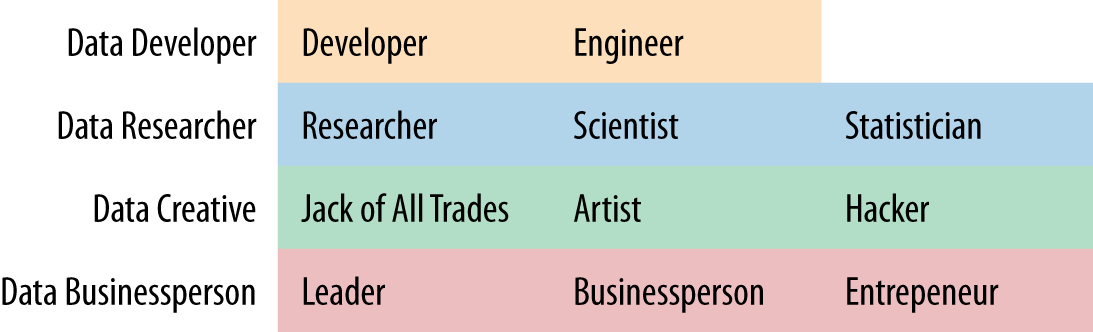
So… the ambiguity in understanding the meaning of data science stems from a failure to communicate? Classic movie references aside, the research from O’Reilly identified four main “clusters” of data scientists (and roles within said “clusters”):

Within these clusters fits some of the components described earlier, including two additional components: math/operations research (including things like algorithms and simulations) and business (including things like product development, management, and budgeting). The graphic below demonstrates the t-shaped-nature of data scientists — they have depth of expertise in one area and knowledge of other closely related areas. NOTE: ML is an acronym for machine learning.


NOTE: This post originally appeared on GCconnex.

Do New Stadiums Lead to an Increase in Business?

Unless you’re familiar with the literature in this arena (no pun intended) or you know about Betteridge’s law of headlines, the title of this post is actually still an unresolved question for you. Well, I won’t delay the inevitable: according to research published earlier this year, the answer is no — new stadiums do no lead to an increase in business.

There are two things I want to talk about as it relates to this research. The first is Richard Florida. If this area is an interest of yours, there’s a good chance that you’ve come across him. Florida has been a professor for the last 20+ years and has written extensively on cities. Here’s a post I found from him within the last year that talks about the very thing that the journal article discussed:

The overwhelming conclusion of decades of economic research on the subject is that using public funds to subsidize wealthy sports franchises makes zero economic sense and is a giant waste of taxpayer money. A wide array of studies have shown that professional teams add virtually no income to local economies. In fact, some of them find that large subsidies actually have a negative effect, taking money out of the local economy. Aside from the jobs generated by actually building the stadium, most jobs inside the stadium—selling food and beer or working at team concessions—are low-paying temp jobs. It’s even worse for football stadiums, which are used for games at most a dozen times a year, and maybe a few more times for concerts or large events. Public economic development dollars can be put to much better use on things besides subsidizing sports teams and their wealthy owners.

Ultimately, the burden of public subsides falls disproportionately on small cities that are the least able to bear the cost. For example, a $200 million public subsidy for a new stadium ends up costing a small city like Santa Clara roughly $1,650 per resident, compared to just $50 a person for L.A. And, of course, teams in bigger cities, with their bigger markets and more revenue, often do not need subsidies at all.

The reason I raise Florida’s name is because I was surprised that I didn’t see his name mentioned in the journal article. To be fair, I don’t think that Florida has done any primary research in this domain, but I would have thought that even in the opening introduction or literature review that there may have been some reference to Florida’s constant discussion of literature like this.

Anyhow, the second thing I wanted to talk about is something that might not be measurable. Well, it might not be measurable in a simple way. As a former amateur athlete, I have a special place in my heart for sports. Certainly, there are plenty of things that one could classify as “wrong” about sports, but part of me still wants to defend it/them and I’ll be upfront: that might be part of what’s going on with this section of this post.

Something I didn’t see in the article (and probably something I wouldn’t expect to find in any well-written article) is a measure of (or discussion of?) the positive externalities that result from a city’s team winning the championship or even the spillover effects from the possible positive externalities. Now that’s a tortured sentence. I’m talking about how the residents of a city feel after their team wins the championship (in a given sport). Naturally, not everyone would be watching (or care), but for those that are fans of the team that wins, there would certainly be elevated levels of joy and happiness immediately following the victory. If there were studies done on this, I suspect that there might be comparisons to those who have won the lottery in that a couple of months after, lottery winners return to a similar level of satisfaction/happiness that they had prior to the lottery win.

I wonder, though, could we measure the economic gains for a city from this positive externality and the resulting spillover effect (in this case, let’s say the spillover effect would be the “pay it forward”-ness of joy from the fans of the team to the non-fans that the fans will be interacting with in the weeks following the city’s team’s victory). Even if there is a tangible effect that can be measured, I’m sure that any reasonable cost-benefit analysis would still conclude that a new stadium isn’t worth it for a city.

ResearchBlogging.orgHarger, K., Humphreys, B., & Ross, A. (2016). Do New Sports Facilities Attract New Businesses? Journal of Sports Economics, 17 (5), 483-500 DOI: 10.1177/1527002516641168

Positive Stereotypes Are Pervasive and Powerful

Pop quiz: hands up — how many of you think positive stereotypes are OK?

I suspect that for many of you, your first reaction may have been, “well, yeah, they’re positive, right?” I can totally empathize with that shortcut, but consider this excellent quote from Gordon Allport, one of the “founders” of personality psychology: “People may be prejudiced in favor of others; they may think well of them without sufficient warrant,” [quote excerpted from journal article cited below].

Last year, researchers sought to summarize some of the research about positive stereotypes. There were a number of interesting findings. For instance:

Among [a] sample of Asian American students, the majority (52%) had negative reactions (e.g., feeling marginalized) to their group being considered the “model minority” compared with 26% who had positive reactions. […] Although the subjective favorability of positive stereotypes may facilitate their expression among perceivers who intend them as “compliments,” the targets of such stereotypes can feel depersonalized as if they are being acknowledged exclusively through their category membership. [Emphasis mine]

So, while it might be a ‘positive’ stereotype that Asian Americans are considered the “model minority,” it’s possible that an Asian American may feel as if they are being depersonalized when having the stereotype directed at them. That is, they may no longer feel like they’re a person, but rather that they simply belong to this category called “Asian American.”

Let’s back up for a moment.

When I talk about stereotypes in my lectures to students, one of the first things I do is explain the mechanics of a stereotype. Our brain is processing way more stimuli than we could possibly fathom. For instance, in your office right now, do you hear the hum of the lights or the sound of the fan? If you’re on the bus or in a car, do you notice the sound of the brakes? How about at home… do you still hear the creaky sounds of the floorboards or the plethora of sounds that come out of the basement/vents? I suspect the answer to many of these questions for most of you will be no and that’s because you have habituated to them. Your brain has recognized them as non-threatening and moved on to focus on other stimuli — people.

There are so many people on the planet. Really, we could say that there are over 7 billion different kinds of people, but that’s impossible for a brain that’s trying to process as much as it can. So, when you meet people, your brain is busy trying to recognize patterns that it can map onto previous people you’ve met. When everyone’s brain does this, it follows that a thing called “stereotype” emerges. That is, a stereotype is our brain’s way of trying to find a shortcut for understanding the different kinds of people we interact with during our lives.

So, in the example above about Asian Americans, somewhere along the way, someone’s brain decided Asian Americans represented what they believed was a ‘model citizen.’ Forgetting for a second whether this is valid, it’s likely that there were other people’s brains came to this conclusion and so the stereotype is perpetuated.

Just because our brain is doing this in the “background” doesn’t make it ok. As humans, there are so many biases that we have to be aware of when making decisions — our brain taking shortcuts with stereotypes is just one of them. So, what can you do?

Well, as I often say when it comes to biases — the first step is awareness. You’ve gotta recognize that you’re falling prey to stereotyping and once you recognize that you’re doing it, I urge you not to be so hard on yourself. Let’s be clear — I’m not giving you a “pass” for stereotyping, no. But the culture from which you derive can have a lasting effect on your beliefs about people (which inform whether you employ stereotypes).

One quick and easy way to awareness — if you’re ready for it — is Harvard’s Project Implicit Test. I did a quick search and I was surprised that I’ve only mentioned this one other time in the last few years on this site and it was only in passing. From their site:

Psychologists understand that people may not say what’s on their minds either because they are unwilling or because they are unable to do so. For example, if asked “How much do you smoke?” a smoker who smokes 4 packs a day may purposely report smoking only 2 packs a day because they are embarrassed to admit the correct number. Or, the smoker may simply not answer the question, regarding it as a private matter. These are examples of being unwilling to report a known answer. But it is also possible that a smoker who smokes 4 packs a day may report smoking only 2 packs because they honestly believe they only smoke about 2 packs a day. Unknowingly giving an incorrect answer is sometimes called self-deception; this illustrates being unable to give the desired answer.

The unwilling-unable distinction is like the difference between purposely hiding something from others and unconsciously hiding something from yourself. The Implicit Association Test makes it possible to penetrate both of these types of hiding. The IAT measures implicit attitudes and beliefs that people are either unwilling or unable to report.

If you’re ready for the results, I strongly suggest you take the test.

ResearchBlogging.orgCzopp, A., Kay, A., & Cheryan, S. (2015). Positive Stereotypes Are Pervasive and Powerful Perspectives on Psychological Science, 10 (4), 451-463 DOI: 10.1177/1745691615588091

Wanna Lose Weight? Get Some Sleep!

There was some research published within the last year that you might be particularly interested in, should you be in the middle of or about to go on a diet (or you’re interested in your health in general):

This article provides an integrative review of the mechanisms by which sleep problems contribute to unhealthy food intake. Biological, cognitive, emotional, and behavioral mechanisms all underlie this relationship.

When I first came across this headline — the less you sleep, the more you eat — immediately, I was interested. After reading the source article (which I quoted from above), I’m heartened by the possibilities for progress in this area.

Naturally, the food we eat has an effect on how we sleep, but the insight that the fewer hours of sleep we get having an effect on how much we eat, is really important. While anecdotal, I’ve experienced this phenomenon firsthand. If I find myself up past my “bedtime,” I almost always am hungry. And because it’s late at night, my executive function is impaired. Put differently, my ability to make good choices might be compromised. In this case, a good choice would be to not eat a bag of chips or a tub of ice cream (or anything sugary, for that matter). A good choice might even be to reach for a handful of nuts or maybe an apple.

The thing that I wanted to mention in conjunction with this research is my suspicion that there’s a cumulative effect. If you stay up late and then pig out on snacks too close to bedtime, invariably, you’ll probably be waking up with less sleep than you need. As a result, your executive functioning (willpower, decision-making, etc.), will be impaired for the duration of the day. By the time you get to the end of the day, you may find yourself more tired than usual such that when it gets to the time when you’d rather go to bed, you might prefer to “reward” yourself or (decompress) by eating some sweets and staying up late… and then it all starts over again the next day. Once you’re out of balance, Newton’s laws have a way of keeping you there.

This reminds me of something I shared a few years ago about Aikido:

One of the exercises we would often do to practice this sense of blending involved our partner (or partners as it was usually in groups of three or more!) to approach us as if they were attacking us. It was our job to then move out of the way, whilst staying centered. The tempo of this exercise usually started out really slow (intentionally). Though, as time passed, our partners would then speed up. You can imagine how it might be challenging to stay centered in this kind of an activity.

During these times of practice, I remember having a bit of an epiphany.

As my partner would approach me and I would step out of the way, I noticed that the quicker (and the more out of balance!) I was, the more out of balance I would be when stepping out of the way for the next partner who was approaching. Think about that for a second: as I stepped out of the way of one partner and I was off-balance, I was that much more off-balance when stepping out of the way for the next partner. It’s almost akin to the Bullwhip Effect.

This idea of eating “after hours” seems to be a mirror image of the off-balance I experienced during the Aikido exercise. So, if you find yourself on the cusp of a diet, I suggest you consider setting (and keeping!) a strict bedtime for yourself. If you’re curious about how to start this new habit, I strongly suggest Duhigg’s book: The Power of Habit.

ResearchBlogging.orgLundahl A, & Nelson TD (2015). Sleep and food intake: A multisystem review of mechanisms in children and adults Journal of Health Psychology : 10.1177/1359105315573427

Looking for a Husband or a Wife? It’s Time to Learn About Altruism

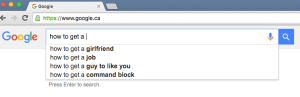
Human companionship. It’s something that we all crave. In fact, a quick look at Google’s autocomplete shows that two of the top three results for “how to get a” return “girlfriend” and “guy to like you.” It’s pretty clear that sharing our life with someone is something we’d like to do (generally, speaking). So, when I came across some research in this area, I thought I’d contribute to those Google searches with some seemingly helpful data. From the journal article:

Our results show that—among single individuals—engaging in prosocial behavior in any given year was associated with increased odds of finding a partner and entering into a romantic relationship in the following year.

I’ve written about the benefits of prosocial behaviour in a work environment (spend your bonus on your coworkers!), so it’s not entirely surprising to me to see that this same behaviour is also beneficial when it comes to increasing one’s odds of finding a romantic partner. Another way of looking at prosocial behaviour is altruism. Essentially, we’re talking about behaviour where one is attempting to help someone else without expecting something in return. Volunteering is an easy example of this.

You may be wondering about the study’s method. That is, did the researchers guard against the possibility that  the reverse is true (entering into romantic relatonships begets more prosocial behaviour). In fact, they did consider this:

We specifically examined whether those individuals who were single at the beginning of a time period and managed to find a partner at the end of the time period were more likely to experience an increase in helping behavior in the meantime than those who remained single. Our results showed that individuals who started a romantic relationship did not experience an increase in helping behavior compared with those who remained single.

So, it looks like the researchers feel pretty confident in their conclusions about volunteering helping to lead one to a romantic relationship. Before you run out to your local Red Cross or Salvation Army, I wanted to offer a different perspective on this research. In particular, I thought I’d look at some of the historical statistics around volunteerism and marriage. That is, if we accept the premise of the research, we might expect to see there to be some covariance between volunteerism and marriage. That is, as marriage goes up, we might expect that volunteerism would also go up. Similarly, as marriage goes down, we might expect that volunteerism would go down.

I had a harder time than I thought I might in trying to find data on these two subjects. However, I did come across a couple of things that gave me pause about this research. The first, volunteerism. According to some research by the US government, it looks like volunteerism is up, recently. That is, it looks like the propensity for volunteering is higher than it used to be (see graph). The second, marriage rates. If the initial research I shared about prosocial behaviour is true, we’d expect to see higher marriage rates (than there used to be). Here’s the headline from the Pew Research Center a few years ago: Record Share of Americans Have Never Married. So, it’s probably fair to say that marriage rates are down. This doesn’t bode well for our initial research on prosocial behaviour.

One last thing I wanted to share on this: millennials. There’s been plenty written about millennials, but I want to focus on the two things we’re talking about today: volunteering and marriage. Compared to previous generations at the same age, millennials are far less likely to get married. Millennials also differ from Gen X’ers when it comes to volunteering:

… higher rates of community service and volunteering. I mean, let’s face it, for Gen X, volunteering was a punishment. You know, you did something wrong at college, you do community service. (Laughter) But the Millennials — it’s more of a norm.

~

It’s quite possible that the effect realized by the initial research on prosocial behaviour is true, but that it’s not big enough to make a dent in some of these bigger statistics. It’s also possible that some of the counterpoints I’ve raised aren’t as analogous as I think they are. Either way, I think the research in prosocial behaviour is important and I certainly hope you take the chance to spend some time “giving without expecting anything in return.”

ResearchBlogging.orgStavrova, O., & Ehlebracht, D. (2015). A Longitudinal Analysis of Romantic Relationship Formation: The Effect of Prosocial Behavior Social Psychological and Personality Science, 6 (5), 521-527 DOI: 10.1177/1948550614568867