Attraversiamo: Creativity and Perspective

Chances are, when you leave the house or you leave the office, you take the same route home. All. The. Time. If you’re in a car, you may have to change your route because of construction or traffic, but it’s pretty much the same. If you’re walking (or walking to the bus/metro/subway/etc.), you’re probably looking to get there as quickly as you can, so you’ve learned which parking lots to cut across and which alleys are safe. That’s absolutely a great reason to continually take the same route — efficiency is useful when you’re in a hurry and who isn’t in a hurry these days? In fact, you’re probably so good at taking the same route that often times, you don’t even realize that you’ve passed 4 or 5 blocks. For those of you who drive, there’s the idea that you get in your car at home and all of a sudden, you find yourself at work, but you have no recollection of actually driving yourself to work.

I wonder… have you ever considered walking on the other side of the street?

I’ve written quite a bit trying to encourage you take a new perspective or to take a fresh perspective, but for some people, that’s a bit ethereal. So, I was trying to imagine some very tangible ways that I could suggest to illustrate the ‘power’ of taking a different perspective. While I think taking a different perspective is extremely important when it comes to making important decisions, training one’s self to realize the value of a new perspective seems like it might be helpful, too.

I want to propose an experiment. I’d like you to, the next time you leave the house (or work), walk on the other side of the street. You’ve probably walked down the same side of the street hundreds, if not thousands of times, and I predict that if you walk on the other side of the street, you’re going to see your environment from a new perspective. Now, categorically, of course you’ll have a different perspective because you’re occupying a different vector of space and time, but forget about that aspect for a second and take a chance. This is such a tiny ask — walking on the other side of the street will do little to inconvenience you during your day, but it could do wonders for you in highlighting a tangible example of how taking a different perspective could allow you to see things differently.

If you need more reasons to convince you to try this tiny experiment then consider that it could help you solve that problem you’ve been working on for the last few days. There’s some research that suggests [can’t seem to locate it at the moment] putting yourself in new environments is a way to spark one’s creativity. By making these new connections in your environment, it could spark new connections for the things that have been ‘keeping you up at night.’

Saving For Retirement — As Simple As Counting in Days

A few years ago, I wrote a post about the problems with saying “I’ll be ready in 5 minutes.” It turns out, there’s now research that — in a way — supports the point I was trying to make.

In this study, the researchers attempted to draw closer the connection between our present selves and our future selves. In particular, they looked at how manipulating the unit used to convey time (days, months, and years) can have an effect on that connection between our present selves and future selves. In plain language, consider the time between now and when you retire. It may be, what, 30, 20, 15, or 10 years away? For those of you closer to 25 years from retirement, that might sound like a long ways away (actually, it’s really not). Have you started saving for retirement? Oh, right, retirement savings, yeah, I’ll start next year.

That attitude right there, the attitude that our “future selves” are far away (when in actuality, they’re not), that’s what the researchers were targeting. From the researchers [Emphasis Added]:

We found that people say they will start saving four times sooner if told how many days rather than how many years they have until their child goes to college or until they want to retire. […] Considering one’s retirement or one’s child’s college education in days rather than years leads people to experience more connection between their present and future selves, which makes the identities linked to these future selves (e.g., “retiree”) feel more congruent with their current self. This reduces the extent that people discount future over current rewards. Less discounting means that saving for the future may feel less painful.

So, when we think about future events in a unit that is more relevant to us (days vs. years), we’re more likely to feel a connection to those future events and by extension, our future selves.

~

Let’s circle back to my post from a few years ago about 300 seconds:

As a way around this — sometimes — I like to use the term “300 seconds.” Why 300 seconds? Well, 300 seconds is the same amount of time as 5 minutes. (Weird, eh?) But it sounds different, doesn’t it? Similarly, if I’m going to need more than 5 minutes, say 10 minutes, I might say 600 seconds.

To piggyback this research, I’d be interested to see results of a study that looked at our perception of time in an even smaller unit of measurement. For things like retirement and college savings, years to days makes sense, but what about for something that’s going to be happening in less than 5 years or something that will be happening in a few months?

Let’s say we’re hosting a conference in 3 months and we need to get things in order for it. Three months isn’t that far away, but thinking about it in months might not give us the necessary urgency. What if we thought about it in weeks? Twelve. Days? 90. Hours? 2160. Minutes? 129,600.

Ok, so minutes is probably too finite a measurement for this analogy, but I think you get the point. Changing the unit of measurement certainly has an effect on our perspective of future events.

ResearchBlogging.orgLewis, N., & Oyserman, D. (2015). When Does the Future Begin? Time Metrics Matter, Connecting Present and Future Selves Psychological Science, 26 (6), 816-825 DOI: 10.1177/0956797615572231

Gasoline-Powered Cars: A New Perspective

One of my favo[u]rite things to write about (or write on?) is perspective. I really and truly believe that perspective is one of the keys to growth and by extension, acceptance (or tolerance, if you prefer). In this context, it sounds like I’m talking about the acceptance (or tolerance) of other people and their beliefs/actions, but I also mean it with regard to reality, in general.

As we take on more perspectives, we’re granted the opportunity to use a new lens to see things and as we use this new lens, we’re far more likely to see something we didn’t see when we first looked. Case and point: vehicular transportation. Specifically, cars.

Many people probably don’t give a second thought to the car they’re driving (unless something goes wrong) except for when they’re looking to buy/lease one. More importantly, though, I bet many people don’t consider the numerous decisions that went into designing and creating that car. The numerous decisions that went into that kind of car being the dominant kind of car on the road today.

Now, you may think I’m talking about the brand of car, but what I’m really talking about is the way the car works: gasoline. Many folks can and probably do grow frustrated when the price of gasoline goes up and so they’ll probably think about their gasoline-powered car in those instances, but have you ever considered what a non-gasoline car driver might think of gasoline-powered cars?

There’s an absolutely wonderful post up on the Tesla Club of Sweden’s website. It takes the reader through the steps one must undergo in order to purchase a gasoline-powered car, but from the perspective of someone with no experience with gasoline-powered cars. Here’s a couple of short excerpts:

It may sound like a bad omen to buy the car from a car repair shop that you want to visit as seldom as possible. But you apparently can’t buy the car directly from the manufacturer but must go through such intermediaries.

[…]

We asked if the constant sound of the engine -that frankly disturbed us from being able to listen to the radio- could be turned off. But it couldn’t. Very distracting.

[…]

When we came to a stop the engine continued to run and the car vibrate – even though the car was standing still! The engine continued to burn gasoline without moving the car forward. Can it really be true? Yes, the seller explained, it is so with gasoline cars: the engine is always running and burning gasoline – even when the car is stationary. Some models however switches off the engine at a red light, he explained. Well that certainly makes more sense.

[…]

With this in mind we ended up in a traffic jam and was horrified that the gasoline engine continued to burn these expensive gasoline drops even when the car was standing still or moving very little. With gasoline vehicles it is easy to run into cost anxiety – the feeling that the car literally burns up your money! No cheap home charging and no regeneration of gasoline back to the fuel tank when braking sounds like economic madness – especially given that all gasoline must be imported from abroad.

It is definitely worth your time. Whether you’re a gasoline-powered car driver or not, I imagine that reading this will allow you the opportunity to consider your choice to drive a gasoline-powered car from a new lens.


Stop Asking: “Are You OK?”

A few weeks ago, I levelled a criticism at parents who attempt to dissuade their children from feeling their feelings in the moment. That is, as soon as they begin to cry, parents usually try to quash the children’s feeling by saying, “You’re OK,” or “You’re fine.” I think that this same attitude carries on when parents (or people) are dealing with older children (or other people) and something happens.

Consider a couple of teenagers who are playing soccer. One of them falls down and ceases playing for a couple of seconds. Almost always, the teenager who hasn’t fallen will immediately say to the other, “Are you OK?” I’m sure we’ve all been the teenager who’s fallen and scraped our knee and I’m sure we’ve all been the teenager who asks our friend if they’re OK, but this is an extension of the problem that begins when we’re toddlers — we’re not allowing the person the space to feel the feelings that they’re feeling.

By quickly jumping in and asking, “Are you OK?” one probably thinks that they’re being a good friend. My friend has just hurt themselves, so I should ask and see if they’re okay. Certainly, that’s the right spirit. However, by jumping in so quickly, it’s actually demonstrating to your friend that you’re uncomfortable with their pain/feelings. Let’s say that your friend starts to cry. Forgot that, let’s say that you have just begun to cry. When you’re crying, do you really want someone to ask how you’re doing? Well, if you’ve been asked that you’re whole life, you probably do, but if you stop and think about it for a second, when you’re crying (or when you’re upset), the best thing for you is space.

I’m not saying you (or your friend) should walk away when you (or your friend) begins to cry, no. Instead, you (or your friend) should sit there with you and allow you the space to feel the feelings — let you cry. After an acceptable amount of time (this varies), then it might be appropriate to break the silence, but if it were me, I’d actually wait until the person who’s crying begins saying something. By simply being there with your friend in their time of need, you’re holding a safe space that allows them to process their emotions/feelings. And if/when you do that, you’ll be giving your friend a gift they probably haven’t had the chance to experience.

Visualization and Sports: Accounting for Errors in Performance

There was a great article in Pacific Standard magazine last month that I really enjoyed called: “The Game Slowed Down.” It talks a great deal about visualization and sports. In reading through it, I was somewhat amazed at just how mainstream the idea of visualization has become.

“Mental rehearsal” isn’t a new idea by any stretch of the imagination, but as I think back to my brief time as an elite athlete, visualization was hardly spoken of and certainly not openly encouraged by coaches or teammates. Lucky for me that it was something my parents taught me, so I had that early exposure to it, but I certainly think I would have benefited (and my teammates would have benefited) from group sessions where we all sat down as a team and went to “practice” by closing our eyes and visualizing our successful outcomes.

On that note, there was one passage in the article that pleasantly surprised me:

During the 2014 Winter Games in Sochi, 18-year-old Shiffrin was asked if she was nervous about participating in her first Olympics. Her response was, well, these aren’t my first Olympics:

I’ve envisioned this moment for quite a while. I’ve visualized myself on the top step of the podium, and on the third step of the podium. I’ve envisioned myself crashing, because I know what mistake I (would have) made to crash, and I know I’m not going to do that in the race.

Running reps through her head—every sliver of ice on every turn, every scenario in which something didn’t go exactly right—prepared her for the biggest event of her life. When she made a mistake halfway through her second run, causing both of her skis to leave the ground—a big no-no in downhill slalom—she didn’t panic, over-correct the error, and tumble into the snow. Instead, she stretched out those vital milliseconds through practiced over-cranking, shifted her body back into the correct position, and quickly got back on track for the rest of the run.

That’s brilliant. When I used to visualize my performances, I don’t remember accounting for “errors” in my performance, but it certainly makes sense that one would want to be prepared for all scenarios and to do that, one would want to prepare for “errors” in one’s performance.

This reminds me of the study (that I can’t seem to find at the moment) about positive self-talk. Most people think that before a performance (be that sports, musical, or even a job interview), it’s best to tell one’s self that one is awesome or that one is great and that undoubtedly, they’re going to perform well. However, this study found that, instead of pumping one’s self up in this manner, it’s actually better if one asks one’s self how one is going to perform well. That is, if you’re applying for a job, instead of saying to yourself that you’re awesome and that you’re a perfect fit for the job, it’s better if you ask yourself how you’re going to get this job or how you’re going to do well in the interview to get the job. The research showed that by asking yourself these questions, it prompts your brain to come up with strategies or ways to do perform well.

Parents: Stop Saying “You’re OK!”

I’ve been a parent for more than a year. There’s so much I could talk about, but today, I want to make a plea to parents (and anyone who interacts with children, for that matter): STOP SAYING YOU’RE OKAY or YOU’RE FINE!

Now that the weather’s turned, most of the parents and little ones that have been inside protecting against the harsh winter (at least in Ottawa, that is), are out and about at playgrounds and parks. Naturally, as there are more ‘dangerous’ new things for children to interact with, they’re bound to hurt themselves in some way. When little Jonny bangs his head on the stairs of the play structure — before he starts to cry — mom (it’s usually mom, but when dad is on Jonny-duty, dad does it, too), will say “You’re ok, you’re fine,” in what’s meant to pacify little Jonny. Mom thinks that she’s helping Jonny by telling him that he’s okay, but what she doesn’t realize is she’s stunting Jonny’s growth.

Let’s go back to the moment that Jonny bumps his head. If mom doesn’t say anything, maybe Jonny doesn’t even notice that he’s hurt himself (that is, maybe he didn’t hurt himself enough that he noticed — do you cry every time you bang a limb on a doorway, cabinet, or wall?) and Jonny continues on playing. Or maybe Jonny does start to cry because he’s hurt himself. Is that a problem? Do you expect little Jonny to go through his entire life without hurting himself? That is, do you really think that you thwarting his moment of pain by interrupting him and telling him he’s okay is really helping? Let me tell you — it’s not. It’s actually harmful. By intervening, mom is unintentionally telling Jonny that it’s not okay to feel pain. Mom is telling Jonny that feeling pain is bad.

When Jonny hurts himself and he’s upset — he’s upset. Let him be upset. Allow him the space to be upset that he’s hurt himself and experiencing pain. He’s allowed to feel pain. Most times, Jonny will cry for mere seconds and then he’s right back to running around the playground as if nothing happened. If mom intervenes and tells him, “You’re OK,” mom is signifying to Jonny that this ‘event’ of hurting one’s self is important and needs more attention. It doesn’t.

When Jonny hurts himself on the playground and mom intervenes telling him that he’s okay, what’s really going on? Mom is uncomfortable and when she’s telling Jonny, “You’re OK,” she’s actually saying that to comfort herself.

So, the next time Jonny hurts himself on the playground, I’d encourage parents (or caregivers) out there to, before you tell him that he’s okay, think about why it is that you’re telling Jonny he’s okay. Is it for him or is it for you?

Where’s the Positive Music?

I’ve written before about the importance in choosing our words carefully (here and here) and so along those lines, today I’m interested in lyrics. Specifically, musical lyrics. A few months ago, there was a perfect tweet from Ezra Klein that captures my feelings on this matter:

https://twitter.com/ezraklein/status/551913397047287808

As a result, I’m interest in finding songs that are more along the lines of this one:

The lyrics:

I love myself the way I am,
there’s nothing I need to change
I’ll always be the perfect me
there’s nothing to rearrange
I’m beautiful and capable
of being the best me I can
And I love myself just the way I am

I love you the way you are
there’s nothing you need to do
When I feel the love inside myself
it’s easy to love you
Behind your fears, your rage and tears
I see your shining star
And I love you just the way you are

I love the world the way it is,
’cause I can clearly see
That all the things I judge are done
by people just like me
So ’til the birth of peace on earth
that only love can bring
I’ll help it grow by loving everything

I love myself the way I am
and still I want to grow.
But change outside can only come
when deep inside I know
I’m beautiful and capable,
of being the best me I can,
And I love myself just the way I am
I love myself just the way I am

Now that’s beautiful! A song about loving one’s self and the world. While it doesn’t have the same beat as anything you’d find on the radio today, singing those words over and over would be a far better affirmation than the songs that Klein is alluding to in the tweet above.

My question for you: are there songs out there like this one that have a more “positive” spin to them, but don’t necessarily invoke God? 

I say that because when I used to look for other songs like this one, I’d often find myself in Christian music. I have nothing against Christian music, I’d just prefer not to be continuously invoking Him or God, while I’m singing. I should say, I don’t mind a gentle nod or reference to God/Spirit like is done in this song by Josefs.

Tyler Cowen Convinced Me to Stop Eating Dessert

It’s been a couple of months since my last post, but with the academic semester waning, I should have a bit more time to get a few things written and posted here in the next month. Several weeks ago, I came across a post from a colleague, Tyler Cowen, who wrote about desserts. From Cowen:

Let me stress there are two different propositions:

1. “I don’t like desserts.”

2. “I don’t like desserts (with economist’s hat on).”

I meant mainly the latter, although I do also find many desserts overrated.

In any case, the sugar and calories “shadow price” of most desserts is pretty high.  I’d rather consume my health sins in other ways, and so relative to their actual net prices I find few desserts are worth it.

The green pepper is a food which as a human I like a small amount but as an economist I like a great deal.

I read this post, as luck would have it, a few days before I got the flu. When I get sick, I usually eat ice cream. While I know that’s very counterintuitive and probably contraindicated, for me, so far in this life, eating ice cream has done the trick in making me feel better and nursing me back to health quickly. I suppose it also helps that I don’t often get sick and so the eating of ice cream when I’m sick doesn’t have much of an effect on my health (or at least I like to think that it doesn’t). So this time, upon falling ill, I decided I wasn’t going to eat ice cream and upon regaining my health, I kicked desserts altogether.

This was a big move for me as I’m known to have a sweet tooth for Ben & Jerry’s (coffee coffee buzz buzz buzz, in particular). On a side note, I wonder if this decision would have been harder if my favourite kind of ice cream were sold in Ottawa. The closest thing I can get to my favourite flavour of Ben & Jerry’s is Coffee Heath Toffee Bar Crunch. Anyway, so even though Cowen didn’t write a treatise on the matter, the simple yet eloquent argument about the negative effect that dessert has on a nation’s health and the effect that this can have in so many other areas, made me want to give up dessert.

It’s been over a month since I’ve given up dessert and while I’ve certainly thought about “cheating” and having something here or there, I’ve held strong to my conviction.

At this point, I should also add that I expanded my “no desserts” decision to sugar, in general. I’ve made a conscious decision to try and select foods that don’t have any (or very little!) sugar in them. For instance, did you know that some organic saltines (!) have sugar (evaporate cane juice, but still) in them? Or, some organic crackers, in general? A more obvious choice in cutting out sugar comes from trips to Starbucks. My drink of choice used to be vanilla lattes or caramel macchiato’s, but what do you think is in those flavour shots? Back to americano’s or cappuccino’s for me.

At some point, I do imagine that I will begin to eat “dessert” again, but there’s something that I’ll want to remember if/when I do decide to eat dessert again — just because I’m served a plate of dessert doesn’t mean I have to eat a plate of dessert.

There’s a story that I remember being told about Kate Hudson. I tried to find it just now, but Hudson recently mentioned something about a story in France that has similar keywords to the search I ran and so I’m not able to find it. It may or may not be true, but let’s just say that it is. When Hudson was young, her mother (Goldie Hawn), taught her an important lesson when it came to dessert: only take one bite. That is, when you’re served a piece of pie or a piece of cake, it’s not necessary to eat the entire piece. Instead, just take one bite of the dessert to “enjoy” the taste of the dessert and let that be it.

So, if/when I go back to eating dessert, my plan is to just take one bite and then push my plate forward.

Is “A” Really the Best Option or is it Just that It’s Better Than “B”: List of Biases in Judgment and Decision-Making, Part 18

The other day, someone was talking to me about my series on biases in judgment and decision-making and it made me realize that I was missing a rather important bias — the contrast effect! I’m not sure how this one slipped through the cracks, but I’m glad to be able to write about it for you today.

It’s been almost a year and a half since I wrote something for this series, so let me refresh your memory. Each week, I took a cognitive bias and explained it. I provided an example and then I offered some ways for mitigating that cognitive bias in your own life. So, without further adieu, the contrast effect.

What’s the contrast effect? Well, as with many of the biases, it’s exactly what it sounds like: an effect that occurs because of a comparison. That is, people are more likely to perceive differences that are bigger or smaller because of something they’ve seen first. This is something that is used in sales — all — the — time. If you’re shopping for a new car, the salesperson may show a series of cars that are way out of your price range and then show you one that’s just a little out of your price range. After having seen so many cars that are way out of your price range, the one that’s just a little out of your price range won’t seem that far out of your price range. The contrast effect.

That’s not to pick on folks who sell cars, it can even happen with smaller purchases, shoes, for instances. Let’s say you’re looking for a particular kind of footwear. The salesperson may show you a bunch of shoes that don’t quite fit your needs and happen to be priced rather cheaply. Then, the salesperson shows you a shoe that does fit your needs, but is quite a bit more expensive. As you’ve seen all these shoes that aren’t what you need and now you’ve finally come to one that meets you’re needs, you may ignore the price and buy the shoes.

One of my favourite examples of the contrast effect comes from Dan Ariely‘s book, Predictably Irrational:

One day while browsing the World Wide Web (obviously for work-not just wasting time), I stumbled on the following ad, on the Web site of a magazine, the Economist.

excerpt.gif

I read these offers one at a time. The first offer-the Internet subscription for $59 seemed reasonable. The second option-the $125 print subscription-seemed a bit expensive, but still reasonable.

But then I read the third option: a print and Internet subscription for $125. I read it twice before my eye ran back to the previous options. Who would want to buy the print option alone, I wondered, when both the Internet and the print subscriptions were offered for the same price? Now, the print- only option may have been a typographical error, but I suspect that the clever people at the Economist‘s London offices (and they are clever-and quite mischievous in a British sort of way) were actually manipulating me. I am pretty certain that they wanted me to skip the Internet- only option (which they assumed would be my choice, since I was reading the advertisement on the Web) and jump to the more expensive option: Internet and print.

But how could they manipulate me? I suspect it’s because the Economist‘s marketing wizards (and I could just picture them in their school ties and blazers) knew something important about human behavior: humans rarely choose things in absolute terms. We don’t have an internal value meter that tells us how much things are worth. Rather, we focus on the relative advantage of one thing over another, and estimate value accordingly. (For instance, we don’t know how much a six- cylinder car is worth, but we can assume it’s more expensive than the four- cylinder model.)

In the case of the Economist, I may not have known whether the Internet- only subscription at $59 was a better deal than the print- only option at $125. But I certainly knew that the print and-Internet option for $125 was better than the print- only option at $125. In fact, you could reasonably deduce that in the combination package, the Internet subscription is free! “It’s a bloody steal-go for it, governor!” I could almost hear them shout from the riverbanks of the Thames. And I have to admit; if I had been inclined to subscribe I probably would have taken the package deal myself. (Later, when I tested the offer on a large number of participants, the vast majority preferred the Internet- and- print deal.)

Before we movie into some of the ways for avoiding the Contrast Effect, I wanted to make it clear that sales isn’t the only place where this bias can creep up on us. Another good example is in evaluations (be they interviewing job candidates or marking term papers). If one doesn’t have a rubric by which one is scoring candidates (or papers), it can be easy to slip into the contrast effect: “Well, that candidate was much better than the last candidate, let’s put them through to the next round.” It could be that the latter candidate, while better than the first, still doesn’t meet your criteria to make it the next round, so putting them through would be wasting valuable resources — both yours and theirs.

Ways for Avoiding the Contrast Effect

1) Standardized Evaluation

In our most recent case involving interview candidates or term papers, creating a rubric or standardized method of evaluation prior to examining candidates/papers will go a long way to help one avoid falling into the trap of the contrast effect. This method could also be applied when it comes to shopping (i.e. sales). For instance, let’s say you’re looking for a car. Prior to arriving at the dealership, you could create a table for how you’re going to evaluate the cars you view while at the dealership. In this way, you can guard against the salesperson knowingly (or unknowingly) showing you cars at either end of the spectrum before showing you the cars you might actually purchase.

2) Are There Other Options?

Often times, when we’re succumbing to the contrast effect, we’re looking at option A versus option B. This is why it’s so important to have some sort of standardized evaluation (see #1), but short of a standardized evaluation, it’s important to remember that almost never are those two options your only two options. “Should I get this car or that car?” Well actually, you have another option — neither of those cars. And another option, you could consider buying a bike or maybe taking public transportation. Whenever you find yourself faced with a decision between two options, it can be useful to consider other options, just in case you’ve fallen into the trap of the contrast effect.

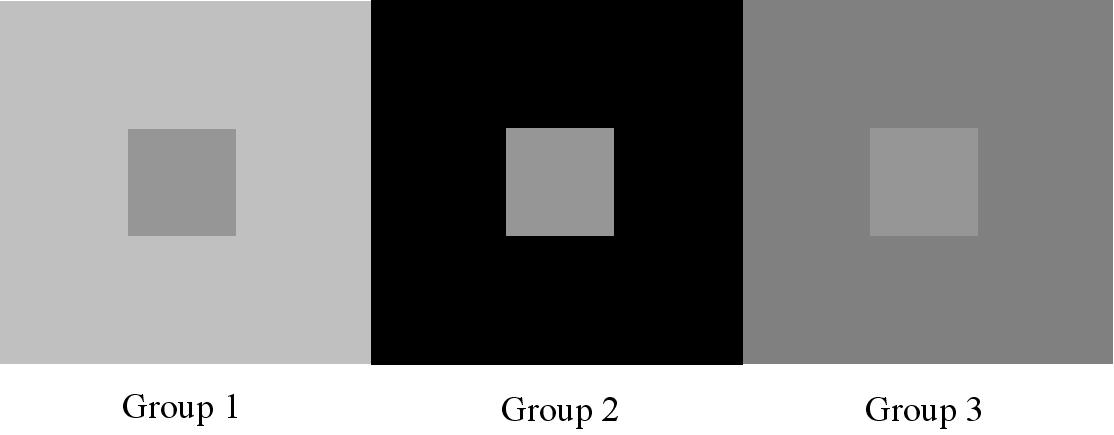
Note: the images in this post are all examples of the contrast effect.

If you liked this post, you might like one of the other posts in this series:

What if We Learned That Objects Aren’t Meant to Be Owned?

Now that I’ve got a little one to look after, I spend a lot of time watching him interact with the world around him. At this point in his life, that means he’s interacting with just about anything he can get his hands on. Sometimes, I wish it were just his toys and then that got me thinking… his toys. What if we taught our young ones that the things they use aren’t actually theirs? What if we taught our young ones that the things they use aren’t meant to be possessed?

Part of these thoughts stem from watching other little ones interact with their toys. They can be quite possessive about what’s theirs and what they’ll allow different people to touch and/or play with. So, I was thinking, what if, from a very early age, we instilled within our young ones a sense that these things that they’re playing with aren’t theirs. Instead, we helped them understand that they were simply using these things.

There are certainly implications for them when they’re young, assuming that this is something that we could teach them. For instance, let’s say that they lose a toy. Instead of having a “melt down” over losing this toy, they just realize that they toy is gone. Since it wasn’t theirs to begin with, there’s no need to ‘mourn’ its loss. A similar thing could play out when our little ones are playing with other little ones. There’s often differing levels of development in play-groups, so some kids may physically take toys from other kids. This could lead to the proverbial “melt down,” but what if the kid who was about to “melt down,” didn’t, and it was because they learned that the toy was never meant to be theirs forever.

As I write this, I realize how difficult this may be to teach to someone at a very, very young age, but that shouldn’t be a reason not to try.

Let’s talk about how this might affect adulthood.

The first thing that comes to mind is the idea of renouncing materialism, which immediately made me think of Hinduism and Sannyasa. Of course, that’s a bit beyond what I had in mind when I was imagining our little ones learning about possessing objects. In fact, I was thinking more about Buddhism and Upādāna, which has to do with the idea of “grasping.” So, I wonder… if we were raised with the idea that objects aren’t meant to be owned/possessed, how different would our lives be? Maybe the whole idea of materialism fades away. Maybe we don’t spend much of our early adulthood (and for some, middle and late adulthood) acquiring things. Maybe we focus more time on enjoying ourselves and less time wishing we had a better car, house, or some other object that we deem desirable.