Life is a Gift — and so is Suffering

lina-trochez-ktPKyUs3Qjs-unsplash.jpgA few weeks ago, there was a rather poignant interview that aired between Stephen Colbert and Anderson Cooper. I didn’t see or read much of the coverage of it, but the thing that kept coming across my feed was the first thirty seconds of the clip below. And, in seeing the views on this video, it looks like a lot of people were touched by the moment:


Here’s the first thirty seconds:

Cooper: You told an interviewer that you have learned to, in your words, ‘love the thing that I most wish had not happened.’ You went on to say, ‘What punishments of God are not gifts?’ Do you really believe that?

Colbert: Yes… it’s a gift to exist and with existence comes suffering. There’s no escaping that.

Lots of folks are keying in on these thirty seconds and, naturally, there’s a lot in there to chew on. Colbert’s sadness is evident and Cooper’s empathy is very apparent as he asks the question, while choking back tears. To my eyes, it’s the 120 seconds that follows.

I don’t have the time to transcribe that bit at the moment, so I’ll just briefly summarize — Colbert talks about how important gratitude is for the things that have happened in your life, whether they are positive or negative. He’s focusing on the negative here because of the question from Cooper. He talks about how he realized the lesson of having gratitude for things that have caused him suffering, rather than learning the lesson. This is important to him and in watching it, you can feel that this is something that he feels deep in his bones. It’s not some intellectual exercise that he’s worked through to come to the conclusion that he must accept the bad with the good — it’s part of him.

With human existence, comes suffering, and Colbert believes that this suffering has allowed him to have deeper relationships with the people in his life who have also suffered. He feels like he can better understand where they’re coming from because he has had this very traumatic experience early on in his life.

The best part is his philosophy on life — wanting to be the most human — not the best human, but the most human. And since suffering is part of the human experience, he welcomes (maybe not welcomes), but he’s grateful for those experiences, too.

Would You Go to the Gym, If It Would Save a Life?

That’s what Jen-Hsien Chiu thinks.

Chiu, a graduate of the Royal College of Art in London, developed Phabit – a “smart pot” that will nurture a plant, depending on whether or not you stick to your habit.

There’s actually some nuance to it. Users of the app complete a personality quiz that puts them into one of four buckets: obliger, questioner, rebel, and upholder. The idea being that the app will challenge each group of people differently.

On its face, it certainly seems like an innovative way to help us form better habits. However, I’m not sure how I feel about the idea of “holding something hostage,” especially another lifeform. I realize that to some, it’s just a plant, but there’s a growing body of evidence substantiating the sentience of plants.

Plant sentience aside (for the moment), let’s look at it purely from a habit forming perspective. Recall from Charles Duhigg’s excellent book, The Power of Habit:

Studies have shown that if you can diagnose your habits, you can change them in whichever way you want.

As I said previously:

That’s really important because this thinking wasn’t always the case. Sometimes, folks will tell you that you need to focus on the cue, while others will say you need to focus on the reward. As Duhigg suggests, you can focus on whichever aspect you want, so long as you’ve diagnosed the habit.

Now returning to Phabit – do you think seeing a wilted plant on your desk would raise your level of awareness, with regard to your shirking your goals? If I had to say, I’m probably going to guess the answer is yes. So, purely from a “science of habits”-perspective, Phabit certainly seems like it’s a great way to get people thinking about their habits.

Let’s revisit the plant sentience aspect.

If we presume that plants are sentient (and the evidence certainly points in that direction), then we must consider the ramifications of literally holding another life hostage to our actions. There are two possible outcomes I want to mention: empathy and PTSD.

Empathy. One might argue that by subjecting one’s self to this could foster a sense of empathy (i.e. I feel bad because *I’m* hurting the plant). One might also argue that the “continued killing of plants” (through not completing one’s daily goals) could potentially promote emotional numbing and maybe begin to strip someone of their empathy.

PTSD. Dovetailing with the point on empathy above, I suppose it’s possible that someone might begin to exhibit symptoms of post-traumatic stress from “killing” a plant (or multiple plants, depending on how things go). I realize that this might sound absurd in the abstract, but if we presume plant sentience, killing a plant would fall on the same continuum as killing another being. Granted, the ramifications to one’s psychological wellbeing might not be as severe as if one were to kill an animal or another human being, but when we invent things, it’s incumbent upon us to consider the possible ramifications from as many sides as possible.

Building Society on a Foundation of Kindness: Parenting Without Borders, Part 9

In the Introduction, we broached the idea that the way other cultures parent might be more “right” than the way that the culture in North America parents, as discussed in the book Parenting Without Borders. In Part 1, we looked at some of the different cultural thoughts around sleep. There was also that stunning example of how it’s normal for babies in Scandinavia to be found taking a nap on the terrace in the dead of winter! In Part 2, we explored “stuff” and how having more of it might not be best for our children. In Part 3, we looked at how different cultures relate to food in the context of parenting. In Part 4, we looked at how saying “good job” to our little ones might not have the effect we think it does. In Part 5, we talked about the virtues of allowing our little ones the space to work through problems on their own. In Part 6, we examined the importance of unstructured “play.” In Part 7 and Part 8, we explored what education is like in East Asia and Finland. In Part 9, we’ll look at cultural notions about rearing our children to be kind.

If you’ve been following this series, no doubt there may have been some things that have made the hairs on the back of your neck stand on end. And if that hasn’t been the case up to this point, it wouldn’t surprise me if this chapter is the one that finally does it.

One of the first anecdotes, while it shouldn’t be, is still a bit shocking [Emphasis Added]: “In 1970, the primary goal stated by most college freshmen was to develop a meaningful life philosophy; in 2005, it was to become comfortably rich.” It’s no wonder that the way we treat each other in today’s society may seem a bit different than the way we treated each other 50 years ago (“-isms” like racism and sexism aside, of course). As a quick aside — how different would society look like today if the goal of 90% of university students was to develop a meaningful life philosophy, rather than to get rich?

Near the beginning of this chapter, Gross-Loh recounts how some of the parents she knows are emphasizing (possibly unintentionally), individuality over community awareness. What does that mean? Well, for example, she retells the story of a mother of a three-year-old rushing to comfort her son after her son had thrown a wooden toy and hit Gross-Loh’s son in the head. The idea behind this is that the other parent was trying to get her son to understand the feelings he felt that precipitated the chucking of the wooden toy at the other kid.

Allowing children to behave as they want to until they feel like acting differently actually makes our kids more miserable and less compassionate. Children who have too few boundaries often flail around for a solid surface to ground them.

Consequently, it’s up to us — as parents — to set these boundaries and more importantly, enforce them. Building on this idea of boundaries…

Believe it or not, research shows that children are born with a sense of kindness, but that’s not enough. If this sense of kindness isn’t fostered and reinforced by parents, it can be “overwritten.” Similarly, research has shown that kids are happier when they’re giving something to someone else than when they receive it. That shouldn’t be too surprising (spending your bonus on your coworker will make you happier than spending it on yourself!). An important aspect of this is incentives. If we reward kids for sharing through incentives, we may unintentionally dissuade them from developing a sense of internalizing the virtue of sharing (thereby dissociating sharing from its innate spontaneity and instead, teaching our children to expect an external reward whenever they share).

Two more things I wanted to highlight from this chapter —

Parents who teach their children to speak with authenticity and honesty but do not simultaneously teach them the art of being considerate send their children the message that it is always better to be honest to your true self even if it means hurting someone.

And finally, a difference in orientation in American and Japanese cultures:

While American mothers often orient their babies to things apart from themselves, such as objects, Japanese mothers more often orient their babies to themselves, encouraging a constant awareness of relationships and the impact of one’s actions on other people.

[…]

In disagreements that warrant adult intervention, kids are asked what they think the other person felt that motivated him.

Can you imagine how different American society would be, if every kid is taught the value and importance of considering the underlying motivations of the actions of their friends and other people?

Understanding is Inherent to Empathy: On Paul Boom and Empathy

I came across an article in The Atlantic recently that expressed the opinion that empathy might be overrated. You’ll note that the way the headline is written: “Empathy: Overrated?” should already tell us that the answer is no (via Betteridge’s law of headlines). While from the outset, I’m already noticing my bias against the idea of empathy being overrated, I did my best to read the piece with an open mind and I’m glad I did because there are a few passages that I think are important to highlight from the “con” side of empathy:

The problem, as Bloom sees it, is that “because of its focusing properties, [empathy] can be innumerate, parochial, bigoted.” People are often more empathetic toward individuals who resemble themselves, a fact that can exacerbate already-existing social inequalities. And empathy can cause people to choose to embrace smaller goods at the expense of greater ones. “It’s because of the zooming effect of empathy that the whole world cares more about a little girl stuck in a well than they do about the possible deaths of millions and millions due to climate change,” Bloom said.

Empathy can also make people do evil. “Atrocities are typically motivated by stories of suffering victims—stories of white women assaulted by blacks, stories of German children attacked by Jewish pedophiles,” Bloom said. It also can lure countries into violent conflicts based on relatively small provocations, and researchers have shown that people who are more empathetic are more likely to want to impose harsh punishments on people. “The more empathy you have, the more violent you are—the more ready and willing you are to cause pain,” Bloom said.

Bloom raises some really good points here, but I don’t know if it’s fair to lay the blame for climate change at the feet of empathy. There’s been an extremely strong misinformation movement that I’d “blame” before I’d blame empathy.

The point about empathy exacerbating social inequalities is also a bit curious to me. While we may be more inclined be to empathetic to people who look like us, that doesn’t preclude us from being empathetic to people who don’t look like us and to that end, wouldn’t being at least marginally more empathetic to people who don’t look like us be better than not being empathetic to them at all (if we’re to look at it from a cold, calculated, and objective standpoint)?

Lastly, and most importantly, I’m worried about this point that the more empathetic you are, the more likely you are to want to impose harsh punishments on people. I looked and looked, but couldn’t find the study that Bloom is referring to in this article in the New Yorker from a few years ago, so I won’t attempt to critique the study’s methodology, but I will say this: isn’t campaigning for less empathy taking us a step back? If we’re looking at the progression of humans, I think it’s probably fair to say that empathy is something that we’ve developed along the way. It’s growth. It’s positive (I mean that it’s an addition to our species, rather than when positive is meant to indicate a judgment). Wouldn’t it be better for us — as a species — to incorporate this new phenomenon of empathy as we continue to grow?

This idea reminds me of Ken Wilber and his work. In particular, the idea that we start with x, move to y, and then find a way to integrate our understanding of x and y to move to a third stage, let’s call it xy. It seems to me that we’ve learned about this thing called empathy (stage x), and now we’re learning about how it can sometimes have a negative effect on us. As a result, there’s this backlash or movement against empathy (stage y). So now, we’ve got to move to place where we can integrate the two (stage xy).

~

Finally, I wanted to talk about one more thing that Bloom said:

At the end of the Aspen session, an audience member posed a scenario to the scientists: What if she was fired from her job, and her partner offered her a back rub and kind words but didn’t truly get why she was upset? Wouldn’t the comfort feel hollow, useless?

“What you’re really asking for is compassion plus understanding,” Bloom replied. “Suppose you feel humiliated. I don’t think it’s what you want or what you need for your partner to feel humiliated. You want your partner to understand your humiliation and respond with love and kindness. I think for your partner to feel humiliated would be the worst thing you want. Because now, you have to worry about your partner’s feelings.”

I like Paul Bloom and I’ve even written about him before, but I wonder if this is a misunderstanding of empathy. Or maybe more accurately, the way that the study defines empathy is different from the way that others may define empathy. The way that I remember empathy is that understanding is a component of empathy. I wrote a post about this a little while back and included a helpful short from the RSA:

Stop Asking: “Are You OK?”

A few weeks ago, I levelled a criticism at parents who attempt to dissuade their children from feeling their feelings in the moment. That is, as soon as they begin to cry, parents usually try to quash the children’s feeling by saying, “You’re OK,” or “You’re fine.” I think that this same attitude carries on when parents (or people) are dealing with older children (or other people) and something happens.

Consider a couple of teenagers who are playing soccer. One of them falls down and ceases playing for a couple of seconds. Almost always, the teenager who hasn’t fallen will immediately say to the other, “Are you OK?” I’m sure we’ve all been the teenager who’s fallen and scraped our knee and I’m sure we’ve all been the teenager who asks our friend if they’re OK, but this is an extension of the problem that begins when we’re toddlers — we’re not allowing the person the space to feel the feelings that they’re feeling.

By quickly jumping in and asking, “Are you OK?” one probably thinks that they’re being a good friend. My friend has just hurt themselves, so I should ask and see if they’re okay. Certainly, that’s the right spirit. However, by jumping in so quickly, it’s actually demonstrating to your friend that you’re uncomfortable with their pain/feelings. Let’s say that your friend starts to cry. Forgot that, let’s say that you have just begun to cry. When you’re crying, do you really want someone to ask how you’re doing? Well, if you’ve been asked that you’re whole life, you probably do, but if you stop and think about it for a second, when you’re crying (or when you’re upset), the best thing for you is space.

I’m not saying you (or your friend) should walk away when you (or your friend) begins to cry, no. Instead, you (or your friend) should sit there with you and allow you the space to feel the feelings — let you cry. After an acceptable amount of time (this varies), then it might be appropriate to break the silence, but if it were me, I’d actually wait until the person who’s crying begins saying something. By simply being there with your friend in their time of need, you’re holding a safe space that allows them to process their emotions/feelings. And if/when you do that, you’ll be giving your friend a gift they probably haven’t had the chance to experience.

Parents: Stop Saying “You’re OK!”

I’ve been a parent for more than a year. There’s so much I could talk about, but today, I want to make a plea to parents (and anyone who interacts with children, for that matter): STOP SAYING YOU’RE OKAY or YOU’RE FINE!

Now that the weather’s turned, most of the parents and little ones that have been inside protecting against the harsh winter (at least in Ottawa, that is), are out and about at playgrounds and parks. Naturally, as there are more ‘dangerous’ new things for children to interact with, they’re bound to hurt themselves in some way. When little Jonny bangs his head on the stairs of the play structure — before he starts to cry — mom (it’s usually mom, but when dad is on Jonny-duty, dad does it, too), will say “You’re ok, you’re fine,” in what’s meant to pacify little Jonny. Mom thinks that she’s helping Jonny by telling him that he’s okay, but what she doesn’t realize is she’s stunting Jonny’s growth.

Let’s go back to the moment that Jonny bumps his head. If mom doesn’t say anything, maybe Jonny doesn’t even notice that he’s hurt himself (that is, maybe he didn’t hurt himself enough that he noticed — do you cry every time you bang a limb on a doorway, cabinet, or wall?) and Jonny continues on playing. Or maybe Jonny does start to cry because he’s hurt himself. Is that a problem? Do you expect little Jonny to go through his entire life without hurting himself? That is, do you really think that you thwarting his moment of pain by interrupting him and telling him he’s okay is really helping? Let me tell you — it’s not. It’s actually harmful. By intervening, mom is unintentionally telling Jonny that it’s not okay to feel pain. Mom is telling Jonny that feeling pain is bad.

When Jonny hurts himself and he’s upset — he’s upset. Let him be upset. Allow him the space to be upset that he’s hurt himself and experiencing pain. He’s allowed to feel pain. Most times, Jonny will cry for mere seconds and then he’s right back to running around the playground as if nothing happened. If mom intervenes and tells him, “You’re OK,” mom is signifying to Jonny that this ‘event’ of hurting one’s self is important and needs more attention. It doesn’t.

When Jonny hurts himself on the playground and mom intervenes telling him that he’s okay, what’s really going on? Mom is uncomfortable and when she’s telling Jonny, “You’re OK,” she’s actually saying that to comfort herself.

So, the next time Jonny hurts himself on the playground, I’d encourage parents (or caregivers) out there to, before you tell him that he’s okay, think about why it is that you’re telling Jonny he’s okay. Is it for him or is it for you?

What Do You Want to Hear First: Good News or Bad News?

As it turns out, our answer to this question is different depending on whether we’re the one delivering the news or we’re the one receiving the news. If we’re delivering the news, we’re more likely to want to lead with the good news and if we’re receiving the news, we’re more likely to want to hear the bad news before the good news. Research published in last month’s Personality and Social Psychology Bulletin indicates that the order the news is delivered has implications for both the deliverer and the recipient.

The deliverer, wanting to avoid the ‘pain’ of delivering bad news and acting on egocentric biases, prefers to lead with the good news. The receiver, wanting to allay their anxiety about the bad news, much prefer to receive it before the good news. There’s certainly a disconnect here between the giver and the receiver. The giver, wanting to delay the painful experience of delivering bad news, prefers to save it for the end of the conversation. Conversely, the receiver would rather get the bad news out of the way from the outset.

The researchers found that if deliverers were to take the perspective of news-recipients, they’d be more inclined to lead with the bad news. While not specifically labelled as such, in testing this hypothesis, the researchers have found another positive to empathy. If the deliverers were to empathize with the the news-recipients, that is, pretend as if they were the ones receiving the news, they’d much rather hear the bad news first.

As it happens, hearing the bad news first might not be what’s best for the recipient.

If there is behaviour that needs to be changed, hearing the good news after the bad news might leave the recipient on their preferred high note, but also might diminish any motivation they might have had to act on the bad news. In Study 3:

News-recipients who received bad news first were less likely to take an easy opportunity to improve, choosing instead to engage in a boring and personally unproductive task (i.e., stapling papers for the researcher).

While deliverers of bad news might be acting out of their own self-interest when they prefer to deliver the good news first, they might actually be doing what’s in the best interest of the receiver. So, what order should you deliver the news? Well, that seems to depend on whether you want to motivate the receiver to act on the bad news.

One other implication of the good then bad sequence is that sometimes people like to tack on another piece of good news after the bad news to soften the impact. This is often referred to as a sandwich. While this may make the deliverer feel better, it tends to quash the motivational effect of ending with the bad news.

ResearchBlogging.orgLegg, A. M., & Sweeny, K. (2014). Do You Want the Good News or the Bad News First? The Nature and Consequences of News Order Preferences Personality and Social Psychology Bulletin, 40 (3), 279-288 DOI: 10.1177/0146167213509113

What’s the Difference Between Empathy and Sympathy?

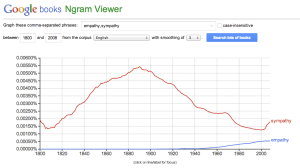
Screen Shot 2014-01-23 at 12.48.00 PMWhen you search for empathy on Google, you get almost 10,000,000 results. When you search for sympathy on Google, you get almost 25,000,000 results. I bet if we could look at historical search results in Google, I bet that we’d see a big trend where the number of search results for empathy has been increasing. The closest thing we can do to this is a search of all the books that contain the word empathy (at least the ones that have been digitized by Google). How? Using Google’s Ngram Viewer.

The chart above shows the mentions of empathy and sympathy starting in 1800 and ending in 2008. As we can see, empathy was hardly mentioned at all when compared to sympathy until the 1920s. That makes me wonder if there might have been some writings about empathy around the time of the Great Depression. What’s noteworthy though, is the steady increase in mentions of empathy. Granted, it’s still in only a fraction (0.0005%) of books, but it’s still progress.

Sympathy, on the other hand, we can see has steadily declined since the early 1900s. However, there’s been a small blip in sympathy since the mid-2000s. I would guess that this may have to do with the title question of this post: the difference between sympathy and empathy.

There’ve probably been several books written about the differences between empathy and sympathy in the last 5 or 10 years. So, do you know the difference between the two? I have to admit, even as an undergraduate in psychology, I’d often find myself googling the difference between the two terms. About a month ago, I came across a great video from the RSA that quickly explains the difference between empathy and sympathy. Of course, there’s a slight bias towards empathy in the video, but I think you’ll agree — empathetic is far better than sympathetic.

In case you’re inspired to be a champion of empathy or want some more information about programs that are helping to increase the level of empathy, I’d suggest checking out Ashoka: Empathy.

And if you want a bit more information about how empathy has shaped our society and continues to shape it, then I highly recommend checking out the RSA Animate video of Jeremy Rifkin’s book, The Empathic Civilization:

Struggle Does Not Mean Bad: Choices and Illusions, Part 3

In Part 1, we took a closer look at the first 6 chapters of Eldon Taylor’s book, Choices and Illusions. There were some great stories about how our thoughts can have an effect on us, even when we don’t think they do. In Part 2, we looked at chapters 7 through 12. In particular, we looked at an important story that emphasized the importance of ‘wait and see’ as a viable option when deciding a course of action. In today’s post, we’ll look at the last 6 chapters of the book.

~

Chapter 13 reminds us that we may have limiting belief systems preventing us from achieving what we ‘want.’ For instance, if you want to be successful or prosperous, do you think you’ll get there if you have a belief that people who are prosperous or successful are evil (and you don’t want to be evil)? Taylor also reminds us that we shouldn’t hate our work and discusses the importance of empathy.

In chapter 14, Taylor reassures us that having limiting beliefs doesn’t make you a bad person. In fact, it’s actually quite normal. He goes on to talk about the importance of looking within one’s self to find those limiting beliefs that may no longer be serving you. For instance, when you were younger, you may have developed the belief that speaking in front of people is really scary or that it may cause you harm. If you now work as an analyst for a big company, there’s a good chance that you may have to speak in front of people at some point. As a result, it would probably do you good to have brought this limiting belief to light and then replaced it.

Like with yesterday’s post, there’s a great story from Chapter 16 that I think you’ll enjoy. In fact, it reminds me of the best piece of advice (We’ll See…):

There once was a scientist who beheld the glory of an emperor moth and was so totally taken by the creature that he decided to study it. For more than a year he monitored the activities of the giant moth.

One day he came upon a caterpillar ready to spin its cocoon. He gently captured the caterpillar and took it back to his lab. He watched the caterpillar build its cocoon within a glass container and enter that state of deep sleep. While in the chrysalis it changed its form, from crawling on the ground to floating in the sky.

The day came when the moth was ready to leave the cocoon. The scientist watched anxiously as the tiny head chewed its way into the light of the laboratory. The moth struggled and struggled, seemingly getting nowhere. Its body was simply too large to fit through the tiny hole in the cocoon. The moth tired and laid its head to rest on the shell of the cocoon. The scientist took it upon himself to help the tiny creature. “How could I stand here for so many hours watching this beautiful moth go through such agony and pain?” he questioned. “Where is my mercy?” he continued as he took his tweezers and scissors to cut away the cocoon. The moth fell from the cocoon badly deformed, and soon died.

Later the scientist discovered that it was precisely the cocoon-escaping struggle that pressured the fluids down into the body of the emperor moth and gave it its aerodynamic ability. The cocoon forced the fluids into the body, perfectly proportioning the moth as it pushed its way out. Cutting away the cocoon in an effort to help had only killed the moth.

You may be familiar with a similar story about butterflies and moths, but this is an important story with regard to being okay with things that you may otherwise not be. For instance, some folks couldn’t stand to watch the moth struggle in this case, but if they were to interfere, they’d actually be disrupting the process by which the moth needs to undergo to become a butterfly. This raises all kinds of possible ethical dilemmas when we consider intervening within certain environments or the animal kingdom. To be clear, I’m not necessarily advocating no intervention, but I think it’s important to remember stories like this when we are considering intervening. As Taylor says, “Struggle does not mean bad.”

There’s another great story in Chapter 18 highlighting the possibility that judging could be viewed as a sickness. I’ll let you read that one on your own, though.

(Disclosure: I was given a free copy of the book.)

~

If you liked this paper/series, you might want to check out some of the other papers/series I’ve posted.

The Most Effective Form of Discipline: Punishment or Empathy?

Have you ever broken the rules? If you’re answering honestly, no doubt, your answer should almost certainly be yes. If you drive, you’ve probably rolled a stop sign once or twice in your life. Or, you’ve probably at least barely gone over the speed limit, even if you were trying to maintain a speed below the limit. There’s always jaywalking. That is, you’ve probably crossed the street when you weren’t in the crosswalk when the walk sign was on the cross. What about taking office supplies from work? You may feel justified in doing so, but I bet if you read your contract or the rules/regulations of your organization, it’s not something that’s endorsed. There are probably plenty of other examples where you’ve broken a rule (accidentally or intentionally!), but there may only be a few (one?) where you’ve had an experience that changed your life.

I don’t necessarily mean that it changed your life in some profound way (although it may have). I’m speaking more towards those experiences that you’ll always remember. The lesson(s) you learned from the experience(s) was/were just what you needed at the time. Do you have one of those experiences? Now that you’re thinking of that experience, I wonder: did you receive a punishment for breaking the rules or did you get off with a warning?

I’d hazard a guess that if I polled those of you reading this article, the majority of you would say that the experience where you were left off with a warning was the one that stuck with you. And why is this? Empathy. Compassion. Kindness.

These are human expressions that tend to touch us in ways that the antithesis of these expressions don’t. It’s a tired sentiment, but the news is filled with negativity. As a result, experiences that show us the opposite of this negativity tend to shock us. This surprise tends to stick with us and the experience can teach us something we weren’t expecting.

I’d like to share an example that I think accentuates my point. I came across an answer on Quora to a question asking about people’s best experiences with police. This particular answerer, Andrew Bosworth, was 16 years old and on his way home from Sacramento to the Bay Area. He was really tired and knew he was driving somewhat erratically. He’d glance down at the odometer and he’d be just as likely to be going 20 mph over the speed limit as he would be going 20 mph under the speed limit. Eventually, he was pulled over by the California Highway Patrol:

Instead of giving me a ticket, he pointed down the offramp to a place I could get some coffee and rest. He asked if I had enough money to get some coffee and offered to give me some if I didn’t. He said if I really couldn’t get back to an alert state that I should call a friend or my parents and get a ride because what I was doing wasn’t safe for myself or other drivers.

Honestly, I can’t imagine that getting a ticket would have had nearly as big an impact on my driving as the short, compassionate conversation that officer had with me that night.

While there are certainly times where some form of punishment may be more appropriate, I’d like to believe that in many cases, compassion and empathy can be just as, if not more, effective.