How Do We Free Magneto From the Pentagon: A Lesson in Functional Fixedness

I don’t know if you’ve had the chance to see the new X-Men movie — I rather liked it. There was a scene in the movie that presents a wonderful example of functional fixedness, depending upon your familiarity with the story. Before moving on, I should remind you of the meaning of functional fixedness. Essentially, it’s the idea that, sometimes, we might have a hard time seeing the potential utility of an object. For example, if you need to push nail back into a piece of wood, but you don’t have a hammer around, it might take you more than a few minutes to think of using your shoe. The functional fixedness lies in one’s lack of ability to see the shoe as a potential hammer-like object. The ‘function’ of the shoe is ‘fixed’ on being a shoe.

Alright, now that we’ve reviewed functional fixedness, let’s look at the example from the recent X-Men movie, Days of Future Past. Before continuing, I should say…

(minor spoiler alert)

Near the beginning of the movie, a couple of the X-Men are trying to free another X-Men from a holding cell in the basement of the Pentagon. As the person being held in this cell is Magneto and has the ability to create/control magnetic fields, jailing him with metal is a bad idea. So, he’s being held in a glass encasing. The X-Men trying to free Magneto make it into the basement of the Pentagon and the one person who is meant to free Magneto from the cell is Quicksilver. Earlier scenes from this movie show us that he has the ability to move extremely fast. In fact, he moves so fast that his ability could be mistaken for teleportation.

With Quicksilver standing on top of the glass enclosure, those who weren’t familiar with the X-Men comics may have wondered just how this person with ‘superhuman speed’ was going to free Magneto. This is our example of functional fixedness.

If, when you were watching this scene, you thought to yourself, “Quicksilver won’t be able to free Magneto with his superpower because he can just move quickly, and there’s no door for him to get in,” you’d be locked in functional fixedness.

A few moments later, the answer is revealed: Quicksilver has superhuman speed, so he can use his power to shatter the glass and Magneto is freed.

Note: I didn’t mention this initially, but Quicksilver is able to break the glass because he is able to move his hands so quickly such that he can create a resonance that breaks the glass. For real-life example of this in action, watch this wine glass.

Why Women are Better CEOs, Presidents, and Prime Ministers

New research shows that women are far better at handling stress than men. I suppose that’s not a newsflash as most people already think that’s true, but consider the way in which this study frames it [Emphasis added]:

We consistently found the same general response pattern: while stressed women showed higher self-other distinction than women in the non-stressful control condition, men showed the converse pattern. More specifically, stressed women showed reduced emotional egocentricity bias, enabling them to judge the emotions of the other person in a way that was less influenced by their own emotional state. Moreover, their response times in the cognitive perspective-taking task decreased under stress, documenting that they were able to regulate the mismatch between their own and the “director’s” perspective faster under stress. Finally, stressed women showed a reduction of automatic imitative tendencies in the imitation-inhibition task, indicating that they were able to overcome low-level social signals interfering with their own movement intentions. Note that the latter finding is crucial. It highlights that women did not simply show an increase in other-related responses under stress – as this would have resulted in increased interference from automatic imitation. Instead, they were able to flexibly increase either self- or other-related representations, depending on the task demands which either required overcoming egocentric biases, or overcoming social interference.

As the stereotype goes, women are more “emotional” than men, so it would be much better for an organization or unit if it were managed by a man. However, this research is telling us that, when under stress, it is men who are less able to distinguish their emotional state from the intentions of those around them. It is men who are more adversely affected by stress. For women, it’s the opposite. In fact, women tend to be more prosocial [behaviour intended to benefit others] when they’re stressed. Meaning, instead of retreating inward, women are actually more helpful when they’re stressed.

This research certainly makes one think about the way that many organizations and countries are run today. Most people would agree that being a CEO, President, or Prime Minister certainly comes with oodles of stress. Unfortunately, the number of women who hold these positions is far outweighed by their male counterparts. Of course, there are a number of reasons for that, which we won’t get into in this post, but consider for a moment if the numbers were flipped. That is, what if there were more women CEOs (or high-powered leaders)? Or, what even if it was 50/50! What if the number of high-powered leaders and CEOs was 50% women and 50% men? At that point, would it be easier for folks to see, understand, and digest that women are actually better leaders and better at handling the stress?

Maybe it’s the language we use.

A quick Google search showed mixed results for “women are better CEOs.” In fact, many of the results near the top indicated that women CEOs are more likely to be fired. However, when I keyed in “women are better leaders,” I got plenty of positive results. Posts on Harvard Business Review, Business Insider, and articles talking about academic research in newspapers like The Globe and Mail.

If there’s one thing I’ve learned about the world during my time in it, it’s that change (usually) happens gradually. Rarely is there a massive cultural shift overnight. So, here’s hoping that research like this contributes to the realization for some that when it comes to managers and leadership, women just might have an edge over men.

ResearchBlogging.orgTomova L, von Dawans B, Heinrichs M, Silani G, & Lamm C (2014). Is stress affecting our ability to tune into others? Evidence for gender differences in the effects of stress on self-other distinction. Psychoneuroendocrinology, 43, 95-104 PMID: 24703175

What I’ve Learned as a Fan That I Wish I Knew as a Player

In my youth, I played quite a bit of baseball. Well, actually, I played a number of sports, but baseball was the one I was involved with the most. Baseball is one of those sports where there is some level of subjectivity. For example, when the umpire calls a pitch a strike when you think it’s a ball. Or, when you’re sliding into second and you think you touch the base before the fielder tags you with his glove. Of course, with instant replay now instituted in professional baseball, some of these calls are more likely to be ‘right.’

Switching gears for a moment: this past weekend, the Brooklyn Nets beat the Toronto Raptors — by one point — to advance to the second round of the NBA playoffs. The Raptors trailed for most of the game and by double-digits deep into the 4th quarter. However, they made it really close at the end and, in fact, had a chance to win the game with less than seven seconds in the 4th quarter. The reason I’m bringing up this game and this series is because there were quite a few controversial calls by the officials. And that article only mentions the calls made in the last game.

When I was younger (and playing competitively), I would have stewed for hours after the game because of what I perceived as a “bad call.” I would have blamed the umpires for the part they played in my team “losing” the game. Even as a fan when I was younger, I would blame the officials of whatever sport I was watching for the poor calls that negatively affected the team I was cheering for.

After watching the series between the Nets and the Raptors, there were certainly times when I disagreed with the way the referees saw a play (and on many occasions, so did the announcers). Even still, as any good athlete will tell you, they’ve got to play well enough that a call by an official doesn’t mean a win or a loss. That doesn’t mean that a call from an official won’t disappoint you, but you’ve got to put it out of your mind and move onto the next play. I’m not implying that some of the poor calls affected the Raptors (or the Nets), but I’d be surprised if they didn’t even just a little.

With that being said, as a “fan,” it’s so much more enjoyable to watch a game and not stew about a bad call long after it’s over.

An Alternative to Coffee During the Afternoon Lull — Meditation

No doubt you’ve come across articles that explain that we have a tendency to fall into an afternoon lull. There have also been a number of article that offer a solution to beating this afternoon lull. However, I’ve yet to see any of these articles offer what could be the best use of that time, yet — meditation.

The benefits of meditation are endless not the least of which is mitigating the effect of cognitive biases. So, instead of reaching for another cup of coffee, why not try doing a quick 2-, 3-, 5-, or 10-minute meditation when that afternoon lull comes along. In fact, to up the stakes, I’d be interested to see some research on this. My bet is that meditation would be more effective (and sustainable) than coffee in picking you up. Of course, researching this might prove a bit difficult, but I think it’s doable. Let’s break it down.

I’d want to see three groups: meditation, coffee, and control. Of course, we’d need to have a representative sample, controlling for people who already have a proclivity towards meditation and/or coffee. If at all possible, it’d be great to have two meditation groups, actually: one that already regularly meditates and one that doesn’t.

Initially, I hypothesized that meditation would be more effective. We’d need to determine how we were going to measure effectiveness. I suppose one could consider the remaining hours at work, as the pick-me-up during the afternoon lull is likely a way to get one to the end of the day. In that sense, we’d also want to control for the amount of hours that people continued to work after the meditation/coffee break. At a minimum, it’s something we’d need to measure to maintain internal validity.

I also hypothesized that meditation would be a more sustainable solution to the afternoon lull. Again, how are we going to measure this. My thinking would be including some sort of fatigue/health factor in the study. I suspect that those inclined to have a cup of coffee as an afternoon pick-me-up are probably already drinking coffee to start their day and as a result, might just be taxing their system by having that extra hit of caffeine in the afternoon. Conversely, plenty of research has been conducted on the health benefits of meditation. So, not only would some folks be eliminating the overtaxing nature of a second dose of caffeine, they’d also be reaping the benefits of meditation.

Labor is the Superior of Capital, and Deserves Much the Higher Consideration

Do you recognize those words? Scholars (and/or) American history buffs just might. They were spoken by one Abraham Lincoln on December 3rd, 1861, as part of his first State of the Union address. The quote comes from very near to the end of the speech; the beginning of the third last paragraph. The sentence on its own is worth pondering, but let’s put it in context:

Now there is no such relation between capital and labor as assumed, nor is there any such thing as a free man being fixed for life in the condition of a hired laborer. Both these assumptions are false, and all inferences from them are groundless.

Labor is prior to and independent of capital. Capital is only the fruit of labor, and could never have existed if labor had not first existed. Labor is the superior of capital, and deserves much the higher consideration. Capital has its rights, which are as worthy of protection as any other rights. Nor is it denied that there is, and probably always will be, a relation between labor and capital producing mutual benefits. The error is in assuming that the whole labor of community exists within that relation. A few men own capital, and that few avoid labor themselves, and with their capital hire or buy another few to labor for them.

As is clear, Lincoln is referring to what was a major problem at the time — slavery. While those words were initially spoken with regard to slavery, I think that they have a broader application. That is, labor really is the superior of capital and not just in the context of slavery. Without labor, there’d be no capital. Labor is the backbone of any economy — local or global. As a result, it’s frustrating to see how poorly mismanaged the workforce can be.

From a business standpoint, I can understand why managers would want to crimp on labor, both in the number of employees and their However, I see this as extremely short-sighted. Whatever short-term gains are made from this strategy, they’re lost in the longer term when one has to replace the employee because they’ve either quit or because they’re overworked (and needed time off because of stress and/or fatigue).

I wonder if treating labor as if it’s another “expense” or “liability” is endemic to the culture of work in America. If we revisit the chart about vacation from this past summer, we see that just about every country on that list is in Europe and from what we know about the culture of many European countries, there’s an air of slowness that you just don’t find in America. Maybe it’s that European businesses have already learned this lesson of treating the workforce like an expense and realizing that it’s just easier to pay up front. How different would business look like in the US if the workweek went from 40 to 30 and the number of mandatory paid vacation days went from 0 to 20? Even if the US workweek went from 40 to 37.5 as is the case in Canada, how different would things be, then?

This focus on the short-term seems to be in more places than one. It’s even present in the way public companies are structured — they have to report their earnings every quarter. That is, every 90 days — 90! — a company gives a report to their shareholders (and the public) about their earnings. Predominantly, people are looking to see whether a company “beat” estimates. If (when?) a company doesn’t meet estimates, the stock price usually takes a tumble. But what if this incessant push to meet estimates and focus on these 90-day windows doesn’t allow for an appropriate longer term strategy? What if this 90-day crunch is preventing a company from pursuing a strategy that would make it far more sustainable in the long run and if they attempted to pursue that strategy, their stock price would plummet?

I don’t have all the answers to these questions, but I believe the beginning of the answer starts with labor. Companies that honor and respect their workforce tend to perform better.

If We Want to Change the World, We’ve Got to be Better Parents

Note: I’ve been away from writing here for the past 6 weeks or so. My writing will continue to be less frequent than it used to be, but my plan is to at least write something once a week. Hopefully, it can be more frequent than that, but we’ll see how things go. I chose this post’s topic to return to writing because, as fate would have it, I’ve recently become a dad!

As some of you know, I like to use my favourites on twitter to accumulate things I want to write about or read. As I haven’t been writing very much in the last little while, the list of my favourites that I want to write about has grown — quite a bit. There were two tweets that I’d been saving to write about because I knew that it would fit perfectly with my return to writing. Both were about parental leave.

As you can see from the map above, the United States is the only western country that doesn’t have paid maternal leave. Of course, you’ll find that many companies offer paid maternal leave for people in the US as a way to stay “competitive,” but this isn’t something that’s required by law. This is a travesty. Unequivocally. Nothing is more important for a child’s growth than having their mother near in the early stages of life. Nutrition is tantamount to the survival of the child, but so is tender loving care.

Europe, in particular some of the Nordic countries, really understand this:

Swedish parents now receive a total of 480 days of leave per child, 390 days of which is paid at 80 per cent of salary (up to a maximum of $162 a day).

Quite frankly, the necessity for maternal leave is so obvious that one shouldn’t even need to argue for it. Instead, the debate should be about how long maternity leave should be.

While the US continues to shirk its responsibility to mothers, there’s an interesting argument that offering (more) paternity leave would help to close the gender gap. It’s certainly a compelling argument and the study in Quebec lends credence to the idea, but I think this is another one of those “no-brainer” kind of policies. Of course there should be paternity leave. Of course fathers should be there for their young infants and the new mothers. There is so much work required in the early stages of an infant’s life that I can’t imagine a mother trying to do this all by herself. And as history would tell us, they’re not meant to.

Only recently has our society shifted in a way that it’s become the “norm” for mothers to stay at home by themselves and tend to the children. As a new father, I’m embarrassed by this. If we want to do right by our families, our countries, our societies, and the world, we’ve got to take more time to spend shaping our young ones who will inherit the world.

Meditation Mitigates Effects of Cognitive Biases

There have been thousands of scholarly articles written about the myriad benefits of meditation, but the one I came across recently was one of the first that confirmed one of my previously held beliefs: meditation helps you make better decisions.

The thing that struck me most about this study were the similarities to an experiment I conducted (on intuition and decision-making) as a research assistant. I had a condition where students would meditate for a short time and then use their intuition to make decisions. The results weren’t as I, (the research assistant I was working nor the professor), had hoped. I wrote it off as the the reluctance of undergraduates to meditate, but in this study, in particular, studies 2a and 2b, the researchers used undergraduates (approximately 200 combined) and they meditated!

In the second study, the researchers had the undergraduates listen to a 15-minute audio track, which was was specifically designed for this study. In one condition, students listened to a mindfulness meditation created by a professional mindfulness-meditation instructor and in the other, the students listened to a track, again, by a professional mindfulness-meditation instructor, that continuously instructed students to think about whatever came to mind. This second condition was called the “mind-wandering” condition and previous research used a similar method as a control for mindfulness experiments.

As I already mentioned in the opening paragraph, the researchers found that increasing mindfulness (i.e. meditation) reduced the effects of cognitive biases (i.e. the sunk cost fallacy). My favourite part of this study [Emphasis added]:

It is particularly notable in this set of studies that increased resistance to the sunk-cost bias occurred after only a brief recorded mindfulness-meditation induction. Many prior mindfulness-meditation interventions have involved 8 weeks of face-to-face training (Brown & Ryan, 2003); by comparison, our 15-min recorded manipulation is substantially more practical.

Many people have gotten it into their heads that the positive effects of meditation takes weeks to manifest. Here is tangible proof that — today — meditation can help you make better decisions. Also:

We also encourage research investigating how mindfulness practice might improve other decision-making processes and outcomes.

Absolutely! I would suspect that meditation would help guard against a whole host of other cognitive biases, but it would be fantastic if there were scientific evidence to back this up. For instance, years ago when I was the president of the student body, I once tried to begin a general assembly meeting with a quick 1-minute meditation, but the maturity level just wasn’t there. Even after 10 seconds, some of the representatives couldn’t handle the silence. I take the blame for that as I probably didn’t do the method justice by properly introducing it with the research. Can you imagine, if, before every semi-major decision, you took 10, 5, 2, or even 1 minute just to sit still and clear your mind of the previous discussion. I wonder how much lost revenue there is from not taking a moment to pause and reflect before a decision is made.

I should say, I’m sure that there is certainly time between major decisions (i.e. mergers & acquisitions, although, there is fascinating research on how big of a failure those can be), but I’m thinking about the mid-level manager who makes many decisions in a day that can affect the bottomline of a company. The managers that make quick decisions about whether to go with this contract or that contract, whether to make this purchase or that purchase. Maybe that’s a good place to start with more research.

ResearchBlogging.orgA. C. Hafenbrack, Z. Kinias, & S. G. Barsade (2013). Debiasing the Mind Through Meditation: Mindfulness and the Sunk-Cost Bias Psychological Science DOI: 10.1177/0956797613503853

Why Poor People Have Harsher Moral Judgments

Morals is certainly one of my interests, as is evidenced by my series on Michael Sandel’s bookWhat Money Can[‘t] Buy. And so, when I came across a journal article called, “A Lack of Material Resources Causes Harsher Moral Judgments,” I was intrigued, if not a bit saddened.

The researchers attempted to test the idea of whether a lack of material resources would cause people to have harsher moral judgments. The reason they posited this was because a lack of material resources is correlated with a lower ability to cope with other people’s harsh behaviour. Not only were they able to prove that a relationship exists between a lack of material resources and harsher moral judgments, but they were also able to prove this true in state dependent instances. Meaning, yes, a lack of material resources corresponded to making harsher judgments, but even when participants perceived themselves as having a lack of material resources, they offered harsher moral judgments.

The implications of this research seem rather important.

While it’s not specifically addressed in the study, I wonder what the plotted relationship between harsher moral judgments and income would look like. That is, I wonder at what point does income no longer correlate with harsher moral judgments. In particular, I wonder about the whole idea that there are 24 times as many millionaires in the US Congress than there are in the US population. As a result, I’d expect that moral judgments would be less harsh (than if there were fewer millionaires), but we know that doesn’t quite make sense because there are more things than just income that affect moral judgments.

More recently, however, I wonder about the World Economic Forum and the data released that less than 100 people have as much wealth as over 50% of the world’s population. By the information gleaned from the study, we’d expect that over half of the world’s population would have harsh moral judgments.

On a smaller scale, I’d wonder about the psychological health of people who have harsher moral judgments. It may seem only tangentially related, but negative thinking has been shown to have negative effects on one’s health. As  result, I’d expect that these harsher moral judgments might have an effect on one’s health.

ResearchBlogging.orgM. Pitesa, & S. Thau (2014). A Lack of Material Resources Causes Harsher Moral Judgments Psychological Science DOI: 10.1177/0956797613514092

What’s the Difference Between Empathy and Sympathy?

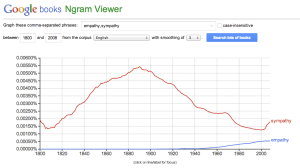
Screen Shot 2014-01-23 at 12.48.00 PMWhen you search for empathy on Google, you get almost 10,000,000 results. When you search for sympathy on Google, you get almost 25,000,000 results. I bet if we could look at historical search results in Google, I bet that we’d see a big trend where the number of search results for empathy has been increasing. The closest thing we can do to this is a search of all the books that contain the word empathy (at least the ones that have been digitized by Google). How? Using Google’s Ngram Viewer.

The chart above shows the mentions of empathy and sympathy starting in 1800 and ending in 2008. As we can see, empathy was hardly mentioned at all when compared to sympathy until the 1920s. That makes me wonder if there might have been some writings about empathy around the time of the Great Depression. What’s noteworthy though, is the steady increase in mentions of empathy. Granted, it’s still in only a fraction (0.0005%) of books, but it’s still progress.

Sympathy, on the other hand, we can see has steadily declined since the early 1900s. However, there’s been a small blip in sympathy since the mid-2000s. I would guess that this may have to do with the title question of this post: the difference between sympathy and empathy.

There’ve probably been several books written about the differences between empathy and sympathy in the last 5 or 10 years. So, do you know the difference between the two? I have to admit, even as an undergraduate in psychology, I’d often find myself googling the difference between the two terms. About a month ago, I came across a great video from the RSA that quickly explains the difference between empathy and sympathy. Of course, there’s a slight bias towards empathy in the video, but I think you’ll agree — empathetic is far better than sympathetic.

In case you’re inspired to be a champion of empathy or want some more information about programs that are helping to increase the level of empathy, I’d suggest checking out Ashoka: Empathy.

And if you want a bit more information about how empathy has shaped our society and continues to shape it, then I highly recommend checking out the RSA Animate video of Jeremy Rifkin’s book, The Empathic Civilization:

Coping Strategies Used by Teens When Criticized by Their Peers for Their Brand Choice

Remember back in high school, middle school, or elementary school when you were worried to go to school because your jeans weren’t Levis, or Jordache, or Lucky, or whatever name brand was popular when you were an adolescent? A couple of researchers from Paris decided that they were going to take a closer look at this phenomenon. That is, how we coped (or cope) with being criticized for not wearing the ‘right’ clothes.

Their results revealed that we have five main coping strategies for these situations: justification, revenge, denial, self-reproach, and making the criticizers feel guilty. Can you remember how you reacted (or might have reacted) if you were in one of these situations? Personally, I have a hard time remembering what I might have said (or did say), so let’s take a look at some of the responses.

In justification:

I tell them why I bought this particular brand.

I justify my choice, explaining why I picked this brand, the circumstances of my purchase, etc.

I explain what are the reasons that pushed me to make this brand choice in particular.

In revenge:

I no longer bother to criticize their clothes.

I try to get my own back by criticizing their clothes.

From now on I’ll carefully take note of how they look and won’t hold back from criticizing it.

In denial:

I act as if I hadn’t heard what they said.

I act is if nothing’s been said. [sic]

I imagine that they haven’t said anything and that’s enough to fix the problem.

In self-reproach:

I bear a grudge against myself: why did I choose this jeans’ brand? It’s rubbish!

I think that I wouldn’t have to buy an unknown brand for my friends.

In making the criticizers feel guilty:

I tell them it’s not cool to criticize people about their appearance.

I tell them it’s not very nice for one’s friends to make comments like that.

After reading the responses under the five strategies, do you think adolescents would be more inclined to use one strategy over the other? What about in girls vs. boys? It turns, that’s the case.

The researchers found that the emotion-centered coping strategies (denial and self-reproach) were the strategies that were mostly influenced by “perceived controllability,” which is, “evaluation of the capacity people believe they have to do or not do something when confronted with a situation.” This runs opposite to previous theories, with regard to coping and so the researchers advocated caution when examining coping strategies from the perspective of major dimensions and that more care should be taken to include context.

One last piece that I found interesting were the differences between boys and girls. That is, the researchers found that girls, more than boys, were more likely to make the criticizers feel guilty. This made me wonder about this whole idea of girls developing emotionally before boys and that girls are more empathetic. I wonder if we looked at boys when they reached the same “level of maturity,” would they begin using this last coping strategy more than the others?

More than this, though, I wonder about the cultural effects on coping strategies. I continuously refer back to the documentary Miss Representation and its soon-to-be released brother, The Mask You Live In. The perspectives presented in those documentaries highlight the importance of culture and media on our youth, too. Maybe our adolescents wouldn’t have to develop coping strategies for combatting criticism about their clothing, if kids didn’t even think it was “cool” to criticize someone for the clothes they wear.

ResearchBlogging.orgSarah Benmoyal-Bouzaglo, & Denis Guiot (2013). The coping strategies used by teenagers criticized by their peers for their brand choice Recherche et Applications en Marketing DOI: 10.1177/2051570713487478