A Quick Note on the Argument FOR Guns in Schools…

Since the events of last Friday, there have been a number of arguments put forth to curb the incidence of mass shootings. Some folks seem to think that lowering the number of guns in circulation will lower the number of gun deaths. A logical inference. Other folks think that raising the number of guns in circulation will lower the number of gun deaths.

In fact, some folks argue — specifically — that if the teachers were armed, they would have been able to prevent what happened in Newtown. There’s already been a great deal written in contrary to this belief, so I won’t address it. There is one thing I do want to address: more guns in schools.

I couldn’t find the exact statistics, but there are *x* number of gun deaths in America as a result of gun accidents. That is, the guns weren’t properly stored and then kids find them, play with them, and tragedy ensues. My point: if we can’t eliminate accidental gun deaths in the home, do we really think that there wouldn’t be accidental gun deaths in schools? And, couldn’t these gun deaths in schools be worse (by way of having more people die)?

Something to think about this morning.


Arbitrage: Another Reason Why Mergers & Acquisitions Fail?

I’ve seen a couple of good movies in the last few weeks (look for some posts on them in the upcoming days). In this post, I wanted to talk a bit about one of those movies: Arbitrage. It came out this past year and stars Richard Gere (and Susan Sarandon). In fact, Gere is up for a Golden Globe for his performance.

And Wikipedia says that, “Many critics pointed out Gere’s ‘conflicted performance’ as a ‘career-best’, and cited the screenplay, ensemble acting, and direction as high quality.” Although there isn’t a reference, I did find this article in Rolling Stone from a few months ago that says, “Gere’s performance in Arbitrage is too good to ignore. At 62, he is at the peak of his powers.” And another from a CBS affiliate that says this could be Gere’s, “best performance ever.”

The movie really reminds me of a movie I saw around this time last year: Margin Call. It’s not hard to see why — they’re both about Wall Street and some of the transgression that may lead to turmoil. In Arbitrage, Gere is a financial wizard who is in the process of selling his firm (that he built from the ground up to a $600 million business). In amongst this, there are affairs, murder, lies, cheating, scandal — just about everything you’d expect in a good movie. While clearly a movie, some of these plots don’t seem out of the realm of possibility for actually happening (in real life).

The one thing that I found the most telling was something towards the end of the movie. Now, it’s going to spoil the movie, so this is where I’m supposed to say “SPOILER ALERT.” If you don’t want the plot ruined, you should definitely bookmark this post and come back to it after having watched the movie. You can watch it on Amazon right now!

Okay — so this is what it was: as the acquiring CEO is on the way to the gala, his right-hand man hands him a piece of paper that points out that Gere’s character’s firm has a $400 million shortfall. The CEO says something to the effect of, “what do you think?” And right-hand man says, “It’s all right there.” And then the CEO says, “I don’t see anything.” And then the CEO smiles at the right-hand man.

It’s often written that mergers & acquisitions fail and there are plenty of reasons why this is the case. Managerial hubris being a key culprit. However, after watching Arbitrage, I wonder how often it happens that the acquiring firm learns about a firm’s “cooked books” after acquiring it and then has to “sit on it,” or else the stock price would take a major hit.

If I were the CEO of CNN… (Part 2)

In yesterday’s post (Part 1), I went down a bit of a tangent and really focused on CNN’s potential to become the “go-to” network for fact-checking. Today, I wanted to revisit the idea of being the CEO of CNN and take a closer look at CNN from a strategic standpoint.

Yesterday, I mentioned that one of CNN’s resources was its plethora of international journalists. This is certainly something that needs to be considered when developing a new strategy for CNN. Although, also as I said yesterday, Americans are known for not caring about what’s going on in the world.

Another one of CNN’s resources (intangible, mind you) is their brand. I couldn’t find any hard data, but my guess is that CNN has a better reputation for reporting impartial and accurate news than MSNBC or Fox News. (Aside from some slip-ups, of course.)

As some critics have said, CNN grew in popularity when it was showcasing, “hard-hitting investigative reporting.” One could postulate that this strength grew out of the two resources above. By having lots of international journalists, they’re able to report on the day-to-day news, while still researching/developing investigative reports. Similarly, their brand equity gives them an “in” because people around the world recognize CNN as a news organization that is watched by many people. As a result, someone may be more likely to tell CNN their story.

When examined from this perspective, it certainly seems that this kind of reporting is one of CNN’s core competenciesWhy is it a core competency? It’s certainly a unique strength and it is embedded deep within CNN. It also allows CNN to differentiate itself from its rivals. Unfortunately, it seems that CNN has strayed from this core competency.

So, in addition to yesterday’s conclusion about CNN expanding its “fact-checking” programming, it seems that CNN would be well-served to, as some critics have said, “get back to its roots,” and bring back the hard-hitting investigative reporting that brought it brand awareness.

[Note: I’ve barely scratched the surface on the tools that one can use to analyze/develop strategy. Notably missing are things like a SWOT analysis, Porter’s 5 Forces, the BCG Matrix, McKinsey‘s 7S framework, and the list goes on. This two part-series on CNN’s strategy was meant to provide a taste into some of the things that upper-level management would need to consider when developing strategy.]

~

If you liked this paper/series, you might want to check out some of the other papers/series I’ve posted.

If I were the CEO of CNN… (Part 1)

A few weeks ago, I was stuck in traffic so I flipped on NPR. As it was the 6 o’clock hour, Marketplace with Kai Ryssdal was on. To my delight, they were talking about the impending shift at CNN. That is, earlier this summer, the current CEO of CNN announced that he’d be stepping down at the end of the year. Recently, CNN announced that Jeff Zucker would be replacing Walton as the President of the company.

Anyway, on the Marketplace broadcast, Ryssdal was speaking with someone who argued that CNN was going to redefine itself:

But that may be tougher than it sounds. With Fox News cornering the political right, and MSNBC owning the political left, the question is, says Sherman, “How do you define yourself, if not by politics?”

Indeed. Fox News is most certainly known as the network that favors the opinion of political conservatives and MSNBC certainly seems to favor the opinion of political liberals. In today’s cable TV marketplace, that certainly leaves little room for CNN. It would be silly of CNN to try to compete with MSNBC in its market (liberals) and it would be foolish of CNN to try to compete with Fox News in its market (conservatives).

Since I just finished up a course on strategy, I thought I’d use some of the tools I learned about to analyze CNN’s current situation. Keeping in mind that this is meant to be a cursory or 30,000-foot view, as I didn’t do a great deal of research, (which is what would need to be done to have a thorough analysis).

The first thing that comes to mind is one of CNN’s resources: international journalists. I remember hearing at one point that this was one of CNN’s distinct advantages (over MSNBC and Fox News): they have a number of journalists worldwide, whereas the other two networks don’t. This allows them to compete in other markets than the US and probably helps lead to CNN’s extensive name recognition worldwide (over MSNBC and Fox News). This is certainly a resource that CNN should try to incorporate into their strategy moving forward.

Though, I have also read that while this is a key resource for CNN, it doesn’t necessarily help them with the US market. Why? While Americans know that it’s good for them to know what’s going on in the world, a great deal of the population doesn’t care. Since the US is the most coveted market, CNN’s going to have to do something to try to pull away viewers from Fox News and MSNBC — or attract new viewers.

After reading about some of the things that Zucker has said, it certainly seems like he doesn’t want to continue to compete just with MSNBC and CNN. It seems like Zucker might also consider other cable networks like Bravo and TLC competitors of CNN.

I tend to agree with some of the critics who think that CNN should return to the kind of programming that made it successful: “hard-hitting investigate reporting.”

But more than that, I think there’s a real opportunity for CNN to create a new market or at least add-value to a different market: fact-checking. As can be seen from Google trends, searches for fact-checking really seem to peak around the time of a presidential election. My thought: CNN could try to capitalize on this by creating programming (not just around election season, but all the time) where they fact-check other news organizations. That is, they could almost do what Jon Stewart and The Daily Show do, but without the satirical/comedic element. That is, CNN could inform viewers how the other two networks are distorting the facts. I remember seeing some programming like this on CNN recently, but my idea would be for more of this programming. Maybe the majority of its programming would be fact-checking.

It’s possible that the networks have already market-tested this idea and found that it won’t work, so that might be why we haven’t yet seen a plethora of this kind of programming, yet, but it’s also possible that no one had considered it or that it was considered and top management didn’t like it.

Maybe my naïvety and wish for this kind of a public service is clouding my strategic thinking, but something tells me that this could work.

[Author’s Note: When I read through this post just now after having written it a couple of days ago, I realized that I didn’t really talk too much about some of the fundamentals of strategy. Look for Part 2 on Sunday.]

What’s More Valuable — Money or Life?

It only happened about 3 hours ago, but with how quickly news travels today, you’ve no doubt heard about the school shooting in Connecticut. As I heard some of the coverage (and watched some of the reaction on Twitter — most notably from a fictional Twitter handle: President Bartlet), I couldn’t help but think of something that I shared on Facebook recently.

It was a post about Bob Costas and his mention of gun control on national television — the same weekend where a professional football player took his own life (along with his girlfriend). There were some reactions to my sharing this on Facebook, which precipitated my going and finding an article about what it was like to own a gun in Canada (vs. owning a gun in the US). I’m very aware that there’s a second amendment to the United States Constitution and that it’s probably there for a very good reason, but it’s painful — painful — when there’s a tragedy that may have been prevented if there were better rules/regulations in place.

People who want stronger regulations to own guns are not infringing on citizens’ second amendment rights. Let me say that again: people who want stronger gun control regulations are not trying to take people’s guns away.

There are a few important points from the article detailing the differences between getting a gun in Canada and getting one in the US:

The first step in legally obtaining a gun in Canada is taking the Canadian Firearms Safety Course and Test.  The course is required to obtain a possession and acquisition licence.

Obtaining an PAL does not allow its owner unfettered access to firearms, but instead allows its bearer to obtain a “non-restricted” firearm.  Non-restricted firearms are generally considered to be sporting rifles, shotguns or airguns.

The PAL allows Canadians to own and operate “non-restricted” firearms. A “restricted” firearm generally refers to handguns, and requires a separate certification training course, according to the Royal Canadian Mounted Police website.

The people in this class will have to wait several weeks to find out if they pass, but even if they do, there are several more steps before they can actually get a gun.

They still have to apply for a firearms license, which like a driver’s license requires a photo.

There’s a 28-day waiting period for that and the government runs background checks and calls personal references to talk to them to see if they think the applicant can handle a gun.

But that still doesn’t allow the person to buy a handgun and bring it home. There’s a separate license required to take the handgun out of the store.  The Authorization to Transport (ATT) is even required for person to a gun from one location to another in Canada – even to move a gun from a home to a firing range.

The whole process takes months, but for the most part the students in this class don’t mind the restrictions. In fact, they appreciate them. [Emphasis added]

And one last quote that I wanted to share from the article:

“I don’t really consider it going through hoops.  It’s a weekend, a couple hundred dollars,” said one student Paula.  “For the responsibility of carrying around a firearm?  I think that’s more than worth it.  I would like to know that anyone around me who has the ability to use a firearm knows what the hell they’re doing and knows how to do it safely, and knows how to think of me and my family and not just themselves and I want to do this so I’m gonna do it,” she said. [Emphasis added]

These are not unreasonable expectations. A common argument you hear from supporters of gun control: you need a license to drive a car, why wouldn’t you need a license to own a gun? I hear that argument, but I think it incorrectly equates cars with guns (somewhat ironically — both lead to a number of deaths in the Western world).

A far more important argument — in my eyes — is the question of what we value as a society. What does our society value more — money or life? Because that’s what it costs. “Unfettered” freedom with regard to gun control — costs lives. Today’s event wasn’t the first school shooting and if there continues to be such lax gun regulations in the US, it probably won’t be the last.

Yes — regulations cost money. But what’s more important, money or life?

Should PED Users Be Allowed into the Baseball Hall of Fame? Old Hoss Radbourn Thinks So

A couple of weeks ago, there was a retweet that came up in my feed from someone I don’t currently follow. As a brief aside: this is another cool thing about Twitter. Even though I don’t follow a person, their tweets may show up if someone else retweets them. The cool part: I get introduced to someone (by way of 140 characters, their Twitter handle, and their Twitter picture), that I wouldn’t have otherwise knew existed.

Anyway, this tweet was from @OldHossRadbourn. For those who don’t know, “Old Hoss” is the nickname for Charles Radbourn who was a MLB pitcher in the late 1800s. Radbourn was elected to the National Baseball Hall of Fame in 1939. He was one of the first 25 players elected to the Hall of Fame. Radbourn passed away before the dawn of the 20th century, so it’s safe to say that the person behind the Twitter account is someone else. The tweet:

Obviously, the person who is behind this account is being sarcastic. In fact, one of the people who replied to this tweet made an even more salient point:

Like Radbourn, Ty Cobb was elected to the Hall of Fame very early on. In fact, Ty Cobb was part of the first class of players elected to the Hall of Fame. A bit of baseball trivia for you: Ty Cobb was elected to the Hall of Fame with a higher percentage of the vote than Babe Ruth (98.23% to 95.13%). While Ty Cobb was probably one of the greatest baseball players — ever — he’s also know for being one of “bad boys” of baseball.

From one of the reviews of a biography of Cobb:

Stump, Ty Cobb’s ghostwriter for the 1961 autobiography My Life in Baseball, fleshes out the story in this bare-knuckle, shocking biography. Born in Georgia in 1886, Cobb began his baseball career with the Detroit Tigers in 1905 and stayed in the big leagues until 1928-all the time hated by his rivals and teammates alike because of his meanness and combativeness. The author portrays the highlights of Cobb’s career: his first batting championship in 1907; his 96 stolen bases in 1915; and his three .400 seasons in 1911, 1912 and 1922. Stump also looks at Cobb’s involvement in game-fixing in 1919, his time as a manager and his activities after retiring. He died in 1961. The most sensational aspects of the book deal with Cobb’s personal life: his mother’s murder of his father, millionaire Cobb’s cheapness (no electricity or telephone in his house), wife beating, alcoholism and racial bigotry.

So, we’ve got meanness/combativeness, game-fixing, wife beating, alcoholism, and racial bigotry. Not exactly the upstanding qualities of a person you’d expect to be elected to a Hall of Fame, right? It’s worth noting that some of the severity of these claims have been challenged, but from what I’ve read/seen, I’m inclined to think that there’s at least some truth to them.

I suppose there’s the argument that Cobb’s transgressions don’t immediately relate to his ability to play the game. That is, those players who have dabbled in Performance Enhancing Drugs (PEDs), are immediately affecting their ability to play the game by using these drugs. I can totally understand that point.

Although, as I look down the list of players who have been suspended for using PEDs, there aren’t more than a handful of players that the casual MLB fan would recognize. Similarly, there are only a handful of all-stars. My point here is that even though players use PEDs, it doesn’t automatically skyrocket them to the top of the list of the best players in baseball. The player still has to play at an extremely high-level and for an extended period of time. No easy feat.

As the 2013 baseball hall of fame balloting starts to wind down (voting closes in January of 2013), there will probably be much ink spilt opposing the inclusion of Barry Bonds and Roger Clemens and there will probably be much ink spilt supporting their inclusion. I found these two cases, one from the San Jose Mercury and the other from NBCSports to seem well-rounded. In particular, the NBCSports article specifically addresses 3 common arguments you hear in opposition to players like Barry Bonds and Roger Clemens.

If I were casting a ballot for the 2013 baseball hall of fame class, I’d almost certainly tick the box for Barry Bonds and Roger Clemens. The conclusion from the NBCSports article puts it succinctly:

In the final analysis, I hope we can all agree that there is no baseball reason whatsoever to keep Barry Bonds and Roger Clemens out of the Hall of Fame. Their baseball accomplishments — both those which can be measured by statistics and those which cannot — are so far beyond sufficient for induction that it’s almost laughable to list them.  To oppose their candidacy, then, one must make a moral or ethical case based on their drug use and the voter’s opinion of their character. And that case will almost certainly be made from a great distance and with imperfect information.

You may feel comfortable doing such a thing.  I do not.  And I believe that any Hall of Fame that does not include two of the best players to ever swing a bat or throw a ball, no matter what their flaws, is an utter joke.

What Do You Stand For?

In skimming through this week’s The Economist, I noticed a rather intriguing letter. I’ve included it below:

Go west!

SIR – I am a water-treatment operator in Fort McMurray, in the heart of Alberta’s oil-sands country, and I read your piece about our boom town (“The sands of grime”, November 17th). There are labour shortages here and we really do need 100,000 skilled tradesmen, as you said. But I’m worried that articles like yours might frighten off workers by writing about, for instance, our “ultra-low temperatures”.

Of course it’s cold here. It’s Canada. Last night was -27 Celsius (-17 Fahrenheit) and I went out without my jacket zipped up; you get used to the cold. And it is expensive to buy or rent property, which is why many people share apartments. In order to attract more workers the site camps are improving their facilities and financial packages.

My grandfather owned an iron foundry in Britain’s West Midlands. I was always taught that dirty hands make clean money. If you tell someone here that you are out of work you will get no sympathy as so much employment is available. Over the past 20 months I have earned $300,000 and spent a few weeks on vacation in Miami, a few more in Virginia and a few more in Toronto. It certainly beats overturning cars and waiting for some Russian or Arab billionaire to buy my local football club while collecting benefits.

The oil-sands boom is happening, like it or not, so why not make some money during this gold rush. Come on out and get your hands dirty.

Simon Moss
Fort McMurray, Canada

The letter-writer makes some good points, but as I considered the closing thoughts, I struggled with imagining myself as someone working in the oil-sands of Canada. Don’t get me wrong, I understand that oil is an important part of life (and the economy) as it stands today, but I just don’t know if I could bring myself to work for a cause that I didn’t whole-heartedly support. When I started my MBA back in the fall of 2011, one of my first thoughts was that I would graduate and work for a firm for which the mission was wholly congruent with mine. This was a strong contributing factor that led to me interning with Ashoka this past summer.

While providing energy/goods is a noble mission, I don’t know if I want to be directly part of it in this way. That is, I don’t know if I would want to use my skills in this way. However, I wouldn’t absolutely rule out working for a firm/organization that is in this industry. My way of reconciling something like this would be working for the firm’s department/area responsible for corporate social responsibility.

Stephen Colbert: Political Satirist and… United States Senator?

The Junior Senator from South Carolina, Jim DeMint, is retiring. By retiring, DeMint will vacate his Senate seat before the term is up. Meaning, there will be an opening for a United States Senate seat in South Carolina. As a result of this opening, the Governor of South Carolina, Nikki Haley, can appoint someone to the seat to serve the rest of its term.

There’s a certain South Carolina son who a number of people think would be a great person to fill that seat: Stephen Colbert.

This wouldn’t be the first time that Stephen Colbert ran for office. Back in 2008, he made a push to be President of the United States of South Carolina. His bid was often thought of as not serious, but Colbert contended that he was serious.

Appointing Stephen Colbert to the seat wouldn’t be that absurd, would it? A reputable polling firm, Public Policy Polling, asked South Carolinians who they wanted to fill the seat. Topping the list: Stephen Colbert. Although, the Governor has poured water on that fire, stating that she wouldn’t appoint Colbert to the seat.

I have to say: this is a little disappointing. I understand that, politically, this probably isn’t the best thing for Haley to do, given that Colbert is a satirical Republican. But when I think about Colbert in the Senate, it gets me excited. Think of the possibilities! Colbert does an excellent job of satirizing the issues of the day — can you imagine what it would be like if he did this in real-time — in the US Senate!?

[Note: I thought that the Comedy Central clip of Colbert would embed properly — guess not. I found the same clip on Hulu, though.]

http://www.hulu.com/watch/433905

Appreciative Inquiry and George Mason University’s Strategic Vision

This morning I was fortunate to be part of an Appreciative Inquiry (AI) event at George Mason University. If you’re not familiar with AI, from Wiki: “Appreciative Inquiry is primarily an organizational development method which focuses on increasing what an organization does well rather than on eliminating what it does badly.” The whole purpose of today’s AI was, “to help shape aspects of the new Vision related to Mason’s mission, values and the Mason Graduate (the attributes we wish all of our students have in common by the time they graduate).” Currently, George Mason University is creating a new strategic vision.

During my time as the student body president of Saginaw Valley State University, I contributed to the university’s strategic planning process. I was fortunate that during my time as the president coincided with when the university was in the process of redoing its 5-year plan. I say this because at the AI event today was George Mason University’s student government president. It made me a bit nostalgic about my time in that role.

Getting back to AI: I really like this method. By focusing on the positives of an organization, it certainly feels like there’s a better energy about the process. I could be demonstrating one of my biases, but even the faculty facilitator (who was there at the birth of this method in 1987!) spoke about the importance of steering clear of falling into a trap of opining the things that an organization lacks. Why? Simply stated: that list is never-ending.

The group of folks that I spent morning with really came up with some great ideas. This process gave me a new appreciation for some of the positives of George Mason University. In fact, I even joked with the group that it made me want to forget about moving back to Canada and get a job here at Mason.

Lastly, I wanted to say that today’s event reinforced my enjoyment of being part of strategic planning. While there wasn’t any actual “strategic planning” that happened today, I knew that the things that the larger group (of about 100 people) talked about today would be a data point that could be used by those folks who are doing the strategic planning. So, in a larger sense, today’s event was about strategic planning. And strategic planning is something that I can get really excited about.

Oh, one last thing. There was a really great line that was said during the meeting that the room seemed to love. I captured it in a tweet:

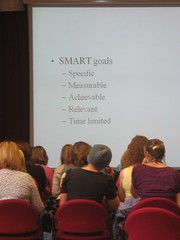
Your Goals may be SMART, but are they PURE and CLEAR, too?

If you’ve ever been to some sort of personal development seminar (or any seminar where action is called for), there’s a good chance that you’ve heard of SMART goals. That is, “Specific, Measurable, Attainable, Realistic, and Time-Bound.” However, have you heard of the less often mentioned PURE and CLEAR acronyms that seem to go hand-in-hand? Maybe it’s part of the “advanced” seminar course [tongue-in-cheek].

A couple of weeks ago, I happened to be at a Barnes & Noble. As I was walking through the store, there was a book about decision-making that drew my attention (I’ll have more about this book in future posts). As I thumbed through the book, there were many familiar models/theories (SWOT analysis, etc.) and one of those was SMART goals. However, as my eyes glanced over the section on SMART goals, I noticed that there were two other acronyms: PURE and CLEAR. Intriguing.

I bet your wondering what the acronyms PURE and CLEAR represent? At the time, I certainly was. Without further adieu:

PPositively Stated

UUnderstood

RRelevant

EEthical

and

CChallenging

LLegal

EEnvironmentally Sound

AAgreed

RRecorded

Now, one could argue that some of these overlap (ethical and legal or environmentally sound and ethical), but there certainly seems to be value-added in these two additional acronyms. Though, I don’t know how much incremental value is added. If you’re someone who’s never heard of SMART goals, I would certainly stick to that model to start with. However, if you’ve heard of SMART goals (and have used this method!), then I would think about adding PURE and CLEAR to your method of goal-setting.

[Note: I couldn’t find a Wiki article on PURE and CLEAR, but I did find two resources that may prove to be useful. This first one appears to be a PPT slide in the form of a PDF with all the acronyms (including SMART). The second one appears to be a blog post from someone detailing what is meant by the acronyms for PURE and CLEAR.]