What’s the Difference Between Empathy and Sympathy?

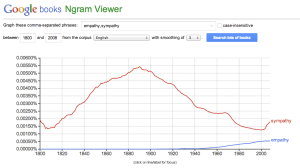
Screen Shot 2014-01-23 at 12.48.00 PMWhen you search for empathy on Google, you get almost 10,000,000 results. When you search for sympathy on Google, you get almost 25,000,000 results. I bet if we could look at historical search results in Google, I bet that we’d see a big trend where the number of search results for empathy has been increasing. The closest thing we can do to this is a search of all the books that contain the word empathy (at least the ones that have been digitized by Google). How? Using Google’s Ngram Viewer.

The chart above shows the mentions of empathy and sympathy starting in 1800 and ending in 2008. As we can see, empathy was hardly mentioned at all when compared to sympathy until the 1920s. That makes me wonder if there might have been some writings about empathy around the time of the Great Depression. What’s noteworthy though, is the steady increase in mentions of empathy. Granted, it’s still in only a fraction (0.0005%) of books, but it’s still progress.

Sympathy, on the other hand, we can see has steadily declined since the early 1900s. However, there’s been a small blip in sympathy since the mid-2000s. I would guess that this may have to do with the title question of this post: the difference between sympathy and empathy.

There’ve probably been several books written about the differences between empathy and sympathy in the last 5 or 10 years. So, do you know the difference between the two? I have to admit, even as an undergraduate in psychology, I’d often find myself googling the difference between the two terms. About a month ago, I came across a great video from the RSA that quickly explains the difference between empathy and sympathy. Of course, there’s a slight bias towards empathy in the video, but I think you’ll agree — empathetic is far better than sympathetic.

In case you’re inspired to be a champion of empathy or want some more information about programs that are helping to increase the level of empathy, I’d suggest checking out Ashoka: Empathy.

And if you want a bit more information about how empathy has shaped our society and continues to shape it, then I highly recommend checking out the RSA Animate video of Jeremy Rifkin’s book, The Empathic Civilization:

Could There Be No Poor Countries in 20 Years? Bill Gates Thinks So

Screen Shot 2014-01-21 at 1.10.10 PMThis is probably one of my favourite headlines I’ve had to write so far this year, especially on the heels of yesterday’s post about less than 100 people having more wealth than half of the world. In the Bill and Melinda Gates’ Foundation annual letter, Bill Gates is optimistic, to say the least:

I am optimistic enough about this that I am willing to make a prediction. By 2035, there will be almost no poor countries left in the world. (I mean by our current definition of poor.) Almost all countries will be what we now call lower-middle income or richer. Countries will learn from their most productive neighbors and benefit from innovations like new vaccines, better seeds, and the digital revolution. Their labor forces, buoyed by expanded education, will attract new investments.

By current definition of poor, Gates clarifies that he means that, “almost no country will be as poor as any of the 35 countries that the World Bank classifies as low-income today, even after adjusting for inflation.”

WOW!

Can you imagine a world where this happens? And Gates thinks that this could happen by 2035 — that’s 20 years from now! Twenty years!

A few months ago, I wrote a post considering what might be my generation’s version of racism:

I’ve spent a lot of time talking about my generation in comparison to generations past, but the true purpose of this post is a juxtaposition of the generations to come. As I said, it seems that past generations had a harder time than mine digesting the mix of cultures. For kids growing up today (in certain countries), it’s abundantly clear that there are people who look different from them and it’s just normal to grow up and be friends with people like this. My question, what is it that my generation will have a hard time with that future generations will see as natural?

Maybe a tangential answer to that question is poverty. Maybe in my lifetime, poverty (as we know it) will be eradicated. That’s certainly a wild idea given the current state of the world, but I for one would be thrilled to see this come to pass as I imagine others would be. With that being said, I could see how some folks might not be as accepting of this change and that’s not to say that they wouldn’t want poverty to be forever changed, but just that they might be a little less comfortable with the change.

As an example, let’s use technology. Generations before mine had technology that was quite different from what we use today. That is, the invention of TV was amazing. Now today, we can watch TV on a device that we can carry around in our pocket. Some folks from past generations are amazed by this and might still have a hard time adjusting to this reality.

That’s how I’m trying to superimpose the possibility of the eradication of poverty for my generation. Some folks might have a hard time adjusting to this reality. Regardless of the comfortability of some folks with this potential reality, I think it’s great that the Gates’ have wrote a letter helping to debunk some of the myths in developmental economics:

  1. Poor countries are doomed to stay poor.
  2. Foreign aid is a big waste.
  3. Saving lives leads to overpopulation.

I definitely recommend checking out the whole letter, which you can read here.

85 People Have As Much Wealth as 3.5 Billion People

Just think about that headline for a second… 85 people have as much wealth as 3.5 billion people. Eighty-five vs. Three and a half billion. Maybe looking at the words isn’t enough, let’s look at it in numbers. 85 vs. 3,500,000,000. If I were graphically inclined, I’d make a quick “infographic” showing 85 people on one side and 3,500,000,00 on the other side. That’s an astronomical difference.

The article in The Guardian where I first read it had a good analogy:

The world’s wealthiest people aren’t known for travelling by bus, but if they fancied a change of scene then the richest 85 people on the globe could squeeze onto a single double-decker.

This isn’t the first time I’ve written about wealth inequality and it probably won’t be the last. There are two posts that come immediately to mind. The first is the one from a couple of years ago where I shared a graphic that came from a paper by two researchers studying the wealth distribution in the US. Most notably from the graphic was that the perception of American was way off from reality. Americans thought that the top 20% had approximately 60% of the wealth and they wanted the distribution to be that the top 20% was closer to 30%. In actuality, the top 20% (at the time) had close to 90% of all wealth in the US.

The second post was just under a year ago and it took a deeper look at the graphic that I shared in the first post. Someone animated the chart, that is to say, they made a video of the information to make it more accessible to people and it was shared heartily across the internet — it’s currently over 14,000,000 views.

So what does all of that have to do with today’s information? Well, as is pointed out in the article in The Guardian, the World Economic Forum is starting in a few days, so talking about these kinds of issues are important. That is, reminding folks that the people in attendance at Davos will make up well over half of the wealth in the entire world

The image I’ve used for this post comes from that same article and it’s how I’d like to finish today’s post. Take a look at the United States. In 1980, the top 1%’s share of the national income was 10%. In 20 years, that’s doubled to 20% (of the national income). There’s been movement in other countries, but none as great as the US. I’m not picking on the US, but it’s quite clear that if you’re interested in being part of the wealthiest sect of the world, the US is a good place to do just that.

My point in sharing this image is to forward the conversation on this matter. People have very different opinions on how money should be spent, especially when that money is tax dollars. I’m not necessarily trying to trumpet one opinion more than the other, but I think it’s important to highlight this massive disparity and question whether this is how we want to live in the world.

What Will Major Cities Look Like in 25 Years?

Have you ever visited your hometown only to find that there’s been so much change since you’ve left? I certainly have and it’s amazing to see how different things have become since I’ve moved away. Well, if your hometown happens to be a major city, then the pictures in this slideshow might be quite interesting.

The slideshow demonstrates the changes to some of the world’s biggest cities. It’s simply amazing to see the change in what amounts to a rather short time. For instance, the second one from the slideshow included below), showing the difference between Dubai in the span of 13 years… wow. Of course, this is a bit of an anomaly based on the kind of money that’s been invested in Dubai, but it’s still remarkable to see just how much it’s changed.

Dubai – 1990 to 2003

There are plenty more that are just as amazing as Dubai. There’s Atlanta in the span of about 50 years:

Some of the other images, like the ones of Shanghai, Singapore, and Fortaleza (Brazil), make it appears as if you’re looking at a picture of two different places (and in effect you are, because of the time component). If not for the water landmarks, you might think you were being deceived.

My point in discussing these images is look at where we are today. It’s 2014. Think about some of the major places you’ve come to know and love. There are buildings that we look at and think, “Wow… that building’s so tall… we’ll never have taller buildings, will we?” What do you think folks thought 50 years ago?

That’s not to say that taller buildings is where we’re headed. There’s always the possibility that they’ll be advances in magnetization or some other form of technology and we will finally get those flying cars that we’ve been predicting for so long. I have a sneaky suspicion that when the time comes to pass that we do finally have the “next” bit of where we’re going, that it won’t be what many of us are expecting. I doubt that many people in 1950 would have thought that this is what infrastructure would look like 60 years into the future. Similarly, I’ve learned that we, as a species, are rather horrible at predicting the future, so I don’t know that what we’ve predicted has even an infinitesimal chance of coming to pass. Either way, I encourage you to think about it and reflect on how things different could (will?) be.

Where Humans Live: Is There Really an Overpopulation Issue?

In the last 50 to 100 years or so, there has been plenty written about humans having an overpopulation problem. When you read through these articles, you may become concerned that there really is a population problem that’s sweeping the planet. However, rarely (do you ever?) see a picture like the one I’ve included here accompanying those articles. Rather, you usually see a graph (see below), that shows the population has exploded in the last 50-100 years. While that’s true, it’s also true that much of the Earth is still not inhabited by humans.

Of course, I’m not necessarily volunteering to go live in the Arctic, but I think it’s something that’s worth keeping in mind when you hear folks talk about population problems on the planet. I’m not necessarily advocating that we — as a species — go live in the Arctic, but it would appear, at least from a superficial level, that there’s plenty of Earth for humans to spread out, too.

In addition toe “Earth” sprawl, there’s still the option for vertical sprawl. While many major cities in Asia have already ticked that box, there are plenty of areas across the United States were you could just about plant down a new city of 5 million people. There would need to be quite a bit of infrastructure set down first, but there’s room for people.

Should the population continue to grow like it is, humans are just going to have to get a lot more comfortable with each other. In Western cultures, folks are used to having their “own” space. That is, they’re used to some semblance of individuality and personal space. However, if you visit Asian cultures, you’ll find that there’s certainly a lot less focus on the “individual” person and more focus on many people at once (often times, a family — extended or nuclear).

~

I still remember in one of my graduate classes a few years back now, there was a student from South Africa (Note: I’m not implying that South Africa is part of “Asian” cultures.) Our assignment was to draw something where we were relating to our families. I don’t exactly remember what it was, but I want to say a family tree. Anyway, just about every student in the class (predominantly white and/or had spent quite a bit of time living in North America), completed the assignment in the conventional way that one would think to. However, this student from South Africa completed it quite differently. Instead of drawing something resembling lineage, they drew themselves in the middle and drew lines out to each one of their family members.

It was an eye-opening experience. It illustrated just how easily it is for two people to hear the same instructions, but complete the tasks in different ways.

~

Bringing that back to the topic at hand (adapting to conditions), I have complete faith in the human race to adapt should they need to live in areas they haven’t lived before. If there’s one things humans have become good at over the years, it’s adapting.

Coping Strategies Used by Teens When Criticized by Their Peers for Their Brand Choice

Remember back in high school, middle school, or elementary school when you were worried to go to school because your jeans weren’t Levis, or Jordache, or Lucky, or whatever name brand was popular when you were an adolescent? A couple of researchers from Paris decided that they were going to take a closer look at this phenomenon. That is, how we coped (or cope) with being criticized for not wearing the ‘right’ clothes.

Their results revealed that we have five main coping strategies for these situations: justification, revenge, denial, self-reproach, and making the criticizers feel guilty. Can you remember how you reacted (or might have reacted) if you were in one of these situations? Personally, I have a hard time remembering what I might have said (or did say), so let’s take a look at some of the responses.

In justification:

I tell them why I bought this particular brand.

I justify my choice, explaining why I picked this brand, the circumstances of my purchase, etc.

I explain what are the reasons that pushed me to make this brand choice in particular.

In revenge:

I no longer bother to criticize their clothes.

I try to get my own back by criticizing their clothes.

From now on I’ll carefully take note of how they look and won’t hold back from criticizing it.

In denial:

I act as if I hadn’t heard what they said.

I act is if nothing’s been said. [sic]

I imagine that they haven’t said anything and that’s enough to fix the problem.

In self-reproach:

I bear a grudge against myself: why did I choose this jeans’ brand? It’s rubbish!

I think that I wouldn’t have to buy an unknown brand for my friends.

In making the criticizers feel guilty:

I tell them it’s not cool to criticize people about their appearance.

I tell them it’s not very nice for one’s friends to make comments like that.

After reading the responses under the five strategies, do you think adolescents would be more inclined to use one strategy over the other? What about in girls vs. boys? It turns, that’s the case.

The researchers found that the emotion-centered coping strategies (denial and self-reproach) were the strategies that were mostly influenced by “perceived controllability,” which is, “evaluation of the capacity people believe they have to do or not do something when confronted with a situation.” This runs opposite to previous theories, with regard to coping and so the researchers advocated caution when examining coping strategies from the perspective of major dimensions and that more care should be taken to include context.

One last piece that I found interesting were the differences between boys and girls. That is, the researchers found that girls, more than boys, were more likely to make the criticizers feel guilty. This made me wonder about this whole idea of girls developing emotionally before boys and that girls are more empathetic. I wonder if we looked at boys when they reached the same “level of maturity,” would they begin using this last coping strategy more than the others?

More than this, though, I wonder about the cultural effects on coping strategies. I continuously refer back to the documentary Miss Representation and its soon-to-be released brother, The Mask You Live In. The perspectives presented in those documentaries highlight the importance of culture and media on our youth, too. Maybe our adolescents wouldn’t have to develop coping strategies for combatting criticism about their clothing, if kids didn’t even think it was “cool” to criticize someone for the clothes they wear.

ResearchBlogging.orgSarah Benmoyal-Bouzaglo, & Denis Guiot (2013). The coping strategies used by teenagers criticized by their peers for their brand choice Recherche et Applications en Marketing DOI: 10.1177/2051570713487478

The Problem With Facebook: Young People Really Are Social Networking Elsewhere

Remember yesterday when I was talking about Facebook’s “young person” problem? It turns out, there’s actually data to back this up. It turns out, there was actually an article in TIME that I didn’t realize had data when I was writing my post yesterday:

According to iStrategy, Facebook has 4,292,080 fewer high-school aged users and 6,948,848 college-aged users than it did in 2011.

That amounts to more than 11 million users gone in the past 3 years. While Facebook has more than 1 billion people, so 11 million might not seem like much, but is it a trend? That is, should this be something that the folks over at Facebook should be worried about. Well, there’s a handy graphic that can also be found in the TIME article, (but it comes from iStrategy):

Two of the cells I want to draw your attention to are already conveniently highlighted in red: the ages 13-17 and 18-24. If you’ll notice, both of these age groups are experiencing negative growth. Of particular noteworthiness is the 13-17 age group, which is down 25% over the last 3 years. Again, as I said earlier, Facebook’s user base is rather large right now, so it might not have that big of an effect anytime soon, but it is something to watch out for.

In the article, the author also points out that part of the reason people advertise with Facebook isn’t necessarily for the volume of its users, but because of all the information that it has on its users making microtargeting that much more effective. Maybe this information is enough to overcome the decline in new users, who knows. As I said yesterday, if I were part of Facebook’s team, I would be worried about the continued decline in my user base — especially because it’s the younger folks who are leaving. Why?

Pretty soon, these young folks are going to be reaching those prime marketing age groups (18-34) and if they’re already not using Facebook, that could be bad news. In fact, if they’re not using Facebook, they’re probably using some other social network to communicate and that is where the marketing dollars are going to go. I suppose only time will tell.

The Problem With Facebook: Is It Really Out of Room to Grow?

I rarely read the front page of YouTube, but today when I typed in YouTube to my address bar (with the intention of finding some music to listen to while I worked), one of the videos I saw on the front page was titled “The Problem With Facebook.” Truth be told, I thought it was a video by MinutePhysics and thought that there was going to be some scientific explanation of Facebook’s problems, but it turns out the video was by 2veritasium. (I guess MinutePhysics may have liked the video, so that’s why I saw their name or maybe they had just come out with another video, who knows.)

Anyway, if you have Facebook (or had Facebook) or know anything about Facebook, I’d say it’s worth the 6 and a half minutes to watch it:

I’m not sure what the fellow’s name is, but it reminds me of when George Takei went on a bit of a rant about Facebook not letting him reach all of his fans on Facebook. At the time, I think I still had a Facebook profile (rather than the page I have now) and I thought that was strange that your posts weren’t reaching all of your friends — by design.

The fellow in this video makes that same point, but he does it in a more thorough way than I remember Takei doing it (which is not to say Takei didn’t do it), and he also juxtaposes Facebook with YouTube. He makes a rather compelling argument, but something I don’t think he highlights is that he kind of has a vested interest in YouTube being more successful — his videos are hosted on YouTube! Now, this doesn’t really take anything away from the argument — it’s sound — but I think it’s worth noting.

Throughout the video, he talks about the incentives. I wonder what Michael Sandel would say about the incentives in this situation. Would he say that the incentives have been perverted? It’s tough to say because Facebook is trying to make money and there’s nothing inherently wrong with that, but I wonder if maybe they’ve strayed a bit too far from the original purpose of the site.

There’s one last thing I want to highlight from the video — in part — because it dovetails nicely with something that I’ve been trumpeting on here for awhile. He argues that Facebook has already maxed out, with regard to the amount of time people spend on the site per day (approximately 30 minutes) and that Facebook has already reached just about everyone in the developing world. When it comes to online video, however, he argues that there is still lots of room to grow based on the fact that people still don’t watch that much of it when compared to television. I might not put it in those words exactly, but I think he’s on the right track.

If even the President of the United States knows that Facebook is becoming or already is unpopular with young folks, I have to think that the smart people over at Facebook know this, too. As they’ve got a fiduciary duty to their shareholders, I’m sure they’ve been hard at work trying to figure out just how they’re going to capture more value — translation: how they are going to make more money.

Who knows… maybe Facebook will soon go the way of the social networks that have gone before it. Remember MySpace?

Quick Thoughts on Last Night’s Golden Globe Awards

Last night was the 71st Golden Globes. They’re a little behind the Academy Awards who are on their 86th taking place in about a month. Anyhow, I usually like watching these awards shows, especially if I’ve seen some of the movies that are in contention. This year, I had the chance to see a few of the movies that had garnered a number of nominations: American Hustle, Her, 12 Years a Slave, Captain Phillips, Gravity, and Dallas Buyers Club.

I really liked American Hustle, but after watching Dallas Buyers Club and 12 Years a Slave, I was torn between who I thought deserved the awards in some categories. I thought that Jennifer Lawrence had a great performance in American Hustle, but I also thought that Lupita Nyong’o had an excellent performance in 12 Years a Slave. I think they’re both talented and terrific actresses, but with the underrepresentation…

… I’m torn.

I wish that this weren’t an issue in our society. I wish we could judge/award movies/performances on their merits and not worry about whether we’ve been fair in accounting for diversity. Don’t get me wrong, I absolutely know and understand that because of our history, white people have a decided advantage when it comes to events like this (and life, in general), but I wish I could just be happy for Jennifer Lawrence and not wonder about Lupita Nyong’o. Unfortunately…

I was also torn when it came to the Best Actor in a Drama category. I’d seen three of the films for which actors were nominated in that category and in my opinion, it would be a toss up between Chiwetel Ejiofor (Choo-it-tell Edge–ee-o-for) and Matthew McConaughey. I thought they both gave excellent — excellent — performances. When Jessica Chastain announced Matthew McConaughey, I was happy, but as was the case for Jennifer Lawrence, I was a bit sad that Ejiofor didn’t win (or, for that matter Idris Elba, who I’ve read gave a great performance in Mandela).

~

I don’t have a solution to this dissonance I feel, but I wanted to express my desire for a time when feelings like these needn’t be had. Maybe it will come in 10 years, maybe it will come in 100 years. When it does, I will welcome it with open arms.

Can an Holacratic Organization Be Successful?

Because of some of the work that I’ve done, one of the things that really interests me is organizational structure. I like peeking into the ways in which an organization functions because I think that we can learn a lot about how and why they succeed. As a result, when I heard that Zappos was going to be transferring over to an holacratic organization, I was very interested:

During the 4-hour meeting, Hsieh talked about how Zappos’ traditional organizational structure is being replaced with Holacracy, a radical “self-governing” operating system where there are no job titles and no managers. The term Holacracy is derived from the Greek word holon, which means a whole that’s part of a greater whole. Instead of a top-down hierarchy, there’s a flatter “holarchy” that distributes power more evenly. The company will be made up of different circles—there will be around 400 circles at Zappos once the rollout is complete in December 2014—and employees can have any number of roles within those circles. This way, there’s no hiding under titles; radical transparency is the goal.

Typically, when people think about organizational structure, three systems come to mind: divisional, functional, and matrix. [Note: as an aside, I wrote an answer for a question on Quora a couple of weeks back about how organizational structure can support an organization’s strategy.] A divisional structure is one in which there is a degree of redundancy to the organization (each division has their own HR, accounting, etc.). A functional structure is one in which there are “shared services,” such that there would be only one HR, accounting, etc. Lastly, a matrix structure is a hybrid of the two.

Now, Zappos is throwing all that out the window and is adopting a new kind of organizational structure: holacracy. To be perfectly honest, I have no idea if they’re going to be successful. I don’t think anyone can honestly say whether Zappos will be successful in this change and in fact, I don’t think we could definitively say that this organizational structure works (or doesn’t) based on how Zappos performs under this structure. However, it’ll certainly give us a window into how a bigger organization (1500+) functions in this kind of structure. From what I’ve read, this is the biggest organization to attempt to use a holacratic system.

One interesting tangent I find to this discussion about holacratic organizational structure is this idea of holons and who’s associated with this idea. I first heard about “holons” in conjunction with Ken Wilber. I’ve written about Wilber only a few times here, but he’s someone who’s certainly worth checking out, if you haven’t already. He presents some fascinating ideas on a number of topics. That’s not to say that he’s right or wrong, but he’ll certainly present a perspective that you likely hadn’t considered. And if you’ve been reading me long enough, you know that I’m a major proponent of perspective. With regard to Wilber, I’m, in particular, thinking about the work he’s done with Spiral Dynamics. That is, I wonder if, in order to ensure that an holacratic organizational structure is successful, would the “participants” of said organizational structure need to be from 2nd or 3rd tier of development or the “yellow” or “green” memes in spiral dynamics.