Should the Los Angeles Dodgers Have Started Clayton Kershaw on 4 Days Rest?

A few days ago, there was a bit of a hullabaloo as the Los Angeles Dodgers decided they were going to start their star pitcher, Clayton Kershaw, in Game 4 on short rest. Let me back up for a second and explain a few things. Typically, starting pitchers in MLB get 5 days between starts. Meaning, if you pitched on Monday, you wouldn’t pitch again until Saturday. As we’re now into postseason baseball, some of the typical norms aren’t followed very closely. For example, last night in the elimination game between the Rays and the Red Sox, the Rays’ manager, Joe Maddon, changed the pitcher after the first inning even though the Red Sox hadn’t scored any runs! This is highly unorthodox. The Rays went on to lose last night, but as to whether that was a result of Maddon’s strategy is a post for another. Getting back to Kershaw and the Dodgers…

The Dodgers were up 2-1 in the series against the Atlanta Braves. Game 4 was to be played in Los Angeles. If the Dodgers won, they would move onto the next round of the playoffs. If the Braves won, there would be another game in Atlanta — Game 5 — to decide which of the two teams would advance. Kershaw pitched in Game 1 of the series, October 3rd, (and won). It was now October 7th, and the Dodgers’ manager, Don Mattingly, had decided that Kershaw was going to pitch in Game 4 that night.

There were many opinions about whether this was a good idea. There’s the “we’ve always done it this way” opinion that says you shouldn’t start Kershaw on short rest because that’s not how you do things. There’s also the mathematical opinion that starting Kershaw in Game 4 increased the Dodgers chances of winning Game 4.

In thinking about this decision that faced Mattingly, I was reminded of playing baseball when I was younger and being in double elimination tournaments. When it gets down near the end of the tournament, your pitchers are tired and some rules won’t let you pitch certain players more than a certain number of innings (depending on the league you’re playing in). So, coaches are often faced with the decision of starting their best pitcher in the semi-final game (or quarter-final) game to get onto the next round, where, quite possible, they won’t have anyone left to pitch. I’ve seen the strategy employed where one pitcher is held back in the “just in case” scenario. I understand why some coaches do this, but I don’t know that it’s the optimal strategy in most cases.

Elimination games are slightly different from games where you’re not facing elimination, but similar principles are used. Mattingly chose to use Kershaw in Game 4 instead of Game 5 because he thought it gave him the best chance to win. I totally respect that and if I were in his shoes, I think it’s the right call and the call that I would have made.

As it turns out, the Dodgers went on to win Game 4, so Mattingly’s use of Kershaw was vindicated. Even if the Dodgers lost, I still think that Mattingly would have made the right call in that situation. The mathematics supported Mattingly using Kershaw in Game 4 (to increase the Dodgers’ chances of winning Game 4).

~

I wanted to use this sports example as a way to pivot towards strategy and decisions in your own life — personal or professional. I want you to think about decisions that are coming up in your life. Are you holding back your “Clayton Kershaw” for the “do-or-die” situation later or are you using him/her to close the deal or make the change right now? There’s not necessarily a right or wrong way to do it, but in reading this post, I hope that you’re able to map this scenario onto your own life to identify those instances where you might not be putting your best foot forward in the here and now because you’re saving it for tomorrow.
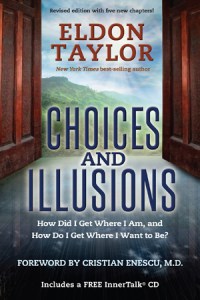
What Was Your Last Original Thought: Choices and Illusions, Part 2

In yesterday’s post, we looked at the first 6 chapters of Eldon Taylor’s book, Choices and Illusions. There were some great stories about how our thoughts can have a tangible effect on our bodies. In today’s post, we’ll take a closer look at the next 6 chapters.

~

Chapter 7 picks up right where the last three chapters leave off: marketing. In particular, Taylor asks one of his favourite questions: “What was your last original thought?” In continuing down this line of thinking, Taylor emphasizes how a great deal of planning and money has been spent on trying to get you to, in a sense, manipulate your thoughts. Now, I don’t want you think that Taylor’s talking about ‘mind control’ or something like that. In fact, if you think about it, you can probably come to the same conclusions that Taylor has. When you’re hungry, what’s the first thought that comes to mind? For many, that will be fast food. When you’re thirsty, what’s the first thought that comes to mind? Pop (or soda, or coke, depending on what part of the country/world you live in). How are those your first thoughts with these biological instincts?

Taylor also continues on subliminal thinking in Chapter 8. There are a couple of good stories, one about the 2000 election and the subliminal messaging used by the Bush campaign. There’s also a discussion of dichotic listening, which brought me back to my class in cognitive psychology from several years ago. Similarly, if you’ve never taken the Stroop Test, I suggest checking it out.

Chapter 9 has a two-part story that I thought you’d enjoy. Here’s part 1:

 It is about a Zen master who made it a habit at noontime to meditate while he walked in the gardens. On this particular day, he became so engrossed in his meditation that he wandered far into the jungle, where he met a hungry tiger. Well, our Zen master did what any Zen master would do, which is to attend to the urgency of the moment. He fled as fast as he could with the hungry tiger in pursuit. Soon he came to the edge of a sheer cliff, but with a hungry tiger about to eat him, he jumped over the edge. On the way down he grabbed the only thing jutting out from the cliff, a small tree. There he hung on as he heard a roar from below. Now, there was a hungry tiger above and a hungry tiger below. Just then the small tree began to pull out of the ground. He looked to his right. Nothing. He looked below. Nothing. He looked to his left. A beautiful strawberry. He picked the strawberry, and it was the best fruit he’d eaten in his life.

Taylor uses this story to emphasize the now: “The moral of the story is, be mindful — you will find the strawberries.” The second part of the story is just as good:

 After I told this story to an audience in Malaysia, a fellow approached me during a break and asked if I knew the entire story.

“I thought that was the entire story.”

“No,” he said. “Would you like to know it?”

We sat down and had coffee while he related the story that he said comes from Paramahansa Yogananda. It seems that the Zen master, when confronted with the tigers, was actually hanging from a small apple tree while mice were digging away the light soil that the tree was rooted in. The story cuts away to a picture of the event hanging in a gallery. There spectators are viewing the art, when one speaks up, “Look at that stupid fellow. He’s selfishly indulging his senses while blind to his circumstances.” The story then returns to the Zen master. Another tiger runs onto the scene, and now there are two tigers above. The Zen master enjoys his apple, and pretty soon he sees vultures circling overhead. The two tigers have fought and killed each other. The mice see the shadow of the birds and flee. Below a herd of deer comes down to drink from the brook, and the tiger below sets off in pursuit of them. In short, what seemed like dire circumstances fixed themselves or were fixed by some power above.

Of course, some folks may balk at the idea that every situation will fix itself, but I’d argue that lots of people forget that when they are trying to decide the best course of action, ‘wait and see’ is overlooked more often than it should be. In tomorrow’s post, we’ll look at the last 6 chapters of the book.

(Disclosure: I was given a free copy of the book.)

They Limped in and Danced Out: Choices and Illusions, Part 1

A few of my posts recently have been about the importance that our thoughts and beliefs can have on how we function. Coincidentally, I was asked to write a review of a book that is right in line with this thinking. The book: Choices and Illusions: How Did I Get Where I Am, and How Do I Get Where I Want to Be? by Eldon Taylor. I enjoyed reading it and if you’re unfamiliar with the idea that our thoughts can have a tangible impact on us, this book is certainly a great introduction. Over the next few days, I’ll take a closer look at some of the sections of the book. In today’s post, I’ll look at the first 6 chapters.

~

Chapter 1 was a great introduction to this idea that our thoughts can have a tangible effect on our lives. Taylor tells a clever story about an eagle that was raised as a chicken. The eagle, all its life, assumes it’s a chicken, even when an eagle comes to tell it that it’s an eagle. This chapter reminds me of many of the posts I’ve written about perspective. If you don’t know what other possibilities there are out there, it’s hard to choose something different.

In chapter 2, I was surprised to hear about someone who can draw fractals freehand! I remember a few years ago being really enthralled by fractals. In fact, there were times when I’d just watch YouTube videos of fractals for in 15-30 minute increments. If you’re interested, Jason Padgett is the fellow who can draw fractals freehand. He’s quite good! And if you don’t believe me that fractals can be encapsulating, watch this: Fractal Zoom Mandelbrot Corner.

Chapter 3 had a really fun story about a high school reunion. There were a number of people who had reached the age where they weren’t as mobile as they used to be. The DJ, not accounting for this in creating the playlist, became worried when people weren’t moving so well on the way into the event. Figuring that there wasn’t enough time to change the playlist, the DJ played it as it was. The DJ later told Taylor: “Eldon, they limped in and danced out!” How is this possible? Well, as Taylor emphasizes, our thoughts can have a powerful effect on our abilities. Many of these people were transported to their youthful days upon hearing the popular music during the time they were in high school.

Chapters 4 through 6 reminded me of the importance of the documentary Miss Representation (and it’s soon to be released companion: The Mask You Live In). The media can have such a powerful impact on the way we think about ourselves and it can often be overlooked. In particular, chapter 6 reminds us that advertising is not always the most ethical profession. With that being said, it’s important to say that not all advertisers behave in this way.

In tomorrow’s post, we’ll look at chapters 7 through 12.

(Disclosure: I was given a free copy of the book.)

Leonardo da Vinci Thinks You Need a Fresh Perspective

A couple of weeks ago, I shared a photo of a real estate listing in Korea and the story of the blind men and the elephant. These were both meant to emphasize the point that perspective is really important. A few days ago I came across an article from Inc. that continues to strengthen my opinion that being able to assume different perspectives is extremely beneficial.

This particular article had to do with Leonardo da Vinci — a famous polymath from the 15th and 16th centuries. The article was illustrating the different ways that da Vinci could teach the reader about creativity. The lede for this article:

The Italian master had skill and great ideas, but he also had something else: the ability to look at the world around him differently.

Perspective.

Here’s the two “things” that I think highlight this point:

Independent Thinking

Diversity is critical for creativity and innovation, which is why it’s important to seek out points of view different from your own.

“The problem is the more senior someone becomes the more likely they’re going to believe their own publicity and surround themselves with people who always agree with them. So the more senior you become, the more concerted effort you must make to seek out different opinions. Then you have a chance to think independently,” Gelb says.

Make New Connections

Logical and linear-thinking types–engineers, analysts, and scientists, for example–can have a hard time looking for patterns and new connections, but doing so is the key to creativity.

Again, Gelb likes to use mind mapping, although it take a while to train these kinds of folks since they’re used to doing things in a formal order.

“At first it feels very messy… thinking through association and letting the mind go free and generating lots of key words and other images in different directions,” he says.

So, if you won’t take my word that seeing things from a new perspective is important, will you take da Vinci’s word?


If You Want a Successful and Sustainable Company, Focus on the Workforce

Several months ago in one of those posts where I write about a bunch of ideas, but don’t flesh any of them out, I wrote the following:

Focus on Labor — I’ve never been the CEO or a highly placed Vice President of a company, but from an outsider’s perspective, I always have a hard time understanding the lack of focus on the labor force. At times, it really looks like labor is the key to success. If the labor force is well taken care of, production and profits tend to do well. It reminds me of that post I did about sustainability and pitchers. The relation here is that when management takes care of the labor force, it is with an eye towards long-term sustainability.

I still believe that this is an important idea. Without the workforce, where would a company’s profits be? Without the workforce, where would the economy be? Even after the rise of the robots, I still think it’ll be really important for companies to take care of their workforce. It turns out, I’m not the only one with this opinion.

From Henry Blodget, CEO and and Editor of Business Insider:

If you watch TV, you’ll be led to believe that the problem with the U.S. economy is that one political team or the other is ruining the country.

A sharp drop in government spending this year is, in fact, temporarily hurting economic growth, but that’s not the real problem.

The real problem is that American corporations, which are richer and more profitable than they have ever been in history (see chart below), have become so obsessed with “maximizing short-term profits” that they are no longer investing in their future, their people, and the country.

This short-term greed can be seen in many aspects of corporate behavior, from scrimping on investment to obsessing about quarterly earnings to fretting about daily fluctuations in stock prices. But it is most visible in the general cultural attitude toward average employees.

Employees are human beings. They devote their lives to creating value for customers, shareholders, and colleagues. And, in return, at least in theory, they share in the rewards of the value created by their team.

In theory.

In practice, American business culture has become so obsessed with maximizing short-term profits that employees aren’t regarded as people who are members of a team.

Rather, they are regarded as “costs.”

And “costs,” as we all know, are supposed to be reduced as much as is humanly possible (except the “costs” of the salaries of senior management and investors–those are supposed to be increased).

Bingo! Mr. Blodget hits the nail on the head. Regarding employees as costs is a fundamental mistake in thinking. As we know, our words are important. Not only for ourselves, but for those around us. He continues:

Whenever you suggest to folks that it doesn’t have to be this way, that some companies can and do balance the interests of shareholders with the interests of customers and employees–and, in so doing, create a symbiotic relationship that supports all of these constituencies–folks call you a “socialist.”

This is a strange insult, because the government has nothing to do with this. But, nevertheless, “socialist” is the label you get branded with if you suggest that the senior managers and owners of America’s corporations should share more of their vast wealth with the employees who create it.

This view of capitalism is that it is a sort of Lord-Of-The-Flies economic system in which the only consideration should be “every man for himself.” In this style of capitalism, leaders do not manage teams and organizations in a way that creates value for everyone–customers, shareholders, and employees. Rather, in this style of capitalism, a handful of winners extract as much value as they can from hapless losers who don’t have the skills, knowledge, or time necessary to “demand a raise” or “go get a better job.”

It doesn’t have to be this way.

There is no capitalist law that says companies have to view employees as “costs” and pay them as little as possible.

Senior managers and owners can choose to share more of a company’s wealth with the people who generate it. They can choose to make only reasonable profits, while still generating compelling financial returns. And they can choose to pay their team-mates living wages instead of viewing them as “costs” and extracting every penny of possible value from them.

If American corporations were struggling to earn money these days, we wouldn’t be having this conversation.

But they aren’t.

American corporations have the highest profits and profit margins in history.

American corporations can afford to pay their employees better, hire more employees, and invest more in their future and the country’s future.

But American corporations aren’t doing that.

Instead, American corporations are choosing to divert as much of their value as possible to their owners and senior managers.

Doing this is not a law of capitalism.

It’s a choice.

And it is a choice, unfortunately, that is destroying America’s middle class, robbing American consumers (a.k.a., “employees”) of spending power, and, ironically, hurting the growth of the same corporations that are making this choice.

If your customers are strapped, your company can’t grow.

And, right now, American companies are choosing to impoverish their customers (employees), while skimming off as much wealth as possible for themselves.

The idea of viewing employees as costs is perfectly in keeping with the idea that the US doesn’t require any paid vacation daysWhat kind of a company do you want to work for: one that treats its employees as assets or one that treats its employees as liabilities?

It’s All About Perspective: The Blind Men and the Elephant

BQxiYHmCAAE9dmQA few days ago, I shared a photo on Facebook that epitomizes what I believe to be one of the hallmarks of life: perspective. I’ve included the photo in today’s post (you can see it there on the right). I can’t tell for sure because I don’t read Korean, but the photo appears to come from advertisement for house for sale (or for rent). In the first frame, we can see what appears to be a lovely shot of the house featuring a nice pool. In the second shot, a different angle of the house where — again — the pool is featured. In the last shot, the big reveal — the pool is not what it appeared to be in the first two frames.

Some may look at the surface-level lesson — someone could have been severely swindled had they not gone to see this place (if they were going to rent/buy). I prefer to look at in a broader sense: it’s all about perspective. Without considering all of these photos together, one would miss the perspective that the pool certainly isn’t anywhere near as large as it appears. There’s certainly a “swindler” streak to these three photos, so let’s at a story that you may or may not have heard before:

It was six men of Indostan
To learning much inclined,
Who went to see the Elephant
(Though all of them were blind),
That each by observation
Might satisfy his mind.

The First approached the Elephant,
And happening to fall
Against his broad and sturdy side,
At once began to bawl:
“God bless me! but the Elephant
Is very like a WALL!”

The Second, feeling of the tusk,
Cried, “Ho, what have we here,
So very round and smooth and sharp?
To me ’tis mighty clear
This wonder of an Elephant
Is very like a SPEAR!”

The Third approached the animal,
And happening to take
The squirming trunk within his hands,
Thus boldly up and spake:
“I see,” quoth he, “the Elephant
Is very like a SNAKE!”

The Fourth reached out an eager hand,
And felt about the knee
“What most this wondrous beast is like
Is mighty plain,” quoth he:
“‘Tis clear enough the Elephant
Is very like a TREE!”

The Fifth, who chanced to touch the ear,
Said: “E’en the blindest man
Can tell what this resembles most;
Deny the fact who can,
This marvel of an Elephant
Is very like a FAN!”

The Sixth no sooner had begun
About the beast to grope,
Than seizing on the swinging tail
That fell within his scope,
“I see,” quoth he, “the Elephant
Is very like a ROPE!”

And so these men of Indostan
Disputed loud and long,
Each in his own opinion
Exceeding stiff and strong,
Though each was partly in the right,
And all were in the wrong!

That story is iconic of what it’s like to have an opinion. We’re all looking at things from our own perspective and believe that what we’re telling is the truest truth. I wrote about this very thing with regard to watching the news a couple of years ago. Depending on where we get our news, we’ll be listening to a different man who’s describing the elephant. There’s absolutely nothing wrong with that, but it’s important that we recognize that we may only be getting one perspective on the news (or elephant).

~

This is one of the things that I’ve tried to do on this site. Two of the categories I write under: Fresh Perspective and Perspective. When I write posts for one of these two categories, I’m trying to shed light on the story like we get when we look at the story of the Blind Men and the Elephant. I’m trying to look at the story from the same perspective we have as the reader of the story. That is, we know that all of the men are right in some way, but that they can’t connect the dots because of where their perspective lies.

To give you a sampling…

Fresh Perspective

Just yesterday, I wrote a post about the plethora of weak characters in movies that are women, but aren’t men. A few weeks ago, a post about having less written tests and more oral tests in education. What about having young people run the country? Or a reexamination of the US and terrorism? Maybe we don’t need to workout at all?

Perspective

Is there a modern day version of writing yourself a $10,000,000 post-dated check? Does market economics tell us that we need to pay politicians more? Do you know how long the US has been dependent on oil? Do you think that your team made a blunder with that trade? What would the world have looked like without the “I Have A Dream” speech?


Is It Time to Pay Politicians More?

A few months ago, I saw this very argument made in Slate. At first, I’m sure you’re doing a double-take? Why would we pay them more? They are hardly doing the job that we elected them to do in the first place. Why would we reward failure, stagnation, and an inability to get stuff done? That’s absurd!

All natural reactions, yes, but when you take a second to think about it, the idea isn’t that bat-crap crazy. For instance, consider the Governor of Virginia, Bob McDonnell. Josh Barro over at Business Insider makes the case that the Governor is underpaid. Why? Well, look to the incentives! The Governor of Virginia has a salary of $175,000, which is in the 90th percentile for Governors in the USA. That’s certainly a lot of money — almost triple the median income in Virginia. So, again, you may be thinking, why would we pay them more?

Well, consider the kinds of people that the Governor interacts with on a daily basis. Plutocrats. Governor McDonnell, on a daily basis, interacts with people who have income/wealth that far exceed the Governor’s “measly” $175,000 salary. You may be thinking, why is this a problem if the Governor got into politics for purely altruistic reasons?

Even if the Governor did do such a thing, research tells us that unethical behavior has to do with the kind of person you are and more to do with the situations you find yourself in. For instance, you may be the most ethical person in the world, but if you happen to find yourself in a bind financially and a whole host of other variables are weighing on you, there’s probably a situation that you may find yourself in where overlooking a conflict of interest may seem like an okay thing to do.

That’s the argument for increasing the salaries of politicians — to remove the incentive to be unethical. Of course, there’s still likely to be unethical behavior conducted regardless of what the salaries are raised to, but it may eliminate some of it. How much, I don’t know. What would be a fair salary?

The article in Slate discussed Sinagpore, which is known for being one of the most efficient governments in the world. He explained that in Singapore, the Prime Minister earns more than four times the salary of President Barack Obama and the President gets $400,000 a year! Government Ministers (akin to cabinet Secretaries), earn over $1 million a year. The highest paid cabinet Secretary (Secretary of the Treasury) gets approximately $190,000. So, government Ministers earn more than 5 times as much as their American counterparts.

I’m not advocating this particular raise, but I think it’s a conversation worth having.

I suppose the other option would be to remove the influential plutocrats from the equation. Although, I don’t know that with the American political system arranged in the way that it is, if that’d be constitutional. Larry Lessig, someone who’s been working tirelessly on the option of getting money out of politics was asked what a question about salaries for Congress. I’ll leave you with the question and his answer:

Question: You advocate in your book that congressmen should be paid much more than what they are right now (about $175,000/year). How much do you think they should be paid to make them lose the incentive to become a lobbyist? Does 250-300k sound better?

Lessig: Oh please don’t out me on this. Ok, but DON’T TELL ANYONE I SAID THIS: They are lawmakers. Why aren’t they paid as much as a first year partner at a DC firm? In Singapore, gov’t ministers get paid $1 million a year. Where is corruption in Singapore. NO-where.

The Evolution of Energy Sources for Humans Is Shorter Than You Think

I’m a big proponent of clean, renewable, and sustainable energy. Our species will not survive if we continue to use energy in the same way that we do at the same pace at that we do. That’s simply a fact. However, in my thinking about this issue, it never really occurred to me just how “new” energy is to humans. That is, it never really occurred to me just how new our energy sources were.

Take this chart of energy consumption in the United States, for instance.

History of Energy Consumption in the United States

Americans only started using petroleum as an energy source around the time that Abraham Lincoln was president. That’s almost 150 years ago. Americans have “only” been using petroleum as a source of energy for the last 150 years. That means, potentially, your great-great-grandfather may have lived in a world where using petroleum as an energy source was a “new” thing.

Looking a little further along the chart and we can see that 50 years after petroleum became an energy source that Americans used (albeit scarcely), coal was far and away surpassing our usage of petroleum. About 100 years ago, coal was 12, 13, or 14 times as popular as petroleum as a source of energy. It looks as if even wood was more popular as an energy source.

Now let’s look at the last 50 years. Between the early 1900s and the 1950s, the use petroleum as an energy source skyrocketed! As did the use of natural gas as an energy source. Coal seemed to be on the decline, but still in heavy use. Fast-forwarding a little bit more and we see that petroleum is trending down (in terms of its use) as is coal, but not before coal had a big uptick between the 1950s and the early 2000s. In that timespan, nuclear power also took off as an energy source, but it appears to have leveled off in the 2000s and may even be headed for a downward spike since the 2010s.

More notably is the green line for other renewables. We don’t see its existence until the 1950s and its growth is rather slow and steady. However, in what looks like the early 2000s, it begins to trend up. Who knows — maybe we’re on the cusp of what could be an energy revolution. Maybe “other renewables” will grow in popularity and use as coal or petroleum. Maybe its a bit naive or foolhardy to expect great energy transformation from non-renewables to renewables. Evolution does take time.

My point in sharing this today is to add some perspective on just how far humanity has come in terms of its use of energy. Really, only in the last 50 to 100 years has energy consumption skyrocketed in the way that we know and understand today. Who knows what energy consumption will look like in the years to come.


Does the Middle East Today Look Like Europe Before WWI?

I recently saw a tweet that was rather intriguing:

If you care about international relations, this probably was rather intriguing to you, too. The part that got me interested was the comparison between what Europe looked like before WWI and what the Middle East looks like today. There’s been plenty written about the Middle East with things happening in Syria, Iran, Iraq, Saudi Arabia, Bahrain, etc. So, I thought this post from Foreign Policy would make some interesting parallels between what Europe looked like then and what the Middle East looks like now.

Sadly, this wasn’t the case. It seemed that this brief article was more about what the strategy should be for the US in the region. While that’s probably important, I was more interested in looking at things from a historical perspective. As far as I can tell, history often repeats itself and as a result, it is one of our greatest teachers. So, if we could learn something about what happened in Europe before WWI, that might give us some indication of how things are going to proceed in the Middle East. Of course, it’d be purely speculative, but it might be enlightening.

I don’t know enough about what Europe looked like before WWI nor do I know enough about what the Middle East looks like now to make informed guesses. If I did, you can be sure that the rest of this post would have been a comparison of those two topics. The one thing I will say, though, is that I bet that if conflict does bubble over like the Admiral is *kind of* predicting might happen, I wouldn’t be surprised if there are some parallels to what happened before WWI.