Square Peg for a Square Hole Inside of a Square

jehyun-sung-6U5AEmQIajg-unsplash.jpgEvery couple of weeks or so, Ben Thompson from Stratechery and James Allworth from Harvard Business Review sit down to talk tech and society. On their most recent episode, I couldn’t help but think of some of the parallel applications to the public service. At around the 30-minute mark of the podcast, the two start talking about the different kinds of organizations (functional and divisional) and how certain leaders are better suited to lead from the different structures.

For instance, they use the example of Steve Jobs — who, most regard as a very successful leader. At the time that he was in charge of Apple, the organization operated, mostly, in a functional structure. The two referred to Jobs as the ultimate “product manager” — all decisions ran through him. As organizations grow, it’s natural for them to shed the functional structure for a divisional structure.

In listening to Ben and James talk about this, the thing that got me excited was that we could almost draw up a 2×2:

  • Functional Leader
  • Divisional Leader
  • Functional Org Structure
  • Divisional Org Structure

Naturally, you’ll want a functional leader operating within a functional org structure and a divisional leader within a divisional org structure. So, it could be that the person who looked like they had potential to be a good leader might be mismatched in the type of role they’ve found themselves in.

~

This episode also made me wonder if there needs to be more intentionality around, not only finding the right kind of leader suited for the org structure, but also being clearer about what kind org structure is best for the work being done in the organization. For instance, let’s say we’re in an area of a department that’s highly segmented for projects. OK — maybe that area should be setup in a ‘functional’ way. Or, maybe let’s say that we have a department where there are some clear delineations from one group to the next delivering on big programs. OK — maybe that area should be setup in a ‘divisional’ way.

Essentially, we want to make sure we put the square pegs in the square holes inside of squares and that we put the circular pegs in the circular holes inside of the circles.

Outcomes vs. Outputs – The “How’s” of Decision-Making

71GiSvm+a0LRecently, I read (er, re-read?) Phil Tetlock’s Superforecasting: The Art and Science of Prediction. This book came out a couple of years ago (and was co-authored by Dan Gardner, whom I believe is a senior advisor to Prime Minister Trudeau – or was at one point, I’m not sure if he still is). Anyway, the book is excellent and I highly recommend it to anyone who wants expand their understanding of decision-making.

The reason I’m mentioning this book today is because of one of the chapters: The Leader’s Dilemma. The crux of the chapter is a juxtaposition between the central theme of the book – individual superforecasters and their ability to remain steadfast in the face of uncertainty and the fact that leaders need to take action. They can’t waffle in their decision-making – they have to choose. The chapter invokes a German General from the 1800’s, Helmuth von Moltke. To be frank, I haven’t read many books (or seen many documentaries/videos, for that matter) about military leadership and strategy, so this was new to me.

You: Jeremiah, why are you talking to us about German Generals from 200 years ago?

Me: I’m going somewhere with this, I promise, just hang with me for a bit.

So, Moltke. He had a particular way of leading that is often characterized by the German word Auftragstaktik. In English, we know this as mission command. Essentially, this style of leadership boils down to top-down intent, but bottom-up(ish) execution. For example, the leader of the military would say that we need to expand our defenses west, but the leader wouldn’t say how we’re going to do it. Instead, the order makes its way down the hierarchy – absent the how, every time! – until someone would then be executing on that order.

The key here is that there’s no prescription for how to do something when the order is given. The emphasis is on the outcome. Expand our defenses west. Invade that country. Secure that town. OK. So, why is this important? Moltke: “In war, everything is uncertain.” If a General were to give prescriptive orders about how to takeover a bridge, there will absolutely be things that occur on the ground that aren’t accounted for in the General’s orders. Maybe there’s heavy rainfall, which presents a problem for the troops who were told to stake out in the nearby field and wait for the cover of night to execute the plan. Maybe when they arrive, the enemy has three times (!) as many soldiers there to defend the bridge. What will they do? Well, they’ll have to callback to HQ, as everything’s being run through the General.

/It’s at this point that, if I were doing a video of this, I’d splice in a scene from Family Feud where Steve Harvey (or Ray Combs) points to the big board and says, “Show me… waiting for orders from HQ when you’re under heavy fire and have no place to go…”

/Stttttttttrrrrriiiikkkkkkeeee

Yeah, that strategy will not pan out – every time. OK, so we’ve established that in the military, they push decision-making down the hierarchy. How does that relate to us, you might be asking?

Well, how many things do you do at work where you have complete control over how you do them? We need to brief the Director, quick write a briefing note.

/Stttttttttrrrrriiiikkkkkkeeee

What if a briefing note isn’t the best way to brief the Director? What if the Director would rather a quick 2-minute meeting to explain what’s going on, rather than you spending the next 2+ hours crafting the ‘perfect’ briefing note, only to have your manager spend an hour after that re-writing the whole thing? And how does it make you feel after you’ve done all that work, had most of it invalidated by your manager, and then the Director calls you and your manager in anyway because he doesn’t want to read 300 words on the topic, but instead, wants to have a quick chat about it.

~

Or let’s say you’re working in operations – the front lines – where the proverbial ‘government meets the Canadian.’ You’re working with a Canadian who needs a new passport, but is having trouble getting it. Your performance metrics are clear – you’ve already spent 20+ minutes on the phone and if you stay on the phone longer, you know that you’re not going to be able to meet your performance objective because this call will inflate your average time on call.

/Stttttttttrrrrriiiikkkkkkeeee

Clearly, time on call isn’t the best metric to use to evaluate folks who answer calls from Canadians, but the order has already been given from down on high (we need to spend only x-amount of time on the phone with Canadians because it’s part of my performance agreement that our average call-time improves year-over-year).

~

Or how about this – the DM has decided that the department is short on funds so we’re going to reorg two branches – they’re now going to become one branch. *gasp* The ADMs filter the message down to the DGs that they want these directorates axed, the others merged, and some others expanded. The DGs filter that message down to the Directors about which divisions will be axed, merged, and expanded. The Directors filter that message down to the managers about whose role will be shifting, reassigned, or expanded. The managers filter that message down to their teams. And at the end of this exercise no one is happy.

There were no consultations, no engagements, and no empowerment. People were told what they were going to do and how they were going to do it. No one considered that the people they were managing might have ideas about how to do things better. The person filtering the message down was always assumed to be ‘right.’ That’s no way to run a firm and it’s certainly no way to manage change in an organization. Push the “how” of decision-making down the hierarchy. The people you hired are smart (otherwise you wouldn’t have hired them, right?). Let them prove your decision to hire them was a smart one. They can’t wait to do it.

This post originally appeared on GCconnex/GCcollab.

When Will the United States Next Have a Transformational President on Domestic Policy?

I was catching up on some of the journal articles I’ve accumulated to read over the last year and I one caught my eye: “Transformational and transactional presidents,” by Joseph Nye, Jr. In the article, Nye makes the case that presidents didn’t matter (as much) to the US developing into a great power as we may have previously thought. Furthermore, Nye makes the case that our definitions of the two types of leadership aren’t clear and that the preference for transformational leaders is misplaced.

One of the parts that I enjoyed about this brief article was how Nye identified that presidents can be transformational and transactional at the same time. How? Because there are many different facets to a presidency and so while a president may be transformational in domestic policy, they might not be in foreign policy. Similarly, they can not be transformational in foreign policy early on in their term, but become transformational in response to external events.

Upon finishing the article, I was left wondering if (when?) the United States will again have a transformational president, with regard to domestic policy. Nye didn’t make this case in the article (but maybe he did in his book?), but based on his definition of transformational leaders, with regard to objectives [seeking major change], President Obama was certainly a transformational president. Obamacare is a sweeping change to the way that the US administers healthcare to its people. At the time, President Obama also enjoyed majorities in both the Senate and the House, so this kind of change was more possible (especially more possible than it is now. Can you imagine Pres. Obama trying to pass anything close to Obamacare with the GOP-controlled House and Senate?)

Given Hillary Clinton’s speech this past weekend, I’m inclined to think that she has ideas about domestic policy that would make her a transformational president. However, based on what’s been written about the likelihood of the GOP to continue to hold the majority in the House (redistricting, etc.), it doesn’t seem like there’s likely to be a Democratic-controlled House for the next few election cycles. It’s possible that the Senate flips back to the Democrats in 2016, but they’d need the House to also make a “big change.” So, it seems that, if there’s going to be a transformational president (on domestic policy), it’d have to come from the GOP.

I haven’t been following too closely the candidates from the GOP side, especially with regard to their domestic policy ideas, but is there a transformational president amongst them? There could be, but I suppose we’ll have to wait and see. If neither party is able to sweep the polls in 2016, we might be waiting for a transformational president on domestic policy in the US until at least the next decade.

ResearchBlogging.orgNye, J. (2013). Transformational and transactional presidents Leadership, 10 (1), 118-124 DOI: 10.1177/1742715013512049

Why Women are Better CEOs, Presidents, and Prime Ministers

New research shows that women are far better at handling stress than men. I suppose that’s not a newsflash as most people already think that’s true, but consider the way in which this study frames it [Emphasis added]:

We consistently found the same general response pattern: while stressed women showed higher self-other distinction than women in the non-stressful control condition, men showed the converse pattern. More specifically, stressed women showed reduced emotional egocentricity bias, enabling them to judge the emotions of the other person in a way that was less influenced by their own emotional state. Moreover, their response times in the cognitive perspective-taking task decreased under stress, documenting that they were able to regulate the mismatch between their own and the “director’s” perspective faster under stress. Finally, stressed women showed a reduction of automatic imitative tendencies in the imitation-inhibition task, indicating that they were able to overcome low-level social signals interfering with their own movement intentions. Note that the latter finding is crucial. It highlights that women did not simply show an increase in other-related responses under stress – as this would have resulted in increased interference from automatic imitation. Instead, they were able to flexibly increase either self- or other-related representations, depending on the task demands which either required overcoming egocentric biases, or overcoming social interference.

As the stereotype goes, women are more “emotional” than men, so it would be much better for an organization or unit if it were managed by a man. However, this research is telling us that, when under stress, it is men who are less able to distinguish their emotional state from the intentions of those around them. It is men who are more adversely affected by stress. For women, it’s the opposite. In fact, women tend to be more prosocial [behaviour intended to benefit others] when they’re stressed. Meaning, instead of retreating inward, women are actually more helpful when they’re stressed.

This research certainly makes one think about the way that many organizations and countries are run today. Most people would agree that being a CEO, President, or Prime Minister certainly comes with oodles of stress. Unfortunately, the number of women who hold these positions is far outweighed by their male counterparts. Of course, there are a number of reasons for that, which we won’t get into in this post, but consider for a moment if the numbers were flipped. That is, what if there were more women CEOs (or high-powered leaders)? Or, what even if it was 50/50! What if the number of high-powered leaders and CEOs was 50% women and 50% men? At that point, would it be easier for folks to see, understand, and digest that women are actually better leaders and better at handling the stress?

Maybe it’s the language we use.

A quick Google search showed mixed results for “women are better CEOs.” In fact, many of the results near the top indicated that women CEOs are more likely to be fired. However, when I keyed in “women are better leaders,” I got plenty of positive results. Posts on Harvard Business Review, Business Insider, and articles talking about academic research in newspapers like The Globe and Mail.

If there’s one thing I’ve learned about the world during my time in it, it’s that change (usually) happens gradually. Rarely is there a massive cultural shift overnight. So, here’s hoping that research like this contributes to the realization for some that when it comes to managers and leadership, women just might have an edge over men.

ResearchBlogging.orgTomova L, von Dawans B, Heinrichs M, Silani G, & Lamm C (2014). Is stress affecting our ability to tune into others? Evidence for gender differences in the effects of stress on self-other distinction. Psychoneuroendocrinology, 43, 95-104 PMID: 24703175

Best Posts of Jeremiah Stanghini’s Blog in 2013

Last year when I did a best posts series, I ended up doing three different posts. This year, since all of the posts that appear on this website originated on this website, I wouldn’t need to include any posts about Genuine Thriving. My first inclination was to do a best of 2013 and a best of all-time, but after looking at the statistics, the best of 2013 and the best of all-time are essentially — identical. As a result, I decided to just do the one post of the best posts of 2013.

Before revealing the top 6 posts along with an excerpt, there is one thing to keep in mind. On the old site, there used to be only an excerpt shown with the post. So, if someone wanted to read the whole post, they had to click the link (this was just how the theme worked). On this site, however, I specifically chose a theme where folks wouldn’t have to click a link to view the whole post (only to share or comment because those links are on the post’s page). As a result, the statistics for the most popular posts are sure to be skewed because people may have read a certain post more than another, but without them clicking the link for the post, there’s no way (that I know of) for me to know. On top of that, the theme I’ve chosen here allows the viewer to scroll (all the way to the first post!) What does that mean? When you’re on the homepage, you can continue to scroll down and more posts will load… all the way ’til you get to the first post. And in looking at the statistics of the top posts, it’s clear that “scrolling down” is far and away the most popular “post” on this site (this was true last year, too). With that in mind, here they are with an excerpt for each:

The Official Final Jeopardy Spelling Rules [UPDATED]

If you know me, you know that I’m really good at finding things on the Internet. After doing a couple of cursory google searches (Final Jeopardy RulesOfficial Final Jeopardy RulesOfficial Jeopardy Rules), I was surprised that I couldn’t find them. Sometimes, the site that hosts a document like this doesn’t do a good job of using keywords. So, I thought I’d poke around the official Jeopardy site — nothing.

After some more derivations of “Rules of Jeopardy,” I was beginning to think that maybe the rules aren’t online. I thought that maybe the contestants were handed a paper copy that they signed before going on the show and that document wasn’t online. Having never been a contestant on Jeopardy (though I’d like to be some time!) I couldn’t confirm whether this was true. However, given that it’s a game show, I’m sure they signed something before going on the show. Regardless, I didn’t have access to that document.

In The End, Everything Will Be OK – If It’s Not OK, It’s Not Yet The End

It’s no secret that I like quotes. Since converting my Facebook profile to a Facebook page, I’ve gotten into the habit of sharing a “quote of the day.” If my calculations are correct, I’ve been sharing quotes of the day for over 80 days now. As you’ll notice that I also have a quotes category, I’ve shared a number of quotes here on this site, too. And if I think back to the days of AIM (AOL Instant Manager), I often had quotes as my “away” message. And even before then, I remember really liking quotes in high school and in elementary (or grade) school. So, like I said, it’s no secret that I like quotes.

If You Want to Be Happy, Spend Your Bonus On Your Coworkers

That bonus you were looking forward to at the end of the year is “yours” and you should get to spend it on you and your family. Except, research shows that’s not the case. In fact, the research indicates that spending the money on someone other than yourself actually leads to greater happiness. More than that, it can lead to your improved performance at work.

The Confirmation Bias — What Do You Really Know: List of Biases in Judgment and Decision-Making, Part 6

Why is the confirmation bias so loathed? Well, as Nickerson points out, it may be the root cause of many disputes both on an individual and an international level. Let’s think about this for a second: let’s say that in the world of objectivity “out there,” there are any number of possibilities. In the world  of subjectivity “inside my head,” there are only the possibilities that I can imagine. Humans, on the whole, tend to fear change (there are over 600,000,000 results for that search on Google!). In order to allay those fears, I’m going to prefer information that already conforms to my previously held beliefs. As a result, when I look “out there,” I’m going to unconsciously be looking for things that are “inside my head.”

Advancing America’s Public Transportation System: High-Speed Rail in the USA

When it was first announced that the US was going to work on , I was very excited! Growing up in the , I am very familiar with the value of public transportation. I often rode a bus to and from school. As I matured and wanted to explore downtown with my friends, we’d ride the  to get there from the suburban area we lived. Beyond that, when I needed to make trips between Detroit and Toronto, I would ride the  between Toronto and Windsor instead of taking the 45 minute flight. Public transportation is a great way, in my opinion, to feel better about reducing one’s .

Three Lessons from The Hobbit: On Doing What You Can, Having Faith, and Demonstrating Leadership

Anyway, as I was watching, there were a few instances I noticed that could serve as quintessential lessons. Given that The Hobbit is a good example of the hero’s journey, it’s not surprising that there’d be great lessons to be found in the story.

Can You Succeed in Politics if You Aren’t Selfish?

From time to time, I like to highlight what I think are important passages in books (Stockdale Paradox, The Art of War, etc.). As I begin my journey through some of the classics, there’ll probably be more and more posts where I’m sharing passages from books. While the passage I’m going to share in this post isn’t from a “classic,” it is highly lauded. Not only has it garnered 116 five-star reviews (out of a possible 161), it’s received glowing endorsements from the likes of: Daniel Pink, Susan Cain, Robert Cialdini, Gretchen Rubin, Daniel Gilbert, Dan Ariely, Martin Seligman, Chip Conley, and many more!

The book I’m talking about: Give and Take, by Adam Grant. In today’s post, I’d like to share with you a few pages from near the beginning of the book. In these few pages, Grant uses a story to support the case that givers can succeed in even the most cutthroat of professions — politics. It is a book that is absolutely worth reading, so I hope that this excerpt compels you to give it a look.

~
[Excerpt Begins]

In some arenas, it seems that the costs of giving clearly outweigh the benefits. In politics, for example, Mark Twain’s opening quote suggests that diplomacy involves taking ten times as much as giving. “Politics,” writes former president Bill Clinton, “is a ‘getting’ business. You have to get support, contributions, and votes, over and over again.” Takers should have an edge in lobbying and outmaneuvering their opponents in competitive elections, and matchers may be well suited to the constant trading of favors that politics demands. What happens to givers in the world of politics?

Consider the political struggles of  a hick who  went  by the  name Sampson. He said his goal was to be the “Clinton of Illinois,” and he set his sights on winning a seat in the Senate. Sampson was an unlikely candidate for political office, having spent his early years working on a farm. But Sampson had great ambition; he made his first run for a seat in the state legislature when he was just 23 years old. There were 13 candidates, and only the top four won seats. Sampson made a lackluster showing, finishing eighth.

After losing that race, Sampson turned his eye to business, taking out a loan to start a small shop with a friend. The business failed, and Sampson was unable to repay the loan, so his possessions were seized by local authorities. Shortly thereafter, his business partner died without assets, and Sampson took on the debt. Sampson jokingly called his liability “the national debt”: he owed 15 times his annual income. It would take him years, but he eventually paid back every cent. After his business failed, Sampson made a second run for the state legislature. Although he was only 25 old, he finished second, landing a seat. For his first legislative session, he had to borrow the money to buy his first suit. For the next eight years, Sampson served in the state legislature, earning a law degree along the way. Eventually, at age 45, he was ready to pursue influence on the national stage. He made a bid for the Senate.

Sampson knew he was fighting an uphill battle. He had two primary opponents: James Shields and Lyman Trumbull. Both had been state Supreme Court justices, coming from backgrounds far more privileged than Sampson’s. Shields, the incumbent running for reelection, was the nephew of a congressman. Trumbull was the grandson of an eminent Yale-educated historian. By comparison,  Sampson had little experience or political clout. In the first poll, Sampson was a surprise front-runner, with 44 percent support. Shields was close behind at 41 percent, and Trumbull was a distant third at 5 percent. In the next poll, Sampson gained ground, climbing to 47 percent support. But the tide began to turn when a new candidate entered the race: the state’s current governor, Joel Matteson. Matteson was popular, and he had the potential to draw votes from both Sampson and Trumbull.

When Shields withdrew from the race, Matteson quickly took the lead. Matteson had 44 percent, Sampson was down to 38 percent, and Trumbull was at just 9 percent. But hours later, Trumbull won the election with 51 percent, narrowly edging out Matteson’s 47 percent.

Why did Sampson plummet, and how did Trumbull rise so quickly? The sudden reversal of their positions was due to a choice made by Sampson, who seemed plagued by pathological giving. When Matteson entered the race, Sampson began to doubt his own ability to garner enough support to win. He knew that Trumbull had a small but loyal following who would not give up on him. Most people in Sampson’s shoes would have lobbied Trumbull’s followers to jump ship. After all, with just 9 percent support, Trumbull was a long shot.

But Sampson’s primary concern wasn’t getting elected. It was to prevent Matteson from winning. Sampson believed that Matteson was engaging in questionable practices. Some onlookers had accused Matteson of trying to bribe influential voters. At minimum, Sampson had reliable information that some of his own key supporters had been approached by Matteson. If it appeared that Sampson would not stand a chance, Matteson argued, the voters should shift their loyalties and support him. Sampson’s concerns about Matteson’s methods and motives proved prescient. A year later, when Matteson was finishing his term as governor, he redeemed old government checks that were outdated or had been previously redeemed, but were never canceled. Matteson took home several hundred thousand dollars and was indicted for fraud.

In addition to harboring suspicions about Matteson, Sampson believed in Trumbull, as they had something in common when it came to the issues. For several years, Sampson had campaigned passionately for a major shift in social and economic policy. He believed it was vital to the future of his state, and in this he and Trumbull were united. So instead of trying to convert Trumbull’s loyal followers, Sampson decided to fall on his own sword. He told his floor manager, Stephen Logan, that he would withdraw from the race and ask his supporters to vote for Trumbull. Logan was incredulous: why should the man with a larger following hand over the election to an adversary with a smaller following? Logan broke down into tears, but Sampson would not yield. He withdrew and asked his supporters to vote for Trumbull. It was enough to propel Trumbull to victory, at Sampson’s expense.

That was not the first time Sampson put the interests of others ahead of his own. Before he helped Trumbull win the Senate race, despite earning acclaim for his work as a lawyer, Sampson’s  success was stifled by a crushing liability. He could not bring himself to defend clients if he felt they were guilty. According to a colleague, Sampson’s clients knew “they would win their case—if it was fair; if not, that it was a waste of time to take it to him.” In one case, a client was accused of theft, and Sampson ap- proached the judge. “If you can say anything for the man, do it—I can’t. If I attempt it, the jury will see I think he is guilty, and convict him.” In another case, during a criminal trial, Sampson leaned over and said to an associate, “This man is guilty; you defend him, I can’t.” Sampson handed the case over to the associate, walking away from a sizable fee. These decisions earned him respect, but they raised questions about whether he was tenacious enough to make tough political decisions.

Sampson “comes very near being a perfect man,” said one of his political rivals. “He lacks but one thing.” The rival explained that Sampson was unfit to be trusted with power, because his judgment was too easily clouded by concern for others. In politics, operating like a giver put Sampson at a disadvantage. His reluctance to put himself first cost him the Senate election, and left onlookers wondering whether he was strong enough for the unforgiving world of politics. Trumbull was a fierce debater; Sampson was a pushover. “I regret my defeat,” Sampson admitted, but he maintained that Trumbull’s election would help to advance the causes they shared. After the election, a local reporter wrote that in comparison with Sampson, Trumbull was “a man of more real talent and power.” But Sampson wasn’t ready to step aside forever. Four years after helping Lyman Trumbull win the seat, Sampson ran for the Senate again. He lost again. But in the weeks leading up to the vote, one of the most outspoken supporters of Sampson’s was none other than Lyman Trumbull. Sampson’s sacrifice had earned goodwill, and Trumbull was not the only adversary who became an advocate in response to Sampson’s giving. In the first Senate race, when Sampson had 47 percent of the vote and seemed to be on the brink of victory, a Chicago lawyer and politician named Norman Judd led a strong 5 percent who would not waver in their loyalty to Trumbull. During Sampson’s second Senate bid, Judd became a strong supporter.

Two years later, after two failed Senate races, Sampson finally won his first election at the national level. According to one commentator, Judd never forgot Sampson’s “generous behavior” and did “more than anyone else” to secure Sampson’s nomination.

In 1999, C-SPAN, the cable TV network that covers politics, polled more than a thousand knowledgeable viewers. They rated the effectiveness of Sampson and three dozen other politicians who vied for similar offices. Sampson came out at the very top of the poll, receiving the highest evaluations. Despite his losses, he was more popular than any other politician on the list. You see, Sampson’s Ghost was a pen name that the hick used in letters.

His real name was Abraham Lincoln.

[Excerpt Ends]
~

Did that story knock you off your feet? It certainly did for me the first time I read it. This story is just the tip of the iceberg of what’s contained in Grant’s book. Seriously, go read it!

The Habits of Societies: The Power of Habit, Part 3a

In Part 1a, we had an introduction Duhigg’s book on habits. In Part 1b, we looked at some of the highlights and the key points from the first section (on individuals) of the book. In yesterday’s post, we looked some of the stories that Duhigg shared in the second section about Michael Phelps, Alcoa, Starbucks, and the Rhode Island Hospital.  In today’s post, we’ll look at the last section of the book on societies.

Because of my sense that I’m meant to be a leader of a very large organization, I was particularly excited to get to the section on societies. It certainly did not disappoint. There were only two chapters in this section. The first chapter talked about movements: the civil rights movement in the 1960s and Rick Warren. With regard to the civil rights movement, Duhigg tells the story of how we came to know Rosa Parks. I was shocked to learn that Parks wasn’t the only (nor was she the first!) black person to take a stand (metaphorically) against the injustice in the South. In fact, there had been others like her who tried to remain in their seats on the bus, but no movements formed after their decision to remain steadfast.

Part of the reason that Parks created such a stir was because of how connected she was to her community. When people learned that Parks had been arrested, people wanted to help. Simply wanting to help wasn’t enough. As we learn, all of this willingness to help had to be funneled into a new activity: civil disobedience. There’s a particular powerful passage that I want to share. In my reading of the passage, it makes me think that this was one of the important turning points of civil rights movement:

As the bus boycott expanded from a few days into a week, and then a month, and then two months, the commitment of the Montgomery’s black community began to wane.

The police commissioner, citing an ordinance that required taxicabs to charge a minimum fare, threatened to arrest cabbies who drove blacks to work at a discount. The boycott’s leaders responded by signing up two hundred volunteers to participate in a carpool. Police started issuing tickets and harassing people at carpool meeting spots. Drivers began dropping out. “It became more and more difficult to catch a ride,” King later wrote. “Complaints began to rise. From early morning to late at night my telephone rang and my doorbell was seldom silent. I began to have doubts about the ability of the Negro community to continue the struggle.”

One night, while King was preaching at his church, an usher ran up with an urgent message. A bomb had exploded at King’s house while his wife and infant daughter were inside. King rushed home and was greeted by a crowd of several hundred blacks as well as the mayor and the chief of police. His family had not been injured, but the front windows of his home were shattered and there was a crater in his porch. If anyone had been in the front rooms of the house when the bomb went off, they could have been killed.

As King surveyed the damage, more and more blacks arrived. Policemen started telling the crowds to disperse. Someone shoved a cop. A bottle flew through the air. One of the policemen swung a baton. The police chief, who months earlier had publicly declared his support for the racist White Citizen’s Council, pulled King aside and asked him to do something — anything — to stop a riot from breaking out.

King walked to his porch.

“Don’t do anything panicky,” he shouted to the crowd. “Don’t get your weapons. He who lives by the sword shall perish by the sword.”

The crowd grew still.

“We must love our white brothers, no matter what they do to us,” King said. “We must make them know that we love them. Jesus still cries out in words that echo across the centuries: ‘Love your enemies; bless them that curse you; pray for them that despitefully use you.'”

“We must meet hate with love,” King [said].

Powerful.

The parts about Rick Warren were equally powerful, but when contrasted with the life/death matters of the civil rights movement, it’s hard to see it in the same light.

Because I’ve shared an excerpt from this book about Martin Luther King, Jr. and the civil rights movement, I thought it best to talk about the last chapter of the section in a different post. Look for it tomorrow.

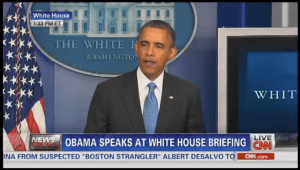
The Audacity of Hope: Obama’s Impromptu Speech About Trayvon Martin and Race

This afternoon, President Obama surprised everyone by making an appearance in the White House press briefing room. He spoke for approximately 17 minutes about Trayvon Martin, race, the law, and some other things. Part of the specialness of this speech was that it was impromptu (at least it appeared that it was unplanned) and was unscripted. [I couldn’t embed the video, but you can see it here.]

There were a lot of key things that he addressed in his speech, but what I thought to be the most important was the last few minutes. In the last few minutes, President Obama said that the younger generations are doing it much better than previous generations. The implication here is that the younger generations are less racist (or less unapproving) than previous generations. He talked about how he would listen to Malia and Sasha (his kids) speak with their friends and hear how they interacted. As a result, he thinks that the younger generations are doing it better than the older generations.

As I heard him say that, it made me think about how our countries are governed. Right now, the people who run the country (and by extension, the world) are older. I wonder what it’d be like if we had younger people who ruled the world. Maybe younger people would “get us there faster.” As a way to temper the eagerness of young people, maybe it’d be important to have some people from older generations to be advisors.

I wonder… are there any countries, states, provinces, counties, cities, or towns that are run by “younger” people? Are they more successful? Could we map this onto bigger populations with the same success?

~

For the first 14+ minutes, it seemed like there was an almost sombre tone to President Obama’s remarks. However, as he shifted to talking about the younger generations, I got the sense that he had hope for the future. I got the sense that he had hope for the future of the country because of the progress he sees in younger generations. While nothing is certain about the future nor are the implications, I’d like to think that it’s rather poetic that the leader of the United States believes in a brighter tomorrow. That President Obama believes that we are getting better as a society. As a people. That we are beginning to treat each other with more respect. More love. More kindness. And the hope is that this will continue with each succeeding generation. Hope.

It is Important to Speak, but not More Important than it is to Listen

A couple of days ago I wrote a post about leadership and followership, the overwhelming majority of literature dedicated to leadership, and the dearth of literature dedicated to followership. When writing that post, it reminded me of the same relationship between speaking and listening. That is, how much literature do we see dedicated to speaking or communicating and how much do we see dedicated to listening?

Don’t get me wrong, I think that communication is an essential part of the human experience, but dont we think that learning to listen should be equally (if not more?) important than speaking. We can make the same comparison we did with leadership: how much time do we spend speaking in relation to how much time we spend listening? We spend far more of our time listening. So, shouldn’t it follow that we need to learn how to be excellent listeners?

Of course, if we don’t know how to speak (at all) then the listening is futile, but I suspect that if the majority of people were excellent listeners, we might be able to aid the speaker in communicating their point. Just as I made the case with followers who can make a leader better, I think that listeners can make a speaker better, too.

~

A slight tangent: how many courses are there in communication? There are probably quite a few more than there are in listening. In fact, there’s even an entire academic discipline dedicated to communication. Is there one for listening? Some may argue that clinical/counseling psychology might be how listening creeps its way into an academic discipline, but that’s only one piece of the training for clinical/counseling psychologists. It’s important to note that psychologists who don’t go the route of counseling won’t get this kind of training, so it’s necessary to specify clinical/counseling.

I like to think I’m a pretty good listener (and have been given affirmative feedback), but I don’t doubt that I would benefit from the insights of academic research on listening. In fact, I bet we all could benefit from academic research on listening. Until then, we’ll have to rely on the wisdom of quotes:

“Wise men speak because they have something to say; fools because they have to say something.” – Plato

“When people talk, listen completely. Most people never listen.” – Ernest Hemingway

“If A equals success, then the formula is A equals X plus Y and Z, with X being work, Y play, and Z keeping your mouth shut.” – Albert Einstein

“Everything has been said before, but since nobody listens we have to keep going back and beginning all over again.” – Andre Gide

“Most people do not listen with the intent to understand; they listen with the intent to reply.” – Stephen Covey

“We have two ears and only one tongue in order that we may hear more and speak less.” – Diogenes Laërtius

And one last one that I really like:

“You cannot truly listen to anyone and do anything else at the same time.” – M. Scott Peck

Thirty Leaders and Two Followers: Can We All Be Leaders?

A few weeks ago, I was preparing to teach by re-reading the chapter for which the material we’d be covering in class. Part of the class session was going to be spent on leadership. Granted, this is an undergraduate textbook in organizational behavior, I was truly disappointed to find that of the 30+ pages on leadership, there were only two — 2 — pages spent talking about followers. I don’t know about you, but I’ve never seen a successful leader without followers.

One of the broader issues here is math. Of all the people in the world, how many of them do you think will be leaders? Of all the people in the world, how many of them do you think will be followers? I’m not saying that people shouldn’t strive to be leaders or be the best they can be, but based on our current definition/understanding of leadership, not everyone will spend a great deal of their time being a leader. In fact, most people will spend the majority of their lives being followers — and there’s nothing wrong with that. In fact, many of the people that we think of as great leaders were — in fact — once followers. Some say you have to be a good follower before you can be a good leader, but I’m not really going to get into leadership philosophy right now.

Instead, I wanted to draw to your attention to the amount of time we spend thinking about, talking about, and teaching leadership and the absolute void with regard to following. For instance, a quick Google search returns over 450,000,000 results for leadership, but only 420,000 for followership. You might think that’s not a fair comparison, so what about how to be a good follower or how to be a good leader? Follower returns: 54,000,000 (though I think some of these might be returning religious results). Leader returns: 1,350,000.

While leadership is more revered, it certainly seems like there’s room in the popular literature for a few great books on followers and how to be a good one.