
The More Things Change, The More They Stay The Same… Wait What?

Change management is the cornerstone of shepherding an organization through and to change. And since change is the only constant in life [side note: how many articles are there out there about change management where you think Heraclitus is not mentioned?], it seems pretty important that we understand the best ways to go about doing that.

When I think about the times that I’ve aided in an organization undergoing large-scale change, I think about the principles used to help bring that to fruition. Some lean on approaches like Kotter’s 8-step change model while others lean on approaches like ADKAR. For as long as I’ve been part of making change happen more smoothly (or teaching it to university students!), I don’t remember coming across this approach –

Emphasize What Will Stay the Same

Wait, what? We’re changing things here, why do we want to talk about what’s staying the same? We need to sell our people on this new vision and way of doing things. Won’t this torpedo our efforts?

Well, as it happens, no, it won’t. An excerpt [Emphasis Added]:

A root cause of resistance to change is that employees identify with and care for their organizations. People fear that after the change, the organization will no longer be the organization they value and identify with — and the higher the uncertainty surrounding the change, the more they anticipate such threats to the organizational identity they hold dear. Change leadership that emphasizes what is good about the envisioned change and bad about the current state of affairs typically fuels these fears because it signals that changes will be fundamental and far-reaching.

We announce that a change is coming and then people begin to fear the ramifications of losing what it is that they know. We then think that by emphasizing how things are going to be better (read: different) that this will then onboard people to this new vision, when instead, we’re giving them even more reason to dig in their heels against the change. Wow. It reminds me of those times in parenting when, as the parent, you want things not to go a certain way and by espousing that wish, you unintentionally expedite its occurrence.

What should we do, then? Well, how about:

In overcoming resistance to change and building support for change, leaders need to communicate an appealing vision of change in combination with a vision of continuity.

Let’s see if we can apply this knowledge:

  • We’re going to centralize all IT within the federal government. While this change will help us realize efficiencies upon efficiencies, our main goal is – and always will be – to continue to deliver exemplary service to Canadians.
  • We’re going to fundamentally improve the way that public servants apply for positions within the federal government. This change will allow us to better track the knowledge and experience of public servants and of the kinds of skills required of hiring managers across the government. While the interface for jobs.gc.ca will appear different, you’ll still be able to offer hiring managers the same information you did previously (more efficiently to boot!).
  • We’re going to Make America Kind Again increase the level of respect within the federal public service. You’ll still come to work and work on all the same cool things that you get to work today, but now we want to emphasize actions and behaviours that end harassment, curb negative behaviours, and multiply positive behaviours.

Can you think of other examples where you can apply this approach in your upcoming (ongoing) change management efforts?

This was cross-posted to GCconnex/GCcollab.

Ohh, You Betta Recognize!

mark-adriane-muS2RraYRuQ-unsplash.jpgThe other day I was feeling particularly spry. There was a jump in my step and I went about my day with great jubilance. You could argue for any number of things that contributed to this feeling, but in reflecting back on it, I’d argue strongly that there was a direct link to my being recognized. Recognized you say? Yes, recognized.

What does it mean to be recognized. Well, for one, it means that you’re doing good work (which is always a good thing). Two, it means that someone saw you doing the good work. And most importantly, three, that someone saw fit to tell you (or someone else) about the good work that they saw you doing.

It sounds so simple when I lay it out like that, but I know it won’t surprise any of you when I saw that following through on recognition is a lot harder than it seems. Reviewing the proverbial ‘tape’ shows that, according to public servants, there’s still a lot left to be desired when it comes to recognition for a job well done (since 2011, 2 out of every 5 public servants feel like they don’t receive meaningful recognition for a job well done).

So – what can we do to fix this (aside from the obvious, i.e. recognize them!)?

Well, it turns out that recognition isn’t as simple as all that. There’s more to it than simply “going through the motions.” I expect you probably already knew that, so let’s get right to it.

Frequency. How often do you think recognition should happen? Daily? Weekly? Monthly? Yearly? How about… bi-weekly! It might sound trite, but you might find it useful to keep a ‘scorecard’ of recognition (say, within an Excel file?), so that you can be sure that you’re making the proverbial rounds.

Organizational values. So, if you’re praising folks bi-weekly, what are you praising them for, exactly? Well, one school of thought would have the praise be directly tied into the organization’s values (i.e. culture). This is the perfect way to perpetuate the behaviours within the organization that one wants to see.

Matching. This is one of my pet peeves. Many years ago when I was a resident assistant, it was common for my resident director to hand out ‘recognition’ in the form of gift cards to a local restaurant – no matter what it was that we were doing in our jobs. We might have prevented one of our residents from committing dying by suicide or we could have made sure all of our residents had passed their “clean room check” – we still got that gift card. Ironically, this recognition sometimes had the opposite effect – it was demotivating. If you’re doling out recognition, make sure the recognition matches what’s being recognized.

Personalize. Maybe more importantly than matching is ensuring that recognition is personalized to the individual. Meaning, maybe some folks would eat up the gift cards for the local eatery (pun intended!). Maybe other folks just want to have a simple “thank you.” Other folks might thrive on being lauded for their achievements in a public setting. The point is that it’s incumbent upon you to figure out what it is your employees want when it comes to recognition, so that when it comes time to recognize them, you do so in a way that encourages them to continue doing things worthy of recognition.

EDIT: Big thank you to @Darlene.Marion for catching the language slip up re: “dying by suicide.”

This post originally appeared on GCconnex/GCcollab.

The Most Common Biases in Business Decisions

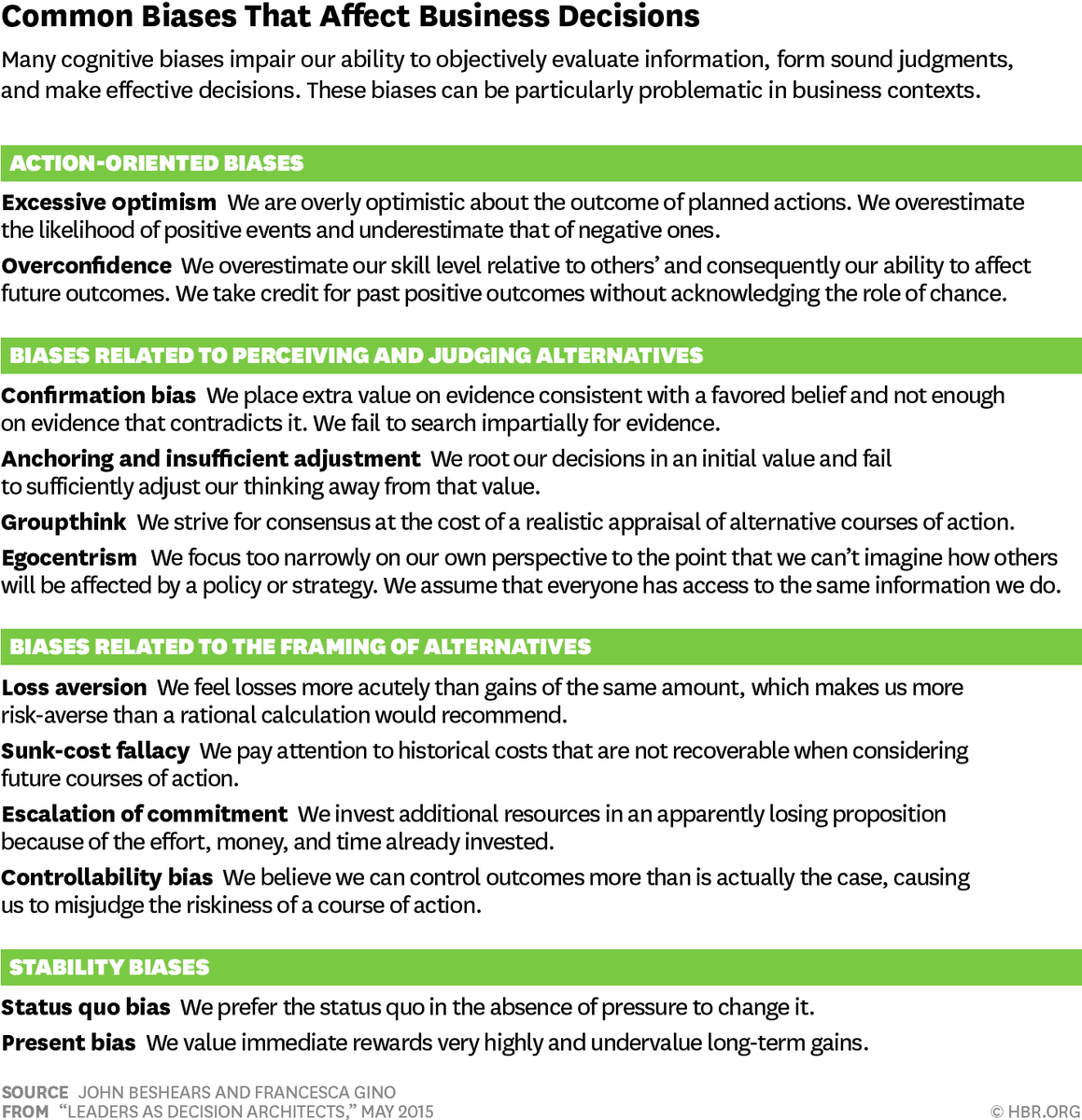
If you’ve been following me for any length of time, you’ll know that one of topics that I write about the most is cognitive biases. So, when I came across an article on the Harvard Business Review that neatly wrapped up some of the more common biases in business decisions, I just had to comment on it.

I agree with just about everything in this table (?), but I’m surprised about one thing: the endowment effect. That is, I’m surprised it’s not listed in the table. Specifically, listed under ‘stability biases’ as this is where it would fit. To refresh your memory:

In short, it means that people want more money for something than they’d be willing to pay for it. Put differently: we overvalue that which we own. You could think of a simple example of this through the course of a negotiation. When negotiation with someone, we’ll probably overvalue what we bring to the table. Someone may offer you $50 for your 25-year old keyboard (piano), but you think it’s worth at least $75. Barring any outside appraisal, the endowment effect is likely at play here.

Given the number of deal-making that takes place on a regular basis, I’m surprised that we didn’t see this as part of the table. It seems to me that in business, when money is often the thing that’s held in the highest regard (for better or for worse), you’d want to have people with the decision-making power understand that they may be overvaluing what’s theirs.

Upon further reflection, I can understand why one may not see it as a “common” bias because in today’s society, (at least in Western cultures), the common transaction is cash for stuff and not stuff for stuff (barter). If bartering were more the name of the game, then I would certainly want to see the endowment effect on that list. Either way, though, it’s certainly worth remembering that we tend to overvalue the stuff we have.

Why Women are Better CEOs, Presidents, and Prime Ministers

New research shows that women are far better at handling stress than men. I suppose that’s not a newsflash as most people already think that’s true, but consider the way in which this study frames it [Emphasis added]:

We consistently found the same general response pattern: while stressed women showed higher self-other distinction than women in the non-stressful control condition, men showed the converse pattern. More specifically, stressed women showed reduced emotional egocentricity bias, enabling them to judge the emotions of the other person in a way that was less influenced by their own emotional state. Moreover, their response times in the cognitive perspective-taking task decreased under stress, documenting that they were able to regulate the mismatch between their own and the “director’s” perspective faster under stress. Finally, stressed women showed a reduction of automatic imitative tendencies in the imitation-inhibition task, indicating that they were able to overcome low-level social signals interfering with their own movement intentions. Note that the latter finding is crucial. It highlights that women did not simply show an increase in other-related responses under stress – as this would have resulted in increased interference from automatic imitation. Instead, they were able to flexibly increase either self- or other-related representations, depending on the task demands which either required overcoming egocentric biases, or overcoming social interference.

As the stereotype goes, women are more “emotional” than men, so it would be much better for an organization or unit if it were managed by a man. However, this research is telling us that, when under stress, it is men who are less able to distinguish their emotional state from the intentions of those around them. It is men who are more adversely affected by stress. For women, it’s the opposite. In fact, women tend to be more prosocial [behaviour intended to benefit others] when they’re stressed. Meaning, instead of retreating inward, women are actually more helpful when they’re stressed.

This research certainly makes one think about the way that many organizations and countries are run today. Most people would agree that being a CEO, President, or Prime Minister certainly comes with oodles of stress. Unfortunately, the number of women who hold these positions is far outweighed by their male counterparts. Of course, there are a number of reasons for that, which we won’t get into in this post, but consider for a moment if the numbers were flipped. That is, what if there were more women CEOs (or high-powered leaders)? Or, what even if it was 50/50! What if the number of high-powered leaders and CEOs was 50% women and 50% men? At that point, would it be easier for folks to see, understand, and digest that women are actually better leaders and better at handling the stress?

Maybe it’s the language we use.

A quick Google search showed mixed results for “women are better CEOs.” In fact, many of the results near the top indicated that women CEOs are more likely to be fired. However, when I keyed in “women are better leaders,” I got plenty of positive results. Posts on Harvard Business Review, Business Insider, and articles talking about academic research in newspapers like The Globe and Mail.

If there’s one thing I’ve learned about the world during my time in it, it’s that change (usually) happens gradually. Rarely is there a massive cultural shift overnight. So, here’s hoping that research like this contributes to the realization for some that when it comes to managers and leadership, women just might have an edge over men.

ResearchBlogging.orgTomova L, von Dawans B, Heinrichs M, Silani G, & Lamm C (2014). Is stress affecting our ability to tune into others? Evidence for gender differences in the effects of stress on self-other distinction. Psychoneuroendocrinology, 43, 95-104 PMID: 24703175

Case Study: When The Twitterverse Turns on You

http://blogs.hbr.org/2013/12/case-study-when-the-twitterverse-turns-on-you/Every once and a while, Harvard Business Review posts a case study to their blog and solicits their readers to come up with answers to the case. After reading what was posted earlier today, I took some time on my flight back from Washington, DC to Toronto to see if I could develop a suitable strategy for responding to the ‘crisis’ at hand. Head on over to HBR and check out the Case Study. I’d be interested to hear some of your thoughts on how Canadian Jet should proceed.

Here’s what I came up with:

When faced with a decision like this, it’s important to ensure that the group isn’t succumbing to any biases in judgment and decision-making. Right off the bat, it’s clear that one potential trap is the sunk cost fallacy. While the decision to keep the contest running might be the right one, it’s necessary to discern whether this choice is being made because “this is our biggest social media campaign,” and we’ve got “nothing [else planned] on this scale.”

If it were my decision, I would advise Charlene to keep the contest. Right now, it’s going through a bit of a bumpy stage, but when viewed through an optimistic lens, these customers who have tweeted “doozies” can actually turn into some of Canadian Jet’s biggest assets. How? By directly addressing their concerns.

Seek out those customers on Twitter who have shared tweets that have had the greatest impact (reach via retweets, etc.) and apologize to them. Speak to them directly on Twitter, (but not in a direct message, part of the purpose in doing this is so that others can see that you’re) on Twitter and express remorse for their concerns. Where possible, maybe offer some sort of compensation in the form of a discount on their next flight or something similar. It’s important to keep clear that you don’t think that this makes up for the fact that they’ve “missed their daughter’s wedding,” but that you hope they can find some consolation in it.

In The End, Everything Will Be OK – If It’s Not OK, It’s Not Yet The End

It’s no secret that I like quotes. Since converting my Facebook profile to a Facebook page, I’ve gotten into the habit of sharing a “quote of the day.” If my calculations are correct, I’ve been sharing quotes of the day for over 80 days now. As you’ll notice that I also have a quotes category, I’ve shared a number of quotes here on this site, too. And if I think back to the days of AIM (AOL Instant Manager), I often had quotes as my “away” message. And even before then, I remember really liking quotes in high school and in elementary (or grade) school. So, like I said, it’s no secret that I like quotes.

As you may have noticed, the title of this post is a quote. I’ve seen this quote in many places — most recently, on a Harvard Business Review comment:

Failure is seldom fatal or final. I loved the line in The Best Exotic Marigold Hotel movie. “It will be alright in the end and if it is not alright, it is not the end.”

Some may quibble over the word “alright” vs. the word “OK,” but the essence of the quote is the same. After seeing it there, I felt motivated to find the original author. Not that I was planning on digging through reams of archives at an historic library, but just that I thought with some Google-sleuthing, I’d be able to figure it out. It’s a quote that I often see unattributed and I thought to myself that someone had to have said that at some point, right? I did something like this about 18 months ago, when I wrote a post about a great quote being often incorrectly attributed to Howard Whitman — when in fact it was spoken by Howard Thurman.

So, after some Google-sleuthing, I came to a Wikipedia page for Fernando Sabino, who was a Brazilian writer. On that page were a few quotes, one of which read:

“No fim, tudo dá certo. Se não deu, ainda não chegou ao fim.”

The translation follows:

“In the end, everything will be ok. If it’s not ok, it’s not yet the end.”

Having seen how incorrect Wikipedia can be sometimes (pranksters, of course), I thought I’d wait for a while before being sure that this was correct. [Note: I originally wanted to include a link to an image I uploaded to Twitter that showed “Buddha” as the author of The Hunger Games, but apparently old images on Twitter are deleted — or something like that. So, you’ll just have to imagine that there was a screengrab showing “Buddha” as the author on The Hunger Games Wikipedia page.] And then I thought, this Wikipedia page probably isn’t visited nearly as often as The Hunger Games page, so I thought I could trust it. So, I plugged the same Portuguese from the page into Google Translate (just to see if it was the same), and I got a similar quote to the English that appears on the page.

My next step was to see if I could find this quote attributed to him somewhere else on the Internet. Since this quote is often unattributed, this took a bit more time. When I noticed I was hitting a bit of a roadblock, I thought I’d see if I could find other pages on the web of Sabino — and I did! I found a Facebook page for him. While it doesn’t take “too” much effort to create a Facebook page, I noticed that there were almost 2000 likes and that the page has been around for 3+ years. I noticed that the quote was also on the Facebook page. And next to the quote was  this:

– Fonte: “No fim dá certo”

When I plugged this into Google Translate, it said, “- Source: “In the end it works.” So, now I had a source! In looking for that source in English, I didn’t have much luck, so I used the Portuguese. One of the first Google results was a book! The book was also available on Google Books, (but I couldn’t see very much of it, so searching the book for the quote was difficult). Not to mention that I don’t speak Portuguese and sometimes, when you look for words on Google Books, they don’t always show as being there (even though they are there).

It’s still quite possible that I fell victim to some sort of hoax (not as elaborate as Lance Armstrong or Manti T’eo, though). I am fairly confident (at least 90%) that Fernando Sabino is the original author of this quote.