Another “Final Jeopardy!” Spelling Error: Yul Brynner vs. Yule Brenner

Earlier tonight, I received an email from someone who found a post I wrote this past summer about the official final jeopardy spelling rules. This person alerted me to a something that happened on tonight’s (January 2nd, 2014) final jeopardy. [As an aside, I tried to wait before posting this to see if there might be a YouTube video of what happened, but I haven’t seen one, yet.]

As it was retold to me through email, the “answer” (or question, as it were) to final jeopardy tonight was “Yul Brynner.” One of the contestants correctly spelled this and one of the other contestants answered incorrectly. However, the last contestant (there are usually three), spelled their answer, “Yule Brenner.” Note the “E” in the first name and the “E” replacing the “Y” in the last name. Most people would think that they answered incorrectly. While it’s true that they did spell their answer incorrectly, note that it doesn’t really change the pronunciation of the two names. That is, you can pronounce “Yul Brynner” effectively the same way that you pronounce, “Yule Brenner.”

Why am I focusing on the pronunciation and not the spelling? Because from what people have identified in watching the show, it’s the pronunciation that the judges emphasize in this game. That’s why there was quite an uproar this past summer when a young Jeopardy! contestant misspelled Emancipation Proclamation as “EmancipTation Proclamation.”

Here are a couple of excerpts from my post this summer that might help shed some light on this whole idea of spelling vs. pronunciation [Emphasis Added]:

I have no official source for this, but from what I’ve heard from various people over the years, there is no official written set of rules that the judges are required to abide by. It has been mentioned that this could be done for liability purposes, because if the judges were to make a ruling that went against their written rules, a player could potentially sue them, or something like that. I believe that in the contestant paperwork, all players must sign something agreeing that all judges’ decisions are final. There may be some general guidelines for acceptable responses in this paperwork, but they probably don’t cover all possible scenarios, and the judges’ decision will always be final.

There are a lot of little rules of thumb that longtime viewers of the show have been able to piece together over the years, and most times the show’s rulings seem pretty consistent with past precedents. It is generally accepted that leading articles can be omitted and still be ruled correct, as in “Grapes of Wrath” or “Midsummer Night’s Dream”. However, incorrect or missing articles within a title will lead to an incorrect ruling, such as “One Flew Over a Cuckoo’s Nest” or “Gone With Wind”. Those may be poor examples, but I can’t really think of any good ones at the moment.

As to the consonant/vowel distinction, the general rule is that when giving a response verbally, you don’t have to pronounce it correctly, but you must at least give something that could be a possible phonetic pronunciation of the correct spelling. Generally this means that you could change vowel sounds, but you need to use the correct consonants, otherwise what you’ve said does not appear to be the same word as the intended correct response. Without examples in front of me this is hard to explain. It often comes up in cases of foreign words, or names of famous people that someone has seen in writing many times, but rarely has heard spoken aloud.

In Final Jeopardy, the rules are similar, but the opposite is true.While your spelling can be incorrect, what you have spelled should be possible to pronounce in the same way as the intended correct response. Normally if you change a consonant, something is not going to be pronounced the same way, while changing vowels could still lead to similar pronunciation. One recent exception to this rule was when Franz Liszt was the correct FJ response, and one contestant responded with “Who is Lizt”. While she was missing a vowel, the “s” and “z” sounds in Liszt sort of blend together, so the judges likely decided that “Lizt” or “Lizst” would be accepted. I don’t know if they would have accepted “List”. They may also have accepted something like “Lieszt” or “Leeszt”, as there is probably a lot of wiggle room in dealing with vowel sounds of foreign names like this.

France’s 75% Tax on Millionaires is Not What You Think

Almost two years ago now, there was a big hullabaloo because France proposed a 75% tax on millionaires. Some folks were really upset that millionaires were going to have to pay 75% of what they earned in a year for taxes. WRONG. This is not true. In no country (that I’ve ever seen), do taxes work this way. One of the words you often hear — progressive. Another one — marginal. Confused?

I’ve been thinking about this over the last few days. Since it was announced that the President of France was getting approval for the 75% tax, I’ve been listening to what some folks have been saying about this tax. It reminds me of what happened last year (around this time) when there was talk of extending the Bush tax cuts in the US. People were confusing or not really understanding just how the tax system works.

Essentially, taxes are the same for everyone. How?

There was an article in the New York Times a couple of years ago where there was someone in the US who was worried about making a few extra thousand bucks because she didn’t want to be taxed at the higher rate. What? That’s right. She thought that because she made (fictitious numbers) $100,000 instead of $98,000, she was going to have to pay more taxes on all of her $100,000. If you know anything about taxes, you know that this is not true.

When you pay taxes, you pay the same as everyone else. That is, if someone earns $35,000/year and you earn $50,000/year, you both pay the same amount of taxes (up to) $35,000/year. However, you will also have to pay taxes on that $15,000 difference. Depending on the country’s laws, that might be the same rate. Another word for this is tax brackets.

Remember earlier when I mentioned the words marginal and progressive? This system of paying similar amounts of money across people is called marginal or progressive taxes. It’s important that it’s conducted in this manner, otherwise people would be incentivized to do what that lady in the NYT article was talking about — not earn extra money when you’re near a new bracket for fear of having to pay a different rate on all of your money. Of course, we know that this isn’t true.

Something I don’t understand is how many people simply don’t understand this. There are some things in life that are important and worth knowing and I’d think that knowing how/why you pay your taxes would be one of them. Maybe we need to do a better job of educating folks in school about this idea of marginal/progressive taxes. Maybe we need to change the name, I don’t know. Until then, I’ll keep writing posts like this to remind you just how tax systems work.

By the way — I should note that I’m not arguing for/against the 75% tax that Francois Hollande has just had approved, I’m simply trying to explain what it is, so that when people do debate the merits, they’ll actually be talking about the same thing.

What’s Wrong with the Dallas Cowboys?

Yesterday evening was the last game of the 2013 NFL regular season. It featured the Philadelphia Eagles and the Dallas Cowboys — bitter rivals — in what was a game where the winner was crowned the NFC East division champion. Both teams took very different paths to the game. The Eagles started the season quite poorly, losing 5 of their first 8 games. The Cowboys finished the season quite poorly, losing 3 of their last 4 games (including the game last night against the Eagles). The one win in the last 4 games for the Cowboys was in the game just before last night’s game where the team’s QB, Tony Romo, played through a season-ending injury to lift the Cowboys to victory.

As Tony Romo was one of the team’s stars, most people didn’t give the Cowboys much of a chance of winning last night’s game. However, there they were, in the waning minutes of the game, with a chance to win. What happened instead? A mental error. The Cowboys have been making mental errors near the end of the game more frequently than they had been in decades past. More importantly, there have been these mental errors when the game is on the line.

Let’s back up for a moment and look at the Cowboys as a franchise. They are one of the most storied football teams in the NFL and certainly one of the most lucrative. In the ’90s, they had what could be called a dynasty when they won the Superbowl in 3 out of 4 years between 1992 and 1995. In the decade of the ’90s, they only missed the playoffs twice (1990 and 1997). In that one decade, they made the playoffs more times than they have in the past 14 years (6 times). What happened?

In 2000, Troy Aikman, the star QB of the ’90s for the Cowboys, retired. In the time between Aikman (and Romo), the Cowboys had a potpourri of QBs that I’m sure most people would rather not remember. In 2006, when Romo took over as the starter in the middle of the season, the Cowboys went on to make the playoffs. They went on to make the playoffs in 3 out of the first 4 seasons that Romo was the QB, but haven’t been back to the playoffs in the last 4 seasons.

Based on how some of those seasons ended and/or how some of those playoff games ended, it seems evident that Tony Romo is in dire need of a sports psychologist. If we go back to the 2006 season playoff game against the Seattle Seahawks, Tony Romo dropped the ball when the kicker was attempting a go ahead field goal with less than 100 seconds left in the game. Or the playoffs in the next season when the Cowboys were tied for the 2nd best record in the NFL. Tony Romo threw an interception in the end zone with less than 10 seconds to go in the game. Or last season’s final game when all the Cowboys had to do was win and they were in the playoffs — Romo threw 3 interceptions. Last night Romo didn’t play, but if we can look at more than one game this season when Romo threw an interception when the game was on the line (against the Broncos and against the Packers).

Because of how the game ended last night, with the Cowboys QB — again –throwing an interception when the game was on the line, I wonder if there might be something else at play here. A couple of years ago, I wrote about some of the problems that the Vancouver Canucks goalie was having in the Stanley Cup Finals and how there might be something else that was affecting play. I wonder if that might be happening with the Dallas Cowboys’ QBs right now.

Part of the reason I talked about the success of Troy Aikman and the Cowboys during the ’90s is because I wonder if something changed — energetically speaking — with the “position” of the Cowboys QB. I know that this might sound strange, but it’s an option worth considering. Tony Romo has been one of the best QBs — statistically speaking — since he’s been in the NFL. He’s already thrown for 50 more TDs than Troy Aikman did in his career and Romo has played in 50+ less games. Romo currently has a 95.8 career passer rating. Currently, that ranks him 5th highest — all-time. Assuming Romo is able to recover from his injury, he’ll more than likely pass Troy Aikman on the all-time passing yards list, where Aikman currently ranks 30th. Tony Romo has been a fantastic QB for the Cowboys — statistically. However, when the game is on the line, things haven’t exactly gone his way. As a result, I’m lead to believe that, a) a sports psychologist is in order, and b) maybe there’s something energetically at play that’s affecting the organizational position of “Dallas Cowboys QB.” It might behoove Jerry Jones to call someone who can figure it out.

Why Love Actually is a Good Christmas Movie

While Christmas happened a few days ago now, I wanted to write a quick note on Love Actually. You may or may not have heard of this Christmas movie. It was first released about a decade ago, but many people seem to want to watch it when Christmas rolls around. I didn’t realize just how popular this movie had become at Christmas time (my wife and I have watched it just about every Christmas since we’ve been married) until I started seeing notes about the movie in my twitter feed.

That is, there were some folks who were vehemently against Love Actually as a “good” romantic comedy. In fact, one person wrote:

The fundamental problem with Love Actually is that it presents romance as either absurdly easy—something that strikes you like a thunderclap and requires only a single grand gesture in order to be fulfilled—or all but impossible. Notably absent is the idea that love might ever be worth a little sustained effort: some mutual exploration and discovery, a bit of care and nurture, maybe even the overcoming of an obstacle or two. Indeed, it’s hard to shake the sense that what is “classic” about Love Actually is not that it shows us anything about how people fall in love, but that it so conspicuously declines even to try.

But there are also those folks who feel quite the opposite. That is, they think the film is actually quite good:

More than anything, Love Actually is a movie by people who get it. That get that the holidays are about love and loss and memories. It’s about new beginnings and it’s about endings. It’s about family and second chances, and sometimes it’s about the same old, same old. It’s love, in its many, many forms, lighting the way through the coldest season.

Then, there are those who are trying to figure out whether the movie should actually qualify as a classic (over 80% of voters on this CBC website think that it should be).

I can stipulate that Love Actually might not be promoting the “best” version of love, but I would say that with a level of maturity and understanding that some of what’s being portrayed is actually tongue-in-cheek (do all British men really think that their accent is enough to get American women to sleep with them?) the movie can be quite heartwarming. Putting that aside for a moment, one of the best aspects of the movie for me is the message of truth-telling. On a number of occasions we hear the characters saying something to the effect of, “It’s Christmas, so I wanted to tell the truth,” (or “tell you,” or “check with you,”).

To me, this is great. I enjoy that there’s this subtle albeit noticeable message that it’s important that we tell the truth with people we care about and/or are interested in spending time with on a regular basis. So, if you do decide to watch Love Actually at Christmas time or any time for that matter, maybe pay less attention to the “fake love” parts and pay more attention to the “truth” parts.

How Y’all, Youse and You Guys Talk: What About Canada?

I’ve been clearing out some of the tweets that I’ve favourited over the last week or so and one of them was a fun dialect quiz from the New York Times Sunday Review. There are 25 questions that ask you the various ways you do (or do not) refer to certain things in the world around you. For instance, do you say y’all or youse or you guys (or something else) when referring to other people?

I found it relatively fun.

If you do decide to do it, though, I’d advise you to be careful in selecting an answer too quickly. There were a few questions where I clicked on one option and hit next and as the next question was loading, I noticed that there was actually an option for (none of these).

I realize that the New York Times is hosting this quiz, but I would have been interested to see where I stand in Canada. Maybe The Globe and Mail or the National Post can look into doing something similar?

I grew up in the Toronto area and have spent some time in British Columbia (and now Ottawa), but I’d be interested to see how I compare to other Canadians. Since I did grow up in Toronto, I wonder if that throws a wrench into my dialect. And, since I’ve lived in so many different places (California, Hawaii, New Zealand, Michigan, Virginia, etc.).

On the whole, it turns out that my dialect is closest to the people in Portland or Seattle. If I’m being honest, after undergraduate university, the west coast of the continent is where I’ve spent most of my adult life. I spent about a year in California and about a year in British Columbia (and about a year in Hawaii). The next closest would have been Virginia with 2 years.

Still Looking for a Christmas Present? Try These Projects on Kickstarter Canada

It’s the last weekend before Christmas, so there’s a good chance that a lot of you out there are out in the hustle and bustle trying to find last-minute gifts for friends and family. If the weather forecasts are to be believed, some of you might not be able to make it out into the madness that is last-minute shopping before Christmas. That’s great! Why? Well, that means that you’ll have to be a bit more creative with your gift ideas.

So, why don’t you make someone’s day (in addition to the person who you’re giving the gif to) by making a donation in their name to one of these projects on Kickstarter Canada. Also, you could just donate to them anyways — and not make the donation on behalf of someone else: it could be on behalf of you!

Note: I’ve only included projects that — at the time of writing this post — hadn’t reached their goal.

NASH: The Movie

“You may have heard of Steve Nash, the NBA superstar and multiple MVP winner. You may also know that he’s Canadian. A Vancouver documentary crew secured unparalleled access to Nash, and they’re in the middle of raising money for production and editing costs for the final film. Unlike many film projects, tiers of this project include a physical and digital copy of the final product, which gives potential backers a tangible reward for their donation.” (Source)

Stratus Watch

“The concept is as simple as it is unprecedented; a titanium wristwatch with a face that you can choose. You can choose from dozens of patterns and colours from the manufacturer, or design your own and submit it to them. The watches exude a clean, straightforward charm, and even the lowest funding tier gifts you one of them.” (Source)

Shot Time

“In what could easily be the ruin of many a young soul, this is a shot glass that measures the amount of liquor consumed over a period of time; a potent mix of a stopwatch and a case of acute alcohol poisoning. The consequences of such a device are best left to the imagination, but if it meets its funding goals, the consequences may become very real, very quickly. Hooray for progress?” (Source)

Canadian Black Garlic

“Exactly what it says on the tin; backers are funding the creation and shipping of various black-garlic-based condiments and seasonings. The majority of the project’s funding goal will go to securing a large batch of Canadian-grown garlic, and the rest will go into the blackening and production/packaging process. Is there anything more Canadian than authentic Northern delicacies?” (Source)

SpecShot

“Like the mirror universe version of the Shot Time, the SpecShot is a two-in-one system that scans your drinking water for contaminants and then posts the results online. This process could be equal parts fascinating and harrowing, depending on your results, but the ultimate goal is to spread awareness through hard data, and hopefully inspire some change to our water quality standards.” (Source)

Poorest Canadians Spend More Than Half of Income on Food & Shelter

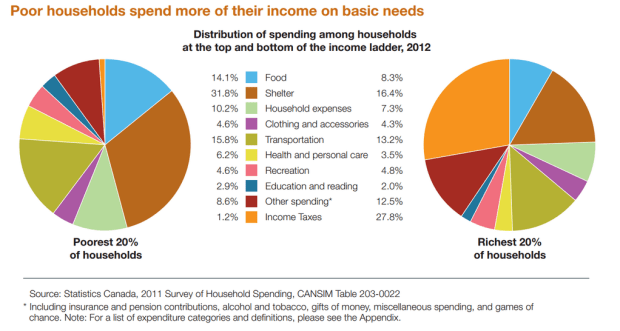
Just over a week ago, I saw this photo retweeted by Gerald Butts, who happens to be a senior advisor to Justin Trudeau (the Leader of the Liberal Party of Canada). As I’ve spent most of my adult life in the US, I’m used to hearing and writing (here, here, and here) about some of the sobering statistics in that country (approximately 50 million American live in poverty — right now!) As a result, I thought it’d be enlightening to take a closer look at some of the inequalities in Canada. This graph seemed like a good place to start.

For instance, I had no idea just how large the disparity was between the richest 20% and poorest 20%, with regard to food and shelter. Looking at the numbers, we can see that the poorest 20% spend approximately 56% (!) of their income on food and shelter. Fifty-six percent! While the richest 20% spend just 32%. I chose these categories because of Maslow’s Hierarchy of Needs. Food and shelter are some of the most basic needs we have and if the poorest 20% has to spend so much of their income on — essentially — surviving, it’s going to make it that much harder to “climb the economic ladder.” Of course, some might say it’s misleading to look at the numbers in aggregate like this.

With that being said, this holiday season, I hope you’ll remember this graph when you’re out at holiday parties and issues of politics and/or charities arise. It may add an important layer of perspective to the conversation.

Would You Rather Pay Fees or Taxes?

A little over a week ago, Matt Yglesias wrote a post on Slate about how to balance the budget while slashing taxes. The solution: call everything a fee.

Well we could solve an awful lot of problems that way. For example, I’d love to see us impose a greenhouse gas emissions fee to internalize the social cost of carbon dioxide. On top of that, I think a small additional fee on the use of gasoline would be justified. And of course road congestion fees on crowded highways. I used to think we should raise the alcoholic beverages tax, but now I think we should eliminate it entirely. Instead, let’s put an “alcohol fee” in place that just happens to be higher than the current tax. Do the same for cigarettes. Legalize marijuana, but subject its sale to a rather hefty fee. It actually turns out that we could replace most taxes on labor and capital with a land occupancy fee, especially if we call it a “land occupancy fee” rather than a “land value tax.”

After reading this post, it made me think of Michael Sandel’s chapter about fines versus fees. Maybe some of the things that Yglesias is talking about in this post should actually be labeled fines and not fees. For instances, if we’re talking about internalizing the social cost of carbon dioxide, isn’t there a moral piece to it? That is, shouldn’t we call this a fine, then? You may disagree, but the nomenclature in this case does matter.

It seems a bit absurd to think that people would be more amenable to paying money for something merely by changing the label from ‘tax’ to ‘fee,’ but labels matter.

While it’s certainly a creative idea to start charging fees and lower taxes, there is an important bit to consider here. Namely, the control of these fees. Have you ever had to pay a fee to get your license renewed? Do you know how much it costs the government to ‘actually’ renew your license? I don’t. But I know that I get charged close to $100 to renew it. Josh Barro solidifies the point:

Politicians tend to regard fees as more palatable than taxes, and more focused too. If a state needs to finance an infrastructure to oversee fishing, why shouldn’t fishermen foot the bill? But groups like the nonpartisan Tax Foundation in Washington worry that governments are now using fees to shore up budget shortfalls rather than cover specific costs incurred by specific users.

“When it comes to paying for bananas, you’ve got the market as a mechanism to make sure you’re paying a fair price,” says Josh Barro, a staff economist at the Tax Foundation. “But when it comes to getting your driver’s license renewed, the government has a monopoly, and you have no idea what it costs the state or what it’s doing with the money.”

The moral of the story: maybe taxes aren’t so bad after all.

Should it be Illegal to Call Someone ‘fat’ on TV?

Jennifer Lawrence thinks so.

Take a look:

She certainly makes a good point. If we’re regulating other words that are spoken on TV because of the effect they have on younger generations, why not the word fat? I can already begin to see the argument against: “if we start regulating words like ‘fat,’ does this become a slippery slope into regulating other words?” While I understand that practically, regulating criticisms like ‘fat’ on TV might be a bit difficult, I think it’s certainly something interesting to consider.

I originally saw this clip as part of a bit from Morning Joe, but that doesn’t embed so well here, so I found a clip of Walters’ interview with Lawrence on YouTube. The actual bit I saw had some commentary from some of the folks who make regular appearances on the morning television program on MSNBC. As I said, I can’t embed that video, so take a look.

Similar to how the opinion can be understood of the “slippery slope,” the first fellow that speaks on the video that’s telling Jennifer Lawrence (and other celebrities) to ‘shut up’ because they always blame the media for everything — I don’t buy that. It’s not that the media’s at fault for everything, but as has been demonstrated, they certainly do have a large impact on the way that people feel about themselves. In particular, young and impressionable people.

As a result, someone who outright denies the possibility that the media can have an opinion on the way that young people (and even not young people!) can feel about themselves, to me, seems out of touch. To reiterate, I can see where this fellow is coming from, but putting that aside for a second, Jennifer Lawrence absolutely has a point. There’s certainly a culture of highlighting flaws that is perpetuated (not just in the media), but in our culture — and in particular, with young women. I’ve said it before, but I’ll say it again: if you haven’t yet, take the time and watch Miss Representation. It’s an important documentary that I hope will shed some light on this issue.

To be clear, I’m not implying that people, the media, or our culture are necessarily perpetuating this attitude intentionally, but that doesn’t mean that there completely innocent, either.

How Americans Get to Work: Is It Time to Change Incentives?

This past Friday, there was a rather startling chart from The Atlantic. The chart illustrated how Americans get to work, by volume. That is, the total number of people who take the bus, the total number of people who drive, the total number of people who walk — you get the idea. Before clicking through to read the post, I was hopeful… afterwards, not so much:

In case the numbers are too small to read, the effect should still stand — well beyond the majority of Americans drive alone to work. Now, it’s not that there’s anything inherently wrong with this, but now that we’ve seen things like the image below, that illustrates the space needed to transport 60 people in various ways, it seems more reasonable that people shouldn’t drive alone in their car.

Of course, some folks might jump to the argument that there are more people who live in rural areas in America — not true. “In 2010, a total of 80.7 percent of Americans lived in urban areas, up from 79 percent in 2000.” However, just because the vast majority of American live in urban areas, that doesn’t mean that they have access to viable alternative means of transportation. Maybe it’s time for Americans to reconsider the emphasis on culture of cars.