How History’s Most Famous People Scheduled Their Day Doesn’t Matter

Last month, there was a chart that was making its way around showing how some of the most famous creative people scheduled their day.

To be perfectly honest, how they scheduled their day should have little to no effect on how you schedule your day. I appreciated that some articles (like the one from Mic) acknowledged part of the issue:

Since the greats examined here were already generally well-off and moderately successful before the peak of their careers, it’s hard to tell whether the schedules helped them reach success or were a product of it.

The sentence that follows is the most important of the article:

But what is clear is that the vast majority spent large stretches of time doing intellectual and creative work on a regular basis.

Trying to plan how you should spend your day based on how da Vinci or Picasso spent their days is ludicrous. They lived in a completely different time than we do. More than that, the ways that they schedule their days might not be the most advantageous way for you to structure your day. That is, maybe you’re not an early riser — maybe you’re a night owl. Or maybe you’re a hybrid in that some days you stay up late and some days you wake up early.

As the article in Mic alludes to near the end, but doesn’t outright say, there are only two important things to consider here: sleep and exercise. Time and time again, research has shown positive correlations between sleep and creativity and exercise and creativity. If you want to be creative, there’s a better chance that you’ll be successful if you get enough sleep and you get some exercise. Everything else is optional.

The Long View Perspective on Big Data and Metrics?

One of the things that I like to write about is perspective. In my opinion, it’s so important to continue to look at things from different angles and assume other viewpoints to understand the many ways that things can interact. A little over a week ago, I came across a series of tweets from Chris Hayes that presented a perspective that I hadn’t considered:

Big Data is certainly something that has captivated the popular press and some might even say rightfully so. Of course, it’s important that we use metrics when making decisions, but is it possible that the pendulum has swung too far to metrics? It’s hard to say. Chris Hayes certainly seems to think so.

I like how he’s compared this to another phenomenon (can we call it a phenomenon?) from history where engineering took the world by storm. To be honest, given my age, and what I know about ‘recent’ history, I don’t know that engineering had as much hoopla as big data has today. Regardless, this perspective, this long view, is something that we all would be better off with. That is, looking at things from a longer perspective. Considering the adage that ‘history repeats itself.’ Maybe there’s something from our recent past that would help us better understand where we are today.

A good example of this might be international relations. If you’re looking for a ‘fictional’ example, may I recommend the movie “Now You See Me?”

Labor is the Superior of Capital, and Deserves Much the Higher Consideration

Do you recognize those words? Scholars (and/or) American history buffs just might. They were spoken by one Abraham Lincoln on December 3rd, 1861, as part of his first State of the Union address. The quote comes from very near to the end of the speech; the beginning of the third last paragraph. The sentence on its own is worth pondering, but let’s put it in context:

Now there is no such relation between capital and labor as assumed, nor is there any such thing as a free man being fixed for life in the condition of a hired laborer. Both these assumptions are false, and all inferences from them are groundless.

Labor is prior to and independent of capital. Capital is only the fruit of labor, and could never have existed if labor had not first existed. Labor is the superior of capital, and deserves much the higher consideration. Capital has its rights, which are as worthy of protection as any other rights. Nor is it denied that there is, and probably always will be, a relation between labor and capital producing mutual benefits. The error is in assuming that the whole labor of community exists within that relation. A few men own capital, and that few avoid labor themselves, and with their capital hire or buy another few to labor for them.

As is clear, Lincoln is referring to what was a major problem at the time — slavery. While those words were initially spoken with regard to slavery, I think that they have a broader application. That is, labor really is the superior of capital and not just in the context of slavery. Without labor, there’d be no capital. Labor is the backbone of any economy — local or global. As a result, it’s frustrating to see how poorly mismanaged the workforce can be.

From a business standpoint, I can understand why managers would want to crimp on labor, both in the number of employees and their However, I see this as extremely short-sighted. Whatever short-term gains are made from this strategy, they’re lost in the longer term when one has to replace the employee because they’ve either quit or because they’re overworked (and needed time off because of stress and/or fatigue).

I wonder if treating labor as if it’s another “expense” or “liability” is endemic to the culture of work in America. If we revisit the chart about vacation from this past summer, we see that just about every country on that list is in Europe and from what we know about the culture of many European countries, there’s an air of slowness that you just don’t find in America. Maybe it’s that European businesses have already learned this lesson of treating the workforce like an expense and realizing that it’s just easier to pay up front. How different would business look like in the US if the workweek went from 40 to 30 and the number of mandatory paid vacation days went from 0 to 20? Even if the US workweek went from 40 to 37.5 as is the case in Canada, how different would things be, then?

This focus on the short-term seems to be in more places than one. It’s even present in the way public companies are structured — they have to report their earnings every quarter. That is, every 90 days — 90! — a company gives a report to their shareholders (and the public) about their earnings. Predominantly, people are looking to see whether a company “beat” estimates. If (when?) a company doesn’t meet estimates, the stock price usually takes a tumble. But what if this incessant push to meet estimates and focus on these 90-day windows doesn’t allow for an appropriate longer term strategy? What if this 90-day crunch is preventing a company from pursuing a strategy that would make it far more sustainable in the long run and if they attempted to pursue that strategy, their stock price would plummet?

I don’t have all the answers to these questions, but I believe the beginning of the answer starts with labor. Companies that honor and respect their workforce tend to perform better.

The Pentagon Spends More on War Than All 50 States Combined Spend on Health, Education, Welfare, and Safety

I realize that the US is a big country and it has a lot of land that it needs to defend, but that seems like an unbelievable figure, doesn’t it? More on war than all 50 states spend on health, education, welfare, and safety — combined!

That’s just one of the many alarming statistics that I found in this post from Business Insider from 3 years ago. As it’s 3 years old, I don’t know if the the title of this post remains true, but I wouldn’t be surprised if it’s far off. I first went digging on this issue because one of the things I’ve been meaning to write about is how much the US spends on defense.


As the above graphic shows, the US spends a lot on its military and not just a lot in terms of the amount of money it spends, bit it spends so much more than the country that spends the second most, China. In fact, the US spends more on its military than the next ten countries — combined!

Do you think that the US spends too much on defense spending? If I were answering honestly, I’d have to say probably. According to a Gallup poll from February of this year, a plurality of American seem to agree. And it’s not just average Americans who think the US spends too much on defense, but scholars of international relations.

That’s almost 75% of scholars of international relations who believe that the US spends too much on defense. The post where it comes from even parsed out some of the different types of international relations scholars. For instance, over half of “realists” believe that the US spends too much on defense and “realists” view international relations through the lens that the primary aim of a country (but they would call them states) is survival.

There are probably a whole host of reasons why the US defense budget has inflated to the size that it is. There was one answer I found on Reddit that seemed particularly enlightening:

Because the US military doesn’t just exist to defend the invasion of the physical United States.

As the country with the biggest economy in the world, the US has a vested interest in maintaining a global environment that favorable to its interests.

This means having the power to impose its will (for better or worse) on other countries that act against the US’s interests. To do this the US has to spend an incredible amount of money on research and development to make sure that it has the best military technology while also projecting force abroad to make sure its interests are maintained.

Nonetheless, in a parallel universe, it would be interesting to see how the citizens of the US would survive/thrive in a world where defense budget for the the US is cut in half and that money is redirected to other important areas like health and education.

What’s the Difference Between Empathy and Sympathy?

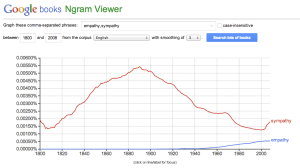
Screen Shot 2014-01-23 at 12.48.00 PMWhen you search for empathy on Google, you get almost 10,000,000 results. When you search for sympathy on Google, you get almost 25,000,000 results. I bet if we could look at historical search results in Google, I bet that we’d see a big trend where the number of search results for empathy has been increasing. The closest thing we can do to this is a search of all the books that contain the word empathy (at least the ones that have been digitized by Google). How? Using Google’s Ngram Viewer.

The chart above shows the mentions of empathy and sympathy starting in 1800 and ending in 2008. As we can see, empathy was hardly mentioned at all when compared to sympathy until the 1920s. That makes me wonder if there might have been some writings about empathy around the time of the Great Depression. What’s noteworthy though, is the steady increase in mentions of empathy. Granted, it’s still in only a fraction (0.0005%) of books, but it’s still progress.

Sympathy, on the other hand, we can see has steadily declined since the early 1900s. However, there’s been a small blip in sympathy since the mid-2000s. I would guess that this may have to do with the title question of this post: the difference between sympathy and empathy.

There’ve probably been several books written about the differences between empathy and sympathy in the last 5 or 10 years. So, do you know the difference between the two? I have to admit, even as an undergraduate in psychology, I’d often find myself googling the difference between the two terms. About a month ago, I came across a great video from the RSA that quickly explains the difference between empathy and sympathy. Of course, there’s a slight bias towards empathy in the video, but I think you’ll agree — empathetic is far better than sympathetic.

In case you’re inspired to be a champion of empathy or want some more information about programs that are helping to increase the level of empathy, I’d suggest checking out Ashoka: Empathy.

And if you want a bit more information about how empathy has shaped our society and continues to shape it, then I highly recommend checking out the RSA Animate video of Jeremy Rifkin’s book, The Empathic Civilization:

Could There Be No Poor Countries in 20 Years? Bill Gates Thinks So

Screen Shot 2014-01-21 at 1.10.10 PMThis is probably one of my favourite headlines I’ve had to write so far this year, especially on the heels of yesterday’s post about less than 100 people having more wealth than half of the world. In the Bill and Melinda Gates’ Foundation annual letter, Bill Gates is optimistic, to say the least:

I am optimistic enough about this that I am willing to make a prediction. By 2035, there will be almost no poor countries left in the world. (I mean by our current definition of poor.) Almost all countries will be what we now call lower-middle income or richer. Countries will learn from their most productive neighbors and benefit from innovations like new vaccines, better seeds, and the digital revolution. Their labor forces, buoyed by expanded education, will attract new investments.

By current definition of poor, Gates clarifies that he means that, “almost no country will be as poor as any of the 35 countries that the World Bank classifies as low-income today, even after adjusting for inflation.”

WOW!

Can you imagine a world where this happens? And Gates thinks that this could happen by 2035 — that’s 20 years from now! Twenty years!

A few months ago, I wrote a post considering what might be my generation’s version of racism:

I’ve spent a lot of time talking about my generation in comparison to generations past, but the true purpose of this post is a juxtaposition of the generations to come. As I said, it seems that past generations had a harder time than mine digesting the mix of cultures. For kids growing up today (in certain countries), it’s abundantly clear that there are people who look different from them and it’s just normal to grow up and be friends with people like this. My question, what is it that my generation will have a hard time with that future generations will see as natural?

Maybe a tangential answer to that question is poverty. Maybe in my lifetime, poverty (as we know it) will be eradicated. That’s certainly a wild idea given the current state of the world, but I for one would be thrilled to see this come to pass as I imagine others would be. With that being said, I could see how some folks might not be as accepting of this change and that’s not to say that they wouldn’t want poverty to be forever changed, but just that they might be a little less comfortable with the change.

As an example, let’s use technology. Generations before mine had technology that was quite different from what we use today. That is, the invention of TV was amazing. Now today, we can watch TV on a device that we can carry around in our pocket. Some folks from past generations are amazed by this and might still have a hard time adjusting to this reality.

That’s how I’m trying to superimpose the possibility of the eradication of poverty for my generation. Some folks might have a hard time adjusting to this reality. Regardless of the comfortability of some folks with this potential reality, I think it’s great that the Gates’ have wrote a letter helping to debunk some of the myths in developmental economics:

  1. Poor countries are doomed to stay poor.
  2. Foreign aid is a big waste.
  3. Saving lives leads to overpopulation.

I definitely recommend checking out the whole letter, which you can read here.

What Will Major Cities Look Like in 25 Years?

Have you ever visited your hometown only to find that there’s been so much change since you’ve left? I certainly have and it’s amazing to see how different things have become since I’ve moved away. Well, if your hometown happens to be a major city, then the pictures in this slideshow might be quite interesting.

The slideshow demonstrates the changes to some of the world’s biggest cities. It’s simply amazing to see the change in what amounts to a rather short time. For instance, the second one from the slideshow included below), showing the difference between Dubai in the span of 13 years… wow. Of course, this is a bit of an anomaly based on the kind of money that’s been invested in Dubai, but it’s still remarkable to see just how much it’s changed.

Dubai – 1990 to 2003

There are plenty more that are just as amazing as Dubai. There’s Atlanta in the span of about 50 years:

Some of the other images, like the ones of Shanghai, Singapore, and Fortaleza (Brazil), make it appears as if you’re looking at a picture of two different places (and in effect you are, because of the time component). If not for the water landmarks, you might think you were being deceived.

My point in discussing these images is look at where we are today. It’s 2014. Think about some of the major places you’ve come to know and love. There are buildings that we look at and think, “Wow… that building’s so tall… we’ll never have taller buildings, will we?” What do you think folks thought 50 years ago?

That’s not to say that taller buildings is where we’re headed. There’s always the possibility that they’ll be advances in magnetization or some other form of technology and we will finally get those flying cars that we’ve been predicting for so long. I have a sneaky suspicion that when the time comes to pass that we do finally have the “next” bit of where we’re going, that it won’t be what many of us are expecting. I doubt that many people in 1950 would have thought that this is what infrastructure would look like 60 years into the future. Similarly, I’ve learned that we, as a species, are rather horrible at predicting the future, so I don’t know that what we’ve predicted has even an infinitesimal chance of coming to pass. Either way, I encourage you to think about it and reflect on how things different could (will?) be.

Where Humans Live: Is There Really an Overpopulation Issue?

In the last 50 to 100 years or so, there has been plenty written about humans having an overpopulation problem. When you read through these articles, you may become concerned that there really is a population problem that’s sweeping the planet. However, rarely (do you ever?) see a picture like the one I’ve included here accompanying those articles. Rather, you usually see a graph (see below), that shows the population has exploded in the last 50-100 years. While that’s true, it’s also true that much of the Earth is still not inhabited by humans.

Of course, I’m not necessarily volunteering to go live in the Arctic, but I think it’s something that’s worth keeping in mind when you hear folks talk about population problems on the planet. I’m not necessarily advocating that we — as a species — go live in the Arctic, but it would appear, at least from a superficial level, that there’s plenty of Earth for humans to spread out, too.

In addition toe “Earth” sprawl, there’s still the option for vertical sprawl. While many major cities in Asia have already ticked that box, there are plenty of areas across the United States were you could just about plant down a new city of 5 million people. There would need to be quite a bit of infrastructure set down first, but there’s room for people.

Should the population continue to grow like it is, humans are just going to have to get a lot more comfortable with each other. In Western cultures, folks are used to having their “own” space. That is, they’re used to some semblance of individuality and personal space. However, if you visit Asian cultures, you’ll find that there’s certainly a lot less focus on the “individual” person and more focus on many people at once (often times, a family — extended or nuclear).

~

I still remember in one of my graduate classes a few years back now, there was a student from South Africa (Note: I’m not implying that South Africa is part of “Asian” cultures.) Our assignment was to draw something where we were relating to our families. I don’t exactly remember what it was, but I want to say a family tree. Anyway, just about every student in the class (predominantly white and/or had spent quite a bit of time living in North America), completed the assignment in the conventional way that one would think to. However, this student from South Africa completed it quite differently. Instead of drawing something resembling lineage, they drew themselves in the middle and drew lines out to each one of their family members.

It was an eye-opening experience. It illustrated just how easily it is for two people to hear the same instructions, but complete the tasks in different ways.

~

Bringing that back to the topic at hand (adapting to conditions), I have complete faith in the human race to adapt should they need to live in areas they haven’t lived before. If there’s one things humans have become good at over the years, it’s adapting.

How Our Culture Failed Women in 2013

I’ve written before about my affinity for the documentary Miss Representation and its “brother” film that’s coming out in a few weeks The Mask You Live In. Well, a few weeks ago, the organization responsible for those movies put out a wonderful — well, in some ways — video detailing the ways in which the media has failed women in 2013. At first, it lists some of the great achievements that women have had this year and then… the video turns a bit sour.

https://www.youtube.com/watch?v=NswJ4kO9uHc

We see a time lapse of a woman being airbrushed on the cover of a magazine, very sexist advertising (magazine and commercial), oversexed music videos, movies, tv shows, and then it turns to how the media cover some news events. There are — seemingly — ignorant men (mostly) patronizing women either in person or talking about women in patronizing ways. However, there are some really powerful moments. There’s a segment from Rachel Maddow where she’s discussing how women can have all of these ticks in the boxes and still get talked to in a negative way. There’s also — and this is my favourite — a video from this past summer when the Texas legislature was trying to ram a bill through that severely limited the rights of women regarding abortion.

I realize that for some, this can be an issue that incites a lot of passion in one direction or the other, but my preference for the video has nothing to do with that issue and everything to do with this woman, this strong and powerful woman, standing up for herself and for women to what is a room and a profession dominated by men. I remember when the now famous Wendy Davis filibuster was first starting to take shape in June and I remember turning on the stream sometime in the evening and having it running in the background. And then as they got closer to the end when things were really getting interesting. I remember trying to understand some of the wonky ways that procedure was being applied and then I remember Leticia Van de Putte…

It was one of the most powerful things I’d ever seen live. And if I recall correctly, I think these words were enough to motivate the gallery (the visitors sitting up above watching) to make noise until the clock ran out and the filibuster worked. Again, I want to make it clear that I’m not arguing in favour or against the merits of the filibuster, but just to draw your attention to that moment when Leticia Van de Putte said those words and the crowd erupted. I wish it weren’t, but it seems an apt metaphor for so much of how the world works today.

~

On a slightly happier (?) and stranger point, in an edition of The Economist from late last year, someone pointed out that Angela Merkel, the Chancellor (kind of like a President or Prime Minister) of Germany, appointed a female defence minister. And not only was this defense minster going to be a woman, but also that she is a gynecologist, entered politics at age 42, and has 7 children.

I think it’s great that Germany has appointed a female defence minister, but I wish that it weren’t news that Germany appointed a female defense minister. I look forward to the time in my life where the fact that someone’s been appointed to high political office or has been crowned the CEO of a big corporation and happens to also be a female is not newsworthy.

Note: You’ll notice that I made the title of this post about “our culture” and not “the media” and that’s because I don’t think it’s necessarily fair to pin the failure all on the media. There’s a feedback loop between our culture and the media. Yes, the media could certainly end that feedback loop, but so could the culture. In a way, everyone deserves a bit of the blame.

Evidence that Liberals and Conservatives Can Have Civilized Conversations on Climate Change

This past summer, I talked about a segment on a cable news show in the US called, “All In With Chris Hayes.” I first started watching Chris Hayes when he started his weekly weekend show, “Up With Chris Hayes,” (that has since been renamed for the new host, Up With Steve Kornacki). I really liked his show because he often had guests on the show who were of differing ideologies. For some cable news networks, that’s big, but what was even bigger was that the people that were on the show — rarely — would scream at each other to make a point. That’s not to say the arguments never got heated — sometimes, they did — but there was still an element of civilized conversation. It’s what I imagine good political discourse should look like.

When Chris’s show moved to primetime, he tried to bring some of those same elements. There was a graphic a while back (this is the closest I could find) that showed Chris Hayes’ weekend show (or was it Melissa Harris-Perry’s? I don’t quite remember) was — by far — the most welcoming show for non-white male guests. Meaning, proportionally, the show had far more women and non-white people on the show than any of the other shows on cable news.

Anyway, back to the segment from this summer.

In the segment, Chris Hayes had on Tim Carney — a noted conservative. They were talking about what was a bit of a hot button issue at the time, but the two of them were able to actually participate in a civil discussion. No one tried to yell over the other and as a viewer, I left the segment feeling more informed about the issue from both perspectives.

A couple of days ago, Chris had Tim on the show again — this time to talk about climate change. When Chris first introduced the segment, I wondered if the discussion might descend into a yelling match, but I was pleased to find that wasn’t the case. In fact, someone of a liberal ideology (Chris Hayes) and someone of a conservative ideology (Tim Carney) were actually able to have a civil discussion about climate change. It was kind of amazing to see. In fact, I don’t know if I’ve ever seen a cable news segment where that’s happened on the matter of climate change.

The end of the segment was my favourite part:

If we get to the point, Tim, if we get to the point where James Inhofe goes to the floor and says, ‘you know what the world is warming and carbon emissions are contributing to that warming, but the liberals are wrong with their solution’ and [Matt] Drudge goes on the front page of Drudge [Report] and says the world is warming, but the liberals are wrong about their solution,’ … nothing would make me happier.

In case you’re not very familiar with the climate change “debate,” there’s a sect who purport that climate change isn’t real. Usually, the ideology of people who makeup these kinds of groups are conservative, (but that doesn’t mean they speak for all conservatives or that they’re the only ones). As a result, this tends to make conservative politicians — as a way to cater to these voters — espouse the same kinds of opinions (Senator James Inhofe from Oklahoma being one of them).

That’s why Chris is saying that nothing would make him happier than to see noted conservative outlets (the Drudge Report) submit that climate change is real, but that the liberals are wrong about how to fix it. As far as I can tell, this is what many liberals have been wishing would be the case for some time. That is, ‘it’s okay if you don’t think we have the right solution, but can we at least agree that this thing is real and we have to do something about it?’