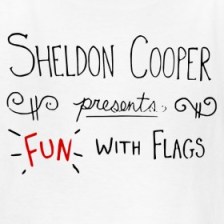
The other day I happened to be eating lunch and staring off out the window. While that may not seem important, it is. Most of the time, I like to be reading or doing something, while I’m eating. I completely understand that it’s probably better to not do this, but I often can’t help myself. Anyway, as I was sitting and just eating, an idea came to me. (Don’t you find that ideas come to you when you’re not thinking about them?) The idea, as the title of this post suggests, a web series from one of The Big Bang Theory’s main cast members: Sheldon Cooper.
I don’t know if you’ve seen the show (it’s quite funny), but a few times throughout the six seasons, Dr. Sheldon Cooper has led us on a journey through the wonderful world of vexillology: “scientific study of the history, symbolism and usage of flags or, by extension, any interest in flags in general.” Sheldon’s generally a pretty funny guy (not on purpose, that is, on purpose by the writers, but not by the character himself), so when he does these short podcasts on flags, it certainly provides a laugh or two. To date, there have been 5 instances of “Fun With Flags.”
In the first podcast, Sheldon and his, at the time, “girl who’s a friend, but is not my girlfriend,” Amy Farrah Fowler, introduce us to vexillology and tell us a bit about Oregon’s state flag.
Every time I watch this one, when Sheldon asks Amy about the white flag, I can’t help but laugh… “I’m submitting… to fun.”
In the second podcast, we learn about Bavaria.
In the third podcast, we learn a little bit about flags in Star Trek with Wil Wheaton.
In the fourth podcast, LeVar Burton replaces Wil Wheaton in attempting to teach us about flags in Star Trek.
In the fifth podcast, Penny (Sheldon’s across-the-hall neighbour), helps teach us about Nebraska’s state flag.
The idea is that these podcasts could actually become an online series that supplements the show. They wouldn’t necessarily have to be every week or even every other week. The idea is that Dr. Sheldon Cooper could teach us about flags. This could be a big boon for CBS and The Big Bang Theory as I can’t imagine it not being a hit with fans of the show. Plus, there’s the whole social media aspect to it. That is, these clips would undoubtedly be shared vehemently across many networks.
Maybe I’m way off, but my guess is that this could really be a creative way for the show to engage viewers on a medium other than the TV. There could even be “special guests” (i.e. other cast members or noted vexillologists [are there any?]).
If you’re an executive at CBS and you’re reading this, I’d encourage you to get the marketing team on this and see if they think that there are enough people to warrant this kind of endeavour. I understand that there’d still be some cost to it (paying Jim Parsons, the film crew, the editing team, etc.), but I wouldn’t be surprised if it’d be profitable.
~
For those of you who think that I may be a bit biased because I like these online learning formats (John Green, Hank Green, ASAPScience, Michael Sandel, etc.), I’d encourage you to take a look at some of the number of followers of these accounts. The Crash Course has almost 1,000,000 subscribers. AsapSCIENCE has almost 1.5 million subscribers. MinutePhysics has almost 2 million subscribers. Consistently, the videos that these users upload obtain views in the hundreds of thousands.
One final note — Mental Floss. They’ve, in a sense, tested the market as they already have a “Fun With Flags” kind of series. They’re up to episode 17. Here’s a link to the first.
About a month ago, I wrote a post about the future of TV. I came to the conclusion that it was surprising that there wasn’t “live TV” online. That is, I am surprised that you can’t watch a TV on your laptop at the same time as you could watch it on your TV. Of course, I understand why that might not be the case right now (advertising, contracts, etc.), it seems like this form of entertainment is moving in this direction. When you take into account mobile TV, one has to think that live streaming TV shows is on the way, right?
It turns out that I’m not the only one frustrated by the lack of online TV streaming. Xeni Jardin, an editor/partner at Boing Boing (a rather popular technology zine), also shares this frustration:
It’s so dumb that it’s 2013 and I’m all SHUT UP AND TAKE MY MONEY BITCH but the cable cos won’t allow simultaneous online content access.
As you can see, Xeni seems to think that we should be able to watch TV shows online at the same time that we can watch them on TV. This doesn’t seem like an unreasonable request, right?
It turns out, many of you out there agree with Xeni and I:
Market researcher GfK says 51% of those 13-54 years of age watch a TV program or movie via streaming video platforms. This is up from 48% in 2012 and 37% higher than three years ago.
What’s even more convincing is that the data go on to show that many folks would drop their Netflix service if cable companies offered a similar service at a similar price.
It seems to me one of a few things are happening:
a) TV executives already know all of this, but have run the data a different way and don’t think that people would actually follow-through on what they say when they answer these polls. [Not necessarily a response bias, but something more to the effect of the people who intend to vote on election day, but don’t.]
b) TV executives know this and they’re trying to convince the right people (CEO?) that this is what they need to do.
c) TV executives don’t know about these data.
Option c) seems the least likely, but I suppose it’s possible. Option a) seems like it could be plausible, but my guess is that the majority fall into option b). As a result, there seems to be a window of opportunity for an enterprising network to take a leap of faith and capture a great deal of value. Who’s going to be first?
If you have no experience with schizophrenia, Longden’s talk will certainly change that. It’s important to note, not everyone comes as ‘far’ as she did. Nonetheless, I hope her story fosters empathy within you.
I don’t remember when I first saw this lecture from Bartlett, but I know that it was probably one of the first lectures I watched on the internet (maybe 15 years ago?). If you’re captivated by headlines like “Crime Doubles in a Decade,” or you’re confused about inflation then you’ll learn a lot in the first half of the video. As someone who majored (second major) in sociology, I can certainly empathize with the idea of a Malthusian catastrophe. I suppose I’m putting stock in the fact that something will change before it gets to that. You may be tired of hearing that people of time X couldn’t have predicted what life would be like in time Y, but I’d say that this is a big factor in why I think we’re not hurtling toward the future that Bartlett explains. Of course, I could be wrong, but I really think that something will change before it comes to this.
If you’ve ever taken PSYC 100, there’s a good chance you’ve heard of Zimbardo. If the name doesn’t sound familiar, his famous experiment will: the Stanford Prison Experiment. I remember watching the RSA Animate version of this talk a couple of years ago. Zimbardo shines a light where you might not have been looking: your relationship to time.
In 2011 when this talk was given, the idea of 3D printing was brand new. To some, it may still be. I remember talking about it last year in the context of rapid technological change. If you’re still fuzzy on 3D printing, this is an enlightening place to start.
If you’ve ever watched a TEDTalk, there’s a good chance you’ve heard of this one from Ken Robinson. As of this time last year, it was the most watched TEDTalk – ever – with almost 15,000,000 views. If you haven’t seen this one, spend the next 20 minutes doing just that.
A little over a week ago, I wrote a post about the 20 biggest questions in science. It turns out, The Guardian must have been on a listicle-kick because they also recently published a list of the 20 online talks that could change your life. Some of these I’ve seen, so I thought I’d go through them in the same way I did for the science questions from last week.
I was so glad to see that they started with this talk. This talk is by a British researcher who has dedicated his life’s work to social inequalities. Along with Kate Pickett, he published a book called The Spirit Level. I remember reading it a few years back. It’s chock-full of resources and citations that formed the basis for the beginning of the recent discussion on inequality. Of course, there are folks who don’t see eye-to-eye with Wilkinson and Pickett.
I haven’t seen Cuddy’s talk, but I’ve read a number of her journal article. She certainly knows what she’s talking about and is worth your time. I haven’t seen Katz’s talk either, but it really reminds me of the work of Miss Representation and The Mask You Live In.
Not many TEDTalks have caused such a ruckus so quickly. I remember when this talk first happened earlier this year and was put online. Here were my “quick thoughts” after first watching it:
Amanda Palmer: A big congratulations! This TEDTalk certainly created news yesterday. For some, it’s because she didn’t answer questions that some had asked regarding the Kickstarter funds, for others, because she raised some important ideas about the music business. It’s certainly not easy to challenge mainstream ideas and even harder to do so with so many people who think you’re wrong (and are shouting that at you).
The Art of Asking: For some, there is nothing harder than asking for help. Asking for what you’re worth. People who are just starting their own business often have lots of problems trying to figure out just how much they should charge. Much of this has to do with psychology and our ideas of self-worth, but there’s also the cultural stereotype that it’s not okay to ask. It’s so great that Amanda could demonstrate how asking is not something to be afraid of.
Vulnerability: On the topic of asking… I remember reading about people who pose as beggars — not for the money, but to gain the experience of what it’s like to beg or ask for money. It’s not something that I’ve done, but after watching this TEDTalk, it’s an experience that I think is certainly worth considering. It might shatter stereotypes of what it’s like to ask for help and would certainly foster a greater sense of empathy.
Trust: Without getting too much into a philosophical discussion, it’s great to see a tangible example of someone who “trusts the flow of life,” and is rewarded for it.
As with Stevenson’s, if you have the time, Palmer’s is certainly a talk worth watching.
After reading the description for Larson’s talk, I couldn’t help but think that the work of Richard Florida, noted urban theorist, is probably mentioned in the talk.
We’ve covered the first ten talks. This seems like a good place to pause and take a break. Check back tomorrow for the rest of the talks.
About a week ago, I got back to the series I was doing about the chapters in Michael Sandel‘s book, What Money Can’t Buy. In the first chapter, we looked at things like when it’s okay to jump the line. In the second chapter, we looked at the difference between fines and fees. In the third chapter, we looked at fairness and inequality. In last week’s post, the fourth chapter, we looked at corporate-owned life insurance and placebos. In today’s post, the fifth and final chapter, we’ll look at the commercialization of everything.
I wasn’t expecting to come across sports in this book, so I was pleasantly surprised when the first few pages were about stadiums being renamed by corporate sponsors. I didn’t realize that this was a fairly new thing. In 1988 only three sports stadiums had been renamed by corporate sponsors. Sixteen years later, in 2004, there were sixty-six. The amount of money went up significantly, too. In 1988, the deals totaled $25 million, while in 2004, the amount came to a whopping $3.6 billion! In 2010, over 100 stadiums in the United States were named for corporate sponsors. So, in the span of less than 25 years, we went from 3 corporate-sponsored stadiums to more than 100.
Having grown up in Toronto, I still find myself referring to Rogers Centre as Skydome.
This chapter also discussed the idea of athletes selling their autograph. In the old days, this wasn’t even something to be considered. Many athletes willingly signed cards and sports equipment (i.e. baseball, hockey pucks, etc.) for fans. Near the same time that stadiums were being renamed, some athletes were beginning to sell their autographs rather than giving them away. This may seem greedy at first, but consider that athletes from before the 80s weren’t necessarily making lucrative contracts. In fact, athletes back then were not only often paid much worse than athletes today, but they were more on par with what you’d be paid to be an employee at a “normal job.”
~
The chapter then moves into a discussion of — in my words — the commercialization of everything.We’re now seeing advertisements and commercials in places we wouldn’t have ever imagined. For instance, when you pump gas, there’s a TV above the pump feeding you advertisements. Or how about when you’re driving down the highway. It’s kind of hard to ignore some of those catchy billboards, isn’t it? Then, there’s the always in vogue idea of product placement. Some of the places you find product placement was a bit surprising. I didn’t know that police stations were in talks to have cars with advertisements on them nor did I realize that in some state parks around the US are there advertisements for things like North Face.
I was surprised to read about some of the commercialization in the US, especially when I know that in some states, there’s a ban on billboards (Alaska, Hawaii, Maine, and Vermont). Moving outside of the US, I know that some countries (or maybe the citizens of those countries) have a real aversion to commercials seeping into unwanted places. For instance, São Paulo in Brazil hasn’t allowed public advertising since 2006. I also know that TV commercials in Germany aren’t nearly as frequent as they are in the US. On most German TV stations, there can’t be more than 20 minutes of commercials (before 8pm).
~
The last part of the chapter ends the book almost exactly the way I would have [Emphasis added]:
Once we see that markets and commerce change the character of the goods they touch, we have to ask where markets belong — and where they don’t. And we can’t answer this question without deliberating about the meaning and purpose of goods, and the values that should govern them.
Such deliberations touch, unavoidably, on competing conceptions of the good life. This is terrain on which we sometimes fear to tread. For fear of disagreement, we hesitate to bring our moral and spiritual convictions into the public square. But shrinking from these questions does not leave them undecided. It simply means that markets will decide them for us. This is the lesson of the last three decades. The era of market triumphalism has coincided with a time when public discourse has been largely empty of moral and spiritual substance. Our only hope of keeping markets in their place is to deliberate openly and publicly about the meaning of the goods and social practices we prize.
In addition to debating the meaning of this good or that good, we also need to ask a bigger question, about the kind of society in which we wish to live…
At a time of rising inequality, the marketization of everything means that people of affluence and people of modest means lead increasingly separate lives. We live and work and shop and play in different places. Our children go to different schools. You might call it the skyboxification of American life. It’s not good for democracy, nor is it a satisfying way to live.
Democracy does not require perfect equality, but it does require that citizens share a common life. What matters is that people of different backgrounds and social positions encounter one another, and bump up against one another, in the course of everyday life. For this is how we learn to negotiate and abide by our differences, and how we come to care for the common good.
So, if you prefer not to get too deep into a discussion of inequality that focuses on wealth, then I’d encourage you to think about the ideas that Prof. Sandel is talking about here at the end of the book. He’s just spent the last 200 pages explaining how markets (in some places), to some people, are corroding the value of these goods. Regardless of which side of the fence you fall down on, maybe it’s time we start talking about this. Maybe it’s time to have a dialogue in the public square of more moral and spiritual substance. Of course, this might not be as easy as it sounds, as he says, the last three decades have been void of this.
~
If you liked this paper/series, you might want to check out some of the other papers/series I’ve posted.
After reading Kelefa Sanneh‘s piece in The New Yorker that took an in-depth look at MSNBC, it got me thinking about what I wrote a few days about about the future of TV. In that post, I mostly talked about the idea of moving television programs to online streaming or mobile streaming. I didn’t, however, talk about the idea of unbundling TV packages and allowing people to choose which networks they wanted.
This is one of the the things that Sanneh briefly touches on in his article. In particular, he questions whether the unbundling of TV packages would hurt cable news programming. That is, would CNN, MSNBC, and FOX News keep their heads above water if they weren’t part of a bundle? For instance, Sanneh tells us that FOX News (the leading cable news network since 2002), gets about half as many viewers as the lowest-rated network news program. That’s significant. Would FOX News survive if it wasn’t bundled? Might it do better if it weren’t bundled?
Chances are that cable news — barring something unforeseen — would be in trouble if TV packages became unbundled.
~
About a quarter of the way into the article, Sanneh has a quote from the President of MSNBC that I find rather startling. I’ll include the lead-in, so the quote makes sense [Emphasis mine]:
“I’m building for the future,” Griffin said, not long after the switch. He was sitting in his office, reviewing a series of promotional clips that highlighted Hayes and the network’s other stars. “You’ve got a young guy who’s incredibly smart, who’s got a following,” he said. “We’re making a bet that this is what our audience wants.”
The startling part is the bit that I’ve bolded. I don’t understand that a company as big as MSNBC would be gambling in the way that Griffin claims to be. They’re making a bet that this is what the audience wants? They don’t have the resources to find out if that’s what their audience wants? Maybe Sanneh hasn’t included the whole quote, but this to me makes it sound like Griffin is being a bit cavalier with the most important time slot.
~
FOX News consistently outperforms other cable news networks in an older demographic: 35-64. Take this past Monday’s cable news ratings, for example. FOX News outperformed all the other cable news networks in this demographic at every time slot. The closest any network came in this demographic was in the 9 o’clock hour when Hannity beat The Rachel Maddow Show by over 200,000 viewers. I don’t know how to put this delicately, so I’ll say it like this: what happens when this demographic “passes on?”
Yes, FOX News still outperforms the other networks in the coveted 25-54 age bracket, but their lead is substantially smaller. The largest lead FOX News has is during the 8 o’clock hour and that’s a little more than 250,000 viewers (over the next closest show). If I were Roger Ailes (or the guy who was likely to replace Roger Ailes), this is something I would be thinking considering, in addition to the prospect of unbundling TV packages.
~
The last thing I wanted to talk about is this idea that those people who MSNBC is trying to reach may not like cable news or TV:
One explanation for MSNBC’s struggles is that the network is trying to do something nearly impossible: it is a cable news network for people who don’t like cable news, and may not even like television.
MSNBC, in its current format as I understand it, is still quite new. It’s only recently switched over to a more partisan-esque feel. I wonder if there’s still a bit of a lag before the viewers they’re trying to reach will show up. I also wonder if TV does start to move in a new direction (simultaneous online streaming), will this open up a new audience for MSNBC? I’m particularly interested in MSNBC because of this idea that the people who MSNBC is targeting are those people who wouldn’t normally watch cable news or TV. I wonder if these people had another avenue to watch these programs, would they?
I don’t watch much TV and part of this is precipitated by the fact that I don’t currently own a TV. The TV that I do watch, however, is, for the most part, online. [Except in cases where I’m visiting someone who has TV and we’re watching something together.] Shows that I started watching years ago (when I had a TV) like Grey’s Anatomyor The Big Bang Theory often post the full episode online the next day. This is very convenient as I’m not required to be in front of my TV on a Thursday night to watch these shows.
I always find it disappointing when a show that I might be interested in does not have an online version. This got me thinking about what the future of TV might be. I remember seeing a PPT from Business Insider at the turn of the new year (to 2013) that analyzed the way people use technology. That is, it took into account mobile devices, TV, computers, etc. The trend, as you might guess, is to mobile. More and more people are using their phones for things. As a result, there’s certainly money to be made in advertising in the mobile arena.
Then I thought, why haven’t TV shows made the leap to mobile? Or, why is this leap taking so long? If more and more people are using their phone to interact with the world, then wouldn’t it behoove TV networks to start making their content more accessible on a mobile device?
As I’m moving back to Canada in the next few weeks, I’ve been looking at cell phone plans. [Note: it is outrageously more expensive for mobile plans in Canada than in the US!] One thing I noticed was that Bell (one of the telecommunications companies in Canada) has an option just like I was thinking. You can watch live TV on your cell phone. After seeing this, I thought I’d look at some of the US companies to see if they had it and sure enough, they have this, too.
As it turns out, companies have already made the leap to mobile and it’s moved faster than I thought (I guess that’s what you get when you don’t have a cell phone for 4+ years).
My next thoughts move to the internet. There must be lots of people like me who like to watch the shows online the next, otherwise they wouldn’t be available like they are. So, I wonder if there’s rumblings of moving to live TV internet. That is, instead of posting the video the next day, why not broadcast the show online at the same time you do on network TV?
I’m sure there’s probably lots of red tape with this kind of an option as advertisers have paid to target certain demographics at certain time and so on and so forth. But wouldn’t this open up a whole new market for TV networks — people who’d prefer to watch online?
I came across a Kevin Spacey speech a few days ago that talks about this very fact.
[Note: The first half of the title is a famous line from the movie, The Matrix.]
I’ve been thinking about Malcolm Gladwell and the 10,000-hour rule. This is a concept that comes from one of his books, Outliers. Recently, this idea came under fire after an article in Timeearlier this year in May. After some time, Gladwell wrote a response (a few days ago) that seems to adequately account for the critiques in the Time article. Nonetheless, it got me thinking about the idea of 10,000 hours and what it represents.
In case you’re not familiar, the 10,000-hour rule is the idea that in order to be “great” at something, one has to put in 10,000 hours of deliberate practice. After the 10,000 hours (approximately), one will likely be at the pinnacle or very near to, of the field. Ten thousand hours.
That’s 20 hours a week for 10 years.
You have to really like something — a lot — or really want to do well at something, in order to remain committed to the goal of becoming an expert. Twenty hours a week. Ten years. Nowadays, people might not even spend that much time at the same job (if we compress it to 40 hours a week and 5 years)!
~
Then I got to thinking about Daniel Day-Lewis. Certainly one of the premier actors of our time. Since 1989, Day-Lewis has appeared in 11 movies. Of those 11 movies, he’s won the Academy Award for Best Actor, three times — making him the only male actor to win the award three times. He was also nominated for Best Actor two other times. So, of the 11 movies he’s been in during the last 20+ years, he’s been up for the award for Best Actor five times. From what I understand, most people are pretty happy to simply have been nominated once, much less 5 times — and then win three times!
Daniel Day-Lewis is certainly someone who is at the top of his field. He has put in the hours and done the work to become one of the best actors.
And then there’s Meryl Streep. She’s received more nominations for Academy Awards (17) and more nominations for Golden Globes (27) than anyone in the history. She’s also won 3 Academy Awards and 8 Golden Globes. Clearly, someone else who is at the top of their field.
But why have I highlighted both performers?
They continue to win awards. Daniel Day-Lewis won his first Academy Award for Best Actor back in 1989. And then again in 2007. Do you think he ‘rested on his laurels?’ No, how else would he have been able to pull off such a convincing Abraham Lincoln in Steven Spielberg’s flick last year. And Meryl Streep won her first Academy Award in 1979. Again, in 1982. She wouldn’t win again until 2011 for her portrayal of Margaret Thatcher in The Iron Lady. Between 1982 and 2011, she was nominated 12 other times. 12!
Both of these performers are stunning examples of the idea that even though you’ve won, even though you’ve made it to the top of your field, that doesn’t mean you can’t still keep working. That doesn’t mean you can’t still keep getting better. Practicing. Perfecting.
If you want to be good at something, really good at something, you’ve got to put in the work even if you think you’ve already made it. If Daniel Day-Lewis and Meryl Streep don’t rest on their laurels, what makes you think you can?
A couple of weeks ago, I happened to see a lovely coming of age story in The Way, Way Back. I rather enjoyed it and so did my movie companion. In fact, I even thought Steve Carrell was convincing as a ‘villain.’ The one thing that did bother me about the movie, though, was the weakness of Toni Collette‘s character.
I won’t spoil the plot because I think you can imagine what I’m talking about from the title of this post and my reference to a weak character. Why does the female always have to be the weak character? Why aren’t there more movies where the male character is weak or the female character is strong?
I realize that some folks may think that I’m quibbling over something small, but this subtle norm is pervasive in the culture and it perpetuates itself by people considering it something small. By not kicking up dust about this issue, the issue is allowed to continue on with the perception that it’s not worth discussing. Well — it is worth discussing.
Several weeks ago, I wrote a post about a Kickstarter campaign that is the Yang to the issue we’re talking about. Have you heard of Miss Representation? It’s a powerful documentary from 2011 that dissects the portrayal of women in the media. The Yin. The Yang version is due to come out in February. It’s called: The Mask You Live In. The Kickstarter campaign closed yesterday and they finished with more than 2400 backers and more than $100,000 pledged (125% of their goal).
If you don’t think the portrayal of gender in the media is important, then you simply mustsee Miss Representation and, when it comes out in February, The Mask You Live In. If you do think that the portrayal of gender in the media is important, then tell your friends! NOW!
I noticed I was getting a bump in search engine traffic for people who were looking for the spelling rules to Final Jeopardy. No doubt, this is in part because there was a small bit about the incident on The Today Show this morning. When I wrote about some of the implications for whether they should have given the contestant the benefit of the doubt, I didn’t include the official final jeopardy spelling rules. At the time, I was merely reflecting in hypothetical, but with people searching for the official rules, it made me wonder just what they rules said about spelling in Final Jeopardy.
If you know me, you know that I’m really good at finding things on the Internet. After doing a couple of cursory google searches (Final Jeopardy Rules, Official Final Jeopardy Rules, Official Jeopardy Rules), I was surprised that I couldn’t find them. Sometimes, the site that hosts a document like this doesn’t do a good job of using keywords. So, I thought I’d poke around the official Jeopardy site — nothing.
After some more derivations of “Rules of Jeopardy,” I was beginning to think that maybe the rules aren’t online. I thought that maybe the contestants were handed a paper copy that they signed before going on the show and that document wasn’t online. Having never been a contestant on Jeopardy (though I’d like to be some time!) I couldn’t confirm whether this was true. However, given that it’s a game show, I’m sure they signed something before going on the show. Regardless, I didn’t have access to that document.
When I was poking around the Jeopardy site, I noticed there was a message board for Jeopardy. While not an official source, I thought that there might be some discussion of what had happened on the show last week (EmancipTation Proclamation) in the context of the rules. After reading through some of the messages on the thread talking about it, I realized that it could take a while. Before reading through that thread, I noticed a different thread that was directing everyone to the 22-page thread talking about what happened because it had “several clear explanations” as to why the judges had to rule the way that they did.
After reading the 22-page thread — the majority of which were people who registered for the forum simply to complain about the ruling — there were some interesting anecdotes. For instance, did you know that this misspelling incident has happened on Final Jeopardy in the past? In an episode that aired on June 6, 2007, there was a clue that was looking for the response: “Sargasso Sea.” The person in the lead (going into Final Jeopardy), however, misspelled his response. He wrote, “SarAgasso Sea.” As you can see in the video below, the judges ruled the same way they did for EmancipTation:
As this really didn’t answer my question about the “official rules,” I thought I’d do a Site Search of the message board to see if I could find the rules. I used some of those keywords from earlier and like before, didn’t find anything official. Although, this was an interesting entry [Emphasis Added]:
I have no official source for this, but from what I’ve heard from various people over the years, there is no official written set of rules that the judges are required to abide by. It has been mentioned that this could be done for liability purposes, because if the judges were to make a ruling that went against their written rules, a player could potentially sue them, or something like that. I believe that in the contestant paperwork, all players must sign something agreeing that all judges’ decisions are final. There may be some general guidelines for acceptable responses in this paperwork, but they probably don’t cover all possible scenarios, and the judges’ decision will always be final. While they do have appeal processes, and I presume that they work to the best of their ability to ensure that no contestant is treated unfairly, I’m sure there have been instances of players leaving the show feeling that they were in some way treated unfairly due to an unfortunate judges ruling either against them, or in favor of a competing player.
There are a lot of little rules of thumb that longtime viewers of the show have been able to piece together over the years, and most times the show’s rulings seem pretty consistent with past precedents. It is generally accepted that leading articles can be omitted and still be ruled correct, as in “Grapes of Wrath” or “Midsummer Night’s Dream”. However, incorrect or missing articles within a title will lead to an incorrect ruling, such as “One Flew Over a Cuckoo’s Nest” or “Gone With Wind”. Those may be poor examples, but I can’t really think of any good ones at the moment.
As to Veteran Affairs or Veterans Affairs, I think it is usually the case that when dealing with something that has an official title, the wording must be exact, and in many cases the inclusion or exclusion of something as small as an “s” could indeed lead to an incorrect ruling.
As to the consonant/vowel distinction, the general rule is that when giving a response verbally, you don’t have to pronounce it correctly, but you must at least give something that could be a possible phonetic pronunciation of the correct spelling. Generally this means that you could change vowel sounds, but you need to use the correct consonants, otherwise what you’ve said does not appear to be the same word as the intended correct response. Without examples in front of me this is hard to explain. It often comes up in cases of foreign words, or names of famous people that someone has seen in writing many times, but rarely has heard spoken aloud.
In Final Jeopardy, the rules are similar, but the opposite is true. While your spelling can be incorrect, what you have spelled should be possible to pronounce in the same way as the intended correct response. Normally if you change a consonant, something is not going to be pronounced the same way, while changing vowels could still lead to similar pronunciation. One recent exception to this rule was when Franz Liszt was the correct FJ response, and one contestant responded with “Who is Lizt”. While she was missing a vowel, the “s” and “z” sounds in Liszt sort of blend together, so the judges likely decided that “Lizt” or “Lizst” would be accepted. I don’t know if they would have accepted “List”. They may also have accepted something like “Lieszt” or “Leeszt”, as there is probably a lot of wiggle room in dealing with vowel sounds of foreign names like this.
While to my knowledge there is no list compiled on the web of all Jeopardy! ruling precedents, there are plenty of diehard fans of the show, and many seem to have near-photographic memories of these kinds of things, so you should always feel free to ask any ruling questions on this board or at the jboard. It has been my experience that Jeopardy! fans are always more than willing to help.
We can apply some of what this commenter said to the two examples. Adding the ‘T’ to Emancipation does change the pronunciation. Similarly, the ‘A’ in Sargasso does change the pronunciation. I know that this probably won’t satisfy many people who think that the contestant should have been given the benefit of the doubt, but I hope this will shed a little more light on the process (at least perceived) that judges use to make rulings on spelling in Final Jeopardy.
~
So, maybe what this commenter is saying is true — maybe there aren’t any official rules. If there are official rules, they’re not readily available on the Internet. I can imagine that with what’s happened over the last week, some journalist/reporter would have likely emailed the producers of Jeopardy to ask about the official rules and I haven’t seen any articles recently about official rules. For now, I suppose this comment from a message board will have to suffice.
UPDATE: Remember Ken Jennings? Probably the most prolific Jeopardy player — ever. I came across something that Jennings said about what happened last week with EmancipTation. As you’ll see, it seems to be in line with what I found earlier on the message board:
Jeopardy! record-maker and Parade columnistKen Jennings agrees that the ruling, however frustrating, was fair. “I feel bad for Thomas, of course,” he told Parade.com. “But the unwritten rule on Jeopardy! has always been that your Final Jeopardy answer doesn’t have to be spelled right, but it has to be the same phonetically as the right answer. If he’d spelled it ‘Emansipation’ or even ‘Immancipation,’ he probably would have been okay,” Jennings explained. “I once spelled Grenada as ‘Granada’ and Alex let it slide. But add a new consonant sound, like Thomas did, and that’s ball game.”
 The other day I happened to be eating lunch and staring off out the window. While that may not seem important, it is. Most of the time, I like to be reading or doing something, while I’m eating. I completely understand that it’s probably better to not do this, but I often can’t help myself. Anyway, as I was sitting and just eating, an idea came to me. (Don’t you find that ideas come to you when you’re not thinking about them?) The idea, as the title of this post suggests, a web series from one of The Big Bang Theory’s main cast members: Sheldon Cooper.







 Jeremiah Stanghini