Protection from Nuclear War: Look to the Cockroaches

Yesterday, I saw a post from Mental Floss about whether or not cockroaches would be able to survive a nuclear war. That is, not whether or not the cockroaches would put up a fight in a nuclear war, but whether or not they would survive the radiation from a nuclear war that happened where they existed.

The post cited research done by MythBusters that concluded cockroaches have a much higher tolerance for radiation.

Does anyone else see an opportunity for innovation here?

If I were a scientist, (aside from ethical conundrum), I might be interested in seeing how much radiation cockroaches could withstand before it affects their ability to function. Why? Because then I would want to study what it is about the cockroaches that allows them to withstand such radiation. Then, I’d want to see if I could design some sort of protection for humans. To be fair, it’d be very hard to get this to pass through any kind of Institutional Review Board (IRB). That is, the IRB would probably balk at any kind of research where humans were being used to test the strength of some kind of cockroach shield. Though, I imagine that scientists might be able to work around this by using human cells in the lab, right?

Do Percentages Matter in a One-Time Decision?

I write a lot about decision-making. It’s clearly something that interests me. As a result, I often find myself thinking about how to make better decisions or how to help people make better decisions. That’s why I’m already up to Part 10 of that series on decision-making (and I’ve got at least 4 more to go). I’m not including today’s post as part of that series, but it serves as an interesting addendum. Meaning, it should at least give you something to think about. So, here we go!

As I said, I often find myself thinking about how to optimize decisions. Often times, when people are trying to make a decision about something in the future, there may be percentages attached to the success of a decision. For example, if you’re the elected leader of a country, you might have to decide about a mission to go in and rescue citizens that are being held hostage. When you’re speaking with your military and security advisors, they may tell you the likelihood of success of the different options you have on the table.

I was going to end the example there and move into my idea, but I think it might make it easier to understand, if I really go into detail on the example.

So, you’re the President of the United States and you’ve got citizens who are being held hostage in Mexico (but not by the government of Mexico). The Chief of the Joint Chiefs of Staff presents a plan of action for rescuing the citizens. After hearing about the chance of success of this plan, you ask the Chief what the chance of success is and he tells you 60%. The other option you have is to continue to pursue a diplomatic solution in tandem with the Mexican government. As the President, what do you do?

So, my wondering is whether that 60% number really matters that much. In fact, I would argue that the only “numbers” that would be useful in this situation are 100%, 0%, or whether the number is greater than 50 or less than 50 (to make sure that this is still three numbers, we could call this last number ‘x’). This sounds silly, right? A mission that has a 80% chance of success would make you more inclined to choose that mission, right? The problem is that 20% of the time, that mission is still going to fail. And my point is that since this is a one-time decision (meaning, it’s astronomically unlikely that the identical situation would occur again), there won’t be iterations such that 80% of the time, the decision to carry out that mission will be successful.

I suppose the argument against this idea is that in a mission that has only a 51% chance of success, there’s a 49% chance of failure and one would presume that there are more factors that might lead to failure with these percentages (or at least a higher chance of these failures coming to fruition).

I realize that this idea is off-the-wall, but I’d be interested to read an article in a math journal that explains why this is wrong (using reasoning beyond what I’ve explained here) or… why it’s right!

It is Important to Speak, but not More Important than it is to Listen

A couple of days ago I wrote a post about leadership and followership, the overwhelming majority of literature dedicated to leadership, and the dearth of literature dedicated to followership. When writing that post, it reminded me of the same relationship between speaking and listening. That is, how much literature do we see dedicated to speaking or communicating and how much do we see dedicated to listening?

Don’t get me wrong, I think that communication is an essential part of the human experience, but dont we think that learning to listen should be equally (if not more?) important than speaking. We can make the same comparison we did with leadership: how much time do we spend speaking in relation to how much time we spend listening? We spend far more of our time listening. So, shouldn’t it follow that we need to learn how to be excellent listeners?

Of course, if we don’t know how to speak (at all) then the listening is futile, but I suspect that if the majority of people were excellent listeners, we might be able to aid the speaker in communicating their point. Just as I made the case with followers who can make a leader better, I think that listeners can make a speaker better, too.

~

A slight tangent: how many courses are there in communication? There are probably quite a few more than there are in listening. In fact, there’s even an entire academic discipline dedicated to communication. Is there one for listening? Some may argue that clinical/counseling psychology might be how listening creeps its way into an academic discipline, but that’s only one piece of the training for clinical/counseling psychologists. It’s important to note that psychologists who don’t go the route of counseling won’t get this kind of training, so it’s necessary to specify clinical/counseling.

I like to think I’m a pretty good listener (and have been given affirmative feedback), but I don’t doubt that I would benefit from the insights of academic research on listening. In fact, I bet we all could benefit from academic research on listening. Until then, we’ll have to rely on the wisdom of quotes:

“Wise men speak because they have something to say; fools because they have to say something.” – Plato

“When people talk, listen completely. Most people never listen.” – Ernest Hemingway

“If A equals success, then the formula is A equals X plus Y and Z, with X being work, Y play, and Z keeping your mouth shut.” – Albert Einstein

“Everything has been said before, but since nobody listens we have to keep going back and beginning all over again.” – Andre Gide

“Most people do not listen with the intent to understand; they listen with the intent to reply.” – Stephen Covey

“We have two ears and only one tongue in order that we may hear more and speak less.” – Diogenes Laërtius

And one last one that I really like:

“You cannot truly listen to anyone and do anything else at the same time.” – M. Scott Peck

WRAP — An Acronym from Decisive: List of Biases in Judgment and Decision-Making, Part 10

I recently came across a post from Farnam Street that seems like it would make a great addition to the series we’ve been exploring over the last 10 weeks (biases in judgment and decision-making). So, instead of going over another bias today, I thought I’d share the information I found and tie it back into our series. Check back next week for a new bias (it could be functional fixedness, the hindsight bias, the status quo bias, or maybe the recency/primacy effect(s)…)

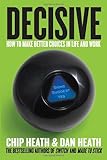
The author of the Farnam Street blog summarized some of the work in Chip and Dan Heath’s new book: Decisive: How to Make Better Choices in Life and Work. Given that our series is about decision-making, this book seems like it would be absolutely on-point, with regard to the closing of each post (How to avoid *blank*).

I haven’t yet read the book, but I did want to include a brief excerpt (courtesy of Farnam Street), along with a lead-in from Farnam Street:

The Heaths came up with a process to help us overcome these villains and make better choices. “We can’t deactivate our biases, but … we can counteract them with the right discipline.” The nature of each of the four decision-making villains suggests a strategy for how to defeat it.

1. You encounter a choice. But narrow framing makes you miss options. So … Widen Your Options. How can you expand your sent of choices? …

2. You analyze your options. But the confirmation bias leads you to gather self-serving information. So … Reality-Test Your Assumptions. How can you get outside your head and collect information you can trust? …

3. You make a choice. But short-term emotion will often tempt you to make the wrong one. So … Attain Distance Before Deciding. How can you overcome short-term emotion and conflicted feelings to make better choices? …

4. Then you live with it. But you’ll often be overconfident about how the future will unfold. So … Prepare to Be Wrong. How can we plan for an uncertain future so that we give our decisions the best chance to succeed? …

There’s also a handy picture that’s included (again, courtesy of Farnam Street):

As we can see, the Heaths have offered four universal ways for avoiding biases in judgment and decision-making. If we recall some of the different ways for avoiding biases that we’ve discussed over the last 9 weeks, many of them can be collapsed into one of the categories listed above. In case you’re a bit hazy, here are some of the biases that we’ve talked about before that have a “way for avoiding” that falls into one of the categories above:

So, if you’re having trouble remembering the different ways for avoiding the biases we’ve talked about, all you have to do is remember “W-R-A-P!”

Thirty Leaders and Two Followers: Can We All Be Leaders?

A few weeks ago, I was preparing to teach by re-reading the chapter for which the material we’d be covering in class. Part of the class session was going to be spent on leadership. Granted, this is an undergraduate textbook in organizational behavior, I was truly disappointed to find that of the 30+ pages on leadership, there were only two — 2 — pages spent talking about followers. I don’t know about you, but I’ve never seen a successful leader without followers.

One of the broader issues here is math. Of all the people in the world, how many of them do you think will be leaders? Of all the people in the world, how many of them do you think will be followers? I’m not saying that people shouldn’t strive to be leaders or be the best they can be, but based on our current definition/understanding of leadership, not everyone will spend a great deal of their time being a leader. In fact, most people will spend the majority of their lives being followers — and there’s nothing wrong with that. In fact, many of the people that we think of as great leaders were — in fact — once followers. Some say you have to be a good follower before you can be a good leader, but I’m not really going to get into leadership philosophy right now.

Instead, I wanted to draw to your attention to the amount of time we spend thinking about, talking about, and teaching leadership and the absolute void with regard to following. For instance, a quick Google search returns over 450,000,000 results for leadership, but only 420,000 for followership. You might think that’s not a fair comparison, so what about how to be a good follower or how to be a good leader? Follower returns: 54,000,000 (though I think some of these might be returning religious results). Leader returns: 1,350,000.

While leadership is more revered, it certainly seems like there’s room in the popular literature for a few great books on followers and how to be a good one.

Maybe We Don’t Need to Workout At All

About a week ago, I wrote a post about the perfect exercise routine. My point was that there is no universal perfect exercise routine because there are so many different people on the planet, but that there may be some universal principles that could be applicable across peoples. It turns out that one of those “perfect” exercise routines might just be not exercising at all. Curious?

I recently came across a post from Harley Pasternak in, of all places, People. The post has a great opening illustrating just how sedentary our lives have become — amounting to the fact that we spend 45 minutes at the gym and the other 23 hours and 15 minutes sitting at our desks or sleeping. I really encourage you to read it because it paints quite a picture.

After I read it, I was reminded of the post I wrote a week ago that I referenced above (perfect routine), but also of the post I wrote about the obesity crisis. In that post, I focused on the neuromarketing aspect. That is, the idea that consumers may not have an *unbiased* choice to make when they reach for that bag of potato chips or for a second piece of chocolate cake. My main point in that post was that neuromarketing is having a large impact on the choices that are leading to the obesity epidemic. Pasternak argues that are innovation is also leading to obesity. Because we’ve worked so hard to make it easier to do things, we’ve cut out a lot of the time we spend getting from A to B or completing task A and completing task B:

They take leisurely daily walks, do their errands on foot, and walk, bicycle, or take public transportation to work. To make my case, consider this: the average European walks 237 miles every year and cycles 116 miles. The average American walks just 87 miles and cycles just 24 miles. No wonder Europeans are healthier – they’re three times as active!

It never occurred to me that public transportation would be linked to a country’s health, but I guess that just goes to show you the power of externalities and unintended consequences. This revelation makes me think that it’s even more important for the US to get on with advancing the infrastructure of the public transportation in the country.

~

This brief bit about public transportation increasing a country’s health does remind me of something I read recently about the amount of time that patrons spend walking to and from public transportation. Something to the effect of it doubling the number of steps they take in a day. I couldn’t find that particular article, but I was able to find something from the CDC (Center for Disease Control and Prevention) that supports that finding:

Walking to and from public transportation can help physically inactive populations, especially low-income and minority groups, attain the recommended level of daily physical activity. Increased access to public transit may help promote and maintain active lifestyles.

Metta World Peace, Chad Ochocinco, World B. Free, and Mark Super Duper!

A couple of years ago, one Ron Artest decided he was going to change his name. Ron Artest might not be a name you recognize unless you watch or are a fan of basketball (NBA). Artest has played for 5 NBA teams (Chicago Bulls, Indiana Pacers, Sacramento Kings, Houston Rockets, and currently, Los Angeles Lakers). He’s had a number of accolades during his career, too. The thing that Artest will most be remembered for is what he did in September of 2011 — changed his name to Metta World Peace.

World Peace wasn’t the first athlete to make a wild name change like this. In fact, a few years before World Peace, there was one, Chad Johnson, an NFL receiver for the Cincinnati Bengals who changed his name to Chad Ochocinco. But Ochocinco wasn’t the first, either. There have been many athletes who’ve made name changes that would seem rather odd to some:

  • In 1985, a football player decided he was going to make his nickname more official, so he changed his name from Mark Duper to Mark Super Duper.
  • In 1981, a basketball player by the name of Lloyd B. Free changed his first name to World, making his name World B. Free.
  • In 1971, another basketball player, this one by the name of Ferdinand Lewis Alcindor, Jr, decided to change his name. You’ll probably recognize him by the name he chose: Kareem Abdul-Jabbar.
  • In 1964, a famous boxer by the name of Cassius Clay decided he was going to change his name to Muhammad Ali.

As I said, World Peace and Ochocinco are certainly not the first athletes to change their name. Though, of the athletes I’ve mentioned only Super Duper seems to have made the change for ‘innocuous’ reasons. The other three (and World Peace) were making the change for religious reasons or because they were trying to make a point. There was another basketball player a couple of years ago who made the change so that he would be more accepted by the Japanese people (as he was immigrating there). A baseball player in the 2000s decided that there were one too many “Johan Santana’s,” so he changed his first name to Ervin.

When I first started this post, I expected to find many more athletes who had changed their names for reasons that some people might find strange. Instead, I’ve found a number of athletes who’ve changed their names for reasons that I think most people would think were worthy. In fact, one of my favorite name changes (and one I didn’t know before I started writing this post) comes from Maurice Jones-Drew, a football player:

Maurice Jones’s grandfather, Drew, succeeded in his one goal: to see his grandson play through his first two seasons at UCLA. And after Drew suffered a fatal heart attack at the end of the second game of Maurice’s third season, the younger Jones altered the name on his jersey in tribute.

Speaking the Same Language is Harder than it Looks

Have you ever tried speaking with someone who’s native language is not your own? That is, if you’re an English speaker, have you ever tried to have a conversation with someone who’s first language is not English? As the world grows closer to itself (in many ways) I suspect that you’re more likely to be forced to converse with people who won’t be communicating in their first language. I bet you might be surprised just how difficult communication can be with someone who’s native language is not your own. It can be quite an experience and I encourage you to try it.

~

The corollary that follows from this idea is you being the person who’s not the native speaker. That is, if you’re native language is English, try learning another language and then speaking with someone for which this language is their native language. So, maybe you’re trying to learn French. It can be quite a humbling experience to try and speak to someone who is a French-speaking person. You might recognize some of the frustrations you had when you were the native speaker when looking at the person speaking French with you.

The important point I’m trying to make here is the idea of empathy. This exercise I’ve just outlined is a great way to foster empathy. You’d be able to tangibly experience what it’s like to be in someone else’s shoes.

Room for Innovation in Wind Energy Industry

I was driving down the 401 in Toronto and I noticed a wind turbine setback from the highway. As I looked at it, I remembered seeing it when I used to live in Toronto over 10 years ago. That’s a long time. On one of my first trips across the USA, I drove north through the California desert. As you’d expect, there were lots of wind turbines. When I traveled through New Zealand, there were lots of wind turbines there, too.

The extent of my knowledge (at this point) of wind energy is that the energy is captured through the use of a wind turbine. And because of the structure of the turbines, there are lots of folks who oppose wind turbines. There concerns are understandable and shouldn’t easily be dismissed. That being said, I think about the abundance of wind on the planet I think that there’s gotta be room for innovation in this industry, right?

If I had to choose, my guess is that solar energy is going to be what revolutionizes energy on our planet, but while we’re still trying to perfect energy storage (batteries just won’t cut it), I have a hunch that there’s something we can do about the wind energy industry. I don’t have a grand idea to propose in this post, but there are many inventions or discoveries that come from people who weren’t working inside that industry. My guess is that I don’t have many readers who work in the wind energy industry, so it might be people like you and I who come up with an idea that revolutionizes the wind energy industry.

The next time you get a few minutes, think about the abundance of wind on the planet and how we might capture and store that energy. It just might be a million dollar idea…

When 99% Confident Leads to Wrongness 40% of the Time: List of Biases in Judgment and Decision-Making, Part 9

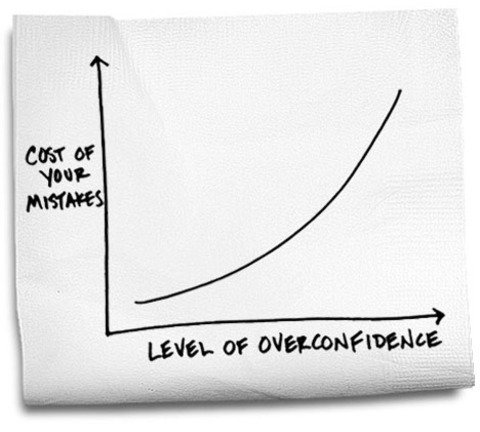
This week, we’re looking at one of my ‘favorite’ biases, in that it’s one that once you know, it can be quite comical to spot it in others (and yourself, if you still fall for it, from time to time). From Wikipedia: the overconfidence effect “is a well-established bias in which someone’s subjective confidence in their judgments is reliably greater than their objective accuracy, especially when confidence is relatively high.” That’s a bit jargon-y, so let me illustrate with a simple example.

In fact, this example comes from a lecture I heard about negotiation and talked about in one of my previous posts. In case you were wondering, the lecture comes from Professor Margaret Neale at Stanford. It was a brilliant! There was so much information packed into the lecture. I remember listening to it a few different times and still pulling out nuggets of wisdom. Anyway, I digress. The example that Prof. Neale uses is particularly on point for illustrating the overconfidence effect.

She has an empty pop bottle filled with paper clips (but not to the top). She says to the crowd that she wants them to guess how many paper clips are in the bottle. She walks up and down the aisles, so they can get a closer look, too. She instructs the crowd to write down their answer. Then, she asks them to write down a range where they could be 100% (she may say 99%, I don’t remember) sure that the number of paper clips fell in the range. Essentially, she was asking for a confidence interval. I think she also told them that she was sure there weren’t more than 1,000,000 paper clips in there. After some time, she then tells the audience how many were in there. She asks if anyone got it right (no one raises their hand). She then says something to the effect of, “For how many of you did the number of paper clips fall within the range?” There may have been about 35% of the room who raised their hand. 35%! She exclaims that this is terrible given that all of these people were 100% (or 99%) sure that the number would fall in the range. In fact, she said that in a room that size, there should have only been a handful of people who’s range wasn’t met (if the 99% figure was being used, rather than 100%). Prof. Neale then goes on to explain that this is the overconfidence effect. The audience was being asked to make an estimate of something about which they knew nothing, and then asked to rate their confidence. Knowing that they knew nothing about the topic, it would have been logical for the audience to have a large confidence interval (between 10 paper clips and 20,000 paper clips) — or even bigger!

This happens in more ways than just simply estimating the number of paper clips in a bottle. We also see this with investors. When asked, fund manager typically report having performed above-average service. In fact, 74% report having delivered above-average service, while the remaining 26% report having rendered average service.

Another place that we see the overconfidence effect show up is with the planning fallacy: “Oh yeah, I can finish that in two weeks…”

Ways for Avoiding the Overconfidence Effect

1) Know what you know (and don’t know)

The fastest way to slip into the trap of the overconfidence effect is to start making “confident” predictions about things that you don’t know about. Guessing the number of paper clips in a bottle is something that most of us have little to no expertise in. So, list a large confidence interval. If you have no experience in managing a project, it might be in your best interest not to make a prediction about how long it will take to complete the project (planning fallacy).

2) Is this person really an expert?

Sometimes, you’ll hear someone displaying a level of confidence in a given situation that makes you think they know what they’re talking about. As a result, it might bias you into believing what they are saying. It’s important to know if this person is an expert in this field, or if maybe they’re succumbing to the overconfidence effect.

From Scott Plous‘ book called The Psychology of Judgment and Decision Making: “Overconfidence has been called the most ‘pervasive and potentially catastrophic’ of all the cognitive biases to which human beings fall victim. It has been blamed for lawsuits, strikes, wars, and stock market bubbles and crashes.”

If you liked this post, you might like one of the other posts in this series: