Why Love Actually is a Good Christmas Movie

While Christmas happened a few days ago now, I wanted to write a quick note on Love Actually. You may or may not have heard of this Christmas movie. It was first released about a decade ago, but many people seem to want to watch it when Christmas rolls around. I didn’t realize just how popular this movie had become at Christmas time (my wife and I have watched it just about every Christmas since we’ve been married) until I started seeing notes about the movie in my twitter feed.

That is, there were some folks who were vehemently against Love Actually as a “good” romantic comedy. In fact, one person wrote:

The fundamental problem with Love Actually is that it presents romance as either absurdly easy—something that strikes you like a thunderclap and requires only a single grand gesture in order to be fulfilled—or all but impossible. Notably absent is the idea that love might ever be worth a little sustained effort: some mutual exploration and discovery, a bit of care and nurture, maybe even the overcoming of an obstacle or two. Indeed, it’s hard to shake the sense that what is “classic” about Love Actually is not that it shows us anything about how people fall in love, but that it so conspicuously declines even to try.

But there are also those folks who feel quite the opposite. That is, they think the film is actually quite good:

More than anything, Love Actually is a movie by people who get it. That get that the holidays are about love and loss and memories. It’s about new beginnings and it’s about endings. It’s about family and second chances, and sometimes it’s about the same old, same old. It’s love, in its many, many forms, lighting the way through the coldest season.

Then, there are those who are trying to figure out whether the movie should actually qualify as a classic (over 80% of voters on this CBC website think that it should be).

I can stipulate that Love Actually might not be promoting the “best” version of love, but I would say that with a level of maturity and understanding that some of what’s being portrayed is actually tongue-in-cheek (do all British men really think that their accent is enough to get American women to sleep with them?) the movie can be quite heartwarming. Putting that aside for a moment, one of the best aspects of the movie for me is the message of truth-telling. On a number of occasions we hear the characters saying something to the effect of, “It’s Christmas, so I wanted to tell the truth,” (or “tell you,” or “check with you,”).

To me, this is great. I enjoy that there’s this subtle albeit noticeable message that it’s important that we tell the truth with people we care about and/or are interested in spending time with on a regular basis. So, if you do decide to watch Love Actually at Christmas time or any time for that matter, maybe pay less attention to the “fake love” parts and pay more attention to the “truth” parts.

How Y’all, Youse and You Guys Talk: What About Canada?

I’ve been clearing out some of the tweets that I’ve favourited over the last week or so and one of them was a fun dialect quiz from the New York Times Sunday Review. There are 25 questions that ask you the various ways you do (or do not) refer to certain things in the world around you. For instance, do you say y’all or youse or you guys (or something else) when referring to other people?

I found it relatively fun.

If you do decide to do it, though, I’d advise you to be careful in selecting an answer too quickly. There were a few questions where I clicked on one option and hit next and as the next question was loading, I noticed that there was actually an option for (none of these).

I realize that the New York Times is hosting this quiz, but I would have been interested to see where I stand in Canada. Maybe The Globe and Mail or the National Post can look into doing something similar?

I grew up in the Toronto area and have spent some time in British Columbia (and now Ottawa), but I’d be interested to see how I compare to other Canadians. Since I did grow up in Toronto, I wonder if that throws a wrench into my dialect. And, since I’ve lived in so many different places (California, Hawaii, New Zealand, Michigan, Virginia, etc.).

On the whole, it turns out that my dialect is closest to the people in Portland or Seattle. If I’m being honest, after undergraduate university, the west coast of the continent is where I’ve spent most of my adult life. I spent about a year in California and about a year in British Columbia (and about a year in Hawaii). The next closest would have been Virginia with 2 years.

Still Looking for a Christmas Present? Try These Projects on Kickstarter Canada

It’s the last weekend before Christmas, so there’s a good chance that a lot of you out there are out in the hustle and bustle trying to find last-minute gifts for friends and family. If the weather forecasts are to be believed, some of you might not be able to make it out into the madness that is last-minute shopping before Christmas. That’s great! Why? Well, that means that you’ll have to be a bit more creative with your gift ideas.

So, why don’t you make someone’s day (in addition to the person who you’re giving the gif to) by making a donation in their name to one of these projects on Kickstarter Canada. Also, you could just donate to them anyways — and not make the donation on behalf of someone else: it could be on behalf of you!

Note: I’ve only included projects that — at the time of writing this post — hadn’t reached their goal.

NASH: The Movie

“You may have heard of Steve Nash, the NBA superstar and multiple MVP winner. You may also know that he’s Canadian. A Vancouver documentary crew secured unparalleled access to Nash, and they’re in the middle of raising money for production and editing costs for the final film. Unlike many film projects, tiers of this project include a physical and digital copy of the final product, which gives potential backers a tangible reward for their donation.” (Source)

Stratus Watch

“The concept is as simple as it is unprecedented; a titanium wristwatch with a face that you can choose. You can choose from dozens of patterns and colours from the manufacturer, or design your own and submit it to them. The watches exude a clean, straightforward charm, and even the lowest funding tier gifts you one of them.” (Source)

Shot Time

“In what could easily be the ruin of many a young soul, this is a shot glass that measures the amount of liquor consumed over a period of time; a potent mix of a stopwatch and a case of acute alcohol poisoning. The consequences of such a device are best left to the imagination, but if it meets its funding goals, the consequences may become very real, very quickly. Hooray for progress?” (Source)

Canadian Black Garlic

“Exactly what it says on the tin; backers are funding the creation and shipping of various black-garlic-based condiments and seasonings. The majority of the project’s funding goal will go to securing a large batch of Canadian-grown garlic, and the rest will go into the blackening and production/packaging process. Is there anything more Canadian than authentic Northern delicacies?” (Source)

SpecShot

“Like the mirror universe version of the Shot Time, the SpecShot is a two-in-one system that scans your drinking water for contaminants and then posts the results online. This process could be equal parts fascinating and harrowing, depending on your results, but the ultimate goal is to spread awareness through hard data, and hopefully inspire some change to our water quality standards.” (Source)

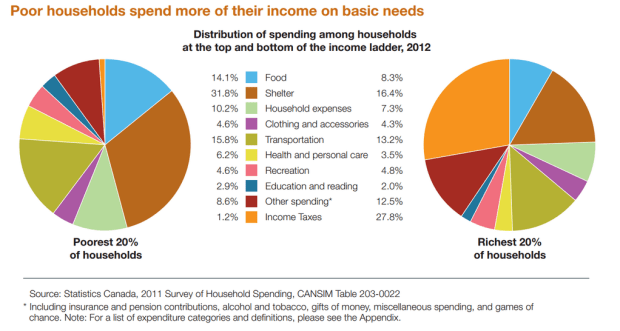
Poorest Canadians Spend More Than Half of Income on Food & Shelter

Just over a week ago, I saw this photo retweeted by Gerald Butts, who happens to be a senior advisor to Justin Trudeau (the Leader of the Liberal Party of Canada). As I’ve spent most of my adult life in the US, I’m used to hearing and writing (here, here, and here) about some of the sobering statistics in that country (approximately 50 million American live in poverty — right now!) As a result, I thought it’d be enlightening to take a closer look at some of the inequalities in Canada. This graph seemed like a good place to start.

For instance, I had no idea just how large the disparity was between the richest 20% and poorest 20%, with regard to food and shelter. Looking at the numbers, we can see that the poorest 20% spend approximately 56% (!) of their income on food and shelter. Fifty-six percent! While the richest 20% spend just 32%. I chose these categories because of Maslow’s Hierarchy of Needs. Food and shelter are some of the most basic needs we have and if the poorest 20% has to spend so much of their income on — essentially — surviving, it’s going to make it that much harder to “climb the economic ladder.” Of course, some might say it’s misleading to look at the numbers in aggregate like this.

With that being said, this holiday season, I hope you’ll remember this graph when you’re out at holiday parties and issues of politics and/or charities arise. It may add an important layer of perspective to the conversation.

Would You Rather Pay Fees or Taxes?

A little over a week ago, Matt Yglesias wrote a post on Slate about how to balance the budget while slashing taxes. The solution: call everything a fee.

Well we could solve an awful lot of problems that way. For example, I’d love to see us impose a greenhouse gas emissions fee to internalize the social cost of carbon dioxide. On top of that, I think a small additional fee on the use of gasoline would be justified. And of course road congestion fees on crowded highways. I used to think we should raise the alcoholic beverages tax, but now I think we should eliminate it entirely. Instead, let’s put an “alcohol fee” in place that just happens to be higher than the current tax. Do the same for cigarettes. Legalize marijuana, but subject its sale to a rather hefty fee. It actually turns out that we could replace most taxes on labor and capital with a land occupancy fee, especially if we call it a “land occupancy fee” rather than a “land value tax.”

After reading this post, it made me think of Michael Sandel’s chapter about fines versus fees. Maybe some of the things that Yglesias is talking about in this post should actually be labeled fines and not fees. For instances, if we’re talking about internalizing the social cost of carbon dioxide, isn’t there a moral piece to it? That is, shouldn’t we call this a fine, then? You may disagree, but the nomenclature in this case does matter.

It seems a bit absurd to think that people would be more amenable to paying money for something merely by changing the label from ‘tax’ to ‘fee,’ but labels matter.

While it’s certainly a creative idea to start charging fees and lower taxes, there is an important bit to consider here. Namely, the control of these fees. Have you ever had to pay a fee to get your license renewed? Do you know how much it costs the government to ‘actually’ renew your license? I don’t. But I know that I get charged close to $100 to renew it. Josh Barro solidifies the point:

Politicians tend to regard fees as more palatable than taxes, and more focused too. If a state needs to finance an infrastructure to oversee fishing, why shouldn’t fishermen foot the bill? But groups like the nonpartisan Tax Foundation in Washington worry that governments are now using fees to shore up budget shortfalls rather than cover specific costs incurred by specific users.

“When it comes to paying for bananas, you’ve got the market as a mechanism to make sure you’re paying a fair price,” says Josh Barro, a staff economist at the Tax Foundation. “But when it comes to getting your driver’s license renewed, the government has a monopoly, and you have no idea what it costs the state or what it’s doing with the money.”

The moral of the story: maybe taxes aren’t so bad after all.

Should it be Illegal to Call Someone ‘fat’ on TV?

Jennifer Lawrence thinks so.

Take a look:

She certainly makes a good point. If we’re regulating other words that are spoken on TV because of the effect they have on younger generations, why not the word fat? I can already begin to see the argument against: “if we start regulating words like ‘fat,’ does this become a slippery slope into regulating other words?” While I understand that practically, regulating criticisms like ‘fat’ on TV might be a bit difficult, I think it’s certainly something interesting to consider.

I originally saw this clip as part of a bit from Morning Joe, but that doesn’t embed so well here, so I found a clip of Walters’ interview with Lawrence on YouTube. The actual bit I saw had some commentary from some of the folks who make regular appearances on the morning television program on MSNBC. As I said, I can’t embed that video, so take a look.

Similar to how the opinion can be understood of the “slippery slope,” the first fellow that speaks on the video that’s telling Jennifer Lawrence (and other celebrities) to ‘shut up’ because they always blame the media for everything — I don’t buy that. It’s not that the media’s at fault for everything, but as has been demonstrated, they certainly do have a large impact on the way that people feel about themselves. In particular, young and impressionable people.

As a result, someone who outright denies the possibility that the media can have an opinion on the way that young people (and even not young people!) can feel about themselves, to me, seems out of touch. To reiterate, I can see where this fellow is coming from, but putting that aside for a second, Jennifer Lawrence absolutely has a point. There’s certainly a culture of highlighting flaws that is perpetuated (not just in the media), but in our culture — and in particular, with young women. I’ve said it before, but I’ll say it again: if you haven’t yet, take the time and watch Miss Representation. It’s an important documentary that I hope will shed some light on this issue.

To be clear, I’m not implying that people, the media, or our culture are necessarily perpetuating this attitude intentionally, but that doesn’t mean that there completely innocent, either.

How Americans Get to Work: Is It Time to Change Incentives?

This past Friday, there was a rather startling chart from The Atlantic. The chart illustrated how Americans get to work, by volume. That is, the total number of people who take the bus, the total number of people who drive, the total number of people who walk — you get the idea. Before clicking through to read the post, I was hopeful… afterwards, not so much:

In case the numbers are too small to read, the effect should still stand — well beyond the majority of Americans drive alone to work. Now, it’s not that there’s anything inherently wrong with this, but now that we’ve seen things like the image below, that illustrates the space needed to transport 60 people in various ways, it seems more reasonable that people shouldn’t drive alone in their car.

Of course, some folks might jump to the argument that there are more people who live in rural areas in America — not true. “In 2010, a total of 80.7 percent of Americans lived in urban areas, up from 79 percent in 2000.” However, just because the vast majority of American live in urban areas, that doesn’t mean that they have access to viable alternative means of transportation. Maybe it’s time for Americans to reconsider the emphasis on culture of cars.


What Do You Do When You’re THAT Much Better Than The Competition?

The Miami Heat have won the last two NBA championships and they’ve been to the finals for the last three years (losing in Game 7 of the finals before winning back-to-back championships). So far this year, they’re one of two teams in the Eastern Conference (as of this writing) to have a winning record. The other team being the Indiana Pacers, whom many think will challenge the Heat for the best team in the Eastern Conference this season. If we take a peek at the Western Conference, we see that there are quite a few more teams with winning records. In fact, there are five times as many winning teams in the West than in the East.

I’m not here to talk about the parity in the NBA conferences, even though it’s clear that there is, but instead, about the Heat and their competition. That is, they’ll play most of their games against the Eastern conference, of which there are only two teams with winning records. Given that the Heat have been an elite team for the last three years, it’s not surprising that a they’d have to resort to “games within games” to stay focused.

After reading that article on SB Nation, I thought to myself how difficult it must be for the Miami Heat coach (Erik Spoelstra) to keep his players focused, not only as each season wears on, but as each game wears on and each quarter wears on. The Heat have played 23 games so far this season and have won 17 of them. While they’re not in first place in the conference (that title belongs to the other winning team in the East, the Pacers), they’re well above the 3rd place team in the conference. For a team that plays that much better than its opponents on a nightly basis, one can see how it might be easy for the players to lose focus. Heck, it’s possible that a few of those six losses came as a result of the team losing focus after having outplayed the other team through the first few quarters of the game.

The reason I’ve raised this issue is because I was thinking about the success of a “games within games” strategy. For instance, let’s say that the “game inside the game” for today’s game is that we’re going to try to get the ball to the guy down low. That is, the strategy is to beat this team by using a certain player in a certain way. I wonder what happens when it gets down to near the end of the game and the score is close — do you abandon that strategy? And if you do, how do you get the players who hadn’t been as involved ready to go now that it’s the key time in the game?

A games within games strategy can be successful, but I worry at what cost.

This also reminds me of one of the chapters in Michael Sandel’s book that we reviewed about 6 months ago — the idea of fines and fees. In particular, the idea that parents pay their kids to read. By doing so, parents are incentivizing a certain behaviour. The worry, from some, is that by paying their kids to read, the kids will no longer derive the same joy out of reading if there’s no incentive involved. If we apply that to this situation, I wonder if the strategy of using the one player in that one game might pervert the incentives for the team. And not just in that game, but over the long haul. Maybe the players don’t then have the same incentives as before when there aren’t games within games.

Of course, I’m not an NBA basketball coach (or even a high school basketball coach), but I think it’s still an idea worth considering.

Case Study: When The Twitterverse Turns on You

http://blogs.hbr.org/2013/12/case-study-when-the-twitterverse-turns-on-you/Every once and a while, Harvard Business Review posts a case study to their blog and solicits their readers to come up with answers to the case. After reading what was posted earlier today, I took some time on my flight back from Washington, DC to Toronto to see if I could develop a suitable strategy for responding to the ‘crisis’ at hand. Head on over to HBR and check out the Case Study. I’d be interested to hear some of your thoughts on how Canadian Jet should proceed.

Here’s what I came up with:

When faced with a decision like this, it’s important to ensure that the group isn’t succumbing to any biases in judgment and decision-making. Right off the bat, it’s clear that one potential trap is the sunk cost fallacy. While the decision to keep the contest running might be the right one, it’s necessary to discern whether this choice is being made because “this is our biggest social media campaign,” and we’ve got “nothing [else planned] on this scale.”

If it were my decision, I would advise Charlene to keep the contest. Right now, it’s going through a bit of a bumpy stage, but when viewed through an optimistic lens, these customers who have tweeted “doozies” can actually turn into some of Canadian Jet’s biggest assets. How? By directly addressing their concerns.

Seek out those customers on Twitter who have shared tweets that have had the greatest impact (reach via retweets, etc.) and apologize to them. Speak to them directly on Twitter, (but not in a direct message, part of the purpose in doing this is so that others can see that you’re) on Twitter and express remorse for their concerns. Where possible, maybe offer some sort of compensation in the form of a discount on their next flight or something similar. It’s important to keep clear that you don’t think that this makes up for the fact that they’ve “missed their daughter’s wedding,” but that you hope they can find some consolation in it.

What Will the Obamas Do in 2017?

Today’s been a bit hectic. I rode the bus from downtown Ottawa to get to the airport. The “hectic-ness” stems from the fact that it was quite snowy outside. The visibility was quite poor and I was sure my flight would be delayed (it wasn’t). Right now, I’m sitting in the Toronto Island Airport (not the much more known Toronto Airport, which is actually almost in Mississauga) and waiting for my next flight.

In amongst my travels today, I had the chance to see Pres. Obama’s speech at Nelson Mandela’s memorial. I knew that it was today, but I also knew I wouldn’t have much time to watch it today. As I was getting ready to board the bus in Ottawa, I saw some folks on Twitter talking about this being one of Obama’s best speeches yet. He’s certainly delivered some doozies in his time, so I wondered if the rhetoric was hyperbole. As it turns out — it’s not. I buffered the speech and watched it at 30,000 feet. It was… awesome. And I don’t mean awesome in the way that the word has been co-opted to mean as a form of slang. The speech was awesome.

There were so many great portions of the speech that I’d be hear all day if I were excerpting. One part in particular I wanted to highlight:

The struggles that follow the victory of formal equality and universal franchise may not be as filled with drama and moral clarity as those that came before, but they are no less important.

Essentially, we’re not finished, yet. We’ve still got work to do. (If you want to watch video of the speech, this is all I could find with airport WiFi.)

Update: as expected, there’s a YouTube video of the speech.

Pres. Obama is the 44th President of the United States, so he belongs to a unique club of people. No doubt, history will remember him. However, he’s also one of the youngest presidents in a time in history where people are living longer than ever. As a result, I’m infinitely curious as to what the Obamas will do post-White House. For instance, look at Bill and Hillary Clinton. Hillary Clinton went on to be a United States Senator and then the Secretary of the State (and maybe one day, President). Bill (along with Hillary) created a foundation and have been effecting change the world over.

There are probably an infinite number of things that the Obamas could get into, but I wonder which issue excites them the most. That is, where do they want to leave their mark on history. Given the way that Pres. Obama speaks about equality, social justice, and social rights, it seems like a natural fit for him.

Of course, the Obamas probably aren’t thinking about that right now, but that time is not too far away for them. We’re almost finished with 2013 and the 2014 midterm elections aren’t even a year away. After that, it’s essentially “open season” on candidates announcing their intentions to run for President.