The Long View Perspective on Big Data and Metrics?

One of the things that I like to write about is perspective. In my opinion, it’s so important to continue to look at things from different angles and assume other viewpoints to understand the many ways that things can interact. A little over a week ago, I came across a series of tweets from Chris Hayes that presented a perspective that I hadn’t considered:

Big Data is certainly something that has captivated the popular press and some might even say rightfully so. Of course, it’s important that we use metrics when making decisions, but is it possible that the pendulum has swung too far to metrics? It’s hard to say. Chris Hayes certainly seems to think so.

I like how he’s compared this to another phenomenon (can we call it a phenomenon?) from history where engineering took the world by storm. To be honest, given my age, and what I know about ‘recent’ history, I don’t know that engineering had as much hoopla as big data has today. Regardless, this perspective, this long view, is something that we all would be better off with. That is, looking at things from a longer perspective. Considering the adage that ‘history repeats itself.’ Maybe there’s something from our recent past that would help us better understand where we are today.

A good example of this might be international relations. If you’re looking for a ‘fictional’ example, may I recommend the movie “Now You See Me?”

Solving False Equivalence in Politics?

Last week, John Oliver had a great segment that poked fun at how most (all?) television outlets cover climate change. Take a look:

Upon watching it, I didn’t think that Oliver was going to “even out” the representation in a physical manner. Instead, I thought that he was going to solve the issue of the “talking heads” appearing equal. Let me explain. Watch this:

That’s Lewis Black from the 2006 film, Man of the Year. I have no doubt that this sentiment had been expressed before this film, but this was the first time that I had heard it in this way. Hosting someone on a TV program with ideas that are clearly incorrect and putting their “talking head” up next to someone who has legitimately studied and confirmed that the other person is incorrect is a form of false equivalence.

As Black explains, to the viewer, both of these sides appear “equal.” It appears that one person is expressing an opinion and that the other person has a different opinion. What’s being missed is that one person’s opinion is factually erroneous (just as we saw in the video with Bill Nye earlier).

When I was watching the Oliver video, it made me think that he was going to do something else. I thought he was going to show the two talking heads in boxes (as you usually see on “debates” on political talk shows), but instead of giving them both a 50/50 split on the screen, I thought he was going to ration it more appropriately given the overwhelming support for climate change. I thought he’d give Bill Nye’s box 97% of the screen and the other guy’s box 3% of the screen.

I realize that this probably wouldn’t work in an actual talk show, but since I knew it was supposed to be semi-satirical, it seemed like a plausible idea.

On that note, can you imagine if that’s how political talk shows actually did things? That is, instead of having that 50/50 split, when they were talking about something factual, the size of the box for the talking head espousing the nonfactual opinion would be smaller. Of course, there’s all kinds of problem that could be raised with regard to censorship, but it’s certainly creative.

Why Does Respect Fly Out the Window When Women are Involved?

Yesterday, Liberal MP Chrystia Freeland asked — ahem, tried to ask — a question during Question Period of the government. Unfortunately for her (and those watching), she wasn’t given the same respect afforded other MPs. As far as I can tell, this was the first question she’s asked during question period and as folks would expect who’ve read her work, she asked a question that was grounded in research [this one happened to be from the IMF]. The video doesn’t seem to be up on YouTube and all I could find was the link through AOL, which doesn’t embed nicely on this site, so you’ll have to watch the video here (2 minutes and 23 seconds in all).

On most days, Question Period can seem a bit immature, but I took particular issue with this instance because of some of the comments that followed on Twitter. Actually, the comment from the Minister of State was a bit off the wall, but most answers in Question Period don’t really address the details of the question. The comment on Twitter that came from a journalist (!) no less, which has since been deleted:

Part of the reason that it seems so appalling that this came from a journalist is because Freeland herself, was a journalist before she became an MP. I would have thought that if any profession were to cut Freeland a little more slack, it might be journalists. Freeland’s response on Twitter:

Exactly! It’s 2014! Why are we still marginalizing women in such a sexist fashion. I was glad to see Michelle Rempel, a Conservative MP, tweet the following, shortly after Freeland’s tweet:

This was the same Michelle Rempel who came under fire because of the way she posed in her Twitter pic! It’s absurd to me just how awful we still treat women in our society. As Freeland said, it’s 2014, for Pete’s sake!

Beyond all of this, though, I don’t necessarily hold the journalist completely at fault for what he said. [He did apologize, too — twice.] Yes, it was awful and unnecessary, but in a way, we are all a bit culpable. How? Why? Well, because we all live in this society and we all help to create the norms and values upon which we act and behave. One of the best ways to help effect change here: awareness. Go watch Miss Representation and tell your friends to do the same!

85 People Have As Much Wealth as 3.5 Billion People

Just think about that headline for a second… 85 people have as much wealth as 3.5 billion people. Eighty-five vs. Three and a half billion. Maybe looking at the words isn’t enough, let’s look at it in numbers. 85 vs. 3,500,000,000. If I were graphically inclined, I’d make a quick “infographic” showing 85 people on one side and 3,500,000,00 on the other side. That’s an astronomical difference.

The article in The Guardian where I first read it had a good analogy:

The world’s wealthiest people aren’t known for travelling by bus, but if they fancied a change of scene then the richest 85 people on the globe could squeeze onto a single double-decker.

This isn’t the first time I’ve written about wealth inequality and it probably won’t be the last. There are two posts that come immediately to mind. The first is the one from a couple of years ago where I shared a graphic that came from a paper by two researchers studying the wealth distribution in the US. Most notably from the graphic was that the perception of American was way off from reality. Americans thought that the top 20% had approximately 60% of the wealth and they wanted the distribution to be that the top 20% was closer to 30%. In actuality, the top 20% (at the time) had close to 90% of all wealth in the US.

The second post was just under a year ago and it took a deeper look at the graphic that I shared in the first post. Someone animated the chart, that is to say, they made a video of the information to make it more accessible to people and it was shared heartily across the internet — it’s currently over 14,000,000 views.

So what does all of that have to do with today’s information? Well, as is pointed out in the article in The Guardian, the World Economic Forum is starting in a few days, so talking about these kinds of issues are important. That is, reminding folks that the people in attendance at Davos will make up well over half of the wealth in the entire world

The image I’ve used for this post comes from that same article and it’s how I’d like to finish today’s post. Take a look at the United States. In 1980, the top 1%’s share of the national income was 10%. In 20 years, that’s doubled to 20% (of the national income). There’s been movement in other countries, but none as great as the US. I’m not picking on the US, but it’s quite clear that if you’re interested in being part of the wealthiest sect of the world, the US is a good place to do just that.

My point in sharing this image is to forward the conversation on this matter. People have very different opinions on how money should be spent, especially when that money is tax dollars. I’m not necessarily trying to trumpet one opinion more than the other, but I think it’s important to highlight this massive disparity and question whether this is how we want to live in the world.

Coping Strategies Used by Teens When Criticized by Their Peers for Their Brand Choice

Remember back in high school, middle school, or elementary school when you were worried to go to school because your jeans weren’t Levis, or Jordache, or Lucky, or whatever name brand was popular when you were an adolescent? A couple of researchers from Paris decided that they were going to take a closer look at this phenomenon. That is, how we coped (or cope) with being criticized for not wearing the ‘right’ clothes.

Their results revealed that we have five main coping strategies for these situations: justification, revenge, denial, self-reproach, and making the criticizers feel guilty. Can you remember how you reacted (or might have reacted) if you were in one of these situations? Personally, I have a hard time remembering what I might have said (or did say), so let’s take a look at some of the responses.

In justification:

I tell them why I bought this particular brand.

I justify my choice, explaining why I picked this brand, the circumstances of my purchase, etc.

I explain what are the reasons that pushed me to make this brand choice in particular.

In revenge:

I no longer bother to criticize their clothes.

I try to get my own back by criticizing their clothes.

From now on I’ll carefully take note of how they look and won’t hold back from criticizing it.

In denial:

I act as if I hadn’t heard what they said.

I act is if nothing’s been said. [sic]

I imagine that they haven’t said anything and that’s enough to fix the problem.

In self-reproach:

I bear a grudge against myself: why did I choose this jeans’ brand? It’s rubbish!

I think that I wouldn’t have to buy an unknown brand for my friends.

In making the criticizers feel guilty:

I tell them it’s not cool to criticize people about their appearance.

I tell them it’s not very nice for one’s friends to make comments like that.

After reading the responses under the five strategies, do you think adolescents would be more inclined to use one strategy over the other? What about in girls vs. boys? It turns, that’s the case.

The researchers found that the emotion-centered coping strategies (denial and self-reproach) were the strategies that were mostly influenced by “perceived controllability,” which is, “evaluation of the capacity people believe they have to do or not do something when confronted with a situation.” This runs opposite to previous theories, with regard to coping and so the researchers advocated caution when examining coping strategies from the perspective of major dimensions and that more care should be taken to include context.

One last piece that I found interesting were the differences between boys and girls. That is, the researchers found that girls, more than boys, were more likely to make the criticizers feel guilty. This made me wonder about this whole idea of girls developing emotionally before boys and that girls are more empathetic. I wonder if we looked at boys when they reached the same “level of maturity,” would they begin using this last coping strategy more than the others?

More than this, though, I wonder about the cultural effects on coping strategies. I continuously refer back to the documentary Miss Representation and its soon-to-be released brother, The Mask You Live In. The perspectives presented in those documentaries highlight the importance of culture and media on our youth, too. Maybe our adolescents wouldn’t have to develop coping strategies for combatting criticism about their clothing, if kids didn’t even think it was “cool” to criticize someone for the clothes they wear.

ResearchBlogging.orgSarah Benmoyal-Bouzaglo, & Denis Guiot (2013). The coping strategies used by teenagers criticized by their peers for their brand choice Recherche et Applications en Marketing DOI: 10.1177/2051570713487478

Why I Like Snow and Not for the Reasons You Might Think

I grew up in Canada. I’m Canadian. I lived in and around the Toronto area until I went off to university in Michigan. From there, I spent some time in warmer parts of the continent (California and British Columbia) and even spent some time in New Zealand and Hawaii. As I’ve spent some time away from Canada, I’ve been able to avoid “Canadian Winters.” In fact, this winter will be my first Canadian Winter in almost a decade.

As a Canadian, I can say that Canadian Winters aren’t all that bad, but I suppose that depends on where you live when you’re experiencing said Canadian Winter. Just a little while ago, Winnipeg experienced weather that was colder than Mars
and at the time, Mars was much farther from the Sun than Earth:

Folklore tells us that it can be “too cold to snow,” but a smart meteorologist will tell you that this isn’t true. Technically, it can never be too cold to snow (except when you reach absolute zero, but there are other things to worry about when this happens). However, snow can become far less likely when it’s colder and this has to do with a lack of water vapour in the cold air.

So, in my first Canadian Winter in almost a decade, I find myself elated whenever I see snow in the forecast or when I open the curtains to see it snowing. Of course, snow is quite pretty, so it’s fun to see it snowing and it can be fun to play in, but when I see it snowing, I know that it’s likely not that cold outside. I should also mention that I rarely, if ever, have to drive in said weather because I usually walk, so that may be colouring my experience. Nonetheless, it’s great to know that I won’t be needing to wear my long underwear just to walk down the street to get groceries.

How Y’all, Youse and You Guys Talk: What About Canada?

I’ve been clearing out some of the tweets that I’ve favourited over the last week or so and one of them was a fun dialect quiz from the New York Times Sunday Review. There are 25 questions that ask you the various ways you do (or do not) refer to certain things in the world around you. For instance, do you say y’all or youse or you guys (or something else) when referring to other people?

I found it relatively fun.

If you do decide to do it, though, I’d advise you to be careful in selecting an answer too quickly. There were a few questions where I clicked on one option and hit next and as the next question was loading, I noticed that there was actually an option for (none of these).

I realize that the New York Times is hosting this quiz, but I would have been interested to see where I stand in Canada. Maybe The Globe and Mail or the National Post can look into doing something similar?

I grew up in the Toronto area and have spent some time in British Columbia (and now Ottawa), but I’d be interested to see how I compare to other Canadians. Since I did grow up in Toronto, I wonder if that throws a wrench into my dialect. And, since I’ve lived in so many different places (California, Hawaii, New Zealand, Michigan, Virginia, etc.).

On the whole, it turns out that my dialect is closest to the people in Portland or Seattle. If I’m being honest, after undergraduate university, the west coast of the continent is where I’ve spent most of my adult life. I spent about a year in California and about a year in British Columbia (and about a year in Hawaii). The next closest would have been Virginia with 2 years.

Poorest Canadians Spend More Than Half of Income on Food & Shelter

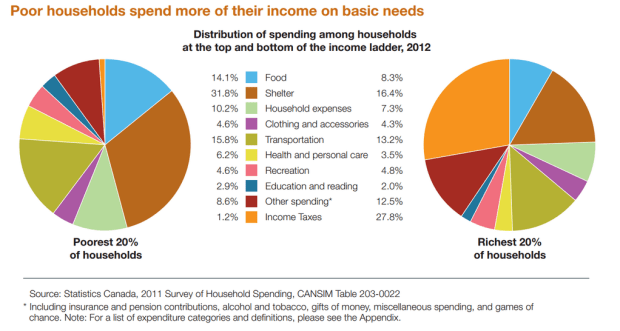
Just over a week ago, I saw this photo retweeted by Gerald Butts, who happens to be a senior advisor to Justin Trudeau (the Leader of the Liberal Party of Canada). As I’ve spent most of my adult life in the US, I’m used to hearing and writing (here, here, and here) about some of the sobering statistics in that country (approximately 50 million American live in poverty — right now!) As a result, I thought it’d be enlightening to take a closer look at some of the inequalities in Canada. This graph seemed like a good place to start.

For instance, I had no idea just how large the disparity was between the richest 20% and poorest 20%, with regard to food and shelter. Looking at the numbers, we can see that the poorest 20% spend approximately 56% (!) of their income on food and shelter. Fifty-six percent! While the richest 20% spend just 32%. I chose these categories because of Maslow’s Hierarchy of Needs. Food and shelter are some of the most basic needs we have and if the poorest 20% has to spend so much of their income on — essentially — surviving, it’s going to make it that much harder to “climb the economic ladder.” Of course, some might say it’s misleading to look at the numbers in aggregate like this.

With that being said, this holiday season, I hope you’ll remember this graph when you’re out at holiday parties and issues of politics and/or charities arise. It may add an important layer of perspective to the conversation.

Would You Rather Pay Fees or Taxes?

A little over a week ago, Matt Yglesias wrote a post on Slate about how to balance the budget while slashing taxes. The solution: call everything a fee.

Well we could solve an awful lot of problems that way. For example, I’d love to see us impose a greenhouse gas emissions fee to internalize the social cost of carbon dioxide. On top of that, I think a small additional fee on the use of gasoline would be justified. And of course road congestion fees on crowded highways. I used to think we should raise the alcoholic beverages tax, but now I think we should eliminate it entirely. Instead, let’s put an “alcohol fee” in place that just happens to be higher than the current tax. Do the same for cigarettes. Legalize marijuana, but subject its sale to a rather hefty fee. It actually turns out that we could replace most taxes on labor and capital with a land occupancy fee, especially if we call it a “land occupancy fee” rather than a “land value tax.”

After reading this post, it made me think of Michael Sandel’s chapter about fines versus fees. Maybe some of the things that Yglesias is talking about in this post should actually be labeled fines and not fees. For instances, if we’re talking about internalizing the social cost of carbon dioxide, isn’t there a moral piece to it? That is, shouldn’t we call this a fine, then? You may disagree, but the nomenclature in this case does matter.

It seems a bit absurd to think that people would be more amenable to paying money for something merely by changing the label from ‘tax’ to ‘fee,’ but labels matter.

While it’s certainly a creative idea to start charging fees and lower taxes, there is an important bit to consider here. Namely, the control of these fees. Have you ever had to pay a fee to get your license renewed? Do you know how much it costs the government to ‘actually’ renew your license? I don’t. But I know that I get charged close to $100 to renew it. Josh Barro solidifies the point:

Politicians tend to regard fees as more palatable than taxes, and more focused too. If a state needs to finance an infrastructure to oversee fishing, why shouldn’t fishermen foot the bill? But groups like the nonpartisan Tax Foundation in Washington worry that governments are now using fees to shore up budget shortfalls rather than cover specific costs incurred by specific users.

“When it comes to paying for bananas, you’ve got the market as a mechanism to make sure you’re paying a fair price,” says Josh Barro, a staff economist at the Tax Foundation. “But when it comes to getting your driver’s license renewed, the government has a monopoly, and you have no idea what it costs the state or what it’s doing with the money.”

The moral of the story: maybe taxes aren’t so bad after all.

Revisiting Using Pitchers on Short Rest: Long-Term Ramifications

A couple of weeks ago, I wrote about the Los Angeles Dodgers’ strategy of using their best pitcher (and one of the best pitchers in baseball) on short rest to pitch in a non-elimination game. The Dodgers ended up winning that game and the series, but the debate over the strategy doesn’t end there.

In my post from a couple of weeks ago, I compared the Dodgers’ decision to my younger years when I was playing baseball in double elimination tournaments. This wasn’t a perfect comparison, but I the spirit of the decision to use your best pitcher was there in both. A few nights ago, the Los Angeles Dodgers were eliminated from the postseason. All but one of the thirty teams are eliminated, so this isn’t earth-shattering news. However, the fashion in which they lost is.

In Game 6 of the National League Championship Series, the Dodgers started Clayton Kershaw. Yes, the same one who started in Game 4 for the Dodgers in the National League Divisional Series. This time, Kershaw’s start didn’t go so well. In fact, Kershaw only pitched 4 innings before pulled by the manager, Don Mattingly, but not before Kershaw gave up 7 runs. So, the question might be warranted: did using Kershaw on short rest affect his ability in Game 6? It turns out, this was a thought that had crossed some minds before Kershaw made the start in Game 4.

As they say, hindsight is 20-20, but it does seem a bit prescient. McCarthy’s hypothesis makes sense, but it’d be hard to test. One may point to Kershaw’s start in Game 2 of the NLCS. He tossed 6 innings and allowed 1 unearned run. Shouldn’t he have unravelled in that game if he were fatigued from the short rest start in the NLDS? One could argue that, but the way that McCarthy’s argument is setup leads one to believe that the “fatigue” could happen later and later. So, if the Dodgers won Game 6 and won Game 7, would McCarthy have expected Kershaw to unravel during one of his starts in the World Series?

~

Let’s see if we can apply this lesson to decisions in other arenas. The analogy I used for the other post doesn’t really hold anymore. We’d be better off thinking about a decision for a business. Using Kershaw in the way the Dodgers did was almost like using a certain machine in the factory to fill some rush orders. The machine might only be able to fill a certain number of orders per week, but because it’s the holiday season, the boss thinks that running it on overdrive is necessary. Initially, the machine churns out the widgets just the way the boss would have expected, but next week when you use the machine, the widgets aren’t as high a quality. And then the week after that, the widgets aren’t even of a high enough quality to give away. It’s clear, the machine needs a break and some recalibration. In weighing the risk, the boss thought that using the machine more than usual was worth it for it potentially shutting down.

There are other ways we can map out this scenario, but I want you to think about how you might be overdoing it. Maybe the machine you use at work is fatiguing. Maybe you are fatiguing from working too hard.