Quick Thoughts: Planning Fallacy, Sci-Fi, Gendered Language, and Scarcity/Excess

glenn-carstens-peters-RLw-UC03Gwc-unsplashAs I look to breathe some life back into writing, I thought I’d take a quick peek at some of the “drafts” I had saved from when I used to write regularly. Fortunately, there aren’t too many there. In the interest of trying to start fresh, I thought I’d do a quick post addressing some of these ideas kind of in the same way that Wikipedia has stubs.

Planning Fallacy: Many years ago, I wrote about the planning fallacy as part of my series on cognitive biases (i.e. how to make decision better). Something I didn’t talk about in that post was the difference between a 7-day and 5-day workweek. Let me explain. For those that go to university, everyday is eligible for a “work” day (i.e. homework). Many things are due on Monday morning and rather than push to complete something on Friday afternoon (or night?), students will often be writing things on Sunday night. Not only am I drawing on my experience as a student, but I’ve been teaching for the last 7+ years and I can say with authority, if I give students a full week (7 days) to complete an assignment and make an assignment due at 1159p on Sunday night, 50%+ of the class will complete that assignment sometime on Sunday. I’m digressing a bit from the point. So, we get used to this “7-day workweek” to complete things. When we move into the work world, that “week” shifts from 7 days to 5 days (and even less in cases of holidays or even less than that if you take into account mandatory meetings, etc.). So, when someone estimates how much time they’ll have to complete a work product, they’re used to (primacy effect?) how they were estimating when they were a student and don’t take into account the ‘truncated’ week.

Science Fiction, Humans, and Aliens: In those sci-fi movies that have some form of alien (i.e. non-human), often times, there’ll be a scene where the humans are kept in a cage. It made me think about how humans keep some animals in cages (i.e. zoo). Maybe to a different species, we (humans) would be treated in the same way we treat animals.

Gendered Language: There was a journal article from a few years ago that caught my eye. Here’s a bit of the abstract:

The language used to describe concepts influences individuals’ cognition, affect, and behavior. A striking example comes from research on gendered language, or words that denote individuals’ gender (e.g., she, woman, daughter). Gendered language contributes to gender biases by making gender salient, treating gender as a binary category, and causing stereotypic views of gender.

Like I said yesterday, if you’ve been following me for any sort of time, this bit about our words having an effect on us shoudn’t come as a surprise. However, this journal article is strong evidence to keep in your pocket if you need to point to something evidence-based in a discussion.

The Problem of Excess: Another good journal article that I’ve been saving for over 5 (!) years. /facepalm. I still remember my first grad school economics course and the professor was explaining the fundamental principle that underlines economics — scarcity. I wanted to raise my hand and disagree on the merits, but it didn’t seem appropriate. I can see and understand how scarcity came to be the dominant theory of the day, but a part of my being just feels that that interpretation is… near-sighted. Seeing this journal article a few years after that class highlighted a different perspective. Here’s a bit of the abstract:

This article argues for a new branch of theory based not on presumptions of scarcity—which are the foundational presumptions of most existing social theory—but on those of excess. […] It then considers and rejects the idea that excess of one thing is simply scarcity of another. It discusses the mechanisms by which excess creates problems, noting three such mechanisms at the individual level (paralysis, habituation, and value contextuality) and two further mechanisms (disruption and misinheritance) at the social level. […] It closes with some brief illustrations of how familiar questions can be recast from terms of scarcity into terms of excess.

Enjoy your weekend!

Your Invention is about to Launch: Did You Consider ALL Ramifications?

Do you think it’d be wonderful to have government departments with such lofty titles like the Ministry of Peace, the Ministry of Truth, the Ministry of Plenty, and the Ministry of Love? OK, maybe that’s a bit too on the nose, as most people have probably read (and/or heard of) 1984. The point I’m trying to make:

The best-laid plans of mice and men often go awry.

Huh? Let me explain.

You’re a burgeoning, young social entrepreneur who can’t wait to set the world on fire with this idea you’ve been cultivating for years. This invention has all the hallmarks of a game-changer in its industry and will surely have a spillover effect into other industries. It will revolutionize the way business takes place for years to come. You know that as soon as your invention goes to market, the world will be a better place. Finally, the day is here and your invention goes live. There is an enormous uptake rate. People start using it instantly – across the world. You’re so happy and can’t believe how quickly people have adapted to making it part of their daily lives. You always hoped and thought they would, but to see it actually happening – wow!

Two months later, you start to notice something peculiar in how your invention is being used. You notice that people are starting to use the invention in a way that you hadn’t intended and that this is starting to have an adverse effect in some areas. Weeks pass and you see that the trend has continued. People are continuing to use your invention in the “wrong” way and as a result, some people are starting to get hurt. More weeks pass and you realize that your invention, while if used in the way you intended is wonderful, has become a main driver of pain and suffering in the world.

Recognizing this, you wish with all your might that you could go back to the day before you launched the invention to undo it. Take it all back. Unfortunately, the proverbial cat is out of the bag and there’s no going back. The internet is here to stay…

I share this anecdote on account of something I read in The New Yorker recently:

In an influential piece that appeared in Rolling Stone in 1972, Brand prophesied that, when computers became widely available, everyone would become a “computer bum” and “more empowered as individuals and co-operators.” This, he further predicted, could enhance “the richness and rigor of spontaneous creation and human interaction.” No longer would it be the editors at the Times and the Washington Post and the producers at CBS News who decided what the public did (or didn’t) learn. No longer would the suits at the entertainment companies determine what the public did (or didn’t) hear.

“The Internet was supposed to be a boon for artists,” Taplin observes. “It was supposed to eliminate the ‘gatekeepers’—the big studios and record companies that decide which movies and music get widespread distribution.” Silicon Valley, Foer writes, was supposed to be a liberating force—“the disruptive agent that shatters the grip of the sclerotic, self-perpetuating mediocrity that constitutes the American elite.”

Fifty years ago, people thought computers would bring us closer together in a way that we hadn’t imagined. Certainly, we can say that that’s the case, but we must also say that they’ve brought us closer together in a way that we hadn’t imagined!

When we aspire to bring things into the world through entrepreneurship (or) intrapreneurship, it’s extremely important that there be someone there to play the role of “devil’s advocate” to consider ways in which this “wonderful idea” might literally set the world on fire. Optimism is great, but without a healthy dose of pessimism in the planning process, we might be closer to a Ministry of Plenty than we’d like to believe.

NOTE: This was cross-posted.

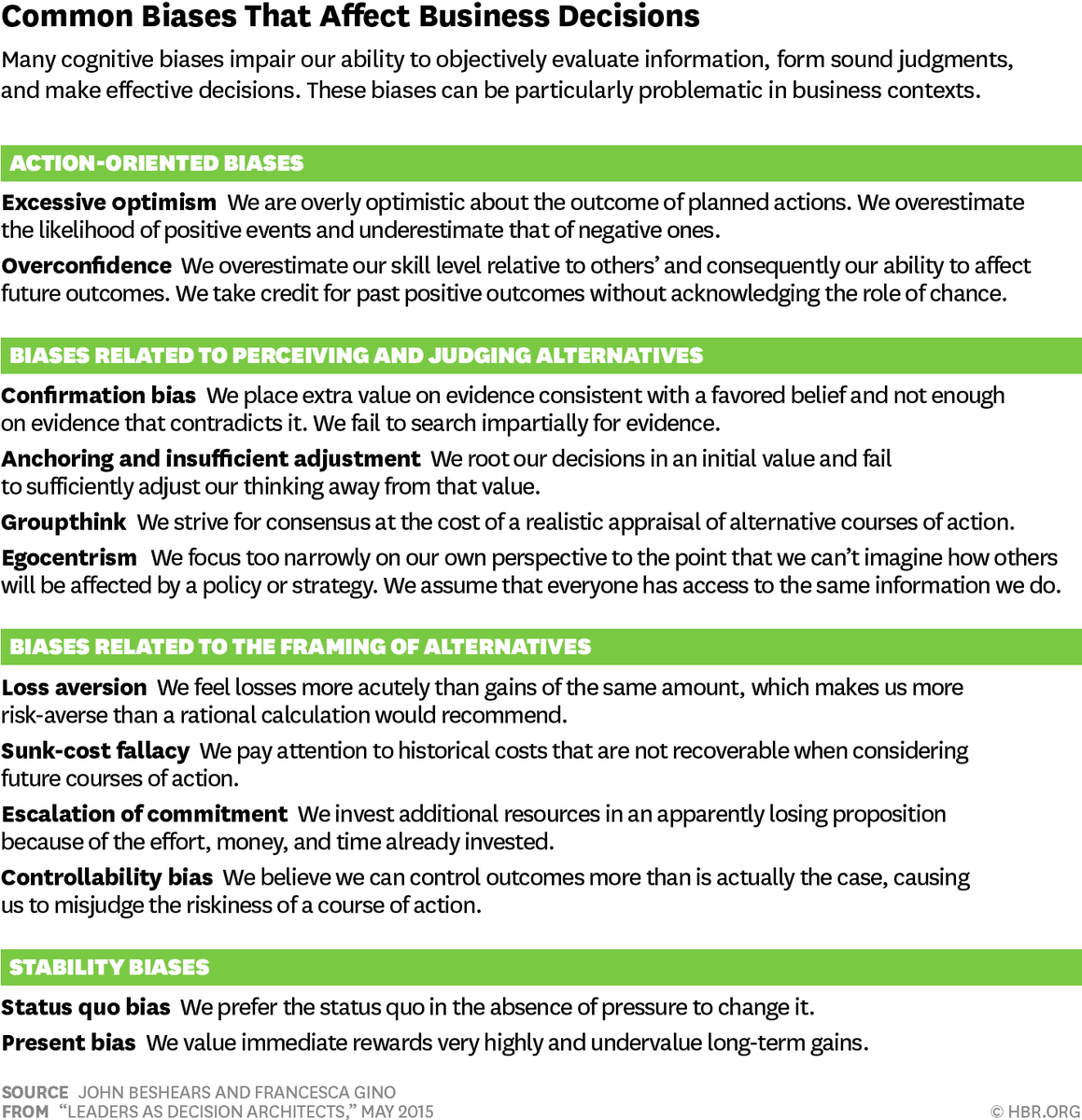
The Most Common Biases in Business Decisions

If you’ve been following me for any length of time, you’ll know that one of topics that I write about the most is cognitive biases. So, when I came across an article on the Harvard Business Review that neatly wrapped up some of the more common biases in business decisions, I just had to comment on it.

I agree with just about everything in this table (?), but I’m surprised about one thing: the endowment effect. That is, I’m surprised it’s not listed in the table. Specifically, listed under ‘stability biases’ as this is where it would fit. To refresh your memory:

In short, it means that people want more money for something than they’d be willing to pay for it. Put differently: we overvalue that which we own. You could think of a simple example of this through the course of a negotiation. When negotiation with someone, we’ll probably overvalue what we bring to the table. Someone may offer you $50 for your 25-year old keyboard (piano), but you think it’s worth at least $75. Barring any outside appraisal, the endowment effect is likely at play here.

Given the number of deal-making that takes place on a regular basis, I’m surprised that we didn’t see this as part of the table. It seems to me that in business, when money is often the thing that’s held in the highest regard (for better or for worse), you’d want to have people with the decision-making power understand that they may be overvaluing what’s theirs.

Upon further reflection, I can understand why one may not see it as a “common” bias because in today’s society, (at least in Western cultures), the common transaction is cash for stuff and not stuff for stuff (barter). If bartering were more the name of the game, then I would certainly want to see the endowment effect on that list. Either way, though, it’s certainly worth remembering that we tend to overvalue the stuff we have.

The Sunk Cost Trap on TV: Fitzgerald Grant and Olivia Pope

A few months ago on the popular TV series “Scandal,” the fictional President of the United States fell into the sunk cost trap:

We have to get Olivia back, not just because I love her, not just because having her out there is a threat to national security. There are soldiers who are never coming home because I tried to get her back. Someone’s father, someone’s husband. I have killed so many mothers’ sons trying to get her back. The flags placed on the coffins where they lay are there because they had the courage to give their lives and I did not have the courage to give Liv’s, so she has to come back because their sacrifice damn well has to mean something. They cannot have died for nothing. They cannot have gone to their death for no other reason than I asked them to.

If you’ll remember from my post about the sunk cost trap a couple of years ago:

The United States has invested much in attempting to achieve its objectives. In addition to the many millions of dollars that have been spent, many thousands of lives have been lost, and an even greater number of lives have been irreparably damaged. If the United States withdraws from Vietnam without achieving its objectives, then all of these undeniably significant sacrifices would be wasted.

Do you see the parallels?

Now, I totally get why the writers of Scandal couldn’t have the fictional President of the United States not continue to try and rescue Olivia Pope (how could there be a show without Olivia?), but I wish they didn’t have to write it in this way. In actuality, based on what he’s saying, it sounds like he’s come to the realization that sending more troops to war is a bad idea, so right there — right at the point — is when he should stop sending troops to war. Right then, he has the knowledge that continuing down the same path is the wrong thing to do, so he should stop. His rationalization for continuing is the sunk cost trap.

The thing that worries me is that by having things play out like this, it’s almost affirming that what the President is doing is the “right” thing or that it is the only choice he has. Certainly, there are plenty of other courses of actions he could have chose (many that probably wouldn’t make for good TV). Most people probably won’t find themselves in a situation where they’re forced to continue a war (or start a war, for that matter) for dubious reasons (or any reason, for that matter), but seeing stuff like this on TV, in a way, gives people an idea of how they can do things. I’d much rather popular entertainment actually err on the side of educating viewers, if it’s going to incorporate lessons of this nature.

I can already hear you yelling at me that this doesn’t make for good TV or entertainment (I know, I alluded to that earlier), but can’t we find a way to blend effective decision-making with entertainment, so that while we’re being entertained, we’re also learning something, too?

Is “A” Really the Best Option or is it Just that It’s Better Than “B”: List of Biases in Judgment and Decision-Making, Part 18

The other day, someone was talking to me about my series on biases in judgment and decision-making and it made me realize that I was missing a rather important bias — the contrast effect! I’m not sure how this one slipped through the cracks, but I’m glad to be able to write about it for you today.

It’s been almost a year and a half since I wrote something for this series, so let me refresh your memory. Each week, I took a cognitive bias and explained it. I provided an example and then I offered some ways for mitigating that cognitive bias in your own life. So, without further adieu, the contrast effect.

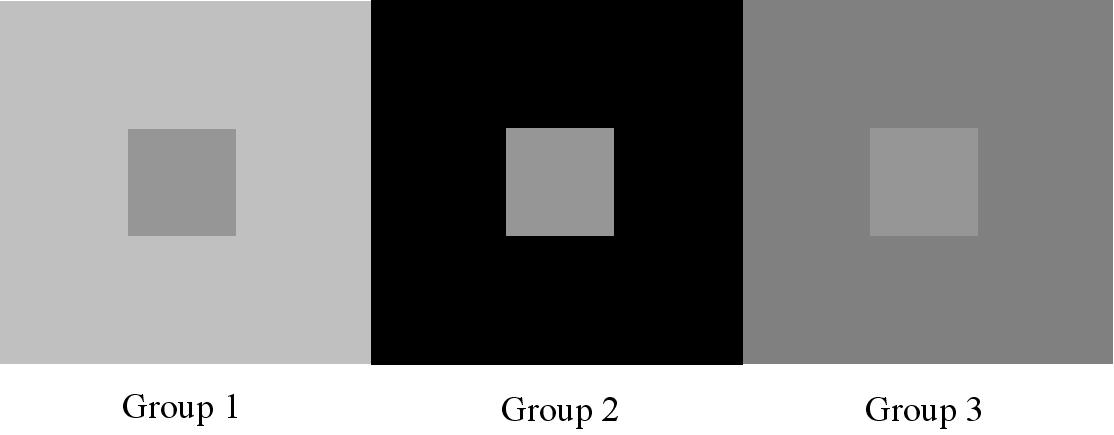
What’s the contrast effect? Well, as with many of the biases, it’s exactly what it sounds like: an effect that occurs because of a comparison. That is, people are more likely to perceive differences that are bigger or smaller because of something they’ve seen first. This is something that is used in sales — all — the — time. If you’re shopping for a new car, the salesperson may show a series of cars that are way out of your price range and then show you one that’s just a little out of your price range. After having seen so many cars that are way out of your price range, the one that’s just a little out of your price range won’t seem that far out of your price range. The contrast effect.

That’s not to pick on folks who sell cars, it can even happen with smaller purchases, shoes, for instances. Let’s say you’re looking for a particular kind of footwear. The salesperson may show you a bunch of shoes that don’t quite fit your needs and happen to be priced rather cheaply. Then, the salesperson shows you a shoe that does fit your needs, but is quite a bit more expensive. As you’ve seen all these shoes that aren’t what you need and now you’ve finally come to one that meets you’re needs, you may ignore the price and buy the shoes.

One of my favourite examples of the contrast effect comes from Dan Ariely‘s book, Predictably Irrational:

One day while browsing the World Wide Web (obviously for work-not just wasting time), I stumbled on the following ad, on the Web site of a magazine, the Economist.

excerpt.gif

I read these offers one at a time. The first offer-the Internet subscription for $59 seemed reasonable. The second option-the $125 print subscription-seemed a bit expensive, but still reasonable.

But then I read the third option: a print and Internet subscription for $125. I read it twice before my eye ran back to the previous options. Who would want to buy the print option alone, I wondered, when both the Internet and the print subscriptions were offered for the same price? Now, the print- only option may have been a typographical error, but I suspect that the clever people at the Economist‘s London offices (and they are clever-and quite mischievous in a British sort of way) were actually manipulating me. I am pretty certain that they wanted me to skip the Internet- only option (which they assumed would be my choice, since I was reading the advertisement on the Web) and jump to the more expensive option: Internet and print.

But how could they manipulate me? I suspect it’s because the Economist‘s marketing wizards (and I could just picture them in their school ties and blazers) knew something important about human behavior: humans rarely choose things in absolute terms. We don’t have an internal value meter that tells us how much things are worth. Rather, we focus on the relative advantage of one thing over another, and estimate value accordingly. (For instance, we don’t know how much a six- cylinder car is worth, but we can assume it’s more expensive than the four- cylinder model.)

In the case of the Economist, I may not have known whether the Internet- only subscription at $59 was a better deal than the print- only option at $125. But I certainly knew that the print and-Internet option for $125 was better than the print- only option at $125. In fact, you could reasonably deduce that in the combination package, the Internet subscription is free! “It’s a bloody steal-go for it, governor!” I could almost hear them shout from the riverbanks of the Thames. And I have to admit; if I had been inclined to subscribe I probably would have taken the package deal myself. (Later, when I tested the offer on a large number of participants, the vast majority preferred the Internet- and- print deal.)

Before we movie into some of the ways for avoiding the Contrast Effect, I wanted to make it clear that sales isn’t the only place where this bias can creep up on us. Another good example is in evaluations (be they interviewing job candidates or marking term papers). If one doesn’t have a rubric by which one is scoring candidates (or papers), it can be easy to slip into the contrast effect: “Well, that candidate was much better than the last candidate, let’s put them through to the next round.” It could be that the latter candidate, while better than the first, still doesn’t meet your criteria to make it the next round, so putting them through would be wasting valuable resources — both yours and theirs.

Ways for Avoiding the Contrast Effect

1) Standardized Evaluation

In our most recent case involving interview candidates or term papers, creating a rubric or standardized method of evaluation prior to examining candidates/papers will go a long way to help one avoid falling into the trap of the contrast effect. This method could also be applied when it comes to shopping (i.e. sales). For instance, let’s say you’re looking for a car. Prior to arriving at the dealership, you could create a table for how you’re going to evaluate the cars you view while at the dealership. In this way, you can guard against the salesperson knowingly (or unknowingly) showing you cars at either end of the spectrum before showing you the cars you might actually purchase.

2) Are There Other Options?

Often times, when we’re succumbing to the contrast effect, we’re looking at option A versus option B. This is why it’s so important to have some sort of standardized evaluation (see #1), but short of a standardized evaluation, it’s important to remember that almost never are those two options your only two options. “Should I get this car or that car?” Well actually, you have another option — neither of those cars. And another option, you could consider buying a bike or maybe taking public transportation. Whenever you find yourself faced with a decision between two options, it can be useful to consider other options, just in case you’ve fallen into the trap of the contrast effect.

Note: the images in this post are all examples of the contrast effect.

If you liked this post, you might like one of the other posts in this series:

The Confirmation Bias in Action: “When I Looked Closer, It’s Obvious I’m Right”

Decision-making biases are challenging, to say the least. Often times, we don’t know that they’re affecting our ability to make logical and rational decisions. The first step in combating these biases is knowing what they are. The next step would then be identifying when we use these biases. On that note, I came across a funny comic that perfectly illustrated the confirmation bias in action.

The confirmation bias is just dripping from this comic. It might not always be easy to see when we’re operating under the confirmation bias, but “luckily,” we might have an easier time of seeing it in someone else.

A couple of years ago, I offered some other ways for combating the confirmation bias (once you know that it’s a thing). One of these ways is a two-pronged approach: seeking out contradictory information. It may sound easy to go out and look for information that doesn’t conform to your opinion, but it can actually be quite difficult. The difficulty is amplified by the fact that much of our social media sites are doing their best to show us content that conforms to our beliefs and opinions (in part because that’s what they think we want). As a result, it *might* be easier to seek out people with contradictory opinions.

When you’re trying to combat the confirmation bias by being exposed to different information, seeking out a person with a contradictory opinion is usually superior to seeking out contradictory information. Why? Because the person can engage with you and refute the things you might mutter under your breath as you’re reading the contradictory information. Essentially, you’d be engaging in the Socratic method.

If seeking out someone with a contradictory opinion sounds interesting to you, I’d encourage you to find someone who’s aware that you’re trying to combat your own confirmation bias. That is, you don’t want your first experience in this regard to be with someone who’s going to screech at you that your ideas are crazy.

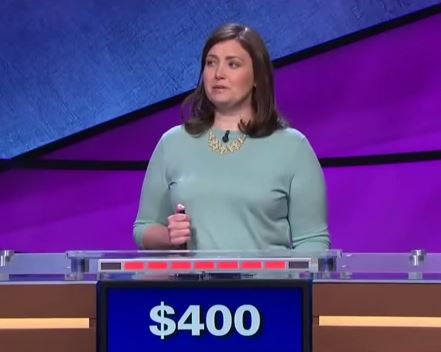
“Julia Lost on Jeopardy Because I Watched Live”

A few weeks ago, there was a contestant on Jeopardy that made quite a run. She didn’t break any of Ken Jennings’ records, but she certainly set a few records for females on Jeopardy. In fact, Julia Collins now has the record for the longest winning streak by a woman (and also the second longest winning streak — male or female) and the woman to have won the most money on Jeopardy. As it happens, I was lucky enough to see every episode.

Earlier this year, my son was born and one of the ways that helps him to sleep is if I bounce on an exercise ball. Since this can happen at odd hours of the day, I started watching DVR’d episodes of Jeopardy. In fact, I remember the first game that Julia won because she had to beat a Canadian. Anyway, over the course of 5 weeks, I continued to watch Julia handily defeat her competition and then when it was interrupted for the Jeopardy Battle of the Decades, I watched that.

When the regularly scheduled episodes returned with Julia, she was beginning to get some media attention. On the one hand, I thought this was great because she certainly deserved it, but it made it harder for me to avoid spoilers (really? Who needs to avoid spoilers for Jeopardy!?). I started to watch the episode a few hours after it aired on some nights because I noticed that some folks were tweeting about Julia’s streak continuing.

Julia hit her 20th win in a row on a Friday, which meant she got to come back on Monday. It just so happened that I was near the TV on Monday night, so, to avoid spoilers, I watched the episode live. As you already know (either from the title of this post or from knowing), Julia went on to lose that game. After she lost, I laughed to myself, “I shouldn’t have watched the episode live — that’s why Julia lost.”

Now, did you notice the cognitive bias?

The confirmation bias.

To be fair, I didn’t divulge all the information up front, but if you understand the confirmation bias, you’re going to think you have all the information. After watching Julia lose attempting to win her 21st game in a row, I said to myself that because I watched it live, she lost. [Note: of course, you’re going to have to suspend disbelief for a short while as my watching or not watching an episode of Jeopardy is not actually going to cause or not cause someone to win/lose. At this point, it’s science fiction.]

The thing I’m not telling you (nor was I telling myself to have said this to myself then, lest I be experiencing cognitive dissonance), was that I had also snuck a peak at a few of the episodes from wins 16 to 20. That is, even though I may not have watched a full episode live until her loss going for win 21, I did watch some bits of the other episodes live. So, at the conclusion of Julia’s streak, I selectively (though not intentionally) misremembered the number of times I’d seen Julia live and concluded that by my watching live, she lost.

How Do We Free Magneto From the Pentagon: A Lesson in Functional Fixedness

I don’t know if you’ve had the chance to see the new X-Men movie — I rather liked it. There was a scene in the movie that presents a wonderful example of functional fixedness, depending upon your familiarity with the story. Before moving on, I should remind you of the meaning of functional fixedness. Essentially, it’s the idea that, sometimes, we might have a hard time seeing the potential utility of an object. For example, if you need to push nail back into a piece of wood, but you don’t have a hammer around, it might take you more than a few minutes to think of using your shoe. The functional fixedness lies in one’s lack of ability to see the shoe as a potential hammer-like object. The ‘function’ of the shoe is ‘fixed’ on being a shoe.

Alright, now that we’ve reviewed functional fixedness, let’s look at the example from the recent X-Men movie, Days of Future Past. Before continuing, I should say…

(minor spoiler alert)

Near the beginning of the movie, a couple of the X-Men are trying to free another X-Men from a holding cell in the basement of the Pentagon. As the person being held in this cell is Magneto and has the ability to create/control magnetic fields, jailing him with metal is a bad idea. So, he’s being held in a glass encasing. The X-Men trying to free Magneto make it into the basement of the Pentagon and the one person who is meant to free Magneto from the cell is Quicksilver. Earlier scenes from this movie show us that he has the ability to move extremely fast. In fact, he moves so fast that his ability could be mistaken for teleportation.

With Quicksilver standing on top of the glass enclosure, those who weren’t familiar with the X-Men comics may have wondered just how this person with ‘superhuman speed’ was going to free Magneto. This is our example of functional fixedness.

If, when you were watching this scene, you thought to yourself, “Quicksilver won’t be able to free Magneto with his superpower because he can just move quickly, and there’s no door for him to get in,” you’d be locked in functional fixedness.

A few moments later, the answer is revealed: Quicksilver has superhuman speed, so he can use his power to shatter the glass and Magneto is freed.

Note: I didn’t mention this initially, but Quicksilver is able to break the glass because he is able to move his hands so quickly such that he can create a resonance that breaks the glass. For real-life example of this in action, watch this wine glass.

Meditation Mitigates Effects of Cognitive Biases

There have been thousands of scholarly articles written about the myriad benefits of meditation, but the one I came across recently was one of the first that confirmed one of my previously held beliefs: meditation helps you make better decisions.

The thing that struck me most about this study were the similarities to an experiment I conducted (on intuition and decision-making) as a research assistant. I had a condition where students would meditate for a short time and then use their intuition to make decisions. The results weren’t as I, (the research assistant I was working nor the professor), had hoped. I wrote it off as the the reluctance of undergraduates to meditate, but in this study, in particular, studies 2a and 2b, the researchers used undergraduates (approximately 200 combined) and they meditated!

In the second study, the researchers had the undergraduates listen to a 15-minute audio track, which was was specifically designed for this study. In one condition, students listened to a mindfulness meditation created by a professional mindfulness-meditation instructor and in the other, the students listened to a track, again, by a professional mindfulness-meditation instructor, that continuously instructed students to think about whatever came to mind. This second condition was called the “mind-wandering” condition and previous research used a similar method as a control for mindfulness experiments.

As I already mentioned in the opening paragraph, the researchers found that increasing mindfulness (i.e. meditation) reduced the effects of cognitive biases (i.e. the sunk cost fallacy). My favourite part of this study [Emphasis added]:

It is particularly notable in this set of studies that increased resistance to the sunk-cost bias occurred after only a brief recorded mindfulness-meditation induction. Many prior mindfulness-meditation interventions have involved 8 weeks of face-to-face training (Brown & Ryan, 2003); by comparison, our 15-min recorded manipulation is substantially more practical.

Many people have gotten it into their heads that the positive effects of meditation takes weeks to manifest. Here is tangible proof that — today — meditation can help you make better decisions. Also:

We also encourage research investigating how mindfulness practice might improve other decision-making processes and outcomes.

Absolutely! I would suspect that meditation would help guard against a whole host of other cognitive biases, but it would be fantastic if there were scientific evidence to back this up. For instance, years ago when I was the president of the student body, I once tried to begin a general assembly meeting with a quick 1-minute meditation, but the maturity level just wasn’t there. Even after 10 seconds, some of the representatives couldn’t handle the silence. I take the blame for that as I probably didn’t do the method justice by properly introducing it with the research. Can you imagine, if, before every semi-major decision, you took 10, 5, 2, or even 1 minute just to sit still and clear your mind of the previous discussion. I wonder how much lost revenue there is from not taking a moment to pause and reflect before a decision is made.

I should say, I’m sure that there is certainly time between major decisions (i.e. mergers & acquisitions, although, there is fascinating research on how big of a failure those can be), but I’m thinking about the mid-level manager who makes many decisions in a day that can affect the bottomline of a company. The managers that make quick decisions about whether to go with this contract or that contract, whether to make this purchase or that purchase. Maybe that’s a good place to start with more research.

ResearchBlogging.orgA. C. Hafenbrack, Z. Kinias, & S. G. Barsade (2013). Debiasing the Mind Through Meditation: Mindfulness and the Sunk-Cost Bias Psychological Science DOI: 10.1177/0956797613503853

The Top Ways For Avoiding Cognitive Biases: List of Biases in Judgment and Decision-Making, Part 17

Last Monday I wrote that my cognitive bias series had come to an end. However, several of you emailed me asking for a more concise summary (as you’ll recall, the last post was over 3000 words). So, I thought I’d aggregate the most frequent suggestions of ways for avoiding cognitive biases. It’s in the same vein as a post in this series I don’t often link to: WRAP — An Acronym from Decisive.

Today, I’ve gone back through the post I wrote last week and categorized the different ways for avoiding the cognitive biases that I’ve listed. I’ll list the ways in descending order of their most frequent occurrence on the lists, along with the biases that they helped to counteract:

Alternatives (6): Sunk Cost Fallacy, Endowment Effect, Planning Fallacy, Framing Effect, Confirmation BiasThe Contrast Effect

Assumptions (5): Sunk Cost Fallacy, Framing Effect, Overconfidence Effect, Halo Effect, Functional Fixedness,

Data (5): Planning FallacyGambler’s Fallacy, Primacy/Recency Effect(s), Status Quo BiasThe Contrast Effect

Empathy (3): Endowment Effect, Framing Effect, Fundamental Attribution Error,

Big Picture (3): Loss Aversion, Fundamental Attribution ErrorThe Contrast Effect

Emotional (2): Loss Aversion, Endowment Effect,

Self-Awareness (2): Overconfidence Effect, Hindsight Bias,

Expectations (1): Loss Aversion,

As you might expect, assumptions plays a big part in our decision-making, so naturally, uncovering our assumptions (or recognizing them) is an important way for avoiding the traps of cognitive biases in decision-making. Similarly, it’s important to consider and/or develop alternatives. On an important related note, one of the most important things you’ll learn about negotiating is BATNA. This stands for: the Best Alternative to a Negotiation Agreement. Alternative. It’s also not surprising to see the frequency with which “data” appears, too. Data are a really important part of making a “cognitive bias”-free decision. I’ve written about the virtues of empathy, so I won’t review it.

Lastly, I wanted to highlight that “big picture” appeared on this list a couple of times. I was surprised that it only appeared a couple of times, but that could be a result of the way I was thinking (or my biases!) when I was writing these series. For instance, two of the categories here on this site are Perspective and Fresh Perspective. Meaning, I think it’s really important that we learn how to view things from a wider scope. “Big Picture” probably coud have fallen under “Alternatives,” but I believe there’s an important distinction. With alternatives, it’s still possible to only be considering things from a micro-level, but with the big picture, there’s a necessity for seeing things from the macro-level.

PS: Happy Canada Day!

~

If you liked this paper/series, you might want to check out some of the other papers/series I’ve posted.