Belief Matters More Than You Think

I came across an article in Scientific American last week that reminded me of a story of mine that I haven’t yet told. When I was a PhD candidate at Sofia University, one of the classes that we were required to take was aikido. I really enjoyed learning this martial art having had past experiences with taekwondo and karate — specifically, Gōjū-ryū. (In fact, I did some googling and even found the dojo where I spent a great deal of my youth!)

Anyway, while at Sofia University and learning  aikido, I remember one of the classes quite vividly. In this class, we were learning about the five elements, as they related to aikido. In particular, we were learning about earth. The Sensei (teacher) asked one of the smallest women in the class to come to the front and then he asked me to come to the front, too. He asked her to stand normally and then asked me to lift her off the ground from under her arms. I did it easily. Next, he asked her to imagine that she was the earth element — planting roots deep into the ground. After a few dozen seconds, he then asked me to try lifting her again (in the same way I lifted her before) — nothing. I bent my knees a bit more and put some more force behind my lift — nothing.

I was amazed.

It was quite clear from the first half of this exercise that I could lift her off of the ground, but when she was imagining that she was the earth element, I was — so it seems — helpless. I’ve written before about the importance that our words/thoughts can have on ourselves (and on each other!), but this is a tangible example of how someone’s beliefs are actually effecting reality in a very tangible way. Is there something you’re believing about yourself that may be limiting your ability to lift yourself off of the ground?

~

I realize that my story is anecdotal, so I thought I’d also include one of the many examples from the Scientific American article:

Psychologists Ulrich Weger and Stephen Loughnan recently asked two groups of people to answer questions. People in one group were told that before each question, the answer would be briefly flashed on their screens — too quickly to consciously perceive, but slow enough for their unconscious to take it in. The other group was told that the flashes simply signaled the next question. In fact, for both groups, a random string of letters, not the answers, was flashed. But, remarkably, the people who thought the answers were flashed did better on the test. Expecting to know the answers made people more likely to get the answers right.

~

Editor’s Note: As an aside, I’m in the process of moving from Washington, DC, to Ottawa, Canada (the Glebe!), so my posts may become a bit sparser over the next few weeks. I’ll still do my best, but if you don’t see anything for a couple of days, it’s probably because I’m busy with planning/arranging the move.

Women Read More Fiction: Is That Why They’re More Empathic?

A couple of weeks ago, I saw a rather informative tweet:


When I first saw that, I was a bit surprised. Statistics tells us that for every 100 females born, there are 105 males born. So, there should be more boys than girls and as a result, we might expect that more boys would be reading than girls. Of course, there are so many other factors involved, but from a volume standpoint, I’d think that more boys would read than girls. I thought I’d click-through and read the report, but it’s behind a wee bit of a paywall to the tune of $799. As a result, I won’t be able to (maybe you or someone you know can?) read over the statistics. Nonetheless, I had a different direction I’d like to take this post. Empathy.

I’ve written before about how reading fiction can boost empathy. This very important human skill needs to be cultivated and one of the ways to do that is to read fiction. In addition, we all know the ‘stereotype’ that women are more empathetic than men. However, when there’s data to back it up, I suppose that it’s not so much a ‘stereotype’ as a likelihood. So, in putting these pieces together, my thought was that maybe this empathy gap has grown because women are more likely to read fiction than men. Sounds plausible, right?

In doing research for this post, I came across something from the Greater Good Science Center at Berkeley. That post was talking about whether women’s empathy is the result of nature or nurture. It cited a few studies supporting both sides of the debate. I wonder if we could then add the data point of women reading more fiction to the nurture side… or the nature side? Nature side, you ask confused? Well, in saying that women read more fiction leading to greater empathy, we’d have to test whether women reading more fiction leads to a greater empathy or if women having greater empathy prefer to read. If you know anyone doing empathy research, this might be an interesting study.

The Habits of Societies: The Power of Habit, Part 3a

In Part 1a, we had an introduction Duhigg’s book on habits. In Part 1b, we looked at some of the highlights and the key points from the first section (on individuals) of the book. In yesterday’s post, we looked some of the stories that Duhigg shared in the second section about Michael Phelps, Alcoa, Starbucks, and the Rhode Island Hospital.  In today’s post, we’ll look at the last section of the book on societies.

Because of my sense that I’m meant to be a leader of a very large organization, I was particularly excited to get to the section on societies. It certainly did not disappoint. There were only two chapters in this section. The first chapter talked about movements: the civil rights movement in the 1960s and Rick Warren. With regard to the civil rights movement, Duhigg tells the story of how we came to know Rosa Parks. I was shocked to learn that Parks wasn’t the only (nor was she the first!) black person to take a stand (metaphorically) against the injustice in the South. In fact, there had been others like her who tried to remain in their seats on the bus, but no movements formed after their decision to remain steadfast.

Part of the reason that Parks created such a stir was because of how connected she was to her community. When people learned that Parks had been arrested, people wanted to help. Simply wanting to help wasn’t enough. As we learn, all of this willingness to help had to be funneled into a new activity: civil disobedience. There’s a particular powerful passage that I want to share. In my reading of the passage, it makes me think that this was one of the important turning points of civil rights movement:

As the bus boycott expanded from a few days into a week, and then a month, and then two months, the commitment of the Montgomery’s black community began to wane.

The police commissioner, citing an ordinance that required taxicabs to charge a minimum fare, threatened to arrest cabbies who drove blacks to work at a discount. The boycott’s leaders responded by signing up two hundred volunteers to participate in a carpool. Police started issuing tickets and harassing people at carpool meeting spots. Drivers began dropping out. “It became more and more difficult to catch a ride,” King later wrote. “Complaints began to rise. From early morning to late at night my telephone rang and my doorbell was seldom silent. I began to have doubts about the ability of the Negro community to continue the struggle.”

One night, while King was preaching at his church, an usher ran up with an urgent message. A bomb had exploded at King’s house while his wife and infant daughter were inside. King rushed home and was greeted by a crowd of several hundred blacks as well as the mayor and the chief of police. His family had not been injured, but the front windows of his home were shattered and there was a crater in his porch. If anyone had been in the front rooms of the house when the bomb went off, they could have been killed.

As King surveyed the damage, more and more blacks arrived. Policemen started telling the crowds to disperse. Someone shoved a cop. A bottle flew through the air. One of the policemen swung a baton. The police chief, who months earlier had publicly declared his support for the racist White Citizen’s Council, pulled King aside and asked him to do something — anything — to stop a riot from breaking out.

King walked to his porch.

“Don’t do anything panicky,” he shouted to the crowd. “Don’t get your weapons. He who lives by the sword shall perish by the sword.”

The crowd grew still.

“We must love our white brothers, no matter what they do to us,” King said. “We must make them know that we love them. Jesus still cries out in words that echo across the centuries: ‘Love your enemies; bless them that curse you; pray for them that despitefully use you.'”

“We must meet hate with love,” King [said].

Powerful.

The parts about Rick Warren were equally powerful, but when contrasted with the life/death matters of the civil rights movement, it’s hard to see it in the same light.

Because I’ve shared an excerpt from this book about Martin Luther King, Jr. and the civil rights movement, I thought it best to talk about the last chapter of the section in a different post. Look for it tomorrow.

Motivational Redux: To Make the Obituary in The Economist

About a week ago, I wrote a post about what could be the modern day version of writing yourself a $10,000,000 post-dated check. A few days ago, I saw a tweet that made me reconsider another common motivational activity: writing your own obituary. This tweet came from @GSElevator, which purports to be “things heard in the Goldman Sachs elevators.” Having never worked at a company liked Goldman Sachs (or Goldman Sachs, for that matter), I have no idea whether this account is purely a parody or if these things are actually spoken (or could be spoken).

Anyway, the tweet:

This sounds like it was a question asked in an interview and it’s great on so many levels. To begin, it shows ambition. The people who have obituaries written for them in The Economist are certainly no slouches. These are people who have accomplished — a lot. Second, it shows that the candidate reads The Economist (or at least that the candidate wants to provide the illusion that they do). Working at a place like Goldman Sachs means that The Economist would be required reading. Third (and unrelated to the interview), it gives us another opportunity to talk about ways to motivate ourselves. If you’re having trouble committing to that project or you just can’t get started on that book, you’ve got a number of ways (write your own Wiki page, post-dating a check, writing your The Economist obituary, etc.) to try and get you going.

Take a few minutes this Monday morning and think about that To Do list you haven’t quite gotten to in a while. What grand idea have you been putting off that you just know is brilliant?


Try New Things: My Reintroduction to Merlot

Several months ago, I bought tickets to Quidam — one of the Cirque du Soleil shows. Because I happened to buy the tickets through Ticketmaster, I ended up on some mailing list. One of the ads that I got in the mail was rather enticing (at least it seemed like it) offer for wine. It was an offer to WSJwine. At first, I thought it a bit strange to be considering buying wine through the Wall Street Journal (clearly not one of their core competencies!), but some of the wines in the list sounded pretty tasty.

I did the math on the number of bottles of wine I was going to get (15) and the price I was to pay ($69.99) and it came out to less than $5/bottle. As there were at least half of the wines in there that I was interested in trying, I thought it was a pretty good deal. (This amounted to paying approximately $10/bottle for the bottles I wanted to try and I was comfortable with that.)

As I said, about half of the bottles I wanted to try, while the other half were just icing on top. After drinking a few of the bottles that I knew (or thought) I would enjoy, I thought it might be time to try one of the bottles I was less sure of. In fact, one of these bottles was a Merlot. I didn’t remember liking Merlot (I have a tendency towards Italian wine — maybe it’s because of my heritage), but since I had the bottle and these wines were supposed to be award-winning, I thought I’d give it a try. (Note: this is different from the sunk cost fallacy. Had I taken a sip and not liked it, but continued to drink, that would have been the sunk cost fallacy. Simply having a glass from a bottle of wine that I was unsure as to whether I’d like is more along the lines of ‘openness to experience.’)

After pouring the glass and taking a sip… I liked it!

I was pleasantly surprised. I used to remember not liking Merlot, but it’s possible that my experience with it was when I was younger before my wine palette had developed. I’m certainly no sommelier, but I’d like to *think* that I’ve developed a sense for the kind of wine that I like and don’t, which I *think* is reasonable even taking into account some of the research that may run counter to that.

~

My point in telling you this story is that I tried something new (or at least something that I was unsure as to whether I’d like). What have you done lately that’s new and different? What have you tried recently that has expanded your horizons (even if it’s only slightly)? If the answer to those questions is nothing, then might I encourage you to step out of your comfort zone and try something.


It’s All About Perspective: The Blind Men and the Elephant

BQxiYHmCAAE9dmQA few days ago, I shared a photo on Facebook that epitomizes what I believe to be one of the hallmarks of life: perspective. I’ve included the photo in today’s post (you can see it there on the right). I can’t tell for sure because I don’t read Korean, but the photo appears to come from advertisement for house for sale (or for rent). In the first frame, we can see what appears to be a lovely shot of the house featuring a nice pool. In the second shot, a different angle of the house where — again — the pool is featured. In the last shot, the big reveal — the pool is not what it appeared to be in the first two frames.

Some may look at the surface-level lesson — someone could have been severely swindled had they not gone to see this place (if they were going to rent/buy). I prefer to look at in a broader sense: it’s all about perspective. Without considering all of these photos together, one would miss the perspective that the pool certainly isn’t anywhere near as large as it appears. There’s certainly a “swindler” streak to these three photos, so let’s at a story that you may or may not have heard before:

It was six men of Indostan
To learning much inclined,
Who went to see the Elephant
(Though all of them were blind),
That each by observation
Might satisfy his mind.

The First approached the Elephant,
And happening to fall
Against his broad and sturdy side,
At once began to bawl:
“God bless me! but the Elephant
Is very like a WALL!”

The Second, feeling of the tusk,
Cried, “Ho, what have we here,
So very round and smooth and sharp?
To me ’tis mighty clear
This wonder of an Elephant
Is very like a SPEAR!”

The Third approached the animal,
And happening to take
The squirming trunk within his hands,
Thus boldly up and spake:
“I see,” quoth he, “the Elephant
Is very like a SNAKE!”

The Fourth reached out an eager hand,
And felt about the knee
“What most this wondrous beast is like
Is mighty plain,” quoth he:
“‘Tis clear enough the Elephant
Is very like a TREE!”

The Fifth, who chanced to touch the ear,
Said: “E’en the blindest man
Can tell what this resembles most;
Deny the fact who can,
This marvel of an Elephant
Is very like a FAN!”

The Sixth no sooner had begun
About the beast to grope,
Than seizing on the swinging tail
That fell within his scope,
“I see,” quoth he, “the Elephant
Is very like a ROPE!”

And so these men of Indostan
Disputed loud and long,
Each in his own opinion
Exceeding stiff and strong,
Though each was partly in the right,
And all were in the wrong!

That story is iconic of what it’s like to have an opinion. We’re all looking at things from our own perspective and believe that what we’re telling is the truest truth. I wrote about this very thing with regard to watching the news a couple of years ago. Depending on where we get our news, we’ll be listening to a different man who’s describing the elephant. There’s absolutely nothing wrong with that, but it’s important that we recognize that we may only be getting one perspective on the news (or elephant).

~

This is one of the things that I’ve tried to do on this site. Two of the categories I write under: Fresh Perspective and Perspective. When I write posts for one of these two categories, I’m trying to shed light on the story like we get when we look at the story of the Blind Men and the Elephant. I’m trying to look at the story from the same perspective we have as the reader of the story. That is, we know that all of the men are right in some way, but that they can’t connect the dots because of where their perspective lies.

To give you a sampling…

Fresh Perspective

Just yesterday, I wrote a post about the plethora of weak characters in movies that are women, but aren’t men. A few weeks ago, a post about having less written tests and more oral tests in education. What about having young people run the country? Or a reexamination of the US and terrorism? Maybe we don’t need to workout at all?

Perspective

Is there a modern day version of writing yourself a $10,000,000 post-dated check? Does market economics tell us that we need to pay politicians more? Do you know how long the US has been dependent on oil? Do you think that your team made a blunder with that trade? What would the world have looked like without the “I Have A Dream” speech?


The Time I Almost Drowned in Paradise

A couple of years ago, I had the good fortune to live in paradise. I lived on the island of Kauai — part of the Hawaiian Archipelago. It really does feel like paradise. There aren’t any roads that permit you to go faster than 50mph. The beaches aren’t usually very crowded. The temperature, on average, doesn’t get any higher than the mid-80s and doesn’t dip below the mid-60s. It’s wonderful.

Just about everyday, I got into the routine of going to the beach. I was living in Hawai’i and I knew that it likely wouldn’t be a long-term thing (though I certainly considered it!), so I wanted to squeeze out as much paradise time as I could. It helped that I had a dog who needed exercise. At some point, I wanted to learn how to surf, but I never quite got around to it. Although, I did enjoy boogie-boarding and playing in the surf. I would usually exercise my dog and then I would go and get my exercise (by boogie-boarding).

Anyhow, there was this one day where the waves weren’t particularly high, so I was just relaxing close to the shore (in the water). In fact, it was on my favorite beach in Hawai’i — Hanalei Bay. Depending on who’s rankings you’re reading, it’s often rated as one of the best beaches in the US. After having spent many afternoons, evenings, and even a Christmas morning (!) there, it’s easy to see why it’s been rated as one of the best in the US. I haven’t seen many beaches outside of the US, but it wouldn’t surprise me to see it on a top 25 (maybe even a top 10?) list of the best beaches in the world.

So, on this world-class beach, I was enjoying the water near the shore. I was experimenting with the undertow, which wasn’t particularly strong that day (but which I would eventually learn that it was stronger than I realized). I would face the horizon and plant my feet in the water and lie back, while still keeping my feet planted. By doing this, the undertow would then rake against my calves and sometimes, it would pull the feet out from under me. When the undertow would pull my feet out, I would sometimes float on the water for a bit before I’d then stand up and go back to the spot that I started.

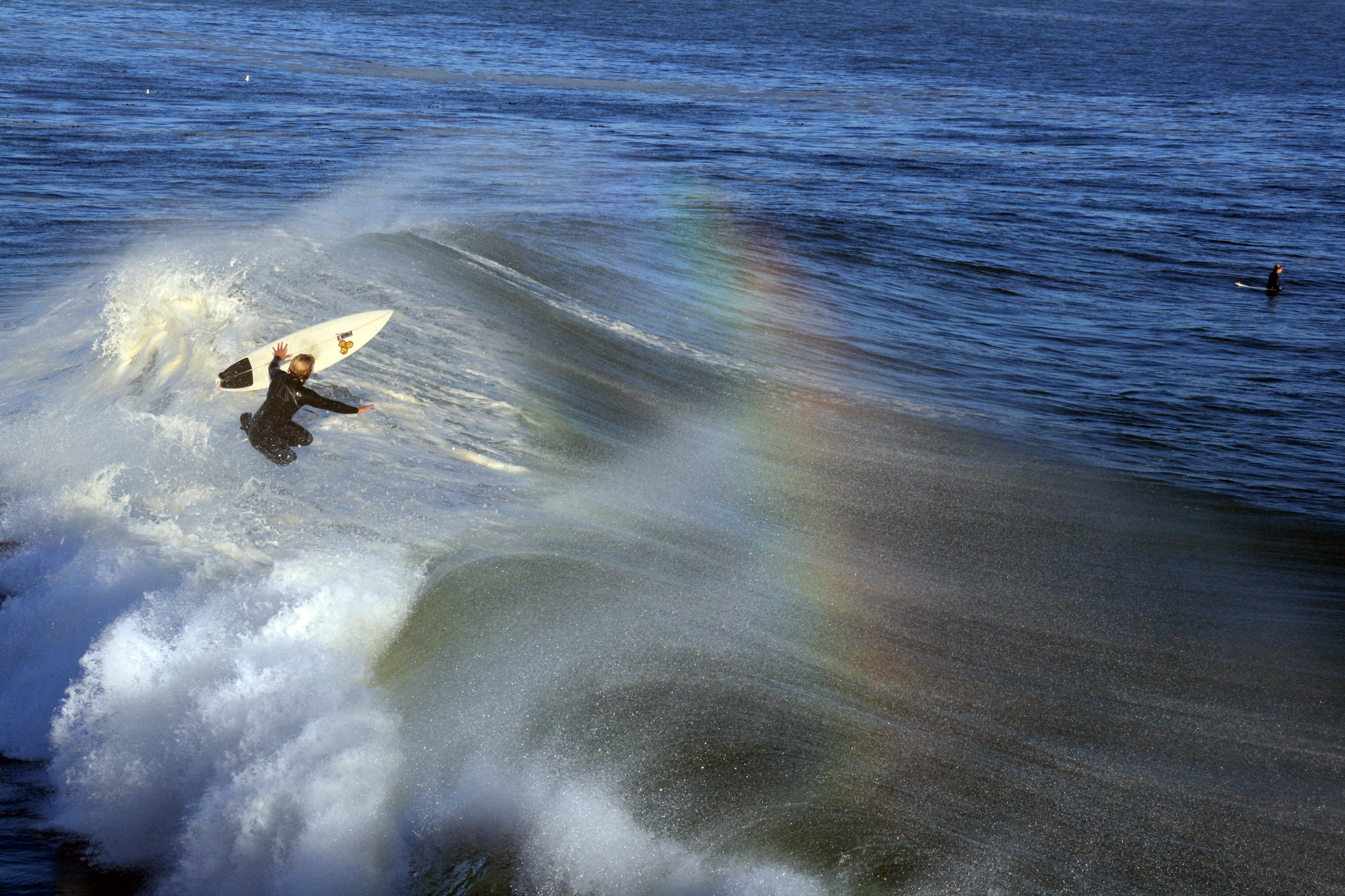
Well, one of these times that I was floating on the water, probably lost in thought, I went to put my feet down on the ground, but there wasn’t a ground. That’s alright, I thought. I can just swim back into a place where I can stand. So, I started swimming towards the shore. As I was doing this, I noticed that the waves had started to pick up a little bit. In addition, by being out away from the shore, the waves were stronger than the undertow that I was standing in. At first, I thought this was to my advantage. I thought I could just catch one of the waves with my body and have it carry me in.

I would watch the waves and try to catch one as it was picking up speed. No matter what I tried, I never seemed to catch the wave with my body. I later learned that this was probably because I wasn’t doing it right, but at the time I thought I was doing it right. By this time, the rhythm of the waves had taken me out even farther from the shore than when I started trying to bodysurf into safety.

I don’t consider myself a very strong swimmer (which is why I was trying to catch one of the waves back into the shore), but I was out of options — I had to swim. So, I turned on my stomach and started to swim (albeit, a bit panicked) back to the shore. There was one slight problem. I had to watch out for the waves, which had now grew to 3- to 4-feet. By surfing standards, still rather small, but for a not so strong swimmer trying to get back to shore, seemingly insurmountable. Watching for the waves, which were crashing down on me at times and trying to swim back to the shore, I could feel my panic rising. I would swim 5 or 10 feet and then would have to duck under the water because of the wave crashing. When I would reemerge from the water, I’d be right back where I started swimming or sometimes, even farther out!

I was in trouble.

A poor swimmer who was already fatigued was now caught in between the waves and the undertow. I had given up. I wasn’t going to be able to swim back to the safety. Thoughts of drowning started to flood my head. I’m not going to make it. I’m going to be a statistic! I’m going to die in paradise! All I had left to do was to try and wave someone down. My eyes caught the shore which seemed like it was 200 feet away. The beach was sparse. More panic. It was a lazy weekday prevening. I started to wave one of my hands towards the shore trying to get someone’s attention. In order to wave one hand towards the shore, I lost one of my four limbs to keeping my head above water. More panic. I could feel the water getting shallower, so I turned my head to notice — at the last second — that a 5-foot wave was about to crash down on me. I ducked under the water just before the wave crashed on me above the water, but that didn’t stop it from hitting me once under the water.

The force from the wave spun me. When I reemerged from under the water, I was facing the horizon. I turned again to face the shore and began waving an arm again. More panic. The beach was so sparse that I was sure no one saw me.

And then…

It looked like someone was taking a boogie board into the water. Was he coming for me or was he just coming to play in the water? He didn’t seem to be moving with much urgency, so I waved my hand a bit more vigorously. I wanted him to know that I was in trouble. It looked like he was coming for me. Crash. I wasn’t paying attention and the wave crashed down on me. Luckily, it wasn’t like the 5-footer that spun me under the water, but it still knocked me under and forced me to swallow a bit of salt water.

I turned again to face the shore and noticed that the boogie-boarder was only 20 feet or so from me. He was coming to save me. I’m going to live!

When he reached me, he told me to put a hand on the boogie board and we began swimming towards the shore together. With the boogie board, it didn’t take us very long to get into the shore. One of the waves caught us and helped us forward a bit. Soon enough, I was standing again in the water. I was standing! It never felt so good to have the ground under my feet. Even walking through the water back to the beach, I could feel the adrenaline coursing through my veins to the point that I was almost shaking.

When we got the shore, I thanked the Hawaiian man — profusely — and he explained to me that, at first, he thought I was waving at a friend to come out into the water. I’m glad that he eventually realized that was not the case. He also told me what to do in those situations, if it ever happened again (while I was thinking to myself, “yeah right, I’m never going in the water again!”). He instructed me to swim parallel to the shore rather than perpendicular. By swimming parallel to the shore (or on an angle that’s more parallel than perpendicular), I’d eventually get to a place where I could stand. If I continued to swim perpendicular, I’d be stuck in-between the wave and the undertow for hours.

I profusely thanked him again and then walked with my wobbly legs to the car. When I got to my car, there was a surfer there who asked me if I was alright. I said that I was still shaking a bit, but that I was embarrassed and grateful that the Hawaiian man came to save me. He said not to worry about it and that it had happened to him before, too. I thought to myself, really? I was watching him surf and he certainly knew what he was doing. He continued by explaining that sometimes, the waves can get stronger when you’re not expecting it and by the time you realize it, you’re stuck. He said that someone had to come and get him. Wow, I thought to myself. If it can happen to a skilled surfer, I guess it can happen to anyone. I thanked him for telling me. Again, he told me not to worry about it and that it could happen to anyone. I got in my car and drove home.
~~~

I didn’t go to the beach the next day, but I did eventually go back to the beach (I mean, I was still living in Hawai’i, how could I not go to the beach, right?) When I did build up enough confidence to get back to the beach, you can be sure that I was vigilant in my ability to stand while I was in the water.

I thought I’d share this story with you for a couple of reasons.

1. You never know when you’re going to be humbled by nature. I didn’t go to the beach that day expecting to nearly drown. Water makes up 99% of the Earth! The sheer size and force of water is awe-inspiring. As a result, it’s necessary to respect the water. If you don’t, it’s sure to humble you.

2. The kindest of strangers is infinite. The Hawaiian man could have easily ignored my waving hand assuming I was waving to a friend. Luckily for me, he thought I might be in trouble to come check it out. To him, and to strangers, I am forever grateful.

You’re Not Supposed to Hate Work

About a month ago, there was a rather disturbing headline that came as a result of a Gallup study: “70% of americans hate their job.” When I first read that, I thought, that can’t be right, can it? 70%!? That means for every person who likes their job, there are at least 2 people who hate their job. Do you like your job? That means that 2 of your friends hate their job.

Even now, reflecting on this, I find it hard to believe that this many people would stay at a job they don’t like. There would have to be an overwhelmingly compelling reason to stay at a job that one hates. A few things that come to mind: mortgage, children’s college fund, student loans, etc. I suppose we could talk about some of these big-ticket items weigh on the minds of people, but I’d rather talk about work. Why is it that we can’t all be doing something that we like to do?

Assuming that there are as many jobs out there as there are people, couldn’t we reach some sort of Nash equilibrium where everyone’s doing something that they like to do and no one’s doing anything they don’t? Part of the problem with reaching Nash equilibrium would be that some people are motivated by different things or are coming from different situations. So, I might really like construction, but I’m not very good at the things that you need to work in construction. If I have a degree in accounting, I might become an accountant, even though I’d rather be working in construction. There may be someone who’s in just the opposite situation, too. If we could switch jobs, we’d both be moving from miserable situations to desirable situations.

I haven’t really touched on the health implications of hating your job, but that’s an important factor to consider, too:

‘Our analysis clearly established that there was no difference in the rates of common mental disorders, such as anxiety and depression, between those who were unemployed and those who were in the poorest quality jobs.’

I think it’s a misnomer to say that work is supposed to “suck.” Why can’t we do what we love? Maybe for some folks, they don’t do what they love “full-time,” but they can gradually work their way into doing what they love full-time. Ken Robinson, noted TEDTalk speaker, wrote a great book a few years ago about finding your passion. If you’re working in a job that you hate (and statistics would tell us that you probably do) or you know someone who is, I’d recommend taking a look at Ken’s book. It just might change your life…

The Mask You Live In – Gender Stereotypes in the Media

Screen Shot 2013-07-11 at 10.10.47 PMA couple of years ago, a really important documentary came out: Miss Representation. I mentioned it in my series about the people I follow on Twitter. I was surprised that when I did a search of the website that I hadn’t written about Miss Representation. The documentary brings to light how the media portray women. *Spoiler Alert* They don’t do a good job.

After I saw the film, my first reaction is that it should be required viewing in classrooms across the US (and probably Canada, too, as Canada does consume a great deal of US Media). This movie is really important, especially for teenagers and children. They need to see and understand the perversion of the portrayal of women in the media. As can be seen in the movie, a number of young girls seem quite grateful to learn that some of the beliefs that they’d internalized were a result of the media they consumed. I can only imagine the number of young girls across the US that had similar experiences upon seeing the movie. As a man, I was very moved by the the film and whole-heartedly support the cause of MissRepresentation.org (and hope you will check it out and support it, too!)

All that to say is, there’s going to be a “sequel” to the movie — this time, for the boys. Yes, we do a great disservice to our young women, but we also do a great disservice to our young men, too. The Director/Producer of Miss Representation has launched a Kickstarter to help fund The Mask You Live In. Based on some of the dates listed on the Kickstarter page, it looks like the movie is set to debut in February of 2014. I have already made a note in my calendar and can’t wait to see it!

If you have a few minutes, I strongly recommend heading over to the Kickstarter page to watch the trailer. And, if the project moves you, why not donate some money, too?

What Does the Dalai Lama Want for his Birthday?

The Dalai Lama turned 78 (does he look 78?) this past Saturday. If you were invited to his birthday party, what do you think he’d ask you to get for him? He’s clearly not a man who seeks out material possessions, so a new car/house wouldn’t be in order. Would you believe that all he wanted was empathy? No? Then, you should watch his birthday message.

Please, keep your own mind, your own heart, more compassionate. More sort of, spirit of, seriously or genuinely, sense of concern of others well-being. And with that sort of motivation, if possible, serve other, helping other, other people, also other animal, if you do not have the opportunity to serving, then at least, resisting harming them.

The laughing at the end is priceless. He has such an infectious laugh.