Cell Phone Etiquette: Necessary Evil vs. “Old-Fashioned” Manners

Have you ever been out to dinner with people when suddenly you hear the (vibration) of a cell phone and then one of the people has their head buried in their phone? How about walking down the street and hearing someone talking to what looks like thin air? Or what about in the grocery store, seeing someone carrying on a conversation while deciding which box of breakfast bran to select? [] Cell phone are ubiquitous these days. In a , researchers polled over 3000 adults 18 or older and found that 85% owned a cell phone.

We know that cell phones aren’t going away anytime soon, especially because 96% the demographic between 18-29 in the survey above indicated that they had a cell phone. In doing some digging for this post, I found an talking about cell phone etiquette. As the technology has advanced, so to have the ways in which we connect with our mobile phones. To keep up with the necessary niceties, there’s an talking about some of the ‘okay’ and not-so-okay times to check your phone.

You’d think that since this issue has been around since the inception of cell phones that we’d eventually kick some of the dirty cell phone habits. This seems not to be the case. In a who polled over 2000 US adults from a nationally representative sample:

75% of US adults say mobile manners are worse now than in 2009.

The scary part about that survey to me is that 20% of people admitted to these same ‘bad manners,’ but will continue doing so because “everyone else is doing it.” The first thing I notice about this is that something is not right with the numbers. If 20% of the people are admitting to bad cell phone behavior, but 75% of the same respondents are saying that the behavior has gotten worse since 2009, ‘something’s gotta give.’ Either people are lying about their bad behavior (or maybe they don’t think when they do it that it’s bad). Given the plethora of articles written across the web about the ‘lack of cell phone etiquette’ (, , and ), I’m going to say that there is probably a little bit of at play.

I can see the reasoning and logic behind those that would advocate using their phones in social situations. In fact, this article I Will Check My Phone At Dinner And You Will Deal With It” from TechCrunch published in February has stirred quite the debate among the commenters. Even the title is a little inciting and at first glance, one may pre-suppose an air of bravado from the author. After reading it, the author makes the argument that supplementing dinner conversation with interesting facts from Wikipedia enhance the conversation rather than hinder it. Many of the comments that I read that received (high regards from other readers) seem to disagree.

As a counterpoint to this article, there was a survey done by of over 1000 Americans about their cell phone use. When asked “What is your level of tolerance when you encounter… someone interrupting a conversation to take a call?” 37% of respondents answered that was “very annoying.” There’s another interesting article (which also has ) that talks about people being so fed up with fellow cell phone users that they have turned to to keep people off of their phone.

I haven’t owned a cell phone for the last couple of years in part because I’ve been on the move (Canada, USA, and New Zealand) and in part because to keep a Canadian/American number through my travels abroad (and still be initiating/receiving “local” calls to/from Canada and the US). However, I have a feeling that I’ll be re-acquiring a cell phone in the near future and when I do, you can be sure that you won’t often find me interrupting in-person conversations for something happening on my phone.

The Next Facebook: We’re Asking The Wrong Question

I wonder what it is about humans that make us so eager to find the next something. Awhile after eBay made it big with their online auction site, there were articles that popped up in newspapers, magazines, and other writing outlets, positing what would be the next eBay. Even though eBay has been around for nearly 15 years, there are still articles written about what will be the next eBay (a sampling: , , and ). The confusing thing for me is, why are we looking for the next eBay, shouldn’t we be looking for the next big thing — in general?

The same question that was asked when eBay made it big is being asked about Facebook now that it has gotten so big. “What’s going to be the next Facebook?” (Again, a sampling: , , and .) I can even remember an article about how one of the original investors in Facebook, , thinks that . How, or maybe more accurately, why are these people trying to figure out what the next Facebook is going to be? I wonder if it’s more a stature thing. They are asking about what is going to be the next big thing rather than what will bump these internet companies from atop the food chain.

Some of the articles I’ve read about this area really trying to figure out what is going to usurp eBay or Facebook from their status as an online auction site (or social networking site, in Facebook’s case). To my mind, there really won’t ever be a next eBay or a next Facebook. The technology that knocks Facebook off of its pedestal will not be seen coming as the next Facebook. It might even be something totally different. It could be something more scientific, really, that garners support and slowly starts to grow across a few industries. I think it’s ludicrous to think that there will be a next anything with regard to the kinds of technology and organizations that we have today.

Facebook is too smart (and beginning to be too powerful) to let a start-up come up with an idea that is slightly off-center of Facebook, but that could siphon off Facebook’s users. They have more than enough money to dedicate to R & D that will have the company expanding upon itself for quite some time.

Companies like Facebook and eBay succeed because they have found a ‘sweet spot.’ In the Venn diagram to the right, the ‘sweet spot’ would be characterized by the triple intersection of A, B, and C, in either the top left portion, highlighted by a bright green color, or in the bottom portion, highlighted by a mix of red, green, and blue. This triple intersection can vary from (revolution) to (revolution). I think one of the main reasons for the success of eBay was in part due to the Western world’s undeniable urge to shop. As the internet started to grow, people began seeing the internet as a legitimate place to buy things. As eBay was a place to buy things, naturally, people flocked to the site. As they learned they could also sell things to, well, then it just took off.

For eBay, and more importantly in the case of Facebook, the development of their company (or product) filled a desire in the population that the population didn’t otherwise know existed. People didn’t really know (before Facebook came) that they wanted to spend countless hours on the computer interacting with their friends. I think that articles that try to pinpoint what the next anything is going to be are a little near-sighted. If these people were really curious as to what the next big thing was going to be, they should be trying to identify desires of the population that haven’t already been satisfied. I suppose if they could do that, they’d probably not be writing articles about it.

Misrepresenting the News: Infer-mation Overload

In a previous post, I talked about how the . This post is about a blatant misrepresentation of fact.

In the first line of , the author writes:

Secretary of State Hillary Clinton said on Wednesday that Al Jazeera is gaining more prominence in the U.S. because it offers “real news” — something she said American media were falling far short of doing.

If you watch the video that accompanies said article, or read the article on the , you see that Secretary of State Hillary Clinton is actually saying:

“In fact viewership of al Jazeera is going up in the United States because it’s real news. You may not agree with it, but you feel like you’re getting real news around the clock instead of a million commercials and, you know, arguments between talking heads and the kind of stuff that we do on our news which, you know, is not particularly informative to us, let alone foreigners.”

Clinton does not explicitly say that the U.S. media does not offer real news. Instead, she says that American news is not particularly informative. One can see how this can be inferred from what she said, but it is not what she said. This is something that irks me about news agencies in general, but I can understand how it is necessary in our entertainment-driven society.

Why can’t we just have news that reports on the facts rather than one that tries to ‘‘ the news in one direction. This has gone so far that after debates between political candidates, representatives from either side are meant to spin what their respective candidate said in what is called the “.” We actually call the place where this happens the spin room. Isn’t that a little far? Shouldn’t we just be talking about what the candidate said?

Maybe my line of thinking is too utopian. Maybe my ideals are a little lofty in that there needn’t be a place for — intentionally or unintentionally. I’d really just like to have someone tell me the facts of the day and what that could potentially mean, from a systematic point of view.

In today’s world where there are proponents from both side jockeying for mine (and your) attention at 6pm to get the daily dose of the facts, it almost seems safer to watch both of the news to get a more accurate perspective on what’s been happening. However, some sources like one, and one, explain that watching the news can actually make you less informed about what’s going on. With the advance of social networking, maybe it’s almost safer just to follow the to see what’s happening in the world.

Advancing America’s Public Transportation System: High-Speed Rail in the USA

When it was first announced that the US was going to work on , I was very excited! Growing up in the , I am very familiar with the value of public transportation. I often rode a bus to and from school. As I matured and wanted to explore downtown with my friends, we’d ride the to get there from the suburban area we lived. Beyond that, when I needed to make trips between Detroit and Toronto, I would ride the between Toronto and Windsor instead of taking the 45 minute flight. Public transportation is a great way, in my opinion, to feel better about reducing one’s .

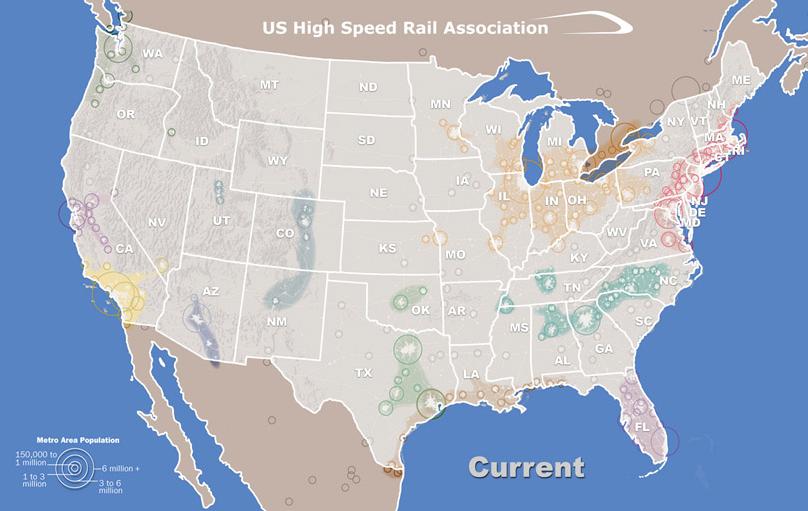
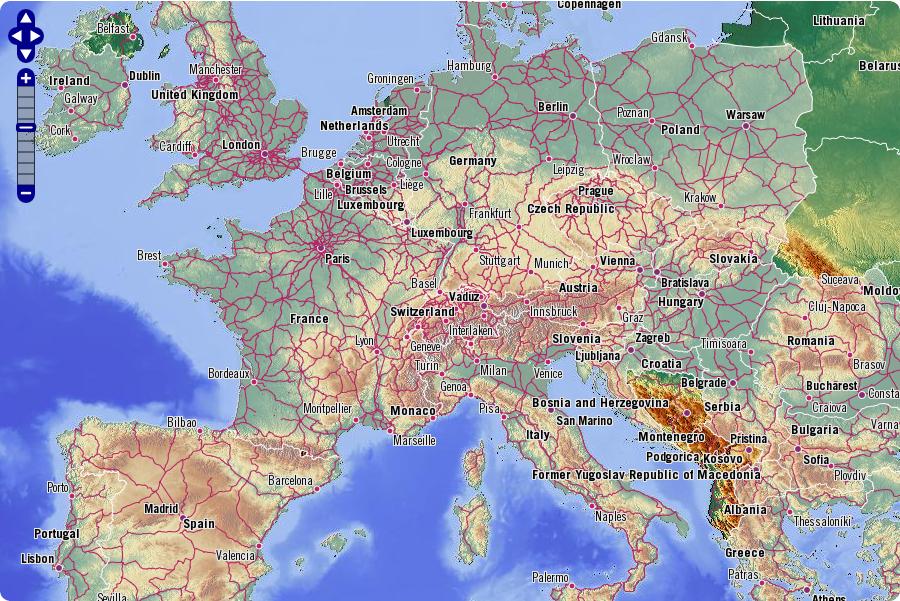
Don’t get me wrong, I love flying just as much as the next person and I’d much prefer it for travel to/from Europe to/from North America — who’d want to take a passenger ferry across the Atlantic given how much longer it would be? When I look at what the current high-speed rail map in the US looks like and then I look at the current high-speed rail map of Europe… it’s flabbergasting!   I’ve hyperlinked the two maps to bigger versions of themselves, so you can really get an idea for how much more advanced Europe is than the US when it comes to their rail system. It’s almost a little embarrassing just how much farther ahead Europe is in this regard.

Some people try to argue that Europe is much smaller, so a rail system makes more sense there. Well, as we can see from the image to the right (), Europe is not actually that much smaller than the USA. In fact, they’re pretty comparable in size. One of the reasons that Europe can sometimes be perceived as smaller than the USA is a function of . Regardless, from my perspective, there really aren’t any good reasons as to why the US hasn’t adopted a high-speed rail system. Even adds his two cents to the debate. In all my time watching Bill Nye as a kid (and in the classroom), I don’t think I’ve ever heard him speak so blatantly negative about anything! He must really feel passionate about this particular circumstance.

Not everything surrounding the high-speed rail system in the US has to be about negativity. In taking a closer look at what the network of rail systems will look like when the projected plan is completed (in 2030), is kind of exciting. Passengers will be able to go from Vancouver, BC, to Miami, FL — all by high-speed rail! They could go from San Diego, CA, to Montreal, QC, again — all by high-speed rail! For me, someone who cherishes the value of public transportation, this is really exciting.

As the plans and the work for this public transportation system continue, I wonder what Europe (and Asia) will come up with next in the way of public transportation. Many areas on these continents already have high-speed rail systems, so, it is logical to think that they will be busy thinking up the next great transportation revolution. Regardless, I’m very excited to see the progress being made in the world with regard to public transportation.

The Superbowl and Twitter

Earlier today, I took the time to watch the . While I watched the Superbowl, I also followed things on Twitter — something I have never done before. I currently do not have a Twitter account and so the ‘‘ is something that is quite foreign to me. I do find myself onto Twitter from time-to-time, to read various updates about things, but I am by no means an expert on the social networking site.

I think part of this is because I currently do not have a cell phone. For some reason, to me, Twitter goes hand-in-hand with a blackberry or an iPhone and just seems a little odd to be tweeting solely from a computer. But really, what do I know?

Anyway, as I was following some of the things happening on Twitter, I was treated to a number of good laughs. The Late Show writers were jokes throughout the whole game. Some of them were quite funny. I also noticed something that is probably known to most people who use Twitter: . “Top Tweets algorithmically selects and retweets some of the most interesting tweets spreading across Twitter,” (straight from the bio page for Top Tweets). I found many of the ‘top tweets deserving of an “lol” as I watched the game and followed the tweets.

As the game wore on, I noticed that as a player would perform well on the field or something would happen, almost immediately, it would become a trending topic on Twitter. There are nearly (or maybe are now), 200,000,000 users on Twitter. For things to be immediately trending so quickly, it’d mean that quite a few of those users would have to tweet that topic.

I don’t think it is a surprise to anyone the popularity of the Superbowl around the US. People gather at parties all across the nation whether they enjoy football or not. The Superbowl has become one big social event and as such, it shouldn’t be a surprise that things that happen during this ‘massive social event’ would be ‘revealed on Twitter’ — instantaneously. I can’t help but think of the possibilities for using Twitter for “good.” As some have written about, for their ‘revolutionary’ actions. I’m thinking beyond one country and thinking globally.

What if we used Twitter to organize a worldwide day of silence or mass meditation? I’m sure I’m not the first person to have come up with this idea given how long Twitter has been in popular culture, but I think that it would be, downright awesome if something like that could happen. A day organized through Twitter where everyone meditated at the exact same moment. I like how has a domino effect, but I think it’d be cool if there were a day where there was also a simultaneous event. Something that is positive and contributes to the greater well-being of our planet.

Copyright & Disclaimer

Copyright © 2009 All Rights Reserved

For copyright purposes,  the blog of “Jeremiah Stanghini” is not in the public domain. The fact that an RSS feed is published does not grant any rights for republication or re-use of the material except in the manner described below.

All content in this blog created by the blog owner and his guest authors is the property of the blog owner and his guest authors and protected by U.S. and international copyright laws and cannot be stored on any retrieval system, reproduced, reposted, displayed, modified or transmitted in any form, electronic or otherwise without written permission of the copyright owner except as noted below.

A brief excerpt of content that does not exceed 50 words may be quoted as long as a link is provided back to the source page on this blog and authorship is properly attributed.

Disclaimer


I am the creator of this blog and my perspective of five years or five minutes ago do not necessarily reflect my views right now. My thoughts, opinions, and viewpoints will change as I learn, grow, and develop my understanding of the world. Therefore, I reserve the right to allow my viewpoints to evolve and to change my thoughts, viewpoints and opinions over time without assigning any reason for such changes. Additionally, the views expressed herein do not necessarily reflect the views of any of my employer(s) past, present, or future.

My quotations within this blog are intended to be used under a policy of personal use. The use of any Trademark or Copyrighted material is not intended to infringe copyright. If you see anything on this blog that has not been properly attributed to its creator please and I will rectify it.

All material on this website is posted in accordance with the limitations set forward by the Digital Millennium Copyright Act (DMCA). If a documented copyright owner so requests, their material will be removed from published display, although the Author reserves the right to provide linkage to that material or to a source for that material.

Fair Use Notice


This website may at times present copyrighted material, the use of which might not always been specifically authorized by the copyright owner. Such material is made available in an effort to advance understandings of democratic, economic, environmental, human rights, political, scientific, and social justice issues, among others. The author believes that this constitutes a “fair use” of any such copyrighted material as provided for in section 107 of the U. S. Copyright Law. In accordance with Title 17 U.S.C. Section 107, the articles published on this website are distributed without profit for research and educational purposes.

Note: Every effort is made to find and use images that are licensed under Creative Commons.

Comment Policy

A blog is like a community. In this community of Jeremiah’s Blog, I feel it is important that all who contribute to this community feel safe in doing so. Your comments are absolutely valued and that is why after every post, there is a comment box provided, so that you can share your point of view with the blogger and fellow readers. In this community, we encourage you to add to the discussion, and as long as you do not violate the terms of these “Commenting Policies,”  we will be hono[u]red to approve and post your comments.

1.   Authorship: The blog owner, administrator, contributor, editor, and/or author acknowledge that all comments submitted are the views of their author and, expect readers to appreciate that posting of them does not imply agreement with their contents.

2.   Privacy: A person commenting may choose to use either their  name or an alias. Valid email addresses are required but will not be posted and/or disclosed to others. Valid URLs to active blogs and/or websites belonging to the commenter are also required and the username (real name or alias) will be linked to them. (See 4. for the exceptions.)

3.   Moderation: To make sure that nothing distasteful such as, but not limited to, obscene language and spam is automatically posted to the blog, all comments are moderated.

4.   Link limit: This blog will automatically hold any blog comment with more than two links in the moderation queue. Any blog comment with more than two links may be marked as comment spam and deleted.

  • All links will be reviewed.
  • Including a link to your “personal” ie.  non-commercial  blog and/or website is acceptable (all usernames are linked) but all links are subject to review and may be removed.
  • We do not approve and post comments from those who use ‘keywords’ (words or phrases they want to rank in search engines for) as their username.

5.   What To Do If Your Comment Does Not Appear:

  • We do not approve and post comments which seem to be primarily made as advertising and promotion of the commenter’s site.
  • We  do not approve and post comments which seem to be primarily made as advertising for a commercial product or service.

If you leave a comment on this blog that does not appear within a reasonable time period, and you know that it does not violate any terms in these Comment Policies, then please .

6.   Comment editing: If you wish to correct typos or spelling errors in a comment submitted , they will be edited accordingly. All other editing requests will be dealt with on a one-by-one basis.

7.   Personal attacks: Comments that stray from addressing the published topic and venture into the inflammatory and/or defamatory realm will not be posted.

8.   All Rights Reserved: The blog owner, administrator, contributor, editor, and/or author reserve the right to edit, delete, move, or mark as spam any and all comments and reserve all rights of refusal and deletion of any and all trackbacks. They also reserve the right to block access to any individual or group from commenting or from the entire blog.

Comment policy credit: TimeThief