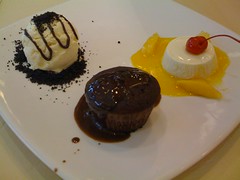
Tyler Cowen Convinced Me to Stop Eating Dessert

It’s been a couple of months since my last post, but with the academic semester waning, I should have a bit more time to get a few things written and posted here in the next month. Several weeks ago, I came across a post from a colleague, Tyler Cowen, who wrote about desserts. From Cowen:

Let me stress there are two different propositions:

1. “I don’t like desserts.”

2. “I don’t like desserts (with economist’s hat on).”

I meant mainly the latter, although I do also find many desserts overrated.

In any case, the sugar and calories “shadow price” of most desserts is pretty high.  I’d rather consume my health sins in other ways, and so relative to their actual net prices I find few desserts are worth it.

The green pepper is a food which as a human I like a small amount but as an economist I like a great deal.

I read this post, as luck would have it, a few days before I got the flu. When I get sick, I usually eat ice cream. While I know that’s very counterintuitive and probably contraindicated, for me, so far in this life, eating ice cream has done the trick in making me feel better and nursing me back to health quickly. I suppose it also helps that I don’t often get sick and so the eating of ice cream when I’m sick doesn’t have much of an effect on my health (or at least I like to think that it doesn’t). So this time, upon falling ill, I decided I wasn’t going to eat ice cream and upon regaining my health, I kicked desserts altogether.

This was a big move for me as I’m known to have a sweet tooth for Ben & Jerry’s (coffee coffee buzz buzz buzz, in particular). On a side note, I wonder if this decision would have been harder if my favourite kind of ice cream were sold in Ottawa. The closest thing I can get to my favourite flavour of Ben & Jerry’s is Coffee Heath Toffee Bar Crunch. Anyway, so even though Cowen didn’t write a treatise on the matter, the simple yet eloquent argument about the negative effect that dessert has on a nation’s health and the effect that this can have in so many other areas, made me want to give up dessert.

It’s been over a month since I’ve given up dessert and while I’ve certainly thought about “cheating” and having something here or there, I’ve held strong to my conviction.

At this point, I should also add that I expanded my “no desserts” decision to sugar, in general. I’ve made a conscious decision to try and select foods that don’t have any (or very little!) sugar in them. For instance, did you know that some organic saltines (!) have sugar (evaporate cane juice, but still) in them? Or, some organic crackers, in general? A more obvious choice in cutting out sugar comes from trips to Starbucks. My drink of choice used to be vanilla lattes or caramel macchiato’s, but what do you think is in those flavour shots? Back to americano’s or cappuccino’s for me.

At some point, I do imagine that I will begin to eat “dessert” again, but there’s something that I’ll want to remember if/when I do decide to eat dessert again — just because I’m served a plate of dessert doesn’t mean I have to eat a plate of dessert.

There’s a story that I remember being told about Kate Hudson. I tried to find it just now, but Hudson recently mentioned something about a story in France that has similar keywords to the search I ran and so I’m not able to find it. It may or may not be true, but let’s just say that it is. When Hudson was young, her mother (Goldie Hawn), taught her an important lesson when it came to dessert: only take one bite. That is, when you’re served a piece of pie or a piece of cake, it’s not necessary to eat the entire piece. Instead, just take one bite of the dessert to “enjoy” the taste of the dessert and let that be it.

So, if/when I go back to eating dessert, my plan is to just take one bite and then push my plate forward.
Is “A” Really the Best Option or is it Just that It’s Better Than “B”: List of Biases in Judgment and Decision-Making, Part 18

The other day, someone was talking to me about my series on biases in judgment and decision-making and it made me realize that I was missing a rather important bias — the contrast effect! I’m not sure how this one slipped through the cracks, but I’m glad to be able to write about it for you today.

It’s been almost a year and a half since I wrote something for this series, so let me refresh your memory. Each week, I took a cognitive bias and explained it. I provided an example and then I offered some ways for mitigating that cognitive bias in your own life. So, without further adieu, the contrast effect.

What’s the contrast effect? Well, as with many of the biases, it’s exactly what it sounds like: an effect that occurs because of a comparison. That is, people are more likely to perceive differences that are bigger or smaller because of something they’ve seen first. This is something that is used in sales — all — the — time. If you’re shopping for a new car, the salesperson may show a series of cars that are way out of your price range and then show you one that’s just a little out of your price range. After having seen so many cars that are way out of your price range, the one that’s just a little out of your price range won’t seem that far out of your price range. The contrast effect.

That’s not to pick on folks who sell cars, it can even happen with smaller purchases, shoes, for instances. Let’s say you’re looking for a particular kind of footwear. The salesperson may show you a bunch of shoes that don’t quite fit your needs and happen to be priced rather cheaply. Then, the salesperson shows you a shoe that does fit your needs, but is quite a bit more expensive. As you’ve seen all these shoes that aren’t what you need and now you’ve finally come to one that meets you’re needs, you may ignore the price and buy the shoes.

One of my favourite examples of the contrast effect comes from Dan Ariely‘s book, Predictably Irrational:

One day while browsing the World Wide Web (obviously for work-not just wasting time), I stumbled on the following ad, on the Web site of a magazine, the Economist.

excerpt.gif

I read these offers one at a time. The first offer-the Internet subscription for $59 seemed reasonable. The second option-the $125 print subscription-seemed a bit expensive, but still reasonable.

But then I read the third option: a print and Internet subscription for $125. I read it twice before my eye ran back to the previous options. Who would want to buy the print option alone, I wondered, when both the Internet and the print subscriptions were offered for the same price? Now, the print- only option may have been a typographical error, but I suspect that the clever people at the Economist‘s London offices (and they are clever-and quite mischievous in a British sort of way) were actually manipulating me. I am pretty certain that they wanted me to skip the Internet- only option (which they assumed would be my choice, since I was reading the advertisement on the Web) and jump to the more expensive option: Internet and print.

But how could they manipulate me? I suspect it’s because the Economist‘s marketing wizards (and I could just picture them in their school ties and blazers) knew something important about human behavior: humans rarely choose things in absolute terms. We don’t have an internal value meter that tells us how much things are worth. Rather, we focus on the relative advantage of one thing over another, and estimate value accordingly. (For instance, we don’t know how much a six- cylinder car is worth, but we can assume it’s more expensive than the four- cylinder model.)

In the case of the Economist, I may not have known whether the Internet- only subscription at $59 was a better deal than the print- only option at $125. But I certainly knew that the print and-Internet option for $125 was better than the print- only option at $125. In fact, you could reasonably deduce that in the combination package, the Internet subscription is free! “It’s a bloody steal-go for it, governor!” I could almost hear them shout from the riverbanks of the Thames. And I have to admit; if I had been inclined to subscribe I probably would have taken the package deal myself. (Later, when I tested the offer on a large number of participants, the vast majority preferred the Internet- and- print deal.)

Before we movie into some of the ways for avoiding the Contrast Effect, I wanted to make it clear that sales isn’t the only place where this bias can creep up on us. Another good example is in evaluations (be they interviewing job candidates or marking term papers). If one doesn’t have a rubric by which one is scoring candidates (or papers), it can be easy to slip into the contrast effect: “Well, that candidate was much better than the last candidate, let’s put them through to the next round.” It could be that the latter candidate, while better than the first, still doesn’t meet your criteria to make it the next round, so putting them through would be wasting valuable resources — both yours and theirs.

Ways for Avoiding the Contrast Effect

1) Standardized Evaluation

In our most recent case involving interview candidates or term papers, creating a rubric or standardized method of evaluation prior to examining candidates/papers will go a long way to help one avoid falling into the trap of the contrast effect. This method could also be applied when it comes to shopping (i.e. sales). For instance, let’s say you’re looking for a car. Prior to arriving at the dealership, you could create a table for how you’re going to evaluate the cars you view while at the dealership. In this way, you can guard against the salesperson knowingly (or unknowingly) showing you cars at either end of the spectrum before showing you the cars you might actually purchase.

2) Are There Other Options?

Often times, when we’re succumbing to the contrast effect, we’re looking at option A versus option B. This is why it’s so important to have some sort of standardized evaluation (see #1), but short of a standardized evaluation, it’s important to remember that almost never are those two options your only two options. “Should I get this car or that car?” Well actually, you have another option — neither of those cars. And another option, you could consider buying a bike or maybe taking public transportation. Whenever you find yourself faced with a decision between two options, it can be useful to consider other options, just in case you’ve fallen into the trap of the contrast effect.

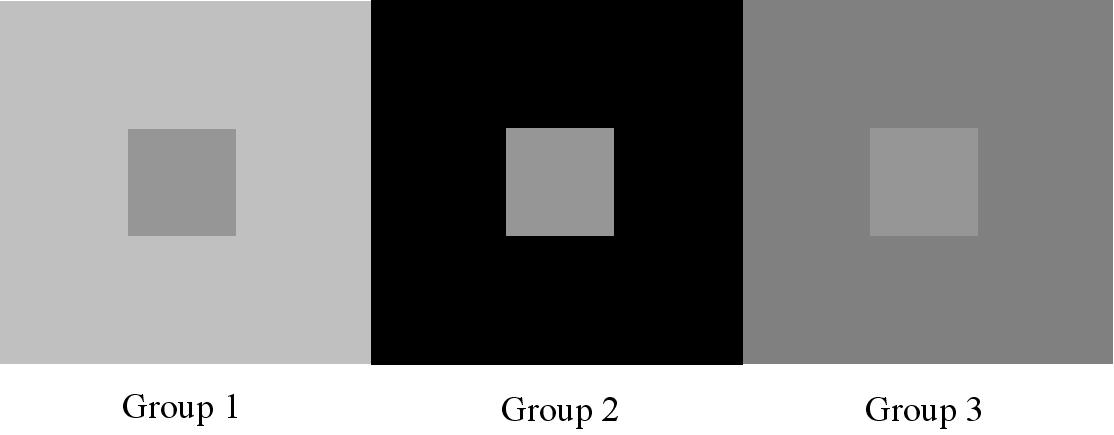
Note: the images in this post are all examples of the contrast effect.

If you liked this post, you might like one of the other posts in this series:

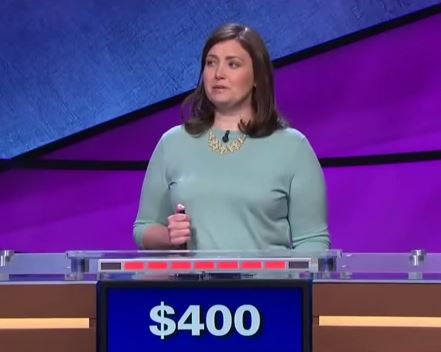
“Julia Lost on Jeopardy Because I Watched Live”

A few weeks ago, there was a contestant on Jeopardy that made quite a run. She didn’t break any of Ken Jennings’ records, but she certainly set a few records for females on Jeopardy. In fact, Julia Collins now has the record for the longest winning streak by a woman (and also the second longest winning streak — male or female) and the woman to have won the most money on Jeopardy. As it happens, I was lucky enough to see every episode.

Earlier this year, my son was born and one of the ways that helps him to sleep is if I bounce on an exercise ball. Since this can happen at odd hours of the day, I started watching DVR’d episodes of Jeopardy. In fact, I remember the first game that Julia won because she had to beat a Canadian. Anyway, over the course of 5 weeks, I continued to watch Julia handily defeat her competition and then when it was interrupted for the Jeopardy Battle of the Decades, I watched that.

When the regularly scheduled episodes returned with Julia, she was beginning to get some media attention. On the one hand, I thought this was great because she certainly deserved it, but it made it harder for me to avoid spoilers (really? Who needs to avoid spoilers for Jeopardy!?). I started to watch the episode a few hours after it aired on some nights because I noticed that some folks were tweeting about Julia’s streak continuing.

Julia hit her 20th win in a row on a Friday, which meant she got to come back on Monday. It just so happened that I was near the TV on Monday night, so, to avoid spoilers, I watched the episode live. As you already know (either from the title of this post or from knowing), Julia went on to lose that game. After she lost, I laughed to myself, “I shouldn’t have watched the episode live — that’s why Julia lost.”

Now, did you notice the cognitive bias?

The confirmation bias.

To be fair, I didn’t divulge all the information up front, but if you understand the confirmation bias, you’re going to think you have all the information. After watching Julia lose attempting to win her 21st game in a row, I said to myself that because I watched it live, she lost. [Note: of course, you’re going to have to suspend disbelief for a short while as my watching or not watching an episode of Jeopardy is not actually going to cause or not cause someone to win/lose. At this point, it’s science fiction.]

The thing I’m not telling you (nor was I telling myself to have said this to myself then, lest I be experiencing cognitive dissonance), was that I had also snuck a peak at a few of the episodes from wins 16 to 20. That is, even though I may not have watched a full episode live until her loss going for win 21, I did watch some bits of the other episodes live. So, at the conclusion of Julia’s streak, I selectively (though not intentionally) misremembered the number of times I’d seen Julia live and concluded that by my watching live, she lost.

How Do We Free Magneto From the Pentagon: A Lesson in Functional Fixedness

I don’t know if you’ve had the chance to see the new X-Men movie — I rather liked it. There was a scene in the movie that presents a wonderful example of functional fixedness, depending upon your familiarity with the story. Before moving on, I should remind you of the meaning of functional fixedness. Essentially, it’s the idea that, sometimes, we might have a hard time seeing the potential utility of an object. For example, if you need to push nail back into a piece of wood, but you don’t have a hammer around, it might take you more than a few minutes to think of using your shoe. The functional fixedness lies in one’s lack of ability to see the shoe as a potential hammer-like object. The ‘function’ of the shoe is ‘fixed’ on being a shoe.

Alright, now that we’ve reviewed functional fixedness, let’s look at the example from the recent X-Men movie, Days of Future Past. Before continuing, I should say…

(minor spoiler alert)

Near the beginning of the movie, a couple of the X-Men are trying to free another X-Men from a holding cell in the basement of the Pentagon. As the person being held in this cell is Magneto and has the ability to create/control magnetic fields, jailing him with metal is a bad idea. So, he’s being held in a glass encasing. The X-Men trying to free Magneto make it into the basement of the Pentagon and the one person who is meant to free Magneto from the cell is Quicksilver. Earlier scenes from this movie show us that he has the ability to move extremely fast. In fact, he moves so fast that his ability could be mistaken for teleportation.

With Quicksilver standing on top of the glass enclosure, those who weren’t familiar with the X-Men comics may have wondered just how this person with ‘superhuman speed’ was going to free Magneto. This is our example of functional fixedness.

If, when you were watching this scene, you thought to yourself, “Quicksilver won’t be able to free Magneto with his superpower because he can just move quickly, and there’s no door for him to get in,” you’d be locked in functional fixedness.

A few moments later, the answer is revealed: Quicksilver has superhuman speed, so he can use his power to shatter the glass and Magneto is freed.

Note: I didn’t mention this initially, but Quicksilver is able to break the glass because he is able to move his hands so quickly such that he can create a resonance that breaks the glass. For real-life example of this in action, watch this wine glass.

How to Stop Binge-Watching

Thirty-years ago if you told someone that you ‘binge-watched’ MacGyver over the weekend they would have looked at you funny — mostly because binge-watching wasn’t really common parlance, but also because you couldn’t binge-watch in the 80s the way that you can now. Today, you can fire up your computer (or set-top box) and stream episode after episode. Heck, you could even watch episode after episode on DVD or blu-ray, if you’re into that kind of thing. It’s become so easy to binge-watch shows and in part, is contributing to people actually binge-watching more shows.

I’d be lying if I said I hadn’t binge-watched a show. In fact, that was part of the reason that I first signed up for Netflix in February of 2013 — to watch House of Cards. And did I watch one episode and then wait a week? No. I finished the first season in a weekend. I also finished season 2 in a weekend, but who’s keeping track. Well, since we’re confessing, I also caught up on four and a half seasons Breaking Bad relatively quickly (4 or 5 weeks?) before the last half of the final season was to begin.

I should make it clear that I’m not encouraging binge-watching, but simply providing evidence that I’ve got plenty of experience with it, which brings me to my point:

How to stop binge-watching.

I don’t remember how I stumbled on this little trick, but it has certainly helped me when I needed to pull myself away from a set of gripping episodes. This method works particularly well for a show that uses a lot of cliffhangers or plot twists near the end of an episode (Scandal is a good example, however the finale to season three, which was essentially three season finales in one, might confound this). Instead of watching the whole episode before calling it quits for the night/afternoon, you’ve got to stop the episode well before they introduce a new plot twist. One way to do this is to “hang up” very near to the reveal of the climax. It’s in the falling action where they get you!

I realize that the show isn’t meant to be watched in this way, but I’ve found myself, on many occasions, where I wanted to stop watching, but kept getting sucked in at the end of an episode. After enough times of this happening, I realized that I needed to end the episode before the end of the episode. Hence, stopping the episode somewhere after the climax (usually somewhere two-thirds into the episode).

One of the potential criticisms to this method is that you’ve got to “fast-forward” to the point where you’ve left off. That’s true only if you’re not using something like Netflix. When you end an episode with Netflix part-way through, it picks up where you’ve left off (in fact, it rewinds it a few seconds sometimes). Since this is pretty much the only way I’ve binge-watched shows, I can attest to it working splendidly.

Solving False Equivalence in Politics?

Last week, John Oliver had a great segment that poked fun at how most (all?) television outlets cover climate change. Take a look:

Upon watching it, I didn’t think that Oliver was going to “even out” the representation in a physical manner. Instead, I thought that he was going to solve the issue of the “talking heads” appearing equal. Let me explain. Watch this:

That’s Lewis Black from the 2006 film, Man of the Year. I have no doubt that this sentiment had been expressed before this film, but this was the first time that I had heard it in this way. Hosting someone on a TV program with ideas that are clearly incorrect and putting their “talking head” up next to someone who has legitimately studied and confirmed that the other person is incorrect is a form of false equivalence.

As Black explains, to the viewer, both of these sides appear “equal.” It appears that one person is expressing an opinion and that the other person has a different opinion. What’s being missed is that one person’s opinion is factually erroneous (just as we saw in the video with Bill Nye earlier).

When I was watching the Oliver video, it made me think that he was going to do something else. I thought he was going to show the two talking heads in boxes (as you usually see on “debates” on political talk shows), but instead of giving them both a 50/50 split on the screen, I thought he was going to ration it more appropriately given the overwhelming support for climate change. I thought he’d give Bill Nye’s box 97% of the screen and the other guy’s box 3% of the screen.

I realize that this probably wouldn’t work in an actual talk show, but since I knew it was supposed to be semi-satirical, it seemed like a plausible idea.

On that note, can you imagine if that’s how political talk shows actually did things? That is, instead of having that 50/50 split, when they were talking about something factual, the size of the box for the talking head espousing the nonfactual opinion would be smaller. Of course, there’s all kinds of problem that could be raised with regard to censorship, but it’s certainly creative.

Conflict of Interest: The Importance of Independent Inquiry

For the last couple of months on Sunday nights, Fox has been airing a documentary that will probably be watched in science classes across America (when there’s a substitute teacher or otherwise) — Cosmos: A Spacetime Odyssey. Among other things, the show has taken the viewer on a journey back to the beginning of time. In one of the more recent episodes, host Neil deGrasse Tyson explained to viewers how we’ve come to know the age of the Earth.

In short, this came as a result of the work of scientist Clair Patterson. As a result of Patterson’s journey to determine the age of the Earth, he discovered some alarming findings related to the presence of lead in the environment. Through testing, he determined that the amount of lead in the environment wasn’t naturally occurring and concluded that the increased presence of lead near the ocean surface had to be man-made. He then was able to determine that this increase in lead in the oceans was because of leaded gasoline.

You’d think that a discovery like this would be well-received by those with influence. Unfortunately, that wasn’t the case.

At the time, there was a scientist “on the other side” of the debate who had published claims long ago that leaded gasoline was “safe.” In fact, one scientist in particular, Robert A. Kehoe. Why is this scientist significant? Because he was funded by the very people who were benefitting from the sale of leaded gasoline — oil companies.

My point isn’t to vilify Kehoe or extol Patterson. Instead, I want to highlight the fact that despite Kehoe was a scientist with credentials, at the time, it wasn’t always clear when he was speaking on matters related to leaded gasoline that he was being funded by oil companies. That is, he failed to disclose a potential conflict of interest.

This scenario perfectly illustrates the importance of disclosing conflicts of interest. If one’s funding is coming from the very industry that one is studying, then it’s important to disclose that. As an example: if you’re a chemist and you’re doing research on tobacco and you’re funded by Marlboro (or some cleverly named organization that represents a number of tobacco companies), there’s a better chance than not that your funders might not be pleased if your findings reflect “negatively” on their business.

How Big Data Can Make Watching Baseball More Fun

I like baseball. I played it all throughout my youth and my years as a teenager. So, not surprisingly, I also like to watch baseball. Watching baseball on TV has come quite a ways. While baseball was first televised in the 1930s, instant replay didn’t come along until almost 1960. Nowadays, you can’t watch a game without seeing just about every “key play” replayed. From the replay of the last double in the gap to the last pitch that was so close to being called a strike. And on that note about strikes, we can now see a makeshift strike zone on the screen next to the batter/catcher.

My post today is a pitch (pardon the pun) about how to improve the viewing experience in the context of that makeshift strike zone, which on some networks, is called pitch tracker.

On the pitch tracker, we can see a few things that have happened during the at bat. We can see where each pitch crossed the plate and at what height. We can also see if the pitch was fouled off and if the pitch was a ball. While all of this great, in my opinion, there is one major flaw to all of this — the “strike zone” isn’t universal. That is, as many players will tell you, each umpire has a different “strike zone.” Some umpires like to call a “wider” strike zone. Meaning, on the screen, it will appear as though the pitch is quite a few inches outside of the strike zone, the umpire calls that pitch a strike.

To the casual fan this may be confusing, but to a fan who watches baseball frequently, this may be frustrating. Especially as the game wears on, you might hear the announcer state that the last pitch was called a strike earlier in the game, but now it’s being called a ball. I’d like to eliminate the need for the announcer to tell me this. I’d also like to eliminate the confusion of the fan who sees a pitch that appears outside the strike zone, but is called a strike. How can we do this? Big Data.

Umpires go through a rigorous process before becoming an MLB umpire. As a result, their strike zone will probably be pretty much set in stone by the time they get to umpire their first MLB game. I propose that instead of using the “standard” or traditional strike zone on the screen during the game that networks show us the strike zone of the umpire. So, if an umpire usually calls strikes that appear 6 inches outside, we can see that because that’s the strike zone on the screen. We could even using a rolling average of the umpire’s career, such that only the last 3 seasons are taken into account when creating the strike zone on the screen.

The reason I suggested Big Data as the solution to this is because of all the sports, baseball is one of the ones with reams of data. Bill James did an excellent job of using data to allow us to better understand the success and failure of players, I think it’s time we use some of that data to make watching baseball just a bit more interesting.

Should We Be Reading Instead of Binge-Watching?

If you’ll recall from yesterday’s post, humans are wired for binge-watching. I wonder — are we spending too much time “vegging out” binge-watching when we’d be better off reading?

The map above comes from a post from Gizmodo earlier this month. It might be a bit hard to read the numbers, but it shows the average amount of time spent by each country reading. India comes out on top reading, on average, 10 hours and 42 minutes per week. The US, by comparison, reads a little more than half as much as India at 5 hours and and 42 minutes per week. Canada’s not much better at 5 hours and 48 minutes.

I wonder if this data is affected by the availability of TV or maybe more specifically, the cultural availability of TV. Let me explain: in countries like the US, watching TV isn’t just something that’s an option when you’re trying to figure out what to do when you come home from work or school, it’s the norm. People have whole rooms dedicated for just TV watching. I’d suspect that this isn’t the case in other parts of the world where space is a premium. If I think about a country like India where 4 times as many people than there are in the US, I wonder if going off and reading a book somewhere might be a more desirable activity than trying to watch TV with 4, 5, or 6 other people. In the US, there’s the joke about who gets to have the TV controller — the husband or the wife. I wonder what the equivalency would be when you’re fighting for the controller with 2 aunts and uncles, along with your cousins.

Regardless, as I alluded to in the second sentence, North Americans might be better off taking after the rest of the world by burying their heads in a good book. Or, maybe it’s time to hit the gym.

What’s Better: Binge-Watching TV or Movies?

Quite some time ago (maybe 1-3 years ago?), I remember Matt Yglesias writing something about how movies were far superior to TV shows. That opinion has stuck with me for a while. It’s not that I agreed or disagreed, but I found the idea curious. With the explosion of binge-watching, I wondered if Matt Yglesias still thinks that movies were far superior to TV shows.

That is, when you can watch 3-5 hours of a TV show and really get into the intricacies of the plot in one sitting, does that somehow make it better than a 1.5- to 2-hour movie?

More recently, there’ve been a couple of interesting articles about movies and binge-watching. The first, on movies, discusses how going to the movies is a shared experience and how that might be dying out. The author explains that fewer people are going to the movies, even though ticket sales are at an all-time high (increased prices). She closes by saying that she thinks only a limited number of movies will debut in the theatre and the rest will go straight to video.

I think she’s right — the movies as a shared experience is dying out. However, I don’t think “shared experiences” are dying out. Instead, I think they’re moving away from the movies to other events like the one the author mentions, but not in the same context, the Oscars. Or perhaps the Superbowl is another good example. More than that, I wonder if we’re substituting the shared collective experience of going to the movies for binge-watching.

The second article, on binge-watching, argued that humans are wired to binge-watch. With the rise of online video streaming sites like Netflix, Hulu, and Amazon (Prime), it’s not surprising that people are spending more time watching videos online and at home than they are going out to the theatre. I would posit that as more people binge-watch, the more other people also want to binge-watch.

Think about shows like House of Cards or Orange is the New  Black. These shows were released all at once on a Friday. As a result, some people will have watched the whole season before going back to work on Monday. As a way to stay “part of the conversation,” some people may feel compelled to watch the whole season, too. Given that we’re already wired to binge-watch, it’s not surprising that this might become self-reinforcing. 

This leads me to my argument that binge-watching might be replacing movie-going as the norm when it comes to shared experiences. After you’ve binge-watched House of Cards or some other series, maybe you start binge-watching that series that you never got into when it was on TV (Lost? Frasier? The West Wing?). There are a lot of series that are on Netflix and there are also lots of series on some of the other online streaming sites.

After having a baby fall asleep on my lap/shoulder night after night, I think my vote might be for binge-watching.