A Collection of Scriptures for Guidance: Judaism, Part 5

Note: the first two paragraphs are introductory and are derived from the first post in this series. I’ll continue to repost them, in case this is your first time reading a post from this series.

When I was still a doctoral candidate at Sofia University, one of the courses I completed was “World Religions.” This was one of the classes I enjoyed the most during my time at Sofia University. I’d never had such broad exposure to the world’s religions before and this class really allowed me to gain a better understanding of them.

One of the papers I wrote for that class really tied in the fact that I was in a clinical psychology PhD program. The purpose of the paper was to collect quotes from scriptures of the various world religions that I could use with clients/patients when I became a therapist. While I’m no longer pursuing a PhD in clinical psychology, the quotes I collected could certainly be of use, so I thought I’d share them here.

Today’s collection of scriptures for guidance comes courtesy of Judaism. Enjoy!

Anxiety

Whoever had bread in his basket and says, “What am I going to eat tomorrow?” only belongs to those who are little in faith. (Talmud Sota 48b)

Anger

Anger deprives a sage of his wisdom, a prophet of his vision. (Talmud Pesahim 66b)

Addiction

Rabbi Isaac said, quoting Proverbs 23.31, “Wine makes the faces of the wicked red in this world, but pale in the world to come.” Rabbi Me’ir said, “The tree of which Adam ate was a vine, for it is wine that brings lamentation to man.” (Talmud Sanhedrin 70ab)

Death

The body is the sheath of the soul. (Talmud Sanhedrin 108a)

Grief

Before He brought on the flood, God Himself kept seven days of mourning, for He was grieved at heart. (Midrash Tanhumma Shemini 11a)

Do not be daunted by the enormity of the world’s grief. Do justly, now. Love mercy, now. Walk humbly, now. You are not obligated to complete the work, but neither are you free to abandon it. (attributed to the Talmud)

Rabbi Me’ir said, “When man is sore troubled, the Shechinah says, ‘How heavy is my head, how heavy is my arm.’ If God suffers so much for the blood of the wicked, how much more for the blood of the righteous.” (Mishnah Sanhedrin 6.5)

Guilt

Forgive all guilt and accept what is good. Instead of bulls we shall pay [the offering] with our lips. (Hosea 14:3)

If you liked this post, you might like one of the other posts in this series:

We are Just One Small Adjustment Away from Making Our Lives Work

Have you seen the movie, How Do You Know? It’s a 2010 romantic comedy starring Paul Rudd and Reese Witherspoon. It also has Owen Wilson and Jack Nicholson in it. If you like romantic comedies, there’s a good chance you’ll enjoy the movie. It’s a movie written and directed by James L. Brooks who also directed As Good As It Gets.

Anyhow, there’s a quote (from Paul Rudd’s character) that I wanted to share with you. I think you might find it… enlightening. To put it in context: Paul Rudd’s character (George) is trying to decide whether he wants to go to prison for his dad (Jack Nicholson). To make this decision, he needs to find out whether the girl he loves Lisa (Reese Witherspoon) would rather be with Matty (Owen Wilson), who she’s currently with, or him. I found a version of this clip on YouTube, so I’ve also included it below the dialogue I transcribed from watching the clip.

George: This is only half the gift. It doesn’t work without the story. This stuff was invented by this man in Central Ohio as white goo and he used it to remove soot off of wall paper from old-fashioned heating. So, when gas and electric heating came, there was no longer a need for the cleaning goo. So, the guy was going under. But, his sister-in-law, was a nursery school teacher.

Lisa: Now, is this a true story?

George: The man’s name was Joe McVicker. His sister-in-law was Kay Zufall.

Lisa: OK, I believe you.

George: So, Kay Zufall, discovered that her little kids liked squeezing the goo a lot more than hard modeling clay. So, she suggested to her brother-in-law, Joe, they color the stuff and call it play-doh.

Lisa: Hey, nice.

George: So, I have kept this for a long time as proof that we are just one small adjustment away from making our lives work.

Cell Phones and Driving: Do You Value Your Life?

A couple of days ago, I happened to be in the car when NPR’s The Kojo Nnamdi Show was playing. It just so happened that it was “Tech Tuesday,” and they were talking about new findings on distracted driving. Some of the findings would probably shock most people. For instance, would you have guessed that there is no (statistically) significant difference between talking on a cell phone with bluetooth and without bluetooth? I wouldn’t have. And, in fact, part of me thinks that the study maybe wasn’t designed optimally for testing the hypothesis, but I didn’t read the journal article.

One of the more interesting parts of the conversation was when one of the callers brought up the point about having cell phones automatically “lock” themselves when the car is in motion. One of the guests pointed out that this is already out there. She mentioned that there were apps that would “lock” the phone if the car is in motion. Then, Kojo brought up the point about passengers in the car — would they still be able to use their phones in the car? At this point, the guest then explained that getting around the “locked” phone is not too difficult.

After listening to this exchange, I realized that car safety (ala cell phones) is a choice. That is, it’s a choice by the driver. It’s probably not possible to completely legislate away a person’s ability to use their cell phone while driving (meaning: it likely wouldn’t hold up in court), so then it becomes a choice for driver. Does the driver want to increase their chances of causing an accident? Because that’s what happens when a driver decides to use their cell phone while driving. They’re increasing their chances of causing (or being in) an accident. To take this down a psychological tangent, it’s possible that they don’t value their life (as much as the next person) and so they’re willing to take this kind of risk.

As I got out of the car and began walking to my destination, my thoughts floated back to the 2009 book, Nudge (I think I’ve mentioned it on here before). I was trying to think of a way that we, as a society, could help nudge people to make better choices when behind the wheel. Is there some way we could nudge drivers away from using their cell phone?

A Collection of Scriptures for Guidance: Islam, Part 4

Note: the first two paragraphs are introductory and are derived from the first post in this series. I’ll continue to repost them, in case this is your first time reading a post from this series.

When I was still a doctoral candidate at Sofia University, one of the courses I completed was “World Religions.” This was one of the classes I enjoyed the most during my time at Sofia University. I’d never had such broad exposure to the world’s religions before and this class really allowed me to gain a better understanding of them.

One of the papers I wrote for that class really tied in the fact that I was in a clinical psychology PhD program. The purpose of the paper was to collect quotes from scriptures of the various world religions that I could use with clients/patients when I became a therapist. While I’m no longer pursuing a PhD in clinical psychology, the quotes I collected could certainly be of use, so I thought I’d share them here.

Today’s collection of scriptures for guidance comes courtesy of Islam. Enjoy!

Anxiety

Any who believes in his Lord has no fear, either of loss or of any injustice. (Qur’an 72.13)

Anger

Abu Huraira reported God’s Messenger as saying, “The strong man is not the good wrestler; the strong man is only he who controls himself when he is angry.” (Hadith of Bukhari and Muslim)

Addiction

You who believe! Intoxicants and gambling… are an abomination – of Satan’s handiwork: eschew such that you may prosper. Satan’s plan is to stir up enmity and hatred among you by means of liquor and gambling, and to hinder you from the remembrance of God and from prayer. Will you not abstain? (Qur’an 5.90-91)

Death

And He originated the creation of man out of clay,
then He fashioned his progeny of an extraction of mean water,
then He shaped him, and breathed His spirit in him. (Qur’an 32.8-9)

Know that the present life is but a sport and a diversion, an adornment and a cause of boasting among you, and a rivalry in wealth and children. It is as a rain whose vegetation pleases the unbelievers; then it withers, and you see it turning yellow, then it becomes straw. And in the Hereafter there is grievous punishment, and forgiveness from God and good pleasure; whereas the present life is but the joy of delusion. (Qur’an 57.20)

Depression

Who is it that Sustains you (in life) From the sky and from the earth? Or who is it that Has power over hearing And sight? And who Is it that brings out The living from the dead And the dead from the living? And who is it that Rules and regulates all affairs? They will soon say, “God.” Say, “Will ye not then Show piety (to him)?” (Surat Viunus, 10, 31)

O my Servants who have transgressed against their souls! Despair not of the Mercy of God: for God forgives All sins: for He is Oft-Forgiving, Most Merciful. (Surat al-Zumar, 39, 53)

Grief

Abu Dharr reported God’s Messenger as saying, “I see what you do not see and I hear what you do not hear; heaven has groaned, and it has a right to groan.” (Hadith of Ahmad, Tirmidhi and Ibn Majah)

Though wouldst only, perchance, Fret thyself to death, Following after them, in grief, If they believe not In this Message. (Surat al-Kahf 18, 6)

Guilt

Say, “If you love God, follow me, and God will love you, and forgive you all your sins; God is All-forgiving, All-compassionate.” (Qur’an 3.31)

Say, “O my Servants who have transgressed against their souls! Despair not of the mercy of God: for God forgives all sins: for He is Oft-forgiving, Most Merciful.” (Qur’an 39.53)

If you were not to commit sins, God would have swept you out of existence and would have replaced you with another people who have committed sin, and then asked for God’s forgiveness, that He might grant them pardon. (Hadith of Muslim)

If you liked this post, you might like one of the other posts in this series:

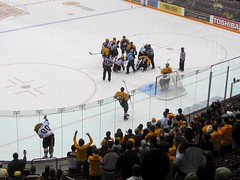
Does the Culture of Hockey Encourage Over-Aggression?

Last night, I happened to catch a short video clip from CBC that was rather appalling. I’m unable to embed the video, so you can watch it at the link above. The gist of the video (and article) is to tell the watcher/reader what happened in a Minor hockey game in Ontario, Canada.

One player was skating down the ice and stopped in front of the opposing team’s goalie. Upon doing this, he “sprayed” the opposing goalie. If you’re not familiar with skating (on ice), when you come to a stop, sometimes, the ‘snow’ that has accumulated on the ice will be kicked up. After the player did this, one of the opposing player’s took exception and proceeded to start roughing up the original player. The original player did not fight back and, as you’ll see from the video, took a pretty harsh beating.

The story explains that the parents took the video to the league and the police are investigating the matter as to whether there should be charges pressed.

Now, I’d like to talk a little bit about the culture of hockey and maybe broaden that to sports in general. As I was born and raised in Canada, I’m familiar with the hockey culture. Though, I never played in any organized hockey, so I won’t ever be able to fully understand the experience. Nonetheless, I still think that, as a former athlete, my opinion should carry some weight.

This player’s actions are unacceptable. The original player simply sprayed the goalie and as punishment, he was given a broken nose and a concussion. Does anyone not think that the opposing player went a little too far when he was pummeling the original player? This scenario reminds me of an episode of The West Wing. In fact, it was the 3rd episode in the series: “A Proportional Response.”

In that episode, Syrian operatives blow up a plane that’s carrying Americans (and the President’s personal physician). The President’s military advisors come up with a plan that they call, “a proportional response.” The President doesn’t like it because he doesn’t think it’s going far enough. He wants to do more damage to the country that’s responsible for those American deaths and demands to see a plan that will take out the airport in Syria’s capital city, Damascus. There’s more to the story (isn’t there always with an Aaron Sorkin script?), but at one point, the Chief of the Joint Chiefs of Staff says to the President’s Chief of Staff, ” he will have doled out five thousand dollars worth of punishment for a fifty buck crime.”

Among other things, this is what it appears to me that happened in this minor league hockey game where one player committed a five dollar crime and ended up with a five thousand dollar punishment. Of course, I’m not saying that the player shouldn’t have stuck up for his goalie, but maybe he went a little overboard? And it’s certainly not the first time a player has gone overboard in sticking up for his teammate. It’s been almost 10 years since the infamous Bertuzzi-Moore incident.

I have to think that the “punisher” had he knew what was happening, wouldn’t have wanted to give the original player a broken nose and a concussion. I have to think that, because this happened, somewhere as part of the culture, this is okay. Not necessarily that it’s okay to inflict such physical damage to a player, but the culture of over-aggression is normal and maybe even lauded. Again, as I said, I never played organized hockey, so I can’t be certain of hockey culture in the dressing room or on the ice. As a spectator, I know that this isn’t something I want to see. I understand the logic and reasoning behind having enforcers on a hockey team, but I wonder what the NHL would look like without enforcers.

Hindsight is Always 20/20: List of Biases in Judgment and Decision-Making, Part 15

While it is a little later than I would have liked, it still is Monday (at least in EDT). Today’s cognitive bias: hindsight bias. As many of the previous biases, this is exactly how it sounds. In fact, there’s even a handy idiom to help you remember the gist of this bias: “Hindsight’s 20/20.”

So, what is the hindsight bias? It’s the idea that when looked at a course of events after they’ve happened, things seem quite predictable. ‘I knew that was gonna happen.’ This often happens in spite of someone not thinking those events were going to happen. That is to say, even if they thought there was little likelihood of an event happening, after the fact, someone would think that it would obviously happen. Let me further explain it through an example. Let’s start with an easy example, too.

Remember back to when you were applying to college/university? Let’s say a letter comes in the mail telling this person that they’ve been accepted. When they tell their parents about it, mom gets really excited and says that she knew it all along. Meanwhile, she had previously expressed doubts that this person was going to get accepted. That’s a hindsight bias. Like I did with the gambler’s fallacy, I’ll list some other common ways we can see the hindsight bias affecting us:

  • You tell your friend that you think it’s going to rain later that day — and it does! So, you say something to the effect of, “I was sure it was going to rain!”
  • You give your number out at the bar, but the person doesn’t call you for a few days. When the person eventually calls, you tell yourself that you were sure he was going to call.
  • You’re getting ready to go on a trip and you tell your friend that you’re sure you’re to forget something. When you get to your destination, it turns out you did forget something, so you tell your friend that you knew it was going to happen.

These are some everyday examples, but hindsight bias has proven to be very important in the judicial system. For instance: “Hindsight bias results in being held to a higher standard in court. The defense is particularly susceptible to these effects since their actions are the ones being scrutinized by the jury. Due to the hindsight bias, defendants will be judged as being capable of preventing the bad outcome.”

Ways for Avoiding the Hindsight Bias

1) Write it down!

This might be a bit tedious, but it’s a surefire way to guard against the hindsight bias. I’ve read a few articles about folks who’ve documented every prediction that they’ve ever made. While this had more to do with their profession (forecasting, stocks, etc.) it might be something you want to consider.

2) “I knew it all along!”

Have you ever found yourself saying, “I knew it all along,” or “I’m was sure it was going to happen?” These are good indicators that you’re probably operating under the hindsight bias. When you catch yourself saying these phrases, stop and think about what has happened in the situation. Chances are that you’ve “short-circuited” and you’re not thinking about what’s happened to cause that situation.

If you liked this post, you might like one of the other posts in this series:

A Collection of Scriptures for Guidance: Confucianism, Part 3

Note: the first two paragraphs are introductory and are derived from the first post in this series. I’ll continue to repost them, in case this is your first time reading a post from this series.

When I was still a doctoral candidate at Sofia University, one of the courses I completed was “World Religions.” This was one of the classes I enjoyed the most during my time at Sofia University. I’d never had such broad exposure to the world’s religions before and this class really allowed me to gain a better understanding of them.

One of the papers I wrote for that class really tied in the fact that I was in a clinical psychology PhD program. The purpose of the paper was to collect quotes from scriptures of the various world religions that I could use with clients/patients when I became a therapist. While I’m no longer pursuing a PhD in clinical psychology, the quotes I collected could certainly be of use, so I thought I’d share them here.

Today’s collection of scriptures for guidance comes courtesy of Confucianism. Enjoy!

Anxiety

The Master said, “What need has nature of thought and care? In nature all things return to their common source and are distributed along different paths; through one action, the fruits of a hundred thoughts are realized. What need has nature of thought, of care?” (I Ching, Great Commentary, 2.5.1)

When you have faults, do not fear to abandon them. (Confucius)

Addiction

Men who are grave and wise, Though they drink, are mild and masters of themselves; But those who are benighted and ignorant Are devoted to drink, and more so daily. Be careful, each of you, of your deportment – What heaven confers, when once lost, is not regained. (Book of Songs, Ode 196)

Death

The union of seed and power produces all things; the escape of soul and brings about change. Through this we come to know the conditions of outgoing and returning spirits. (I Ching, Great Commentary, 1.4.2)

Depression

Our greatest glory is not in never falling, but in rising everytime we fall. (Confucius)

Everything has its beauty, but not everyone sees it. (Confucius)

Grief

Never give a sword to a man who can’t dance. (Confucius)

Guilt

Wheresoever you go, go with all your heart. (Confucius)

Loneliness

Respect yourself and others will respect you. (Confucius)

If you liked this post, you might like one of the other posts in this series:

A Collection of Scriptures for Guidance: Taoism, Part 2

Note: the first two paragraphs are introductory and are derived from the first post in this series. I’ll continue to repost them, in case this is your first time reading a post from this series.

When I was still a doctoral candidate at Sofia University, one of the courses I completed was “World Religions.” This was one of the classes I enjoyed the most during my time at Sofia University. I’d never had such broad exposure to the world’s religions before and this class really allowed me to gain a better understanding of them.

One of the papers I wrote for that class really tied in the fact that I was in a clinical psychology PhD program. The purpose of the paper was to collect quotes from scriptures of the various world religions that I could use with clients/patients when I became a therapist. While I’m no longer pursuing a PhD in clinical psychology, the quotes I collected could certainly be of use, so I thought I’d share them here.

Today’s collection of scriptures for guidance comes courtesy of Taoism. Enjoy!

Anxiety

The man who has had his feet cut off in punishment discards his fancy clothes – because praise and blame no longer touch him. The chained convict climbs the highest peak without fear – because he has abandoned all thought of life and death. These two are submissive and unashamed because they have forgotten other men, and by forgetting other men they have become men of Heaven. You may treat such men with respect and they will not be angry. Only because they are one with the Heavenly Harmony can they be like this. (Chuang Tzu, 23)

Anger

A person in danger should not try to escape at one stroke. He should first calmly hold his own, then be satisfied with small gains, which will come by creative adaptations. (I Ching)

Death

Look upon life as a swelling tumor, a protruding goiter, and upon death as the draining of a sore or the bursting of a boil. (Chuang Tzu, 6)

Birth is not a beginning; death is not an end. There is existence without limitation; there is continuity without a starting point. Existence without limitation is space. Continuity without a starting point is time. There is birth, there is death, there is issuing forth, there is entering in. That through which one passes in and out without seeing its form, that is the Portal of God. (Chuang Tzu, 23)

Depression

He who knows other men is discerning; he who knows himself is intelligent. He who overcomes others is strong; he who overcomes himself is mighty. He who is satisfied with his lot is rich; he who goes on acting with energy has a (firm) will.

He who does not fail in the requirements of his position, continues long; he who dies and yet does not perish, has longevity. (Tao Te Ching, 33)

Grief

The valley spirit dies not, aye the same;
The female mystery thus do we name.
Its gate, from which at first they issued forth,
Is called the root from which grew heaven and earth.
Long and unbroken does its power remain,
Used gently, and without the touch of pain. (Tao Te Ching, 6)

Guilt

The Tao in its regular course does nothing (for the sake of
doing it), and so there is nothing which it does not do.

If princes and kings were able to maintain it, all things would of
themselves be transformed by them.

If this transformation became to me an object of desire, I would
express the desire by the nameless simplicity.

Simplicity without a name
Is free from all external aim.
With no desire, at rest and still,
All things go right as of their will. (Tao Te Ching, 37)

If you liked this post, you might like one of the other posts in this series:
A Collection of Scriptures for Guidance: Primal Religions, Part 1

A couple of weeks ago, I shared something that I wrote for a paper this semester about Canada needing to diversify its export strategy. The recent news of Edward Snowden reminded me of a paper I wrote this semester for a different course. Writing both of those posts reminded me that I’ve written plenty of papers that you might find interesting, so I thought I’d dig into my old files and see what’s worth sharing.

When I was still a doctoral candidate at Sofia University, one of the courses I completed was “World Religions.” This was one of the classes I enjoyed the most during my time at Sofia University. I’d never had such broad exposure to the world’s religions before and this class really allowed me to gain a better understanding of them.

One of the papers I wrote for that class really tied in the fact that I was in a clinical psychology PhD program. The purpose of the paper was to collect quotes from scriptures of the various world religions that I could use with clients/patients when I became a therapist. While I’m no longer pursuing a PhD in clinical psychology, the quotes I collected could certainly be of use, so I thought I’d share them here.

As the title of this post suggests, the quotes in today’s post are geared towards “primal religions.” Enjoy!

Anger

The fly cannot be driven away by getting angry at it. (Idoma Proverb, Nigeria)

When a man goes to sacrifice he must remain peaceful, without a hot heart. He must stay thus for at least a day. If he quarrels on that day or is hot in his heart he becomes sick and destroys the words of the lineage and of the sacrifice. (Luhya Saying, Kenya)

Death

Onyame does not die, I will therefore not die. (Akan Proverb, Ghana)

Some day the Great Chief Above will overturn the mountains and the rocks. Then the spirits that once lived in the bones buried there will go back into them. At present those spirits live in the tops of the mountains, watching their children on earth and waiting for the great change which is to come. The voices of these spirits can be heard in the mountains at all times. Mourners who wail for their dead hear spirit voices reply, and thus they know that their lost ones are always near. (Yakima Tradition)

Grief

Abuk, mother of Deng,
Leave your home in the sky and come to work in our homes,
Make our country to become clean like this original home of Deng,
Come make our country as one: the country of Akwol
Is not as one, either by night or by day,
The child called Deng, his face has become sad,
The children of Akwol have bewildered their Chief’s mind. (Dinka Song, Sudan)

Is Sunshine Really the Best Disinfectant: Edward Snowden, PRISM, and the NSA

In keeping with the theme from yesterday’s post about Edward Snowden and the leaks about PRISM and the NSA, I thought I’d share something that I was reminded of when I was watching some of the coverage of it earlier this week. Before doing that though, if you haven’t, and regardless of your position on whether he should or shouldn’t have done this, I would urge you to read the article and watch the clip about him in The Guardian.

A couple of days ago I happened to catch a segment of Morning Joe where one of the journalists who broke the story about the NSA, Glenn Greenwald, was on. The clip is about 20 minutes and there’s an interesting exchange between one of the hosts and Greenwald. The part I’d like to highlight today happens towards the end of the segment. I think it was Willie Geist who asked the question and included the phrase, “Sunshine is the best disinfectant,” in reference to getting the information about these programs out in the open. This reminded me of a paper I wrote for a Public Administration class and I thought it might be useful if I detailed some of the research I used for that paper.

The idea that “sunshine is the best disinfectant” with regard to public administration stems from the idea of government reform. In a 2006 paper in Public Administration Review, Paul C. Light defined four tides of government reform:

All government reform is not created equal. Some reforms seek greater efficiency through the application of scientific principles to organization and management, whereas others seek increased economy through attacks on fraud, waste, and abuse. Some seek improved performance through a focus on outcomes and employee engagement, whereas others seek increased fairness through transparency in government and access to information. Although these four approaches are not inherently contradictory — and can even be found side by side in omnibus statutes such as the 1978 Civil Service Reform Act — they emerge from very different readings of government motivations.

These approaches also offer an ideology for every political taste: scientific management for those who prefer tight chains of command and strong presidential leadership; the war on waste for those who favor coordinated retrenchment and what one inspector general once described as “ the visible odium of deterrence ” ( Light 1993 ); a watchful eye for those who believe that sunshine is the best disinfectant for misbehavior; and liberation management for those who hope to free agencies and their employees from the oppressive rules and oversight embedded in the three other philosophies. [Emphasis Added]

My point in sharing this article wasn’t to say that the idea that sunshine is the best disinfectant is good or bad, but merely to put it in context with some other ways of reforming government. You can decide for yourself which you prefer. In fact, there’s a handy table for differentiating the four:

The Four Tides of Reform

And one more interesting table that shows you how government reform in the US has changed since 1945:

Patterns in Reform Philosophy