The Audacity of Hope: Obama’s Impromptu Speech About Trayvon Martin and Race

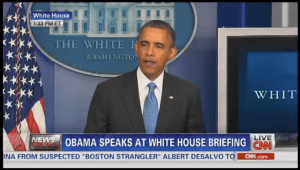
This afternoon, President Obama surprised everyone by making an appearance in the White House press briefing room. He spoke for approximately 17 minutes about Trayvon Martin, race, the law, and some other things. Part of the specialness of this speech was that it was impromptu (at least it appeared that it was unplanned) and was unscripted. [I couldn’t embed the video, but you can see it here.]

There were a lot of key things that he addressed in his speech, but what I thought to be the most important was the last few minutes. In the last few minutes, President Obama said that the younger generations are doing it much better than previous generations. The implication here is that the younger generations are less racist (or less unapproving) than previous generations. He talked about how he would listen to Malia and Sasha (his kids) speak with their friends and hear how they interacted. As a result, he thinks that the younger generations are doing it better than the older generations.

As I heard him say that, it made me think about how our countries are governed. Right now, the people who run the country (and by extension, the world) are older. I wonder what it’d be like if we had younger people who ruled the world. Maybe younger people would “get us there faster.” As a way to temper the eagerness of young people, maybe it’d be important to have some people from older generations to be advisors.

I wonder… are there any countries, states, provinces, counties, cities, or towns that are run by “younger” people? Are they more successful? Could we map this onto bigger populations with the same success?

~

For the first 14+ minutes, it seemed like there was an almost sombre tone to President Obama’s remarks. However, as he shifted to talking about the younger generations, I got the sense that he had hope for the future. I got the sense that he had hope for the future of the country because of the progress he sees in younger generations. While nothing is certain about the future nor are the implications, I’d like to think that it’s rather poetic that the leader of the United States believes in a brighter tomorrow. That President Obama believes that we are getting better as a society. As a people. That we are beginning to treat each other with more respect. More love. More kindness. And the hope is that this will continue with each succeeding generation. Hope.

Who Wants to Play Sports in 122° Weather, in the Middle East, in the Summer?

A couple of days ago, I saw a headline that the FIFA President, Sepp Blatter, was going to ask the executive committee to consider moving the 2022 World Cup, set to be played in Qatar (a country that borders Saudi Arabia), to the Winter. It seems to me that this should have been considered when Qatar was chosen as the host back in December (is that ironic?) of 2010.

I did some checking and since there’s been a World Cup for soccer (or football, depending on your geographic orientation), the event has always taken place in the “summer.” Every World Cup happens in the month of June or July. A few times, it started in May, but it has always, at a minimum, gone into June. Some have taken place solely in July. None of the previous 19 World Cups (dating back to 1934) have taken place in any of the other months. So, it would seem, considering moving the 2022 World Cup to the Winter would be unprecedented.

Adding another layer to this debate is that the English Premier League (one of the best soccer/football leagues in the world), isn’t interested in having the World Cup move to the Winter as it will affect their schedule. Not only will it affect one year’s schedule, but it’s likely to affect two year’s schedules. And, it will have an affect on broadcasting contracts.

As I read more and more about this story, I’m still flabbergasted that something like this wasn’t considered. It seems that someone, somewhere along the line should have thought about playing sports in 122° weather, in the Middle East, in the Summer. Along those same lines of due diligence or “thinking ahead,” I remember reading something recently about concerns that it won’t be cold enough in 2014 for the Winter Olympics in Sochi, Russia. Let’s hope that those concerns aren’t realized.

Belongingness & Transcendence: Transcendence and Belongingness, Part 3

In the first post in this series, we explored Maslow’s Hierarchy of Needs. In the second post, we looked at belongingness, transpersonal psychology, and transpersonal experiences. In this — the last — post, we’ll tie everything together in a section on belongingness & transcendence, followed by the conclusion.

~

Belongingness and Transcendence

In this section, we will explore some of the experiences of transcendence that relate specifically to belongingness. We will do this by reviewing a series of examples of transcendence. In the first example, Maslow (1968) refers to transcendence as transcending the ego or the self. Specifically, Maslow (1968) stated “The phrase ‘being in harmony with nature’ implies this ability to yield, to be receptive to, or respond to, to live with extra-psychic reality as if one belonged with it, or were in harmony with it” (p. 58). Meaning, if one transcended one’s ego, one would not only feel a sense of belongingness with the people around one’s self, but one would also feel a sense of belongingness with nature. In this example, we can see how there is a transpersonal element within belongingness.

In another example of transcendence, Maslow (1968) refers to love being a kind of transcendence. Specifically, this refers to love for one’s child or for one’s friend (Maslow, 1968). According to Maslow (1968), “This can also be expressed intrapsychically, phenomenologically, as experiencing one’s self to be one of the band of brothers, to belong to the human species” (p. 59). Meaning, when one experiences a state of transcendence by way of loving one’s child or one’s friend, there is possibility that they are experiencing a state of belongingness with all of humanity. This state of belongingness is possible by one’s state of transcendence. Just as in the first example, this example also shows us how belongingness has a transpersonal element to it.

In an additional example of transcendence, Maslow (1968) refers to a “special phenomenological state in which the person somehow perceives the whole cosmos or at least the unity and integration of it and of everything in it, including his Self” (pp. 63-64). In this example, not only does the person feel connected to all human species, but to the whole of the universe. “He then feels as if he belongs by right in the cosmos” (Maslow, 1968, p. 64). This is an example of transcendence leading to a sense of belongingness. The belongingness feeling is attained once the person has transcended. This is another example showing us transpersonal elements within belongingness.

In the next example of transcendence, Maslow (1968) refers to one transcending “individual difference in a very specific sense” (p. 64). Maslow (1968) stated that “the highest attitude to have toward individual differences is to be aware of them, to accept them, but also to enjoy them and finally to be profoundly grateful for them” (p. 64). This is, yet another way of attaining a sense of belongingness through transcendence. According to Maslow (1968), “Rising above them [individual differences] in the recognition of the essential commonness and mutual belongingness and identification with all kinds of people in ultimate humanness or species-hood” (p. 64). This illustrates another potential way of attaining belongingness by transcending individual differences.

In this section, we have seen that there are transpersonal elements to belongingness. Specifically, we have seen that there is an aspect of transcendence to belongingness. We have seen examples of how transcendence is present in belongingness by way of four separate examples. In the first example, we saw that one could transcend one’s ego or self to attain a feeling of being one with nature and feel a sense of belongingness with everything. In the second example, we saw that one could transcend by way of loving one’s child or one’s friend and in turn, feeling a sense of belongingness with all of humanity. In the third example, we saw that one could transcend to the point that one attains a feeling of oneness with the cosmos or the universe and in turn, feels a sense of belongingness with the whole of the universe. In the fourth example, we saw that one could transcend the individual differences between people to feel a sense of belongingness with all kinds of people.

Conclusion

In this paper, there was a brief description of Maslow’s hierarchy of needs. There was an explanation of each of the needs of the hierarchy: physiological, safety, love, esteem, and self-actualization. There was an expanded description of one of the components within love needs – belongingness. There was a brief explanation of transpersonal psychology followed by a description of a transpersonal experience, specifically, transcendence. There were then connections made between transcendence and belongingness to illustrate that there are transpersonal elements to belongingness. This was demonstrated by using examples of transcendence and belongingness.

~

References

Baumeister, R. F., & Leary, M. R. (1995). The need to belong: Desire for interpersonal attachments as a fundamental human motivation, Psychological Bulletin, 117(3), 497-529.

Hartelius, G., Caplan, M., & Rardin, M. A. (2007). Transpersonal psychology: Defining the past, diving the future. The Humanistic Psychologist, 35(2), 1-26.

Hastings, A. (1999). Transpersonal psychology: The fourth force. In D. Moss (Ed.), Humanistic and transpersonal psychology: A historical and biographical sourcebook (pp. 192-208). Westport, CN: Greenwood Press.

Maslow, A. H. (1943). A theory of human motivation. Psychological Review, 50(4), 370-396.

Maslow, A. H. (1969). Various meanings of transcendence. Journal of Transpersonal Psychology, 1(1), 56-66.

~

If you liked this paper/series, you might want to check out some of the other papers/series I’ve posted.
 

Lies, Damned Lies, and Statistics: America’s Dependence on Mideast Oil

Earlier this morning, I came across a headline that was a bit shocking (to me): “Americans Support the Keystone XL Pipeline by Wide Margin.” All of the data I’d seen regarding polls of Americans showed that there certainly wasn’t a wide margin in support or against the pipeline. So, with my curiosity piqued, I clicked the article to find out that 67% (of the survey respondents) support building the pipeline. That still seemed a bit surprising, as, like I said, most polls I’d seen had stayed in the range of 45/55 or 55/45.

Upon getting to the actual survey, I scrolled to the question that led to the headline. Here’s the question that was read to survey respondents:

The President is deciding whether to build the Keystone X-L Pipeline to carry oil from Canada to the United States. Supporters of the pipeline say it will ease America’s dependence on Mideast oil and create jobs. Opponents fear the environmental impact of building a pipeline. What about you – do you support or oppose building the KeystoneX-L pipeline?

Do you see anything wrong with this question?

Let’s start with the idea that they’re telling respondents what supporters say and opponents say. If the respondent doesn’t really have a strong opinion about the question, they may prefer to identify with one group or the other (and they might even if they have a strong opinion!) One could argue that there’s a response bias present. There has been quite a bit of press about “America’s dependence on foreign oil.” So, someone might not want to oppose that viewpoint in a survey. That is, the respondent wouldn’t want to appear, (to the person conducting the survey), that they don’t think that reducing America’s dependence on foreign oil is as important as the environment.

Juxtaposing the dependence on foreign oil with environmental impact is a bit unfair. As I said in the previous paragraph, I’d bet that most people have heard/read something about the America’s dependence on foreign oil, but they probably don’t know very much about the environmental impact of oil. Now, that could be a messaging problem for the environmental movement, but there hasn’t been a compelling enough case made. (If there were, there certainly wouldn’t have been this many people who were “A-OK” with building the pipeline.)

Lastly, let’s actually examine this so called dependence on foreign oil. From the US Energy Information Administration:

The United States relied on net imports (imports minus exports) for about 40% of the petroleum (crude oil and petroleum products) that we consumed in 2012. Just over half of these imports came from the Western Hemisphere. Our dependence on foreign petroleum has declined since peaking in 2005. [Emphasis added]

In doing the math, 60% of the petroleum (oil) that the US consumed in 2012 was produced domestically — inside the US! In doing some more math, we’re told that just over half of the imports came from the Western Hemisphere. Meaning, less than half of the imports are coming from countries outside of the Western Hemisphere. Meaning, less than half of the imports could be coming from the Mideast and we already know that only 40% of the oil consumed in the US comes from imports. In fact, this same agency tells us just how much oil is imported from Persian Gulf countries: 29%. So, 29% of the imports (40%) is how reliant the US is on Mideast oil. Again, doing the math the total US consumption of Mideast oil: 11.6%. Does 11.6% sound like dependence?

If you recall the last line of the quote from the agency: “Our dependence on foreign petroleum has declined since peaking in 2005.

The next time you read survey data, I hope you’ll remember this post and consider just how construed the results may be.

[Note: The title of this post is a quote that was popularized by Mark Twain.]

Belongingness, Transpersonal Psychology, and Transpersonal Experiences: Transcendence and Belongingness, Part 2

In yesterday’s post, we looked at the first section of this paper: Maslow’s Hierarchy of needs. In today’s post, we’ll look at the three sections that followed: belongingness, transpersonal psychology, and transpersonal experiences.

~

Belongingness

According to Baumeister and Leary (1995), “A need to belong, that is, a need to form and maintain at least a minimum quantity of interpersonal relationships, is innately prepared (and hence nearly universal) among human beings” (p. 499). Meaning, humans have a desire to be in relationships with other humans similar to how we learned from Maslow. Baumeister and Leary (1995) separated belongingness into two features: interactions with people and a perception that the relationship will continue in the future. In the first feature, interactions with people, Baumeister and Leary (1995) specify that these interactions have a positive affect, but more importantly, the interactions need to be free of negative affect or conflict. Affect is in reference to the experience of the interaction. In the second feature, humans must have a perception that the relationship will continue in the future and that the relationship have affective concern and stability (Baumeister & Leary, 1995). It is very important there be a context by which the humans can have when interacting with others. This is important because a human’s interactions with a stranger are markedly different from the interaction with someone that they perceived to have a relationship with (Baumeister & Leary, 1995). According to Baumeister and Leary (1995), “To satisfy the need to belong, the person must believe that the other cares about his or her welfare and likes (or loves) him or her” (p. 500). Baumeister and Leary (1995) continued by saying that it would be ideal if this interaction would be reciprocating in that both parties care about one another. In sum, belongingness is a need that is classified by one’s need for social contact and intimate relationships (Baumeister & Leary, 1995). In this section, we have gained a greater understanding of belongingness. In the next section, we will explore transpersonal psychology.

Transpersonal Psychology

According to Hartelius, Caplan, and Rardin (2007), there are three main themes that make up a comprehensive definition of transpersonal psychology: “An approach to psychology that 1. studies phenomena beyond the ego as context for 2. an integrative/holistic psychology; this provides a framework for 3. understanding and cultivating human transformation” (p. 11). Beyond the ego refers to states where the person is experiencing from a state that is no longer absorbed in their ego. Meaning, the person is experiencing a state that is “outside of ‘ordinary’ state of mind” (Hartelius, Caplan, & Rardin, 2007, p. 9). Integrative/holistic psychology is a way of incorporating the whole person into psychology. Holistic psychology is made possible to be a specific field within psychology as standard psychology has focused mainly on the ego and its pathologies (Hartelius, Caplan, & Rardin, 2007). Human transformation is the process a human undergoes when it is changing, usually in a positive way. To define transpersonal psychology more succinctly, Hartelius, Caplan, & Rardin (2007) said “transpersonal psychology studies human transcendence, wholeness, and transformation” (p. 11). In this section, we have gained a greater understanding of transpersonal psychology. In the next section, we will look at transpersonal experiences and more specifically, transcendence.

Transpersonal Experiences

In the last section, we said that transpersonal psychology has three main themes: beyond-ego psychology, integrative/holistic psychology, and transformational psychology (Hartelius, Caplan, & Rardin, 2007). In this section, we will look at some of the experiences that go along with these themes. According to Hastings (1999), “Transpersonal psychologists have recognized that certain experiences of mystics, meditators, and religious devotees have transpersonal qualities – that is, they bring the self into a state that transcends individual ego boundaries” p. 198). In other words, one possible transpersonal experience could be transcendence. However, Hastings (1999) noted “There is no one typical experience, and there may be images, ESP, voices, forms, nonforms, visions, and physical effects as part of the encounter” (p. 198). While there are ranges of possibilities for transpersonal experiences, we are going to focus specifically on transcendence.

Maslow (1968) wrote of thirty-five varieties of transcendence. According to Maslow (1968), “transcendence refers to the very highest and most inclusive or holistic levels of human consciousness” (p. 66). It has been stated that transcendence is one of the elements of transpersonal psychology, so it is fair to say that transcendence is a transpersonal experience. As there are many varieties of transcendence, in the next section we will look at experiences of transcendence in the context of belongingness.

~

Check back tomorrow for the last section of the paper: belongingness and transcendence, followed by the conclusion.

Maslow’s Hierarchy of Needs: Transcendence and Belongingness, Part 1

It’s time, once again, to dig into the archives. This is a paper I wrote for one of the first classes I took at Sofia University: Proseminar in Transpersonal and Spiritual Psychology. It took me some time to pick a topic, as there was so much that interested me in the first quarter of graduate school. I eventually settled on making a connection between Maslow’s Hierarchy of Needs (more specifically, belongingness) and elements of transpersonal psychology. Enjoy!

~

This paper will give a brief summary of Abraham Maslow’s ‘hierarchy of needs,’ with a focus on ‘love needs’ – more explicitly – belongingness. There will also be a brief summary of transpersonal psychology. In particular, there will be a description of a transpersonal experience, namely, transcendence. Lastly, there will be connections made showing there are transpersonal elements to belongingness. Specifically, in some variations of transcendence, one feels a sense of belongingness. To begin, we will explore Maslow’s hierarchy of needs.

Hierarchy of Needs

Before we can understand Maslow’s description of ‘love needs,’ it is important to understand how the ‘love needs’ fit into the bigger picture of needs. According to Maslow (1943), “Human needs arrange themselves in hierarchies of prepotency” (p. 370). The order that Maslow theorized an arrangement of needs was as follows: physiological, safety, love, esteem, and self-actualization (1943). To start with, we will deepen our understanding of physiological needs.

Physiological needs. According to Maslow (1943), “Physiological needs are the most prepotent of all needs” (p. 373). Meaning, physiological needs are the most basic of all human needs and take precedence over any of the other needs. The physiological needs consist of homeostasis, hunger, thirst, sleep, and sex (Maslow, 1943). Homeostasis is an overarching term that encompasses the four other terms and it means that the human reaches a state of equilibrium or balance. The four other components of physiological needs are all basic needs of a human being to survive. A human must eat and drink in order to survive, just as the human must sleep and reproduce by way of sex to survive. We have a basic understanding of the physiological needs, so we will now deepen our understanding of safety needs.

Safety needs. According to Maslow (1943), “If the physiological needs are relatively well gratified, there then emerges a new set of needs, which we may categorize roughly as the safety needs” (p. 376). Meaning, the physiological needs are the fundamental needs of a human and once those needs are satisfied, the next set of needs is most important – safety needs. The best way to characterize the safety needs is “[the human] seems to want a predictable, orderly world” (Maslow, 1943, p. 377). This predictable and orderly world is part of all aspects of the human’s life. The safety needs consist of security of employment, security of their person including their physical body and health, security of fairness, and security of shelter (Maslow, 1943). Security of employment is in reference to one’s job or vocation. Security of one’s person includes their physical body and health, which refers to one being healthy and not being in any danger from predators. Security of fairness refers to an orderly and predictable world. Security of shelter is a way of keeping one’s person safe and healthy. We have a basic understanding of physiological needs and safety needs, so we will now deepen our understanding of love needs.

Love needs. According to Maslow (1943), “If both physiological and the safety needs are fairly well gratified, then there will emerge the love and affection and belongingness needs” (p. 380). As we learned earlier, the needs occur in a systematic way such that the primary needs are met before the human seeks other needs. The love needs consist of a desire for friends, a desire for a husband or wife, and a desire for children (Maslow, 1943). It is important to note that the word love is not synonymous with sex, as sexual needs seem to be more apparent in physiological needs (Maslow, 1943). As stated by Maslow (1943), “The love needs involve both giving and receiving love” (p. 381). At this stage of one’s needs, they have a desire to give and receive love to their friends and family, if they have family. It is important that the human form social bonds or relationships with friends in order for it to be possible for them to fulfill the love needs. We have an understanding of physiological needs, safety needs, and love needs, so we will now deepen our understanding of esteem needs.

Esteem needs. According to Maslow (1943), “All people in our society . . . have a need or desire for a stable . . . high evaluation of themselves, for self-respect, or self-esteem, and for the esteem of others” (p. 381). Maslow differentiates the esteem needs into two categories: achievement and reputation (1943). Within the achievement category, the human strives for achievement by doing and accomplishing objectives. Within the reputation category, the human strives for reputation by gaining the respect and esteem of other people. Both of these categories are part of the human’s desire for self-esteem, self-respect, and respect by others, which make up the esteem needs (Maslow, 1943). If the person is able to achieve and gain a reasonable reputation, then they will be able to attain their esteem needs. We have an understanding of physiological needs, safety needs, love needs, and esteem needs, so now we will deepen our understanding of self-actualization needs.

Self-actualization needs. According to Maslow (1943), “[Self-actualization] refers to the desire for self-fulfillment, namely, to the tendency for him to become actualized in what he is potentially” (p. 382). Meaning, a painter must paint, a musician must play music, a writer must write, and an athlete must play sports (Maslow, 1943). Self-actualization needs consist of the human “becoming everything that one is capable of becoming” (Maslow, 1943, p. 382). Someone who is capable of becoming a graduate school professor, but instead settles for being a preschool teacher would not likely be someone who is characterized as fulfilling his or her self-actualization needs. We have explored Maslow’s hierarchy of needs and learned that there are five sets of needs: physiological, safety, love, esteem, and self-actualization. Within this section, we have gained a greater understanding of the hierarchy of needs. In the next section, we will look at one of the love needs in further detail – belongingness.

~

Check back tomorrow for the sections on belongingness, transpersonal psychology, and transpersonal experiences.

Can There Be Too Much of a Good Thing?

Earlier today, I saw a tweet from Mental Floss about the home run derby. In fact, it wasn’t about the home run derby that happens the day before the Major League Baseball All-Star Game, no, it was about the home run derby TV show from back in the 1960s. After being reminded of the home run derby from the 60s, I wondered, can there be too much of a good thing?

My first thought is, no! I love the home run derby, as do many other baseball fans. It’s a fantastical display of ability by some of the greater sluggers. There’ve been quite a few memorably home run derbies. There was Cal Ripken, Jr. in 1991. He hit 7 more HRs than the second place hitter. This was particularly memorable for me because it took place in Toronto (my hometown). There was also Josh Hamilton from 2008 when he broke the record for most HRs in one round, but went on to lose the home run derby. There was also Ken Griffey, Jr. in the last 90s. He won back-to-back home run derbies in 1998 and 1999. He still has one of the sweetest swings in the history of the game.

Then, as I thought more about it, maybe seeing the home run derby once a week would begin to take some of the shine off of the event. Maybe if the home run derby happened once a week, we wouldn’t have the once a year, mid-summer classic, to look forward to for the display of towering home runs.

Thinking about this also made me think about the slam dunk contest. It’s one of my favorite parts about the NBA all-star game. Watching the creativity of some of the best “slam dunkers” is really entertaining. If there were a slam dunk contest every week, would that be too much?

Other than actually producing the show, there’d be no way to know (for sure). If I had to hazard a guess, my guess is that it would be too much. Part of the fun of the home run derby and the slam dunk contest is that it only happens once a year. The amazing feats of ability are rare (at least in their display in this context). And that rarity also adds to the fun of the event. We know that at the end of the night, we won’t be seeing the feats again for another year.

Chapter 3 – Fairness and Inequality: What Money Can[‘t] Buy, Part 3

It’s been a couple of weeks since I last finished a chapter in Michael Sandel’s book, What Money Can’t Buy. I recently completed chapter 3 a couple of nights ago and there were some intriguing things to think about. Let’s get right to it!

For me, there were two important parts to the chapter. The first is the explanation of the two objections to markets. Prof. Sandel explains that the two kinds of objections to markets are fairness and inequality:

The fairness objection points to the injustice that can arise when people buy and sell things under conditions of inequality or dire economic necessity. According to this objection, market exchanges are not always as voluntary as market enthusiasts suggest… [The corruption objection] points to the degrading effect of market valuation and exchange on certain goods and practices. According to this objection, certain moral and civic goods are diminished or corrupted if bought and sold. [Emphasis added]

A few pages later, Prof. Sandel explains further what he means:

The fairness and corruption objections differ in their implications for markets: The fairness argument does not object to marketizing certain goods on the grounds that they are precious or sacred or priceless; it objects to buying and selling goods against a background of inequality severe enough to create unfair bargaining conditions… The corruption argument focuses on the character of the goods themselves and the norms that should govern them. So it cannot be met simply by establishing fair bargaining conditions. [Emphasis added]

Reading this was a bit tough to swallow. It seemed unlikely that all arguments against markets could be filtered into one of two categories. Then, I thought about his course that I watched last year, “Justice,” and how many of the students seemed to want to argue for nuance around the edges. While there was still nuance, the arguments they put forth still, for the most part, seemed to fall into a way of thinking that had already been espoused by a philosopher.

Later in the chapter, Prof. Sandel discusses three cases where the marketization of a good crowds out nonmarket norms. That was a bit wordy. Prof. Sandel shares cases where adding a market-like aspect (where there previously wasn’t), changed the way people interacted with the good. One of these cases I found particularly surprising (at least at first).

The case comes from Switzerland in the early 1990s. The country was looking for a place to store its nuclear waste. Of course, no town really wanted to house the nuclear waste, but there was a small village that was picked. Some economists surveyed the village to see if they’d accept it, if the Swiss parliament decided that it was the place to put the waste. Fifty-one percent of residents said they’d accept it. The economists then asked another question. If the parliament also paid each resident, would you then accept it? The idea being that, money is the king incentive for everyone, so adding money to this equation should only get more people accepting of the waste, right? Wrong. By adding the monetary sweetener, support collapsed from 51% to 25%! Even when they added more money, that didn’t seem to affect the outcome. Why?

For many villagers, willingness to accept the nuclear waste site reflected public spirit — a recognition that the country as a whole depended on nuclear energy and that the nuclear waste had to be stored somewhere. If their community was found to be the safest storage site, they were willing to bear the burden. Against the background of this civic commitment, the offer of cash to residents of the village felt like a bribe, an effort to buy their vote.

This seemed like an incredible story with an important lesson — money isn’t always the solution. There were two other examples, but none that were as powerful for me as this one.

~

The second important part of this chapter is the explanation of the “two tenets of market faith”:

The first is that commercializing an activity doesn’t change it. On this assumption, money never corrupts, and market relations never crowd out nonmarket norms… The second tenet of market faith is that ethical behavior is a commodity that needs to be economized. The idea is this: we should not rely too heavily on altruism, generosity, solidarity, or civic duty, because these moral sentiments are scarce resources that are depleted with use. [Emphasis added]

Prof. Sandel already showed earlier in the chapter that money can crowd out nonmarket norms. After this above quoted section, he goes on to show that things like altruism and generosity are not scarce resources and that they are not depleted with use. In fact, it’s quite the opposite. Fields like positive psychology have done research on these areas and shown that there’s almost a multiplier effect with things like altruism and generosity.

If you liked this post, you might like one of the other posts in this series:


The Mask You Live In – Gender Stereotypes in the Media

Screen Shot 2013-07-11 at 10.10.47 PMA couple of years ago, a really important documentary came out: Miss Representation. I mentioned it in my series about the people I follow on Twitter. I was surprised that when I did a search of the website that I hadn’t written about Miss Representation. The documentary brings to light how the media portray women. *Spoiler Alert* They don’t do a good job.

After I saw the film, my first reaction is that it should be required viewing in classrooms across the US (and probably Canada, too, as Canada does consume a great deal of US Media). This movie is really important, especially for teenagers and children. They need to see and understand the perversion of the portrayal of women in the media. As can be seen in the movie, a number of young girls seem quite grateful to learn that some of the beliefs that they’d internalized were a result of the media they consumed. I can only imagine the number of young girls across the US that had similar experiences upon seeing the movie. As a man, I was very moved by the the film and whole-heartedly support the cause of MissRepresentation.org (and hope you will check it out and support it, too!)

All that to say is, there’s going to be a “sequel” to the movie — this time, for the boys. Yes, we do a great disservice to our young women, but we also do a great disservice to our young men, too. The Director/Producer of Miss Representation has launched a Kickstarter to help fund The Mask You Live In. Based on some of the dates listed on the Kickstarter page, it looks like the movie is set to debut in February of 2014. I have already made a note in my calendar and can’t wait to see it!

If you have a few minutes, I strongly recommend heading over to the Kickstarter page to watch the trailer. And, if the project moves you, why not donate some money, too?

Second-Guessing Managers and General Managers

About a week ago, I was watching the Toronto Blue Jays baseball game and there were some questionable decisions made by the manager. (Note: questionable in that they didn’t really make all that much sense to me or another group of fans of the Blue Jays.) Based on the game situation, many viewers of the game who are familiar with the Blue Jays would have anticipated that the manager would have substituted a certain pitcher. However, this didn’t happen. In fact, the manager substituted a player that was completely unexpected.

As someone who wants to see the Blue Jays succeed, it’s flabbergasting when things like this happen. I watched as fans on Twitter were absolutely dumbfounded by the decision. And that one decision *seemingly* affected decisions in the following game. For instance, because some pitchers can’t necessarily pitch on consecutive days, by using one pitcher on Tuesday, he can’t be used on Wednesday. Having played baseball for some time and having a relatively sophisticated understanding of the game (at least when compared to an average fan), I found it hard to determine the reasoning for the decisions made by the manager. Of course, I was assuming that the primary goal was to “win the game.” However, when you consider that this might not always be the only goal, then one can begin to consider different possibilities.

For instance, maybe the general manager (GM) told the manager that he needed to have a certain pitcher showcased in a game because a scout from a different team was going to be in attendance. Or, maybe the GM said that a certain player was about to be called up and another released, so he should use that player in the game. Heck, maybe there are personality issues (or “office politics“) at play that can’t be seen by fans who simply watch the game on TV. Think about the kinds of politics that happen at your office. These kinds of politics are bound to be at play on baseball teams, especially because the personalities might be a bit more extreme (it takes a certain kind of person to become a high-performance athlete). And, sports teams probably spend more time with each other than your typical office does.

My point in all of this is that it can be tough for a fan when a manager makes a move that seems completely counter to what one would think is the primary goal: winning the game.

On a related note, the NHL free agency period recently opened. Much to the chagrin of Toronto Maple Leafs‘ fans, the Leafs decided to let go of their best center, Mikhail Grabovski. Statistically speaking, that is, if you use advanced statistics, there’s no question that Grabovski was the best center on the Leafs. However, as has been noted with statistics, one can interpret the data to fit their opinion. Regardless, the decision by the GM of the Leafs, like the decision of the manager of the Blue Jays, left fans dumbfounded. These moves by the Leafs were even more frustrating because they had to do with personnel. With the explosion of fantasy sports, many fans have had the ability to pretend to be GMs. My guess is that because of this, some fans may think that they know better (and have tangential proof?) than the current GM of their favorite team.

All this is to say that when your favorite team does something that seems contra-indicated, consider that there might be something behind the scenes that you can’t know. I know, this will probably be of little comfort, but it might allow you to gain a more nuanced perspective of the business of sports.