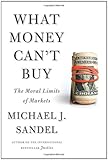
What Money Can[‘t] Buy – Everything and Nothing

Now that the semester has concluded, I can get to some of the reading that I have put off for some time. One of the books I’ve been excited to read for a while, but wanted to wait until I had time to chew over the issues discussed is a book by Professor Michael Sandel: What Money Can’t Buy. I’ve previously talked about how much I enjoyed Prof. Sandel’s online course “Justice.” This is part of the reason I was excited to read his latest book. I just picked it up from the library yesterday and have already zoomed through the introduction. Here’s an excerpt that I thought was particularly on point for the subject:

If the only advantage of affluence were the ability to buy yachts, sports cars, and fancy vacations, inequalities of income and wealth would not matter very much. But as money comes to buy more and more — political influence, good medical care, a home in a safe neighborhood rather than a crime-ridden one, access to elite schools rather than failing ones — the distribution of income and wealth looms larger and larger. Where all good things are bought and sold, having money makes all the difference in the world. (p. 8).

There are certainly going to be other passages that I’ll want to talk about, so look for other posts on this book in the coming weeks/months.

Can the Discourse in American Politics Be Saved: The Lost Art of Democratic Debate

I came across a tweet earlier this morning that linked to a TEDTalk given by Michael Sandel in 2010. I’ve written about Prof. Sandel’s course “Justice,” so naturally, I was interested to see his TEDTalk. The title: “The lost art of democratic debate.”

Of course, given the election tomorrow and the absurd hyper-partisanship in the US right now, I thought it would be interesting to hear what Prof. Sandel had to say, even though it was something he said 2 years ago. Ironically, 2 years ago, Congress was still at odds with each other (over healthcare). There’s still discussion about healthcare in the US.

As a quick primer to the video, you may want to check out what I wrote on golf being a sport last summer.

After watching the video, I’d love to hear what you think of what Prof. Sandel has proposed. Do you think discussing the morality of ideas will make Congress less partisan and more productive?

Harvard University’s Justice with Professor Michael Sandel

This past semester I had the good fortune of taking a class in . I rather enjoyed the class and it sparked my interest in deepening the learning on the subject. As a result, I did some digging and came across a course that has been put (Aside: I am a big fan of ). The course is called “Justice” and it is offered by . The professor: .

I find the subject of ethics fascinating. I think it is a subject that everyone should have at least a basic understanding of. That is, I think people should have read some of the basic texts or at least know some of the basic arguments from the different theorists or theories (eg. , , , , etc.).

Back to this course: it’s fantastic! There are 12 ‘episodes’ that are really a total of 24 classes. There’s a different subject each week and the professor really engages the students. There’s a great deal of discussion between the students and the professor on a range of moral issues.Here’s a quote from the professor during what could have potentially become a rather contentious point in the last episode: “We’ve done pretty well over a whole semester and we’re doing pretty well now dealing with questions that most people think that can’t even be discussed in a university setting.”

After watching all 12 episodes, I think that his quote is spot on. The students (and the professor) spoke about a number of contentious and possibly controversial subjects without descending into ad hominem attacks. In fact, the way that the students engaged in civil discourse is what I’d like to think that our politicians and pundits could do to set an example for the citizens of the world.

Here’s a short video preview of the course, in case you’re interested:

~

On another note, I’m really looking forward to reading Michael Sandel’s new book called: .