 Anytime I write something to another person, I nearly always end the message with: With Love and Gratitude. I’ve been asked on a number of occasions why it is that I do this. I usually give people the abridged version (spreading joy) or something like that. I thought it would be good to have a post here explaining why it is that I use these four words to sign off on what I’ve said. Initially, I will refer you to two posts I have already written here having to do with the importance of our words & thoughts (for ourselves and for others).
Sometime during the summer of 2005, I had the chance to see the documentary, What The Bleep Do We Know!? Much of what was offered in the film was not new to me (given my unique exposure to many esoteric influences while growing up), but there was something that I found uniquely interesting about one of the clips from the movie that I’ve included here.
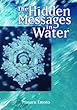 After watching the documentary, I was so happy that there was science being done to “back-up” the sorts of things that I already thought to be true. During the Fall of that same year, I was able to get a copy of Dr. Emoto‘s book: “The Hidden Messages in Water.” I didn’t want to take what the movie was telling me at face value, so I wanted to read his book. After reading his book, I was confident that there had to be something to the experiments he was doing. So this is half the story. The other half involves a piece of synchronicity.
At the same time I was reading about Emoto’s work, I happened upon an email (or maybe I stumbled onto the site, I really don’t remember exactly how it happened) regarding “The Go Gratitude Experiment.” The ‘experiment’ was all about Gratitude. I really enjoyed getting the “42 knew views on Gratitude” [spelling intended] and I still have the emails they came in. Some of the work by the Go Gratitude folks has shifted over to a new website (Blooming Humans), but from what I can tell, it’s essentially the same message: Gratitude matters.
After reading Emoto’s book and pairing it with the knowledge from the “Gratitude Experiment,” I was so pleased that I printed off a document containing the words “Love & Gratitude” filling the page in size 80 font and taped the words in different parts of my room. I put one on each wall, I put one on the face of the shelf just above where my computer monitor was and I even put some in my closet and drawers (why shouldn’t my clothes radiate Love & Gratitude, right?)
At first, I was a little shy signing off emails to people “With Love and Gratitude.” It didn’t necessarily feel appropriate to have the word “love” in certain kinds of emails. That word can be quite ‘charged’ for some folks, and I didn’t necessarily want to invoke those sorts of feelings when they were reading my email. Eventually, as I got into the habit of signing off emails “With Love and Gratitude” to people, it would sometimes just slip out when signing off emails that were of a more business-like nature. As this started to happen more and more, I began to realize that my initial trepidation was unnecessary. In fact, I began to relish sending emails to people as it allowed me the chance to say what I needed to say, with love and gratitude.
Since Emoto’s work was published, there have been a number of critics, which I suppose is to be expected, and some of them even raise important points. The clincher for me is Dean Radin. I’ve spoken about Dean Radin before a number of times on here. He is a Senior Scientist at the Institute of Noetic Sciences and is the “author or coauthor of over 200 technical and popular articles, a dozen book chapters, and several books.” In 2006, Dean Radin (along with Emoto and other researchers) sought out to test the effects if distant intention on water crystal formation. They used a double-blind method (an experiment in which the experimenters and the participants both do not know which group is experimental and which is the control) and their results:
Results indicated that crystals from the treated water were given higher scores for aesthetic appeal than those from the control water (P = .001, one-tailed), lending support to the hypothesis.
A couple of years later, Radin set out to replicate the findings — again. This time, it was a triple-blind study. A triple-blind study is when the experimenters, the participants, and the evaluators, all, do not know who is receiving treatment and who is not receiving treatment. And again, their results:
Results suggested that crystal images in the intentionally treated condition were rated as aesthetically more beautiful than proximal control crystals (p = 0.03, one-tailed).
I had already believed the water crystal experiments to be true, but after reading the papers published by Radin, now I can be much more sure that they are true. So there you have it. Now you know why I sign-off my emails and comments with:
With Love and Gratitude
 A few weeks ago, there was a rather poignant interview that aired between Stephen Colbert and Anderson Cooper. I didn’t see or read much of the coverage of it, but the thing that kept coming across my feed was the first thirty seconds of the clip below. And, in seeing the views on this video, it looks like a lot of people were touched by the moment:
 I didn’t have the chance to see any of the celebrity-studded final shows of


 Jeremiah Stanghini