The Law of Flotation was not Discovered by Contemplating the Sinking of Things

“… but by contemplating the floating of things which floated naturally, and then intelligently asking why they did so.”

The title of this post and the line above come courtesy of a passage from a book called The Wisdom of Thomas Troward. If I’m being honest, this book is not where I first came across this bit of wisdom. In fact, I first heard it in a movie I saw a couple of years ago called, “You Can Heal Your Life.” For those familiar with those 5 words, yes, there’s a book by that name by Louise Hay. The movie is also by Louise Hay (about her life and her work). If you’ve never heard of Louise Hay, I’d encourage you to check her out — there’s a good chance you might find her work useful. Millions of other people have.

Let’s get back to that quote, though.

On its face, the quote might not make much sense, so I’ll put it in context. Before we used steel for boats, wood was the common element. Why was wood used? Well — quite simply — it didn’t sink. Let’s think about that for a moment. People used wood to make their boats because it wouldn’t sink — not because it floated — because it wouldn’t sink. That might seem like an inconsequential detail, but when the frame of the problem is “don’t sink,” it alters the number of solutions that are available. I should say, it alters the number of solutions that will be readily available to you. Why? Because we’re so focused on solving the problem of “don’t sink,” we might not see the solution that lies in the principles of flotation (see: displacement).

And that’s just it, until someone took a step back and looked at the problem from the perspective of flotation, discovering the principles of displacement was never going to be possible.

So — what is it in your life that you’re so focused on that won’t let you see the forest for the trees? Or, in what ways are you trying not to sink when you should be focused on how to float?

Loss Aversion and the Big Picture: List of Biases in Judgment and Decision-Making, Part 2

I think I’m going to make a habit of posting something new to my series on biases in judgment and decision-making every Monday. Last Monday, we looked at sunk costs. Today, we’re going to look at loss aversion.

As much as I can, I’m trying to write about the different biases by themselves. Sunk costs are closely associated with loss aversion, so I could have included it in the first post. Similarly, the endowment effect is closely associated with loss aversion, so I could have wrote about it here. Learning about the biases one at a time may make it easier to focus on that bias for that week. So, without further adieu: loss aversion.

Loss aversion is the idea that we’d rather avoid losses than reap rewards. Put more simply: we’d prefer to not lose something than acquire something. Like we did with the sunk cost fallacy, let’s look at some examples of loss aversion to give us a better understanding of this bias. The implication of loss aversion is that someone who loses $100 or $1000 will lose more satisfaction (or be unhappier) than someone who gains $100 or $1000 will gain satisfaction (or be happier). If we think about a continuum where both of the people in the above example start at 0, the person who loses money will have an higher absolute number (with regard to their satisfaction) than the other person. This is a rather basic example, so let’s look at something a little juicier: golf.

In golf, the difference between winning and losing is sometimes one stroke (or one putt). A short excerpt from Kahneman’s book, Thinking Fast and Slow:

Every stroke counts in golf, and in professional golf every stroke counts a lot. Failing to make par is a loss, but missing a birdies putt is a foregone gain, not a loss. Pope and Schweitzer reasoned from loss aversion that players would try a little harder when putting for par (to avoid a bogey) than when putting for a birdie. They analyzed more than 2.5 million putts in exquisite detail to test that prediction.

They were right. Whether the putt was easy or hard, at every distance from the hole, the players were more successful when putting for par than for a birdie. The difference in their rate of success when going for par (to avoid a bogey) or for a birdie was 3.6%. This difference is not trivial. Tiger Woods was one of the “participants” in their study. If in his best years Tiger Woods had managed to putt as well for birdies as he did for par, his average tournament score would have improved by one stroke and his earnings by almost $1 million per season. [Emphasis added]

That’s an incredible statistic. With the only difference between putting for par and putting for birdie the fact that one would “lose” a stroke and professional golfers are 3.6% better at putting for par? Wow! As the excerpt said, that accounted for $1 million per season for Tiger Woods in his best years.

Ways for Avoiding Loss Aversion

As with the sunk cost fallacy, one of the most important ways to avoid loss aversion is to recognize it. That is, to know that humans have a tendency for loss aversion is an important first step in not falling into the trap of loss aversion.

1) What’s the big picture?

In our example of golf, that might mean knowing where you are in relation to the other players your competing with in the tournament (rather than where your ball is relation to the hole and what specific stroke you’re about to hit). In business, one might examine a decision about one business unit in relation to the entire company (rather than looking myopically at the one business unit).

2) Am I afraid of losing something?

This may seem like an obvious solution, but it’s pretty important. If before making a decision you can think to yourself (or have your team ask itself), “am I afraid to lose something here?” You might find that you are and it could serve to help you or your company avoid falling into the trap of loss aversion.

3) Do you really expect to never lose anything — ever?

Loss is inevitable. Sometimes, you won’t make that par putt (or that birdie putt). Sometimes, when you negotiate a deal, you won’t get the best deal. Sometimes, the decision to sell that business unit might result in losses somewhere else. If you can come to grips with the fact that every decision you make won’t be perfect and that sometimes you will lose, you may begin to shift your expectations about loss.

Close Your Email — Right Now!

If you’ve read anything about productivity, the appeal in the title of this post will not be new. While this is something that I’ve known for years, it’s not something that I usually practiced. I’ve had my own computer for more than a decade and in that time, I’ve probably almost always had my email open — while at the same time, trying to get work done.

Of course, there would be times when I would be under some sort of deadline, so I’d close everything, but the report I was working on. Aside from those times, I’ve almost always had a tab open in my browser with my email. The ironic part is that when Google Chrome added extensions, I immediately picked up one of those extensions that would let me know when I had email with a chiming sound. Like Pavlov’s dog, I would immediately flip to my inbox.

I’ve read lots and lots about how to be productive. I know that being a slave to your inbox is not an effective way to get anything done (other than keeping our inbox empty, but that’s debatable).

Recently, I’ve had some trouble with the extension in Google Chrome that chimes  when I get a new email. As a result, I experimented with some other extensions, but none of them seemed to work as well as the one I had. I finally came to an extension that was by Google, so I thought that one would probably work really well and forever be compatible with Google Chrome. Before I go on, I should say that the extension I was using had worked for… well, as long as I can remember. So, the new extension. This new extension by Google doesn’t chime the way the old one did.

At first, this was kind of maddening because I was so used to hearing the chime and then going to my Inbox. Mind you, the extension still has a small indicator directly next to the address bar, so I could see if there was a new message or not.

Why am I telling you all this?

Well — because I’m converted.

I no longer have my email open. After 10+ years of having my inbox open all the time, I’ve realized (by accident?) just how much more effective and efficient it is to not have your Inbox open all the time. So, if you were a long-time hold out like me, I implore you — try it — test it out — you may like it!

Note: If you need another reason to close your Inbox… you should know that having Gmail open will slow down your computer — as it takes up quite a bit of RAM.

Ignore Sunk Costs: List of Biases in Judgment and Decision-Making, Part 1

It can be really fun to write a series of posts on a particular topic. By my count, I’ve done this at least seven times so far. Today, I’d like to start what I hope will be an oft-read series on biases in judgment and decision-making (to some, cognitive biases). Because of my background in psychology and my interest in decision-making, I thought it would be wise to share with you the things that I’ve learned either through the classes I’ve taken (the classes I’ve taught!) or the research I’ve read. With each bias, my goal is to explain the bias and offer some possible avenues for not falling into the trap of the bias. Today, we start with one of the big ones: the sunk cost fallacy.

Sunk costs are those costs that have already happened and can’t be recovered. For instance, let’s say you buy an apple and bite into it. The money you used to buy that apple can’t be recovered — it’s a sunk cost. Now let’s say the apple doesn’t taste very good (maybe it’s inorganic). You might say, ‘well, I’ve already paid for the apple, so I might as well eat it.’ NO! That’s the sunk cost fallacy! Just because you’ve already bought the apple and paid for it, doesn’t mean you have to eat it. If it tastes bad, by golly, don’t eat it!

That’s a rather basic example of the sunk cost fallacy, so let’s look at one that might seem a bit more applicable. Sunk costs often come into the fray when they’re contrasted with future costs. Let’s say you’ve bought a subscription to a newspaper or a magazine. Because of your subscription, you get a discount when it’s time to renew your subscription. Now, let’s say that in that year of your subscription, you discovered that there was another newspaper/magazine that you preferred (maybe The Economist?). When it comes time to renew your subscription, you look at the two options to either subscribe to The Economist or continuing with your other subscription. You find out that the discounted price for your current newspaper/magazine will be the same price as The Economist. You say to yourself, “well, I’ve already subscribed to this newspaper and spent so much money on it, so I might as well keep subscribing to it.” NO! That’s the sunk cost fallacy. The money you’ve spent on the subscription for the other newspaper/magazine can’t be recovered! You can’t get it back. As a result, it shouldn’t affect the decision you make now about whether to choose it or The Economist

There’s one more quick example that I want to highlight: war. From a paper by a professor at Princeton:

The United States has invested much in attempting to achieve its objectives. In addition to the many millions of dollars that have been spent, many thousands of lives have been lost, and an even greater number of lives have been irreparably damaged. If the United States withdraws from Vietnam without achieving its objectives, then all of these undeniably significant sacrifices would be wasted. [Emphasis added]

Pay particular attention to that last sentence. That is the sunk cost fallacy in action.

Ways for Avoiding the Sunk Cost Fallacy

So, now that we’ve looked at the sunk cost fallacy, how can we avoid it? Well, the first step in avoiding the sunk cost fallacy is recognizing it. Hopefully, the above examples have given you an idea of how this bias can arise. There are a two other ways I want to highlight that you can use to avoid this trap.

1) What am I assuming?

The crux of the sunk cost fallacy is based on an assumption. That is, you’re assuming that because you’ve already spent money on X, that you should keep spending money on X. If you look at what it is that you’re assuming about a situation, you just might find that you’re about to step into the sunk cost trap.

2) Are there alternatives?

Related to the above example is alternatives. You’re not bound to a decision because you’ve made a similar decision in the past. Just because you bought the ticket to go to the movie, if another activity presents itself as more enticing, you’re allowed to choose that one instead. In fact, if when you sit down to watch the movie, it’s bad, you’re allowed to get up and walk out. Don’t fall into the sunk cost trap thinking that you have to stay because you paid for it. There are any number of things you could be doing: going for a walk, calling an old friend, etc.

Thoughts on the Movie “Life of Pi”: Letting Go

Life of Pi 3DFirst and foremost, the story is fantastic. If you haven’t seen it, be sure to — you’ll be glad you did. As I have with other movies, I’m going to talk about some of the plot, so if you haven’t seen it, save this post and come back to it after you have (if you don’t want some of the plot spoiled for you).

*Spoilers!*

There’s a really important lesson that Pi expresses towards the end of him telling the story to his lunch companion: letting go. So many times throughout Pi’s life he’s had to “let go” and if he didn’t “let go,” he probably wouldn’t have survived his time on the Pacific.

Throughout Pi’s early life, we learn of his experimentation with many religions. As a young boy, he first learns about Hinduism and the multiple Gods. Later on, he learns of Christianity and Islam. As a result, he starts to follow the teachings of the three religions — no easy feat. I find it a bit ironic that when we meet Pi in his adult life and he talks about the story of his time with Richard Parker, the lesson he believes is the most important: “letting go.” That’s Buddhism. Do a quick Google search for Buddhism and let go and you’ll find almost 4,000,000 results. Of course, Buddhism doesn’t have some sort of trademark on the idea of letting go, but of the religions, Buddhism is the one I’ve most heard the idea of letting go expressed.

There’s one more thing I wanted to touch on about this movie — the ending, and I can’t quite put my finger on it. Someone asked me if it was because of Pi telling the different story to the two Japanese fellows from the company and I don’t think that’s why. Just for me, there was something about the way the film ended that didn’t match the fantastical story. Throughout the whole movie, I was right there with Pi on the Pacific and scared as ever for him. I can’t imagine floating on a lifeboat on the Pacific — much less — a self-made raft, so that the tiger doesn’t have me for lunch.

There are two things I can do:

1) I can go and get the book and read the last few chapters (or the whole thing) — to see if maybe there wasn’t something carried over from the book to the movie (with regard to the ending).

2) I can simply let go.

Wanna Be Productive? Avoid Email, Twitter, and Facebook First Thing in the Morning

Hello hello! It’s been almost two weeks since I last posted. I’ve been out-of-town for the last little while without reliable internet connectivity, so my posts were sparse. In fact, I think I only wrote the one about authenticity while I was gone. Well, you’re in for a treat. I’ve got at least a dozen new things to write about since I’ve been gone, one of which will be a series (I’m excited for it!)

Today, I want to talk about an aspect of productivity. I could be conflating things, but I think the first time I read about productivity, with respect to time of day, was in the 4-hour work week. The idea is that people are most productive (or can be the most productive) when they get to work in the morning — straight away. However, many of us, myself included, check email, Facebook, or twitter, before we get down to working on what we’ve got planned for the day. Ferriss (if I’m remember correctly) argued that this is the best way to harpoon your productivity.

So, he advocated not turning on those things until after you’ve done the “key” thing you wanted to get done that day. In fact, he has a whole specific thing about email that you might want to look into (only checking email twice, once, or less [!] a day). By staying away from these black holes of time, you’d be able to get at least that one thing you wanted to do that day and feel good about it.

I know that when I wake up in the morning, email/twitter are two things that I almost always check before I do anything else during the day. This is, in part, because twitter is the way that I get my news/learning, but also because — well — it can be a bit addictive. By checking twitter/email in the morning, I can sometimes get sucked into a problem/task or a series of articles. Before I know it, I’ve spent 60 minutes on things that I hadn’t necessarily planned. As a result, I sometimes don’t get to writing a post that day — and I’d like to write something (at least) once a day.

Let’s make a challenge of it, shall we?

Remember that meditation challenge I wrote about a few months ago? Let’s do the same thing with productivity! Let’s commit to doing the “key” thing before we get into other things (like email and twitter). Of course, I understand that some of you may not have the luxury of not checking your email (based on your jobs), but otherwise, let’s see if we can do it. You’ll be able to check on me because the one thing that I’m going to do before I check Twitter is write a post.

If You Want to Be Happy, Tame Your Expectations

I wanted to finish 2012 with what I think is my biggest “insight.” That is, the thing that I felt taught me the most about myself and other people. As you know, if you follow me on Twitter  Facebook, or read what I write about here (follow button on the right-hand side!), I like to learn. I think that learning doesn’t end once you leave school (whether we like it or not) and I think that learning about ourselves never ends.

I’ve certainly came across quite a few techniques, perspectives, and ways for being in the world and handling stress. In particular, I think that Byron Katie‘s The Work can be quite powerful. While I’ve never attended one of her seminars, watching the videos of people “doing The Work” can have its own cathartic experience.

I’ve noticed that one of the revelations I’ve come to this year is very similar to what Katie has said, but I still feel it to be slightly different. It’s the idea that our expectations about the world are what cause us stress, unhappiness, and you name it. I’m speaking very abstractly, so let me give you a concrete example.

Let’s say I’m having a problem with a coworker. Let’s say that coworker does something that I don’t like. Why does this upset me? Without getting into any psychological underpinnings and staying right at the surface, it’s simply about my expectations of what that coworker should (or shouldn’t) be doing that’s causing me trouble. How? Well, assuming you believe that each human being is entitled to their own autonomy, they have free will to do as they please (within the law, I suppose). If the person is acting in a way that displeases me, it’s probably because I expect them to be acting in some other way — and they aren’t. Again, still kind of abstract, so let’s make it really concrete.

Let’s say that this coworker (by the way, this example works for family, friends, spouses, pets, pretty much anything), has a particular way of answering a question with a question. And let’s say that I find this really annoying (in fact, I’d find it intriguing, but let’s go with annoying, for now). Every time I see this coworker, I’m going to remember that this coworker asks me questions whenever I ask them questions — so it’s going to make me unhappy, just seeing this person! If I happen to need to ask them something and they ask me a question back, I might begin to feel angry. Why am I feeling angry? Simply because my expectations are that this coworker should not ask me questions when I ask them questions. Should this really matter? No! This coworker can ask me questions when I ask them questions — they’re certainly allowed to do that.

Let’s try another example for which I’m sure we can all relate: traffic. Have you ever been sitting in traffic, late for something? I know I have. While sitting in this traffic, do you ever notice that sometimes people will try to “jump the line?” Does that bother you? If I’m being honest, this has certainly bothered me at times. Why should this bother me (or you)? Well, we expect that people will be kind and wait their turn right. We expect… Oh boy — there it is again! Expectations! If I didn’t have expectations that people wouldn’t try to jump the line, this wouldn’t make me upset. I might think, ‘Oh, maybe they’re in a really big hurry. Maybe someone they know is in trouble and they’re trying to go save them.’ It’s really impossible to know why someone would try to jump the line in traffic, so far be it from me to expect something from them in the way that they behave to the other drivers.

So, if I had to choose one thing to offer you from 2012, moving into 2013, it would be your expectations. Notice when you get upset/angry about something and try to discern what it is that you’re expecting should be happening in that situation. If you want to take it a step beyond, try to tame that expectations. Though, for starters, I think it’s important to notice what it is that you’re expecting in a situation. From here, you’ll certainly be well on your way to determining the root of your unhappiness.

Five Years, Five Christmases: You Never Know Where You’ll Be…

As 2012 draws closer to its end, I find myself reflecting on the past. Not the distant past, but the recent past. In fact, with Christmas here today, I found myself reflecting on the last 5 Christmases and just how much things have changed for me over those 5 Christmases. Let’s journey back, shall we?

2008

At Christmas in 2008, I was on reprieve between quarters of the first year of my PhD in clinical psychology (obviously, I didn’t continue with that route). For that Christmas, I left the balmy shores of San Francisco for a flight home to visit my family in Toronto and Detroit. It was a great time.

2009

In 2009, I was in Victoria, British Columbia living on a floathome. My partner and I had just recently come back from New Zealand and decided to spend some time living in the floathome that we had for sale. For that Christmas, my partner and I accepted an invitation to have Christmas dinner with some of the folks living on the Wharf. This particular family had invited a bunch of folks over, so there were like 20+ people inside of this one floathome having Christmas dinner!

2010

The Christmas of 2010 was one that I won’t soon forget, partly because I was just recently married, but probably more so because I spent it on one of the top 10 beaches in the world — on the island of Kauai (in Hawaii). My wife and I got up early on Christmas morning and we went down to Hanalei Bay. The exquisite backdrop of the mountains paired with the sound of the gentle waves kissing the shore… amazing.

2011

In 2011, my wife and I drove up to visit our families in Ottawa/Toronto. If I recall correctly, we spent Christmas in Ottawa visiting with family and friends. It was a rocking good time and makes me consider Ottawa as a place that I might like to live.

2012

And now, 2012. This year, my wife and I have decided to *stay* in Fairfax, VA. I wrote stay like that because it’s not as if we’ve lived in Fairfax for very long (only since August), but we have been in the DC area for over a year now, with me finishing up an MBA.

~

If you would have asked me in 2008 about any of the subsequent Christmases, I almost assuredly wouldn’t have been able to guess how any of them turned out. Victoria!? HAWAII!? FAIRFAX!!? Who knows where I’ll be for Christmas in 2013. Wherever I am, I hope I’m happy and surrounded by people that I love.

Enjoy the rest of your day!

Three Lessons from The Hobbit: On Doing What You Can, Having Faith, and Demonstrating Leadership

The Hobbit: An Unexpected JourneyA few days ago, I went and saw The Hobbit. (Really liked the HFR, by the way.) I don’t remember if I read The Hobbit in high school, (my guess is not), so the story was completely new to me (aside from being a good representation of the hero’s journey) — just as The Lord of the Rings was when I watched the three movies. (Trivia: LOTR is not a trilogy, even though it is often referred to as such.)

Anyway, as I was watching, there were a few instances I noticed that could serve as quintessential lessons. Given that The Hobbit is a good example of the hero’s journey, it’s not surprising that there’d be great lessons to be found in the story. Of course, if you haven’t seen the movie…

*SPOILER ALERT*

The three instances I’m going to share all happen within — essentially — the same scene. If you’ve seen the movie (or read the book), you’ll probably know what I’m talking about.

The first instance comes courtesy our good friend — Bilbo Baggins. It takes place right near the end of the film when Bilbo, Gandalf, and the dwarves are stuck in the tree. Gandalf and the dwarves set the trees on fire to scare off Azog and the Orcs, but it doesn’t work. Thorin (who is to be the leader of the dwarves), descends from the tree to try to fight with Azog. As was to be expected, Azog dominates Thorin and Thorin is about to die. Bilbo — seeing this — and noticing that no one else in the trees looks like they’ll be able to help, descends from the tree to come to Thorin’s rescue to stave off imminent death.

So, the instance that I’m talking about is Bilbo doing what he could do at the time. He knew there was no way for him to be able to take on all the Orcs by himself, but it was clear, in the moment, he was the only one that could have saved Thorin from death. Bilbo had to have faith that by him doing what he did, the other dwarves could then free themselves from the tree and then come to the rescue of Thorin and Bilbo.

Lesson #1: Even though you can’t see how things will turn out, it’s important to do what you can in the moment.

The second instance also comes from this scene. While the dwarves are stuck in the tree, Gandalf catches a butterfly and whispers to it. This proves important because after Bilbo saves Thorin from Azog, a group of eagles comes to the aid of the dwarves. The eagles pick up the dwarves in their talons or swoop them onto their backs and fly off with them. While this is happening, most of the eagles are pulling the dwarves from the tree. Gandalf wasn’t pulled from the tree. In fact, he was the last one to be rescued from the tree and he wasn’t even rescued. As the tree’s roots are being pulled up from the ground, Gandalf has to jump off the cliff… and have faith that one of the eagles will fly by and pick him up. Of course, he did — and an eagle did.

Lesson #2: Even though you can’t see what’s in front of you, sometimes you have to have faith… and jump!

The last instance occurs afte the eagles have dropped off the dwarves, Bilbo, and Gandalf far from the clutches of the Orcs. While on this rock, Thorin says something to the group (and Bilbo), about the fact that he should never have taken him on this quest. And then he says something to the effect of, ‘I’m so glad I was wrong.’ I may have the wording or the bits and pieces of this wrong, but the point I wanted to highlight here is that Thorin was wrong, he knew it, and he admitted it.

Lesson #3: When you’re wrong, don’t be afraid to say so.

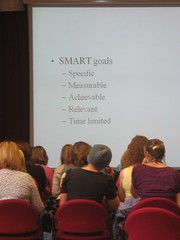
Your Goals may be SMART, but are they PURE and CLEAR, too?

If you’ve ever been to some sort of personal development seminar (or any seminar where action is called for), there’s a good chance that you’ve heard of SMART goals. That is, “Specific, Measurable, Attainable, Realistic, and Time-Bound.” However, have you heard of the less often mentioned PURE and CLEAR acronyms that seem to go hand-in-hand? Maybe it’s part of the “advanced” seminar course [tongue-in-cheek].

A couple of weeks ago, I happened to be at a Barnes & Noble. As I was walking through the store, there was a book about decision-making that drew my attention (I’ll have more about this book in future posts). As I thumbed through the book, there were many familiar models/theories (SWOT analysis, etc.) and one of those was SMART goals. However, as my eyes glanced over the section on SMART goals, I noticed that there were two other acronyms: PURE and CLEAR. Intriguing.

I bet your wondering what the acronyms PURE and CLEAR represent? At the time, I certainly was. Without further adieu:

PPositively Stated

UUnderstood

RRelevant

EEthical

and

CChallenging

LLegal

EEnvironmentally Sound

AAgreed

RRecorded

Now, one could argue that some of these overlap (ethical and legal or environmentally sound and ethical), but there certainly seems to be value-added in these two additional acronyms. Though, I don’t know how much incremental value is added. If you’re someone who’s never heard of SMART goals, I would certainly stick to that model to start with. However, if you’ve heard of SMART goals (and have used this method!), then I would think about adding PURE and CLEAR to your method of goal-setting.

[Note: I couldn’t find a Wiki article on PURE and CLEAR, but I did find two resources that may prove to be useful. This first one appears to be a PPT slide in the form of a PDF with all the acronyms (including SMART). The second one appears to be a blog post from someone detailing what is meant by the acronyms for PURE and CLEAR.]