He’s Not as Bad as it Seems and She’s Not as Good as it Seems: List of Biases in Judgment and Decision-Making, Part 11

Hello Hello! It’s been a little more than three weeks since my last post. I’ve finished up the requirements for the MBA, so I should be back to writing posts with some regularity. Since today’s Monday, I thought I’d restart that series of posting about a cognitive bias on Mondays. Today’s cognitive bias: the halo effect.

The halo effect is essentially believing that someone is good at something because they were good at something else. For instance, celebrities are often cited when talking about the halo effect. Many regard celebrities as beautiful and as a result of the halo effect, surmise that these celebrities are also smart (when in fact, this is not always the case).

There’s a famous study about the halo effect from 40 years ago. Here’s an excerpt:

Two different videotaped interviews were staged with the same individual—a college instructor who spoke English with a European accent. In one of the interviews the instructor was warm and friendly, in the other, cold and distant. The subjects who saw the warm instructor rated his appearance, mannerisms, and accent as appealing, whereas those who saw the cold instructor rated these attributes as irritating. These results indicate that global evaluations of a person can induce altered evaluations of the person’s attributes, even when there is sufficient information to allow for independent assessments of them. Furthermore, the subjects were unaware of this influence of global evaluations on ratings of attributes. In fact, the subjects who saw the cold instructor actually believed that the direction of influence was opposite to the true direction. They reported that their dislike of the instructor had no effect on their ratings of his attributes but that their dislike of his attributes had lowered their global evaluations of him.

Ways for Avoiding the Halo Effect

1) Different strengths for different tasks

One of the easiest ways to avoid falling into the trap of the halo effect is to notice that there are different skills/strengths required for different tasks. As such, just because someone is good at climbing mountains doesn’t mean that they would make a good politician. The strengths/skills required for those two tasks are different. Put another way, think about the strengths/skills required for a particular tasks before evaluating whether someone would be good at that task.

2) Notice other strengths (or weaknesses)

It’s been said that, “nobody’s perfect.” When someone is good at one thing, there’s a good chance that they won’t be good at something else. Noticing that this person isn’t good at someone else may help to quell the urge to assume that this person is good at everything.

If you liked this post, you might like one of the other posts in this series:

It is Important to Speak, but not More Important than it is to Listen

A couple of days ago I wrote a post about leadership and followership, the overwhelming majority of literature dedicated to leadership, and the dearth of literature dedicated to followership. When writing that post, it reminded me of the same relationship between speaking and listening. That is, how much literature do we see dedicated to speaking or communicating and how much do we see dedicated to listening?

Don’t get me wrong, I think that communication is an essential part of the human experience, but dont we think that learning to listen should be equally (if not more?) important than speaking. We can make the same comparison we did with leadership: how much time do we spend speaking in relation to how much time we spend listening? We spend far more of our time listening. So, shouldn’t it follow that we need to learn how to be excellent listeners?

Of course, if we don’t know how to speak (at all) then the listening is futile, but I suspect that if the majority of people were excellent listeners, we might be able to aid the speaker in communicating their point. Just as I made the case with followers who can make a leader better, I think that listeners can make a speaker better, too.

~

A slight tangent: how many courses are there in communication? There are probably quite a few more than there are in listening. In fact, there’s even an entire academic discipline dedicated to communication. Is there one for listening? Some may argue that clinical/counseling psychology might be how listening creeps its way into an academic discipline, but that’s only one piece of the training for clinical/counseling psychologists. It’s important to note that psychologists who don’t go the route of counseling won’t get this kind of training, so it’s necessary to specify clinical/counseling.

I like to think I’m a pretty good listener (and have been given affirmative feedback), but I don’t doubt that I would benefit from the insights of academic research on listening. In fact, I bet we all could benefit from academic research on listening. Until then, we’ll have to rely on the wisdom of quotes:

“Wise men speak because they have something to say; fools because they have to say something.” – Plato

“When people talk, listen completely. Most people never listen.” – Ernest Hemingway

“If A equals success, then the formula is A equals X plus Y and Z, with X being work, Y play, and Z keeping your mouth shut.” – Albert Einstein

“Everything has been said before, but since nobody listens we have to keep going back and beginning all over again.” – Andre Gide

“Most people do not listen with the intent to understand; they listen with the intent to reply.” – Stephen Covey

“We have two ears and only one tongue in order that we may hear more and speak less.” – Diogenes Laërtius

And one last one that I really like:

“You cannot truly listen to anyone and do anything else at the same time.” – M. Scott Peck

WRAP — An Acronym from Decisive: List of Biases in Judgment and Decision-Making, Part 10

I recently came across a post from Farnam Street that seems like it would make a great addition to the series we’ve been exploring over the last 10 weeks (biases in judgment and decision-making). So, instead of going over another bias today, I thought I’d share the information I found and tie it back into our series. Check back next week for a new bias (it could be functional fixedness, the hindsight bias, the status quo bias, or maybe the recency/primacy effect(s)…)

The author of the Farnam Street blog summarized some of the work in Chip and Dan Heath’s new book: Decisive: How to Make Better Choices in Life and Work. Given that our series is about decision-making, this book seems like it would be absolutely on-point, with regard to the closing of each post (How to avoid *blank*).

I haven’t yet read the book, but I did want to include a brief excerpt (courtesy of Farnam Street), along with a lead-in from Farnam Street:

The Heaths came up with a process to help us overcome these villains and make better choices. “We can’t deactivate our biases, but … we can counteract them with the right discipline.” The nature of each of the four decision-making villains suggests a strategy for how to defeat it.

1. You encounter a choice. But narrow framing makes you miss options. So … Widen Your Options. How can you expand your sent of choices? …

2. You analyze your options. But the confirmation bias leads you to gather self-serving information. So … Reality-Test Your Assumptions. How can you get outside your head and collect information you can trust? …

3. You make a choice. But short-term emotion will often tempt you to make the wrong one. So … Attain Distance Before Deciding. How can you overcome short-term emotion and conflicted feelings to make better choices? …

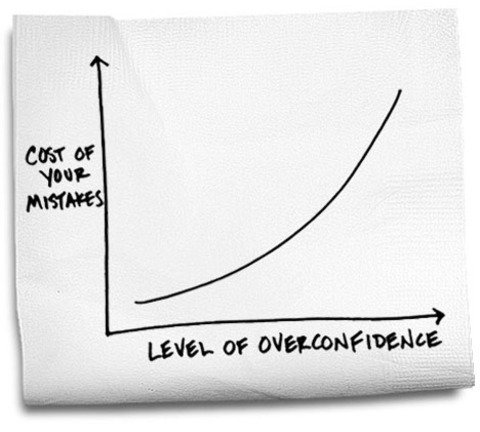
4. Then you live with it. But you’ll often be overconfident about how the future will unfold. So … Prepare to Be Wrong. How can we plan for an uncertain future so that we give our decisions the best chance to succeed? …

There’s also a handy picture that’s included (again, courtesy of Farnam Street):

As we can see, the Heaths have offered four universal ways for avoiding biases in judgment and decision-making. If we recall some of the different ways for avoiding biases that we’ve discussed over the last 9 weeks, many of them can be collapsed into one of the categories listed above. In case you’re a bit hazy, here are some of the biases that we’ve talked about before that have a “way for avoiding” that falls into one of the categories above:

So, if you’re having trouble remembering the different ways for avoiding the biases we’ve talked about, all you have to do is remember “W-R-A-P!”

Thirty Leaders and Two Followers: Can We All Be Leaders?

A few weeks ago, I was preparing to teach by re-reading the chapter for which the material we’d be covering in class. Part of the class session was going to be spent on leadership. Granted, this is an undergraduate textbook in organizational behavior, I was truly disappointed to find that of the 30+ pages on leadership, there were only two — 2 — pages spent talking about followers. I don’t know about you, but I’ve never seen a successful leader without followers.

One of the broader issues here is math. Of all the people in the world, how many of them do you think will be leaders? Of all the people in the world, how many of them do you think will be followers? I’m not saying that people shouldn’t strive to be leaders or be the best they can be, but based on our current definition/understanding of leadership, not everyone will spend a great deal of their time being a leader. In fact, most people will spend the majority of their lives being followers — and there’s nothing wrong with that. In fact, many of the people that we think of as great leaders were — in fact — once followers. Some say you have to be a good follower before you can be a good leader, but I’m not really going to get into leadership philosophy right now.

Instead, I wanted to draw to your attention to the amount of time we spend thinking about, talking about, and teaching leadership and the absolute void with regard to following. For instance, a quick Google search returns over 450,000,000 results for leadership, but only 420,000 for followership. You might think that’s not a fair comparison, so what about how to be a good follower or how to be a good leader? Follower returns: 54,000,000 (though I think some of these might be returning religious results). Leader returns: 1,350,000.

While leadership is more revered, it certainly seems like there’s room in the popular literature for a few great books on followers and how to be a good one.

Speaking the Same Language is Harder than it Looks

Have you ever tried speaking with someone who’s native language is not your own? That is, if you’re an English speaker, have you ever tried to have a conversation with someone who’s first language is not English? As the world grows closer to itself (in many ways) I suspect that you’re more likely to be forced to converse with people who won’t be communicating in their first language. I bet you might be surprised just how difficult communication can be with someone who’s native language is not your own. It can be quite an experience and I encourage you to try it.

~

The corollary that follows from this idea is you being the person who’s not the native speaker. That is, if you’re native language is English, try learning another language and then speaking with someone for which this language is their native language. So, maybe you’re trying to learn French. It can be quite a humbling experience to try and speak to someone who is a French-speaking person. You might recognize some of the frustrations you had when you were the native speaker when looking at the person speaking French with you.

The important point I’m trying to make here is the idea of empathy. This exercise I’ve just outlined is a great way to foster empathy. You’d be able to tangibly experience what it’s like to be in someone else’s shoes.

When 99% Confident Leads to Wrongness 40% of the Time: List of Biases in Judgment and Decision-Making, Part 9

This week, we’re looking at one of my ‘favorite’ biases, in that it’s one that once you know, it can be quite comical to spot it in others (and yourself, if you still fall for it, from time to time). From Wikipedia: the overconfidence effect “is a well-established bias in which someone’s subjective confidence in their judgments is reliably greater than their objective accuracy, especially when confidence is relatively high.” That’s a bit jargon-y, so let me illustrate with a simple example.

In fact, this example comes from a lecture I heard about negotiation and talked about in one of my previous posts. In case you were wondering, the lecture comes from Professor Margaret Neale at Stanford. It was a brilliant! There was so much information packed into the lecture. I remember listening to it a few different times and still pulling out nuggets of wisdom. Anyway, I digress. The example that Prof. Neale uses is particularly on point for illustrating the overconfidence effect.

She has an empty pop bottle filled with paper clips (but not to the top). She says to the crowd that she wants them to guess how many paper clips are in the bottle. She walks up and down the aisles, so they can get a closer look, too. She instructs the crowd to write down their answer. Then, she asks them to write down a range where they could be 100% (she may say 99%, I don’t remember) sure that the number of paper clips fell in the range. Essentially, she was asking for a confidence interval. I think she also told them that she was sure there weren’t more than 1,000,000 paper clips in there. After some time, she then tells the audience how many were in there. She asks if anyone got it right (no one raises their hand). She then says something to the effect of, “For how many of you did the number of paper clips fall within the range?” There may have been about 35% of the room who raised their hand. 35%! She exclaims that this is terrible given that all of these people were 100% (or 99%) sure that the number would fall in the range. In fact, she said that in a room that size, there should have only been a handful of people who’s range wasn’t met (if the 99% figure was being used, rather than 100%). Prof. Neale then goes on to explain that this is the overconfidence effect. The audience was being asked to make an estimate of something about which they knew nothing, and then asked to rate their confidence. Knowing that they knew nothing about the topic, it would have been logical for the audience to have a large confidence interval (between 10 paper clips and 20,000 paper clips) — or even bigger!

This happens in more ways than just simply estimating the number of paper clips in a bottle. We also see this with investors. When asked, fund manager typically report having performed above-average service. In fact, 74% report having delivered above-average service, while the remaining 26% report having rendered average service.

Another place that we see the overconfidence effect show up is with the planning fallacy: “Oh yeah, I can finish that in two weeks…”

Ways for Avoiding the Overconfidence Effect

1) Know what you know (and don’t know)

The fastest way to slip into the trap of the overconfidence effect is to start making “confident” predictions about things that you don’t know about. Guessing the number of paper clips in a bottle is something that most of us have little to no expertise in. So, list a large confidence interval. If you have no experience in managing a project, it might be in your best interest not to make a prediction about how long it will take to complete the project (planning fallacy).

2) Is this person really an expert?

Sometimes, you’ll hear someone displaying a level of confidence in a given situation that makes you think they know what they’re talking about. As a result, it might bias you into believing what they are saying. It’s important to know if this person is an expert in this field, or if maybe they’re succumbing to the overconfidence effect.

From Scott Plous‘ book called The Psychology of Judgment and Decision Making: “Overconfidence has been called the most ‘pervasive and potentially catastrophic’ of all the cognitive biases to which human beings fall victim. It has been blamed for lawsuits, strikes, wars, and stock market bubbles and crashes.”

If you liked this post, you might like one of the other posts in this series:

Trying to Form a New Habit: Take a Vacation

Have you ever wanted to make changes in your life, but haven’t been able to stick to those changes? What about a New Year’s Resolution? If I’m being honest, there have been changes that I’ve tried to make that I haven’t been able to keep up. However, I think I may have discovered a trick to making it easier to stick to a new habit. (Truth be told, I’m probably not the first person to make this discovery, but I don’t remember reading it in any of the literature on habit-forming and/or making changes. Of course, that doesn’t mean that it isn’t.)

There have been some new habits that I’ve tried to form over the past couple of weeks. One of those habits is practicing French. (I’m Canadian and I think I ought to know both of the national languages. Plus, it makes good sense to be able to speak more than one language and since I had some training in French, I thought it was the best one to start with.) Anyways, I’ve tried to practice French. At least once I day, I make a point to practice French. Although, this hasn’t been as easy as I thought it would be.

If you’ve ever tried to create a new habit, you know what it’s like: you’re used to doing certain things throughout your day and as a result, it can be difficult to try to squeeze something else into the day — even if you’ve removed some of the other things that you used to do!

I recently returned from a trip this past Monday. As a result, I thought that this was a perfect time to try and carry out a new routine. Having been away from my “regular” routine for the last 10+ days, I can now impose a new routine. I’ve only been doing it for a few days, but so far, it’s been working great. If we look at it from a physics standpoint, it makes sense. The way I went about my day was an “object in motion,” and until that “object in motion” was acted upon, it was going to maintain its course. My attempts to affect its course weren’t strong enough to move that object in motion, but when I left the country, the object was acted upon strongly enough. Inertia is also another concept that applies here. Inertia is the idea that an object will resist a change to its state of motion (or rest).

So, if you’re trying to make some changes in your life, consider going on vacation or getting out of town for a few days to shakeup your routine. It just may be the change you need to make the change you need!


Situations Dictate Behavior: List of Biases in Judgment and Decision-Making, Part 8

We’re into the 8th week of cognitive biases. A couple of weeks ago, I was trying to decide between the confirmation bias and the fundamental attribution error and decided on the confirmation bias. I’m not sure why I decided to go with the gambler’s fallacy last week (as opposed to the fundamental attribution error), so I thought I’d “circle back” and pick up the fundamental attribution error… in case you were really pining for it.

The fundamental attribution error may sound complicated (I mean, hey, there are three words!), but it’s actually quite simple once you get the hang of it. Normally, I explain the bias and then provide examples, but I think talking about an example will help to solidify the understanding of this bias. In a study done in 1967, researchers asked participants to assess whether a person was pro-/anti-Castro based on an essay the person had written. In one group, participants were told that the essayists were able to choose whether they wanted to write for the pro-side or the anti-side. Of course, when participants believed that essayists were able to choose which side they wanted to write for, they rated those essayists as having more positive (or negative) feelings towards Castro. In the second group, participants were told that the essayists would have their position determined by a coin flip. Meaning, the essayists had no control over whether they were going to be writing a positive/negative essay of Castro. It was all left up to chance (the situation!). Despite the participants’ knowledge of this, on average, they still rated the positive essays as a sign that those essayists had a positive view of Castro. Similarly for the negative essays as a sign that those essayists had a negative view of Castro. Participants were blind to the situation constraints

So that’s the fundamental attribution error — the idea that the situation dictates the behavior of the person, rather than the person’s personality. If you’re looking for some more examples:

  • You call up your friend and find out that they’ve done nothing all day. You assume that your friend is lazy. In fact, your friend was up all night caring for their sick grandmother.
  • You’re sitting a stop light when it turns to green. You advance out into the intersection only to nearly be smashed into by someone who runs the red light. You scoff at the person for running the red light. Little did you know that person was racing to get a pregnant wife to the hospital as she’d just gone into labor. (Ironically, you’d done something similar the week earlier.)
  • Mitt Romney’s declaration that 47% of the population who don’t pay income taxes will categorically support larger government “because those ‘who are dependent upon government, who believe that they are victims, who believe the government has a responsibility to care for them’ can never be persuaded to ‘take personal responsibility and care for their lives.'” In actuality, the 47% of the population who don’t pay income taxes are “…not some distinct parasite class, but rather ordinary, hard-working people who either already have paid or will soon be paying quite substantial taxes.”

Ways for Avoiding the Fundamental Attribution Error

1a) Empathy

As with many of the other biases, empathy is one of the quickest ways to thwart its power of you. If I put myself in the shoes of another, I’m more likely to understand that there might be more going on in the situation than I can see from my perspective. For instance, if we look at the red light example from above, by empathizing with the driver who runs the red light, I have a much higher chance of understanding that there running the red light is not a demonstration of their disregard for the world around them, but maybe that there’s something urgent to be taken care of.

1b) “Why Would a Rational Person Behave This Way?”

The above sentence is essentially a way to create a sense of empathy, but in case empathy is an ambiguous term, I’ve marked this ‘way’ 1b. Asking yourself this question will make it easier to consider the other factors at contributing to a situation.

Note: While the fundamental attribution error tells us that people make the mistake of devaluing the situational factors, it’s important not to sway too far the other way and totally discount the personality factors that might be contributing to a situation. For those folks that do sway too far to the situational factors affecting behavior, there’s a bias for it: actor-observer effect.

If you liked this post, you might like one of the other posts in this series:

The Best Laid Plans… Are Flexible

Forgive me for the long absence (it’s been a week since my last post). In fact, I even missed my weekly cognitive bias yesterday. I’ve been out of town for the last couple of weeks. In fact, the last post I wrote was on a train from Toronto to Ottawa. Nonetheless, something happened this weekend that I think makes for a perfect post. (Note: look for the weekly cognitive bias in tomorrow’s post.)

On Sunday morning, I was scheduled to drive from Ottawa back to the DC area. I was in Ottawa for my brother-in-law’s wedding. As Saturday was a rather late night, waking up early and heading back to DC didn’t seem like a good idea, so I woke up without an alarm. Upon waking, I was still pretty tired. As a result, I didn’t get on the road until later than anticipated.

After driving through New York, I was pretty tired. I still had about 5 hours to go and it was nearing the seven o’clock hour. Normally, I would have thought to myself, ‘I’ve gotta get home — push through this.’ Just as an aside: I’ve done quite a bit of ‘long drives’ in my day. I grew up in the Greater Toronto Area and went to school in mid-Michigan, so there were frequent trips back and forth. I’ve also driven across the US twice (remember these two posts?) and back and forth from DC to Toronto or DC to Ottawa.

So, long drives aren’t foreign to me. In fact, of the long drives I’ve done, I can only remember once stopping in a hotel for the night. That was on a drive from Virginia Beach back to mid-Michigan. I was down in Virginia Beach over New Year’s for a conference and when I made my way into Ohio, there was a pretty bad snow storm that made the driving difficult. Instead of pushing through at the end of a long trip, I decided to stay the night somewhere. I was really happy with that decision. Back to this past Sunday.

I’ve got about 5 hours to get back to DC, it’s around 7 o’clock, and I’m still really tired from the night before. I reviewed my Monday schedule to remind myself that I didn’t have any obligations on Monday until the afternoon. I weighed the cons and pros of driving to DC, while still being quite tired. In the end, it didn’t seem worth it — I stopped in Scranton for the night.

What’s the takeaway?

Plans can change. New data are unending and it’s important to notice that. At the 
start of my trip last week, I would have — without a doubt — planned on driving back to DC sans stops. However, with the late night on Saturday and the late start 
to the drive on Sunday, by the time dinnertime on Sunday rolled around, I was ready to grab some grub and hit the sack.

My point here is that it’s important to stay flexible even when you have an idea of how something “should be.”

Note #1: If you’d like a different perspective on the matter of how something “should be,” I’d urge you to read this: “We’ll See…

Note #2: I should say that I wasn’t alone on this drive. My lovely wife was with me and it was our mutual decision to stop in Scranton. Although, we’ve been known to drive straight through on many occasions.

Know The Rules: Bench-Clearing Brawl at the World Baseball Classic

A couple of weeks ago saw the start of the World Baseball Classic (WBC). This is only the 3rd WBC, but it’s already proving to be quite enjoyable to watch and from what the players say, quite enjoyable to play. The World Baseball Classic is akin to the World Cup (of soccer/football) where countries compete to qualify for (and play in) a tournament against other countries — in baseball. This past weekend, there was a game between Canada and Mexico that erupted into a fistfight. Now, as a baseball player of many years, I can tell you that never have I been in a fistfight on a baseball field. So how did it happen?

In the WBC, there are 4 pools with 4 teams in each pool. Each team plays each other once and the top 2 teams advance. Pretty simple, right? Well, with mathematics, there’s a high probability that there will be a tie for 2nd (or 1st!) and there will need to be tiebreakers to differentiate between teams. The first tiebreaker is head-to-head. Meaning, if Team A and Team B have the same record at the end of the pool play, the winner of the game between those two would advance to the next round. If we included a Team C in that scenario (all three Teams have the same record), then it gets dicey. Let’s also say that Team A beat Team B, Team B beat Team C, and Team C beat Team A. Our first tiebreaker doesn’t work. So, we’ve got to go to the next tiebreaker — run differential (it’s actually a bit more complicated than that, but we’ll just call it this to make it easier). Basically, run differential is just what it sounds like — the difference between the number of runs you scored and the number of runs that were scored against you.

Okay, now that we’ve got the basic understanding of the rules, we can talk about what happened this past weekend. In Pool D of the 2013 World Baseball Classic, Italy beat Mexico in the first game. In the second game, Italy mercy’ed (beat by 10 runs!) Canada. In the third game, Mexico beat the USA. At this point, the standings were: Italy 2-0, Mexico 1-1, Canada 0-1, and USA 0-1. In the fourth game, Canada was to play Mexico. Going into the game, Canada had a -10 run differential because they lost by 10 to Italy. So, if Canada won the game, they knew they were going to have win by a lot (in case that the 2nd tiebreaker came into effect).

Cut to the 9th inning of the game between Canada and the USA. At this point, Canada was winning 9-3. They had the game solidly in hand. The first batter of the inning noticed that there was an opportunity to bunt and make it to first base — so, he did. The 3rd basemen didn’t like this and instructed the pitcher to hit the next batter! Let’s take a step back for a second.

In the way that baseball is normally played (without the imposition of tiebreakers), you wouldn’t a team to try to “run up the score.” Meaning, a player wouldn’t take the advantage that the Canadian player did when he bunted — this is considered ‘bush league.’ So, when the Canadian player bunted to reach first base, the 3rd basemen suggested to the pitcher what would normally be suggested — bean him. Now, I’m not condoning this as a response, but generally, this is how things go in baseball. However, because of the tiebreaker 
rules, Canada wasn’t trying to embarrass Mexico, they were trying to even out their run differential! Herein lies the problem —
the Mexican player didn’t know the rules. After the Mexican player beaned the Canadian player, the benches cleared. When the benches cleared, a fist fight erupted.

This whole kerfuffle could have been prevented if the Mexican players knew the rules. I’m not writing this to place blame on the Mexican players for not knowing the rules. This post is meant to highlight what happens when you don’t know the rules of the game. More than that, we can broaden this to not knowing the rules of play (in business, politics, education, etc.). If you’re operating under the assumption that the rules are X, Y, Z, and the rules are actually Cup, Dog, Queen, then you’re probably going to miss something. More than that, when someone does something relating to Dog, you may get pretty upset expecting that the rules were X.

In short: Know the Rules.