The Audacity of Hope: Obama’s Impromptu Speech About Trayvon Martin and Race

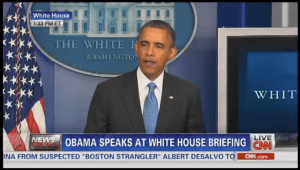
This afternoon, President Obama surprised everyone by making an appearance in the White House press briefing room. He spoke for approximately 17 minutes about Trayvon Martin, race, the law, and some other things. Part of the specialness of this speech was that it was impromptu (at least it appeared that it was unplanned) and was unscripted. [I couldn’t embed the video, but you can see it here.]

There were a lot of key things that he addressed in his speech, but what I thought to be the most important was the last few minutes. In the last few minutes, President Obama said that the younger generations are doing it much better than previous generations. The implication here is that the younger generations are less racist (or less unapproving) than previous generations. He talked about how he would listen to Malia and Sasha (his kids) speak with their friends and hear how they interacted. As a result, he thinks that the younger generations are doing it better than the older generations.

As I heard him say that, it made me think about how our countries are governed. Right now, the people who run the country (and by extension, the world) are older. I wonder what it’d be like if we had younger people who ruled the world. Maybe younger people would “get us there faster.” As a way to temper the eagerness of young people, maybe it’d be important to have some people from older generations to be advisors.

I wonder… are there any countries, states, provinces, counties, cities, or towns that are run by “younger” people? Are they more successful? Could we map this onto bigger populations with the same success?

~

For the first 14+ minutes, it seemed like there was an almost sombre tone to President Obama’s remarks. However, as he shifted to talking about the younger generations, I got the sense that he had hope for the future. I got the sense that he had hope for the future of the country because of the progress he sees in younger generations. While nothing is certain about the future nor are the implications, I’d like to think that it’s rather poetic that the leader of the United States believes in a brighter tomorrow. That President Obama believes that we are getting better as a society. As a people. That we are beginning to treat each other with more respect. More love. More kindness. And the hope is that this will continue with each succeeding generation. Hope.

Lies, Damned Lies, and Statistics: America’s Dependence on Mideast Oil

Earlier this morning, I came across a headline that was a bit shocking (to me): “Americans Support the Keystone XL Pipeline by Wide Margin.” All of the data I’d seen regarding polls of Americans showed that there certainly wasn’t a wide margin in support or against the pipeline. So, with my curiosity piqued, I clicked the article to find out that 67% (of the survey respondents) support building the pipeline. That still seemed a bit surprising, as, like I said, most polls I’d seen had stayed in the range of 45/55 or 55/45.

Upon getting to the actual survey, I scrolled to the question that led to the headline. Here’s the question that was read to survey respondents:

The President is deciding whether to build the Keystone X-L Pipeline to carry oil from Canada to the United States. Supporters of the pipeline say it will ease America’s dependence on Mideast oil and create jobs. Opponents fear the environmental impact of building a pipeline. What about you – do you support or oppose building the KeystoneX-L pipeline?

Do you see anything wrong with this question?

Let’s start with the idea that they’re telling respondents what supporters say and opponents say. If the respondent doesn’t really have a strong opinion about the question, they may prefer to identify with one group or the other (and they might even if they have a strong opinion!) One could argue that there’s a response bias present. There has been quite a bit of press about “America’s dependence on foreign oil.” So, someone might not want to oppose that viewpoint in a survey. That is, the respondent wouldn’t want to appear, (to the person conducting the survey), that they don’t think that reducing America’s dependence on foreign oil is as important as the environment.

Juxtaposing the dependence on foreign oil with environmental impact is a bit unfair. As I said in the previous paragraph, I’d bet that most people have heard/read something about the America’s dependence on foreign oil, but they probably don’t know very much about the environmental impact of oil. Now, that could be a messaging problem for the environmental movement, but there hasn’t been a compelling enough case made. (If there were, there certainly wouldn’t have been this many people who were “A-OK” with building the pipeline.)

Lastly, let’s actually examine this so called dependence on foreign oil. From the US Energy Information Administration:

The United States relied on net imports (imports minus exports) for about 40% of the petroleum (crude oil and petroleum products) that we consumed in 2012. Just over half of these imports came from the Western Hemisphere. Our dependence on foreign petroleum has declined since peaking in 2005. [Emphasis added]

In doing the math, 60% of the petroleum (oil) that the US consumed in 2012 was produced domestically — inside the US! In doing some more math, we’re told that just over half of the imports came from the Western Hemisphere. Meaning, less than half of the imports are coming from countries outside of the Western Hemisphere. Meaning, less than half of the imports could be coming from the Mideast and we already know that only 40% of the oil consumed in the US comes from imports. In fact, this same agency tells us just how much oil is imported from Persian Gulf countries: 29%. So, 29% of the imports (40%) is how reliant the US is on Mideast oil. Again, doing the math the total US consumption of Mideast oil: 11.6%. Does 11.6% sound like dependence?

If you recall the last line of the quote from the agency: “Our dependence on foreign petroleum has declined since peaking in 2005.

The next time you read survey data, I hope you’ll remember this post and consider just how construed the results may be.

[Note: The title of this post is a quote that was popularized by Mark Twain.]

Chapter 3 – Fairness and Inequality: What Money Can[‘t] Buy, Part 3

It’s been a couple of weeks since I last finished a chapter in Michael Sandel’s book, What Money Can’t Buy. I recently completed chapter 3 a couple of nights ago and there were some intriguing things to think about. Let’s get right to it!

For me, there were two important parts to the chapter. The first is the explanation of the two objections to markets. Prof. Sandel explains that the two kinds of objections to markets are fairness and inequality:

The fairness objection points to the injustice that can arise when people buy and sell things under conditions of inequality or dire economic necessity. According to this objection, market exchanges are not always as voluntary as market enthusiasts suggest… [The corruption objection] points to the degrading effect of market valuation and exchange on certain goods and practices. According to this objection, certain moral and civic goods are diminished or corrupted if bought and sold. [Emphasis added]

A few pages later, Prof. Sandel explains further what he means:

The fairness and corruption objections differ in their implications for markets: The fairness argument does not object to marketizing certain goods on the grounds that they are precious or sacred or priceless; it objects to buying and selling goods against a background of inequality severe enough to create unfair bargaining conditions… The corruption argument focuses on the character of the goods themselves and the norms that should govern them. So it cannot be met simply by establishing fair bargaining conditions. [Emphasis added]

Reading this was a bit tough to swallow. It seemed unlikely that all arguments against markets could be filtered into one of two categories. Then, I thought about his course that I watched last year, “Justice,” and how many of the students seemed to want to argue for nuance around the edges. While there was still nuance, the arguments they put forth still, for the most part, seemed to fall into a way of thinking that had already been espoused by a philosopher.

Later in the chapter, Prof. Sandel discusses three cases where the marketization of a good crowds out nonmarket norms. That was a bit wordy. Prof. Sandel shares cases where adding a market-like aspect (where there previously wasn’t), changed the way people interacted with the good. One of these cases I found particularly surprising (at least at first).

The case comes from Switzerland in the early 1990s. The country was looking for a place to store its nuclear waste. Of course, no town really wanted to house the nuclear waste, but there was a small village that was picked. Some economists surveyed the village to see if they’d accept it, if the Swiss parliament decided that it was the place to put the waste. Fifty-one percent of residents said they’d accept it. The economists then asked another question. If the parliament also paid each resident, would you then accept it? The idea being that, money is the king incentive for everyone, so adding money to this equation should only get more people accepting of the waste, right? Wrong. By adding the monetary sweetener, support collapsed from 51% to 25%! Even when they added more money, that didn’t seem to affect the outcome. Why?

For many villagers, willingness to accept the nuclear waste site reflected public spirit — a recognition that the country as a whole depended on nuclear energy and that the nuclear waste had to be stored somewhere. If their community was found to be the safest storage site, they were willing to bear the burden. Against the background of this civic commitment, the offer of cash to residents of the village felt like a bribe, an effort to buy their vote.

This seemed like an incredible story with an important lesson — money isn’t always the solution. There were two other examples, but none that were as powerful for me as this one.

~

The second important part of this chapter is the explanation of the “two tenets of market faith”:

The first is that commercializing an activity doesn’t change it. On this assumption, money never corrupts, and market relations never crowd out nonmarket norms… The second tenet of market faith is that ethical behavior is a commodity that needs to be economized. The idea is this: we should not rely too heavily on altruism, generosity, solidarity, or civic duty, because these moral sentiments are scarce resources that are depleted with use. [Emphasis added]

Prof. Sandel already showed earlier in the chapter that money can crowd out nonmarket norms. After this above quoted section, he goes on to show that things like altruism and generosity are not scarce resources and that they are not depleted with use. In fact, it’s quite the opposite. Fields like positive psychology have done research on these areas and shown that there’s almost a multiplier effect with things like altruism and generosity.

If you liked this post, you might like one of the other posts in this series:


Second-Guessing Managers and General Managers

About a week ago, I was watching the Toronto Blue Jays baseball game and there were some questionable decisions made by the manager. (Note: questionable in that they didn’t really make all that much sense to me or another group of fans of the Blue Jays.) Based on the game situation, many viewers of the game who are familiar with the Blue Jays would have anticipated that the manager would have substituted a certain pitcher. However, this didn’t happen. In fact, the manager substituted a player that was completely unexpected.

As someone who wants to see the Blue Jays succeed, it’s flabbergasting when things like this happen. I watched as fans on Twitter were absolutely dumbfounded by the decision. And that one decision *seemingly* affected decisions in the following game. For instance, because some pitchers can’t necessarily pitch on consecutive days, by using one pitcher on Tuesday, he can’t be used on Wednesday. Having played baseball for some time and having a relatively sophisticated understanding of the game (at least when compared to an average fan), I found it hard to determine the reasoning for the decisions made by the manager. Of course, I was assuming that the primary goal was to “win the game.” However, when you consider that this might not always be the only goal, then one can begin to consider different possibilities.

For instance, maybe the general manager (GM) told the manager that he needed to have a certain pitcher showcased in a game because a scout from a different team was going to be in attendance. Or, maybe the GM said that a certain player was about to be called up and another released, so he should use that player in the game. Heck, maybe there are personality issues (or “office politics“) at play that can’t be seen by fans who simply watch the game on TV. Think about the kinds of politics that happen at your office. These kinds of politics are bound to be at play on baseball teams, especially because the personalities might be a bit more extreme (it takes a certain kind of person to become a high-performance athlete). And, sports teams probably spend more time with each other than your typical office does.

My point in all of this is that it can be tough for a fan when a manager makes a move that seems completely counter to what one would think is the primary goal: winning the game.

On a related note, the NHL free agency period recently opened. Much to the chagrin of Toronto Maple Leafs‘ fans, the Leafs decided to let go of their best center, Mikhail Grabovski. Statistically speaking, that is, if you use advanced statistics, there’s no question that Grabovski was the best center on the Leafs. However, as has been noted with statistics, one can interpret the data to fit their opinion. Regardless, the decision by the GM of the Leafs, like the decision of the manager of the Blue Jays, left fans dumbfounded. These moves by the Leafs were even more frustrating because they had to do with personnel. With the explosion of fantasy sports, many fans have had the ability to pretend to be GMs. My guess is that because of this, some fans may think that they know better (and have tangential proof?) than the current GM of their favorite team.

All this is to say that when your favorite team does something that seems contra-indicated, consider that there might be something behind the scenes that you can’t know. I know, this will probably be of little comfort, but it might allow you to gain a more nuanced perspective of the business of sports.

Political Implications of the SCOTUS Decision on the Voting Rights Act

More than a week ago, the Supreme Court of the United States rendered a decision on a case that had implications for the Voting Rights Act (VRA). The Court ruled that the formula from Section 4 of the VRA was unconstitutional. The decision has certainly enraged liberals and the political left as is clear in Justice Ginsburg‘s dissent:

[T]he Court’s opinion can hardly be described as an exemplar of restrained and moderate decision making. Quite the opposite. Hubris is a fit word for today’s demolition of the VRA.

Because of this outrage, I’ve seen some people argue that this decision was good for liberals/democrats because it will ignite those potentially disenfranchised people to vote. From Ross Douthat:

Well, to begin with, voter identification laws do not belong to the same moral or legal universe as Jim Crow. Their public purpose, as a curb to fraud, is potentially legitimate rather than nakedly discriminatory, and their effects are relatively limited. As Roberts’s majority opinion noted, the voter registration gap between whites and blacks in George Wallace’s segregationist Alabama was 50 percentage points.

… But voter ID laws don’t take effect in a vacuum: as they’re debated, passed and contested in court, they shape voter preferences and influence voter enthusiasm in ways that might well outstrip their direct influence on turnout. They inspire registration drives and education efforts; they help activists fund-raise and organize; they raise the specter of past injustices; they reinforce a narrative that their architects are indifferent or hostile to minorities.

W.W. from The Economist finds Douthat’s analysis “quite plausible.” Both articles referenced the same information I talked about yesterday: the missing white voter.

I don’t know that I necessarily agree with this assessment.

In Wisconsin a couple of years ago, citizens were pretty excited about recalling Governor Scott Walker. Some folks were really upset by Gov. Walker’s actions on collective bargaining. Democrats, Gov. Walker is a Republican, thought that they could seize this opportunity to recall the Governor. There were over 1 million signatures to recall the Governor. It seemed like there was lots of momentum and people engaged in the recall. However, during the recall election of 2012, Gov. Walker won more of the vote than he did in the gubernatorial election of 2010.

There’s another example from this past election: The Affordable Care Act. Otherwise, known as “ObamaCare.” In March 2012, when the Supreme Court heard the arguments for the case, Karl Rove wrote in the Wall Street Journal:

This week’s historic Supreme Court hearings on President Obama’s health-care overhaul will have huge political ramifications.

Then, in June, when the decision was rendered, there was this from The Weekly Standard:

In the wake of the Supreme Court’s decision upholding the constitutionality of Obamacare, the principal choice now facing Americans on November 6 will be whether to keep Obamacare or to repeal it.

Republicans and conservatives thought that ObamaCare was going to give them the chance they needed to have a Republican elected President. It’s safe to say that it didn’t turn out the way they wanted. Not only did Republicans not elect a Republican President, but they also lost seats in the Senate (when they anticipated winning more seats).

Neither of these examples perfectly map onto the VRA decision, but it seems to me that there’s a bit of an overreaction in assuming that this decision is going to be a lightning rod for Democrats. I’d say that it’s “too early to tell” how this will affect the upcoming 2014 and 2016 elections. For now, the one of the only things that can be said about the political implications of the VRA: We’ll see…

More Civilized Conversations, Less Screaming Over Each Other

A few days ago, I happened to catch a segment from All In With Chris Hayes. He had on one of the people I follow on Twitter, Tim Carney. Part of the reason that this is noteworthy is because Carney is of a different ideological perspective from Hayes. Carney writes for the Washington Examiner, which, in 2008, supported McCain for President and in 2012, supported Mitt Romney. And Chris Hayes, a host on MSNBC, probably voted for Obama in the last two elections.

Anyhow, the segment comes after Hayes previews the show and introduces the topic: the ‘missing white voter.’ This particular usage of the phrase comes from a series of articles (I’m not the only one who likes to write series!) in Real Clear Politics by Sean Trende where he makes the argument that Republicans needn’t get onboard with immigration reform in order to win future elections — they just need to appeal to those white voters who didn’t vote in the last election.

After the introduction from Hayes, Carney begins making his points. One of things I thought was worth noting was how Carney talked about Rubio. From what I’ve seen/read, many conservatives think that Rubio will have a good shot at being elected President in 2016. So, when Carney seemed to make points against Rubio, I was a bit surprised. On the whole, I really enjoyed the brief back-and-forth between Hayes and Carney — they’re both smart commentators. Most importantly though, I liked that it didn’t appear that the two of them were getting caught up in the ideological talking points. It seemed like they were really talking about the substance of what Hayes introduced in the segment. I wish that cable news was more like that segment and less like a game of one-upmanship to see who can scream the loudest to convince the viewers that, ‘they must be right because they were more angry.’

Note: If the interview (or this discussion) intrigued you, I highly recommend checking out the article from Tom Edsall on the New York Times’ Opinionator. He has a really good summary of the idea that Republicans should just focus on white voters.

Look Closely and You’ll See that America Values Philosophy and Idealism

About a month ago, I talked about the best kept secret to traveling – tours. Since that post, I’ve been back into DC a few times to visit the monuments and the other sites that there are to see. There was something that struck me as particularly poignant — the US values philosophy/ideals without even knowing it.

You wouldn’t know it to watch TV, go the movies, or listen to the radio, but deeply embedded within the US is a value of philosophy and ideals. What makes me say this? Well, in visiting the monuments, you can’t help but think this. All of these important people in American history and what’s the unifying theme (besides America) between them? They had an ideal or a philosophy and they remained steadfast in pursuing that philosophy. FDR, MLK, Lincoln, Washington, Jefferson, George Mason…

Speaking of George Mason: even though I just finished an MBA from George Mason University, there were some things I didn’t know about the man that I found particularly interesting. For instance, did you know that he was a mentor to Thomas Jefferson? How about that he was the smartest man that George Washington knew? Or, how about that he wrote the Virginia Declaration of Rights? And that Thomas Jefferson borrowed heavily from the Virginia Declaration of Rights in drafting the Declaration of Independence?

I wonder if there will be a time (again?) when these American values will be more apparent. That is, when they will be more overt.

~

After one of these trips into DC to see the monuments, I found myself sitting on a bench outside one of the stores in the Mosaic District. I was looking up at all the store fronts and thinking to myself how distracting consumerism can be. I had just spent the day steeped in American idealism — learning and reading about some of the important figures in American history and now I found myself dropped into consumerism. It [consumerism] seemed so small after FDR, MLK, and Jefferson. It seemed almost insignificant. The most appropriate word I can think of for my thoughts that day: distracting.

It really seemed like everything was distracting. That is, everything but the philosophy/idealism I had spent time with that day. The stores and consumerism — it was distracting away from the philosophy and idealism. To be fair, maybe it’s not reasonable to always be thinking about idealism and philosophy. Maybe it’s fair to sometimes indulge. I should also clarify that I’m not judging consumerism, no.

I was just noticing that after spending a day with idealism, consumerism seemed… distracting.

US Congress: 48% Millionaires, US Population: 2.85% Millionaires

I recently saw an article in The Atlantic with the title: Does the Rise of the Super-Wealthy Require New Global Rules? It’s a provocative question based on a book by Chrystia FreelandPlutocrats. I highly recommend taking the time to read it! Anyway, while the article was good, there was something near the beginning that caught my eye and made me think:

When the 113th Congress opened in January, the number of millionaires in its ranks rose to 257 out of 535, or just over 48 percent.

My first thought — that’s a lot of millionaires in Congress, isn’t it? Forty-eight percent! Then I thought, that percentage probably doesn’t hold for the whole population of the US. Meaning, 48% of the United States probably isn’t made up of millionaires. In fact, it’s not. A study found that there are 9 million millionaires in the US. If we use the clock on the US Census Bureau, we can say that there are approximately 316 million people living in the US. So, if we divide 316 million by 9 million, we get a percentage of… 2.85%. Meaning, 2.85% of the US are millionaires. And yet, 48% of Congress are millionaires. Is something wrong here?

The US has a representative democracy. This means that a group of elected officials represent the people who elected them. Maybe it’s just me, but isn’t the keyword here representative? Do we really think that a Congress in which 48% of the body are millionaires can accurately represent a population in which only 2.85% are millionaires?

If you’re an American, this is certainly something worth thinking about today as you enjoy your holiday.

PS: Happy Independency Day!

The Top Ways For Avoiding Cognitive Biases: List of Biases in Judgment and Decision-Making, Part 17

Last Monday I wrote that my cognitive bias series had come to an end. However, several of you emailed me asking for a more concise summary (as you’ll recall, the last post was over 3000 words). So, I thought I’d aggregate the most frequent suggestions of ways for avoiding cognitive biases. It’s in the same vein as a post in this series I don’t often link to: WRAP — An Acronym from Decisive.

Today, I’ve gone back through the post I wrote last week and categorized the different ways for avoiding the cognitive biases that I’ve listed. I’ll list the ways in descending order of their most frequent occurrence on the lists, along with the biases that they helped to counteract:

Alternatives (6): Sunk Cost Fallacy, Endowment Effect, Planning Fallacy, Framing Effect, Confirmation BiasThe Contrast Effect

Assumptions (5): Sunk Cost Fallacy, Framing Effect, Overconfidence Effect, Halo Effect, Functional Fixedness,

Data (5): Planning FallacyGambler’s Fallacy, Primacy/Recency Effect(s), Status Quo BiasThe Contrast Effect

Empathy (3): Endowment Effect, Framing Effect, Fundamental Attribution Error,

Big Picture (3): Loss Aversion, Fundamental Attribution ErrorThe Contrast Effect

Emotional (2): Loss Aversion, Endowment Effect,

Self-Awareness (2): Overconfidence Effect, Hindsight Bias,

Expectations (1): Loss Aversion,

As you might expect, assumptions plays a big part in our decision-making, so naturally, uncovering our assumptions (or recognizing them) is an important way for avoiding the traps of cognitive biases in decision-making. Similarly, it’s important to consider and/or develop alternatives. On an important related note, one of the most important things you’ll learn about negotiating is BATNA. This stands for: the Best Alternative to a Negotiation Agreement. Alternative. It’s also not surprising to see the frequency with which “data” appears, too. Data are a really important part of making a “cognitive bias”-free decision. I’ve written about the virtues of empathy, so I won’t review it.

Lastly, I wanted to highlight that “big picture” appeared on this list a couple of times. I was surprised that it only appeared a couple of times, but that could be a result of the way I was thinking (or my biases!) when I was writing these series. For instance, two of the categories here on this site are Perspective and Fresh Perspective. Meaning, I think it’s really important that we learn how to view things from a wider scope. “Big Picture” probably coud have fallen under “Alternatives,” but I believe there’s an important distinction. With alternatives, it’s still possible to only be considering things from a micro-level, but with the big picture, there’s a necessity for seeing things from the macro-level.

PS: Happy Canada Day!

~

If you liked this paper/series, you might want to check out some of the other papers/series I’ve posted.

Ways For Avoiding Cognitive Biases: List of Biases in Judgment and Decision-Making, Part 16

It’s Monday, so that means it’s time for another cognitive bias. However, I’ve finished the list of cognitive biases that I wanted to highlight. Of course, there are many more biases that could be discussed, but I thought those 14 were some of the more important cognitive biases. With today’s post, I thought I would review all of the ways for avoiding the biases, categorized by bias. So, I’ll list each bias and recount the ways that I suggested for avoiding the bias.

This is going to be a jam-packed post (with over 3000 words!) I highly recommend bookmarking this post and coming back to it as a reference. Alrighty, with that being said, let’s start with the sunk cost fallacy.

Ways for Avoiding the Sunk Cost Fallacy

So, now that we’ve looked at the sunk cost fallacy, how can we avoid it? Well, the first step in avoiding the sunk cost fallacy is recognizing it. Hopefully, the above examples have given you an idea of how this bias can arise. There are a two other ways I want to highlight that you can use to avoid this trap.

1) What am I assuming?

The crux of the sunk cost fallacy is based on an assumption. That is, you’re assuming that because you’ve already spent money on X, that you should keep spending money on X. If you look at what it is that you’re assuming about a situation, you just might find that you’re about to step into the sunk cost trap.

2) Are there alternatives?

Related to the above example is alternatives. You’re not bound to a decision because you’ve made a similar decision in the past. Just because you bought the ticket to go to the movie, if another activity presents itself as more enticing, you’re allowed to choose that one instead. In fact, if when you sit down to watch the movie, it’s bad, you’re allowed to get up and walk out. Don’t fall into the sunk cost trap thinking that you have to stay because you paid for it. There are any number of things you could be doing: going for a walk, calling an old friend, etc.

Ways for Avoiding Loss Aversion

As with the sunk cost fallacy, one of the most important ways to avoid loss aversion is to recognize it. That is, to know that humans have a tendency for loss aversion is an important first step in not falling into the trap of loss aversion.

1) What’s the big picture?

In our example of golf, that might mean knowing where you are in relation to the other players your competing with in the tournament (rather than where your ball is relation to the hole and what specific stroke you’re about to hit). In business, one might examine a decision about one business unit in relation to the entire company (rather than looking myopically at the one business unit).

2) Am I afraid of losing something?

This may seem like an obvious solution, but it’s pretty important. If before making a decision you can think to yourself (or have your team ask itself), “am I afraid to lose something here?” You might find that you are and it could serve to help you or your company avoid falling into the trap of loss aversion.

3) Do you really expect to never lose anything — ever?

Loss is inevitable. Sometimes, you won’t make that par putt (or that birdie putt). Sometimes, when you negotiate a deal, you won’t get the best deal. Sometimes, the decision to sell that business unit might result in losses somewhere else. If you can come to grips with the fact that every decision you make won’t be perfectand that sometimes you will lose, you may begin to shift your expectations about loss.

Ways for Avoiding the Endowment Effect

1) Am I emotional?

A seemingly obvious way to avoid the endowment effect is assessing whether our emotions are involved. Don’t get me wrong, emotions are a good thing, but they are a surefire way to overvaluing things that you own. That is, if you find yourself overly connected to something, your emotions might be getting in the way.

2) Independent Evaluation

This dovetails nicely with the idea of being unemotional. To guard against succumbing to the endowment effect, be sure to have an independent appraisal of whatever it is that you’re looking to sell of yours. While you’ll still have the final say on what you sell and how much you sell it for, having a second pair of eyes look at your side of the “deal” might help you determine if you’re judgment’s clouded.

3) Empathy

I wasn’t going to include this initially, but after reading the research, it certainly fits. Before I go on, I should say that folks might be confused in that I just suggested asking whether one is emotional and now I’m saying to practice empathy? For those wondering, being emotional is not the same thing as being empathetic. Back to empathy and the endowment effect. In situations where we’re selling something, researchers found there to be an empathy deficit when the endowment effect was present. So, to counter this, you should try to empathize with whom you’re negotiating.

Ways for Avoiding the Planning Fallacy

With the first three biases I talked about, awareness was a key step in overcoming the bias. While you could make that argument for the planning fallacy, one of the hallmarks of [the fallacy] is that people know they’ve erred in the past and stillmake the mistake of underestimating. So, we’ll need to move beyond awareness to help us defend against this bias.

1) Data is your friend

No, I don’t mean Data from Star Trek (though Data would probably be quite helpful in planning), but now that I think about it, Data (the character) might be a good way to position this ‘way for avoiding the planning fallacy.’ For those of you not familiar, Data is a human-like android. In thinking about this way for avoiding the planning fallacy, think about how Data might estimate the length of time it would take to complete a project. It would be very precise and data-driven. Data would likely look at past projects and how long it took for those to be finished to decide the length of time needed for this new project. To put it more broadly, if you have statistics on past projects (that were similar) absolutely use them in estimating the completion time of the new project.

2) Get a second opinion

When we think about the project completion time of one project in relation to another project, we often think about the nuances that make this project different from that project — and by extension — why this project won’t take as long as that project. Planning fallacy. If you can, ask someone who has experience in project completion in the area for which you’re estimating. When you ask this person, be sure not to tell them all the “various ways why this project is different,” because it probably isn’t and it’s only going to cloud the predictive ability of the person you’re asking. You’re probably going to hear an estimate that’s larger than you thought, but I bet you that it’s probably a lot closer to the real project completion time than the estimate you made based on thinking about the ways that this project was going to be different than all the other projects like it.

Ways for Avoiding the Framing Effect

1) Reframe the question

It may seem obvious, but you’d be surprised how many people don’t consider “reframing” the frame with which they are looking at a situation. For instance, in the example from earlier, instead of looking at it as a choice between Program A and Program B, someone could reframe Program A so that it looks like Program C and do the same with Program B, so that it looks like Program D. As a result, one would then be getting a “fuller” picture of their choice.

2) Empathy — assume someone else’s perspective

Many choices implicate another in a situation. As a result, it might be worth it to put yourself in the shoes of that other person to see how they would view a given situation. This is similar to the reframe, but is more specific in that it might serve to help the person remove themselves a little bit from the decision. That is, when we’re faced with a choice, our personal biases can have a big impact on the decision we make. When we imagine how someone else might make this decision, we’re less likely to succumb to our personal biases.

3) Parse the question

Some questions present us with a dichotomous choice: are apples good or bad? Should we exercise in the morning or the evening? Are gap years helpful or harmful? When faced with a question like this, I would highly recommendparsing the question. That is, are we sure that apples can only be good or bad? Are we sure that exercising in the morning or the evening are our only options? Often times, answers to questions aren’t simply this or that. In fact, more times than not, there is a great deal of grey area. Unfortunately, when the question is framed in such a way, it makes it very difficult to see the possibility of the grey area.

Ways for Avoiding the Confirmation Bias

As with other cognitive biases, being aware that there is such a thing as the confirmation bias is really important. It can be hard to change something if you don’t know that there’s something to be changed.

1) Seek out contradictory ideas and opinions

This is something that I’ve written about before. If at all possible, you’ve got to be sure that you’re getting information that is counter to your beliefs from somewhere. If not, there’s little chance for growth and expansion. This can be difficult for some, so I’ve outlined ways to do this on the post I referenced above.

2) Seek out people with contradictory ideas and opinions

I answered a question on Quora last November where I placed these two ways for avoiding the confirmation bias one and two. Some folks might find it a little more difficult to seek out people with opposing views and that’s why I suggest starting with seeking out contradictory views in print (or some other form of media) to begin. However, in my experience, speaking with someone who has opposing views to mine (assuming that they are also altruistic in their endeavor to seek out opposing views) can be quite enriching. A real-life person can usually put up a better defense when your “confirmation bias” is activated. Similarly, you can do the same for them.

3) What do you really know?

My last suggestion for avoiding the confirmation bias is to always be questioning what it is that you know. This can sound tedious, but if you get into the habit of questioning “how” you know something or “why” you know something, you’d be surprised how ‘thin’ the argument is for something that you know. For instance, let’s say that you have a racial stereotype that ethnicity “x” is bad at driving. When you’re on the highway, you notice that someone from ethnicity “x” cuts you off. Instead of going into a tizzy about ethnicity “x,” you might stop and remember that, in fact, of all the times that you’ve been cut off, ethnicity “x” is the ethnicity that cuts you off the least. This is a curt example, but I think you get the idea. Just to emphasize my point: I would argue that questioning your deeply held beliefs would be a good way of countering the confirmation bias.

Ways for Avoiding the Gambler’s Fallacy

1) Independent Events vs. Dependent Events

The biggest way to avoid the gambler’s fallacy is to understand the difference between an independent event and a dependent event. In the classic example, the odds of a coin landing on heads or tails is — negligibly – 50/50 (I say negligibly because there are those who contend that the “heads side” weighs more and thus gives it a slight advantage). An example of a dependent event would be picking cards from a deck. There are 52 cards in a deck and if you pick one card without replacing it, your odds of picking one of the other 51 cards increases (ever so slightly).

Ways for Avoiding the Fundamental Attribution Error

1a) Empathy

As with many of the other biases, empathy is one of the quickest ways to thwart its power of you. If I put myself in the shoes of another, I’m more likely to understand that there might be more going on in the situation than I can see from my perspective. For instance, if we look at the red light example from above, by empathizing with the driver who runs the red light, I have a much higher chance of understanding that there running the red light is not a demonstration of their disregard for the world around them, but maybe that there’s something urgent to be taken care of.

1b) “Why Would a Rational Person Behave This Way?”

The above sentence is essentially a way to create a sense of empathy, but in case empathy is an ambiguous term, I’ve marked this ‘way’ 1b. Asking yourself this question will make it easier to consider the other factors at contributing to a situation.

Ways for Avoiding the Overconfidence Effect

1) Know what you know (and don’t know)

The fastest way to slip into the trap of the overconfidence effect is to start making “confident” predictions about things that you don’t know about. Guessing the number of paper clips in a bottle is something that most of us have little to no expertise in. So, list a large confidence interval. If you have no experience in managing a project, it might be in your best interest not to make a prediction about how long it will take to complete the project (planning fallacy).

2) Is this person really an expert?

Sometimes, you’ll hear someone displaying a level of confidence in a given situation that makes you think they know what they’re talking about. As a result, it might bias you into believing what they are saying. It’s important to know if this person is an expert in this field, or if maybe they’re succumbing to the overconfidence effect.

Ways for Avoiding the Halo Effect

1) Different strengths for different tasks

One of the easiest ways to avoid falling into the trap of the halo effect is to notice that there are different skills/strengths required for different tasks. As such, just because someone is good at climbing mountains doesn’t mean that they would make a good politician. The strengths/skills required for those two tasks are different. Put another way, think about the strengths/skills required for a particular tasks before evaluating whether someone would be good at that task.

2) Notice other strengths (or weaknesses)

It’s been said that, “nobody’s perfect.” When someone is good at one thing, there’s a good chance that they won’t be good at something else. Noticing that this person isn’t good at someone else may help to quell the urge to assume that this person is good at everything.

Ways for Avoiding the Primacy/Recency Effect(s)

How you avoid these two biases really depends on the context of the decision you’re making. For instance, if you want people to remember something, you probably don’t want to give them a long list (thereby invoking the possibility of one of these two biases to happen). There are some general ways to mitigate these baises, though.

1) Keep a record (write down the data)

One of the simplest ways that either of these biases can have an impact on a decision is when there isn’t a record of data. If you’re just making a decision based on what you remember, there will be an unnecessary weighting for the beginning or the end. As a result, keeping a record of the choices can make it easier to evaluate all choices objectively.

2) Standardized data

As I mentioned earlier in this post, it’s important that the data by which you’re evaluating a choice be standardized. As we looked at in number one, keeping data isn’t always enough. it’s important that the data be uniform across choices, so an evaluation can be made. In this way, it’s easier to look at earlier choices and later choices equally whereas if this weren’t instituted, there might be a slight bias towards the beginning or the end. This tip would work for situations similar to making a purchase (and gathering data), interviewing candidates, or something that can be analogized to either of these two.

Ways for Avoiding Functional Fixedness

1) Practice, practice, practice

Probably the easiest and most effective way of overcoming functional fixedness is to practice. What does that mean? Well, take a box of miscellaneous things and see if you can design something fun/creative. The emphasis should be on using those things in a way that they weren’t designed. For instance, if you’re using a toolbox, you might think about how you can use something like wrenches to act as “legs” of a table or as a conductive agent for an electrical circuit.

2) Observant learning — Find examples

Another good way of overcoming functional fixedness is to look at other examples of people who have overcome functional fixedness. When I was giving a presentation on functional fixedness to a group (of college students) about a year ago, I showed the video below. About halfway through the video, one of them remarked: “So, basically, it’s how to be a college student 101.”

Ways for Avoiding the Status Quo Bias

1) Independent Evaluation

It really can be as easy as this. Have someone (or do it yourself) do a cost-benefit analysis on the situation/decision. In this way, you’ll be able to see the pros/cons of your decision in a new light. Of course, you may still succumb to the status quo bias, but you might be less likely to do so.

2) Role Reversal

While the independent evaluation makes “good sense” in trying to avoid this bias, doing some sort of role reversal will probably be the most effective. That is, look at the decision/situation from the other perspective. If it’s a negotiation, imagine that you’re in your negotiating partner’s shoes and you’re actually doing the trade from that side. Evaluate the deal. This may help to shake loose the status quo bias.

Ways for Avoiding the Hindsight Bias

1) Write it down!

This might be a bit tedious, but it’s a surefire way to guard against the hindsight bias. I’ve read a few articles about folks who’ve documented every prediction that they’ve ever made. While this had more to do with their profession (forecasting, stocks, etc.) it might be something you want to consider.

2) “I knew it all along!”

Have you ever found yourself saying, “I knew it all along,” or “I’m was sure it was going to happen?” These are good indicators that you’re probably operating under the hindsight bias. When you catch yourself saying these phrases, stop and think about what has happened in the situation. Chances are that you’ve “short-circuited” and you’re not thinking about what’s happened to cause that situation.