Over 40% of the World’s Population Will Vote in 2014

A few days ago in a post about global museum attendance, I mentioned that there were going to be a number of people voting across the world this year. In fact, that number is almost 3 billion. That’s right — over 3 billion people will be voting in an election this year. The total world population only broke 3 billion in the 1960s.

The Economist had a great graphic showing the different elections there was going to be this year and I thought it was worth taking a closer look at.

For instance, as you might expect there are nearly no elections taking place during the summer months. In fact, from May to September, there are only 2 elections taking place, whereas, aside from December, there is only one month that has only 2 elections (January).

Any election is important and has lasting repercussions, but one of the elections that I’m most interested to see the results of is the election in South Africa in April. This past November, South Africa opened voter registration and had over 2.5 million people register. Of those 2.5 million, 1 million were new voters. There will be another voter registration taking place in February of this year. There are quite a few people expecting the current party in power (African National Congress) to lose quite a bit of their support. Since 1994, all the Presidents of South Africa have been from the African National Congress (ANC).

Currently, the African National Congress has almost 70% of the seats in the National Assembly. The polls are predicting the ANC to lose some of their seats. In fact, support is expected to drop nearly 10%. If this hold true, the ANC would still have a majority of seats in the National Assembly, but there are still many days between now and the election in early April. If that support were to dip below 50%, it would be the first time since 1994 that the ANC had less than 200 seats.

France’s 75% Tax on Millionaires is Not What You Think

Almost two years ago now, there was a big hullabaloo because France proposed a 75% tax on millionaires. Some folks were really upset that millionaires were going to have to pay 75% of what they earned in a year for taxes. WRONG. This is not true. In no country (that I’ve ever seen), do taxes work this way. One of the words you often hear — progressive. Another one — marginal. Confused?

I’ve been thinking about this over the last few days. Since it was announced that the President of France was getting approval for the 75% tax, I’ve been listening to what some folks have been saying about this tax. It reminds me of what happened last year (around this time) when there was talk of extending the Bush tax cuts in the US. People were confusing or not really understanding just how the tax system works.

Essentially, taxes are the same for everyone. How?

There was an article in the New York Times a couple of years ago where there was someone in the US who was worried about making a few extra thousand bucks because she didn’t want to be taxed at the higher rate. What? That’s right. She thought that because she made (fictitious numbers) $100,000 instead of $98,000, she was going to have to pay more taxes on all of her $100,000. If you know anything about taxes, you know that this is not true.

When you pay taxes, you pay the same as everyone else. That is, if someone earns $35,000/year and you earn $50,000/year, you both pay the same amount of taxes (up to) $35,000/year. However, you will also have to pay taxes on that $15,000 difference. Depending on the country’s laws, that might be the same rate. Another word for this is tax brackets.

Remember earlier when I mentioned the words marginal and progressive? This system of paying similar amounts of money across people is called marginal or progressive taxes. It’s important that it’s conducted in this manner, otherwise people would be incentivized to do what that lady in the NYT article was talking about — not earn extra money when you’re near a new bracket for fear of having to pay a different rate on all of your money. Of course, we know that this isn’t true.

Something I don’t understand is how many people simply don’t understand this. There are some things in life that are important and worth knowing and I’d think that knowing how/why you pay your taxes would be one of them. Maybe we need to do a better job of educating folks in school about this idea of marginal/progressive taxes. Maybe we need to change the name, I don’t know. Until then, I’ll keep writing posts like this to remind you just how tax systems work.

By the way — I should note that I’m not arguing for/against the 75% tax that Francois Hollande has just had approved, I’m simply trying to explain what it is, so that when people do debate the merits, they’ll actually be talking about the same thing.

Poorest Canadians Spend More Than Half of Income on Food & Shelter

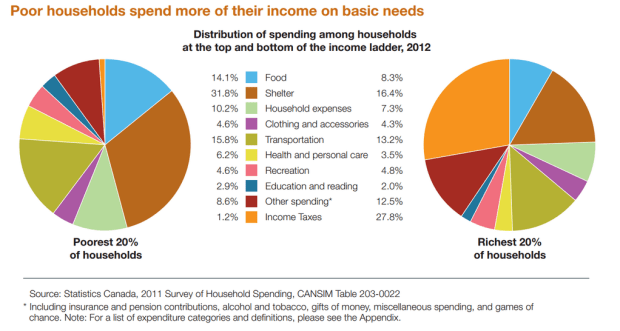
Just over a week ago, I saw this photo retweeted by Gerald Butts, who happens to be a senior advisor to Justin Trudeau (the Leader of the Liberal Party of Canada). As I’ve spent most of my adult life in the US, I’m used to hearing and writing (here, here, and here) about some of the sobering statistics in that country (approximately 50 million American live in poverty — right now!) As a result, I thought it’d be enlightening to take a closer look at some of the inequalities in Canada. This graph seemed like a good place to start.

For instance, I had no idea just how large the disparity was between the richest 20% and poorest 20%, with regard to food and shelter. Looking at the numbers, we can see that the poorest 20% spend approximately 56% (!) of their income on food and shelter. Fifty-six percent! While the richest 20% spend just 32%. I chose these categories because of Maslow’s Hierarchy of Needs. Food and shelter are some of the most basic needs we have and if the poorest 20% has to spend so much of their income on — essentially — surviving, it’s going to make it that much harder to “climb the economic ladder.” Of course, some might say it’s misleading to look at the numbers in aggregate like this.

With that being said, this holiday season, I hope you’ll remember this graph when you’re out at holiday parties and issues of politics and/or charities arise. It may add an important layer of perspective to the conversation.

Would You Rather Pay Fees or Taxes?

A little over a week ago, Matt Yglesias wrote a post on Slate about how to balance the budget while slashing taxes. The solution: call everything a fee.

Well we could solve an awful lot of problems that way. For example, I’d love to see us impose a greenhouse gas emissions fee to internalize the social cost of carbon dioxide. On top of that, I think a small additional fee on the use of gasoline would be justified. And of course road congestion fees on crowded highways. I used to think we should raise the alcoholic beverages tax, but now I think we should eliminate it entirely. Instead, let’s put an “alcohol fee” in place that just happens to be higher than the current tax. Do the same for cigarettes. Legalize marijuana, but subject its sale to a rather hefty fee. It actually turns out that we could replace most taxes on labor and capital with a land occupancy fee, especially if we call it a “land occupancy fee” rather than a “land value tax.”

After reading this post, it made me think of Michael Sandel’s chapter about fines versus fees. Maybe some of the things that Yglesias is talking about in this post should actually be labeled fines and not fees. For instances, if we’re talking about internalizing the social cost of carbon dioxide, isn’t there a moral piece to it? That is, shouldn’t we call this a fine, then? You may disagree, but the nomenclature in this case does matter.

It seems a bit absurd to think that people would be more amenable to paying money for something merely by changing the label from ‘tax’ to ‘fee,’ but labels matter.

While it’s certainly a creative idea to start charging fees and lower taxes, there is an important bit to consider here. Namely, the control of these fees. Have you ever had to pay a fee to get your license renewed? Do you know how much it costs the government to ‘actually’ renew your license? I don’t. But I know that I get charged close to $100 to renew it. Josh Barro solidifies the point:

Politicians tend to regard fees as more palatable than taxes, and more focused too. If a state needs to finance an infrastructure to oversee fishing, why shouldn’t fishermen foot the bill? But groups like the nonpartisan Tax Foundation in Washington worry that governments are now using fees to shore up budget shortfalls rather than cover specific costs incurred by specific users.

“When it comes to paying for bananas, you’ve got the market as a mechanism to make sure you’re paying a fair price,” says Josh Barro, a staff economist at the Tax Foundation. “But when it comes to getting your driver’s license renewed, the government has a monopoly, and you have no idea what it costs the state or what it’s doing with the money.”

The moral of the story: maybe taxes aren’t so bad after all.

What Will the Obamas Do in 2017?

Today’s been a bit hectic. I rode the bus from downtown Ottawa to get to the airport. The “hectic-ness” stems from the fact that it was quite snowy outside. The visibility was quite poor and I was sure my flight would be delayed (it wasn’t). Right now, I’m sitting in the Toronto Island Airport (not the much more known Toronto Airport, which is actually almost in Mississauga) and waiting for my next flight.

In amongst my travels today, I had the chance to see Pres. Obama’s speech at Nelson Mandela’s memorial. I knew that it was today, but I also knew I wouldn’t have much time to watch it today. As I was getting ready to board the bus in Ottawa, I saw some folks on Twitter talking about this being one of Obama’s best speeches yet. He’s certainly delivered some doozies in his time, so I wondered if the rhetoric was hyperbole. As it turns out — it’s not. I buffered the speech and watched it at 30,000 feet. It was… awesome. And I don’t mean awesome in the way that the word has been co-opted to mean as a form of slang. The speech was awesome.

There were so many great portions of the speech that I’d be hear all day if I were excerpting. One part in particular I wanted to highlight:

The struggles that follow the victory of formal equality and universal franchise may not be as filled with drama and moral clarity as those that came before, but they are no less important.

Essentially, we’re not finished, yet. We’ve still got work to do. (If you want to watch video of the speech, this is all I could find with airport WiFi.)

Update: as expected, there’s a YouTube video of the speech.

Pres. Obama is the 44th President of the United States, so he belongs to a unique club of people. No doubt, history will remember him. However, he’s also one of the youngest presidents in a time in history where people are living longer than ever. As a result, I’m infinitely curious as to what the Obamas will do post-White House. For instance, look at Bill and Hillary Clinton. Hillary Clinton went on to be a United States Senator and then the Secretary of the State (and maybe one day, President). Bill (along with Hillary) created a foundation and have been effecting change the world over.

There are probably an infinite number of things that the Obamas could get into, but I wonder which issue excites them the most. That is, where do they want to leave their mark on history. Given the way that Pres. Obama speaks about equality, social justice, and social rights, it seems like a natural fit for him.

Of course, the Obamas probably aren’t thinking about that right now, but that time is not too far away for them. We’re almost finished with 2013 and the 2014 midterm elections aren’t even a year away. After that, it’s essentially “open season” on candidates announcing their intentions to run for President.

Could Markets Have Predicted the Civil Rights Movement?

Author’s note: It’s been quite some time since my last post. In fact, it’s the last day of November and this will be my last post this month. It’s been a bit hectic getting settled in Ottawa, in addition to some other things that have been going on, but I do hope to get back into a regular habit of writing posts again.

I came across an article recently that espoused the value of the efficient-market hypothesis through the success of InTrade — when it was still functioning. In case you’re not familiar, InTrade is a betting site that would post contracts, for instance — “Mitt Romney will be the Republican Presidential nominee” — and then people could ‘buy’ that contract if they thought Romney would be the nominee or (sell) that contract if they thought he wouldn’t. There’d be all kinds of questions, not just political. There are questions about world events (the US will find Saddam Hussein) and questions about awards shows (Avatar will win Best Picture).

In the article, there was a small blurb about futarchy:

The potential of prediction markets to aggregate and reveal information is so great that some have surmised they might remake whole political systems. Robin Hanson, an economist at George Mason University, has endorsed what he calls “futarchy,” a form of government that would use prediction markets extensively as a policymaking tool. If the aggregated predictions of the market are better than the individual predictions of a few appointed experts, why not let citizens bet on, rather than submit to professional opinion on, for example, which tax policy is more likely to bring prosperity?

For the most part, there certainly seems to be something to the argument in favour of the wisdom of the crowds, but as I’ve written before, the wisdom of the crowds can’t always be trusted. When thinking about the wisdom of the crowds in the context of policymaking, I wonder about the crowd’s ability to divine the need for civil rights. That is, I wonder if, during the time leading up to the civil rights movement, the crowd would have accurately predicted it was beyond time to implement a new level of equality in the United States. Or, what about in the time of Lincoln? Would the wisdom of the crowds have decided that black people deserved freedom?

What Was Your Last Original Thought: Choices and Illusions, Part 2

In yesterday’s post, we looked at the first 6 chapters of Eldon Taylor’s book, Choices and Illusions. There were some great stories about how our thoughts can have a tangible effect on our bodies. In today’s post, we’ll take a closer look at the next 6 chapters.

~

Chapter 7 picks up right where the last three chapters leave off: marketing. In particular, Taylor asks one of his favourite questions: “What was your last original thought?” In continuing down this line of thinking, Taylor emphasizes how a great deal of planning and money has been spent on trying to get you to, in a sense, manipulate your thoughts. Now, I don’t want you think that Taylor’s talking about ‘mind control’ or something like that. In fact, if you think about it, you can probably come to the same conclusions that Taylor has. When you’re hungry, what’s the first thought that comes to mind? For many, that will be fast food. When you’re thirsty, what’s the first thought that comes to mind? Pop (or soda, or coke, depending on what part of the country/world you live in). How are those your first thoughts with these biological instincts?

Taylor also continues on subliminal thinking in Chapter 8. There are a couple of good stories, one about the 2000 election and the subliminal messaging used by the Bush campaign. There’s also a discussion of dichotic listening, which brought me back to my class in cognitive psychology from several years ago. Similarly, if you’ve never taken the Stroop Test, I suggest checking it out.

Chapter 9 has a two-part story that I thought you’d enjoy. Here’s part 1:

 It is about a Zen master who made it a habit at noontime to meditate while he walked in the gardens. On this particular day, he became so engrossed in his meditation that he wandered far into the jungle, where he met a hungry tiger. Well, our Zen master did what any Zen master would do, which is to attend to the urgency of the moment. He fled as fast as he could with the hungry tiger in pursuit. Soon he came to the edge of a sheer cliff, but with a hungry tiger about to eat him, he jumped over the edge. On the way down he grabbed the only thing jutting out from the cliff, a small tree. There he hung on as he heard a roar from below. Now, there was a hungry tiger above and a hungry tiger below. Just then the small tree began to pull out of the ground. He looked to his right. Nothing. He looked below. Nothing. He looked to his left. A beautiful strawberry. He picked the strawberry, and it was the best fruit he’d eaten in his life.

Taylor uses this story to emphasize the now: “The moral of the story is, be mindful — you will find the strawberries.” The second part of the story is just as good:

 After I told this story to an audience in Malaysia, a fellow approached me during a break and asked if I knew the entire story.

“I thought that was the entire story.”

“No,” he said. “Would you like to know it?”

We sat down and had coffee while he related the story that he said comes from Paramahansa Yogananda. It seems that the Zen master, when confronted with the tigers, was actually hanging from a small apple tree while mice were digging away the light soil that the tree was rooted in. The story cuts away to a picture of the event hanging in a gallery. There spectators are viewing the art, when one speaks up, “Look at that stupid fellow. He’s selfishly indulging his senses while blind to his circumstances.” The story then returns to the Zen master. Another tiger runs onto the scene, and now there are two tigers above. The Zen master enjoys his apple, and pretty soon he sees vultures circling overhead. The two tigers have fought and killed each other. The mice see the shadow of the birds and flee. Below a herd of deer comes down to drink from the brook, and the tiger below sets off in pursuit of them. In short, what seemed like dire circumstances fixed themselves or were fixed by some power above.

Of course, some folks may balk at the idea that every situation will fix itself, but I’d argue that lots of people forget that when they are trying to decide the best course of action, ‘wait and see’ is overlooked more often than it should be. In tomorrow’s post, we’ll look at the last 6 chapters of the book.

(Disclosure: I was given a free copy of the book.)

Can You Succeed in Politics if You Aren’t Selfish?

From time to time, I like to highlight what I think are important passages in books (Stockdale Paradox, The Art of War, etc.). As I begin my journey through some of the classics, there’ll probably be more and more posts where I’m sharing passages from books. While the passage I’m going to share in this post isn’t from a “classic,” it is highly lauded. Not only has it garnered 116 five-star reviews (out of a possible 161), it’s received glowing endorsements from the likes of: Daniel Pink, Susan Cain, Robert Cialdini, Gretchen Rubin, Daniel Gilbert, Dan Ariely, Martin Seligman, Chip Conley, and many more!

The book I’m talking about: Give and Take, by Adam Grant. In today’s post, I’d like to share with you a few pages from near the beginning of the book. In these few pages, Grant uses a story to support the case that givers can succeed in even the most cutthroat of professions — politics. It is a book that is absolutely worth reading, so I hope that this excerpt compels you to give it a look.

~
[Excerpt Begins]

In some arenas, it seems that the costs of giving clearly outweigh the benefits. In politics, for example, Mark Twain’s opening quote suggests that diplomacy involves taking ten times as much as giving. “Politics,” writes former president Bill Clinton, “is a ‘getting’ business. You have to get support, contributions, and votes, over and over again.” Takers should have an edge in lobbying and outmaneuvering their opponents in competitive elections, and matchers may be well suited to the constant trading of favors that politics demands. What happens to givers in the world of politics?

Consider the political struggles of  a hick who  went  by the  name Sampson. He said his goal was to be the “Clinton of Illinois,” and he set his sights on winning a seat in the Senate. Sampson was an unlikely candidate for political office, having spent his early years working on a farm. But Sampson had great ambition; he made his first run for a seat in the state legislature when he was just 23 years old. There were 13 candidates, and only the top four won seats. Sampson made a lackluster showing, finishing eighth.

After losing that race, Sampson turned his eye to business, taking out a loan to start a small shop with a friend. The business failed, and Sampson was unable to repay the loan, so his possessions were seized by local authorities. Shortly thereafter, his business partner died without assets, and Sampson took on the debt. Sampson jokingly called his liability “the national debt”: he owed 15 times his annual income. It would take him years, but he eventually paid back every cent. After his business failed, Sampson made a second run for the state legislature. Although he was only 25 old, he finished second, landing a seat. For his first legislative session, he had to borrow the money to buy his first suit. For the next eight years, Sampson served in the state legislature, earning a law degree along the way. Eventually, at age 45, he was ready to pursue influence on the national stage. He made a bid for the Senate.

Sampson knew he was fighting an uphill battle. He had two primary opponents: James Shields and Lyman Trumbull. Both had been state Supreme Court justices, coming from backgrounds far more privileged than Sampson’s. Shields, the incumbent running for reelection, was the nephew of a congressman. Trumbull was the grandson of an eminent Yale-educated historian. By comparison,  Sampson had little experience or political clout. In the first poll, Sampson was a surprise front-runner, with 44 percent support. Shields was close behind at 41 percent, and Trumbull was a distant third at 5 percent. In the next poll, Sampson gained ground, climbing to 47 percent support. But the tide began to turn when a new candidate entered the race: the state’s current governor, Joel Matteson. Matteson was popular, and he had the potential to draw votes from both Sampson and Trumbull.

When Shields withdrew from the race, Matteson quickly took the lead. Matteson had 44 percent, Sampson was down to 38 percent, and Trumbull was at just 9 percent. But hours later, Trumbull won the election with 51 percent, narrowly edging out Matteson’s 47 percent.

Why did Sampson plummet, and how did Trumbull rise so quickly? The sudden reversal of their positions was due to a choice made by Sampson, who seemed plagued by pathological giving. When Matteson entered the race, Sampson began to doubt his own ability to garner enough support to win. He knew that Trumbull had a small but loyal following who would not give up on him. Most people in Sampson’s shoes would have lobbied Trumbull’s followers to jump ship. After all, with just 9 percent support, Trumbull was a long shot.

But Sampson’s primary concern wasn’t getting elected. It was to prevent Matteson from winning. Sampson believed that Matteson was engaging in questionable practices. Some onlookers had accused Matteson of trying to bribe influential voters. At minimum, Sampson had reliable information that some of his own key supporters had been approached by Matteson. If it appeared that Sampson would not stand a chance, Matteson argued, the voters should shift their loyalties and support him. Sampson’s concerns about Matteson’s methods and motives proved prescient. A year later, when Matteson was finishing his term as governor, he redeemed old government checks that were outdated or had been previously redeemed, but were never canceled. Matteson took home several hundred thousand dollars and was indicted for fraud.

In addition to harboring suspicions about Matteson, Sampson believed in Trumbull, as they had something in common when it came to the issues. For several years, Sampson had campaigned passionately for a major shift in social and economic policy. He believed it was vital to the future of his state, and in this he and Trumbull were united. So instead of trying to convert Trumbull’s loyal followers, Sampson decided to fall on his own sword. He told his floor manager, Stephen Logan, that he would withdraw from the race and ask his supporters to vote for Trumbull. Logan was incredulous: why should the man with a larger following hand over the election to an adversary with a smaller following? Logan broke down into tears, but Sampson would not yield. He withdrew and asked his supporters to vote for Trumbull. It was enough to propel Trumbull to victory, at Sampson’s expense.

That was not the first time Sampson put the interests of others ahead of his own. Before he helped Trumbull win the Senate race, despite earning acclaim for his work as a lawyer, Sampson’s  success was stifled by a crushing liability. He could not bring himself to defend clients if he felt they were guilty. According to a colleague, Sampson’s clients knew “they would win their case—if it was fair; if not, that it was a waste of time to take it to him.” In one case, a client was accused of theft, and Sampson ap- proached the judge. “If you can say anything for the man, do it—I can’t. If I attempt it, the jury will see I think he is guilty, and convict him.” In another case, during a criminal trial, Sampson leaned over and said to an associate, “This man is guilty; you defend him, I can’t.” Sampson handed the case over to the associate, walking away from a sizable fee. These decisions earned him respect, but they raised questions about whether he was tenacious enough to make tough political decisions.

Sampson “comes very near being a perfect man,” said one of his political rivals. “He lacks but one thing.” The rival explained that Sampson was unfit to be trusted with power, because his judgment was too easily clouded by concern for others. In politics, operating like a giver put Sampson at a disadvantage. His reluctance to put himself first cost him the Senate election, and left onlookers wondering whether he was strong enough for the unforgiving world of politics. Trumbull was a fierce debater; Sampson was a pushover. “I regret my defeat,” Sampson admitted, but he maintained that Trumbull’s election would help to advance the causes they shared. After the election, a local reporter wrote that in comparison with Sampson, Trumbull was “a man of more real talent and power.” But Sampson wasn’t ready to step aside forever. Four years after helping Lyman Trumbull win the seat, Sampson ran for the Senate again. He lost again. But in the weeks leading up to the vote, one of the most outspoken supporters of Sampson’s was none other than Lyman Trumbull. Sampson’s sacrifice had earned goodwill, and Trumbull was not the only adversary who became an advocate in response to Sampson’s giving. In the first Senate race, when Sampson had 47 percent of the vote and seemed to be on the brink of victory, a Chicago lawyer and politician named Norman Judd led a strong 5 percent who would not waver in their loyalty to Trumbull. During Sampson’s second Senate bid, Judd became a strong supporter.

Two years later, after two failed Senate races, Sampson finally won his first election at the national level. According to one commentator, Judd never forgot Sampson’s “generous behavior” and did “more than anyone else” to secure Sampson’s nomination.

In 1999, C-SPAN, the cable TV network that covers politics, polled more than a thousand knowledgeable viewers. They rated the effectiveness of Sampson and three dozen other politicians who vied for similar offices. Sampson came out at the very top of the poll, receiving the highest evaluations. Despite his losses, he was more popular than any other politician on the list. You see, Sampson’s Ghost was a pen name that the hick used in letters.

His real name was Abraham Lincoln.

[Excerpt Ends]
~

Did that story knock you off your feet? It certainly did for me the first time I read it. This story is just the tip of the iceberg of what’s contained in Grant’s book. Seriously, go read it!

High-Speed Rail in the USA: Why Hasn’t it Flourished?

Over two years ago, I wrote a post about high-speed rail in the USA. It was right around the time that the USA had announced that it was going to be improving its high-speed rail system. As someone who enjoys public transportation, it was pretty exciting to see that one would be able to travel from Montreal to San Diego by high-speed train!

While I wrote it over two years ago, it is consistently one of my most popular posts. It’s probably not fair to draw too strong a conclusion from that, but it’s reasonable to think that people are at least interested in high-speed rail in the USA. On that note, I came across a post on Mashable that offers a disheartening update to high-speed rail in the USA:

The not so good news is, if you live in the United States, you’re out of luck when it comes to HSR, thus far. High-speed rail in the U.S. is mired, for the most part, in opposing views about what’s best for the country’s travel infrastructure — and how we should pay for it.

As is the case with many ‘public goods,’ there’s always the question of who’s going to foot the bill. It seems to me, the USA, more than other countries, have a harder time coming to an agreement on who should pay for public transportation. As I mentioned in my post two years ago, most folks say that Europe is much smaller than the USA and that’s why it has public transportation galore and the USA doesn’t — incorrect. Would you believe that Europe actually has more land area than the USA? You should (Europe: 10,180,000 km²; USA: 9,826,675 km²).

After debunking the land area myth, the next logical progression is population. That is, are there enough people that even need to be transported by high-speed rail. Europe’s population is over 700 million, more than double the USA’s population. Of all the points against high-speed rail, this one seems like it’d be the most compelling. With that being said, it still stands to reason that there could be high-speed rail between the large urban centers, right?

At the beginning of the month, Business Insider created a map that showed that half of the United States lives in 146 counties. That is, half of the USA’s population is accounted for in these counties. In looking at the map, you’ll recognize many of the areas. So then why can’t the USA start its high-speed rail adventure by building between some of these urban areas? Well, we’re back at the political issue of who pays for it. Building a high-speed rail line between Chicago and Detroit crosses state lines, so who pays for it: Illinois or Michigan? And this, of course, reinvokes ideological differences.

Like the Mashable article foreshadows, the outlook for those who would find joy in the proliferation of high-speed rail doesn’t look good.

Wanna Be More Productive? Kick Off Your Shoes

When I was an undergraduate, I was fortunate enough to be elected student body president. One of the perks to this position was that I had my own office. For a young twentysomething, this was pretty cool. As I had private office, I would often take off my shoes when I was working. It wasn’t that I had uncomfortable shoes, I just felt more comfortable when I wasn’t wearing them. Knowing that some people are uncomfortable with barefooted-ness, I kept a pair of moccasins close by that I could slip on when I went out into the main part of our office. Many of my colleagues teased me for taking off my shoes, but when I’d walk by the tables in the main office, I’d often see one or two people who’d also removed their shoes.

Since graduating, I’ve lived in a couple of places where barefooted-ness isn’t uncommon. For instance, in New Zealand, it’s not unusual to see people walking down the street or through the supermarket (!) barefoot. Even in the United States, albeit not the continental United States, it’s not abnormal to see people walking around barefoot in public. A couple of years ago, Jennifer Aniston was caught walking around in public without any shoes in Hawaii.

Walking around in public without any shoes is slightly different from walking around an office without any shoes. Many people walk around in public in their pajamas, but you most certainly wouldn’t head to the office in your pajamas — unless, of course, it’s national wear your pajamas to work day. But maybe shoelessness isn’t such a bad idea.

There was a biology professor in Virginia who shed his shoes in the classroom for a little while. The university allowed this while he was promoting his book, The Barefoot Book: 50 Great Reasons to Kick Off Your Shoes, but after a period of time, he was then required to put his shoes back on when he was in the classroom. The professor frequents restaurants without any shoes. ‘Isn’t this a health code violation?’ You might ask. As a matter of fact, it isn’t. The professor keeps a letter with him from the Virginia state health department attesting that it’s not. As you’d imagine, restaurant owners are none too pleased.

As the stereotype goes, professors can be a bit quirky, so you still might think nothing of this. What if I told you that the Deputy Prime Minister of the United Kingdom (!) has admitted to walking around the office barefoot? This yearAs it turns out, a majority of people would be okay with this. According to a survey conducted last year by Adecco, a human resources consulting company, only 43% of people said they’d be offended if people took their shoes off in their workspace.

Can going barefoot actually make you more productive?

It’s no secret that stress is a major inhibitor when it comes to productivity. So, it follows that anything you can do to reduce stress in the workplace should help you be more productive.

Dr. Dieter Breithecker, who is currently the head of Germany’s Federal Institute for Posture and Mobilisation Support and a member of the International Ergonomics Association, says, “Putting the soles of your feet in contact with all the normal sensations helps to relieve internal tension and reduce stress. Shoes, on the other hand, prevent direct contact with the ground and so adversely affect the health of our feet, balance and posture.”

Not only could your shoes be inhibiting your productivity, but there’s a good chance that they might be affecting other aspects of your health like your posture.

It’s been quite a few years since I walked around barefoot in the office as the student body president. As the person ‘in charge,’ it was a little easier to get away with it and not upset too many people. In the years since, as long as I’ve had a private office, you could be sure that my feet were free, while my shoes remained tucked away in the corner. And for those times I needed to venture out of the office, I’d have to decide what the situation required. On some occasions, it’s important to be wearing formal shoes, but for those times it’s not, you’ll almost certainly catch me wearing a pair of Vibram FiveFingers Bormios.