Is An Eye For An Eye Ever Justified?

As I’m sure you’ve heard/read/seen, the United States conducted a mission in which Osama bin Laden “passed away.” At first, I was quite shocked. Everything we’d been told about bin Laden was that he was . Moreover, he hadn’t been in the news in ages, and all of a sudden — boom. Then, I felt empathy. Yes, I understand that this person was seen as a security threat to the United States and in some cases, the world, but it is my belief that no matter the crime, taking life is never the solution, nor is it justifiable.

Some of the archived footage of President Obama talking about bin Laden ( and ) and just my general feelings about President Obama make me think that Obama’s original intention in this mission was not to take an eye for an eye. President Obama doesn’t seem like the kind of president who is out for ‘revenge.’ Rather, I think the initial intent was to capture. Some have already , and others think . Others still, think that for the United States (and the world). Other than some of the footage I’ve seen of Obama talking about bin Laden, and my own intuition, I have no hard evidence. There may be some out there, but I haven’t come across it. Mind you, I haven’t looked very hard, either.

The “An-eye-for-an-eye-for-an-eye-for-an-eye… ends in making everybody blind,” is often to Mahatma Gandhi. In looking at the wiki article for “,” Jesus Christ is also quoted as saying: “You have heard that it was said, ‘An eye for an eye and a tooth for a tooth’. But I say to you, do not resist an evildoer. If anyone strikes you on the right cheek, turn to him the other also.” However, there is no reference to a specific passage from the Bible (or other book), so I don’t know if that’s accurate.

Byron Katie often says, “.” When I first heard that, it took me a some time to wrap my head around what that is really saying. Defense is the first act of war. So, not the aggressor, but the defender. Sounds a bit strange, yes? She’s so eloquent that instead of trying to paraphrase her ‘thoughts’ on the topic, I decided just to include a YouTube video of her talking about the concept:

While Katie is referring to defense in a communication-sense, I think that her ideas on this topic can be extrapolated to other areas of interaction. As an example: think about a school-yard bully. On the playground, the bully pushes another kid down. In one scenario, the kid gets up, retaliates, is seen by one of the people “on-duty” for lunch and is subsequently sent to the principal’s office. Another way this first scenario could play out is the two get into some sort of brawl whereby both are left injured. In the second scenario, the kid gets up and walks away. The kid does not allow the antagonism of the bully to get to her/him. The kid just ‘brushes it off’ and leaves the situation. More times than not, the bully, who is actually seeking some sort of reaction from someone, will not follow the kid as s/he walks away, but instead, will seek out another person to bully.

Now, the two scenarios I’ve presented leave little to be desired. Many people would want the kid to retaliate or have someone reprimand the bully for what they have done — and I can understand this. But looking at this scenario systemically, the problem is much deeper. The questions that need to be asked are less about the kid and the bully, and more about the environment’s in which these two roles have grown up in. That is, what kind of things are happening in the bully’s environment such that would make the bully more likely to be a bully and what kinds of things are happening in the kid’s environment such that would make the kid more likely to be bullied? If we begin looking into the roots of the problem, we see through the veil, so to speak, and gain a better understanding of the world around us, especially as it relates to ‘unrest.’

Politicians Are Inherently Good

I believe that people are inherently good and because I believe that politicians are people, too, I also believe that politicians are inherently good. [.] You’ll find many about the topic as to whether people are good and you’ll also find many people in general debating this topic (, , and ). Some people think it’s clear that . You’ll even find academic articles written on the subject of humans inherent goodness ( and ). While I acknowledge the religious component to this debate, from everything I’ve seen of people, I think they are inherently good.

Yes, there are heinous acts committed everyday around the world, but I don’t think that people are doing these things in their “right mind.” That is, I think that there is some form of . I think that people couldn’t do some of the things that they do without being, in some way, detached from what they are doing. While the human condition encompasses a wide variety of human behavior, I don’t think that humans, without being (unaware) to some extent, of what they are doing, that they could do what they do (when they harm other humans).

I am in the process of working on a series of posts where I make the claim that is way behind and while this implicates the politicians who, by the very nature of the system, are directly involved with the writing and publishing of American public policy, I do not think that politicians are deliberately (and maliciously, that’s key) making it this way. I think that because of the way that the system of the American government is set up and the system of the American media, it’s much easier for American politicians to get away with the kinds of things they get away with, but I don’t think there is harmful intent.

Some may call me idealistic, but I believe that (most) humans on the planet, given an opportunity to help a fellow human, would do so. When presented with an , I think that most humans will do what they can to help someone out. More importantly, I think that those who wouldn’t help out are still human, but are expressing what would call, “.”

We can understand this a little easier by looking at some of the things that  has to say: “The thoughts that go through your mind, of course, are linked to the collective mind of the culture you live in – humanity as a whole. They are not your thoughts as such, but you pick them up from the collective… You believe in every thought that arises and you derive your sense of who you are from what your mind is telling you who you are.”

And then pair them with the lens of : “…when I believed my thoughts, I suffered, but that when I didn’t believe them, I didn’t suffer…”

Inherently people are good. While I understand that some people my disagree, this is a topic that I have a hard time honestly taking a step back and hearing both sides. I think that people always, always mean well. Like I said earlier, yes, there are some “bad” things that happen in the world, but I do not think that its intentionally harmful (and I really hope not, too). I think that psychology’s perspective on the shadow, along with viewpoints from spiritual teachers like Eckhart Tolle and Byron Katie help us to understand why some people may do “bad things,” and still, inherently, be good people.

Lastly, I wanted to offer a perspective from someone who I think has something important to say on this topic. wrote, what I think, is one of the more important books of this generation. It came out in 2010 and it has already been translated into more than 30 languages. He gave (50 minutes), which was then turned into a . The implications are profound and I have included the animated speech below for your viewing pleasure.

Elect Effective Decision-Makers, Not Politicians Catering to Sects

Why do some people get elected and others don’t? Outside of the obvious answer of (more votes), there are oodles of books, articles, and dissertations, trying to answer that question. In fact, some people’s entire career is spent being hired as a because they are an ‘expert’ on getting people elected. They will usually have a very good track record as evidenced by the other candidates they’ve helped to elect. Even though there is so much information on how to get people elected, some people still decide to check one candidate’s box over the other or maybe .

Once the politician becomes an elected member of government (at any level), they are then faced with decisions, decisions, and more decisions. Depending on how high they are in the pecking order of the government, they may have more decisions or less decisions. Most of these decisions that I’m talking about refer to voting, specifically on pieces of legislation. As politicians vote on pieces of legislation, members of the press will inform the general public as to how certain politicians have voted on certain issues. Because of this cycle where the information is disseminated to the public, .

While many people will understand a politician’s desire to get reelected, I wonder if they maybe aren’t doing the public a disservice by going against their conscience and I think this stems all the way back to how it is that politicians are elected. Because candidates are all fancied up by their consultants (mostly because this is what the consultants think the public wants to see), rarely do candidates ever really talk about how they actually feel about one issue or another. So, once they get elected and have to vote on something, instead of having the confidence to vote on what they believe, instead, they vote in a way that they know will make them favorable for reelection.

I think that part of the problem here is that in the cycle of disseminating the information from vote to the people, the information is disseminated in such a way that can paint a particular politician in a certain light. I doubt that this is done in a malicious intent (at least not intentionally), but even still, the public viewing/reading said report would then regard the politician negatively even though they might actually agree with how the politician voted. More than that, when the politicians vote a certain way on a bill because they’re worried about reelection, I think that they may really be catering to a smaller minority of people (based on sets of poll numbers fed to them by consultants).

There are many different reasons to elect one person to an office over another, but somewhere high (if not at the top) of that list should be about their decision-making ability. I don’t mean whether they can pick apples or oranges from the supermarket, rather, how it is that said person comes to a decision. I think it is impossible to know the sorts of issues that will arise during one’s term in an office, so instead of electing someone based on their views of long-standing issues, I think it’s better to elect someone because one trusts in the inherent ability of the candidate to make effective decisions.

Misrepresenting the News: Infer-mation Overload

In a previous post, I talked about how the . This post is about a blatant misrepresentation of fact.

In the first line of , the author writes:

Secretary of State Hillary Clinton said on Wednesday that Al Jazeera is gaining more prominence in the U.S. because it offers “real news” — something she said American media were falling far short of doing.

If you watch the video that accompanies said article, or read the article on the , you see that Secretary of State Hillary Clinton is actually saying:

“In fact viewership of al Jazeera is going up in the United States because it’s real news. You may not agree with it, but you feel like you’re getting real news around the clock instead of a million commercials and, you know, arguments between talking heads and the kind of stuff that we do on our news which, you know, is not particularly informative to us, let alone foreigners.”

Clinton does not explicitly say that the U.S. media does not offer real news. Instead, she says that American news is not particularly informative. One can see how this can be inferred from what she said, but it is not what she said. This is something that irks me about news agencies in general, but I can understand how it is necessary in our entertainment-driven society.

Why can’t we just have news that reports on the facts rather than one that tries to ‘‘ the news in one direction. This has gone so far that after debates between political candidates, representatives from either side are meant to spin what their respective candidate said in what is called the “.” We actually call the place where this happens the spin room. Isn’t that a little far? Shouldn’t we just be talking about what the candidate said?

Maybe my line of thinking is too utopian. Maybe my ideals are a little lofty in that there needn’t be a place for — intentionally or unintentionally. I’d really just like to have someone tell me the facts of the day and what that could potentially mean, from a systematic point of view.

In today’s world where there are proponents from both side jockeying for mine (and your) attention at 6pm to get the daily dose of the facts, it almost seems safer to watch both of the news to get a more accurate perspective on what’s been happening. However, some sources like one, and one, explain that watching the news can actually make you less informed about what’s going on. With the advance of social networking, maybe it’s almost safer just to follow the to see what’s happening in the world.

Advancing America’s Public Transportation System: High-Speed Rail in the USA

When it was first announced that the US was going to work on , I was very excited! Growing up in the , I am very familiar with the value of public transportation. I often rode a bus to and from school. As I matured and wanted to explore downtown with my friends, we’d ride the to get there from the suburban area we lived. Beyond that, when I needed to make trips between Detroit and Toronto, I would ride the between Toronto and Windsor instead of taking the 45 minute flight. Public transportation is a great way, in my opinion, to feel better about reducing one’s .

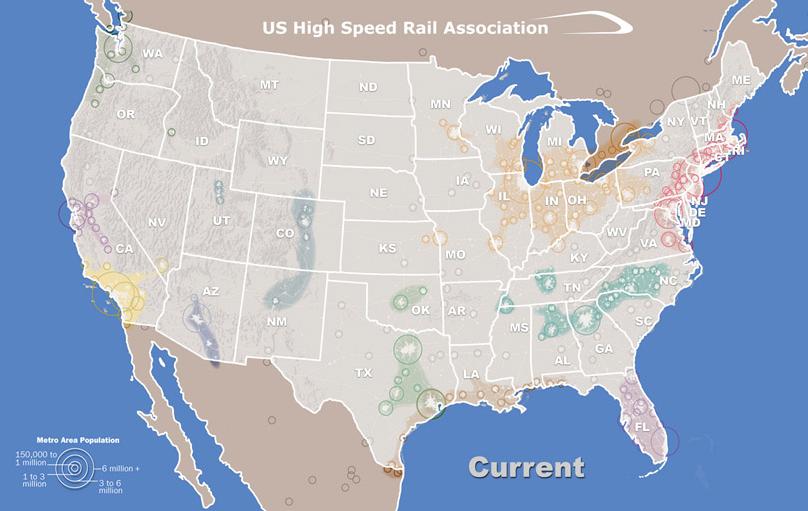
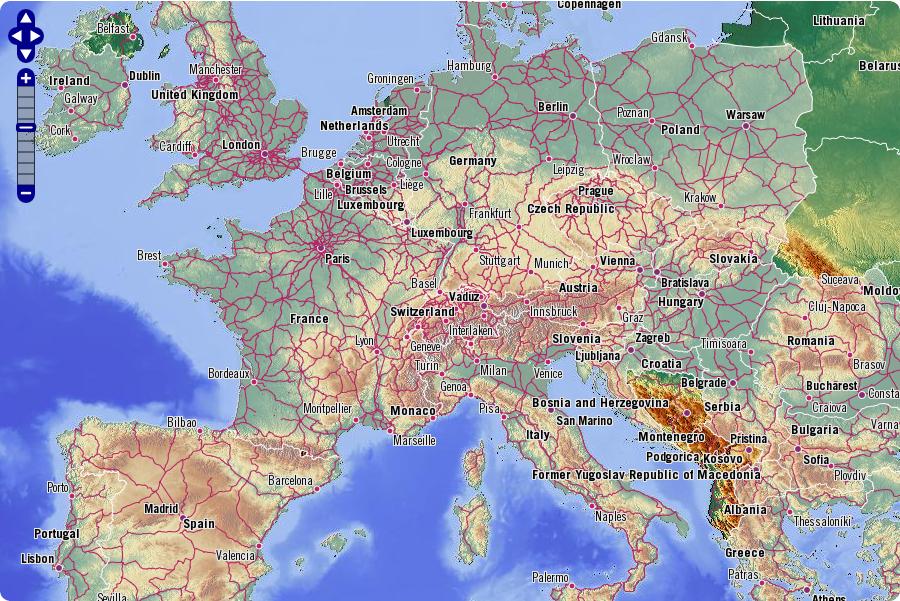
Don’t get me wrong, I love flying just as much as the next person and I’d much prefer it for travel to/from Europe to/from North America — who’d want to take a passenger ferry across the Atlantic given how much longer it would be? When I look at what the current high-speed rail map in the US looks like and then I look at the current high-speed rail map of Europe… it’s flabbergasting!   I’ve hyperlinked the two maps to bigger versions of themselves, so you can really get an idea for how much more advanced Europe is than the US when it comes to their rail system. It’s almost a little embarrassing just how much farther ahead Europe is in this regard.

Some people try to argue that Europe is much smaller, so a rail system makes more sense there. Well, as we can see from the image to the right (), Europe is not actually that much smaller than the USA. In fact, they’re pretty comparable in size. One of the reasons that Europe can sometimes be perceived as smaller than the USA is a function of . Regardless, from my perspective, there really aren’t any good reasons as to why the US hasn’t adopted a high-speed rail system. Even adds his two cents to the debate. In all my time watching Bill Nye as a kid (and in the classroom), I don’t think I’ve ever heard him speak so blatantly negative about anything! He must really feel passionate about this particular circumstance.

Not everything surrounding the high-speed rail system in the US has to be about negativity. In taking a closer look at what the network of rail systems will look like when the projected plan is completed (in 2030), is kind of exciting. Passengers will be able to go from Vancouver, BC, to Miami, FL — all by high-speed rail! They could go from San Diego, CA, to Montreal, QC, again — all by high-speed rail! For me, someone who cherishes the value of public transportation, this is really exciting.

As the plans and the work for this public transportation system continue, I wonder what Europe (and Asia) will come up with next in the way of public transportation. Many areas on these continents already have high-speed rail systems, so, it is logical to think that they will be busy thinking up the next great transportation revolution. Regardless, I’m very excited to see the progress being made in the world with regard to public transportation.

Should We Have Seen This Coming?

While history is made everyday, in the , there was at least a bit of foreshadowing. During these elections, the was the highest it has been since 1938 – when FDR was President. Much of the ink printed around the midterm elections was focused on the prospects of . While that is also an important issue, the pressing matter of today seems to be what is happening in Wisconsin and whether or not it will happen in other states like Ohio, New Jersey, Florida, and Michigan.

I remember when the numbers were rolling in, and the state legislatures began to flip (from Democrat to Republican) such that , that it may prove to be ominous. While I may have thought it to be a foreshadowing of things to come, never could I have predicted (nor do I think others could have) the . Not to mention the kind of national spotlight that has been thrust upon the issue(s) at hand.

I’m wondering, though, if the political arena should have seen this coming when all the state legislatures flipped in November (of 2010)? Like I said, in my non-exhaustive search, I didn’t find anyone predicting it and I suppose you really can’t blame anyone for not predicting it. Who could have, given the data at hand? Nonetheless, it’s quite breathtaking to flip on the TV and see thousands of people gathering together for what they believe.

During my time as an undergraduate, I had a with what it takes to hold and organize a rally at a state legislature. From this experience, I can say that what is happening in Wisconsin is truly remarkable. I was only involved in a rally of about 1000 people for a few hours — these people have sustained protests of more than 50,000 people for nearly two weeks.

While someone, somewhere, may claim to have been able to predict what the Wisconsin State Legislature is doing, I would be highly suspicious of someone claiming to have been able to predict the public opposition in the way of . Citizens have voiced their opinions on issues before, but never in my lifetime have I seen it happen like this. The most interesting thing to me is the context for which this is happening.

I’ve talked about some of the recent world events and how that ,  but I think the protests in Wisconsin may not be happening the way they are if there weren’t already the massive protests in Tunisia and Egypt. The fair majority of Americans stay current in the way of the news of the day and because of technology, the news of the day is something that can become the news of this minute or the news of this second. I think with Americans being exposed to the possibility of protests and more importantly, protests working, it might have given hope or purpose to those in Wisconsin who saw fit to stand for what they believe in.

Are We Missing Something?

In following up on what , had a small bit on her tonight talking about all of the different parts of the Middle East that are experiencing seemingly revolutionary events. I think it’s quite amazing just how many different countries are going through similar unrest. I can’t imagine that anything like this has ever happened in history before.

A couple of weeks back I had the chance to catch a few scenes of . I had already seen the movie before, so it was less about ‘watching a movie’ and more about remembering what the movie was about. As I was watching it and experiencing having “ultimate” powers with the main character, I was struck by how narrow-minded the character was. The character (Bruce) was so focused on improving his immediate life and not exponentially or anything, just the ‘next’ promotion.

He thought that all he needed in life was this promotion and he worked his butt off (even with super powers) to get it. Eventually, the main character realizes that there’s more to life than getting that job that he thought he wanted. However, this is not quite what I’m interested in talking about today.

The character was so focused on what was in front of him that he was missing what was around him. His girlfriend at the time, played by Jennifer Aniston, had been anticipating a marriage proposal. When she thought she was about to receive the proposal, the male protagonist had called her to dinner to tell her that he had finally got the promotion that he was after. Heartbroken, she leaves him, but eventually, things all work out happily in the end.

In the world right now, there is so much happening. There are numerous reforms happening in the Middle East, there are happening all around the globe, there is political unrest in Wisconsin as the in the state that created them, but most of all, the needle of time continues to move from left to right. I wonder, with everything that’s happening in the world in here and now, what are we missing in the grander picture of Earth. What is it that we’re not seeing because we’re so caught up in what’s happening right now?