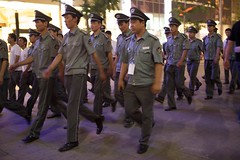
There are More Security Guards in the US than There are High School Teachers

At first blush, the idea that there are more security guards in a country than high school teachers doesn’t seem right. It’s one of those things that, when you hear it, makes you question the values of the country. After seeing the headline, I thought I’d follow the links to see just where the sources came from. It turns out that the source is an academic who, thankfully, included a list of sources.

It seems to me that this is perfectly in keeping with the theme of my last post. For a country that’s national defense headquarters spends more money war than all 50 states combined spend on health, education, welfare, and safety, why wouldn’t you also expect there to be a plethora of security guards employed in the country? I suppose the hope would be that there wouldn’t be more of them than high school teachers.

Given the decline of US education, I wonder if the US might be better served if they took even one-quarter of the security guards and turned them into teachers. Of course, simply taking away their flashlights and guns and giving them chalk won’t necessarily solve the problem of the US falling behind in education across the world, but with some effective training, they could turn out to be pretty good teachers.

I suppose there’s more to it than that, though. Simply shifting one segment of the workforce to another won’t necessarily change the tacit values of the culture that led to this kind of development. That is, as I mentioned earlier regarding the budget of the Pentagon, it might just be that at America’s heart, this is what they value — defense over education. I wonder if there’s a poll out there juxtaposing the two. That is, if citizens were forced to choose where they’d rather have their dollars spent, would the rather it spent on education or defense? Even asking a question like that is difficult given the exposure to the media. In a vacuum, folks might prefer education to defense, but because of the news reports they’ve seen/heard over the last few decades, they’d put their dollar into the defense bucket. One could then argue that nothing really occurs in a vacuum, so that it probably proves nothing. Nonetheless, I’d be interested to see just how many Americans would choose defense over education.

I should clarify that I’m not saying that the US should spend nothing on defense, but when you get a certain point, the marginal utility of a dollar spent on education has to be higher than the the marginal utility of a dollar spent on defense.

Is There a Way to Broadcast Ideology Without it Colouring Opinion?

There was a good article in the New York Times this past weekend from a professor of economics at Harvard, N. Greg Mankiw. He talked about how when economist give advice on policies, they’re also giving advice as political philosophers. While this should come as no surprise to anyone, I think it’s good that it’s being discussed.

What’s more interesting to me, though, is how we can offer opinions or advice on matters as experts, while at the same time disclosing our inherent bias to a given political philosophy. And if we do this, does that then colour the way the opinion is received? Most folks would say that of course it is going to colour the way the opinion is received, but maybe it wouldn’t. Regardless, I think it’s necessary to disclose biases, especially when it comes to making policy advice.

The problem here is that people aren’t always aware that they have a given bias towards one political philosophy over the other. While I’m relatively sure that I lean towards the “left” of the political spectrum when it comes to social issues, where I fall upon the political spectrum when it comes to other matters can vary by issue. This is part of the reason why I encourage folks to take the time and read through some of the more notable philosophers.

I suppose the idea of signaling also comes into play on this matter. That is, if someone has a more conservative viewpoint on health policy and they support a more liberal policy, does that change the way other conservatives view the policy? Does it change the way liberals view the policy? Should it?

There are lots of questions, but no easy answers. As someone who’s steeped in biases in judgment and decision-making, I’m not sure which way would be best, but I’m glad that — at a minimum — it’s being discussed.

If We Want to Change the World, We’ve Got to be Better Parents

Note: I’ve been away from writing here for the past 6 weeks or so. My writing will continue to be less frequent than it used to be, but my plan is to at least write something once a week. Hopefully, it can be more frequent than that, but we’ll see how things go. I chose this post’s topic to return to writing because, as fate would have it, I’ve recently become a dad!

As some of you know, I like to use my favourites on twitter to accumulate things I want to write about or read. As I haven’t been writing very much in the last little while, the list of my favourites that I want to write about has grown — quite a bit. There were two tweets that I’d been saving to write about because I knew that it would fit perfectly with my return to writing. Both were about parental leave.

As you can see from the map above, the United States is the only western country that doesn’t have paid maternal leave. Of course, you’ll find that many companies offer paid maternal leave for people in the US as a way to stay “competitive,” but this isn’t something that’s required by law. This is a travesty. Unequivocally. Nothing is more important for a child’s growth than having their mother near in the early stages of life. Nutrition is tantamount to the survival of the child, but so is tender loving care.

Europe, in particular some of the Nordic countries, really understand this:

Swedish parents now receive a total of 480 days of leave per child, 390 days of which is paid at 80 per cent of salary (up to a maximum of $162 a day).

Quite frankly, the necessity for maternal leave is so obvious that one shouldn’t even need to argue for it. Instead, the debate should be about how long maternity leave should be.

While the US continues to shirk its responsibility to mothers, there’s an interesting argument that offering (more) paternity leave would help to close the gender gap. It’s certainly a compelling argument and the study in Quebec lends credence to the idea, but I think this is another one of those “no-brainer” kind of policies. Of course there should be paternity leave. Of course fathers should be there for their young infants and the new mothers. There is so much work required in the early stages of an infant’s life that I can’t imagine a mother trying to do this all by herself. And as history would tell us, they’re not meant to.

Only recently has our society shifted in a way that it’s become the “norm” for mothers to stay at home by themselves and tend to the children. As a new father, I’m embarrassed by this. If we want to do right by our families, our countries, our societies, and the world, we’ve got to take more time to spend shaping our young ones who will inherit the world.

Why Poor People Have Harsher Moral Judgments

Morals is certainly one of my interests, as is evidenced by my series on Michael Sandel’s bookWhat Money Can[‘t] Buy. And so, when I came across a journal article called, “A Lack of Material Resources Causes Harsher Moral Judgments,” I was intrigued, if not a bit saddened.

The researchers attempted to test the idea of whether a lack of material resources would cause people to have harsher moral judgments. The reason they posited this was because a lack of material resources is correlated with a lower ability to cope with other people’s harsh behaviour. Not only were they able to prove that a relationship exists between a lack of material resources and harsher moral judgments, but they were also able to prove this true in state dependent instances. Meaning, yes, a lack of material resources corresponded to making harsher judgments, but even when participants perceived themselves as having a lack of material resources, they offered harsher moral judgments.

The implications of this research seem rather important.

While it’s not specifically addressed in the study, I wonder what the plotted relationship between harsher moral judgments and income would look like. That is, I wonder at what point does income no longer correlate with harsher moral judgments. In particular, I wonder about the whole idea that there are 24 times as many millionaires in the US Congress than there are in the US population. As a result, I’d expect that moral judgments would be less harsh (than if there were fewer millionaires), but we know that doesn’t quite make sense because there are more things than just income that affect moral judgments.

More recently, however, I wonder about the World Economic Forum and the data released that less than 100 people have as much wealth as over 50% of the world’s population. By the information gleaned from the study, we’d expect that over half of the world’s population would have harsh moral judgments.

On a smaller scale, I’d wonder about the psychological health of people who have harsher moral judgments. It may seem only tangentially related, but negative thinking has been shown to have negative effects on one’s health. As  result, I’d expect that these harsher moral judgments might have an effect on one’s health.

ResearchBlogging.orgM. Pitesa, & S. Thau (2014). A Lack of Material Resources Causes Harsher Moral Judgments Psychological Science DOI: 10.1177/0956797613514092

Could There Be No Poor Countries in 20 Years? Bill Gates Thinks So

Screen Shot 2014-01-21 at 1.10.10 PMThis is probably one of my favourite headlines I’ve had to write so far this year, especially on the heels of yesterday’s post about less than 100 people having more wealth than half of the world. In the Bill and Melinda Gates’ Foundation annual letter, Bill Gates is optimistic, to say the least:

I am optimistic enough about this that I am willing to make a prediction. By 2035, there will be almost no poor countries left in the world. (I mean by our current definition of poor.) Almost all countries will be what we now call lower-middle income or richer. Countries will learn from their most productive neighbors and benefit from innovations like new vaccines, better seeds, and the digital revolution. Their labor forces, buoyed by expanded education, will attract new investments.

By current definition of poor, Gates clarifies that he means that, “almost no country will be as poor as any of the 35 countries that the World Bank classifies as low-income today, even after adjusting for inflation.”

WOW!

Can you imagine a world where this happens? And Gates thinks that this could happen by 2035 — that’s 20 years from now! Twenty years!

A few months ago, I wrote a post considering what might be my generation’s version of racism:

I’ve spent a lot of time talking about my generation in comparison to generations past, but the true purpose of this post is a juxtaposition of the generations to come. As I said, it seems that past generations had a harder time than mine digesting the mix of cultures. For kids growing up today (in certain countries), it’s abundantly clear that there are people who look different from them and it’s just normal to grow up and be friends with people like this. My question, what is it that my generation will have a hard time with that future generations will see as natural?

Maybe a tangential answer to that question is poverty. Maybe in my lifetime, poverty (as we know it) will be eradicated. That’s certainly a wild idea given the current state of the world, but I for one would be thrilled to see this come to pass as I imagine others would be. With that being said, I could see how some folks might not be as accepting of this change and that’s not to say that they wouldn’t want poverty to be forever changed, but just that they might be a little less comfortable with the change.

As an example, let’s use technology. Generations before mine had technology that was quite different from what we use today. That is, the invention of TV was amazing. Now today, we can watch TV on a device that we can carry around in our pocket. Some folks from past generations are amazed by this and might still have a hard time adjusting to this reality.

That’s how I’m trying to superimpose the possibility of the eradication of poverty for my generation. Some folks might have a hard time adjusting to this reality. Regardless of the comfortability of some folks with this potential reality, I think it’s great that the Gates’ have wrote a letter helping to debunk some of the myths in developmental economics:

  1. Poor countries are doomed to stay poor.
  2. Foreign aid is a big waste.
  3. Saving lives leads to overpopulation.

I definitely recommend checking out the whole letter, which you can read here.

85 People Have As Much Wealth as 3.5 Billion People

Just think about that headline for a second… 85 people have as much wealth as 3.5 billion people. Eighty-five vs. Three and a half billion. Maybe looking at the words isn’t enough, let’s look at it in numbers. 85 vs. 3,500,000,000. If I were graphically inclined, I’d make a quick “infographic” showing 85 people on one side and 3,500,000,00 on the other side. That’s an astronomical difference.

The article in The Guardian where I first read it had a good analogy:

The world’s wealthiest people aren’t known for travelling by bus, but if they fancied a change of scene then the richest 85 people on the globe could squeeze onto a single double-decker.

This isn’t the first time I’ve written about wealth inequality and it probably won’t be the last. There are two posts that come immediately to mind. The first is the one from a couple of years ago where I shared a graphic that came from a paper by two researchers studying the wealth distribution in the US. Most notably from the graphic was that the perception of American was way off from reality. Americans thought that the top 20% had approximately 60% of the wealth and they wanted the distribution to be that the top 20% was closer to 30%. In actuality, the top 20% (at the time) had close to 90% of all wealth in the US.

The second post was just under a year ago and it took a deeper look at the graphic that I shared in the first post. Someone animated the chart, that is to say, they made a video of the information to make it more accessible to people and it was shared heartily across the internet — it’s currently over 14,000,000 views.

So what does all of that have to do with today’s information? Well, as is pointed out in the article in The Guardian, the World Economic Forum is starting in a few days, so talking about these kinds of issues are important. That is, reminding folks that the people in attendance at Davos will make up well over half of the wealth in the entire world

The image I’ve used for this post comes from that same article and it’s how I’d like to finish today’s post. Take a look at the United States. In 1980, the top 1%’s share of the national income was 10%. In 20 years, that’s doubled to 20% (of the national income). There’s been movement in other countries, but none as great as the US. I’m not picking on the US, but it’s quite clear that if you’re interested in being part of the wealthiest sect of the world, the US is a good place to do just that.

My point in sharing this image is to forward the conversation on this matter. People have very different opinions on how money should be spent, especially when that money is tax dollars. I’m not necessarily trying to trumpet one opinion more than the other, but I think it’s important to highlight this massive disparity and question whether this is how we want to live in the world.

Would You Rather Pay Fees or Taxes?

A little over a week ago, Matt Yglesias wrote a post on Slate about how to balance the budget while slashing taxes. The solution: call everything a fee.

Well we could solve an awful lot of problems that way. For example, I’d love to see us impose a greenhouse gas emissions fee to internalize the social cost of carbon dioxide. On top of that, I think a small additional fee on the use of gasoline would be justified. And of course road congestion fees on crowded highways. I used to think we should raise the alcoholic beverages tax, but now I think we should eliminate it entirely. Instead, let’s put an “alcohol fee” in place that just happens to be higher than the current tax. Do the same for cigarettes. Legalize marijuana, but subject its sale to a rather hefty fee. It actually turns out that we could replace most taxes on labor and capital with a land occupancy fee, especially if we call it a “land occupancy fee” rather than a “land value tax.”

After reading this post, it made me think of Michael Sandel’s chapter about fines versus fees. Maybe some of the things that Yglesias is talking about in this post should actually be labeled fines and not fees. For instances, if we’re talking about internalizing the social cost of carbon dioxide, isn’t there a moral piece to it? That is, shouldn’t we call this a fine, then? You may disagree, but the nomenclature in this case does matter.

It seems a bit absurd to think that people would be more amenable to paying money for something merely by changing the label from ‘tax’ to ‘fee,’ but labels matter.

While it’s certainly a creative idea to start charging fees and lower taxes, there is an important bit to consider here. Namely, the control of these fees. Have you ever had to pay a fee to get your license renewed? Do you know how much it costs the government to ‘actually’ renew your license? I don’t. But I know that I get charged close to $100 to renew it. Josh Barro solidifies the point:

Politicians tend to regard fees as more palatable than taxes, and more focused too. If a state needs to finance an infrastructure to oversee fishing, why shouldn’t fishermen foot the bill? But groups like the nonpartisan Tax Foundation in Washington worry that governments are now using fees to shore up budget shortfalls rather than cover specific costs incurred by specific users.

“When it comes to paying for bananas, you’ve got the market as a mechanism to make sure you’re paying a fair price,” says Josh Barro, a staff economist at the Tax Foundation. “But when it comes to getting your driver’s license renewed, the government has a monopoly, and you have no idea what it costs the state or what it’s doing with the money.”

The moral of the story: maybe taxes aren’t so bad after all.

Markets and Morality: Why We Shouldn’t Trust Markets with Our Civic Life

About a month ago, I finished up a series about Michael Sandel’s book, What Money Can’t Buy. I really enjoyed reading through the chapters and chewing on the material. As you may recall, I also highly recommended watching Prof. Sandel’s course: Justice. A few day ago, I noticed that one of Sandel’s more recent TEDTalks was published online. After watching it, I thought I’d pass it along to you as a great way to get a quick understanding of some of the things that Sandel talks about in his book. The talk was filmed this past summer.

As I think about markets and morals, I can’t help but seem to agree with much of what Sandel is saying. I’m also aware that not everyone shares his opinion about markets and morality. Do you agree? Do you think that allowing markets to decide everything is crowding out morals? I’d be really interested to hear your opinions.

I do as best I can to take in opinions and information that is contrary to my opinions, but it can be difficult. Especially in the internet environment, it’s quite easy to get caught up in the echo chamber of your own thoughts and beliefs. That’s part of the reason that I try to write posts that provide a new perspective on issues.

On this matter in particular, I’d like to your opinions on Prof. Sandel’s idea of markets and morality. In fact, I’m hoping that some of you disagree with Prof. Sandel and you think that markets are truly the answer to everything. I’m hoping that you think that markets should operate in every part of our lives. I’m hoping that you think what Prof. Sandel is saying is wrong. Most of all, I’m hoping that you can offer a cogent response that’s at least half as well-sourced as Prof. Sandel’s book.

The Most Effective Form of Discipline: Punishment or Empathy?

Have you ever broken the rules? If you’re answering honestly, no doubt, your answer should almost certainly be yes. If you drive, you’ve probably rolled a stop sign once or twice in your life. Or, you’ve probably at least barely gone over the speed limit, even if you were trying to maintain a speed below the limit. There’s always jaywalking. That is, you’ve probably crossed the street when you weren’t in the crosswalk when the walk sign was on the cross. What about taking office supplies from work? You may feel justified in doing so, but I bet if you read your contract or the rules/regulations of your organization, it’s not something that’s endorsed. There are probably plenty of other examples where you’ve broken a rule (accidentally or intentionally!), but there may only be a few (one?) where you’ve had an experience that changed your life.

I don’t necessarily mean that it changed your life in some profound way (although it may have). I’m speaking more towards those experiences that you’ll always remember. The lesson(s) you learned from the experience(s) was/were just what you needed at the time. Do you have one of those experiences? Now that you’re thinking of that experience, I wonder: did you receive a punishment for breaking the rules or did you get off with a warning?

I’d hazard a guess that if I polled those of you reading this article, the majority of you would say that the experience where you were left off with a warning was the one that stuck with you. And why is this? Empathy. Compassion. Kindness.

These are human expressions that tend to touch us in ways that the antithesis of these expressions don’t. It’s a tired sentiment, but the news is filled with negativity. As a result, experiences that show us the opposite of this negativity tend to shock us. This surprise tends to stick with us and the experience can teach us something we weren’t expecting.

I’d like to share an example that I think accentuates my point. I came across an answer on Quora to a question asking about people’s best experiences with police. This particular answerer, Andrew Bosworth, was 16 years old and on his way home from Sacramento to the Bay Area. He was really tired and knew he was driving somewhat erratically. He’d glance down at the odometer and he’d be just as likely to be going 20 mph over the speed limit as he would be going 20 mph under the speed limit. Eventually, he was pulled over by the California Highway Patrol:

Instead of giving me a ticket, he pointed down the offramp to a place I could get some coffee and rest. He asked if I had enough money to get some coffee and offered to give me some if I didn’t. He said if I really couldn’t get back to an alert state that I should call a friend or my parents and get a ride because what I was doing wasn’t safe for myself or other drivers.

Honestly, I can’t imagine that getting a ticket would have had nearly as big an impact on my driving as the short, compassionate conversation that officer had with me that night.

While there are certainly times where some form of punishment may be more appropriate, I’d like to believe that in many cases, compassion and empathy can be just as, if not more, effective.


Twenty Online Talks That Will Change Your Life, Part 1

A little over a week ago, I wrote a post about the 20 biggest questions in science. It turns out, The Guardian must have been on a listicle-kick because they also recently published a list of the 20 online talks that could change your life. Some of these I’ve seen, so I thought I’d go through them in the same way I did for the science questions from last week.

1. How Economic Inequality Harms Societies – Richard Wilkinson

I was so glad to see that they started with this talk. This talk is by a British researcher who has dedicated his life’s work to social inequalities. Along with Kate Pickett, he published a book called The Spirit Level. I remember reading it a few years back. It’s chock-full of resources and citations that formed the basis for the beginning of the recent discussion on inequality. Of course, there are folks who don’t see eye-to-eye with Wilkinson and Pickett.

2. Your Body Language Shapes Who You Are – Amy Cuddy

3. Violence Against Women – it’s a Men’s Issue – Jackson Katz

I haven’t seen Cuddy’s talk, but I’ve read a number of her journal article. She certainly knows what she’s talking about and is worth your time. I haven’t seen Katz’s talk either, but it really reminds me of the work of Miss Representation and The Mask You Live In.

4. Depression in the US – Robert Sapolsky

5. Listening to Shame – Brené Brown

6. Why I Am Not a Christian – Bertrand Russell

7. We Need to Talk About an Injustice – Bryan Stevenson

If you haven’t seen Stevenson’s talk, now’s a good time to do it.

8. The Art of Asking – Amanda Palmer

Not many TEDTalks have caused such a ruckus so quickly. I remember when this talk first happened earlier this year and was put online. Here were my “quick thoughts” after first watching it:

Amanda Palmer: A big congratulations! This TEDTalk certainly created news yesterday. For some, it’s because she didn’t answer questions that some had asked regarding the Kickstarter funds, for others, because she raised some important ideas about the music business. It’s certainly not easy to challenge mainstream ideas and even harder to do so with so many people who think you’re wrong (and are shouting that at you).

The Art of Asking: For some, there is nothing harder than asking for help. Asking for what you’re worth. People who are just starting their own business often have lots of problems trying to figure out just how much they should charge. Much of this has to do with psychology and our ideas of self-worth, but there’s also the cultural stereotype that it’s not okay to ask. It’s so great that Amanda could demonstrate how asking is not something to be afraid of.

Vulnerability: On the topic of asking… I remember reading about people who pose as beggars — not for the money, but to gain the experience of what it’s like to beg or ask for money. It’s not something that I’ve done, but after watching this TEDTalk, it’s an experience that I think is certainly worth considering. It might shatter stereotypes of what it’s like to ask for help and would certainly foster a greater sense of empathy.

Trust: Without getting too much into a philosophical discussion, it’s great to see a tangible example of someone who “trusts the flow of life,” and is rewarded for it.

As with Stevenson’s, if you have the time, Palmer’s is certainly a talk worth watching.

9. The Myth of the Gay Agenda – LZ Granderson

10. Brilliant designs to fit more people in every city – Kent Larson

After reading the description for Larson’s talk, I couldn’t help but think that the work of Richard Florida, noted urban theorist, is probably mentioned in the talk.

We’ve covered the first ten talks. This seems like a good place to pause and take a break. Check back tomorrow for the rest of the talks.