Which US City Has the Worst Drivers: No Weather Variable?

A few days ago, there was an article on Slate that claimed to investigate which US city had the worst drivers. I thought the article was interesting as it’s probably something that everyone has an opinion on. That is, we all think that we know where the worst drivers in the US live. After reading the article, I was surprised — thoroughly — that there wasn’t a mention of weather.

Having grown up in Canada, (near Toronto), I am absolutely used to driving in snow and other forms of precipitation. After having lived in 4 different US states (and spending time in 31 others), I feel supremely confident in saying that not everyone is comfortable driving in forms of precipitation. While not an extraordinary revelation by any means, it still seems important. I had to read through the article a couple of times because I didn’t believe there was no mention of ice, snow, snain, or something else related. Weather absolutely affects the way that people drive and their comfort with precipitation will have certainly affect their ability to drive.

~

I’ve written before about unexpected snow in Washington, DC, but I don’t think I’ve talked about one of the conversations I’ve had with someone who’s lived in Metro DC for over a decade. She was explaining to me that, not only do you have such a wide variety of drivers in the DC area (those who’ve moved from the South or those who’ve moved from the North or those who’ve moved from the West, etc.), but you’ve also got the weather. More specifically, she was explaining that the “moderate” winters in DC make it awful for driving conditions. When the temperature hovers near freezing, the afternoon rain turns into morning ice. For those who have no experience driving in icy conditions, it can certainly cause drivers to be extra cautious (or mistakenly, not be cautious enough).

This is why I think it is important for any discussion of “the worst drivers” to include a weather variable. Sometimes, we need to be careful we’re not misappropriating the blame.

Plutocrats Author Running for Parliament in Canada

I happened to be reading through some of my old posts and noticed that I was going to write a post after I’d finished reading Plutocrats. I guess somewhere along the way it got removed from my to do list. I did write something that came to me while reading the book about looking down our noses, but nothing really about the book after that.

I think the author, Chrystia Freeland, did a really good job of bringing the issues to light and explaining them in ways that were accessible. It’s been more than a few months since I read it, a couple of the main points stuck with me.

1. It’s not just the wealthy that control the global economy, but the uber-wealthy.

Meaning, it’s not the 1% that are controlling the economy and affecting the 99% (as was the main message from Occupy Wall Street), but it’s the 0.1% who control the economy and affect the 99.9%. This may seem like splitting hairs, but Freeland offers compelling data that shows even the “wealthy” (i.e. the 1%) look like small potatoes next to the 0.1%.

2. The wealth gained by these folks wasn’t necessarily from unsightly means.

I don’t know remember if she says unethical, but some may consider it unethical. She makes the case that the uber-wealthy got that way — and continue to stay that way — because they’ve manipulated the market to funnel the wealth in their direction. She also does a little bit of debunking of the “trickle-down” economics perspective.

Overall, like I’ve said before, it’s a book that’s certainly worth reading.

~

Something that I find fascinating — Freeland was (as of a few days ago) a Managing Director and Editor of Consumer News at Thomson Reuters. As you learn from the book, this position allowed her to cultivate the contacts with people in high places to make the book that much more compelling (with stories and anecdotes).  Anyway, like I said, she had this position. She recently left it. Why? She’s running for a seat in Parliament. The Canadian Parliament (she is Canadian).

One of the most storied politicians in Canada in recent history (Bob Rae) left his seat in Toronto Centre to become the chief negotiator for the James Bay area First Nations in negotiations with the provincial government. This vacated his seat and as a result, they’ll be a by-election in the Fall (date not set, yet). Freeland has met with some of the Liberal Party of Canada leaders and decided to seek the seat.

I don’t know if she’ll win the seat (she hasn’t even won the right to represent the Liberal Party just yet), but if she does, I wouldn’t be surprised to see her become part of the “brass” very quickly. In fact, if Justin Trudeau and the Liberals can win enough seats to form a minority or majority government, I wouldn’t be surprised to see Freeland become a Cabinet Minister or at the very least, a senior advisor. Of course, the Federal election isn’t until 2015, but it’s certainly something to think about.

Does the Middle East Today Look Like Europe Before WWI?

I recently saw a tweet that was rather intriguing:

If you care about international relations, this probably was rather intriguing to you, too. The part that got me interested was the comparison between what Europe looked like before WWI and what the Middle East looks like today. There’s been plenty written about the Middle East with things happening in Syria, Iran, Iraq, Saudi Arabia, Bahrain, etc. So, I thought this post from Foreign Policy would make some interesting parallels between what Europe looked like then and what the Middle East looks like now.

Sadly, this wasn’t the case. It seemed that this brief article was more about what the strategy should be for the US in the region. While that’s probably important, I was more interested in looking at things from a historical perspective. As far as I can tell, history often repeats itself and as a result, it is one of our greatest teachers. So, if we could learn something about what happened in Europe before WWI, that might give us some indication of how things are going to proceed in the Middle East. Of course, it’d be purely speculative, but it might be enlightening.

I don’t know enough about what Europe looked like before WWI nor do I know enough about what the Middle East looks like now to make informed guesses. If I did, you can be sure that the rest of this post would have been a comparison of those two topics. The one thing I will say, though, is that I bet that if conflict does bubble over like the Admiral is *kind of* predicting might happen, I wouldn’t be surprised if there are some parallels to what happened before WWI.

The Audacity of Hope: Obama’s Impromptu Speech About Trayvon Martin and Race

This afternoon, President Obama surprised everyone by making an appearance in the White House press briefing room. He spoke for approximately 17 minutes about Trayvon Martin, race, the law, and some other things. Part of the specialness of this speech was that it was impromptu (at least it appeared that it was unplanned) and was unscripted. [I couldn’t embed the video, but you can see it here.]

There were a lot of key things that he addressed in his speech, but what I thought to be the most important was the last few minutes. In the last few minutes, President Obama said that the younger generations are doing it much better than previous generations. The implication here is that the younger generations are less racist (or less unapproving) than previous generations. He talked about how he would listen to Malia and Sasha (his kids) speak with their friends and hear how they interacted. As a result, he thinks that the younger generations are doing it better than the older generations.

As I heard him say that, it made me think about how our countries are governed. Right now, the people who run the country (and by extension, the world) are older. I wonder what it’d be like if we had younger people who ruled the world. Maybe younger people would “get us there faster.” As a way to temper the eagerness of young people, maybe it’d be important to have some people from older generations to be advisors.

I wonder… are there any countries, states, provinces, counties, cities, or towns that are run by “younger” people? Are they more successful? Could we map this onto bigger populations with the same success?

~

For the first 14+ minutes, it seemed like there was an almost sombre tone to President Obama’s remarks. However, as he shifted to talking about the younger generations, I got the sense that he had hope for the future. I got the sense that he had hope for the future of the country because of the progress he sees in younger generations. While nothing is certain about the future nor are the implications, I’d like to think that it’s rather poetic that the leader of the United States believes in a brighter tomorrow. That President Obama believes that we are getting better as a society. As a people. That we are beginning to treat each other with more respect. More love. More kindness. And the hope is that this will continue with each succeeding generation. Hope.

Who Wants to Play Sports in 122° Weather, in the Middle East, in the Summer?

A couple of days ago, I saw a headline that the FIFA President, Sepp Blatter, was going to ask the executive committee to consider moving the 2022 World Cup, set to be played in Qatar (a country that borders Saudi Arabia), to the Winter. It seems to me that this should have been considered when Qatar was chosen as the host back in December (is that ironic?) of 2010.

I did some checking and since there’s been a World Cup for soccer (or football, depending on your geographic orientation), the event has always taken place in the “summer.” Every World Cup happens in the month of June or July. A few times, it started in May, but it has always, at a minimum, gone into June. Some have taken place solely in July. None of the previous 19 World Cups (dating back to 1934) have taken place in any of the other months. So, it would seem, considering moving the 2022 World Cup to the Winter would be unprecedented.

Adding another layer to this debate is that the English Premier League (one of the best soccer/football leagues in the world), isn’t interested in having the World Cup move to the Winter as it will affect their schedule. Not only will it affect one year’s schedule, but it’s likely to affect two year’s schedules. And, it will have an affect on broadcasting contracts.

As I read more and more about this story, I’m still flabbergasted that something like this wasn’t considered. It seems that someone, somewhere along the line should have thought about playing sports in 122° weather, in the Middle East, in the Summer. Along those same lines of due diligence or “thinking ahead,” I remember reading something recently about concerns that it won’t be cold enough in 2014 for the Winter Olympics in Sochi, Russia. Let’s hope that those concerns aren’t realized.

Lies, Damned Lies, and Statistics: America’s Dependence on Mideast Oil

Earlier this morning, I came across a headline that was a bit shocking (to me): “Americans Support the Keystone XL Pipeline by Wide Margin.” All of the data I’d seen regarding polls of Americans showed that there certainly wasn’t a wide margin in support or against the pipeline. So, with my curiosity piqued, I clicked the article to find out that 67% (of the survey respondents) support building the pipeline. That still seemed a bit surprising, as, like I said, most polls I’d seen had stayed in the range of 45/55 or 55/45.

Upon getting to the actual survey, I scrolled to the question that led to the headline. Here’s the question that was read to survey respondents:

The President is deciding whether to build the Keystone X-L Pipeline to carry oil from Canada to the United States. Supporters of the pipeline say it will ease America’s dependence on Mideast oil and create jobs. Opponents fear the environmental impact of building a pipeline. What about you – do you support or oppose building the KeystoneX-L pipeline?

Do you see anything wrong with this question?

Let’s start with the idea that they’re telling respondents what supporters say and opponents say. If the respondent doesn’t really have a strong opinion about the question, they may prefer to identify with one group or the other (and they might even if they have a strong opinion!) One could argue that there’s a response bias present. There has been quite a bit of press about “America’s dependence on foreign oil.” So, someone might not want to oppose that viewpoint in a survey. That is, the respondent wouldn’t want to appear, (to the person conducting the survey), that they don’t think that reducing America’s dependence on foreign oil is as important as the environment.

Juxtaposing the dependence on foreign oil with environmental impact is a bit unfair. As I said in the previous paragraph, I’d bet that most people have heard/read something about the America’s dependence on foreign oil, but they probably don’t know very much about the environmental impact of oil. Now, that could be a messaging problem for the environmental movement, but there hasn’t been a compelling enough case made. (If there were, there certainly wouldn’t have been this many people who were “A-OK” with building the pipeline.)

Lastly, let’s actually examine this so called dependence on foreign oil. From the US Energy Information Administration:

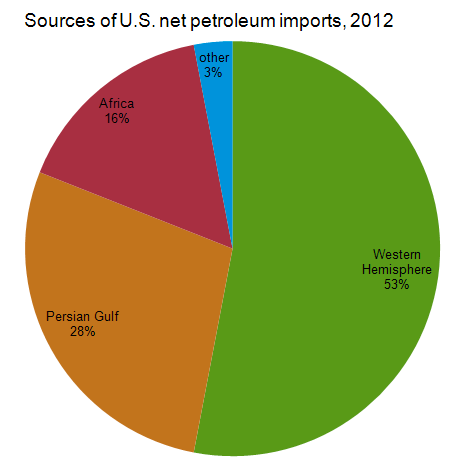
The United States relied on net imports (imports minus exports) for about 40% of the petroleum (crude oil and petroleum products) that we consumed in 2012. Just over half of these imports came from the Western Hemisphere. Our dependence on foreign petroleum has declined since peaking in 2005. [Emphasis added]

In doing the math, 60% of the petroleum (oil) that the US consumed in 2012 was produced domestically — inside the US! In doing some more math, we’re told that just over half of the imports came from the Western Hemisphere. Meaning, less than half of the imports are coming from countries outside of the Western Hemisphere. Meaning, less than half of the imports could be coming from the Mideast and we already know that only 40% of the oil consumed in the US comes from imports. In fact, this same agency tells us just how much oil is imported from Persian Gulf countries: 29%. So, 29% of the imports (40%) is how reliant the US is on Mideast oil. Again, doing the math the total US consumption of Mideast oil: 11.6%. Does 11.6% sound like dependence?

If you recall the last line of the quote from the agency: “Our dependence on foreign petroleum has declined since peaking in 2005.

The next time you read survey data, I hope you’ll remember this post and consider just how construed the results may be.

[Note: The title of this post is a quote that was popularized by Mark Twain.]

Can There Be Too Much of a Good Thing?

Earlier today, I saw a tweet from Mental Floss about the home run derby. In fact, it wasn’t about the home run derby that happens the day before the Major League Baseball All-Star Game, no, it was about the home run derby TV show from back in the 1960s. After being reminded of the home run derby from the 60s, I wondered, can there be too much of a good thing?

My first thought is, no! I love the home run derby, as do many other baseball fans. It’s a fantastical display of ability by some of the greater sluggers. There’ve been quite a few memorably home run derbies. There was Cal Ripken, Jr. in 1991. He hit 7 more HRs than the second place hitter. This was particularly memorable for me because it took place in Toronto (my hometown). There was also Josh Hamilton from 2008 when he broke the record for most HRs in one round, but went on to lose the home run derby. There was also Ken Griffey, Jr. in the last 90s. He won back-to-back home run derbies in 1998 and 1999. He still has one of the sweetest swings in the history of the game.

Then, as I thought more about it, maybe seeing the home run derby once a week would begin to take some of the shine off of the event. Maybe if the home run derby happened once a week, we wouldn’t have the once a year, mid-summer classic, to look forward to for the display of towering home runs.

Thinking about this also made me think about the slam dunk contest. It’s one of my favorite parts about the NBA all-star game. Watching the creativity of some of the best “slam dunkers” is really entertaining. If there were a slam dunk contest every week, would that be too much?

Other than actually producing the show, there’d be no way to know (for sure). If I had to hazard a guess, my guess is that it would be too much. Part of the fun of the home run derby and the slam dunk contest is that it only happens once a year. The amazing feats of ability are rare (at least in their display in this context). And that rarity also adds to the fun of the event. We know that at the end of the night, we won’t be seeing the feats again for another year.

The Mask You Live In – Gender Stereotypes in the Media

Screen Shot 2013-07-11 at 10.10.47 PMA couple of years ago, a really important documentary came out: Miss Representation. I mentioned it in my series about the people I follow on Twitter. I was surprised that when I did a search of the website that I hadn’t written about Miss Representation. The documentary brings to light how the media portray women. *Spoiler Alert* They don’t do a good job.

After I saw the film, my first reaction is that it should be required viewing in classrooms across the US (and probably Canada, too, as Canada does consume a great deal of US Media). This movie is really important, especially for teenagers and children. They need to see and understand the perversion of the portrayal of women in the media. As can be seen in the movie, a number of young girls seem quite grateful to learn that some of the beliefs that they’d internalized were a result of the media they consumed. I can only imagine the number of young girls across the US that had similar experiences upon seeing the movie. As a man, I was very moved by the the film and whole-heartedly support the cause of MissRepresentation.org (and hope you will check it out and support it, too!)

All that to say is, there’s going to be a “sequel” to the movie — this time, for the boys. Yes, we do a great disservice to our young women, but we also do a great disservice to our young men, too. The Director/Producer of Miss Representation has launched a Kickstarter to help fund The Mask You Live In. Based on some of the dates listed on the Kickstarter page, it looks like the movie is set to debut in February of 2014. I have already made a note in my calendar and can’t wait to see it!

If you have a few minutes, I strongly recommend heading over to the Kickstarter page to watch the trailer. And, if the project moves you, why not donate some money, too?

Quick Thoughts on the George Zimmerman Trial

Up until now, I’ve done a relatively good job of avoiding any of the coverage of the George Zimmerman trial. There are plenty of uninformed opinions flying around and plenty of partisan positions espoused. I’m not a lawyer nor am I familiar with the self-defense laws of Florida. I couldn’t possibly have an informed opinion.

Nonetheless, I happened to catch some discussion of the trial on NPR, while I was running some errands yesterday. I was a bit shocked to hear how some of the trial has progressed and some of the things that seem to be important (one of the witnesses not speaking the “Queen’s English“). My thoughts about the situation stem from some of the things I heard back when the event first transpired last winter.

I don’t remember where I heard it, (this is *kind of* important), but I remember thinking that it seemed noteworthy. It was one of the 911 tapes that were released. The conversation was between Zimmerman and the 911-operator. Zimmerman was calling in about the person he saw walking in the neighborhood (Trayvon Martin). I don’t remember if he said ‘suspect,’ but the folks on NPR today seemed to think that he did. While that would be important, it’s not the point that I’m going to make, so I’ll move past it.

On this call, after Zimmerman alerted the 911-operator about Trayvon Martin, the 911-operator said that there was someone on the way. I don’t quite remember what was said in the interceding section, but the 911-operator must have gotten the impression that Zimmerman was going to start following Trayvon Martin because she said something to the effect of, “I’m going to need you to not follow him.” Let me say that again. The nine-one-one operator said don’t follow him. Of course, we all know that Zimmerman went on to follow Martin. I haven’t even really brought into the equation that Zimmerman was a “self-appointed” neighborhood watchman.

Bear with me for a second as we just boil down to the fact that Zimmerman didn’t follow the directions of the 911-operator. Would you do that? I most certainly wouldn’t. If I’m calling in because of an emergency of someone I see outside walking down the sidewalk, I’m not going to jump out of my house and try to follow him. I might go upstairs (if I had an upstairs), to watch where he goes. I’m not a trained police officer or security guard. What would possess me to think that I’m smarter than the 911-operator and begin following someone who I’ve just labeled “suspect?”

As I said in the beginning, I am not a lawyer, but this seems like it’s an important part of this case. And not just inside the case, but outside of the case. Do other citizens make a habit of not following the direction of 911-operators?

Political Implications of the SCOTUS Decision on the Voting Rights Act

More than a week ago, the Supreme Court of the United States rendered a decision on a case that had implications for the Voting Rights Act (VRA). The Court ruled that the formula from Section 4 of the VRA was unconstitutional. The decision has certainly enraged liberals and the political left as is clear in Justice Ginsburg‘s dissent:

[T]he Court’s opinion can hardly be described as an exemplar of restrained and moderate decision making. Quite the opposite. Hubris is a fit word for today’s demolition of the VRA.

Because of this outrage, I’ve seen some people argue that this decision was good for liberals/democrats because it will ignite those potentially disenfranchised people to vote. From Ross Douthat:

Well, to begin with, voter identification laws do not belong to the same moral or legal universe as Jim Crow. Their public purpose, as a curb to fraud, is potentially legitimate rather than nakedly discriminatory, and their effects are relatively limited. As Roberts’s majority opinion noted, the voter registration gap between whites and blacks in George Wallace’s segregationist Alabama was 50 percentage points.

… But voter ID laws don’t take effect in a vacuum: as they’re debated, passed and contested in court, they shape voter preferences and influence voter enthusiasm in ways that might well outstrip their direct influence on turnout. They inspire registration drives and education efforts; they help activists fund-raise and organize; they raise the specter of past injustices; they reinforce a narrative that their architects are indifferent or hostile to minorities.

W.W. from The Economist finds Douthat’s analysis “quite plausible.” Both articles referenced the same information I talked about yesterday: the missing white voter.

I don’t know that I necessarily agree with this assessment.

In Wisconsin a couple of years ago, citizens were pretty excited about recalling Governor Scott Walker. Some folks were really upset by Gov. Walker’s actions on collective bargaining. Democrats, Gov. Walker is a Republican, thought that they could seize this opportunity to recall the Governor. There were over 1 million signatures to recall the Governor. It seemed like there was lots of momentum and people engaged in the recall. However, during the recall election of 2012, Gov. Walker won more of the vote than he did in the gubernatorial election of 2010.

There’s another example from this past election: The Affordable Care Act. Otherwise, known as “ObamaCare.” In March 2012, when the Supreme Court heard the arguments for the case, Karl Rove wrote in the Wall Street Journal:

This week’s historic Supreme Court hearings on President Obama’s health-care overhaul will have huge political ramifications.

Then, in June, when the decision was rendered, there was this from The Weekly Standard:

In the wake of the Supreme Court’s decision upholding the constitutionality of Obamacare, the principal choice now facing Americans on November 6 will be whether to keep Obamacare or to repeal it.

Republicans and conservatives thought that ObamaCare was going to give them the chance they needed to have a Republican elected President. It’s safe to say that it didn’t turn out the way they wanted. Not only did Republicans not elect a Republican President, but they also lost seats in the Senate (when they anticipated winning more seats).

Neither of these examples perfectly map onto the VRA decision, but it seems to me that there’s a bit of an overreaction in assuming that this decision is going to be a lightning rod for Democrats. I’d say that it’s “too early to tell” how this will affect the upcoming 2014 and 2016 elections. For now, the one of the only things that can be said about the political implications of the VRA: We’ll see…