Visiting Mount Vernon: George Washington’s Lesson in Incrementalism

A few weeks ago, I had the opportunity to visit Mount Vernon — otherwise known as George Washington’s home. It was quite lovely. The grounds are beautiful — so many wide open spaces, lots of greenery, and access to a waterway. Just what you’d want in an estate, I suppose. It was a bit goosebump-inducing to be able to walk through (and be near) the room where Washington and some of the other Founding Fathers plotted.

After walking through the museums on the estate, I was a bit surprised. I didn’t grow up with American history (having spent my youth in Canada), so I didn’t know much of the story of how the United States came to be of the United States. As a result, I was surprised to read about just how tenuous the beginning actually was. Of course, I’m aware that some of it may have been a bit dramatized, but Washington did a remarkable thing (depending on your perspective).

The surprising part, though, comes when I reflect on the discussions of the “greatest” President in the history of the United States. Whenever I read articles about this superfluous ranking, invariable, Lincoln tops the list. Part of this could be because some of the articles I’d been reading about the greatest US Presidents were written right around the time that the Lincoln movie was coming out. I’m also not trying to minimize what Lincoln did for the US — it is certainly important. Although, without Washington, would there even have been an Abraham Lincoln (in the way that we know of him)?

One other thing that was interesting to read about when walking through the museum was the idea that Washington also believed that the slaves should be free. Some attribute this belief to the fact that he freed his slaves when he died. Part of the reason (it’s theorized) that he didn’t free all the slaves was because of the shaky grounds that the US was still on when he was alive. Had he tried to make such a bold movie, the US might not have survived. In all fairness, some could make the argument that the US is still struggling with Lincoln’s decision to do just that (and that was a generation after Washington apparently considered the act).

In seeing that Washington was considering freeing the slaves, it made me think about incrementalism. When I used to watch politicians debate seemingly “small” measures to big problems, I would always grow frustrated. I would think to myself, why can’t they just make the big solution? I’m reminded of the phrase, “all in good time.” Sometimes, it’s not feasible to make big changes all at once. Even the small changes take time adjusting to (in politics). Making a big change could be untenable to some groups of people.

I look at the Affordable Care Act that President Obama pushed so hard for a couple of years ago. Many Democrats and liberals were upset that there wasn’t a push for a single-payer system. One would assume that President Obama opted not to push for that because he didn’t think that it could have passed. Healthcare, in and of itself, was hard enough to pass, so trying to pass something like a single-payer system would have been that much harder.

Circling back to Washington… I wonder what he would/could have accomplished for the country had he stayed on for a third term as President. I know that he died two years after stepping aside, but if he had continued as President, would we have gotten the 22nd Amendment sooner? Would Presidents like Jefferson or Madison stayed on for more than two terms?
The Audacity of Hope: Obama’s Impromptu Speech About Trayvon Martin and Race

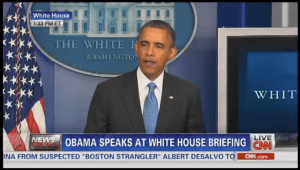
This afternoon, President Obama surprised everyone by making an appearance in the White House press briefing room. He spoke for approximately 17 minutes about Trayvon Martin, race, the law, and some other things. Part of the specialness of this speech was that it was impromptu (at least it appeared that it was unplanned) and was unscripted. [I couldn’t embed the video, but you can see it here.]

There were a lot of key things that he addressed in his speech, but what I thought to be the most important was the last few minutes. In the last few minutes, President Obama said that the younger generations are doing it much better than previous generations. The implication here is that the younger generations are less racist (or less unapproving) than previous generations. He talked about how he would listen to Malia and Sasha (his kids) speak with their friends and hear how they interacted. As a result, he thinks that the younger generations are doing it better than the older generations.

As I heard him say that, it made me think about how our countries are governed. Right now, the people who run the country (and by extension, the world) are older. I wonder what it’d be like if we had younger people who ruled the world. Maybe younger people would “get us there faster.” As a way to temper the eagerness of young people, maybe it’d be important to have some people from older generations to be advisors.

I wonder… are there any countries, states, provinces, counties, cities, or towns that are run by “younger” people? Are they more successful? Could we map this onto bigger populations with the same success?

~

For the first 14+ minutes, it seemed like there was an almost sombre tone to President Obama’s remarks. However, as he shifted to talking about the younger generations, I got the sense that he had hope for the future. I got the sense that he had hope for the future of the country because of the progress he sees in younger generations. While nothing is certain about the future nor are the implications, I’d like to think that it’s rather poetic that the leader of the United States believes in a brighter tomorrow. That President Obama believes that we are getting better as a society. As a people. That we are beginning to treat each other with more respect. More love. More kindness. And the hope is that this will continue with each succeeding generation. Hope.

Look Closely and You’ll See that America Values Philosophy and Idealism

About a month ago, I talked about the best kept secret to traveling – tours. Since that post, I’ve been back into DC a few times to visit the monuments and the other sites that there are to see. There was something that struck me as particularly poignant — the US values philosophy/ideals without even knowing it.

You wouldn’t know it to watch TV, go the movies, or listen to the radio, but deeply embedded within the US is a value of philosophy and ideals. What makes me say this? Well, in visiting the monuments, you can’t help but think this. All of these important people in American history and what’s the unifying theme (besides America) between them? They had an ideal or a philosophy and they remained steadfast in pursuing that philosophy. FDR, MLK, Lincoln, Washington, Jefferson, George Mason…

Speaking of George Mason: even though I just finished an MBA from George Mason University, there were some things I didn’t know about the man that I found particularly interesting. For instance, did you know that he was a mentor to Thomas Jefferson? How about that he was the smartest man that George Washington knew? Or, how about that he wrote the Virginia Declaration of Rights? And that Thomas Jefferson borrowed heavily from the Virginia Declaration of Rights in drafting the Declaration of Independence?

I wonder if there will be a time (again?) when these American values will be more apparent. That is, when they will be more overt.

~

After one of these trips into DC to see the monuments, I found myself sitting on a bench outside one of the stores in the Mosaic District. I was looking up at all the store fronts and thinking to myself how distracting consumerism can be. I had just spent the day steeped in American idealism — learning and reading about some of the important figures in American history and now I found myself dropped into consumerism. It [consumerism] seemed so small after FDR, MLK, and Jefferson. It seemed almost insignificant. The most appropriate word I can think of for my thoughts that day: distracting.

It really seemed like everything was distracting. That is, everything but the philosophy/idealism I had spent time with that day. The stores and consumerism — it was distracting away from the philosophy and idealism. To be fair, maybe it’s not reasonable to always be thinking about idealism and philosophy. Maybe it’s fair to sometimes indulge. I should also clarify that I’m not judging consumerism, no.

I was just noticing that after spending a day with idealism, consumerism seemed… distracting.

The Cross-Section of Social Entrepreneurship and Externalities: Social Entrepreneurship and Externalities, Part 4

In the first post in this series, we looked at the definition of social entrepreneurship. In the second post in this series, we looked at the definition of externalities. In the third post, we looked at some solutions to externalities. In today’s post, the last in this series, we’ll look at the cross-section of social entrepreneurship and externalities and wrap up the paper.

The Cross-Section of Social Entrepreneurship and Externalities

Let’s revisit our definitions of social entrepreneurship and externalities. Social entrepreneurship is the application of innovative solutions to society’s most pressing social problems in the form of massive wide-scale change, usually to the system. Externalities are a cost/benefit experienced by someone who is not a party to the transaction. Just by looking at those two definitions, my first inclination is that externalities are absolutely essential to the understanding of social entrepreneurship. Given that many of society’s most pressing social problems – in some people’s minds – can be traced back to a transaction that resulted in the negative externality, it’s hard to imagine how externalities wouldn’t be essential to the understanding of social entrepreneurship. With that being said, let’s look at some examples where these two concepts meet.

The current Director of the Skoll Center for Social Entrepreneurship, Pamela Hartigan, recently wrote a book chapter entitled, “Creating Blueprints for Business in the 21st Century: Social Entrepreneurship Shows the Way.” In it, she talks about the specific role of social entrepreneurs in the economic ecosystem. “Economic literature often pays much less attention to the role of positive externalities than it does to negative externalities. In so doing, it neglects the primary drivers of social entrepreneurial action.”[1] Hartigan goes on to say that neglected positive externalities should be a main focus of social entrepreneurship. A really good example of this is Wikipedia, which was created by Jimmy Wales (who is also an Ashoka Fellow). Based on that citation alone, one would have to think that externalities are part of the understanding of social entrepreneurship, but let’s see if there are others.

A paper written by a professor at INSEAD, which is consistently one of the top business schools in the world, called A Positive Theory of Social Entrepreneurship offers some more insights into neglected positive externalities. In fact, the author’s first proposition states that, “addressing problems involving neglected positive externalities is the distinctive domain of action of social entrepreneurship.”[2] It looks like Santos and Hartigan share similar viewpoints in that neglected positive externalities are a key to social entrepreneurship. These two examples make it pretty clear that neglected positive externalities feature in the field of social entrepreneurship. Let’s move onto different examples to see if any other key points arise.

If you recall, one of the solutions to externalities had to do with the internalization of the externalities. There’s a book chapter entitled, “The NYC Watershed agreement: sustainable development and social entrepreneurship,” written by Joan Hoffman. In it, she addresses some of the challenges that are faced by those in watershed collaborations (combination of economic and environmental goals). “The economic concept of externalities, or impacts of market transactions on third parties, can be extended to describe the need for social entrepreneurs . . . The new organizations fostered by social entrepreneurs are designed to internalize consideration of these externalities.”[3] It turns out that social entrepreneurs, if not by intention at least by accident, are directly addressing problems of externalities through some of the solutions that have been proposed by economists and academics.

In answering our question about whether externalities are essential to the understanding of social entrepreneurship, we have inadvertently answered the second question: are economic theories of externalities used in the professional understanding of social entrepreneurship? In this last reference, we saw that not only was there a reference to an economic theory of externalities, but there was a reference to a solution of externalities (as offered by economic theory). As a result, I think it is safe to say, “yes” to both questions.

Closing Thoughts

In this paper, we have explored definitions of social entrepreneurship and externalities. We have explored some of the muddiness around both of these definitions. We have taken a closer look at some of the different kinds of externalities (positive, negative, positional, etc.). We have looked at some of the proposed economic solutions to externalities. Then, we looked at the cross-section of externalities and social entrepreneurship. We dove deeper into the intersection of these two concepts to find that at the heart of social entrepreneurship is an inclination to solve some of the externalities facing the planet. Lastly, we were able to answer, “yes” to the two main questions of this paper: “Are externalities essential to the understanding of social entrepreneurship?” and “Are the economic theories of externalities used in the professional understanding of social entrepreneurship?”

In closing, I wanted to revisit one of the ideas put forth by Barnett and Yandle in their paper, The End of the Externality Revolution.[4] Specifically, I want to address their idea that there aren’t any externalities – only inefficiencies. As someone who has had very little training in economics, but a great deal of training in some of the other social sciences, I can appreciate this reframing of externalities. In fact, I think it is appropriate to repackage our understanding of externalities as part of the “main” function of the transaction. In calling them inefficiencies, I don’t think that Barnett and Yandle are doing this. I think both names – externalities and inefficiencies – are not entirely representative of the true state of affairs. In doing research for this paper, I came across a quote that I think captures the essence of what I’m trying to say. It was written in the aftermath of the financial collapse of 2008,[5] [emphasis mine]:

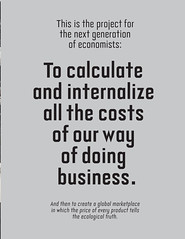
The good news is that I think the economic system we will build next will be one in which environmental and social costs will no longer be externalities; costs that get pushed off the balance sheet. The cost of doing business to the planet . . . will now be factored in.


[1] Lopez-Claros, A. (2010). The innovation for development report 2010-2011: Innovation as a driver of productivity and economic growth. New York: Palgrave Macmillan.

[2] Santos, F. M. (2009). A positive theory of social entrepreneurship. Social Innovation Centre: Working Papers, 1-51.

[3] Perrini, F. (2006). The new social entrepreneurship: What awaits social entrepreneurial ventures? Northampton, MA: Edward Elgar Publishing Limited.

[4] Barnett, A. H., & Yandle, B. (2009). The end of the externality revolution. Social Philosophy and Policy, 26(2), 130-150.

[5] Jones, K. (2009). When more mission equals more money: The more a business focuses on its social mission, the more revenue it will generate. Stanford Social Innovation Review.

~

If you liked this paper/series, you might want to check out some of the other papers/series I’ve posted.

Solutions to Externalities: Social Entrepreneurship and Externalities, Part 3

In the first post in this series, we looked at the definition of social entrepreneurship. In the second post in this series, we looked at the definition of externalities. In today’s post, we’ll look at some solutions to externalities.

Solutions to Externalities

There are a number of different ways to solve the problem of externalities. More generally speaking, these different ways of solving the problem of externalities fall into one of two categories: public or private. Under the category of public solutions to externalities, we have things like government provisions, subsidies, or Pigovian taxes. Pigovian taxes (the name comes from Pigou) are those taxes that are intended to influence a party away (disincentivize) from creating the negative externality. One kind of Pigovian tax is a ‘sin tax,’ which are those taxes that are applied to things like alcohol and tobacco. One of the main arguments for allowing for private sector solutions to externalities is internalization. What is meant by internalization? Consider an example where a fisherman owns a river and a steel plant pollutes the river. The fisherman would demand that the steel plant cease polluting because the fisherman had property rights of the river.[1] The fisherman internalizes the externality of pollution because the fisherman owns the river. The pollution is not an externality to the fisherman; it is a very real and present part of the equation. One of the problems with a solution like this is when the problem is scaled up. Consider the Atlantic Ocean. Who owns it? While property rights may work for some situations, it is most definitely not a viable solution to all issues involving externalities.

Recently, there was a very interesting proposal put forth that, “externalities seem destined to rattle forth from the grave.”[2] In other words, these authors felt that ‘externalities’ was no longer a relevant term in the lexicon nor as a concept to study. Instead, these authors feel that, “externalities do not differ in any substantive way from any other kind of inefficiency.”[3] The argument is quite compelling. They cite two main axioms regarding inefficiencies, “(1) All inefficiencies, including Pareto relevant externalities, represent unexploited gains from trade and (2) When free exchange is allowed and transactions are costless, all Pareto relevant inefficiencies will be negotiated away.”[4] When the argument is phrased in this way, it is hard to disagree. The authors are trumpeting the horns of the free market. In the concluding remarks by the authors, they make it clear that the aim of their article was to highlight the number of policies passed in the name of externalities. To their credit, they are absolutely right. There are a number of laws and regulations put into place in the name of externalities. Now that we have discussed some of the general theories regarding the solutions to externalities, we can dive deeper into the discussion around externalities and social entrepreneurship. Specifically, we can begin to answer some questions about the cross-section of the two concepts.


[1] Gruber, J. (2010). Public finance and public policy (3rd ed.). New York: Worth Publishers.

[2] Barnett, A. H., & Yandle, B. (2009). The end of the externality revolution. Social Philosophy and Policy, 26(2), 130-150.

[3] Ibid.

[4] Ibid.

The Top Ways For Avoiding Cognitive Biases: List of Biases in Judgment and Decision-Making, Part 17

Last Monday I wrote that my cognitive bias series had come to an end. However, several of you emailed me asking for a more concise summary (as you’ll recall, the last post was over 3000 words). So, I thought I’d aggregate the most frequent suggestions of ways for avoiding cognitive biases. It’s in the same vein as a post in this series I don’t often link to: WRAP — An Acronym from Decisive.

Today, I’ve gone back through the post I wrote last week and categorized the different ways for avoiding the cognitive biases that I’ve listed. I’ll list the ways in descending order of their most frequent occurrence on the lists, along with the biases that they helped to counteract:

Alternatives (6): Sunk Cost Fallacy, Endowment Effect, Planning Fallacy, Framing Effect, Confirmation BiasThe Contrast Effect

Assumptions (5): Sunk Cost Fallacy, Framing Effect, Overconfidence Effect, Halo Effect, Functional Fixedness,

Data (5): Planning FallacyGambler’s Fallacy, Primacy/Recency Effect(s), Status Quo BiasThe Contrast Effect

Empathy (3): Endowment Effect, Framing Effect, Fundamental Attribution Error,

Big Picture (3): Loss Aversion, Fundamental Attribution ErrorThe Contrast Effect

Emotional (2): Loss Aversion, Endowment Effect,

Self-Awareness (2): Overconfidence Effect, Hindsight Bias,

Expectations (1): Loss Aversion,

As you might expect, assumptions plays a big part in our decision-making, so naturally, uncovering our assumptions (or recognizing them) is an important way for avoiding the traps of cognitive biases in decision-making. Similarly, it’s important to consider and/or develop alternatives. On an important related note, one of the most important things you’ll learn about negotiating is BATNA. This stands for: the Best Alternative to a Negotiation Agreement. Alternative. It’s also not surprising to see the frequency with which “data” appears, too. Data are a really important part of making a “cognitive bias”-free decision. I’ve written about the virtues of empathy, so I won’t review it.

Lastly, I wanted to highlight that “big picture” appeared on this list a couple of times. I was surprised that it only appeared a couple of times, but that could be a result of the way I was thinking (or my biases!) when I was writing these series. For instance, two of the categories here on this site are Perspective and Fresh Perspective. Meaning, I think it’s really important that we learn how to view things from a wider scope. “Big Picture” probably coud have fallen under “Alternatives,” but I believe there’s an important distinction. With alternatives, it’s still possible to only be considering things from a micro-level, but with the big picture, there’s a necessity for seeing things from the macro-level.

PS: Happy Canada Day!

~

If you liked this paper/series, you might want to check out some of the other papers/series I’ve posted.

Defining Externalities: Social Entrepreneurship and Externalities, Part 2

In the first post in this series, we looked at the definition of social entrepreneurship. In this post, we’ll look at the definition of externalities. Before we get into the post, I wanted to let you know that when I copied part of the paper into this post, the footnotes reset and started at 1. However, as we know from yesterday’s post the first footnote from Pigou is actually footnote #10.

Defining Externalities

The process for defining externalities is as muddled as the process for defining social entrepreneurship. Since the term ‘externalities’ came first,[1] it might be more accurate to say that the process for defining social entrepreneurship is as muddled as the process for defining externalities. The first appearance of a definition of externalities comes in the early 1900s from Pigou,[2] a British economist, who comes from the field of ‘welfare economics,’ which focused on maximizing the well being of society. The general understanding of externalities hasn’t changed too much since then, leaving us with the following definition: “An externality is a cost or benefit that is experienced by someone who is not a party to the transaction that produced it.”[3]

This definition of externalities leaves us with the possibility for positive (benefit) externalities or negative (cost) externalities. An example of a negative externality could be the pollution to the air (or water) caused by a factory. An example of a positive externality could be the honey caused by the natural process of bees. Those two examples of positive/negative externalities are simple ones, but there are many more. Some cite traffic congestion as a negative externality[4] and some cite immunization as a positive externality.[5] The concept of externalities came out of economic theory and as such, we can highlight (through economic theory) some of the results that come from negative/positive externalities. “Negative externalities cause overproduction of the good in a competitive market, while positive externalities cause underproduction of the good in a competitive market, in both cases leading to a deadweight loss.”[6]

There is another kind of externality: positional externalities. “A positional externality occurs when new purchases alter the relevant context within which an existing positional good is evaluated.”[7] An example of this could be said to be when a job candidate starts to wear really expensive suits. The side effect of this is that other job candidates don’t make as good an impression upon the interviewer. From the perspective of the other candidates, it would be most beneficial to go out and purchase expensive suits, so as to make a favorable impression on the interviewers. “But this outcome may be inefficient, since when all spend more, each candidate’s probability of success remains unchanged.”[8] The last kind of externality of this similar vein (positive, negative, and positional) is a network externality. This is also referred to as a network effect and is most often seen in technology. Think about your cell phone. The value of your cell phone is somewhat dependent upon the number of other people [network] who also have cell phones. There is a further way to distinguish between different kinds of externalities: ‘internal’ and ‘external’ externalities.[9] Internal externalities are those externalities that are external to the contractual relationship, but internal to those parties within the contract. External externalities are those externalities that are external to both the contractual relationship and the parties within the contract.

At this point, we have talked about the various kinds of externalities (positive, negative, positional, network, internal, and external). To solidify the understanding of externalities, I’d like to provide an example of the creation of externalities by externalities:[10]

Jacksonville, Florida requires apartment complexes to provide 1.75 parking spaces per one-bedroom apartment – despite the fact that 16% of Jacksonville’s renter households even own one [sic] car . . . Most American cities require office buildings to provide four parking spaces per 1000 square feet of office space. Because four parking spaces consume about 1200 square feet of space, this means that a commercial landlord must allocate the majority of his land to parking.

Minimum parking requirements reduce population and job density, because land that is used for parking cannot be used for housing or commerce. Residents of low-density areas tend to be highly dependent on automobiles for most daily tasks, because they are less likely to live within walking distance of public transit and other amenities.

Minimum parking requirements indirectly discourage walking, by encouraging landowners to surround their building with parking. Where shops and offices are surrounded by a sea of parking, they are unpleasant places for pedestrians, because pedestrians must waste time walking through parking lots and risk their lives dodging automobiles . . .

By increasing the number of parking lots, minimum parking requirements may increase pollution from stormwater runoff. Rainstorms cause stormwater to fall on parking lots, collect metal, oil and other pollutants lying on the ground, and then run off into nearby waters, thus making those waters dirtier and more dangerous.

As one can see, this never-ending string of externalities seems to keep going. All of this stems from the initial action of a policy seemingly trying to do well by its citizens. Now that we have talked about some of the different kinds of externalities and explored a concrete example of how externalities can quickly multiply, let’s look at some of the proposed solutions to these externalities. But just before we move into the description of some of the solutions to externalities, I thought it a good place to add a note from Coase, who is often part of the conversation of externalities: “The traditional approach [to externalities] has tended to obscure the nature of the choice that has to be made. The question is commonly thought of as one in which A inflicts harm on B and what has to be decided is; how should we restrain A? But this is wrong . . . The real question that has to be decided is: should A be allowed to harm B or should B be allowed to harm A?”[11] Coase is absolutely right in his critique of the framing of the question. Even in today’s discussion (Coase wrote this in the 1960s) about externalities, rarely is the question framed in the way that Coase has suggested.

~

Note: when we next pick-up this series, we’ll look at some solutions to externalities.


[1] Pigou, A. C. (1920). The economics of welfare. London: Macmillan and Co.

[2] Ibid.

[4] Bento, A., Kaffine, D., Roth, K., & Zaragoza, M. (2011). The unintended consequences of regulation in the presence of competing externalities: Evidence from the transportation sector. Yale Center for Business and the Environment.

[5] Simpson, B. P. (2007). An economic, political, and philosophical analysis of externalities. Reason Papers, 29(1), 123-140.

[6] Gruber, J. (2010). Public finance and public policy (3rd ed.). New York: Worth Publishers.

[7] Frank, R. H. (2003). Are positional externalities different from other externalities? The Brookings Institution.

[8] Ibid.

[9] Buchanan, J. B., & Vanberg, V. J. (1988). The politicization of market failure, Public Choice Society Meetings.

[10] Lewyn, M. (2010). What would Coase do? (About parking regulation). Fordham Environmental Law Review, 22(1), 89-118.

[11] Coase, R. H. (1960). The problem of social cost. The Journal of Law and Economics, 3(1), 1-44.

When Did our Mental Health Become Separate From our Body’s Health?

I was thinking about the medical system today and it dawned on me, ‘when did mental health become separate from our body‘s health?’ It might seem like a silly question, but think about it for a moment. When you go to see the doctor, the doctor — typically — is there to correct the imbalances in your body, right? S/he asks you questions about your body’s health. How are you feeling? Is your knee any better? Is your head warm? How’s your elbow been lately? Any pain in your stomach? 

What I want to know is, when did general health questions stop including mental health?

I mean, it’s not really still taboo to think that an unhealthy mind can lead to an unhealthy body, right? There’s a whole field dedicated to it — psychoneuroimmunology.

The whole idea of dualism reminds me of a post I read, almost a year ago, that detailed some research about how our health can be affected by our philosophical bent:

Overall, the findings from the five studies provide converging evidence demonstrating that mind-body dualism has a noticeable impact on people’s health-related attitudes and behaviors. These findings suggest that dualistic beliefs decrease the likelihood of engaging in healthy behavior.

These findings support the researchers’ original hypothesis that the more people perceive their minds and bodies to be distinct entities, the less likely they will be to engage in behaviors that protect their bodies.

From a dualistic perspective, bodies are ultimately viewed as a disposable vessel that helps the mind interact with the physical world.

Simply believing (understanding?) that our minds are not separate from our bodies, but that they are one in the same, can lead to better choices that affect one’s health.

I wonder, if as a way to facilitate this understanding in people, doctors started to treat the mind as if it were part of the body and ask questions about one’s mental health during visits to the doctor, would we those who see the mind as separate begin to see it as part of the body?

A Collection of Scriptures for Guidance: Christianity, Part 8

Note: the first two paragraphs are introductory and are derived from the first post in this series. I’ll continue to repost them, in case this is your first time reading a post from this series.

When I was still a doctoral candidate at Sofia University, one of the courses I completed was “World Religions.” This was one of the classes I enjoyed the most during my time at Sofia University. I’d never had such broad exposure to the world’s religions before and this class really allowed me to gain a better understanding of them.

One of the papers I wrote for that class really tied in the fact that I was in a clinical psychology PhD program. The purpose of the paper was to collect quotes from scriptures of the various world religions that I could use with clients/patients when I became a therapist. While I’m no longer pursuing a PhD in clinical psychology, the quotes I collected could certainly be of use, so I thought I’d share them here.

Today’s collection of scriptures for guidance comes courtesy of Christianity. Enjoy!

Anxiety

I’m leaving you with a gift: peace of mind and heart! And the peace I give isn’t fragile like the peace the world gives. So, don’t be troubled or afraid. (John 14:27)

Let not your heart be troubled. You are entrusting God, now trust in Me. (John 14:1)

Surely goodness and mercy shall follow me all the days of my life. (Psalm 23:61)

Anger

The Lord is gracious and merciful, slow to anger and abounding in steadfast love. (Psalm 145:8)

Whoever is slow to anger has great understanding, but he who has a hasty temper exalts folly. (Proverbs 14:29)

Be not quick in your spirit to become angry, for anger lodges in the bosom of fools. (Ecclesiastes 7:9).

Addiction

It was for freedom that Christ set us free; therefore keep standing firm and do not be subject again to a yoke of slavery. (Galatians 5:1)

For the law of the Spirit of life in Christ Jesus has set you free from the law of sin and of death. (Romans 8:2)

Death

Precious in the sight of the Lord the death of his saints. (Psalms 116:15)

The righteous perish, and no one ponders it in his heart; devout men are taken away, and no one understands that the righteous are taken away to be spared from evil. Those who walk uprightly enter into peace; they find rest as they lie in death. (Isaiah 57:1-2)

Now we know that if an earthly tent we live in is destroyed, we have a building from God an eternal house in heaven, not built by human hands. Meanwhile we groan, longing to be clothed with our heavenly dwelling. (2 Corinthians 5:1-2)

Depression

The righteous cry, and the Lord hears and delivers them out of all of their troubles. (Psalms 34:17)

He heals the brokenhearted and binds up their wounds. (Psalms 147:3)

Now He was telling them a parable to show that at all times they ought to pray and not lose heart. (Luke 18:1)

Grief

This is my comfort in my affliction, That Your word has revived me. (Psalm 119:50)

Now may our Lord Jesus Christ Himself and God our Father, who has loved us and given us eternal comfort and good hope by grace, comfort and strengthen your hearts in every good work and word. (2 Thessalonians 2:16-17)

When you pass through the waters, I will be with you; And through the rivers, they will not overflow you. When you walk through the fire, you will not be scorched, Nor will the flame burn you. (Isaiah 43:2)

Guilt

In whatever our heart condemns us; for God is greater than our heart and knows all things. (1 John 3:20)

I, even I, am the one who wipes out your transgressions for My own sake, and I will not remember your sins. (Isaiah 43:25)

They will not teach again, each man his neighbor and each man his brother, saying, “Know the Lord, for they will all know Me, from the least of them to the greatest of them,” declares the Lord, “for I will forgive their iniquity, and their sin I will remember no more.” (Jeremiah 31:34)

Loneliness

I will not leave you as orphans; I will come to you. (John 14:18)

Do not let your heart be troubled; believe in God, believe also in Me. (John 14:1)

“For the mountains may be removed and the hills may shake, but my Loving kindness will not be removed from you, and My covenant of peace will not be shaken,’ says the Lord who has compassion on you. (Isaiah 54:10)

Stress

Peace I leave with you; My peace I give to you; not as the world gives do I give to you. Do not let your heart be troubled, nor let it be fearful. (John 14:27)

Anxiety in a man’s heart weighs it down, but a good word makes it glad. (Proverbs 12:25)

Casting all your anxiety on Him, because He cares for you. (1 Peter 5:7)

The Lord is my light and my salvation; whom shall I fear? The Lord is the stronghold of my life; of whom shall I be afraid? Though an army encamp against me, my heart shall not fear, though war rise up against me, yet I will be confident. (Psalm 27:1, 3)

If you liked this post, you might like one of the other posts in this series:

A Collection of Scriptures for Guidance: Hinduism, Part 7

Note: the first two paragraphs are introductory and are derived from the first post in this series. I’ll continue to repost them, in case this is your first time reading a post from this series.

When I was still a doctoral candidate at Sofia University, one of the courses I completed was “World Religions.” This was one of the classes I enjoyed the most during my time at Sofia University. I’d never had such broad exposure to the world’s religions before and this class really allowed me to gain a better understanding of them.

One of the papers I wrote for that class really tied in the fact that I was in a clinical psychology PhD program. The purpose of the paper was to collect quotes from scriptures of the various world religions that I could use with clients/patients when I became a therapist. While I’m no longer pursuing a PhD in clinical psychology, the quotes I collected could certainly be of use, so I thought I’d share them here.

Today’s collection of scriptures for guidance comes courtesy of Hinduism. Enjoy!

Anxiety

Those who surrender to God all selfish attachments are like the leaf of a lotus floating clean and dry in water. Sin cannot touch them. Renouncing their selfish attachments, those who follow the path of service work with body, senses, and mind for the sake of self-purification. Those whose consciousness is unified abandon all attachment to the results of action and attain supreme peace. (Bhagvad Gita 5.10-12)

Anger

Why, sir, do you get angry at someone
Who is angry with you?
What are you going to gain by it?
How is he going to lose by it?
Your physical anger brings dishonor on yourself;
Your mental anger disturbs your thinking.
How can the fire in your house burn the neighbor’s house
Without engulfing your own? (Basavanna Vachana, 248)

Addiction

Excessive eating is prejudicial to health, to fame, and to bliss in Heaven; it prevents the acquisition of spiritual merit and is odious among men; one ought, for these reasons, to avoid it carefully. (Laws of Manu, 2.57)

Death

Now my breath and spirit goes to the Immortal,
and this body ends in ashes;
OM. O Mind! remember. Remember the deeds.
Remember the actions. (Isah Upanishad, 17, Yajur Veda, 40.15)

Guilt

All evil effects of deeds are destroyed, when He who is both personal and impersonal is realized. (Mundaka Upanishad, 2.2.9)

If we have sinned against the man who loves us, have wronged a brother, a dear friend, or a comrade, the neighbor of long standing or a stranger, remove from us this stain, O King Varuna. (Rig Veda, 5.85.7)

Though a man be soiled with the sins of a lifetime, let him but love me, rightly resolved, in utter devotion. I see no sinner, that man is holy. Holiness soon shall refashion his nature to peace eternal. O son of Kunti, of this be certain: the man who loves me shall not perish. (Bhagavad Gita, 9.30-31)

If you liked this post, you might like one of the other posts in this series: