Look Closely and You’ll See that America Values Philosophy and Idealism

About a month ago, I talked about the best kept secret to traveling – tours. Since that post, I’ve been back into DC a few times to visit the monuments and the other sites that there are to see. There was something that struck me as particularly poignant — the US values philosophy/ideals without even knowing it.

You wouldn’t know it to watch TV, go the movies, or listen to the radio, but deeply embedded within the US is a value of philosophy and ideals. What makes me say this? Well, in visiting the monuments, you can’t help but think this. All of these important people in American history and what’s the unifying theme (besides America) between them? They had an ideal or a philosophy and they remained steadfast in pursuing that philosophy. FDR, MLK, Lincoln, Washington, Jefferson, George Mason…

Speaking of George Mason: even though I just finished an MBA from George Mason University, there were some things I didn’t know about the man that I found particularly interesting. For instance, did you know that he was a mentor to Thomas Jefferson? How about that he was the smartest man that George Washington knew? Or, how about that he wrote the Virginia Declaration of Rights? And that Thomas Jefferson borrowed heavily from the Virginia Declaration of Rights in drafting the Declaration of Independence?

I wonder if there will be a time (again?) when these American values will be more apparent. That is, when they will be more overt.

~

After one of these trips into DC to see the monuments, I found myself sitting on a bench outside one of the stores in the Mosaic District. I was looking up at all the store fronts and thinking to myself how distracting consumerism can be. I had just spent the day steeped in American idealism — learning and reading about some of the important figures in American history and now I found myself dropped into consumerism. It [consumerism] seemed so small after FDR, MLK, and Jefferson. It seemed almost insignificant. The most appropriate word I can think of for my thoughts that day: distracting.

It really seemed like everything was distracting. That is, everything but the philosophy/idealism I had spent time with that day. The stores and consumerism — it was distracting away from the philosophy and idealism. To be fair, maybe it’s not reasonable to always be thinking about idealism and philosophy. Maybe it’s fair to sometimes indulge. I should also clarify that I’m not judging consumerism, no.

I was just noticing that after spending a day with idealism, consumerism seemed… distracting.

The Cross-Section of Social Entrepreneurship and Externalities: Social Entrepreneurship and Externalities, Part 4

In the first post in this series, we looked at the definition of social entrepreneurship. In the second post in this series, we looked at the definition of externalities. In the third post, we looked at some solutions to externalities. In today’s post, the last in this series, we’ll look at the cross-section of social entrepreneurship and externalities and wrap up the paper.

The Cross-Section of Social Entrepreneurship and Externalities

Let’s revisit our definitions of social entrepreneurship and externalities. Social entrepreneurship is the application of innovative solutions to society’s most pressing social problems in the form of massive wide-scale change, usually to the system. Externalities are a cost/benefit experienced by someone who is not a party to the transaction. Just by looking at those two definitions, my first inclination is that externalities are absolutely essential to the understanding of social entrepreneurship. Given that many of society’s most pressing social problems – in some people’s minds – can be traced back to a transaction that resulted in the negative externality, it’s hard to imagine how externalities wouldn’t be essential to the understanding of social entrepreneurship. With that being said, let’s look at some examples where these two concepts meet.

The current Director of the Skoll Center for Social Entrepreneurship, Pamela Hartigan, recently wrote a book chapter entitled, “Creating Blueprints for Business in the 21st Century: Social Entrepreneurship Shows the Way.” In it, she talks about the specific role of social entrepreneurs in the economic ecosystem. “Economic literature often pays much less attention to the role of positive externalities than it does to negative externalities. In so doing, it neglects the primary drivers of social entrepreneurial action.”[1] Hartigan goes on to say that neglected positive externalities should be a main focus of social entrepreneurship. A really good example of this is Wikipedia, which was created by Jimmy Wales (who is also an Ashoka Fellow). Based on that citation alone, one would have to think that externalities are part of the understanding of social entrepreneurship, but let’s see if there are others.

A paper written by a professor at INSEAD, which is consistently one of the top business schools in the world, called A Positive Theory of Social Entrepreneurship offers some more insights into neglected positive externalities. In fact, the author’s first proposition states that, “addressing problems involving neglected positive externalities is the distinctive domain of action of social entrepreneurship.”[2] It looks like Santos and Hartigan share similar viewpoints in that neglected positive externalities are a key to social entrepreneurship. These two examples make it pretty clear that neglected positive externalities feature in the field of social entrepreneurship. Let’s move onto different examples to see if any other key points arise.

If you recall, one of the solutions to externalities had to do with the internalization of the externalities. There’s a book chapter entitled, “The NYC Watershed agreement: sustainable development and social entrepreneurship,” written by Joan Hoffman. In it, she addresses some of the challenges that are faced by those in watershed collaborations (combination of economic and environmental goals). “The economic concept of externalities, or impacts of market transactions on third parties, can be extended to describe the need for social entrepreneurs . . . The new organizations fostered by social entrepreneurs are designed to internalize consideration of these externalities.”[3] It turns out that social entrepreneurs, if not by intention at least by accident, are directly addressing problems of externalities through some of the solutions that have been proposed by economists and academics.

In answering our question about whether externalities are essential to the understanding of social entrepreneurship, we have inadvertently answered the second question: are economic theories of externalities used in the professional understanding of social entrepreneurship? In this last reference, we saw that not only was there a reference to an economic theory of externalities, but there was a reference to a solution of externalities (as offered by economic theory). As a result, I think it is safe to say, “yes” to both questions.

Closing Thoughts

In this paper, we have explored definitions of social entrepreneurship and externalities. We have explored some of the muddiness around both of these definitions. We have taken a closer look at some of the different kinds of externalities (positive, negative, positional, etc.). We have looked at some of the proposed economic solutions to externalities. Then, we looked at the cross-section of externalities and social entrepreneurship. We dove deeper into the intersection of these two concepts to find that at the heart of social entrepreneurship is an inclination to solve some of the externalities facing the planet. Lastly, we were able to answer, “yes” to the two main questions of this paper: “Are externalities essential to the understanding of social entrepreneurship?” and “Are the economic theories of externalities used in the professional understanding of social entrepreneurship?”

In closing, I wanted to revisit one of the ideas put forth by Barnett and Yandle in their paper, The End of the Externality Revolution.[4] Specifically, I want to address their idea that there aren’t any externalities – only inefficiencies. As someone who has had very little training in economics, but a great deal of training in some of the other social sciences, I can appreciate this reframing of externalities. In fact, I think it is appropriate to repackage our understanding of externalities as part of the “main” function of the transaction. In calling them inefficiencies, I don’t think that Barnett and Yandle are doing this. I think both names – externalities and inefficiencies – are not entirely representative of the true state of affairs. In doing research for this paper, I came across a quote that I think captures the essence of what I’m trying to say. It was written in the aftermath of the financial collapse of 2008,[5] [emphasis mine]:

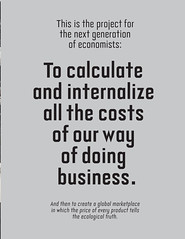
The good news is that I think the economic system we will build next will be one in which environmental and social costs will no longer be externalities; costs that get pushed off the balance sheet. The cost of doing business to the planet . . . will now be factored in.


[1] Lopez-Claros, A. (2010). The innovation for development report 2010-2011: Innovation as a driver of productivity and economic growth. New York: Palgrave Macmillan.

[2] Santos, F. M. (2009). A positive theory of social entrepreneurship. Social Innovation Centre: Working Papers, 1-51.

[3] Perrini, F. (2006). The new social entrepreneurship: What awaits social entrepreneurial ventures? Northampton, MA: Edward Elgar Publishing Limited.

[4] Barnett, A. H., & Yandle, B. (2009). The end of the externality revolution. Social Philosophy and Policy, 26(2), 130-150.

[5] Jones, K. (2009). When more mission equals more money: The more a business focuses on its social mission, the more revenue it will generate. Stanford Social Innovation Review.

~

If you liked this paper/series, you might want to check out some of the other papers/series I’ve posted.

Solutions to Externalities: Social Entrepreneurship and Externalities, Part 3

In the first post in this series, we looked at the definition of social entrepreneurship. In the second post in this series, we looked at the definition of externalities. In today’s post, we’ll look at some solutions to externalities.

Solutions to Externalities

There are a number of different ways to solve the problem of externalities. More generally speaking, these different ways of solving the problem of externalities fall into one of two categories: public or private. Under the category of public solutions to externalities, we have things like government provisions, subsidies, or Pigovian taxes. Pigovian taxes (the name comes from Pigou) are those taxes that are intended to influence a party away (disincentivize) from creating the negative externality. One kind of Pigovian tax is a ‘sin tax,’ which are those taxes that are applied to things like alcohol and tobacco. One of the main arguments for allowing for private sector solutions to externalities is internalization. What is meant by internalization? Consider an example where a fisherman owns a river and a steel plant pollutes the river. The fisherman would demand that the steel plant cease polluting because the fisherman had property rights of the river.[1] The fisherman internalizes the externality of pollution because the fisherman owns the river. The pollution is not an externality to the fisherman; it is a very real and present part of the equation. One of the problems with a solution like this is when the problem is scaled up. Consider the Atlantic Ocean. Who owns it? While property rights may work for some situations, it is most definitely not a viable solution to all issues involving externalities.

Recently, there was a very interesting proposal put forth that, “externalities seem destined to rattle forth from the grave.”[2] In other words, these authors felt that ‘externalities’ was no longer a relevant term in the lexicon nor as a concept to study. Instead, these authors feel that, “externalities do not differ in any substantive way from any other kind of inefficiency.”[3] The argument is quite compelling. They cite two main axioms regarding inefficiencies, “(1) All inefficiencies, including Pareto relevant externalities, represent unexploited gains from trade and (2) When free exchange is allowed and transactions are costless, all Pareto relevant inefficiencies will be negotiated away.”[4] When the argument is phrased in this way, it is hard to disagree. The authors are trumpeting the horns of the free market. In the concluding remarks by the authors, they make it clear that the aim of their article was to highlight the number of policies passed in the name of externalities. To their credit, they are absolutely right. There are a number of laws and regulations put into place in the name of externalities. Now that we have discussed some of the general theories regarding the solutions to externalities, we can dive deeper into the discussion around externalities and social entrepreneurship. Specifically, we can begin to answer some questions about the cross-section of the two concepts.


[1] Gruber, J. (2010). Public finance and public policy (3rd ed.). New York: Worth Publishers.

[2] Barnett, A. H., & Yandle, B. (2009). The end of the externality revolution. Social Philosophy and Policy, 26(2), 130-150.

[3] Ibid.

[4] Ibid.

The Top Ways For Avoiding Cognitive Biases: List of Biases in Judgment and Decision-Making, Part 17

Last Monday I wrote that my cognitive bias series had come to an end. However, several of you emailed me asking for a more concise summary (as you’ll recall, the last post was over 3000 words). So, I thought I’d aggregate the most frequent suggestions of ways for avoiding cognitive biases. It’s in the same vein as a post in this series I don’t often link to: WRAP — An Acronym from Decisive.

Today, I’ve gone back through the post I wrote last week and categorized the different ways for avoiding the cognitive biases that I’ve listed. I’ll list the ways in descending order of their most frequent occurrence on the lists, along with the biases that they helped to counteract:

Alternatives (6): Sunk Cost Fallacy, Endowment Effect, Planning Fallacy, Framing Effect, Confirmation BiasThe Contrast Effect

Assumptions (5): Sunk Cost Fallacy, Framing Effect, Overconfidence Effect, Halo Effect, Functional Fixedness,

Data (5): Planning FallacyGambler’s Fallacy, Primacy/Recency Effect(s), Status Quo BiasThe Contrast Effect

Empathy (3): Endowment Effect, Framing Effect, Fundamental Attribution Error,

Big Picture (3): Loss Aversion, Fundamental Attribution ErrorThe Contrast Effect

Emotional (2): Loss Aversion, Endowment Effect,

Self-Awareness (2): Overconfidence Effect, Hindsight Bias,

Expectations (1): Loss Aversion,

As you might expect, assumptions plays a big part in our decision-making, so naturally, uncovering our assumptions (or recognizing them) is an important way for avoiding the traps of cognitive biases in decision-making. Similarly, it’s important to consider and/or develop alternatives. On an important related note, one of the most important things you’ll learn about negotiating is BATNA. This stands for: the Best Alternative to a Negotiation Agreement. Alternative. It’s also not surprising to see the frequency with which “data” appears, too. Data are a really important part of making a “cognitive bias”-free decision. I’ve written about the virtues of empathy, so I won’t review it.

Lastly, I wanted to highlight that “big picture” appeared on this list a couple of times. I was surprised that it only appeared a couple of times, but that could be a result of the way I was thinking (or my biases!) when I was writing these series. For instance, two of the categories here on this site are Perspective and Fresh Perspective. Meaning, I think it’s really important that we learn how to view things from a wider scope. “Big Picture” probably coud have fallen under “Alternatives,” but I believe there’s an important distinction. With alternatives, it’s still possible to only be considering things from a micro-level, but with the big picture, there’s a necessity for seeing things from the macro-level.

PS: Happy Canada Day!

~

If you liked this paper/series, you might want to check out some of the other papers/series I’ve posted.

Defining Externalities: Social Entrepreneurship and Externalities, Part 2

In the first post in this series, we looked at the definition of social entrepreneurship. In this post, we’ll look at the definition of externalities. Before we get into the post, I wanted to let you know that when I copied part of the paper into this post, the footnotes reset and started at 1. However, as we know from yesterday’s post the first footnote from Pigou is actually footnote #10.

Defining Externalities

The process for defining externalities is as muddled as the process for defining social entrepreneurship. Since the term ‘externalities’ came first,[1] it might be more accurate to say that the process for defining social entrepreneurship is as muddled as the process for defining externalities. The first appearance of a definition of externalities comes in the early 1900s from Pigou,[2] a British economist, who comes from the field of ‘welfare economics,’ which focused on maximizing the well being of society. The general understanding of externalities hasn’t changed too much since then, leaving us with the following definition: “An externality is a cost or benefit that is experienced by someone who is not a party to the transaction that produced it.”[3]

This definition of externalities leaves us with the possibility for positive (benefit) externalities or negative (cost) externalities. An example of a negative externality could be the pollution to the air (or water) caused by a factory. An example of a positive externality could be the honey caused by the natural process of bees. Those two examples of positive/negative externalities are simple ones, but there are many more. Some cite traffic congestion as a negative externality[4] and some cite immunization as a positive externality.[5] The concept of externalities came out of economic theory and as such, we can highlight (through economic theory) some of the results that come from negative/positive externalities. “Negative externalities cause overproduction of the good in a competitive market, while positive externalities cause underproduction of the good in a competitive market, in both cases leading to a deadweight loss.”[6]

There is another kind of externality: positional externalities. “A positional externality occurs when new purchases alter the relevant context within which an existing positional good is evaluated.”[7] An example of this could be said to be when a job candidate starts to wear really expensive suits. The side effect of this is that other job candidates don’t make as good an impression upon the interviewer. From the perspective of the other candidates, it would be most beneficial to go out and purchase expensive suits, so as to make a favorable impression on the interviewers. “But this outcome may be inefficient, since when all spend more, each candidate’s probability of success remains unchanged.”[8] The last kind of externality of this similar vein (positive, negative, and positional) is a network externality. This is also referred to as a network effect and is most often seen in technology. Think about your cell phone. The value of your cell phone is somewhat dependent upon the number of other people [network] who also have cell phones. There is a further way to distinguish between different kinds of externalities: ‘internal’ and ‘external’ externalities.[9] Internal externalities are those externalities that are external to the contractual relationship, but internal to those parties within the contract. External externalities are those externalities that are external to both the contractual relationship and the parties within the contract.

At this point, we have talked about the various kinds of externalities (positive, negative, positional, network, internal, and external). To solidify the understanding of externalities, I’d like to provide an example of the creation of externalities by externalities:[10]

Jacksonville, Florida requires apartment complexes to provide 1.75 parking spaces per one-bedroom apartment – despite the fact that 16% of Jacksonville’s renter households even own one [sic] car . . . Most American cities require office buildings to provide four parking spaces per 1000 square feet of office space. Because four parking spaces consume about 1200 square feet of space, this means that a commercial landlord must allocate the majority of his land to parking.

Minimum parking requirements reduce population and job density, because land that is used for parking cannot be used for housing or commerce. Residents of low-density areas tend to be highly dependent on automobiles for most daily tasks, because they are less likely to live within walking distance of public transit and other amenities.

Minimum parking requirements indirectly discourage walking, by encouraging landowners to surround their building with parking. Where shops and offices are surrounded by a sea of parking, they are unpleasant places for pedestrians, because pedestrians must waste time walking through parking lots and risk their lives dodging automobiles . . .

By increasing the number of parking lots, minimum parking requirements may increase pollution from stormwater runoff. Rainstorms cause stormwater to fall on parking lots, collect metal, oil and other pollutants lying on the ground, and then run off into nearby waters, thus making those waters dirtier and more dangerous.

As one can see, this never-ending string of externalities seems to keep going. All of this stems from the initial action of a policy seemingly trying to do well by its citizens. Now that we have talked about some of the different kinds of externalities and explored a concrete example of how externalities can quickly multiply, let’s look at some of the proposed solutions to these externalities. But just before we move into the description of some of the solutions to externalities, I thought it a good place to add a note from Coase, who is often part of the conversation of externalities: “The traditional approach [to externalities] has tended to obscure the nature of the choice that has to be made. The question is commonly thought of as one in which A inflicts harm on B and what has to be decided is; how should we restrain A? But this is wrong . . . The real question that has to be decided is: should A be allowed to harm B or should B be allowed to harm A?”[11] Coase is absolutely right in his critique of the framing of the question. Even in today’s discussion (Coase wrote this in the 1960s) about externalities, rarely is the question framed in the way that Coase has suggested.

~

Note: when we next pick-up this series, we’ll look at some solutions to externalities.


[1] Pigou, A. C. (1920). The economics of welfare. London: Macmillan and Co.

[2] Ibid.

[4] Bento, A., Kaffine, D., Roth, K., & Zaragoza, M. (2011). The unintended consequences of regulation in the presence of competing externalities: Evidence from the transportation sector. Yale Center for Business and the Environment.

[5] Simpson, B. P. (2007). An economic, political, and philosophical analysis of externalities. Reason Papers, 29(1), 123-140.

[6] Gruber, J. (2010). Public finance and public policy (3rd ed.). New York: Worth Publishers.

[7] Frank, R. H. (2003). Are positional externalities different from other externalities? The Brookings Institution.

[8] Ibid.

[9] Buchanan, J. B., & Vanberg, V. J. (1988). The politicization of market failure, Public Choice Society Meetings.

[10] Lewyn, M. (2010). What would Coase do? (About parking regulation). Fordham Environmental Law Review, 22(1), 89-118.

[11] Coase, R. H. (1960). The problem of social cost. The Journal of Law and Economics, 3(1), 1-44.

Defining Social Entrepreneurship: Social Entrepreneurship and Externalities, Part 1

I enjoyed sharing the work that I’d done several years ago curating those quotes from various religious scriptures into a number of posts. As a result, it got me thinking of some of the other papers I’ve wrote and whether they’d be appropriate to share here. Since I just finished an MBA, I’ve gone through quite a number of case studies. Since professors tend to reuse those cases, it seems inappropriate to share the papers I wrote for those cases (as some students might try to pass it off as their own work). With that being said, yesterday’s post about fines vs. fees reminded me of a paper I wrote about a year ago for a class in social entrepreneurship. This paper wasn’t for a case, so I thought I’d share it in a number of installments. In today’s post, I’ll share the executive summary and the first section: defining social entrepreneurship.

Executive Summary

This aim of this paper is to answer two main questions: (1) are externalities essential to the understanding of social entrepreneurship? (2) are the economic theories of externalities used in the professional understanding of social entrepreneurship? To answer these questions, the definitions of social entrepreneurship and externalities are explored, along with the different categories of externalities. There is also a short examination of the different solutions to externalities. Following this, an analysis of the intersection of the two concepts (social entrepreneurship and externalities) is conducted, the results of which return answers of “yes” to both of the main questions of this paper.

Defining Social Entrepreneurship

Before moving into a discussion about social entrepreneurship and externalities, it is important to define these terms. As one delves further into the literature – both academic and popular – it quickly becomes clear that there are myriad understandings that cloud the space around these terms[1] and thusly make the task of definition that much more important. To begin, I will define social entrepreneurship, but before that, it might be more appropriate to start with a definition of entrepreneurship.

Most definitions of social entrepreneurship begin with an attempt to define entrepreneurship and logically so, as ‘social’ acts as a modifying word to entrepreneurship. One definition of what it means to be an entrepreneur that I particularly like, “A person is an entrepreneur from t1 to t2 if and only if that person attempts, from t1 to t2, to make business profits by innovation in the face of risk.”[2] Subsequently, the definition of entrepreneurship follows as, “The process of attempting from t1 to t2, to make business profits by innovation in the face of risk.”[3] While there is disagreement among some about how to define entrepreneurship, this basic understanding will suffice for the purposes of this paper.

Now that we have defined entrepreneurship, ‘business profits by innovation in the face of risk,’ we can move on to define social entrepreneurship. Similar to entrepreneurship (and maybe understandably so), social entrepreneurship lacks a consensual definition among those who study it. The Skoll Centre for Social Entrepreneurship at the University of Oxford defines social entrepreneurship as, “[being] about innovative, market-oriented approaches underpinned by a passion for social equity and environmental sustainability.”[4] Others believe that social entrepreneurship is, “ a process that catalyzes social change and/or addresses important social needs in a way that is not dominated by direct financial benefits for the entrepreneurs.”[5] While those definitions are similar, one could identify differences. The first definition includes an approach and the second definition includes a process. Part of the issue surrounding the definition of social entrepreneurship is that, “it means different things to different people.”[6] I may be a bit biased as I’m currently interning with Ashoka, but I think the person [Bill Drayton, founder and CEO of Ashoka] who ‘created’ the term[7] should have a great deal of say in the definition of said term. As such, Ashoka defines social entrepreneurship in following way:[8]

Social entrepreneurs are individuals with innovative solutions to society’s most pressing social problems. They are ambitious and persistent, tackling major social issues and offering new ideas for wide-scale change.

Rather than leaving societal needs to the government or business sectors, social entrepreneurs find what is not working and solve the problem by changing the system, spreading the solution, and persuading entire societies to take new leaps.

One of the important distinctions regarding Ashoka’s definition of social entrepreneurship is that the idea precedes the doing. That is, the social entrepreneur plans to address the problem (or social ill) before s/he begins the venture. This will be important later on when we talk about externalities. Another important distinction here is the specification of ‘changing the system.’ This is key because one of the more recent academic articles published on the topic of social entrepreneurship isolates four main factors of the definitions of social entrepreneurship, none of which are ‘changing the system’. They include: characteristics of individual social entrepreneurs, their sphere of operation, the processes and resources used by social entrepreneurs, and the mission of the social entrepreneur.[9] Let’s use the definition of social entrepreneurship provided by Ashoka and move on to define the next piece: externalities.

~

Note: Check back tomorrow for the next section: defining externalities. Below, you’ll find a list of footnotes from this first section of the paper.


[1] For social entrepreneurship, see: Tan, W., Williams, J., & Tan, T. (2005). Defining the ‘social’ in ‘social entrepreneurship’: Altruism and entrepreneurship. International Entrepreneurship and Management Journal, 1(3), 353-365. For externalities, see: Barnett, A. H., & Yandle, B. (2009). The end of the externality revolution. Social Philosophy and Policy, 26(2), 130-150.

[2] Tan, W., Williams, J., & Tan, T. (2005). Defining the ‘social’ in ‘social entrepreneurship’: Altruism and entrepreneurship. International Entrepreneurship and Management Journal, 1(3), 353-365.

[3] Ibid.

[5] Mair, J., & Marti, I. (2004). Social entrepreneurship: A source of explanation, prediction, and delight. Journal of World Business, 41(1), 36-44.

[6] Dees, J. G. (1998). The meaning of ‘social entrepreneurship.’ Stanford University: Center for Social Innovation. See: http://www.caseatduke.org/documents/dees_sedef.pdf

[9] Dacin, M. T., & Dacin, P. A. (2011). Social entrepreneurship: A critique and future directions. Organization Science, 22(5), 1203-1213.


Ways For Avoiding Cognitive Biases: List of Biases in Judgment and Decision-Making, Part 16

It’s Monday, so that means it’s time for another cognitive bias. However, I’ve finished the list of cognitive biases that I wanted to highlight. Of course, there are many more biases that could be discussed, but I thought those 14 were some of the more important cognitive biases. With today’s post, I thought I would review all of the ways for avoiding the biases, categorized by bias. So, I’ll list each bias and recount the ways that I suggested for avoiding the bias.

This is going to be a jam-packed post (with over 3000 words!) I highly recommend bookmarking this post and coming back to it as a reference. Alrighty, with that being said, let’s start with the sunk cost fallacy.

Ways for Avoiding the Sunk Cost Fallacy

So, now that we’ve looked at the sunk cost fallacy, how can we avoid it? Well, the first step in avoiding the sunk cost fallacy is recognizing it. Hopefully, the above examples have given you an idea of how this bias can arise. There are a two other ways I want to highlight that you can use to avoid this trap.

1) What am I assuming?

The crux of the sunk cost fallacy is based on an assumption. That is, you’re assuming that because you’ve already spent money on X, that you should keep spending money on X. If you look at what it is that you’re assuming about a situation, you just might find that you’re about to step into the sunk cost trap.

2) Are there alternatives?

Related to the above example is alternatives. You’re not bound to a decision because you’ve made a similar decision in the past. Just because you bought the ticket to go to the movie, if another activity presents itself as more enticing, you’re allowed to choose that one instead. In fact, if when you sit down to watch the movie, it’s bad, you’re allowed to get up and walk out. Don’t fall into the sunk cost trap thinking that you have to stay because you paid for it. There are any number of things you could be doing: going for a walk, calling an old friend, etc.

Ways for Avoiding Loss Aversion

As with the sunk cost fallacy, one of the most important ways to avoid loss aversion is to recognize it. That is, to know that humans have a tendency for loss aversion is an important first step in not falling into the trap of loss aversion.

1) What’s the big picture?

In our example of golf, that might mean knowing where you are in relation to the other players your competing with in the tournament (rather than where your ball is relation to the hole and what specific stroke you’re about to hit). In business, one might examine a decision about one business unit in relation to the entire company (rather than looking myopically at the one business unit).

2) Am I afraid of losing something?

This may seem like an obvious solution, but it’s pretty important. If before making a decision you can think to yourself (or have your team ask itself), “am I afraid to lose something here?” You might find that you are and it could serve to help you or your company avoid falling into the trap of loss aversion.

3) Do you really expect to never lose anything — ever?

Loss is inevitable. Sometimes, you won’t make that par putt (or that birdie putt). Sometimes, when you negotiate a deal, you won’t get the best deal. Sometimes, the decision to sell that business unit might result in losses somewhere else. If you can come to grips with the fact that every decision you make won’t be perfectand that sometimes you will lose, you may begin to shift your expectations about loss.

Ways for Avoiding the Endowment Effect

1) Am I emotional?

A seemingly obvious way to avoid the endowment effect is assessing whether our emotions are involved. Don’t get me wrong, emotions are a good thing, but they are a surefire way to overvaluing things that you own. That is, if you find yourself overly connected to something, your emotions might be getting in the way.

2) Independent Evaluation

This dovetails nicely with the idea of being unemotional. To guard against succumbing to the endowment effect, be sure to have an independent appraisal of whatever it is that you’re looking to sell of yours. While you’ll still have the final say on what you sell and how much you sell it for, having a second pair of eyes look at your side of the “deal” might help you determine if you’re judgment’s clouded.

3) Empathy

I wasn’t going to include this initially, but after reading the research, it certainly fits. Before I go on, I should say that folks might be confused in that I just suggested asking whether one is emotional and now I’m saying to practice empathy? For those wondering, being emotional is not the same thing as being empathetic. Back to empathy and the endowment effect. In situations where we’re selling something, researchers found there to be an empathy deficit when the endowment effect was present. So, to counter this, you should try to empathize with whom you’re negotiating.

Ways for Avoiding the Planning Fallacy

With the first three biases I talked about, awareness was a key step in overcoming the bias. While you could make that argument for the planning fallacy, one of the hallmarks of [the fallacy] is that people know they’ve erred in the past and stillmake the mistake of underestimating. So, we’ll need to move beyond awareness to help us defend against this bias.

1) Data is your friend

No, I don’t mean Data from Star Trek (though Data would probably be quite helpful in planning), but now that I think about it, Data (the character) might be a good way to position this ‘way for avoiding the planning fallacy.’ For those of you not familiar, Data is a human-like android. In thinking about this way for avoiding the planning fallacy, think about how Data might estimate the length of time it would take to complete a project. It would be very precise and data-driven. Data would likely look at past projects and how long it took for those to be finished to decide the length of time needed for this new project. To put it more broadly, if you have statistics on past projects (that were similar) absolutely use them in estimating the completion time of the new project.

2) Get a second opinion

When we think about the project completion time of one project in relation to another project, we often think about the nuances that make this project different from that project — and by extension — why this project won’t take as long as that project. Planning fallacy. If you can, ask someone who has experience in project completion in the area for which you’re estimating. When you ask this person, be sure not to tell them all the “various ways why this project is different,” because it probably isn’t and it’s only going to cloud the predictive ability of the person you’re asking. You’re probably going to hear an estimate that’s larger than you thought, but I bet you that it’s probably a lot closer to the real project completion time than the estimate you made based on thinking about the ways that this project was going to be different than all the other projects like it.

Ways for Avoiding the Framing Effect

1) Reframe the question

It may seem obvious, but you’d be surprised how many people don’t consider “reframing” the frame with which they are looking at a situation. For instance, in the example from earlier, instead of looking at it as a choice between Program A and Program B, someone could reframe Program A so that it looks like Program C and do the same with Program B, so that it looks like Program D. As a result, one would then be getting a “fuller” picture of their choice.

2) Empathy — assume someone else’s perspective

Many choices implicate another in a situation. As a result, it might be worth it to put yourself in the shoes of that other person to see how they would view a given situation. This is similar to the reframe, but is more specific in that it might serve to help the person remove themselves a little bit from the decision. That is, when we’re faced with a choice, our personal biases can have a big impact on the decision we make. When we imagine how someone else might make this decision, we’re less likely to succumb to our personal biases.

3) Parse the question

Some questions present us with a dichotomous choice: are apples good or bad? Should we exercise in the morning or the evening? Are gap years helpful or harmful? When faced with a question like this, I would highly recommendparsing the question. That is, are we sure that apples can only be good or bad? Are we sure that exercising in the morning or the evening are our only options? Often times, answers to questions aren’t simply this or that. In fact, more times than not, there is a great deal of grey area. Unfortunately, when the question is framed in such a way, it makes it very difficult to see the possibility of the grey area.

Ways for Avoiding the Confirmation Bias

As with other cognitive biases, being aware that there is such a thing as the confirmation bias is really important. It can be hard to change something if you don’t know that there’s something to be changed.

1) Seek out contradictory ideas and opinions

This is something that I’ve written about before. If at all possible, you’ve got to be sure that you’re getting information that is counter to your beliefs from somewhere. If not, there’s little chance for growth and expansion. This can be difficult for some, so I’ve outlined ways to do this on the post I referenced above.

2) Seek out people with contradictory ideas and opinions

I answered a question on Quora last November where I placed these two ways for avoiding the confirmation bias one and two. Some folks might find it a little more difficult to seek out people with opposing views and that’s why I suggest starting with seeking out contradictory views in print (or some other form of media) to begin. However, in my experience, speaking with someone who has opposing views to mine (assuming that they are also altruistic in their endeavor to seek out opposing views) can be quite enriching. A real-life person can usually put up a better defense when your “confirmation bias” is activated. Similarly, you can do the same for them.

3) What do you really know?

My last suggestion for avoiding the confirmation bias is to always be questioning what it is that you know. This can sound tedious, but if you get into the habit of questioning “how” you know something or “why” you know something, you’d be surprised how ‘thin’ the argument is for something that you know. For instance, let’s say that you have a racial stereotype that ethnicity “x” is bad at driving. When you’re on the highway, you notice that someone from ethnicity “x” cuts you off. Instead of going into a tizzy about ethnicity “x,” you might stop and remember that, in fact, of all the times that you’ve been cut off, ethnicity “x” is the ethnicity that cuts you off the least. This is a curt example, but I think you get the idea. Just to emphasize my point: I would argue that questioning your deeply held beliefs would be a good way of countering the confirmation bias.

Ways for Avoiding the Gambler’s Fallacy

1) Independent Events vs. Dependent Events

The biggest way to avoid the gambler’s fallacy is to understand the difference between an independent event and a dependent event. In the classic example, the odds of a coin landing on heads or tails is — negligibly – 50/50 (I say negligibly because there are those who contend that the “heads side” weighs more and thus gives it a slight advantage). An example of a dependent event would be picking cards from a deck. There are 52 cards in a deck and if you pick one card without replacing it, your odds of picking one of the other 51 cards increases (ever so slightly).

Ways for Avoiding the Fundamental Attribution Error

1a) Empathy

As with many of the other biases, empathy is one of the quickest ways to thwart its power of you. If I put myself in the shoes of another, I’m more likely to understand that there might be more going on in the situation than I can see from my perspective. For instance, if we look at the red light example from above, by empathizing with the driver who runs the red light, I have a much higher chance of understanding that there running the red light is not a demonstration of their disregard for the world around them, but maybe that there’s something urgent to be taken care of.

1b) “Why Would a Rational Person Behave This Way?”

The above sentence is essentially a way to create a sense of empathy, but in case empathy is an ambiguous term, I’ve marked this ‘way’ 1b. Asking yourself this question will make it easier to consider the other factors at contributing to a situation.

Ways for Avoiding the Overconfidence Effect

1) Know what you know (and don’t know)

The fastest way to slip into the trap of the overconfidence effect is to start making “confident” predictions about things that you don’t know about. Guessing the number of paper clips in a bottle is something that most of us have little to no expertise in. So, list a large confidence interval. If you have no experience in managing a project, it might be in your best interest not to make a prediction about how long it will take to complete the project (planning fallacy).

2) Is this person really an expert?

Sometimes, you’ll hear someone displaying a level of confidence in a given situation that makes you think they know what they’re talking about. As a result, it might bias you into believing what they are saying. It’s important to know if this person is an expert in this field, or if maybe they’re succumbing to the overconfidence effect.

Ways for Avoiding the Halo Effect

1) Different strengths for different tasks

One of the easiest ways to avoid falling into the trap of the halo effect is to notice that there are different skills/strengths required for different tasks. As such, just because someone is good at climbing mountains doesn’t mean that they would make a good politician. The strengths/skills required for those two tasks are different. Put another way, think about the strengths/skills required for a particular tasks before evaluating whether someone would be good at that task.

2) Notice other strengths (or weaknesses)

It’s been said that, “nobody’s perfect.” When someone is good at one thing, there’s a good chance that they won’t be good at something else. Noticing that this person isn’t good at someone else may help to quell the urge to assume that this person is good at everything.

Ways for Avoiding the Primacy/Recency Effect(s)

How you avoid these two biases really depends on the context of the decision you’re making. For instance, if you want people to remember something, you probably don’t want to give them a long list (thereby invoking the possibility of one of these two biases to happen). There are some general ways to mitigate these baises, though.

1) Keep a record (write down the data)

One of the simplest ways that either of these biases can have an impact on a decision is when there isn’t a record of data. If you’re just making a decision based on what you remember, there will be an unnecessary weighting for the beginning or the end. As a result, keeping a record of the choices can make it easier to evaluate all choices objectively.

2) Standardized data

As I mentioned earlier in this post, it’s important that the data by which you’re evaluating a choice be standardized. As we looked at in number one, keeping data isn’t always enough. it’s important that the data be uniform across choices, so an evaluation can be made. In this way, it’s easier to look at earlier choices and later choices equally whereas if this weren’t instituted, there might be a slight bias towards the beginning or the end. This tip would work for situations similar to making a purchase (and gathering data), interviewing candidates, or something that can be analogized to either of these two.

Ways for Avoiding Functional Fixedness

1) Practice, practice, practice

Probably the easiest and most effective way of overcoming functional fixedness is to practice. What does that mean? Well, take a box of miscellaneous things and see if you can design something fun/creative. The emphasis should be on using those things in a way that they weren’t designed. For instance, if you’re using a toolbox, you might think about how you can use something like wrenches to act as “legs” of a table or as a conductive agent for an electrical circuit.

2) Observant learning — Find examples

Another good way of overcoming functional fixedness is to look at other examples of people who have overcome functional fixedness. When I was giving a presentation on functional fixedness to a group (of college students) about a year ago, I showed the video below. About halfway through the video, one of them remarked: “So, basically, it’s how to be a college student 101.”

Ways for Avoiding the Status Quo Bias

1) Independent Evaluation

It really can be as easy as this. Have someone (or do it yourself) do a cost-benefit analysis on the situation/decision. In this way, you’ll be able to see the pros/cons of your decision in a new light. Of course, you may still succumb to the status quo bias, but you might be less likely to do so.

2) Role Reversal

While the independent evaluation makes “good sense” in trying to avoid this bias, doing some sort of role reversal will probably be the most effective. That is, look at the decision/situation from the other perspective. If it’s a negotiation, imagine that you’re in your negotiating partner’s shoes and you’re actually doing the trade from that side. Evaluate the deal. This may help to shake loose the status quo bias.

Ways for Avoiding the Hindsight Bias

1) Write it down!

This might be a bit tedious, but it’s a surefire way to guard against the hindsight bias. I’ve read a few articles about folks who’ve documented every prediction that they’ve ever made. While this had more to do with their profession (forecasting, stocks, etc.) it might be something you want to consider.

2) “I knew it all along!”

Have you ever found yourself saying, “I knew it all along,” or “I’m was sure it was going to happen?” These are good indicators that you’re probably operating under the hindsight bias. When you catch yourself saying these phrases, stop and think about what has happened in the situation. Chances are that you’ve “short-circuited” and you’re not thinking about what’s happened to cause that situation.

Hindsight is Always 20/20: List of Biases in Judgment and Decision-Making, Part 15

While it is a little later than I would have liked, it still is Monday (at least in EDT). Today’s cognitive bias: hindsight bias. As many of the previous biases, this is exactly how it sounds. In fact, there’s even a handy idiom to help you remember the gist of this bias: “Hindsight’s 20/20.”

So, what is the hindsight bias? It’s the idea that when looked at a course of events after they’ve happened, things seem quite predictable. ‘I knew that was gonna happen.’ This often happens in spite of someone not thinking those events were going to happen. That is to say, even if they thought there was little likelihood of an event happening, after the fact, someone would think that it would obviously happen. Let me further explain it through an example. Let’s start with an easy example, too.

Remember back to when you were applying to college/university? Let’s say a letter comes in the mail telling this person that they’ve been accepted. When they tell their parents about it, mom gets really excited and says that she knew it all along. Meanwhile, she had previously expressed doubts that this person was going to get accepted. That’s a hindsight bias. Like I did with the gambler’s fallacy, I’ll list some other common ways we can see the hindsight bias affecting us:

  • You tell your friend that you think it’s going to rain later that day — and it does! So, you say something to the effect of, “I was sure it was going to rain!”
  • You give your number out at the bar, but the person doesn’t call you for a few days. When the person eventually calls, you tell yourself that you were sure he was going to call.
  • You’re getting ready to go on a trip and you tell your friend that you’re sure you’re to forget something. When you get to your destination, it turns out you did forget something, so you tell your friend that you knew it was going to happen.

These are some everyday examples, but hindsight bias has proven to be very important in the judicial system. For instance: “Hindsight bias results in being held to a higher standard in court. The defense is particularly susceptible to these effects since their actions are the ones being scrutinized by the jury. Due to the hindsight bias, defendants will be judged as being capable of preventing the bad outcome.”

Ways for Avoiding the Hindsight Bias

1) Write it down!

This might be a bit tedious, but it’s a surefire way to guard against the hindsight bias. I’ve read a few articles about folks who’ve documented every prediction that they’ve ever made. While this had more to do with their profession (forecasting, stocks, etc.) it might be something you want to consider.

2) “I knew it all along!”

Have you ever found yourself saying, “I knew it all along,” or “I’m was sure it was going to happen?” These are good indicators that you’re probably operating under the hindsight bias. When you catch yourself saying these phrases, stop and think about what has happened in the situation. Chances are that you’ve “short-circuited” and you’re not thinking about what’s happened to cause that situation.

If you liked this post, you might like one of the other posts in this series:

Is Sunshine Really the Best Disinfectant: Edward Snowden, PRISM, and the NSA

In keeping with the theme from yesterday’s post about Edward Snowden and the leaks about PRISM and the NSA, I thought I’d share something that I was reminded of when I was watching some of the coverage of it earlier this week. Before doing that though, if you haven’t, and regardless of your position on whether he should or shouldn’t have done this, I would urge you to read the article and watch the clip about him in The Guardian.

A couple of days ago I happened to catch a segment of Morning Joe where one of the journalists who broke the story about the NSA, Glenn Greenwald, was on. The clip is about 20 minutes and there’s an interesting exchange between one of the hosts and Greenwald. The part I’d like to highlight today happens towards the end of the segment. I think it was Willie Geist who asked the question and included the phrase, “Sunshine is the best disinfectant,” in reference to getting the information about these programs out in the open. This reminded me of a paper I wrote for a Public Administration class and I thought it might be useful if I detailed some of the research I used for that paper.

The idea that “sunshine is the best disinfectant” with regard to public administration stems from the idea of government reform. In a 2006 paper in Public Administration Review, Paul C. Light defined four tides of government reform:

All government reform is not created equal. Some reforms seek greater efficiency through the application of scientific principles to organization and management, whereas others seek increased economy through attacks on fraud, waste, and abuse. Some seek improved performance through a focus on outcomes and employee engagement, whereas others seek increased fairness through transparency in government and access to information. Although these four approaches are not inherently contradictory — and can even be found side by side in omnibus statutes such as the 1978 Civil Service Reform Act — they emerge from very different readings of government motivations.

These approaches also offer an ideology for every political taste: scientific management for those who prefer tight chains of command and strong presidential leadership; the war on waste for those who favor coordinated retrenchment and what one inspector general once described as “ the visible odium of deterrence ” ( Light 1993 ); a watchful eye for those who believe that sunshine is the best disinfectant for misbehavior; and liberation management for those who hope to free agencies and their employees from the oppressive rules and oversight embedded in the three other philosophies. [Emphasis Added]

My point in sharing this article wasn’t to say that the idea that sunshine is the best disinfectant is good or bad, but merely to put it in context with some other ways of reforming government. You can decide for yourself which you prefer. In fact, there’s a handy table for differentiating the four:

The Four Tides of Reform

And one more interesting table that shows you how government reform in the US has changed since 1945:

Patterns in Reform Philosophy

What’s the Status Quo From the Other Side: List of Biases in Judgment and Decision-Making, Part 14

It’s Monday, so you know what that means — cognitive bias! When I write that, I sort of imagine a “live television audience shouting in chorus: cognitive bias!” Wouldn’t that be fun? Well, maybe it wouldn’t, but it’s kind of funny to think about. I’ve only got a couple of more biases that I’d like to mention, so let’s get right to today’s — the status quo bias.

The status quo bias, like many of the previous biases we’ve talked about, is exactly what it sounds like: a preference for the how things currently are. You may even look at this bias as some people’s inability to accept change or a fear of change, but that probably wouldn’t be completely accurate. Let’s go back to one of those journal articles we looked at in previous biases — Anomalies: The Endowment Effect, Loss Aversion, and Status Quo Bias:

A large-scale experiment on status quo bias is now being conducted (inadvertently) by the states of New Jersey and Pennsylvania. Both states now offer a choice between two types of automo­bile insurance: a cheaper policy that restricts the right to sue, and a more expensive one that maintains the unrestricted right. Mo­torists in New Jersey are offered the cheaper policy as the default option, with an opportunity to acquire an unrestricted right to sue at a higher price. Since this option was made available in 1988, 83 percent of the drivers have elected the default option. In Pennsyl­vania’s 1990 law, however, the default option is the expensive policy, with an opportunity to opt for the cheaper kind. The potential effect of this legislative framing manipulation was studied by Hershey, Johnson, Meszaros, and Robinson (1990). They asked two groups to choose between alternative policies. One group was presented with the New Jersey plan while the other was presented with the Pennsylvania plan. Of those subjects of­fered the New Jersey plan, only 23 percent elected to buy the right to sue whereas 53 percent of the subjects offered the Pennsylvania plan retained that right. On the basis of this research, the authors predict that more Pennsylvanians will elect the right to sue than New Jerseyans. Time will tell.

Another example:

One final example of a presumed status quo bias comes courtesy of the Journal of Economic Perspectives staff. Among Carl Shapiro’s comments on this column was this gem: “You may be interested to know that when the AEA was considering letting members elect to drop one of the three Association journals and get a credit, prominent economists involved in that decision clearly took the view that fewer members would choose to drop a journal if the default was presented as all three journals (rather than the default being 2 journals with an extra charge for getting all three). We’re talking economists here.”

You can see how important this bias would be for your life in making decisions. Should I sell my house (when the market’s hot) or should I hold onto it? You might be more liable to hold onto your house, even though there are economic gains to be had by selling it and, in fact, there are economic losses by keeping it!

As we’ve mentioned with some of the other biases, this bias can operate in tandem with other biases. For instance, think about the scenario I just mentioned and how that might also be similar to the endowment effect or loss aversion.

Ways for Avoiding the Status Quo Bias

1) Independent Evaluation

It really can be as easy as this. Have someone (or do it yourself) do a cost-benefit analysis on the situation/decision. In this way, you’ll be able to see the pros/cons of your decision in a new light. Of course, you may still succumb to the status quo bias, but you might be less likely to do so.

2) Role Reversal

While the independent evaluation makes “good sense” in trying to avoid this bias, doing some sort of role reversal will probably be the most effective. That is, look at the decision/situation from the other perspective. If it’s a negotiation, imagine that you’re in your negotiating partner’s shoes and you’re actually doing the trade from that side. Evaluate the deal. This may help to shake loose the status quo bias.

If you liked this post, you might like one of the other posts in this series: