What’s On My iPod: Lectures From A Road Trip, LA to DC, Part 2

This post is a bit overdue as the lectures/podcasts I listened happened during the last week of June, but I thought it would still be nice to go over some of the things that I learned from the lectures/podcasts. As you’ll see, this is a “Part 2” where the first part was dedicated to the I had on my iPod (). (Look for Part 3 in the coming week, which will list the Podcasts I included from this trip.)

As I mentioned in , I was in the midst of a long haul of a drive — 4o hours of driving time. Initially, I thought I’d be listening to more music than other things, but it didn’t turn out that way. Prior to leaving LA, I went through  and picked out a number of different lectures that I thought would be interesting. Part way through the trip, I discovered what Podcasts were and that allowed me to add a number of other “lecture”-type tracks along with the latest from a few shows that I like to watch to stay ‘informed.’ Without further adieu, here are the lectures along with a little snippet about them (note: partway through the trip, I erased some of the lectures I had heard to make room for others and I’ve forgotten which ones they were, so you won’t find them in this list):

The Authentic Leader: Interview with Bill George – From what I remember of this, it was quite short (about 10 minutes) and the interviewer asks a few questions of Bill George about some of the key findings of his book, .

Preventing Future Financial Failures – This was another short track (about 20 minutes). The interview is with , a professor of Business Administration at Harvard. Moss references his working paper called, “.”

Fiscal Policy in an Emerging Market – This was one of my favorite lectures. It was by the former Chilean Minister of Finance, . He had some fascinating ideas and examples of the success that Chile observed in managing its fiscal policy (and how that could be applied to other countries). The most important takeaway: use the surplus from the “up times” as stimulus during the “down times.” (This is different in that most countries tend to borrow more money in the “up times.”)

Winners Don’t Take All – This probably was my favorite lecture. I learned so much from listening to try to cram her regular (30-hour course) into 90 minutes. There were so many important takeaways from her lecture that I listened to it on three different occasions just to try to retain it all. In fact, I even mentioned her work on negotiation in a (read: plea) to Democrats with regard to negotiation a few weeks ago (on the subject of the debt ceiling negotiations).

The last 4 lectures I have were all from a series from the University of Chicago aimed at educating the educators about “Understanding the Global Economy.” The four titles were:

Econ 101: What are Markets?
Markets, Trade, and Globalization
Teaching Economics and Trying to Step Outside the Bubble of Capitalism
Globalization: The Great Debate

The last lecture (Globalization: The Great Debate) was probably my favorite in this series. The speaker, , had the audience do a mock debate on the pros and cons to globalization. I learned some interesting points about (both) sides of this debate.

As I mentioned earlier, there were some more lectures I listened to, but I deleted them to make room for some new ones. If I recall correctly, one of them was a series by . In about a weeks times, I will be getting back in the car and driving from Ottawa to DC and I will have about 9-11 hours of time to listen to more lectures. If you can think of any that I might find interesting, please let me know with a comment (or email) or even a tweet! ()

The Best Piece of Advice: We’ll See…

One of the best pieces of advice I’ve ever come across is one with regard to . I’ve written about perspective and having a in posts before, but I think that this particular post, or more accurately, the content of this post, is the best summary of my “perspective” when it comes to perspective.

The I’m quoting this from says the story is Taoist, but I’ve heard other people say it’s from different traditions:

[There was] an old farmer who had worked his crops for many years. One day his horse ran away. Upon hearing the news, his neighbors came to visit.

“Such bad luck,” they said sympathetically.

“We’ll see,” the farmer replied.

The next morning the horse returned, bringing with it three other wild horses.

“How wonderful,” the neighbors exclaimed.

“We’ll see,” replied the old man.

The following day, his son tried to ride one of the untamed horses, was thrown, and broke his leg. The neighbors again came to offer their sympathy on his misfortune.

“We’ll see,” answered the farmer.

The day after, military officials came to the village to draft young men into the army. Seeing that the son’s leg was broken, they passed him by. The neighbors congratulated the farmer on how well things had turned out.

“We’ll see” said the farmer.

This kind of story could keep going on and on and on — and it has relevance to every subject (you’ll notice that I’ve placed it in every category that I currently have for the posts I write). While there are some things that I categorically disagree with (the death penalty being one), I could see this story or as the answer to many hardships in people’s lives. Having lived through *some* hardships so far, I can understand how hearing these words are not necessarily comforting with regard to certain instances, but well after the fact (in my experience), the perspective created by these words can illuminate some unexpected insights.

~

I thought I’d present some examples from the news where we could apply this wisdom:

– Many Toronto Blue Jays’ fans are pleased (myself included) that they acquired Colby Rasmus (via trade). He may turn out to be a great player for the Jays, or he may not. We’ll see.

– Most economists (and people) following the “” will tell you that the US needs to raise its debt ceiling or there will be ramifications of epic proportions. Most of what I’ve heard/read on the issue seems to be a whole lot of politicking. If the US defaults on its loans will that be the worst thing in the world? If the US averts this “disaster,” will that be a good thing? We’ll see. (This particular We’ll See might not have a concrete answer for another 30 years).

– As Borders’ stores continue to close their doors for the final time, many speculate on what this may mean for other businesses similar to Borders. The outlook isn’t usually positive, but maybe this will free up time for other endeavors. We’ll see.

– (An odd bit of news, to say the least). This particular example is quite similar to the farmer’s son falling off the horse and breaking his leg. While I don’t expect Alex Trebek to be drafted to the military, who knows what this injury will do for his “perspective” on life. And the answer is: We’ll see.

As you can see, these “three” words can apply to pretty much anything you can come up with. I’d like to invite you to share with us in the comments some situations that you initially thought were poor (or great) that turned out to be great (or not so great) with us in the comments section.

For the folks who are visual learners:

Have You Tried… Rearranging Your Space?

Right now, my house is in a bit of an upheaval of sorts – I’m in the process of packing and subsequently moving from the Hawaiian Islands to the east coast (metro DC). As I went to make myself coffee this morning, I realized that the kettle was not in the same place that it was yesterday (or for the majority of the time I’ve lived here). It threw me for a second, until I realized it was on a counter across the kitchen. As I plugged the kettle in to heat up the water, I realized that this situation offered me a new perspective.

How often do you find yourself stuck in a rut? You’re at your desk and you just can’t think of where to go next. You don’t know if you should choose the first option or the second option. Maybe you have writer’s block. Maybe you’re trying to solve a really important problem, but you can’t think of an answer. In fact, all you can think of with regard to answers are all of the answers you’ve already thought of. Has this ever happened to you? What have you tried to do to rectify the situation? Have you thought of rearranging your space?

Some would say the and this is not a concept unbeknownst to the world’s religions (see: ). Have you ever noticed this? Have you ever noticed that your physical world is a mess (and so is your head space)? It doesn’t even have to be this way. As I was saying earlier, it could just be that the way that things are set-up in your environment has become stagnant. Maybe the energy in the room needs to shift (to allow the energy of your thoughts to shift) and allow you to come to a solution.

You may think it’s , but I pause and reflect anytime someone presents an idea from ancient times. In this particular instance, I think that applies. You don’t even have to believe it because it’s ancient wisdom, try it for yourself. Try rearranging your room (either intuitively or counterintuitively). Maybe put your desk in a way that your and see how it feels.

When I first sat down to write this post, I didn’t intend to use Feng Shui as a reference, but so it goes. If you like, you can totally ignore the inclusion of Feng Shui in this post. I just like to have some sort of reference for you to click on (to lend credence to what it is that I am saying), but with what I’m saying today, you can totally just try it out on your own (sans Feng Shui). Whether or not you believe in “unseen energy,” I think you’ll find that when you rearrange your space (physical), you’ll gain a new perspective on things (literally and figuratively).

McDonald’s Aims for Fidelity Mirage

McDonald's, Mickey Dees, Mickey D's, McDonald's sign, Las Vegas,A couple of weeks ago, I read a book called Trade-Off: Why Some Things Catch On, and Others Don’t. I rather enjoyed it so much that I recommend it to businesses/organizations. The book was written by Kevin Maney who has a knack for predicting the success and failures of business based on their initiatives in what he calls “fidelity and convenience.” Here is the snippet I wrote that you can find through resources page of this website:

In Trade-OffKevin Maney thoroughly explains the successes and failures of businesses who have took aim at what he calls, “the fidelity mirage.” This ‘fidelity mirage,’ is when a company believes that they can create a product (or service) that is simultaneously of high fidelity and of high convenience. Maney defines fidelity as “the total experience of something.” Another way of looking at fidelity is quality. The higher the quality of experience,the higher the fidelity. Overall,  Trade-Off is an essential book for anyone looking to gain a better understanding of why some products or services succeed and others don’t. More importantly, for those aspiring entrepreneurs out there, Maney illustrates, by example, some sure-fire ways for your product to NOT make it off the ground. His advice is sound and based on years of experience.

Trade off, kevin maney, One of the cover-stories this morning of the USA Today is titled: “McDonald’s revamps stores to look more upscale.” The gist of the article can be gleaned from the title, too. McDonald’s, known for its super-convenience, is trying to buy their way into the ‘quality market.’ As Maney may put it, ‘they are attempting to break their way into the fidelity-game.’ At first glance, this may seem like a great idea for McDonald’s. They’ve had a stranglehold on the convenience market for quite some time, and now, they figure, why not expand our horizons and try to get a piece of the ‘fidelity’ pie.

I’m not Kevin Maney, but using his idea of the “fidelity mirage,” I think that McDonald’s is headed down a road that could lead to some major losses. In the book, Maney cites the examples of Coach bags and RAZR cell phones as trying to bridge the gap from fidelity, orMotorola RAZR, flip phone, razr, motorola, black phone, quality, to convenience, or quantity. In the Coach example, the handbag maker had been at the top of the luxury market with the likes of Louis Vuitton. Between 2004 and 2008, Coach opened nearly 100 new stores and lots of outlet shops. In doing so, one of the reasons their bags were selling so well [allure] quickly faded as the bags became more and more accessible, available, and prevalent. It was no longer unique to have a Coach bag. This same thing happened with RAZRs. Motorola took their sleek and fashionable phone, lowered the price (from $400), and flooded the market. Like Coach, RAZR had ruined the product that was based on fidelity.

With what was announced today, I think that McDonald’s is trying to make the leap from convenience to fidelity. The examples I’ve cited are of companies trying to make the leap from fidelity to convenience, but I still think that we can learn from those companies misfirings. For as long as McDonald’s has been serving Big Mac’s, they have been known as the super-convenient place to get food. This will be quite a paradigm shift for a company that has made their money on turning food production into an assembly-line-like process.

I don’t think that McDonald’s will draw customers that would have otherwise not gone to McDonald’s, but I think that this is what they are trying to do. Instead, I think that they may just enhance the ‘experience’ for those customers who already go to McDonald’s. Slow food, slow food cookout, buy slow food, farmer, tractor, slow food nation, farmer's market, friday farmer's market, That is, I don’t think we’ll find a sudden increase of people courting potential high-priced business clients at the local McDonald’s. I also don’t think that McDonald’s will lose any of their customers seeking super-convenience, although, it’s worth mentioning that those customers who are uncomfortable in “luxurious” environments might find it difficult to be in these newly designed McDonald’s.

I don’t know that it’s reasonable for McDonald’s to do so, but I’d like to see them make the leap into Slow Food. I understand that this kind of movement could not happen overnight and maybe not even under the same brand, but I really don’t like the state of health fostered by people eating at McDonald’s. Bringing it back to the issue of today, I think that this attempt to pair fidelity with convenience will not succeed as much as McDonald’s hopes it will.

Altruism, To Give or To Take: Economics & American Public Policy, Part 1

Give, open hand, giving, world, earth, give a gift, gift giving, A couple of weeks ago, I mentioned that I wanted to do a series of posts on American Public Policy. This first post will be about America’s economic policy. As a disclaimer, I should say, economics can be a very academic field, in that there are hundreds of programs around the world that offer doctoral study in economics, so anything that I can say about economics in 1000 words or less is going to pale in comparison. However, I do think I’ve stumbled upon a possible explanation as to the economic “mess” that American economics finds itself in…

I was watching some of the older videos posted by the RSA, (I’ve mentioned them before), and I came across one by a couple of author’s whose blog is rated quite highly. I’ve read Freakonomics, but I haven’t read Superfreakonomics, so if the connection I’m going to make is made in the book (but not in this 10-minute video), you’ll have to forgive me. Anyways, in the video, they are talking about altruism as it relates to economics, but not necessarily to economic policy. Take a look:

The most interesting parts are the last 2 and a half minutes. The speaker is explaining studies done by John List where he has participants, in this case, called dictators, who have the ability to give up to $10 to an unwitting stranger (who won’t know the person who is giving them the money and therefore, is unable to thank them afterwards). Give, open hand, giving, money, cash, give a gift, gift giving, On average, people gave around $3. List then altered the experiment to allow ‘dictators’ to also be allowed to take up to $1 from the stranger (again, the stranger would not know the person who is taking the money from them). So, on a range, the dictators could give the stranger anywhere from $10 to ($1) [brackets implying that the stranger is losing a dollar]. List found that the most common choice was $0 (but the average giving was around $1.50). One more alteration… dictators could now give up to $10 or take up to $10 from the stranger. On average, under these conditions, people steal about $1.30, as opposed to giving.

When I first watched this video, I couldn’t help but make the leap to ‘real-world’ examples of these findings at play. I think about what happened leading up to the events of 2008 and I see parallels. I think back to the movie Inside Job and the ‘simple’ way that is explained as to what happened (of course, this is just one perspective as to what happened leading up to the collapse). People of the financial services industry, in my opinion, are not inherently bad. Give, open hand, giving, world, earth, give a gift, gift giving, love, share, sharingIn fact, just the opposite. As I argued that politicians are inherently good, I think the same case could be made for those who were, in part, responsible for the collapse of the financial system.

To make it explicit: people who work in the financial services industry, like the “dictators” in the studies done above, were, in a sense, given the opportunity to take money from strangers without having to face these strangers. On a range of giving money from $10 to taking $10, the people who work in this industry, in my opinion, were able to freely take money from people without having to face any repercussions. It’s not that they were malicious and they wanted to hurt people. I think it’s more that they were given the opportunity (and as the study above shows), given the opportunity, people usually take it. [As an aside: in the video, they talk specifically about students of economics as it relates to the ultimatum game and how they would take 2 cents because 2 cents is better than none. I think this economics-mentality of some money is better than no money is what sways the amount of money that the financial industry took from citizens who were otherwise clueless as to what was happening.]

Moreover, in the dictator game described above, the range was from giving $10 to taking $10. In this real-world example, I think we could “hold” the giving $10 side of the scale, but the taking side of the scale could be moved to “infinity.” Give, open hand, giving, world, earth, give a gift, gift giving, Meaning, sure, there is a set number of dollars that they are able to give to citizens, but they are unlimited in what they can take from citizens. As this scale is tipped into the ‘taking side,’ I think we would find that people, on average, are more likely to take a greater number of dollars. I haven’t read any of List’s studies, but it’d be interesting to see if he has done any work where the scale is tipped in the other direction (give up to $1 and take up to $10) to see if that average of taking $1.30 from a stranger changes. My guess is that it would.

I think there are a couple of great documentaries (and hoards of books) that I’ve found rather enlightening on the topic with regard to economic policy. I mentioned Inside Job above and would recommend it to get a different perspective on what happened in the late-2000’s. I also think that Capitalism: A Love Story was educational. I understand that Michael Moore is very liberal and as such, his movies come across that way, but I still think it’s important to take in viewpoints that are different from one’s own. Additionally, and maybe my favo[u]rite on this topic, is The Corporation. It was a Canadian documentary done almost 10 years ago now about the pathological disorders of “corporations” as they are, legally, persons.

Give, open hand, giving, world, earth, give a gift, gift giving, love, share, sharingOverall, given the information in these documentaries and various books, and the results of the studies done by List, I think that this speaks to a broader issue with regard to economic policy. We can’t necessarily fault those who, when given the chance to take money, do so. Instead, I think we need to put regulations (read: public policy) in place. These regulations would limit the scope of people’s ability to take money. To put it in terms of the dictator game, instead of having people able to give or take up to $10 from a stranger, I’d like to see the limit be that they can’t take anything from the stranger. Let’s limit their ability to be able to give up to $10 and take nothing. As List found, on average, given these conditions, people are more likely to give around $3 — to complete strangers.

The Next Facebook: We’re Asking The Wrong Question

I wonder what it is about humans that make us so eager to find the next something. Awhile after eBay made it big with their online auction site, there were articles that popped up in newspapers, magazines, and other writing outlets, positing what would be the next eBay. Even though eBay has been around for nearly 15 years, there are still articles written about what will be the next eBay (a sampling: , , and ). The confusing thing for me is, why are we looking for the next eBay, shouldn’t we be looking for the next big thing — in general?

The same question that was asked when eBay made it big is being asked about Facebook now that it has gotten so big. “What’s going to be the next Facebook?” (Again, a sampling: , , and .) I can even remember an article about how one of the original investors in Facebook, , thinks that . How, or maybe more accurately, why are these people trying to figure out what the next Facebook is going to be? I wonder if it’s more a stature thing. They are asking about what is going to be the next big thing rather than what will bump these internet companies from atop the food chain.

Some of the articles I’ve read about this area really trying to figure out what is going to usurp eBay or Facebook from their status as an online auction site (or social networking site, in Facebook’s case). To my mind, there really won’t ever be a next eBay or a next Facebook. The technology that knocks Facebook off of its pedestal will not be seen coming as the next Facebook. It might even be something totally different. It could be something more scientific, really, that garners support and slowly starts to grow across a few industries. I think it’s ludicrous to think that there will be a next anything with regard to the kinds of technology and organizations that we have today.

Facebook is too smart (and beginning to be too powerful) to let a start-up come up with an idea that is slightly off-center of Facebook, but that could siphon off Facebook’s users. They have more than enough money to dedicate to R & D that will have the company expanding upon itself for quite some time.

Companies like Facebook and eBay succeed because they have found a ‘sweet spot.’ In the Venn diagram to the right, the ‘sweet spot’ would be characterized by the triple intersection of A, B, and C, in either the top left portion, highlighted by a bright green color, or in the bottom portion, highlighted by a mix of red, green, and blue. This triple intersection can vary from (revolution) to (revolution). I think one of the main reasons for the success of eBay was in part due to the Western world’s undeniable urge to shop. As the internet started to grow, people began seeing the internet as a legitimate place to buy things. As eBay was a place to buy things, naturally, people flocked to the site. As they learned they could also sell things to, well, then it just took off.

For eBay, and more importantly in the case of Facebook, the development of their company (or product) filled a desire in the population that the population didn’t otherwise know existed. People didn’t really know (before Facebook came) that they wanted to spend countless hours on the computer interacting with their friends. I think that articles that try to pinpoint what the next anything is going to be are a little near-sighted. If these people were really curious as to what the next big thing was going to be, they should be trying to identify desires of the population that haven’t already been satisfied. I suppose if they could do that, they’d probably not be writing articles about it.

Mass Collaboration Will Change the World

One of the benefits to being a , is that you’re able to subscribe to other users. If there is a particular user that publishes videos that you’ve liked in the past, say maybe (you may have seen one of their videos — they’re the ones who write on a whiteboard depicting the ideas from the presenter’s presentation), then when you login to YouTube, if this user has published any new videos, you’ll see it right on your homepage. Additionally, you can also get notifications of new videos via email, but who likes a cluttered inbox, right?

I recently logged into YouTube to find that one of users I’ve subscribed to, [the same user that has uploaded such popular videos as: ] had uploaded a new video called: . I like music, but I like collaboration even more, and most importantly, I was intrigued by the idea of a ‘virtual choir.’ I clicked on the video and watched the presentation by Eric Whitacre. Wow! Wow! Wow! I’ve embedded the video into this post to the right of this paragraph and strongly suggest spending the 15 minutes to watch it [Be sure to watch it in full screen mode, too!].

What struck me most about watching Eric’s presentation is the element of collaboration. In the first video [embedded in the next paragraph], , there were 185 voices in over 12 countries. In the second video [embedded at the end of this post], (which debuted quite recently, April 6th of this year to be exact), , there were 2052 voices in over 58 countries. Can you imagine singing with over 2000 people in person much less, virtually and across the world? This project reminds me a bit of , where they had people in over 156 countries join together and sing at the exact same time. Projects like these get me really excited!

Projects like these give me hope for the future of the world. It is absolutely moving that there are causes that motivate people to gather together across obscure places. The first (Lux Aurumque) of Eric’s videos was moving, but the second, was even more moving! More than two-thousand people decided that this was something that they wanted to be part of. This project was something that they wanted to contribute a piece of their creativity and flare to. This project was something that they thought was inspiring. And can you really disagree with that?

This bit of collaboration demonstrated by the people who spent hours perfecting a video to send to Eric Whitacre makes me think of the possibilities… What if we could get 10,000 people singing together? What if we could get 100,000 people singing together? What if we could get a whole country to sing together? I wonder what kind of positive emotion and inspiration we could invoke from the people of a nation, if they were all singing a song (like the ones in these videos) at the same time. I wonder what that could do for “world peace.”

Advancing America’s Public Transportation System: High-Speed Rail in the USA

When it was first announced that the US was going to work on , I was very excited! Growing up in the , I am very familiar with the value of public transportation. I often rode a bus to and from school. As I matured and wanted to explore downtown with my friends, we’d ride the to get there from the suburban area we lived. Beyond that, when I needed to make trips between Detroit and Toronto, I would ride the between Toronto and Windsor instead of taking the 45 minute flight. Public transportation is a great way, in my opinion, to feel better about reducing one’s .

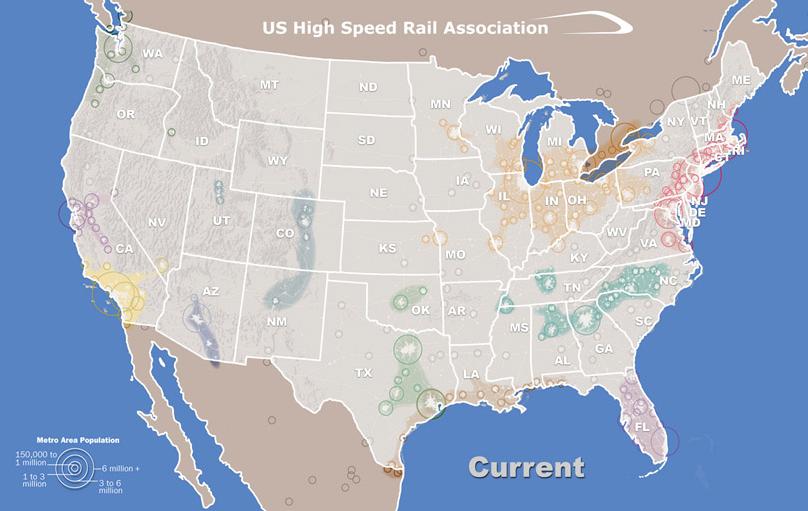
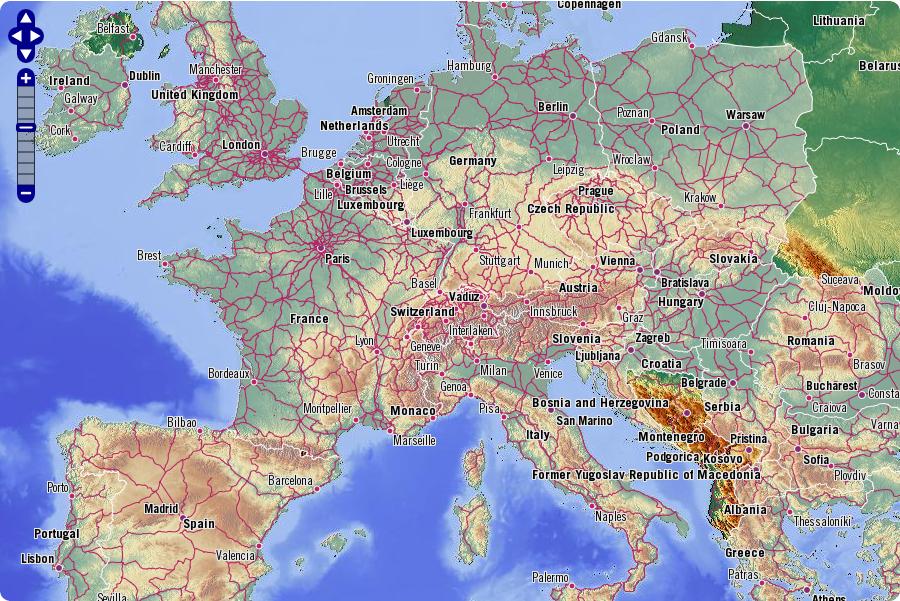
Don’t get me wrong, I love flying just as much as the next person and I’d much prefer it for travel to/from Europe to/from North America — who’d want to take a passenger ferry across the Atlantic given how much longer it would be? When I look at what the current high-speed rail map in the US looks like and then I look at the current high-speed rail map of Europe… it’s flabbergasting!   I’ve hyperlinked the two maps to bigger versions of themselves, so you can really get an idea for how much more advanced Europe is than the US when it comes to their rail system. It’s almost a little embarrassing just how much farther ahead Europe is in this regard.

Some people try to argue that Europe is much smaller, so a rail system makes more sense there. Well, as we can see from the image to the right (), Europe is not actually that much smaller than the USA. In fact, they’re pretty comparable in size. One of the reasons that Europe can sometimes be perceived as smaller than the USA is a function of . Regardless, from my perspective, there really aren’t any good reasons as to why the US hasn’t adopted a high-speed rail system. Even adds his two cents to the debate. In all my time watching Bill Nye as a kid (and in the classroom), I don’t think I’ve ever heard him speak so blatantly negative about anything! He must really feel passionate about this particular circumstance.

Not everything surrounding the high-speed rail system in the US has to be about negativity. In taking a closer look at what the network of rail systems will look like when the projected plan is completed (in 2030), is kind of exciting. Passengers will be able to go from Vancouver, BC, to Miami, FL — all by high-speed rail! They could go from San Diego, CA, to Montreal, QC, again — all by high-speed rail! For me, someone who cherishes the value of public transportation, this is really exciting.

As the plans and the work for this public transportation system continue, I wonder what Europe (and Asia) will come up with next in the way of public transportation. Many areas on these continents already have high-speed rail systems, so, it is logical to think that they will be busy thinking up the next great transportation revolution. Regardless, I’m very excited to see the progress being made in the world with regard to public transportation.

Figure Out What You Love – Then Do It

“Our work is how we create and contribute and it’s how we make the biggest difference with our lives.” – Mike Dooley

Often times, I hear about people who don’t enjoy their chosen career. They get up in the morning, realize it’s a work day, and immediately, their attitude about the day takes a downward spiral. They clean themselves up, eat some breakfast, and head off to work. On their way to work, all they can think about is how much they’d rather be spending their time doing something else. So why don’t they?

Maybe the role models in their life were such that they thought they had to live through jobs that they didn’t like. Maybe they witnessed their mother or father coming home after being at work all day only to complain about how much they completely abhor their job. Maybe they didn’t have any role models at all and they are just modelling what they have seen their peers do or maybe… they picked it up from watching movies and/or TV.

While where they learned this habit is an important factor, I think it’s more important to note that their continued usage of this habit when presented with stimuli to the contrary.

There are lots of feel-good stories out there about people who change their careers midstream from something they despised to something that they love. There are oodles of books on the shelves explaining to people how to leave their current job and go work in a job they love. I’ve read quite a few of them and many of them seem to start with the same premise:

FIGURE OUT WHAT YOU LOVE

This may seem obvious, but authors wouldn’t continue to make money through books aimed at people who don’t like what they do.

There are lots of excuses that you’ll hear bandied about by people who are in jobs they hate, but believe they can’t leave their job because of the money or some other reason. For those people, those reasons are absolutely true – because they believe them. They think that if they quit their job and try to find a new one, they’ll lose out on money they could have been making.

This seems to be a fair point, but I wonder if those people consider the price at which it is costing their mind, body, and spirit to continue to work at a job they don’t like? They spend all day in a ‘low-energy’ vibe and then come home only to need to ‘relax’ by watching TV or doing something completely mind-numbing, only to get up the next day and do it all over again.

If, instead, those people made 20% less money and worked in a job that they loved, they’d be ‘excited’ about the day and enjoy their time at work. They’d come home happy from what they’d accomplished and not need numb their senses through TV or some other form. This positive cycle would continue day after day, rather than the other version of people continuously getting worse and worse.

The jumping off point, for some, contains lots of fear. How will I make money doing something I love? Is it possible? Where will I find this job? All valid questions, but all questions that are based in fear. I believe there is an element of trust in this scenario. When someone trusts that doing something they love to do will reward them – it will. It’s a bit like a self-fulfilling prophecy, I know, but again, there are many examples of people acting in this way and being rewarded.

When it comes to career, the only clear choice is something you cherish doing that will make you happy regardless of the size of your check.

Organizational Systems in Sports: A Decided Advantage

The 1st round of the wrapped up this evening and as I took in some of the games, I couldn’t help but think about how an organizational systems consultant could have a major impact on a sports team. I have no doubt that there are people similar to organizational consultants who do work within the organization and focus on these kinds of issues, but I don’t know that this would be enough. I’ve mentioned before that I think it is important to have someone from outside the organization be involved because the outsider will look at the organization without any bias — at least, that would be the hope.

Just as there are in companies, sports teams have many levels, different departments, and on top of this, all of the ‘stuff’ that the employee of a given position will bring to their job. Meaning, if Joe is the Director of Media Relations for a sports team who just had a major fight within the locker room and Joe has come into work after having a major disagreement with one of his teenage daughters, that disagreement from home will likely (no matter how well-intentioned Joe is) bleed into his meetings with various media personnel. An organizational systems consultant may see something like this coming and have put something in place so that instead of Joe talking with the media (and potentially causing bad press for the team), Joe’s second-in-command handles the media for that day.

Even beyond these kinds of incidents within someone’s family or a dispute between a player and a coach, sometimes there just isn’t the right gelling of players together to create a cohesive environment for success. This is where an organizational systems consultant could use their abilities to work with the underlying energies behind-the-scenes affecting the output of the players, coaches, and team personnel. Have you ever seen a player get traded from one team to another and just completely underperform on his new team? Often, this is because the new player has not been ‘energetically’ disconnected from his old team and ‘energetically’ connected to his new team. It’s amazing how simple procedures like this can have the player flourishing that night.

This example is quite small in terms of the power of affecting the energetic relationships of a sports team. Let’s take a baseball team, for instance. The pitchers and catchers need to have a good relationship for their to be any success for the pitcher. Another important relationship is between the players on the field and the pitcher on the mound. Let’s say that the pitcher has a belief system that whenever he pitches and Richie is playing shortstop, Richie makes an error. While this may be the case (statistically speaking), the pitcher’s belief of this to be true has an effect. The pitcher takes the mound and looks to the shortstop’s area where Richie is standing in the ready position. The pitcher thinks to himself, ‘oh no, not Richie again. He always boots the ball when I’m on the mound.’ The pitcher throws the next pitch and there’s a soft groundball to the shortstop. Without fail, Richie makes an error.

An instance like this can be avoided if there was a shift in the energetic relationship between the two players (and an alteration in the belief system). These kinds of fixes are very easy to facilitate on the energetic level and they always have an effect on the way a player plays. When this kind of change is made, energetically, often you will find that the player will just forget that they ever used to have that belief system — it’s like it just disappeared. The next time the pitcher takes the mound, he doesn’t even think about Richie playing shortstop and when the ball gets hit to him, Richie makes the play easily.

These kinds of examples for on-the-field performance are useful, but it is also important to have a fortified connection within the personnel (coaches, managers, owner, etc.). Let’s say that the Director of Scouting (DoS) doesn’t like the General Manager (GM). This could be for something that actually happened between the two or it could be something more subtle. It could just be that the GM was never liked by the DoS and the DoS never knew why. It could be that the reason there is a rift between these two people of the team personnel is because there is some other energetic charge that is influencing the relationship. Maybe the GM reminds the DoS of his father of which he had a poor relationship with – who knows! Regardless, it would be important for someone to be able to positively effect change in this relationship, so that the DoS doesn’t keep sending players to the GM who have below-professional talent.

In looking at the state of the sports world, I wonder if teams that appear to be very successful from year-to-year are employing someone who can bring about the kind of change that I am talking referring to. Something tells me that this is probably not the case. This makes me wonder, which sport, or even which team, will synchronistically meet someone like who is capable of actualizing this kind of change and reap the benefits for years to come.