The Science of Us: Hank Green’s Crash Course in Anatomy and Physiology

As a professor, it’s probably not surprising that I like to learn. Even though I’ve completed a few degrees, I still try to make time to learn new things — daily. In fact, I’ve even shared these learning experiences. There was the Harvard University’s course on Justice with Professor Michael Sandel (I also went through one of his books chapter by chapter), there was my series on cognitive biases, there was MRUniversity’s course in economics, and before all of that, there was Crash Course.

This was probably one of the first video series that I came across that I felt like I actually learned (and remembered!) something 20 minutes after the video finished. I first went through John Green’s (the same John Green who wrote The Fault in Our Stars) crash course in world history. Later that year, John’s brother, Hank, did a crash course in ecology. John also did a crash course in literature. I didn’t realize it, but Hank also went on to do a crash course in psychology.

There are more crash courses than what I’ve just shared, but those are just a few to give you a taste. Anyway, the reason I’m writing today’s post is because I just learned that Hank is doing a crash course in anatomy and physiology.

Anatomy and physiology are two subjects that I’ve always wished that I spent more time with. In fact, they’re two subjects that I think we all should have spent some time with when we were younger. I used to have the idea that it seemed like a good idea if as part of our basic education, we learned anatomy and physiology and not as some form of “punishment” (as I understand some people don’t necessarily like these subjects), but because anatomy and physiology is/are us. Anatomy and physiology are the reason that you’re alive right now. This seems an appropriate reason to try and understand it.

More specifically, ‘anatomy is the study of the structure and relationships between body parts and physiology is the science of how those parts come together to function.’ Hank calls it, “The Science of Us.”

I’m not going into this expecting to remember every minute detail, but I am expecting that I will have a better understanding of how some of the parts of the body come together to function to make me, me! As an example, I was speaking with a massage therapist the other day and she told me that massage therapists often have to translate what their clients tell them. For instance, a client will often come in complaining that they want to work on their shoulder, while reaching for the area immediately adjacent to their neck. As it turns out, our shoulder is actually far closer to the place where our arm connects to our body. The place that this person was pointing to was, in fact, their neck.

Why Women are Better CEOs, Presidents, and Prime Ministers

New research shows that women are far better at handling stress than men. I suppose that’s not a newsflash as most people already think that’s true, but consider the way in which this study frames it [Emphasis added]:

We consistently found the same general response pattern: while stressed women showed higher self-other distinction than women in the non-stressful control condition, men showed the converse pattern. More specifically, stressed women showed reduced emotional egocentricity bias, enabling them to judge the emotions of the other person in a way that was less influenced by their own emotional state. Moreover, their response times in the cognitive perspective-taking task decreased under stress, documenting that they were able to regulate the mismatch between their own and the “director’s” perspective faster under stress. Finally, stressed women showed a reduction of automatic imitative tendencies in the imitation-inhibition task, indicating that they were able to overcome low-level social signals interfering with their own movement intentions. Note that the latter finding is crucial. It highlights that women did not simply show an increase in other-related responses under stress – as this would have resulted in increased interference from automatic imitation. Instead, they were able to flexibly increase either self- or other-related representations, depending on the task demands which either required overcoming egocentric biases, or overcoming social interference.

As the stereotype goes, women are more “emotional” than men, so it would be much better for an organization or unit if it were managed by a man. However, this research is telling us that, when under stress, it is men who are less able to distinguish their emotional state from the intentions of those around them. It is men who are more adversely affected by stress. For women, it’s the opposite. In fact, women tend to be more prosocial [behaviour intended to benefit others] when they’re stressed. Meaning, instead of retreating inward, women are actually more helpful when they’re stressed.

This research certainly makes one think about the way that many organizations and countries are run today. Most people would agree that being a CEO, President, or Prime Minister certainly comes with oodles of stress. Unfortunately, the number of women who hold these positions is far outweighed by their male counterparts. Of course, there are a number of reasons for that, which we won’t get into in this post, but consider for a moment if the numbers were flipped. That is, what if there were more women CEOs (or high-powered leaders)? Or, what even if it was 50/50! What if the number of high-powered leaders and CEOs was 50% women and 50% men? At that point, would it be easier for folks to see, understand, and digest that women are actually better leaders and better at handling the stress?

Maybe it’s the language we use.

A quick Google search showed mixed results for “women are better CEOs.” In fact, many of the results near the top indicated that women CEOs are more likely to be fired. However, when I keyed in “women are better leaders,” I got plenty of positive results. Posts on Harvard Business Review, Business Insider, and articles talking about academic research in newspapers like The Globe and Mail.

If there’s one thing I’ve learned about the world during my time in it, it’s that change (usually) happens gradually. Rarely is there a massive cultural shift overnight. So, here’s hoping that research like this contributes to the realization for some that when it comes to managers and leadership, women just might have an edge over men.

ResearchBlogging.orgTomova L, von Dawans B, Heinrichs M, Silani G, & Lamm C (2014). Is stress affecting our ability to tune into others? Evidence for gender differences in the effects of stress on self-other distinction. Psychoneuroendocrinology, 43, 95-104 PMID: 24703175

An Alternative to Coffee During the Afternoon Lull — Meditation

No doubt you’ve come across articles that explain that we have a tendency to fall into an afternoon lull. There have also been a number of article that offer a solution to beating this afternoon lull. However, I’ve yet to see any of these articles offer what could be the best use of that time, yet — meditation.

The benefits of meditation are endless not the least of which is mitigating the effect of cognitive biases. So, instead of reaching for another cup of coffee, why not try doing a quick 2-, 3-, 5-, or 10-minute meditation when that afternoon lull comes along. In fact, to up the stakes, I’d be interested to see some research on this. My bet is that meditation would be more effective (and sustainable) than coffee in picking you up. Of course, researching this might prove a bit difficult, but I think it’s doable. Let’s break it down.

I’d want to see three groups: meditation, coffee, and control. Of course, we’d need to have a representative sample, controlling for people who already have a proclivity towards meditation and/or coffee. If at all possible, it’d be great to have two meditation groups, actually: one that already regularly meditates and one that doesn’t.

Initially, I hypothesized that meditation would be more effective. We’d need to determine how we were going to measure effectiveness. I suppose one could consider the remaining hours at work, as the pick-me-up during the afternoon lull is likely a way to get one to the end of the day. In that sense, we’d also want to control for the amount of hours that people continued to work after the meditation/coffee break. At a minimum, it’s something we’d need to measure to maintain internal validity.

I also hypothesized that meditation would be a more sustainable solution to the afternoon lull. Again, how are we going to measure this. My thinking would be including some sort of fatigue/health factor in the study. I suspect that those inclined to have a cup of coffee as an afternoon pick-me-up are probably already drinking coffee to start their day and as a result, might just be taxing their system by having that extra hit of caffeine in the afternoon. Conversely, plenty of research has been conducted on the health benefits of meditation. So, not only would some folks be eliminating the overtaxing nature of a second dose of caffeine, they’d also be reaping the benefits of meditation.

Meditation Mitigates Effects of Cognitive Biases

There have been thousands of scholarly articles written about the myriad benefits of meditation, but the one I came across recently was one of the first that confirmed one of my previously held beliefs: meditation helps you make better decisions.

The thing that struck me most about this study were the similarities to an experiment I conducted (on intuition and decision-making) as a research assistant. I had a condition where students would meditate for a short time and then use their intuition to make decisions. The results weren’t as I, (the research assistant I was working nor the professor), had hoped. I wrote it off as the the reluctance of undergraduates to meditate, but in this study, in particular, studies 2a and 2b, the researchers used undergraduates (approximately 200 combined) and they meditated!

In the second study, the researchers had the undergraduates listen to a 15-minute audio track, which was was specifically designed for this study. In one condition, students listened to a mindfulness meditation created by a professional mindfulness-meditation instructor and in the other, the students listened to a track, again, by a professional mindfulness-meditation instructor, that continuously instructed students to think about whatever came to mind. This second condition was called the “mind-wandering” condition and previous research used a similar method as a control for mindfulness experiments.

As I already mentioned in the opening paragraph, the researchers found that increasing mindfulness (i.e. meditation) reduced the effects of cognitive biases (i.e. the sunk cost fallacy). My favourite part of this study [Emphasis added]:

It is particularly notable in this set of studies that increased resistance to the sunk-cost bias occurred after only a brief recorded mindfulness-meditation induction. Many prior mindfulness-meditation interventions have involved 8 weeks of face-to-face training (Brown & Ryan, 2003); by comparison, our 15-min recorded manipulation is substantially more practical.

Many people have gotten it into their heads that the positive effects of meditation takes weeks to manifest. Here is tangible proof that — today — meditation can help you make better decisions. Also:

We also encourage research investigating how mindfulness practice might improve other decision-making processes and outcomes.

Absolutely! I would suspect that meditation would help guard against a whole host of other cognitive biases, but it would be fantastic if there were scientific evidence to back this up. For instance, years ago when I was the president of the student body, I once tried to begin a general assembly meeting with a quick 1-minute meditation, but the maturity level just wasn’t there. Even after 10 seconds, some of the representatives couldn’t handle the silence. I take the blame for that as I probably didn’t do the method justice by properly introducing it with the research. Can you imagine, if, before every semi-major decision, you took 10, 5, 2, or even 1 minute just to sit still and clear your mind of the previous discussion. I wonder how much lost revenue there is from not taking a moment to pause and reflect before a decision is made.

I should say, I’m sure that there is certainly time between major decisions (i.e. mergers & acquisitions, although, there is fascinating research on how big of a failure those can be), but I’m thinking about the mid-level manager who makes many decisions in a day that can affect the bottomline of a company. The managers that make quick decisions about whether to go with this contract or that contract, whether to make this purchase or that purchase. Maybe that’s a good place to start with more research.

ResearchBlogging.orgA. C. Hafenbrack, Z. Kinias, & S. G. Barsade (2013). Debiasing the Mind Through Meditation: Mindfulness and the Sunk-Cost Bias Psychological Science DOI: 10.1177/0956797613503853

What’s the Difference Between Empathy and Sympathy?

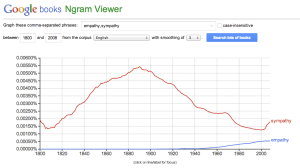
Screen Shot 2014-01-23 at 12.48.00 PMWhen you search for empathy on Google, you get almost 10,000,000 results. When you search for sympathy on Google, you get almost 25,000,000 results. I bet if we could look at historical search results in Google, I bet that we’d see a big trend where the number of search results for empathy has been increasing. The closest thing we can do to this is a search of all the books that contain the word empathy (at least the ones that have been digitized by Google). How? Using Google’s Ngram Viewer.

The chart above shows the mentions of empathy and sympathy starting in 1800 and ending in 2008. As we can see, empathy was hardly mentioned at all when compared to sympathy until the 1920s. That makes me wonder if there might have been some writings about empathy around the time of the Great Depression. What’s noteworthy though, is the steady increase in mentions of empathy. Granted, it’s still in only a fraction (0.0005%) of books, but it’s still progress.

Sympathy, on the other hand, we can see has steadily declined since the early 1900s. However, there’s been a small blip in sympathy since the mid-2000s. I would guess that this may have to do with the title question of this post: the difference between sympathy and empathy.

There’ve probably been several books written about the differences between empathy and sympathy in the last 5 or 10 years. So, do you know the difference between the two? I have to admit, even as an undergraduate in psychology, I’d often find myself googling the difference between the two terms. About a month ago, I came across a great video from the RSA that quickly explains the difference between empathy and sympathy. Of course, there’s a slight bias towards empathy in the video, but I think you’ll agree — empathetic is far better than sympathetic.

In case you’re inspired to be a champion of empathy or want some more information about programs that are helping to increase the level of empathy, I’d suggest checking out Ashoka: Empathy.

And if you want a bit more information about how empathy has shaped our society and continues to shape it, then I highly recommend checking out the RSA Animate video of Jeremy Rifkin’s book, The Empathic Civilization:

Could There Be No Poor Countries in 20 Years? Bill Gates Thinks So

Screen Shot 2014-01-21 at 1.10.10 PMThis is probably one of my favourite headlines I’ve had to write so far this year, especially on the heels of yesterday’s post about less than 100 people having more wealth than half of the world. In the Bill and Melinda Gates’ Foundation annual letter, Bill Gates is optimistic, to say the least:

I am optimistic enough about this that I am willing to make a prediction. By 2035, there will be almost no poor countries left in the world. (I mean by our current definition of poor.) Almost all countries will be what we now call lower-middle income or richer. Countries will learn from their most productive neighbors and benefit from innovations like new vaccines, better seeds, and the digital revolution. Their labor forces, buoyed by expanded education, will attract new investments.

By current definition of poor, Gates clarifies that he means that, “almost no country will be as poor as any of the 35 countries that the World Bank classifies as low-income today, even after adjusting for inflation.”

WOW!

Can you imagine a world where this happens? And Gates thinks that this could happen by 2035 — that’s 20 years from now! Twenty years!

A few months ago, I wrote a post considering what might be my generation’s version of racism:

I’ve spent a lot of time talking about my generation in comparison to generations past, but the true purpose of this post is a juxtaposition of the generations to come. As I said, it seems that past generations had a harder time than mine digesting the mix of cultures. For kids growing up today (in certain countries), it’s abundantly clear that there are people who look different from them and it’s just normal to grow up and be friends with people like this. My question, what is it that my generation will have a hard time with that future generations will see as natural?

Maybe a tangential answer to that question is poverty. Maybe in my lifetime, poverty (as we know it) will be eradicated. That’s certainly a wild idea given the current state of the world, but I for one would be thrilled to see this come to pass as I imagine others would be. With that being said, I could see how some folks might not be as accepting of this change and that’s not to say that they wouldn’t want poverty to be forever changed, but just that they might be a little less comfortable with the change.

As an example, let’s use technology. Generations before mine had technology that was quite different from what we use today. That is, the invention of TV was amazing. Now today, we can watch TV on a device that we can carry around in our pocket. Some folks from past generations are amazed by this and might still have a hard time adjusting to this reality.

That’s how I’m trying to superimpose the possibility of the eradication of poverty for my generation. Some folks might have a hard time adjusting to this reality. Regardless of the comfortability of some folks with this potential reality, I think it’s great that the Gates’ have wrote a letter helping to debunk some of the myths in developmental economics:

  1. Poor countries are doomed to stay poor.
  2. Foreign aid is a big waste.
  3. Saving lives leads to overpopulation.

I definitely recommend checking out the whole letter, which you can read here.

How Our Culture Failed Women in 2013

I’ve written before about my affinity for the documentary Miss Representation and its “brother” film that’s coming out in a few weeks The Mask You Live In. Well, a few weeks ago, the organization responsible for those movies put out a wonderful — well, in some ways — video detailing the ways in which the media has failed women in 2013. At first, it lists some of the great achievements that women have had this year and then… the video turns a bit sour.

We see a time lapse of a woman being airbrushed on the cover of a magazine, very sexist advertising (magazine and commercial), oversexed music videos, movies, tv shows, and then it turns to how the media cover some news events. There are — seemingly — ignorant men (mostly) patronizing women either in person or talking about women in patronizing ways. However, there are some really powerful moments. There’s a segment from Rachel Maddow where she’s discussing how women can have all of these ticks in the boxes and still get talked to in a negative way. There’s also — and this is my favourite — a video from this past summer when the Texas legislature was trying to ram a bill through that severely limited the rights of women regarding abortion.

I realize that for some, this can be an issue that incites a lot of passion in one direction or the other, but my preference for the video has nothing to do with that issue and everything to do with this woman, this strong and powerful woman, standing up for herself and for women to what is a room and a profession dominated by men. I remember when the now famous Wendy Davis filibuster was first starting to take shape in June and I remember turning on the stream sometime in the evening and having it running in the background. And then as they got closer to the end when things were really getting interesting. I remember trying to understand some of the wonky ways that procedure was being applied and then I remember Leticia Van de Putte…

It was one of the most powerful things I’d ever seen live. And if I recall correctly, I think these words were enough to motivate the gallery (the visitors sitting up above watching) to make noise until the clock ran out and the filibuster worked. Again, I want to make it clear that I’m not arguing in favour or against the merits of the filibuster, but just to draw your attention to that moment when Leticia Van de Putte said those words and the crowd erupted. I wish it weren’t, but it seems an apt metaphor for so much of how the world works today.

~

On a slightly happier (?) and stranger point, in an edition of The Economist from late last year, someone pointed out that Angela Merkel, the Chancellor (kind of like a President or Prime Minister) of Germany, appointed a female defence minister. And not only was this defense minster going to be a woman, but also that she is a gynecologist, entered politics at age 42, and has 7 children.

I think it’s great that Germany has appointed a female defence minister, but I wish that it weren’t news that Germany appointed a female defense minister. I look forward to the time in my life where the fact that someone’s been appointed to high political office or has been crowned the CEO of a big corporation and happens to also be a female is not newsworthy.

Note: You’ll notice that I made the title of this post about “our culture” and not “the media” and that’s because I don’t think it’s necessarily fair to pin the failure all on the media. There’s a feedback loop between our culture and the media. Yes, the media could certainly end that feedback loop, but so could the culture. In a way, everyone deserves a bit of the blame.

Revisiting Using Pitchers on Short Rest: Long-Term Ramifications

A couple of weeks ago, I wrote about the Los Angeles Dodgers’ strategy of using their best pitcher (and one of the best pitchers in baseball) on short rest to pitch in a non-elimination game. The Dodgers ended up winning that game and the series, but the debate over the strategy doesn’t end there.

In my post from a couple of weeks ago, I compared the Dodgers’ decision to my younger years when I was playing baseball in double elimination tournaments. This wasn’t a perfect comparison, but I the spirit of the decision to use your best pitcher was there in both. A few nights ago, the Los Angeles Dodgers were eliminated from the postseason. All but one of the thirty teams are eliminated, so this isn’t earth-shattering news. However, the fashion in which they lost is.

In Game 6 of the National League Championship Series, the Dodgers started Clayton Kershaw. Yes, the same one who started in Game 4 for the Dodgers in the National League Divisional Series. This time, Kershaw’s start didn’t go so well. In fact, Kershaw only pitched 4 innings before pulled by the manager, Don Mattingly, but not before Kershaw gave up 7 runs. So, the question might be warranted: did using Kershaw on short rest affect his ability in Game 6? It turns out, this was a thought that had crossed some minds before Kershaw made the start in Game 4.

As they say, hindsight is 20-20, but it does seem a bit prescient. McCarthy’s hypothesis makes sense, but it’d be hard to test. One may point to Kershaw’s start in Game 2 of the NLCS. He tossed 6 innings and allowed 1 unearned run. Shouldn’t he have unravelled in that game if he were fatigued from the short rest start in the NLDS? One could argue that, but the way that McCarthy’s argument is setup leads one to believe that the “fatigue” could happen later and later. So, if the Dodgers won Game 6 and won Game 7, would McCarthy have expected Kershaw to unravel during one of his starts in the World Series?

~

Let’s see if we can apply this lesson to decisions in other arenas. The analogy I used for the other post doesn’t really hold anymore. We’d be better off thinking about a decision for a business. Using Kershaw in the way the Dodgers did was almost like using a certain machine in the factory to fill some rush orders. The machine might only be able to fill a certain number of orders per week, but because it’s the holiday season, the boss thinks that running it on overdrive is necessary. Initially, the machine churns out the widgets just the way the boss would have expected, but next week when you use the machine, the widgets aren’t as high a quality. And then the week after that, the widgets aren’t even of a high enough quality to give away. It’s clear, the machine needs a break and some recalibration. In weighing the risk, the boss thought that using the machine more than usual was worth it for it potentially shutting down.

There are other ways we can map out this scenario, but I want you to think about how you might be overdoing it. Maybe the machine you use at work is fatiguing. Maybe you are fatiguing from working too hard.

It’s More Than Just Body Image, It’s How We Relate to the World

A couple of weeks ago, someone passed along an excellent video of a woman describing her experience with the pressures of body image. It’s an important video and I hope you take the time to watch it (whether you’re a female or a male). As I’ve talked about before, it’s important to understand just how the media is unintentionally reinforcing certain beliefs about the way we think, act, and feel, as a society.

There is one particular piece that’s not explicitly stated in the video that I wanted to highlight: the way of being in the world. Lily Myers talks about this sense that men were taught to “grow out” and women were taught to “grow in.” In a sense, it was okay for men to take up space and not okay for women to take up space. This is important and we should consider this in more contexts than body image. For instance, we often hear about how men are more likely to get promoted quicker or have better salaries. There are myriad reasons for this, but what if wrinkle to those debates are because women are taught to, from a very young age, that taking up space is ‘not okay.’

Of course, I’m not saying that women are actively being taught that their existence isn’t warranted, (though that’s the case in some parts of the world). It’s the subtleties that Myers speaks about in her video. This idea that she is watching her mother and understanding that ‘this is how I should behave, too.’

When I watch a video like this and hear the powerful message, I can’t help but hope that many people will see it. That many people will take this opinion in and consider that this is actually how someone else feels in the world. That this experience could be shared by many. If after watching this video, you’re wondering just how Lily Myers and our society came to be this way, I’d encourage you to check out Miss Representation, which came out a couple of years ago and, in February of 2014, The Mask You Live In

Here’s the text from the poem:

Across from me at the kitchen table, my mother smiles over red wine that she drinks out of a measuring glass.
She says she doesn’t deprive herself,
but I’ve learned to find nuance in every movement of her fork.
In every crinkle in her brow as she offers me the uneaten pieces on her plate.
I’ve realized she only eats dinner when I suggest it.
I wonder what she does when I’m not there to do so.

Maybe this is why my house feels bigger each time I return; it’s proportional.
As she shrinks the space around her seems increasingly vast.
She wanes while my father waxes. His stomach has grown round with wine, late nights, oysters, poetry. A new girlfriend who was overweight as a teenager, but my dad reports that now she’s “crazy about fruit.”

It was the same with his parents;
as my grandmother became frail and angular her husband swelled to red round cheeks, rotund stomach
and I wonder if my lineage is one of women shrinking
making space for the entrance of men into their lives
not knowing how to fill it back up once they leave.

I have been taught accommodation.
My brother never thinks before he speaks.
I have been taught to filter.
“How can anyone have a relationship to food?” He asks, laughing, as I eat the black bean soup I chose for its lack of carbs.
I want to tell say: we come from difference, Jonas,
you have been taught to grow out
I have been taught to grow in
you learned from our father how to emit, how to produce, to roll each thought off your tongue with confidence, you used to lose your voice every other week from shouting so much
I learned to absorb
I took lessons from our mother in creating space around myself
I learned to read the knots in her forehead while the guys went out for oysters
and I never meant to replicate her, but
spend enough time sitting across from someone and you pick up their habits

that’s why women in my family have been shrinking for decades.
We all learned it from each other, the way each generation taught the next how to knit
weaving silence in between the threads
which I can still feel as I walk through this ever-growing house,
skin itching,
picking up all the habits my mother has unwittingly dropped like bits of crumpled paper from her pocket on her countless trips from bedroom to kitchen to bedroom again,
Nights I hear her creep down to eat plain yogurt in the dark, a fugitive stealing calories to which she does not feel entitled.
Deciding how many bites is too many
How much space she deserves to occupy.

Watching the struggle I either mimic or hate her,
And I don’t want to do either anymore
but the burden of this house has followed me across the country
I asked five questions in genetics class today and all of them started with the word “sorry”.
I don’t know the requirements for the sociology major because I spent the entire meeting deciding whether or not I could have another piece of pizza
a circular obsession I never wanted but

inheritance is accidental
still staring at me with wine-stained lips from across the kitchen table.


More Scientific Evidence That Beliefs Affect Biology

If you’ve been following me since I started writing on the internet a couple of years ago, you know that I have a certain soft spot for the power of belief (sampling: here, here, here, and here). I understand that many folks are still leery of that phrase, but when you couch it in the context of the “placebo effect,” it’s amazing how many people begin to accept it as a thing.

Depending upon your philosophical bent, you may believe that willpower is a depletable resource. You certainly wouldn’t be alone in that thought, as President Obama seems to subscribe to this point of view. There are also those who believe that willpower is not a limited resource. So, which one is it? A simple question without a simple answer. It’s important to remember that depending upon from which point we begin, we may be less inclined to believe the other side of the story (remember the confirmation bias?) As much as possible, it’s important to try to take in new information with an open mind. With that being said, (regardless of where you stand), try to examine the following study with an objective and critical eye.

…following a demanding task, only people who view willpower as limited and easily depleted (a limited resource theory) exhibited improved self-control after sugar consumption. In contrast, people who view willpower as plentiful (a nonlimited resource theory) showed no benefits from glucose—they exhibited high levels of self-control performance with or without sugar boosts. Additionally, creating beliefs about glucose ingestion (experiment 3) did not have the same effect as ingesting glucose for those with a limited resource theory.

When I read this, my first thought was, as the title suggests, more evidence that our beliefs can affect our biology (see: Biology of Belief). Of course, I understand if some folks have a hard time jumping on board with this, so, like I said, couching it in the language of the “placebo effect” seems to make it more palatable.

~

After reading this, I’d encourage you to follow-through with application. That is, now that you have this knowledge, apply it to your own life. Test it out. See what works for you. Maybe you used to believe that willpower was a limited resource, but after reading this, think the opposite. It’s certainly worth taking a chance, right?