“Every thought, word, or deed, either purifies or pollutes the body.” – Harold Klemp
“Thoughts become things, choose the good ones!” – Mike Dooley
“You are not a helpless victim of your own thoughts,but rather a master of your own mind.” – Louise Hay
“Thoughts are boomerangs, returning with precision to their source. Choose wisely which ones you throw.” – Author Unknown
“Keep your thoughts positive, because your thoughts become your words.
Keep your words positive, because your words become your behaviours.
Keep your behaviours positive, because your behaviours become your habits.
Keep your habits positive, because your habits become your values.
Keep your values positive, because your values become your destiny.” – Gandhi
~
 I could continue repeating quotes that support the idea that our thoughts have an effect on our reality. There are even theories put forth by scientists that explain how this works. I’ve embedded a video at the end of this post of Nassim Haramein talking about synchronicity and in the context, explains how/why our thoughts affect our reality. While there is much evidence that supports the idea that our thoughts have an influence on the outcome of our lives, there is just as much evidence to the contrary. In fact, a simple Google search for “critique of positive thinking” returns almost 3,000,000 results. I wonder what it is about this topic that is so polarizing for people?
I wonder why there are those people who feel adamant about our thoughts having an effect on us and there are those that feel, just as strongly, that the idea that our thoughts affect us is hogwash. To be honest, I was initially a skeptic. While I grew up in an environment that fostered the development of the idea that our thoughts have an influence on us, I had never seen any tangible evidence of this. Going through my early schooling, I still held the idea of this as a possibility, but I also learned about the scientific method. In doing so, I wondered if there would ever be a way to scientifically measure whether or not our thoughts can have an effect on our lives.
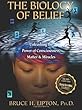 Well, in 2005, a developmental biologist by the name of Bruce Lipton, came out with his first book, The Biology of Belief. In this book, Lipton takes the reader on his journey as a student, professor, and researcher, until his discovery about the cell. For years and years, biologists thought that the cell was controlled by something inside itself — the nucleus. Lipton, however, discovered that this is not the case.
Lipton learned through his research that the cell was actually governed by processes outside the cell. More accurately put, there are processes inside the cell that respond to things happening in the environment outside of the cell. Meaning, as the environment that the cell is in, changes, so too does the cell. There is a dynamic relationship between the cell and its environment.  Lipton has gone on to extrapolate these results to other areas of our life beyond the cell. Namely, thoughts and by extension, actions. You’ll find many videos of Lipton talking about the importance of ‘conscious parenting,’ and even some articles.
Something that I find fascinating about one of the conclusions that Lipton came to from his work is that when cells are presented with nutrients, the cells move openly and towards it. When cells are presented with toxins, the cell closes and moves away. Lipton found that a cell could not simultaneously be in a state of growth (opening and moving forward towards the nutrients) and in a state of protection (closing and moving away from the toxin). I think that this applies directly to the first quote I have provided for this post: “Every thought, word, or deed, either purifies or pollutes the body.” So, we are either thinking positive, warm, and loving thoughts that help our body grow, or we are thinking negative, degrading, and unnecessary thoughts that our body must defend against. Which kind are you thinking?
~


 Jeremiah Stanghini