Belongingness, Transpersonal Psychology, and Transpersonal Experiences: Transcendence and Belongingness, Part 2

In yesterday’s post, we looked at the first section of this paper: Maslow’s Hierarchy of needs. In today’s post, we’ll look at the three sections that followed: belongingness, transpersonal psychology, and transpersonal experiences.

~

Belongingness

According to Baumeister and Leary (1995), “A need to belong, that is, a need to form and maintain at least a minimum quantity of interpersonal relationships, is innately prepared (and hence nearly universal) among human beings” (p. 499). Meaning, humans have a desire to be in relationships with other humans similar to how we learned from Maslow. Baumeister and Leary (1995) separated belongingness into two features: interactions with people and a perception that the relationship will continue in the future. In the first feature, interactions with people, Baumeister and Leary (1995) specify that these interactions have a positive affect, but more importantly, the interactions need to be free of negative affect or conflict. Affect is in reference to the experience of the interaction. In the second feature, humans must have a perception that the relationship will continue in the future and that the relationship have affective concern and stability (Baumeister & Leary, 1995). It is very important there be a context by which the humans can have when interacting with others. This is important because a human’s interactions with a stranger are markedly different from the interaction with someone that they perceived to have a relationship with (Baumeister & Leary, 1995). According to Baumeister and Leary (1995), “To satisfy the need to belong, the person must believe that the other cares about his or her welfare and likes (or loves) him or her” (p. 500). Baumeister and Leary (1995) continued by saying that it would be ideal if this interaction would be reciprocating in that both parties care about one another. In sum, belongingness is a need that is classified by one’s need for social contact and intimate relationships (Baumeister & Leary, 1995). In this section, we have gained a greater understanding of belongingness. In the next section, we will explore transpersonal psychology.

Transpersonal Psychology

According to Hartelius, Caplan, and Rardin (2007), there are three main themes that make up a comprehensive definition of transpersonal psychology: “An approach to psychology that 1. studies phenomena beyond the ego as context for 2. an integrative/holistic psychology; this provides a framework for 3. understanding and cultivating human transformation” (p. 11). Beyond the ego refers to states where the person is experiencing from a state that is no longer absorbed in their ego. Meaning, the person is experiencing a state that is “outside of ‘ordinary’ state of mind” (Hartelius, Caplan, & Rardin, 2007, p. 9). Integrative/holistic psychology is a way of incorporating the whole person into psychology. Holistic psychology is made possible to be a specific field within psychology as standard psychology has focused mainly on the ego and its pathologies (Hartelius, Caplan, & Rardin, 2007). Human transformation is the process a human undergoes when it is changing, usually in a positive way. To define transpersonal psychology more succinctly, Hartelius, Caplan, & Rardin (2007) said “transpersonal psychology studies human transcendence, wholeness, and transformation” (p. 11). In this section, we have gained a greater understanding of transpersonal psychology. In the next section, we will look at transpersonal experiences and more specifically, transcendence.

Transpersonal Experiences

In the last section, we said that transpersonal psychology has three main themes: beyond-ego psychology, integrative/holistic psychology, and transformational psychology (Hartelius, Caplan, & Rardin, 2007). In this section, we will look at some of the experiences that go along with these themes. According to Hastings (1999), “Transpersonal psychologists have recognized that certain experiences of mystics, meditators, and religious devotees have transpersonal qualities – that is, they bring the self into a state that transcends individual ego boundaries” p. 198). In other words, one possible transpersonal experience could be transcendence. However, Hastings (1999) noted “There is no one typical experience, and there may be images, ESP, voices, forms, nonforms, visions, and physical effects as part of the encounter” (p. 198). While there are ranges of possibilities for transpersonal experiences, we are going to focus specifically on transcendence.

Maslow (1968) wrote of thirty-five varieties of transcendence. According to Maslow (1968), “transcendence refers to the very highest and most inclusive or holistic levels of human consciousness” (p. 66). It has been stated that transcendence is one of the elements of transpersonal psychology, so it is fair to say that transcendence is a transpersonal experience. As there are many varieties of transcendence, in the next section we will look at experiences of transcendence in the context of belongingness.

~

Check back tomorrow for the last section of the paper: belongingness and transcendence, followed by the conclusion.

Maslow’s Hierarchy of Needs: Transcendence and Belongingness, Part 1

It’s time, once again, to dig into the archives. This is a paper I wrote for one of the first classes I took at Sofia University: Proseminar in Transpersonal and Spiritual Psychology. It took me some time to pick a topic, as there was so much that interested me in the first quarter of graduate school. I eventually settled on making a connection between Maslow’s Hierarchy of Needs (more specifically, belongingness) and elements of transpersonal psychology. Enjoy!

~

This paper will give a brief summary of Abraham Maslow’s ‘hierarchy of needs,’ with a focus on ‘love needs’ – more explicitly – belongingness. There will also be a brief summary of transpersonal psychology. In particular, there will be a description of a transpersonal experience, namely, transcendence. Lastly, there will be connections made showing there are transpersonal elements to belongingness. Specifically, in some variations of transcendence, one feels a sense of belongingness. To begin, we will explore Maslow’s hierarchy of needs.

Hierarchy of Needs

Before we can understand Maslow’s description of ‘love needs,’ it is important to understand how the ‘love needs’ fit into the bigger picture of needs. According to Maslow (1943), “Human needs arrange themselves in hierarchies of prepotency” (p. 370). The order that Maslow theorized an arrangement of needs was as follows: physiological, safety, love, esteem, and self-actualization (1943). To start with, we will deepen our understanding of physiological needs.

Physiological needs. According to Maslow (1943), “Physiological needs are the most prepotent of all needs” (p. 373). Meaning, physiological needs are the most basic of all human needs and take precedence over any of the other needs. The physiological needs consist of homeostasis, hunger, thirst, sleep, and sex (Maslow, 1943). Homeostasis is an overarching term that encompasses the four other terms and it means that the human reaches a state of equilibrium or balance. The four other components of physiological needs are all basic needs of a human being to survive. A human must eat and drink in order to survive, just as the human must sleep and reproduce by way of sex to survive. We have a basic understanding of the physiological needs, so we will now deepen our understanding of safety needs.

Safety needs. According to Maslow (1943), “If the physiological needs are relatively well gratified, there then emerges a new set of needs, which we may categorize roughly as the safety needs” (p. 376). Meaning, the physiological needs are the fundamental needs of a human and once those needs are satisfied, the next set of needs is most important – safety needs. The best way to characterize the safety needs is “[the human] seems to want a predictable, orderly world” (Maslow, 1943, p. 377). This predictable and orderly world is part of all aspects of the human’s life. The safety needs consist of security of employment, security of their person including their physical body and health, security of fairness, and security of shelter (Maslow, 1943). Security of employment is in reference to one’s job or vocation. Security of one’s person includes their physical body and health, which refers to one being healthy and not being in any danger from predators. Security of fairness refers to an orderly and predictable world. Security of shelter is a way of keeping one’s person safe and healthy. We have a basic understanding of physiological needs and safety needs, so we will now deepen our understanding of love needs.

Love needs. According to Maslow (1943), “If both physiological and the safety needs are fairly well gratified, then there will emerge the love and affection and belongingness needs” (p. 380). As we learned earlier, the needs occur in a systematic way such that the primary needs are met before the human seeks other needs. The love needs consist of a desire for friends, a desire for a husband or wife, and a desire for children (Maslow, 1943). It is important to note that the word love is not synonymous with sex, as sexual needs seem to be more apparent in physiological needs (Maslow, 1943). As stated by Maslow (1943), “The love needs involve both giving and receiving love” (p. 381). At this stage of one’s needs, they have a desire to give and receive love to their friends and family, if they have family. It is important that the human form social bonds or relationships with friends in order for it to be possible for them to fulfill the love needs. We have an understanding of physiological needs, safety needs, and love needs, so we will now deepen our understanding of esteem needs.

Esteem needs. According to Maslow (1943), “All people in our society . . . have a need or desire for a stable . . . high evaluation of themselves, for self-respect, or self-esteem, and for the esteem of others” (p. 381). Maslow differentiates the esteem needs into two categories: achievement and reputation (1943). Within the achievement category, the human strives for achievement by doing and accomplishing objectives. Within the reputation category, the human strives for reputation by gaining the respect and esteem of other people. Both of these categories are part of the human’s desire for self-esteem, self-respect, and respect by others, which make up the esteem needs (Maslow, 1943). If the person is able to achieve and gain a reasonable reputation, then they will be able to attain their esteem needs. We have an understanding of physiological needs, safety needs, love needs, and esteem needs, so now we will deepen our understanding of self-actualization needs.

Self-actualization needs. According to Maslow (1943), “[Self-actualization] refers to the desire for self-fulfillment, namely, to the tendency for him to become actualized in what he is potentially” (p. 382). Meaning, a painter must paint, a musician must play music, a writer must write, and an athlete must play sports (Maslow, 1943). Self-actualization needs consist of the human “becoming everything that one is capable of becoming” (Maslow, 1943, p. 382). Someone who is capable of becoming a graduate school professor, but instead settles for being a preschool teacher would not likely be someone who is characterized as fulfilling his or her self-actualization needs. We have explored Maslow’s hierarchy of needs and learned that there are five sets of needs: physiological, safety, love, esteem, and self-actualization. Within this section, we have gained a greater understanding of the hierarchy of needs. In the next section, we will look at one of the love needs in further detail – belongingness.

~

Check back tomorrow for the sections on belongingness, transpersonal psychology, and transpersonal experiences.

Chapter 3 – Fairness and Inequality: What Money Can[‘t] Buy, Part 3

It’s been a couple of weeks since I last finished a chapter in Michael Sandel’s book, What Money Can’t Buy. I recently completed chapter 3 a couple of nights ago and there were some intriguing things to think about. Let’s get right to it!

For me, there were two important parts to the chapter. The first is the explanation of the two objections to markets. Prof. Sandel explains that the two kinds of objections to markets are fairness and inequality:

The fairness objection points to the injustice that can arise when people buy and sell things under conditions of inequality or dire economic necessity. According to this objection, market exchanges are not always as voluntary as market enthusiasts suggest… [The corruption objection] points to the degrading effect of market valuation and exchange on certain goods and practices. According to this objection, certain moral and civic goods are diminished or corrupted if bought and sold. [Emphasis added]

A few pages later, Prof. Sandel explains further what he means:

The fairness and corruption objections differ in their implications for markets: The fairness argument does not object to marketizing certain goods on the grounds that they are precious or sacred or priceless; it objects to buying and selling goods against a background of inequality severe enough to create unfair bargaining conditions… The corruption argument focuses on the character of the goods themselves and the norms that should govern them. So it cannot be met simply by establishing fair bargaining conditions. [Emphasis added]

Reading this was a bit tough to swallow. It seemed unlikely that all arguments against markets could be filtered into one of two categories. Then, I thought about his course that I watched last year, “Justice,” and how many of the students seemed to want to argue for nuance around the edges. While there was still nuance, the arguments they put forth still, for the most part, seemed to fall into a way of thinking that had already been espoused by a philosopher.

Later in the chapter, Prof. Sandel discusses three cases where the marketization of a good crowds out nonmarket norms. That was a bit wordy. Prof. Sandel shares cases where adding a market-like aspect (where there previously wasn’t), changed the way people interacted with the good. One of these cases I found particularly surprising (at least at first).

The case comes from Switzerland in the early 1990s. The country was looking for a place to store its nuclear waste. Of course, no town really wanted to house the nuclear waste, but there was a small village that was picked. Some economists surveyed the village to see if they’d accept it, if the Swiss parliament decided that it was the place to put the waste. Fifty-one percent of residents said they’d accept it. The economists then asked another question. If the parliament also paid each resident, would you then accept it? The idea being that, money is the king incentive for everyone, so adding money to this equation should only get more people accepting of the waste, right? Wrong. By adding the monetary sweetener, support collapsed from 51% to 25%! Even when they added more money, that didn’t seem to affect the outcome. Why?

For many villagers, willingness to accept the nuclear waste site reflected public spirit — a recognition that the country as a whole depended on nuclear energy and that the nuclear waste had to be stored somewhere. If their community was found to be the safest storage site, they were willing to bear the burden. Against the background of this civic commitment, the offer of cash to residents of the village felt like a bribe, an effort to buy their vote.

This seemed like an incredible story with an important lesson — money isn’t always the solution. There were two other examples, but none that were as powerful for me as this one.

~

The second important part of this chapter is the explanation of the “two tenets of market faith”:

The first is that commercializing an activity doesn’t change it. On this assumption, money never corrupts, and market relations never crowd out nonmarket norms… The second tenet of market faith is that ethical behavior is a commodity that needs to be economized. The idea is this: we should not rely too heavily on altruism, generosity, solidarity, or civic duty, because these moral sentiments are scarce resources that are depleted with use. [Emphasis added]

Prof. Sandel already showed earlier in the chapter that money can crowd out nonmarket norms. After this above quoted section, he goes on to show that things like altruism and generosity are not scarce resources and that they are not depleted with use. In fact, it’s quite the opposite. Fields like positive psychology have done research on these areas and shown that there’s almost a multiplier effect with things like altruism and generosity.

If you liked this post, you might like one of the other posts in this series:


The Mask You Live In – Gender Stereotypes in the Media

Screen Shot 2013-07-11 at 10.10.47 PMA couple of years ago, a really important documentary came out: Miss Representation. I mentioned it in my series about the people I follow on Twitter. I was surprised that when I did a search of the website that I hadn’t written about Miss Representation. The documentary brings to light how the media portray women. *Spoiler Alert* They don’t do a good job.

After I saw the film, my first reaction is that it should be required viewing in classrooms across the US (and probably Canada, too, as Canada does consume a great deal of US Media). This movie is really important, especially for teenagers and children. They need to see and understand the perversion of the portrayal of women in the media. As can be seen in the movie, a number of young girls seem quite grateful to learn that some of the beliefs that they’d internalized were a result of the media they consumed. I can only imagine the number of young girls across the US that had similar experiences upon seeing the movie. As a man, I was very moved by the the film and whole-heartedly support the cause of MissRepresentation.org (and hope you will check it out and support it, too!)

All that to say is, there’s going to be a “sequel” to the movie — this time, for the boys. Yes, we do a great disservice to our young women, but we also do a great disservice to our young men, too. The Director/Producer of Miss Representation has launched a Kickstarter to help fund The Mask You Live In. Based on some of the dates listed on the Kickstarter page, it looks like the movie is set to debut in February of 2014. I have already made a note in my calendar and can’t wait to see it!

If you have a few minutes, I strongly recommend heading over to the Kickstarter page to watch the trailer. And, if the project moves you, why not donate some money, too?

Updates to JeremiahStanghini.com: Papers & Series

I noticed that I’d been getting some more traffic than usual to my about page, so I thought I’d read it and see what it says (it had been a while since I’d seen it). Upon reading it, I realized that it needed some updating… so I’ve gone ahead and done that. I’ve tried to make it a little more universal than it was in the past, so I won’t have to update it as frequently (though, is a yearly update really that unrealistic?)

Anyway, the real reason I wanted to give you an update about the website is for a new page that I’ve created: Papers & Series. You’ll see this on the banner above my name on the right-hand side (it’s an important feature!) On this page, I’ve collected all the papers/series that I’ve posted here online. So, if you remember me saying something about a series on American Public Policy, but couldn’t find the link, you’ll now be able to see all of the links in that series. Or maybe something about telepathy and psi phenomena? Yes, they’re in there, too.

The best part about this page is that I’m going to continually update it. So, when I post a new series, I’ll also update that page to show that the new paper/series has been posted to the website. If you haven’t read all my series, I highly suggest checking them out. There’s likely something in there that you’ll like. Also, be sure to check back soon as I continue to dig through my old papers and share them on here.

Spiritual Development of the Frog: Spiritual Development of Frogs, Part 2

In yesterday’s post, we looked at the first half of a paper I wrote about the spiritual development of frogs. There was a focus on the  biological development of frogs. Today, we’ll look at the second half of the paper and wrap it up. In this half of the paper, we really get into the “creative” part. Enjoy!

Spiritual Development of the Frog

It is conceivable that all species have some form of spiritual development. It would be ludicrous to assume that we, as humans, are the only species that can experience spiritual development. Given this, it is fair to assume that frogs experience spiritual development. As we learned from an earlier section in this paper, biological development can be tied to spiritual development. As such, a frog’s spiritual development is markedly similar to their biological development.

A frog’s life begins as an egg. Not many eggs make it past this stage, so the eggs that do make it past this stage, must have something rare about them. The eggs that survive this stage have something exceptional about them. These eggs are already into stage one of the spiritual development of a frog – protection. In this stage of spiritual development, the frog has to have the intuitive capacity to have chosen the right egg to be born into that will not be eaten by a predator. Not all eggs make it to stage one of spiritual development, so the eggs that do, are already ahead of the game. It is necessary to say that those eggs that do not make it to stage one are eggs that have remained in stage zero, which is called undifferentiated.

Once an egg has made it past the stages of undifferentiated and protection, they move into becoming a tadpole. In this stage, the tadpole undergoes many transitions. During the tadpole stage, the tadpoles that mature too quickly are not only subject to predation from other species, but from their own kind! Tadpoles that fall into this trap do not move onto the next stage of spiritual development – safety. Those tadpoles that have the compassion and understanding of what is going on in their bodies portray an air of safety to them. They are aware of what is in their environment that can harm them and know not to mature at a rate too quickly, so as not to upset the other tadpoles. To this point, we have learned that a frog begins as an egg in biological terms and as undifferentiated in spiritual terms. If the egg that is chosen is ‘protected,’ then the frog spirit that chose the egg moves onto the next biological stage of tadpole and to the next stage of spiritual development of protection. If the tadpole is smart and ‘safe’ enough, then they are permitted the opportunity to undergo a metamorphosis. Before this stage of metamorphosis, the tadpole has moved into the spiritual stage of safety.

The tadpoles are now far enough on their spiritual journey to have gained the title of ‘safe.’ It is the title ‘safe’ required by the frog Gods before they will permit the tadpoles an opportunity to move through the metamorphosis stage. This metamorphosis stage for tadpoles biologically, is the shift they make into the life of being a froglet. In this stage of froglet, the spiritual developmental stage that coincides is ‘becoming.’ The term becoming was chosen because in this stage of froglet, the frog is not quite a frog and not quite a tadpole. It is, by definition, a transitory state, both biologically and spiritually. It is commonly compared to the Dark Night of the Soul, which was a treatise written by a Spanish poet. However, this treatise is commonly referred to a state in one’s spiritual journey for despair, much like the time for froglets – a time of anguish where multiple changes in their body are occurring.

If these froglets can survive the biological changes occurring in them, then they will be granted the ability to move onto the final stage of biological development – an adult frog. In spiritual terms, this stage is referred to as individuation. All froglets that become adult frogs have tails that have undergone resorption, but this resorption of their tails is what separates them from the froglets. This process is an ‘individuation’ of sorts and as such, is the stage of spiritual development. Once the frogs have become adult frogs, they are individuated and then live lives as normal frogs do.

For those frogs that are lucky enough, they will stumble upon, only by way of intuition, the final stage of spiritual development for frogs – communal. This stage is unknown to most of the frog community and is only accessible for those frogs that spend time looking deep within them. All of the frogs have access to this stage, as all frogs are connected, but only the frogs that pay attention and are mindful have the opportunity to access this spiritual stage of communal. Once the individuated frog realizes that there is a stage of communal, they must swim to find it. There are communities of frogs in the Atlantic Ocean who live on an island not known to any species, except for the communal frogs. These frogs have transcended what it means to be a frog and are living in a state of complete bliss. Being in the company of other frogs who have reached the communal stage only further amplifies a frog’s state of bliss.

Conclusion

There was reasoning offered for pairing biological development with spiritual development. There was an explanation of the biological development of a frog. The stages of biological development of a frog are as follows: egg, tadpole, froglet, and adult frog. The stages of spiritual development of a frog were explained. The stages of spiritual development of a frog are as follows: undifferentiated, protection, safety, becoming, individuation, and communal.

~

If you liked this paper/series, you might want to check out some of the other papers/series I’ve posted.

Biological Development of the Frog: Spiritual Development of Frogs, Part 1

In continuing to dig through some of the archives of papers I’ve written in the past, I thought I’d share a fun one I write while attending Sofia University. This paper was for a class in the Psychology of Spiritual Development. The prompt for the paper was for students to ‘construct our own synthetic model of spiritual development that integrated/incorporated two or more traditional or psychology models.’ I don’t remember where I got the idea to couch this in the context of frogs, but I remember that this made it more fun to write. Also, I remember the professor telling me that he really enjoyed reading the paper. I hope you do, too!

~

This paper will give a summary of the biological development of frogs and pair spiritual development with the stages of biological development that a frog experiences. There will be reasoning offered as to why biological development belongs with spiritual development by way of support from other models of spiritual development. The biological stages of frogs are egg, tadpole, froglet, and adult frog. The spiritual stages of frogs are undifferentiated, protection, safety, becoming, individuation, and communal.

Biological Development and Spiritual Development

Biological development occurs across the lifespan from birth to death and it is arguable that spiritual development occurs across the lifespan, too. As we grow and age, we are forever embedded in a learning process. When we are babies, we learn mostly from our parents because they are constantly taking care of us. As we grow out of our baby stage, we begin to learn from other people in our environment, which could include siblings. We then move into early childhood and adolescence where we are not only learning from our parents, but we are learning from teachers, classmates, and any number of other people in our environment (bus drivers, strangers, cashiers, etc.) During these learning experiences, our body is also growing. Our body is in a constant state of change. When we are born from our mother’s womb, we are in one state of being – biologically speaking. This state we begin as babies is not even the same state that we are in the next day. There are multiple processes happening within our body that help us grow. Just as these processes are helping our body grow biologically, there are also spiritual processes that are taking place at the same time.

In M. Scott Peck’s, Stages of Spiritual Growth, Peck highlights that most children are in Stage one on his model. Peck has four different stages of growth and notes that most people progress from stage one to stage two (although not everyone does). Peck is not the only professional to posit that spiritual development occurs at certain ages. In James W. Fowler’s, Stages of Faith Development, Fowler highlights that Stage Zero occurs between birth and two years of age. Fowler has six stages of faith development (including stage zero), that people can progress through. Just as Peck noted with his stages of spiritual development, Fowler notes that not everyone can progress through the stages of faith development. Fowler’s stage six is reserved for those who have reached a state of being liken to that of Mahatma Gandhi or Mother Teresa. The case has been made for a similarity between biological development and spiritual development. In the next section, there will be a description of the biological development of a frog.

Biological Development of the Frog

Before we can understand the spiritual development of a frog, we need to understand the biological development. The unique factor in the biological development of frogs is that there is a metamorphosis. Before there can be a Life cycle of a frogmetamorphosis, there must be eggs. The majority of frogs start out as an egg. Most of the time, female frogs will lay eggs in the water, but sometimes, they will lay them on land. If these eggs are laid on land, they will be laid very close to the water. When the female frog lays eggs, they do not just lay one egg, but multiple eggs. These eggs are the subject of much predation and as a result, most frog eggs do not survive. However, those eggs that do survive from predators will hatch within one week.

Once the eggs hatch, they become tadpoles, which are sometimes referred to as polliwogs. Tadpoles have an oval body with long and vertically-flattened tails, much like the image of (a) in Figure 1. In this stage, the tadpole is completely submerged in water. There are no lungs, but there are external gills for respiration. The tadpoles do not have eyelids, nor do they have front and hind legs, but they do have tails that they use for swimming. These tadpoles typically eat algae. Tadpoles are very vulnerable to predation, just as the eggs. Something interesting to note is that their counterparts (fellow tadpoles) may eat tadpoles developing quicker than their counterparts do. That is, the late bloomers survive longer, which is not something that is common among other species, specifically humans. Tadpoles that develop early would grow hind legs faster as in (b) of Figure 1. Tadpoles can remain tadpoles for as long as one year depending on the time of year that they hatch. If they hatch into tadpoles near winter, they may stay as tadpoles through the winter.

Towards the end of the tadpole stage, frogs undergo a metamorphosis. There is a dramatic transformation in a frog’s physiology. These tadpoles develop hind legs and then front legs. The tadpoles will lose their external gills and develop lungs. The intestines shorten in length as they begin to shift from an herbivorous diet to a carnivorous. The position of their eyes shift to allow for improved binocular vision. This shift in their eye position is important and mirrors their shift from prey to predator. At this stage, the tadpole is no longer referred to as a tadpole, as this is inaccurate. However, it is referred to as a froglet. The image of this description can be found in (c) and (d) of Figure 1.

In the final stage of development to adult frog, the froglet undergoes a transformation known as apoptosis, which is the technical term for programmed cell death. The apoptosis for the froglet occurs in their tail. Instead of the tail falling off as in some other species, the froglet’s tail undergoes resorption, which is the technical term for the process of losing substance. This process can be seen by looking at Figure 1 from (c) to (d) to (e). In this section, there has been an explanation of how the frog undergoes biological development beginning with the egg. Then, there was a depiction of the process as a tadpole and as a froglet. Finally, there was a description of an adult frog. In the next section, there will be ties made between the stages of biological development and the stages of spiritual development.

~

Note: Check back tomorrow for the last two sections of the paper (spiritual development of the frog and the conclusion).

The Cross-Section of Social Entrepreneurship and Externalities: Social Entrepreneurship and Externalities, Part 4

In the first post in this series, we looked at the definition of social entrepreneurship. In the second post in this series, we looked at the definition of externalities. In the third post, we looked at some solutions to externalities. In today’s post, the last in this series, we’ll look at the cross-section of social entrepreneurship and externalities and wrap up the paper.

The Cross-Section of Social Entrepreneurship and Externalities

Let’s revisit our definitions of social entrepreneurship and externalities. Social entrepreneurship is the application of innovative solutions to society’s most pressing social problems in the form of massive wide-scale change, usually to the system. Externalities are a cost/benefit experienced by someone who is not a party to the transaction. Just by looking at those two definitions, my first inclination is that externalities are absolutely essential to the understanding of social entrepreneurship. Given that many of society’s most pressing social problems – in some people’s minds – can be traced back to a transaction that resulted in the negative externality, it’s hard to imagine how externalities wouldn’t be essential to the understanding of social entrepreneurship. With that being said, let’s look at some examples where these two concepts meet.

The current Director of the Skoll Center for Social Entrepreneurship, Pamela Hartigan, recently wrote a book chapter entitled, “Creating Blueprints for Business in the 21st Century: Social Entrepreneurship Shows the Way.” In it, she talks about the specific role of social entrepreneurs in the economic ecosystem. “Economic literature often pays much less attention to the role of positive externalities than it does to negative externalities. In so doing, it neglects the primary drivers of social entrepreneurial action.”[1] Hartigan goes on to say that neglected positive externalities should be a main focus of social entrepreneurship. A really good example of this is Wikipedia, which was created by Jimmy Wales (who is also an Ashoka Fellow). Based on that citation alone, one would have to think that externalities are part of the understanding of social entrepreneurship, but let’s see if there are others.

A paper written by a professor at INSEAD, which is consistently one of the top business schools in the world, called A Positive Theory of Social Entrepreneurship offers some more insights into neglected positive externalities. In fact, the author’s first proposition states that, “addressing problems involving neglected positive externalities is the distinctive domain of action of social entrepreneurship.”[2] It looks like Santos and Hartigan share similar viewpoints in that neglected positive externalities are a key to social entrepreneurship. These two examples make it pretty clear that neglected positive externalities feature in the field of social entrepreneurship. Let’s move onto different examples to see if any other key points arise.

If you recall, one of the solutions to externalities had to do with the internalization of the externalities. There’s a book chapter entitled, “The NYC Watershed agreement: sustainable development and social entrepreneurship,” written by Joan Hoffman. In it, she addresses some of the challenges that are faced by those in watershed collaborations (combination of economic and environmental goals). “The economic concept of externalities, or impacts of market transactions on third parties, can be extended to describe the need for social entrepreneurs . . . The new organizations fostered by social entrepreneurs are designed to internalize consideration of these externalities.”[3] It turns out that social entrepreneurs, if not by intention at least by accident, are directly addressing problems of externalities through some of the solutions that have been proposed by economists and academics.

In answering our question about whether externalities are essential to the understanding of social entrepreneurship, we have inadvertently answered the second question: are economic theories of externalities used in the professional understanding of social entrepreneurship? In this last reference, we saw that not only was there a reference to an economic theory of externalities, but there was a reference to a solution of externalities (as offered by economic theory). As a result, I think it is safe to say, “yes” to both questions.

Closing Thoughts

In this paper, we have explored definitions of social entrepreneurship and externalities. We have explored some of the muddiness around both of these definitions. We have taken a closer look at some of the different kinds of externalities (positive, negative, positional, etc.). We have looked at some of the proposed economic solutions to externalities. Then, we looked at the cross-section of externalities and social entrepreneurship. We dove deeper into the intersection of these two concepts to find that at the heart of social entrepreneurship is an inclination to solve some of the externalities facing the planet. Lastly, we were able to answer, “yes” to the two main questions of this paper: “Are externalities essential to the understanding of social entrepreneurship?” and “Are the economic theories of externalities used in the professional understanding of social entrepreneurship?”

In closing, I wanted to revisit one of the ideas put forth by Barnett and Yandle in their paper, The End of the Externality Revolution.[4] Specifically, I want to address their idea that there aren’t any externalities – only inefficiencies. As someone who has had very little training in economics, but a great deal of training in some of the other social sciences, I can appreciate this reframing of externalities. In fact, I think it is appropriate to repackage our understanding of externalities as part of the “main” function of the transaction. In calling them inefficiencies, I don’t think that Barnett and Yandle are doing this. I think both names – externalities and inefficiencies – are not entirely representative of the true state of affairs. In doing research for this paper, I came across a quote that I think captures the essence of what I’m trying to say. It was written in the aftermath of the financial collapse of 2008,[5] [emphasis mine]:

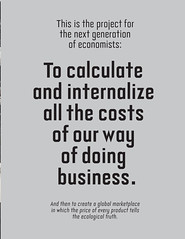
The good news is that I think the economic system we will build next will be one in which environmental and social costs will no longer be externalities; costs that get pushed off the balance sheet. The cost of doing business to the planet . . . will now be factored in.


[1] Lopez-Claros, A. (2010). The innovation for development report 2010-2011: Innovation as a driver of productivity and economic growth. New York: Palgrave Macmillan.

[2] Santos, F. M. (2009). A positive theory of social entrepreneurship. Social Innovation Centre: Working Papers, 1-51.

[3] Perrini, F. (2006). The new social entrepreneurship: What awaits social entrepreneurial ventures? Northampton, MA: Edward Elgar Publishing Limited.

[4] Barnett, A. H., & Yandle, B. (2009). The end of the externality revolution. Social Philosophy and Policy, 26(2), 130-150.

[5] Jones, K. (2009). When more mission equals more money: The more a business focuses on its social mission, the more revenue it will generate. Stanford Social Innovation Review.

~

If you liked this paper/series, you might want to check out some of the other papers/series I’ve posted.

Solutions to Externalities: Social Entrepreneurship and Externalities, Part 3

In the first post in this series, we looked at the definition of social entrepreneurship. In the second post in this series, we looked at the definition of externalities. In today’s post, we’ll look at some solutions to externalities.

Solutions to Externalities

There are a number of different ways to solve the problem of externalities. More generally speaking, these different ways of solving the problem of externalities fall into one of two categories: public or private. Under the category of public solutions to externalities, we have things like government provisions, subsidies, or Pigovian taxes. Pigovian taxes (the name comes from Pigou) are those taxes that are intended to influence a party away (disincentivize) from creating the negative externality. One kind of Pigovian tax is a ‘sin tax,’ which are those taxes that are applied to things like alcohol and tobacco. One of the main arguments for allowing for private sector solutions to externalities is internalization. What is meant by internalization? Consider an example where a fisherman owns a river and a steel plant pollutes the river. The fisherman would demand that the steel plant cease polluting because the fisherman had property rights of the river.[1] The fisherman internalizes the externality of pollution because the fisherman owns the river. The pollution is not an externality to the fisherman; it is a very real and present part of the equation. One of the problems with a solution like this is when the problem is scaled up. Consider the Atlantic Ocean. Who owns it? While property rights may work for some situations, it is most definitely not a viable solution to all issues involving externalities.

Recently, there was a very interesting proposal put forth that, “externalities seem destined to rattle forth from the grave.”[2] In other words, these authors felt that ‘externalities’ was no longer a relevant term in the lexicon nor as a concept to study. Instead, these authors feel that, “externalities do not differ in any substantive way from any other kind of inefficiency.”[3] The argument is quite compelling. They cite two main axioms regarding inefficiencies, “(1) All inefficiencies, including Pareto relevant externalities, represent unexploited gains from trade and (2) When free exchange is allowed and transactions are costless, all Pareto relevant inefficiencies will be negotiated away.”[4] When the argument is phrased in this way, it is hard to disagree. The authors are trumpeting the horns of the free market. In the concluding remarks by the authors, they make it clear that the aim of their article was to highlight the number of policies passed in the name of externalities. To their credit, they are absolutely right. There are a number of laws and regulations put into place in the name of externalities. Now that we have discussed some of the general theories regarding the solutions to externalities, we can dive deeper into the discussion around externalities and social entrepreneurship. Specifically, we can begin to answer some questions about the cross-section of the two concepts.


[1] Gruber, J. (2010). Public finance and public policy (3rd ed.). New York: Worth Publishers.

[2] Barnett, A. H., & Yandle, B. (2009). The end of the externality revolution. Social Philosophy and Policy, 26(2), 130-150.

[3] Ibid.

[4] Ibid.

The Top Ways For Avoiding Cognitive Biases: List of Biases in Judgment and Decision-Making, Part 17

Last Monday I wrote that my cognitive bias series had come to an end. However, several of you emailed me asking for a more concise summary (as you’ll recall, the last post was over 3000 words). So, I thought I’d aggregate the most frequent suggestions of ways for avoiding cognitive biases. It’s in the same vein as a post in this series I don’t often link to: WRAP — An Acronym from Decisive.

Today, I’ve gone back through the post I wrote last week and categorized the different ways for avoiding the cognitive biases that I’ve listed. I’ll list the ways in descending order of their most frequent occurrence on the lists, along with the biases that they helped to counteract:

Alternatives (6): Sunk Cost Fallacy, Endowment Effect, Planning Fallacy, Framing Effect, Confirmation BiasThe Contrast Effect

Assumptions (5): Sunk Cost Fallacy, Framing Effect, Overconfidence Effect, Halo Effect, Functional Fixedness,

Data (5): Planning FallacyGambler’s Fallacy, Primacy/Recency Effect(s), Status Quo BiasThe Contrast Effect

Empathy (3): Endowment Effect, Framing Effect, Fundamental Attribution Error,

Big Picture (3): Loss Aversion, Fundamental Attribution ErrorThe Contrast Effect

Emotional (2): Loss Aversion, Endowment Effect,

Self-Awareness (2): Overconfidence Effect, Hindsight Bias,

Expectations (1): Loss Aversion,

As you might expect, assumptions plays a big part in our decision-making, so naturally, uncovering our assumptions (or recognizing them) is an important way for avoiding the traps of cognitive biases in decision-making. Similarly, it’s important to consider and/or develop alternatives. On an important related note, one of the most important things you’ll learn about negotiating is BATNA. This stands for: the Best Alternative to a Negotiation Agreement. Alternative. It’s also not surprising to see the frequency with which “data” appears, too. Data are a really important part of making a “cognitive bias”-free decision. I’ve written about the virtues of empathy, so I won’t review it.

Lastly, I wanted to highlight that “big picture” appeared on this list a couple of times. I was surprised that it only appeared a couple of times, but that could be a result of the way I was thinking (or my biases!) when I was writing these series. For instance, two of the categories here on this site are Perspective and Fresh Perspective. Meaning, I think it’s really important that we learn how to view things from a wider scope. “Big Picture” probably coud have fallen under “Alternatives,” but I believe there’s an important distinction. With alternatives, it’s still possible to only be considering things from a micro-level, but with the big picture, there’s a necessity for seeing things from the macro-level.

PS: Happy Canada Day!

~

If you liked this paper/series, you might want to check out some of the other papers/series I’ve posted.