Global Museum Attendance has Doubled in the Last Two Decades

A little more than a week ago, The Economist published an article about museums. In particular, they drew attention to the fact that the number of museums isn’t in decline. Instead, it’s quite the opposite. Would you have guessed that today, not only are museums not in decline, but that there are more than double the number of museums there were two decades ago?

As a soon-to-be parent, I can’t help but be pleased with this fact. I’m very much looking forward to taking my little one(s) to the museum to learn about the natural world around them. It seems I’m not the only one pleased by this either, with museum attendance way up.

I suppose what’s surprising to me about this is that I figured that with the advances we have had in technology, most people would be more inclined to explore the natural world around them from the convenience of their couch. While I’m glad that this is not the case, I wish someone would do some sort of study to better understand this behaviour. The article ties in the idea of higher education. That is, more and more people are going to university and graduates are more likely to visit museums. This makes sense, but I don’t think that it explains the whole story.

Another point raised in the article is the burgeoning growth in other countries. If you look at the graph embedded above, you’ll see that there’s quite a bit of growth planned for the Southeast Asian countries. [As an aside, in The Economist’s “The World in 2014,” you may be surprised to know that over 40% of the world’s population will be voting in a national election next year.] While this growth may help explain an addition piece of the growth in museums, it still doesn’t quite feel like it’s explained the whole puzzle. Of course, in science, especially the social sciences, we know that it’s not always possible to completely explain behaviour, but I’d like to think that one aspect of this has to do with technology.

That is, I’d like to think that as a species, we’re recognizing that technology is a useful tool for helping us navigate the world around us, but that it’s not the be-all and end-all of human existence. Don’t get me wrong, I absolutely appreciate technology. Without it, I wouldn’t be able to type on this external keyboard connected to my laptop, while looking at an external monitor connected to my laptop. Beyond that, you wouldn’t be able to read this article on your smartphone or on your laptop/computer, if it weren’t for technology.

With that being said, technology, in my opinion, hasn’t been able to capture the visceral experience of being there and seeing something. Technology can’t (at least not yet) involve all five of our senses in experiencing. Until it does, I’m happy to continue visiting museums.

How Y’all, Youse and You Guys Talk: What About Canada?

I’ve been clearing out some of the tweets that I’ve favourited over the last week or so and one of them was a fun dialect quiz from the New York Times Sunday Review. There are 25 questions that ask you the various ways you do (or do not) refer to certain things in the world around you. For instance, do you say y’all or youse or you guys (or something else) when referring to other people?

I found it relatively fun.

If you do decide to do it, though, I’d advise you to be careful in selecting an answer too quickly. There were a few questions where I clicked on one option and hit next and as the next question was loading, I noticed that there was actually an option for (none of these).

I realize that the New York Times is hosting this quiz, but I would have been interested to see where I stand in Canada. Maybe The Globe and Mail or the National Post can look into doing something similar?

I grew up in the Toronto area and have spent some time in British Columbia (and now Ottawa), but I’d be interested to see how I compare to other Canadians. Since I did grow up in Toronto, I wonder if that throws a wrench into my dialect. And, since I’ve lived in so many different places (California, Hawaii, New Zealand, Michigan, Virginia, etc.).

On the whole, it turns out that my dialect is closest to the people in Portland or Seattle. If I’m being honest, after undergraduate university, the west coast of the continent is where I’ve spent most of my adult life. I spent about a year in California and about a year in British Columbia (and about a year in Hawaii). The next closest would have been Virginia with 2 years.

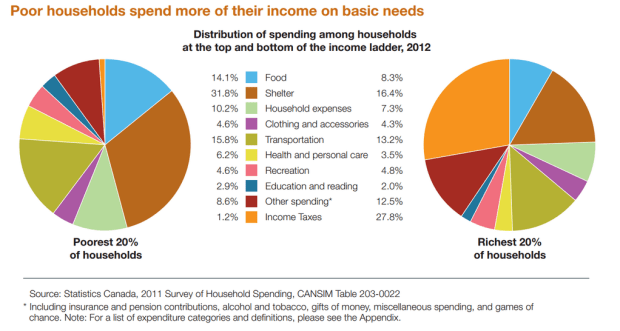
Poorest Canadians Spend More Than Half of Income on Food & Shelter

Just over a week ago, I saw this photo retweeted by Gerald Butts, who happens to be a senior advisor to Justin Trudeau (the Leader of the Liberal Party of Canada). As I’ve spent most of my adult life in the US, I’m used to hearing and writing (here, here, and here) about some of the sobering statistics in that country (approximately 50 million American live in poverty — right now!) As a result, I thought it’d be enlightening to take a closer look at some of the inequalities in Canada. This graph seemed like a good place to start.

For instance, I had no idea just how large the disparity was between the richest 20% and poorest 20%, with regard to food and shelter. Looking at the numbers, we can see that the poorest 20% spend approximately 56% (!) of their income on food and shelter. Fifty-six percent! While the richest 20% spend just 32%. I chose these categories because of Maslow’s Hierarchy of Needs. Food and shelter are some of the most basic needs we have and if the poorest 20% has to spend so much of their income on — essentially — surviving, it’s going to make it that much harder to “climb the economic ladder.” Of course, some might say it’s misleading to look at the numbers in aggregate like this.

With that being said, this holiday season, I hope you’ll remember this graph when you’re out at holiday parties and issues of politics and/or charities arise. It may add an important layer of perspective to the conversation.

It’s More Than Just Body Image, It’s How We Relate to the World

A couple of weeks ago, someone passed along an excellent video of a woman describing her experience with the pressures of body image. It’s an important video and I hope you take the time to watch it (whether you’re a female or a male). As I’ve talked about before, it’s important to understand just how the media is unintentionally reinforcing certain beliefs about the way we think, act, and feel, as a society.

There is one particular piece that’s not explicitly stated in the video that I wanted to highlight: the way of being in the world. Lily Myers talks about this sense that men were taught to “grow out” and women were taught to “grow in.” In a sense, it was okay for men to take up space and not okay for women to take up space. This is important and we should consider this in more contexts than body image. For instance, we often hear about how men are more likely to get promoted quicker or have better salaries. There are myriad reasons for this, but what if wrinkle to those debates are because women are taught to, from a very young age, that taking up space is ‘not okay.’

Of course, I’m not saying that women are actively being taught that their existence isn’t warranted, (though that’s the case in some parts of the world). It’s the subtleties that Myers speaks about in her video. This idea that she is watching her mother and understanding that ‘this is how I should behave, too.’

When I watch a video like this and hear the powerful message, I can’t help but hope that many people will see it. That many people will take this opinion in and consider that this is actually how someone else feels in the world. That this experience could be shared by many. If after watching this video, you’re wondering just how Lily Myers and our society came to be this way, I’d encourage you to check out Miss Representation, which came out a couple of years ago and, in February of 2014, The Mask You Live In

Here’s the text from the poem:

Across from me at the kitchen table, my mother smiles over red wine that she drinks out of a measuring glass.
She says she doesn’t deprive herself,
but I’ve learned to find nuance in every movement of her fork.
In every crinkle in her brow as she offers me the uneaten pieces on her plate.
I’ve realized she only eats dinner when I suggest it.
I wonder what she does when I’m not there to do so.

Maybe this is why my house feels bigger each time I return; it’s proportional.
As she shrinks the space around her seems increasingly vast.
She wanes while my father waxes. His stomach has grown round with wine, late nights, oysters, poetry. A new girlfriend who was overweight as a teenager, but my dad reports that now she’s “crazy about fruit.”

It was the same with his parents;
as my grandmother became frail and angular her husband swelled to red round cheeks, rotund stomach
and I wonder if my lineage is one of women shrinking
making space for the entrance of men into their lives
not knowing how to fill it back up once they leave.

I have been taught accommodation.
My brother never thinks before he speaks.
I have been taught to filter.
“How can anyone have a relationship to food?” He asks, laughing, as I eat the black bean soup I chose for its lack of carbs.
I want to tell say: we come from difference, Jonas,
you have been taught to grow out
I have been taught to grow in
you learned from our father how to emit, how to produce, to roll each thought off your tongue with confidence, you used to lose your voice every other week from shouting so much
I learned to absorb
I took lessons from our mother in creating space around myself
I learned to read the knots in her forehead while the guys went out for oysters
and I never meant to replicate her, but
spend enough time sitting across from someone and you pick up their habits

that’s why women in my family have been shrinking for decades.
We all learned it from each other, the way each generation taught the next how to knit
weaving silence in between the threads
which I can still feel as I walk through this ever-growing house,
skin itching,
picking up all the habits my mother has unwittingly dropped like bits of crumpled paper from her pocket on her countless trips from bedroom to kitchen to bedroom again,
Nights I hear her creep down to eat plain yogurt in the dark, a fugitive stealing calories to which she does not feel entitled.
Deciding how many bites is too many
How much space she deserves to occupy.

Watching the struggle I either mimic or hate her,
And I don’t want to do either anymore
but the burden of this house has followed me across the country
I asked five questions in genetics class today and all of them started with the word “sorry”.
I don’t know the requirements for the sociology major because I spent the entire meeting deciding whether or not I could have another piece of pizza
a circular obsession I never wanted but

inheritance is accidental
still staring at me with wine-stained lips from across the kitchen table.


Why I’m Reading the Classics and You Should, Too

A few days ago, I saw a tweet from Arianna Huffington from one of the sites that I often frequent: Barking Up The Wrong Tree. The tweet was a quote that came from one of the posts that Eric Barker (the author of the site) wrote:

Those who can sit in a chair, undistracted for hours, mastering subjects and creating things will rule the world — while the rest of us frantically and futilely try to keep up with texts, tweets and other incessant interruptions.

I don’t know about you, but that was a bit of a wake-up call for me. I do my best to stay current with a number of twitter lists (not so much with the texts because I don’t currently use a cell phone). I didn’t realize how exhausting it can be trying to keep up with everything. I don’t know if you noticed, but two days ago ended a streak of 111 straight days of me writing a post for this site. That’s nothing compared to the 5000 that Seth Godin has written (though I don’t know if his were consecutive). In fact, yesterday was the first day in quite a long time that I didn’t tweet anything or post anything to Facebook. Even when I’ve got nothing to share to Facebook, I usually have posted a quote of the day and a picture of some sort. And Twitter, I’ve almost always got a tweet scheduled for a time when I know I won’t be near the computer. Not yesterday. Nothing. No posts. Nada. As I mentioned in one of my last few tweets, I was trying to take my own advice and rest.

In this restful time, I realized that I wasn’t going to be able to sustain the same kind of relationship I have had with the online world. Yes, I’ve learned a great deal about a number of different topics from the way I’ve interacted with the internet, but I think it’s time to transition. Seeing Eric Barker’s quote also reminded me of someone else who shares a similar ideal: Shane Parrish.

Parrish is the author of Farnam Street and as you’ll see from glancing at his reading list, he reads — a lot. According to Parrish, the question he gets asked the most often is where he finds the time to read. Here’s part of his answer:

Where do I find the time?

Let’s look at this another way. Rather than say what I do, I’ll tell you what I don’t do.

What gets in the way of reading?

I don’t spend a lot of time watching TV. (The lone exception to this is during football season where I watch one game a week.)

I watch very few movies.

I don’t spend a lot of time commuting.

I don’t spend a lot of time shopping.

These choices are deliberate. I don’t even have cable TV. I watch NFL through gamepass, which also saves time (if you don’t watch games live you can watch the full game in under 30 minutes).

I live downtown; I can walk to the grocery store, purchase a bagful of groceries, and return home all within 15 minutes.

If you presume that the average person spends 3-4 hours a day watching TV, an hour or more commuting, and another 2-3 hours a week shopping, that’s 25 hours a week on the low end.

25 hours. That’s 1,500 minutes. That’s huge. If you read a page a minute, that’s 1,500 pages a week.

Eye-opening, eh?

With this newfound energy for introducing a healthy diet of reading books, what are the best books to read? Should I read the recent best-sellers, the classics, or some combination of both? It turns out, Parrish also answered this question in a post in August:

If something is still ‘in print’ today and it’s been around for a long time, we can assume there is a reason. The most likely reason is that there is something useful to the book. We can further assume that whatever is useful in the book will continue to be useful in the future.

If it’s useful in the past, useful now, and likely useful in the future, there is an argument to be made that we’re probably dealing with something simple – the basics. Anything fragile gets weeded out by time. … so you’re at least dealing with robust ideas … This is something we should be reading to maximize ROI for reading.

This isn’t perfect, of course. But it seems like a decent heuristic.

Most of what’s new and best-selling today will expire rapidly. If you’re reading things that ‘expire’, you get trapped into a Red Queen situation; you’re running faster and faster but staying in the same place. Or in this case you’re reading more and more but not getting much smarter.

You read more and more of the new stuff (e.g., best-sellers) but your knowledge doesn’t improve because you’re learning things with expiry dates … (narratives, studies based on small samples, or something that’s niche and specialized). When reading anything recent, it’s hard to distinguish if what you’re reading is fragile or not. And the base rate for fragility would be huge – almost everything printed today will prove to be fragile.

(The niche and specialized will improve your knowledge, for sure, but only within one particular domain, it won’t increase your broad based worldly wisdom. So these are useful but possibly not in the sense of maximizing knowledge accumulation. And you’d want to think about half-life of knowledge here too.)

Basic knowledge and ideas, however, don’t expire, which is why reading something like Seneca gets you out of the red queen. You learn more, you learn simple ideas, and those ideas don’t change over time so your knowledge actually increases.

So there you have it. A compelling case for reading the classics. I’m still planning on writing posts here on a variety of topics, but they may not be as frequent as they were before. Some will be of a more academic flavour, as I was just accepted by Research Blogging, some will continue in the same fashion as providing a new perspective, some will be observations, and some will be new ideas.

Sheldon Cooper Presents “Fun With Flags”: A YouTube Series of Podcasts

The other day I happened to be eating lunch and staring off out the window. While that may not seem important, it is. Most of the time, I like to be reading or doing something, while I’m eating. I completely understand that it’s probably better to not do this, but I often can’t help myself. Anyway, as I was sitting and just eating, an idea came to me. (Don’t you find that ideas come to you when you’re not thinking about them?) The idea, as the title of this post suggests, a web series from one of The Big Bang Theory’s main cast members: Sheldon Cooper.

I don’t know if you’ve seen the show (it’s quite funny), but a few times throughout the six seasons, Dr. Sheldon Cooper has led us on a journey through the wonderful world of vexillology: “scientific study of the history, symbolism and usage of flags or, by extension, any interest in flags in general.” Sheldon’s generally a pretty funny guy (not on purpose, that is, on purpose by the writers, but not by the character himself), so when he does these short podcasts on flags, it certainly provides a laugh or two. To date, there have been 5 instances of “Fun With Flags.”

In the first podcast, Sheldon and his, at the time, “girl who’s a friend, but is not my girlfriend,” Amy Farrah Fowler, introduce us to vexillology and tell us a bit about Oregon’s state flag.

Every time I watch this one, when Sheldon asks Amy about the white flag, I can’t help but laugh… “I’m submitting… to fun.”

In the second podcast, we learn about Bavaria.

In the third podcast, we learn a little bit about flags in Star Trek with Wil Wheaton.

In the fourth podcast, LeVar Burton replaces Wil Wheaton in attempting to teach us about flags in Star Trek.

In the fifth podcast, Penny (Sheldon’s across-the-hall neighbour),  helps teach us about Nebraska’s state flag.

The idea is that these podcasts could actually become an online series that supplements the show. They wouldn’t necessarily have to be every week or even every other week. The idea is that Dr. Sheldon Cooper could teach us about flags. This could be a big boon for CBS and The Big Bang Theory as I can’t imagine it not being a hit with fans of the show. Plus, there’s the whole social media aspect to it. That is, these clips would undoubtedly be shared vehemently across many networks.

Maybe I’m way off, but my guess is that this could really be a creative way for the show to engage viewers on a medium other than the TV. There could even be “special guests” (i.e. other cast members or noted vexillologists [are there any?]).

If you’re an executive at CBS and you’re reading this, I’d encourage you to get the marketing team on this and see if they think that there are enough people to warrant this kind of endeavour. I understand that there’d still be some cost to it (paying Jim Parsons, the film crew, the editing team, etc.), but I wouldn’t be surprised if it’d be profitable.

~

For those of you who think that I may be a bit biased because I like these online learning formats (John Green, Hank Green, ASAPScience, Michael Sandel, etc.), I’d encourage you to take a look at some of the number of followers of these accounts. The Crash Course has almost 1,000,000 subscribers. AsapSCIENCE has almost 1.5 million subscribers. MinutePhysics has almost 2 million subscribers. Consistently, the videos that these users upload obtain views in the hundreds of thousands.

One final note — Mental Floss. They’ve, in a sense, tested the market as they already have a “Fun With Flags” kind of series. They’re up to episode 17. Here’s a link to the first.


The Flipped Classroom: Homework in Class and Lecture at Home

A couple of weeks ago, there was an article in The Atlantic that not only discussed the idea of a “flipped” classroom (homework in class, lecture at home), but actually had data on this idea. Before we get into the data, I wanted to talk a little bit about this idea of the flipped classroom.

As you know, I’m a big proponent of perspective-taking, so the idea of flipping the classroom on its head is intriguing. That’s not to say that I like being the devil’s advocate just for the fun of it, I think there is great value to having someone intentionally take the opposite perspective. Currently, most folks believe that education happens through lecturing in the classroom and students doing homework at home. So, what if we flipped that around. What if the students had lecture at home and did homework in the classroom?

On its face, the idea might sound a bit strange (how can one have lecture at home without the teacher!), but there are, of course, ways around that. So let’s get back to the study from the article. Do you think that you’d like to have taken part in a flipped classroom? That is, if you think back to your days as a student (or if you still are one), do you think you’d want to learn this way?

Well, the students who took part in the study certainly didn’t think that they’d want to learn this way: 75% of the students in 2012 said that they preferred lectures in class. Do you want to guess how many liked this method after trying it? 90%. That’s a 165-point swing! From 75% who preferred lectures in class to then 90% who preferred the new method.

Alright, so the students like it, but what about their performance? Did it improve?

The study examined three years of a foundational pharmaceutics course, required for all doctor of pharmacy (Pharm.D.) students attending UNC. Overall, student performance improved between 2011 and 2013 by 5.1 percent.

Five percent is a substantial amount, especially when you consider that this method appears unorthodox. The second line of that paragraph causes me to raise an eyebrow: “…doctor of…” Meaning, the students who took part in this study were doctoral students.

Why is this significant?

Well, doctoral students are self-selected group of people who are highly motivated to pursue a graduate degree. This self-selected and highly motivated group is certainly not representative of all university students. Don’t get me wrong, I’m sure that there are undergraduate students who are like this sect of graduate students, but there are probably more students not like them than there are students who are like them.

This is certainly a great window into how a flipped classroom might succeed, but before I’d consider it a viable option for undergraduate classes, I’d want to see some evidence that the effect holds in that kind of a setting.


Future Implications for Fishing: A Universal Therapeutic Skill, Part 4

In the first post of this series, we looked at the idea of fishing and metaskills. In the second post, we explored the idea of fishing in the context of individual therapy. In yesterday’s post, we looked at this idea of fishing in the context of couples’ therapy and group therapy. In today’s post, we’ll look at implications for future research and wrap up the paper.

~

Future Research

Mindfulness. Fishing can be a very important tool in the therapist’s toolbox. Since Mindell’s publication on fishing (1995), there has not been any research conducted about fishing. It is possible that what Mindell called fishing, some people call mindfulness. According to Krasner (2004), “Mindfulness-based interventions ask of the participants to consciously shift that locus of control internally . . . and apply wise attention . . . to the present moment” (p. 208). Mindfulness asks the client to be conscientious of one’s own processes and fishing is a way for the therapist to acknowledge these processes in the client. In mindfulness, the person sits with unhurried attention and notices what is happening inside them at that moment. In fishing, the therapist is sitting with unhurried attention in an effort to notice what is going on inside the client. Comparing and contrasting the mindfulness techniques to fishing could yield practical results for therapists who use either of the techniques. A study of like this could determine if it is more advantageous to be mindful solely on one’s own or if it is better when someone else (a therapist) is being mindful of one’s processes. In the next section, implications for future research on fishing within the field of transpersonal psychology are explored.

Transpersonal psychology. According to Mindell (1995), “At present there is no one unified system of techniques which all practitioners of transpersonal psychology employ” (p. 36). This can make it very difficult to categorize the techniques used by transpersonal psychologists who have a private practice of therapy. As stated by Hammer (1974), “Transpersonal psychotherapy concerns itself, ultimately, with helping consciousness transcend its identification with the various limiting and relative self-defined personal labels, concepts or images which comprise the apparent and illusional ego and awaken to itself” (p. 202). Given that there are conflicting viewpoints, it would be essential to conduct a study to discern the techniques that are the more effective techniques used in transpersonal psychotherapy. After having witnessed a transpersonal therapist conduct a psychodrama at a transpersonal graduate school where the technique of fishing was utilized, it would be appropriate to include fishing as one of the techniques in a study of transpersonal psychotherapy. There are many different techniques used in transpersonal psychotherapy, but it is possible that much of the techniques are derivatives of fishing. Transpersonal psychology is known for focusing on more than just the person. It includes what is beyond the person. Meaning, transpersonal psychotherapy includes the spirit in therapy. In order to be able to notice the spirit in the client, it is important for the therapist to sit with unhurried attention, much the same as a therapist using the metaskill of fishing would. In this section, there have been ties made between transpersonal psychology and fishing. In the next section, there are connections made between fishing and massage therapy.

Massage therapy. Up to this point, fishing has been referred to in the context of mainly talk therapy applications. If during therapy, the therapist notices an instance where the client’s words are not congruent with the client’s actions; this could be considered a fish. However, the concept of fishing could be applied to a discipline that is mainly a touching discipline. According to Moyer, Rounds, and Hannum (2004), “Massage therapy (MT), [is] the manual manipulation of soft tissue intended to promote health and well-being” (p. 3). Within massage therapy, the therapist does not necessarily have to speak to the client in order to administer the therapy. In most massage therapies, the client lays face down on the table, and the therapist massages their neck, shoulders, and back. It is conceivable that the therapist could go into a state of consciousness where their hands are not moving by their own will. In this state of consciousness, similar to unhurried attention, their hands could be ‘fishing’ on the client’s body. The therapist could be massaging the client in one area and have a sense to move to a specific part on the client’s body. This would be very similar to fishing. In moving to this new spot, the client’s body could give the therapist feedback telling them that this spot is a good spot to continue working with or a spot that they need to move stop working with immediately. In this section, there have been implications for how fishing could be researched further with the topics of mindfulness, transpersonal psychology, and massage therapy.

Conclusion

Initially, there was a description of metaskills and the fundamental metaskill of fishing. Within the comprehensive explanation of fishing, there were details on recognizing a fish and determining fish from non-fish by way of the feedback given from the client. There were explanations of individual therapy, couples’ therapy, and group therapy, which contained examples of how fishing is present in all three kinds of therapy. There were also areas for possible further research that tied fishing to mindfulness, transpersonal psychology, and massage therapy.

References

Aposhyan, S. (2004). Body-mind psychotherapy: Principles, techniques, and practical applications. New York: W. W. Norton & Company, Inc.

Bugental, J. (1987). The art of the psychotherapist. New York: W. W. Norton.

Carere-Comes, T. (2007). Bodily holding in the dialogic-dialectical approach. Journal of Psychotherapy Integration, 17(1), 93-110.

Doss, B. D., Thum, Y. M., Sevier, M., Atkins, D. C., & Christensen, A. (2005). Improving relationships: Mechanisms of change in couple therapy. Journal of Consulting and Clinical Psychology, 73(4), 624-633.

Hammer, M. (1974). The essence of personal and transpersonal psychotherapy. Psychotherapy: Theory, Research, and Practice, 11(3), 202-210.

Krasner, M. (2004). Mindfulness-based intervention: A coming of age? Families, Systems, & Health, 22(2), 207-212.

Mindell, A. (1995). Metaskills: The spiritual art of therapy. Tempe, Arizona: New Falcon Publications.

Moyer, C. A., Rounds, J., & Hannum, J. W. (2004). A meta-analysis of massage therapy research. Psychological Bulletin, 130(1), 3-18.

Oei, T. P. S., & Green, A. L. (2008). The satisfaction with therapy and therapist scale – revised (STTS-R) for group psychotherapy: Psychometric properties and confirmatory factor analysis. Professional Psychology: Research and Practice, 39(4), 435-442.

Yalom, I. D., & Leszcz, M. (2005). The theory and practice of group psychotherapy, fifth edition. New York: Basic Books.

~

If you liked this paper/series, you might want to check out some of the other papers/series I’ve posted.

Couples’ and Group Therapy: A Universal Therapeutic Skill, Part 3

In the first post of this series, we looked at the idea of fishing and metaskills. In the second post, we explored the idea of fishing in the context of individual therapy. In today’s post, we’ll look at this idea of fishing in the context of couples’ therapy and group therapy.

~

Couples’ therapy. In couples’ therapy, the therapist may help each person in the relationship hear what the other person is saying. It could be easy for the therapist to get lost in the words of what is being said to her or him during the therapy session. However, if the therapist is sitting with unhurried attention, while listening to what the couple is saying, the therapist will be much more likely to hear the fish. According to Doss, Thum, Sevier, Atkins, and Christensen (2005), “When couple therapies target specific aspects of the relationship, they are typically able to achieve the desired change” (p. 624). When the fish presents itself, the therapist must catch that fish in order to help facilitate and achieve a desired change within the relationship. Working with the fish in couples’ therapy can be trickier because the two people present may be bickering with each other. The therapist must remain centered within himself or herself to notice the fish when it presents itself. Even if the therapist misses the fish, the fish may present itself again in a different way (Mindell, 1995). With all of the possible commotion happening, the therapist could miss the fish that is presented, but because the fish will present itself again, it is not catastrophic if the therapist missed the first fish. So long as the therapist notices one of the fish and then follows it, the therapist will help to achieve the desired change.

An example of fishing in couples’ therapy could be the husband of the couple talking about his wife asking him to do chores around the house and during his speech about the chores, the husband has a somatic reaction. The therapist notices this somatic reaction and sees it as a fish, so the therapist follows it. As the therapist follows this fish, the therapist uncovers the root of the problem, which is really that the husband does not feel like his wife is listening to him. In following this fish, the therapist achieved a desired change for the couple because they wanted an improvement in their relationship. There have been examples of how fishing is present in individual therapy and couples’ therapy. In the next section, there will be examples of how fishing is present in group therapy.

Group therapy. Some people consider group therapy easier than couples’ therapy and some consider it more difficult. Two foundations to group therapy are universality and cohesiveness (Yalom & Leszcz, 2005). Universality is the principle that all human experiences are potentially shared. That is, it is highly unlikely that a single person’s experience is unique. Cohesiveness is when all of the members of the group feel a sense of belonging. Once the group has the sense of universality and cohesiveness to it, the therapist usually has an easier time conducting group therapy. It is possible for the therapist to use the technique of fishing during the opening stages of forming the group, even before the group therapist gets to what some might call therapy. Beginning stages of group therapy can be anxiety producing for some people and because of this, it is possible that they would show all kinds of ‘fish’ to the therapist. As the therapist is scanning the group, he or she may notice that one client is particularly troubled. Because of this, the therapist may want to pose a question to the troubled group member to see if this will lead anywhere. According to Mindell’s fish theory, the group member will then give the therapist feedback to let the therapist know if there is a fish.

This section has defined therapy and outlined some of the things that happen in therapy. There has been an explanation of individual therapy, couples’ therapy, and group therapy, along with examples of how fishing is present in all of the stated therapies. In the following section, there will be possibilities discussed for how research can be conducted on fishing in conjunction with mindfulness, transpersonal psychology, and massage therapy.

~

Check back tomorrow for some implications for future research and the conclusion.


Individual Therapy: A Universal Therapeutic Skill, Part 2

In yesterday’s post, we looked at metaskills and this idea of fishing. In today’s post, we’ll look at fishing and metaskills in the context of individual therapy.

~

Fishing as a Therapeutic Skill

Therapy is a very broad term that has many meanings to many people. According to Mindell (1995), “The practice of psychotherapy, unlike religion or science, is the combination of the techniques and metaskills unique to each practitioner or therapeutic skill” (p. 41). Given this definition of therapy, it is fair to say that therapists use metaskills in therapy. In particular, therapists use the metaskill of fishing in therapy. As stated by Bugental (1987), “The most mature psychotherapists are more artists than technicians and they bring to bear a wide variety of sensitivities and skills so their clients can release their latent potentials for further living” (p. 264). Though fishing is a metaskill that a therapist can use, it is important that fishing not be performed merely as a technique. For effective therapy, the therapist must use the metaskill of fishing as an artist would use their skill of painting on a canvas. The therapist must wait with unhurried attention for a fish to come along and then switch to precise awareness in order to follow the fish. The artist does not attack the canvas, but instead, gently waits with unhurried attention for the art to flow through them. Then, they switch their focus to a more precise awareness as they paint the images that are coming to them.

It is important to note that even though the therapist takes on the role of the therapist and the client takes on the role of the client, neither is devoid of their human qualities. Meaning, underneath the roles they are playing (therapist and client) they are still human. Carere-Comes (2007) wrote “In a sense, every human relationship, however technical and impersonal, is also inevitably more or less interpersonal, since a person never manages to completely hide behind their technical role” (p. 95). The therapist can attempt to put on the image of being all knowing and important, but the therapist that knows the least, does the best. “If you are too intelligent, you are not helpful. If you are too smart, you try to make something happen instead of following nature. You have an inflation that you are the creator of life and not the assistant” (Mindell, 1995, p. 114). The metaskill of fishing is important in individual therapy because it allows the therapist to go with the flow of the session and not force change into the client. The therapist waits patiently for the client to reveal a fish, and then the therapist uses the feedback from the client to determine if there really is a fish. In the following sections, there will be examples of how fishing is used in individual therapy, couples’ therapy, and group therapy. The first form of therapy to be explained in more detail is individual therapy.

Individual therapy. According to Aposhyan (2004), “[There are] three general tasks of psychotherapy: 1. healing developmental deficiencies, 2. resolving trauma, [and] 3. supporting further development” (p. 65). Fishing is an important skill to have for achieving these general tasks of therapy. An example of a developmental deficiency is a client not being able to form social bonds very well. The client may present with a seemingly unrelated issue such as being bored at work, but a fish might reveal itself during the session. It is the job of the therapist to notice this fish and follow it, so the two of them together, can explore the developmental deficiency. Fishing can also be useful in resolving trauma.

If a client had been sexually abused as a child, they might not present with this issue, but this issue might arise from therapy. For example, a client could be talking about playing at the park with their friends and then they suddenly become agitated. The therapist could interpret this agitation as a fish, and follow the agitation by probing it with more questions. The client would then provide feedback to these questions indicating to the therapist that there is a fish. The therapist could then follow the fish and from this fish, the therapist might end up discussing how the child had once been kidnapped at the playground by their uncle and taken to his house. At the uncle’s house, the uncle proceeded to sexually abuse the child. This information about the sexual abuse would not have arisen had the therapist not followed the fish in the form of the agitation. Not only is fishing useful in developmental deficiencies and resolving trauma, but it is also helpful in furthering the development of clients.

It is important for the therapist to support further development within their clients. A fish may present itself in the form of an edge for the client. An edge is a place where a client is at the limit of their comfortableness. If the client were to push their edge, they would be attempting to extend their ability to feel comfortable beyond where they initially felt comfortable. In short, when someone pushes their edge, they are seeking to grow. An example of a therapist supporting further development within a client could be assisting the client to push their edge. The client might be talking about something that took place in their business meeting that morning. The client might say that they had an idea that might have contributed to the advancement of the discussion, but chose not to voice their opinion. The therapist might notice the client shift in their seat, as they mention not voicing their opinion. The client shifting in their seat could be a fish. The therapist tests to see if the shifting within the seat is a fish and discovers that it is. The therapist and client then discuss the possibility of the client speaking up in meetings to further the development within the client. There have been examples of how the three general tasks of psychotherapy relate to fishing. If the client and the therapist worked specifically with one of these tasks of psychotherapy and achieved the task, the client and the therapist would deem the therapy successful. It is important for the client and the therapist to feel like therapy is a success.

According to Oei and Green (2008), “Individuals typically undertake therapy on the assumption of it being a valid endeavor; therefore, the patient’s level of satisfaction with his or her therapeutic experience is fundamental” (p. 435). Because of this, it is imperative that the therapist and the client work together in an efficient manner to achieve the desired outcome – successful therapy. In order to facilitate an expedient process, it is most appropriate for the therapist to use the metaskill of fishing because fishing allows the therapist to get right to the heart of the issue. There have been multiple examples of how fishing is used during individual therapy. The next section will discuss some examples of how fishing can be used in couples’ therapy.

~

Check back tomorrow for the second half of this section where we look at fishing in the context of couples’ therapy and group therapy.