The “Real” Purpose of TV (& Movies): Education, Inspiration, and Storytelling, Part 2

A few years ago, I wrote a post about the purpose of TV and I think I sold it (TV) short. That is, in that post, I essentially decried TV:

Watching TV is a mechanism that allows people to stay at jobs that they are otherwise less pleased about. Being able to tune into a created reality (or sometimes an actual reality) of a situation that they envy or can vicariously live through is something that I think allows people to feel better about themselves and by extension their life. Feeling better about one’s life makes one less likely to reflect on the things that aren’t going as well as they would have planned in life. So, like I said, I don’t proclaim to know the real purpose of TV, but I think that it can be argued that a fair majority of television is meant to entertain, allow for escapism, and sustain employment.

While I still think that there’s some truth to what I wrote over 4 years ago, as I indicated earlier, I think I’ve sold TV short. And while we’re at it, movies, too. Maybe there’s more to TV and film than entertainment, escapism, and employment. Well, of course there is, but let’s get into it.

Maybe there’s also an element of education to it. Remember my post from the other week on fictional presidents and the sunk cost trap? If the the script were written differently, that could have shown viewers the more optimal choice.

Or what about the idea that watching a TV show or a movie can inspire us? Last year, Reese Witherspoon starred (and was rightfully nominated for an Oscar!) in the movie Wild. The movie was based on Cheryl Strayed’s memoir regarding her trek on the Pacific Crest Trail. Importantly, the movie didn’t give viewers misconceptions about hiking 2,500 miles. It’s hard. With that being said, consider this:

“People are definitely worried about the ‘Wild’ effect, though we can’t really figure out what it is yet,” said Dan Moe, a baker from Portland, Oregon who’s hiking this year.

He said while he thinks there are more hikers on the trail this year, he hasn’t yet met anyone who’s out there because of the book or film.

“At least they don’t admit it,” he said.

To add to that:

Before the book was published, about 300 people would take out permits to attempt the full hike, which usually takes four to five months. It’s not yet known how many will try this year, but estimates range from 1,600 to 3,000 — 10 times the number who tried before the book came out.

So, while we may be wrong to infer causality here, there certainly appears to be a correlation worth noting.

There are two more things I want to address. The first, “you can’t be what you can’t see.” This is the motto of a movie/documentary of which I’ve written about many times before: Miss Representation. There has certainly been a lot of progress (at least there appears to have been) since that movie came out, with regard to women having more prominent roles, but similar to the anecdote from above, I’d caution on inferring causality. However, I will say that I’m glad to hear that it appears that there’s this concerted effort arising. For instance, did you know that there’s going to be female Thor? Or that they’re bringing back Macgyver as a female?

Lastly, there’s the idea that TV is a mechanism for storytelling. While that may seem obvious, consider the time before movies, TV, and radio, when we’d have to sit around the fire and tell stories to each other. This was the way that many things were passed on from generation to generation and now we have things like the Internet where we don’t even need to hear the story from someone — we can read all about it (and the blatant hyperbole contained within).

There was a great article on Vox a couple weeks back with the main thesis that the recent string of superhero movies have been an attempt to rewrite the images of 9/11. It’s really a very interesting read and I encourage you to check it out, but I think this adds to the idea that TV (and movies) are and can be much more to us than a place to escape. They can also be a place where we heal. That may seem somewhat ironic given that the average American spends 3 hours a day watching TV (and, in a sense, accelerates their ageing/death because of sedentariness), but maybe it’s time we have a bit more compassion for those among us who would rather go to the movies or binge-watch a season of Star Trek.

Does Everyone Want to Attend University?

There was an op-ed in the New York Times the other week that detailed some of the economic inequality in the US. It used academic data to discuss how poorly Americans estimate the level of social mobility. It’s certainly worth reading, but I wanted to highlight one section (and study):

Studies by another author of this article, the University of Illinois psychologist Michael W. Kraus, and his colleague Jacinth J.X. Tan, to be published in next month’s issue of the Journal of Experimental Social Psychology, found a similar pattern: When asked to estimate how many college students came from families in the bottom 20 percent of income, respondents substantially misjudged, estimating that those from the lowest income bracket attended college at a rate five times greater than the actual one documented by the Current Population Survey.

Now, it’s certainly worth noting how poor Americans are when it comes to estimating social mobility, (they’re certainly just as poor when it comes to estimating wealth inequality), but I’m curious about the desires of those in the bottom quintile. That is, many people espouse the values of higher education (full disclosure: I’m a professor at a higher education institution and I have two master’s degrees!), but what if everyone isn’t meant to go to university? More importantly, what if everyone doesn’t want to go to university?

Higher education is often held up as a mechanism for those in lower income quintiles to move up into a higher quintile (social mobility), but maybe people who come from the bottom quintile don’t want to go to university. I’m not in the bottom quintile nor did I grow up in the bottom quintile, so I have little to no authority to speak about the desires of those who come from the bottom quintile, but I think it’s worth asking what it is that the bottom quintile desires, specifically as it relates to higher education.

In raising this kind of question, it would, of course, be important to raise the issue of culture and how that influences one’s desires. That is, people who come from higher quintiles usually have parents (and friends) who think it natural to make the progression from high school to university. For some, attending post-secondary institutions of learning isn’t a choice — they’re forced to go. For those in the bottom quintile, attending a post-secondary institution of learning isn’t thought about in the same way. For many, it’s not “the thing you do after high school,” but instead, it’s held up as an ideal. It’s held up as a mechanism for transformation from being poor to not being poor.

Don’t get me wrong, I’m not trying to say that people in the bottom quintile shouldn’t attend university or shouldn’t want to attend university, but I think that alongside data discussing that estimates university attendance of different levels of income, there should also be data discussing the desires of those different levels of income.

ResearchBlogging.orgKraus, M., & Tan, J. (2015). Americans overestimate social class mobility Journal of Experimental Social Psychology, 58, 101-111 DOI: 10.1016/j.jesp.2015.01.005

Is “A” Really the Best Option or is it Just that It’s Better Than “B”: List of Biases in Judgment and Decision-Making, Part 18

The other day, someone was talking to me about my series on biases in judgment and decision-making and it made me realize that I was missing a rather important bias — the contrast effect! I’m not sure how this one slipped through the cracks, but I’m glad to be able to write about it for you today.

It’s been almost a year and a half since I wrote something for this series, so let me refresh your memory. Each week, I took a cognitive bias and explained it. I provided an example and then I offered some ways for mitigating that cognitive bias in your own life. So, without further adieu, the contrast effect.

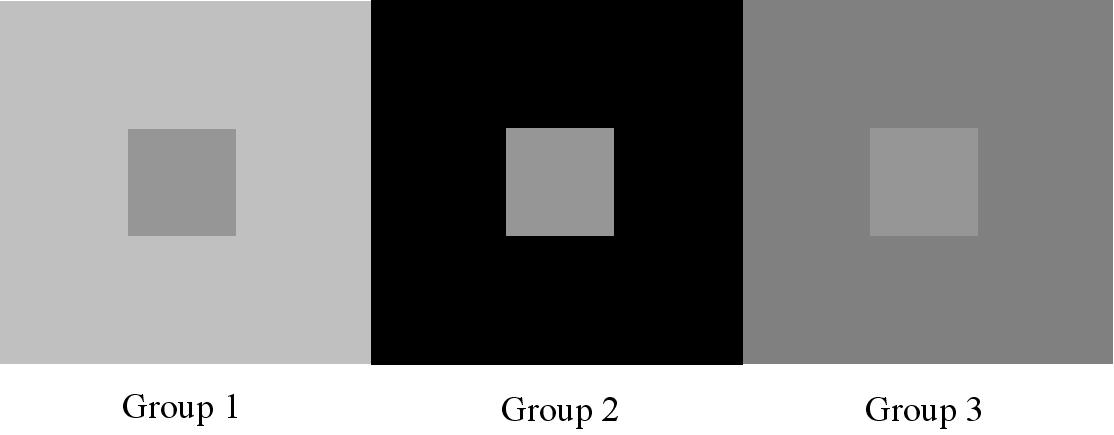
What’s the contrast effect? Well, as with many of the biases, it’s exactly what it sounds like: an effect that occurs because of a comparison. That is, people are more likely to perceive differences that are bigger or smaller because of something they’ve seen first. This is something that is used in sales — all — the — time. If you’re shopping for a new car, the salesperson may show a series of cars that are way out of your price range and then show you one that’s just a little out of your price range. After having seen so many cars that are way out of your price range, the one that’s just a little out of your price range won’t seem that far out of your price range. The contrast effect.

That’s not to pick on folks who sell cars, it can even happen with smaller purchases, shoes, for instances. Let’s say you’re looking for a particular kind of footwear. The salesperson may show you a bunch of shoes that don’t quite fit your needs and happen to be priced rather cheaply. Then, the salesperson shows you a shoe that does fit your needs, but is quite a bit more expensive. As you’ve seen all these shoes that aren’t what you need and now you’ve finally come to one that meets you’re needs, you may ignore the price and buy the shoes.

One of my favourite examples of the contrast effect comes from Dan Ariely‘s book, Predictably Irrational:

One day while browsing the World Wide Web (obviously for work-not just wasting time), I stumbled on the following ad, on the Web site of a magazine, the Economist.

excerpt.gif

I read these offers one at a time. The first offer-the Internet subscription for $59 seemed reasonable. The second option-the $125 print subscription-seemed a bit expensive, but still reasonable.

But then I read the third option: a print and Internet subscription for $125. I read it twice before my eye ran back to the previous options. Who would want to buy the print option alone, I wondered, when both the Internet and the print subscriptions were offered for the same price? Now, the print- only option may have been a typographical error, but I suspect that the clever people at the Economist‘s London offices (and they are clever-and quite mischievous in a British sort of way) were actually manipulating me. I am pretty certain that they wanted me to skip the Internet- only option (which they assumed would be my choice, since I was reading the advertisement on the Web) and jump to the more expensive option: Internet and print.

But how could they manipulate me? I suspect it’s because the Economist‘s marketing wizards (and I could just picture them in their school ties and blazers) knew something important about human behavior: humans rarely choose things in absolute terms. We don’t have an internal value meter that tells us how much things are worth. Rather, we focus on the relative advantage of one thing over another, and estimate value accordingly. (For instance, we don’t know how much a six- cylinder car is worth, but we can assume it’s more expensive than the four- cylinder model.)

In the case of the Economist, I may not have known whether the Internet- only subscription at $59 was a better deal than the print- only option at $125. But I certainly knew that the print and-Internet option for $125 was better than the print- only option at $125. In fact, you could reasonably deduce that in the combination package, the Internet subscription is free! “It’s a bloody steal-go for it, governor!” I could almost hear them shout from the riverbanks of the Thames. And I have to admit; if I had been inclined to subscribe I probably would have taken the package deal myself. (Later, when I tested the offer on a large number of participants, the vast majority preferred the Internet- and- print deal.)

Before we movie into some of the ways for avoiding the Contrast Effect, I wanted to make it clear that sales isn’t the only place where this bias can creep up on us. Another good example is in evaluations (be they interviewing job candidates or marking term papers). If one doesn’t have a rubric by which one is scoring candidates (or papers), it can be easy to slip into the contrast effect: “Well, that candidate was much better than the last candidate, let’s put them through to the next round.” It could be that the latter candidate, while better than the first, still doesn’t meet your criteria to make it the next round, so putting them through would be wasting valuable resources — both yours and theirs.

Ways for Avoiding the Contrast Effect

1) Standardized Evaluation

In our most recent case involving interview candidates or term papers, creating a rubric or standardized method of evaluation prior to examining candidates/papers will go a long way to help one avoid falling into the trap of the contrast effect. This method could also be applied when it comes to shopping (i.e. sales). For instance, let’s say you’re looking for a car. Prior to arriving at the dealership, you could create a table for how you’re going to evaluate the cars you view while at the dealership. In this way, you can guard against the salesperson knowingly (or unknowingly) showing you cars at either end of the spectrum before showing you the cars you might actually purchase.

2) Are There Other Options?

Often times, when we’re succumbing to the contrast effect, we’re looking at option A versus option B. This is why it’s so important to have some sort of standardized evaluation (see #1), but short of a standardized evaluation, it’s important to remember that almost never are those two options your only two options. “Should I get this car or that car?” Well actually, you have another option — neither of those cars. And another option, you could consider buying a bike or maybe taking public transportation. Whenever you find yourself faced with a decision between two options, it can be useful to consider other options, just in case you’ve fallen into the trap of the contrast effect.

Note: the images in this post are all examples of the contrast effect.

If you liked this post, you might like one of the other posts in this series:

The Science of Us: Hank Green’s Crash Course in Anatomy and Physiology

As a professor, it’s probably not surprising that I like to learn. Even though I’ve completed a few degrees, I still try to make time to learn new things — daily. In fact, I’ve even shared these learning experiences. There was the Harvard University’s course on Justice with Professor Michael Sandel (I also went through one of his books chapter by chapter), there was my series on cognitive biases, there was MRUniversity’s course in economics, and before all of that, there was Crash Course.

This was probably one of the first video series that I came across that I felt like I actually learned (and remembered!) something 20 minutes after the video finished. I first went through John Green’s (the same John Green who wrote The Fault in Our Stars) crash course in world history. Later that year, John’s brother, Hank, did a crash course in ecology. John also did a crash course in literature. I didn’t realize it, but Hank also went on to do a crash course in psychology.

There are more crash courses than what I’ve just shared, but those are just a few to give you a taste. Anyway, the reason I’m writing today’s post is because I just learned that Hank is doing a crash course in anatomy and physiology.

Anatomy and physiology are two subjects that I’ve always wished that I spent more time with. In fact, they’re two subjects that I think we all should have spent some time with when we were younger. I used to have the idea that it seemed like a good idea if as part of our basic education, we learned anatomy and physiology and not as some form of “punishment” (as I understand some people don’t necessarily like these subjects), but because anatomy and physiology is/are us. Anatomy and physiology are the reason that you’re alive right now. This seems an appropriate reason to try and understand it.

More specifically, ‘anatomy is the study of the structure and relationships between body parts and physiology is the science of how those parts come together to function.’ Hank calls it, “The Science of Us.”

I’m not going into this expecting to remember every minute detail, but I am expecting that I will have a better understanding of how some of the parts of the body come together to function to make me, me! As an example, I was speaking with a massage therapist the other day and she told me that massage therapists often have to translate what their clients tell them. For instance, a client will often come in complaining that they want to work on their shoulder, while reaching for the area immediately adjacent to their neck. As it turns out, our shoulder is actually far closer to the place where our arm connects to our body. The place that this person was pointing to was, in fact, their neck.

The Problem with Big Data: Lies, Damn Lies, and Statistics

I’ve used the subtitle in a previous post and I think the application to the content of this post also makes it worthwhile to use again. I was reading a post from Tim Ferriss the other day and it made me think of statistics. The post is about alternative medicine, but understanding that isn’t entirely necessary for the point I’m making. Here’s some context:

Imagine you catch a cold or get the flu. It’s going to get worse and worse, then better and better until you are back to normal. The severity of symptoms, as is true with many injuries, will probably look something like a bell curve.

The bottom flat line, representing normalcy, is the mean. When are you most likely to try the quackiest shit you can get your hands on? That miracle duck extract Aunt Susie swears by? The crystals your roommate uses to open his heart chakra? Naturally, when your symptoms are the worst and nothing seems to help. This is the very top of the bell curve, at the peak of the roller coaster before you head back down. Naturally heading back down is regression toward the mean.

If you are a fallible human, as we all are, you might misattribute getting better to the duck extract, but it was just coincidental timing.

The body had healed itself, as could be predicted from the bell curve–like timeline of symptoms. Mistaking correlation for causation is very common, even among smart people.

And the important part of the quote [Emphasis Added]:

In the world of “big data,” this mistake will become even more common, particularly if researchers seek to “let the data speak for themselves” rather than test hypotheses.

Spurious connections galore–that’s what the data will say, among other things.  Caveat emptor.

This analogy reminded me of the first time I learned about correlation and causation in my first psychology class as an undergraduate. It had to do with ice cream, hot summer days, and swimming pools. In fact, here’s a quick summary from wiki:

An example of a spurious relationship can be illuminated by examining a city’s ice cream sales. These sales are highest when the rate of drownings in city swimming pools is highest. To allege that ice cream sales cause drowning, or vice-versa, would be to imply a spurious relationship between the two. In reality, a heat wave may have caused both. The heat wave is an example of a hidden or unseen variable, also known as a confounding variable.

Getting back to what Ferriss was saying near the end of his quote: as “Big Data” grows in popularity (and use), there may be an increased likelihood of making errors in the form of spurious relationships. One way to mitigate this error is education. That is, if the people who are handling Big Data know and understand things like correlation vs. causation and spurious relationships, these errors may be less likely to occur.

I suppose it’s also possible that some, knowing about these kinds of errors and how little the average person might know when it comes to statistics, could maliciously report statistics based on numbers. I’d like to think that people aren’t doing this and it just has more to do with confirmation bias.

Regardless, one way to guard against this inaccurate reporting would be to use hypotheses. That is, before you look at the data, make a prediction about what you’ll find in the data. It’s certainly not going to solve all the issues, but it’ll go a long way towards doing so.

There are More Security Guards in the US than There are High School Teachers

At first blush, the idea that there are more security guards in a country than high school teachers doesn’t seem right. It’s one of those things that, when you hear it, makes you question the values of the country. After seeing the headline, I thought I’d follow the links to see just where the sources came from. It turns out that the source is an academic who, thankfully, included a list of sources.

It seems to me that this is perfectly in keeping with the theme of my last post. For a country that’s national defense headquarters spends more money war than all 50 states combined spend on health, education, welfare, and safety, why wouldn’t you also expect there to be a plethora of security guards employed in the country? I suppose the hope would be that there wouldn’t be more of them than high school teachers.

Given the decline of US education, I wonder if the US might be better served if they took even one-quarter of the security guards and turned them into teachers. Of course, simply taking away their flashlights and guns and giving them chalk won’t necessarily solve the problem of the US falling behind in education across the world, but with some effective training, they could turn out to be pretty good teachers.

I suppose there’s more to it than that, though. Simply shifting one segment of the workforce to another won’t necessarily change the tacit values of the culture that led to this kind of development. That is, as I mentioned earlier regarding the budget of the Pentagon, it might just be that at America’s heart, this is what they value — defense over education. I wonder if there’s a poll out there juxtaposing the two. That is, if citizens were forced to choose where they’d rather have their dollars spent, would the rather it spent on education or defense? Even asking a question like that is difficult given the exposure to the media. In a vacuum, folks might prefer education to defense, but because of the news reports they’ve seen/heard over the last few decades, they’d put their dollar into the defense bucket. One could then argue that nothing really occurs in a vacuum, so that it probably proves nothing. Nonetheless, I’d be interested to see just how many Americans would choose defense over education.

I should clarify that I’m not saying that the US should spend nothing on defense, but when you get a certain point, the marginal utility of a dollar spent on education has to be higher than the the marginal utility of a dollar spent on defense.

Should We Be Reading Instead of Binge-Watching?

If you’ll recall from yesterday’s post, humans are wired for binge-watching. I wonder — are we spending too much time “vegging out” binge-watching when we’d be better off reading?

The map above comes from a post from Gizmodo earlier this month. It might be a bit hard to read the numbers, but it shows the average amount of time spent by each country reading. India comes out on top reading, on average, 10 hours and 42 minutes per week. The US, by comparison, reads a little more than half as much as India at 5 hours and and 42 minutes per week. Canada’s not much better at 5 hours and 48 minutes.

I wonder if this data is affected by the availability of TV or maybe more specifically, the cultural availability of TV. Let me explain: in countries like the US, watching TV isn’t just something that’s an option when you’re trying to figure out what to do when you come home from work or school, it’s the norm. People have whole rooms dedicated for just TV watching. I’d suspect that this isn’t the case in other parts of the world where space is a premium. If I think about a country like India where 4 times as many people than there are in the US, I wonder if going off and reading a book somewhere might be a more desirable activity than trying to watch TV with 4, 5, or 6 other people. In the US, there’s the joke about who gets to have the TV controller — the husband or the wife. I wonder what the equivalency would be when you’re fighting for the controller with 2 aunts and uncles, along with your cousins.

Regardless, as I alluded to in the second sentence, North Americans might be better off taking after the rest of the world by burying their heads in a good book. Or, maybe it’s time to hit the gym.

What’s the Difference Between Empathy and Sympathy?

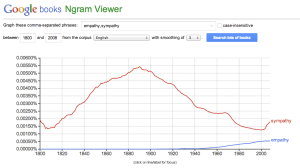
Screen Shot 2014-01-23 at 12.48.00 PMWhen you search for empathy on Google, you get almost 10,000,000 results. When you search for sympathy on Google, you get almost 25,000,000 results. I bet if we could look at historical search results in Google, I bet that we’d see a big trend where the number of search results for empathy has been increasing. The closest thing we can do to this is a search of all the books that contain the word empathy (at least the ones that have been digitized by Google). How? Using Google’s Ngram Viewer.

The chart above shows the mentions of empathy and sympathy starting in 1800 and ending in 2008. As we can see, empathy was hardly mentioned at all when compared to sympathy until the 1920s. That makes me wonder if there might have been some writings about empathy around the time of the Great Depression. What’s noteworthy though, is the steady increase in mentions of empathy. Granted, it’s still in only a fraction (0.0005%) of books, but it’s still progress.

Sympathy, on the other hand, we can see has steadily declined since the early 1900s. However, there’s been a small blip in sympathy since the mid-2000s. I would guess that this may have to do with the title question of this post: the difference between sympathy and empathy.

There’ve probably been several books written about the differences between empathy and sympathy in the last 5 or 10 years. So, do you know the difference between the two? I have to admit, even as an undergraduate in psychology, I’d often find myself googling the difference between the two terms. About a month ago, I came across a great video from the RSA that quickly explains the difference between empathy and sympathy. Of course, there’s a slight bias towards empathy in the video, but I think you’ll agree — empathetic is far better than sympathetic.

In case you’re inspired to be a champion of empathy or want some more information about programs that are helping to increase the level of empathy, I’d suggest checking out Ashoka: Empathy.

And if you want a bit more information about how empathy has shaped our society and continues to shape it, then I highly recommend checking out the RSA Animate video of Jeremy Rifkin’s book, The Empathic Civilization:

Where Humans Live: Is There Really an Overpopulation Issue?

In the last 50 to 100 years or so, there has been plenty written about humans having an overpopulation problem. When you read through these articles, you may become concerned that there really is a population problem that’s sweeping the planet. However, rarely (do you ever?) see a picture like the one I’ve included here accompanying those articles. Rather, you usually see a graph (see below), that shows the population has exploded in the last 50-100 years. While that’s true, it’s also true that much of the Earth is still not inhabited by humans.

Of course, I’m not necessarily volunteering to go live in the Arctic, but I think it’s something that’s worth keeping in mind when you hear folks talk about population problems on the planet. I’m not necessarily advocating that we — as a species — go live in the Arctic, but it would appear, at least from a superficial level, that there’s plenty of Earth for humans to spread out, too.

In addition toe “Earth” sprawl, there’s still the option for vertical sprawl. While many major cities in Asia have already ticked that box, there are plenty of areas across the United States were you could just about plant down a new city of 5 million people. There would need to be quite a bit of infrastructure set down first, but there’s room for people.

Should the population continue to grow like it is, humans are just going to have to get a lot more comfortable with each other. In Western cultures, folks are used to having their “own” space. That is, they’re used to some semblance of individuality and personal space. However, if you visit Asian cultures, you’ll find that there’s certainly a lot less focus on the “individual” person and more focus on many people at once (often times, a family — extended or nuclear).

~

I still remember in one of my graduate classes a few years back now, there was a student from South Africa (Note: I’m not implying that South Africa is part of “Asian” cultures.) Our assignment was to draw something where we were relating to our families. I don’t exactly remember what it was, but I want to say a family tree. Anyway, just about every student in the class (predominantly white and/or had spent quite a bit of time living in North America), completed the assignment in the conventional way that one would think to. However, this student from South Africa completed it quite differently. Instead of drawing something resembling lineage, they drew themselves in the middle and drew lines out to each one of their family members.

It was an eye-opening experience. It illustrated just how easily it is for two people to hear the same instructions, but complete the tasks in different ways.

~

Bringing that back to the topic at hand (adapting to conditions), I have complete faith in the human race to adapt should they need to live in areas they haven’t lived before. If there’s one things humans have become good at over the years, it’s adapting.

Coping Strategies Used by Teens When Criticized by Their Peers for Their Brand Choice

Remember back in high school, middle school, or elementary school when you were worried to go to school because your jeans weren’t Levis, or Jordache, or Lucky, or whatever name brand was popular when you were an adolescent? A couple of researchers from Paris decided that they were going to take a closer look at this phenomenon. That is, how we coped (or cope) with being criticized for not wearing the ‘right’ clothes.

Their results revealed that we have five main coping strategies for these situations: justification, revenge, denial, self-reproach, and making the criticizers feel guilty. Can you remember how you reacted (or might have reacted) if you were in one of these situations? Personally, I have a hard time remembering what I might have said (or did say), so let’s take a look at some of the responses.

In justification:

I tell them why I bought this particular brand.

I justify my choice, explaining why I picked this brand, the circumstances of my purchase, etc.

I explain what are the reasons that pushed me to make this brand choice in particular.

In revenge:

I no longer bother to criticize their clothes.

I try to get my own back by criticizing their clothes.

From now on I’ll carefully take note of how they look and won’t hold back from criticizing it.

In denial:

I act as if I hadn’t heard what they said.

I act is if nothing’s been said. [sic]

I imagine that they haven’t said anything and that’s enough to fix the problem.

In self-reproach:

I bear a grudge against myself: why did I choose this jeans’ brand? It’s rubbish!

I think that I wouldn’t have to buy an unknown brand for my friends.

In making the criticizers feel guilty:

I tell them it’s not cool to criticize people about their appearance.

I tell them it’s not very nice for one’s friends to make comments like that.

After reading the responses under the five strategies, do you think adolescents would be more inclined to use one strategy over the other? What about in girls vs. boys? It turns, that’s the case.

The researchers found that the emotion-centered coping strategies (denial and self-reproach) were the strategies that were mostly influenced by “perceived controllability,” which is, “evaluation of the capacity people believe they have to do or not do something when confronted with a situation.” This runs opposite to previous theories, with regard to coping and so the researchers advocated caution when examining coping strategies from the perspective of major dimensions and that more care should be taken to include context.

One last piece that I found interesting were the differences between boys and girls. That is, the researchers found that girls, more than boys, were more likely to make the criticizers feel guilty. This made me wonder about this whole idea of girls developing emotionally before boys and that girls are more empathetic. I wonder if we looked at boys when they reached the same “level of maturity,” would they begin using this last coping strategy more than the others?

More than this, though, I wonder about the cultural effects on coping strategies. I continuously refer back to the documentary Miss Representation and its soon-to-be released brother, The Mask You Live In. The perspectives presented in those documentaries highlight the importance of culture and media on our youth, too. Maybe our adolescents wouldn’t have to develop coping strategies for combatting criticism about their clothing, if kids didn’t even think it was “cool” to criticize someone for the clothes they wear.

ResearchBlogging.orgSarah Benmoyal-Bouzaglo, & Denis Guiot (2013). The coping strategies used by teenagers criticized by their peers for their brand choice Recherche et Applications en Marketing DOI: 10.1177/2051570713487478