When Did our Mental Health Become Separate From our Body’s Health?

I was thinking about the medical system today and it dawned on me, ‘when did mental health become separate from our body‘s health?’ It might seem like a silly question, but think about it for a moment. When you go to see the doctor, the doctor — typically — is there to correct the imbalances in your body, right? S/he asks you questions about your body’s health. How are you feeling? Is your knee any better? Is your head warm? How’s your elbow been lately? Any pain in your stomach? 

What I want to know is, when did general health questions stop including mental health?

I mean, it’s not really still taboo to think that an unhealthy mind can lead to an unhealthy body, right? There’s a whole field dedicated to it — psychoneuroimmunology.

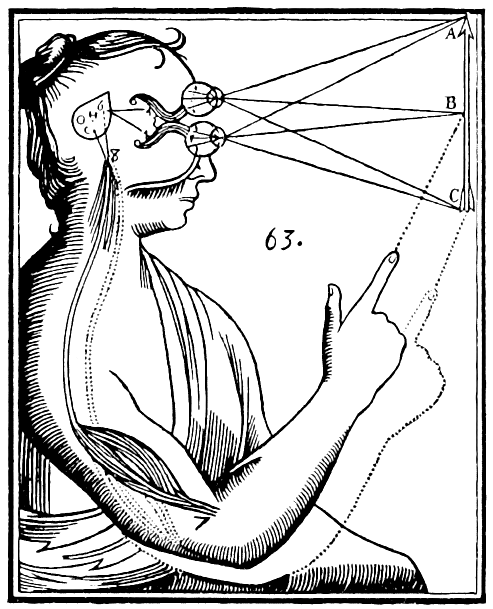
The whole idea of dualism reminds me of a post I read, almost a year ago, that detailed some research about how our health can be affected by our philosophical bent:

Overall, the findings from the five studies provide converging evidence demonstrating that mind-body dualism has a noticeable impact on people’s health-related attitudes and behaviors. These findings suggest that dualistic beliefs decrease the likelihood of engaging in healthy behavior.

These findings support the researchers’ original hypothesis that the more people perceive their minds and bodies to be distinct entities, the less likely they will be to engage in behaviors that protect their bodies.

From a dualistic perspective, bodies are ultimately viewed as a disposable vessel that helps the mind interact with the physical world.

Simply believing (understanding?) that our minds are not separate from our bodies, but that they are one in the same, can lead to better choices that affect one’s health.

I wonder, if as a way to facilitate this understanding in people, doctors started to treat the mind as if it were part of the body and ask questions about one’s mental health during visits to the doctor, would we those who see the mind as separate begin to see it as part of the body?

Love it or Hate it: Cloud Atlas is Worth Seeing

Cloud AtlasA little while ago, I mentioned that I’d seen a bunch of movies recently. One of those movies: Cloud Atlas. I rather liked the movie and think that you should most definitely consider seeing it. I tend to like the kinds of movies that Tom Hanks is in and I thoroughly enjoyed The Matrix trilogy. Yes, Tom Hanks was not in the The Matrix, but two of the directors (there were three) and producers  (there were five), also directed/produced The Matrix.

I really like movies that make you think and The Matrix certainly did that. In fact, from Wikipedia:

The Matrix makes numerous references to recent films and literature, and to historical myths and philosophy including BuddhismVedantaAdvaita Hinduism, Christianity, Messianism, Judaism, GnosticismExistentialismNihilism. The film’s premise resembles Plato’s Allegory of the caveRené Descartes‘s evil demonKant‘s reflections on the Phenomenon versus theDing an sichZhuangzi‘s “Zhuangzi dreamed he was a butterfly“, Marx’s social theory and thebrain in a vat thought experiment. Many references to Jean Baudrillard‘s Simulacra and Simulation appear in the film, although Baudrillard himself considered this a misrepresentation.

A movie that invokes that much has to make you think. In fact, if you get the chance, I’d read the interview between one of the directors of the Matrix (Larry Wachowski) and Ken Wilber, who has done a great deal to forwarding the integral movement.

Anyway, back to Cloud Atlas. The movie weaves together a bunch of different stories and some of the actors overlap between the stories (paying homage to the idea of reincarnation). Some of the stories are quite powerful and address issues that society has struggled with or is still struggling with. There are two quotes that I came across from one of the directors (Lana Wachowski) that I think are worth keeping in mind when reading reviews of this film (or The Matrix, for that matter). Here’s the first:

As soon as they encounter a piece of art they don’t fully understand the first time going through it, they think it’s the fault of the movie or the work of art. They think, [dramatic voice] “It’s a mess.”

“This doesn’t make any sense.” And they reject it, just out of an almost knee-jerk response to some ambiguity or some gulf between what they expect they should be able to understand, and what they understand.

And the second:

There’s really complex ideas in the [Matrix] trilogy. [Laughs.] We think in some ways, it’s the most experimental, complicated trilogy ever made. And it’s frustrating to see people try to will that to not be true. But we know it’s true. And in the same way, people will try to will Cloud Atlas to be rejected. They will call it messy, or complicated, or undecided whether it’s trying to say something New Agey-profound or not. And we’re wrestling with the same things that Dickens and Hugo and David Mitchell and Herman Melville were wrestling with. We’re wrestling with those same ideas, and we’re just trying to do it in a more exciting context than conventionally you are allowed to.