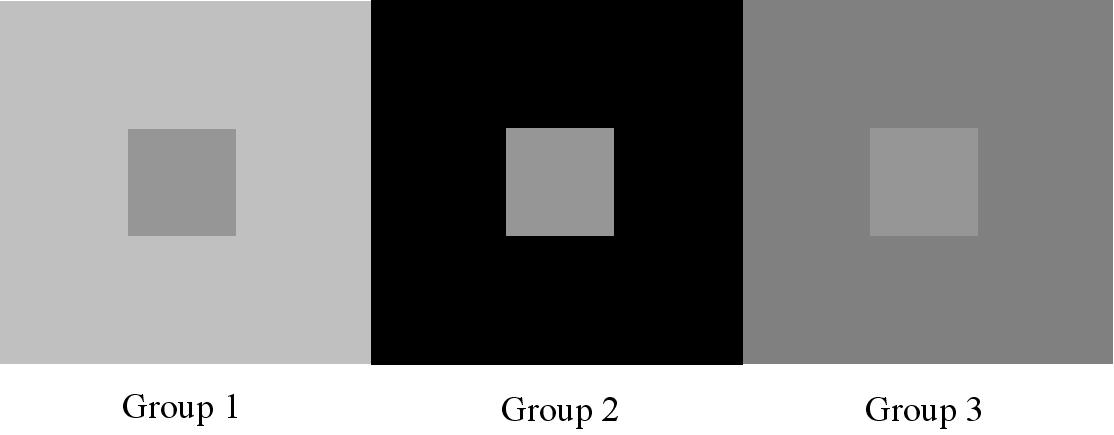
Is “A” Really the Best Option or is it Just that It’s Better Than “B”: List of Biases in Judgment and Decision-Making, Part 18

The other day, someone was talking to me about my series on biases in judgment and decision-making and it made me realize that I was missing a rather important bias — the contrast effect! I’m not sure how this one slipped through the cracks, but I’m glad to be able to write about it for you today.

It’s been almost a year and a half since I wrote something for this series, so let me refresh your memory. Each week, I took a cognitive bias and explained it. I provided an example and then I offered some ways for mitigating that cognitive bias in your own life. So, without further adieu, the contrast effect.

What’s the contrast effect? Well, as with many of the biases, it’s exactly what it sounds like: an effect that occurs because of a comparison. That is, people are more likely to perceive differences that are bigger or smaller because of something they’ve seen first. This is something that is used in sales — all — the — time. If you’re shopping for a new car, the salesperson may show a series of cars that are way out of your price range and then show you one that’s just a little out of your price range. After having seen so many cars that are way out of your price range, the one that’s just a little out of your price range won’t seem that far out of your price range. The contrast effect.

That’s not to pick on folks who sell cars, it can even happen with smaller purchases, shoes, for instances. Let’s say you’re looking for a particular kind of footwear. The salesperson may show you a bunch of shoes that don’t quite fit your needs and happen to be priced rather cheaply. Then, the salesperson shows you a shoe that does fit your needs, but is quite a bit more expensive. As you’ve seen all these shoes that aren’t what you need and now you’ve finally come to one that meets you’re needs, you may ignore the price and buy the shoes.

One of my favourite examples of the contrast effect comes from Dan Ariely‘s book, Predictably Irrational:

One day while browsing the World Wide Web (obviously for work-not just wasting time), I stumbled on the following ad, on the Web site of a magazine, the Economist.

excerpt.gif

I read these offers one at a time. The first offer-the Internet subscription for $59 seemed reasonable. The second option-the $125 print subscription-seemed a bit expensive, but still reasonable.

But then I read the third option: a print and Internet subscription for $125. I read it twice before my eye ran back to the previous options. Who would want to buy the print option alone, I wondered, when both the Internet and the print subscriptions were offered for the same price? Now, the print- only option may have been a typographical error, but I suspect that the clever people at the Economist‘s London offices (and they are clever-and quite mischievous in a British sort of way) were actually manipulating me. I am pretty certain that they wanted me to skip the Internet- only option (which they assumed would be my choice, since I was reading the advertisement on the Web) and jump to the more expensive option: Internet and print.

But how could they manipulate me? I suspect it’s because the Economist‘s marketing wizards (and I could just picture them in their school ties and blazers) knew something important about human behavior: humans rarely choose things in absolute terms. We don’t have an internal value meter that tells us how much things are worth. Rather, we focus on the relative advantage of one thing over another, and estimate value accordingly. (For instance, we don’t know how much a six- cylinder car is worth, but we can assume it’s more expensive than the four- cylinder model.)

In the case of the Economist, I may not have known whether the Internet- only subscription at $59 was a better deal than the print- only option at $125. But I certainly knew that the print and-Internet option for $125 was better than the print- only option at $125. In fact, you could reasonably deduce that in the combination package, the Internet subscription is free! “It’s a bloody steal-go for it, governor!” I could almost hear them shout from the riverbanks of the Thames. And I have to admit; if I had been inclined to subscribe I probably would have taken the package deal myself. (Later, when I tested the offer on a large number of participants, the vast majority preferred the Internet- and- print deal.)

Before we movie into some of the ways for avoiding the Contrast Effect, I wanted to make it clear that sales isn’t the only place where this bias can creep up on us. Another good example is in evaluations (be they interviewing job candidates or marking term papers). If one doesn’t have a rubric by which one is scoring candidates (or papers), it can be easy to slip into the contrast effect: “Well, that candidate was much better than the last candidate, let’s put them through to the next round.” It could be that the latter candidate, while better than the first, still doesn’t meet your criteria to make it the next round, so putting them through would be wasting valuable resources — both yours and theirs.

Ways for Avoiding the Contrast Effect

1) Standardized Evaluation

In our most recent case involving interview candidates or term papers, creating a rubric or standardized method of evaluation prior to examining candidates/papers will go a long way to help one avoid falling into the trap of the contrast effect. This method could also be applied when it comes to shopping (i.e. sales). For instance, let’s say you’re looking for a car. Prior to arriving at the dealership, you could create a table for how you’re going to evaluate the cars you view while at the dealership. In this way, you can guard against the salesperson knowingly (or unknowingly) showing you cars at either end of the spectrum before showing you the cars you might actually purchase.

2) Are There Other Options?

Often times, when we’re succumbing to the contrast effect, we’re looking at option A versus option B. This is why it’s so important to have some sort of standardized evaluation (see #1), but short of a standardized evaluation, it’s important to remember that almost never are those two options your only two options. “Should I get this car or that car?” Well actually, you have another option — neither of those cars. And another option, you could consider buying a bike or maybe taking public transportation. Whenever you find yourself faced with a decision between two options, it can be useful to consider other options, just in case you’ve fallen into the trap of the contrast effect.

Note: the images in this post are all examples of the contrast effect.

If you liked this post, you might like one of the other posts in this series:

Why Coke’s Super Bowl Ad Was Really Smart

By now, you’ve probably seen some of the coverage of Coke’s “controversial” Super Bowl ad. To be honest, I’m with Coke’s Ad Director on this one, “I don’t see any controversy here.” Don’t get me wrong, I can understand where some of the detractors are coming from, but I tend to side with the Ad Director. In case you haven’t yet seen the ad, take a look:

In a word, I thought the ad was beautiful. Maybe it’s because I was born and raised in Canada and I am used to (and appreciate) multiculturalism a bit more than the average American, who knows. Knowing that the Super Bowl has become an event that transcends the borders of the USA, maybe Coke was, surreptitiously, also trying to reach potential customers beyond its borders. Now, that hypothesis seems kind of silly given that the song that’s being sung in many languages is “America the Beautiful,” so let’s revise it and say that maybe Coke is trying to reach current (or potential) immigrants to the US.

Regardless of it’s initial aim, the controversy has stirred up so much discussion that the ad is being shared across the internet many times over. The last time I checked, the video had been viewed almost 8,000,000 times in 3+ days. I can’t think of many companies that don’t wish they made a video like this that’s been viewed this many times on social media (not to mention all the discussion that’s happened in print, TV, and online).

Then, there’s also the copycat-esque videos that extend (or poke fun) at the ad. I came across this one the other day and couldn’t help, but chuckle:

I haven’t seen anyone from Coke comment on it, but I’m sure that, at least off the record, they’d probably laugh at it, too.

Circling back to the original ad, I wanted to draw attention to the internationalist flavour to it. It’s still a few years off now, but folks are projecting that in the next 25-30 years, the majority of people living in the USA won’t be the same as it is today. Instead, there will be a majority of minorities. Meaning, adding up the population of all the minorities will mean that there are more people who identify as a minority than identify as white.

Tying this to the advertisement by Coke and I can’t help but think about how strategic it was for Coke to try and, if this was their strategy, attract younger immigrants to the brand.

Coping Strategies Used by Teens When Criticized by Their Peers for Their Brand Choice

Remember back in high school, middle school, or elementary school when you were worried to go to school because your jeans weren’t Levis, or Jordache, or Lucky, or whatever name brand was popular when you were an adolescent? A couple of researchers from Paris decided that they were going to take a closer look at this phenomenon. That is, how we coped (or cope) with being criticized for not wearing the ‘right’ clothes.

Their results revealed that we have five main coping strategies for these situations: justification, revenge, denial, self-reproach, and making the criticizers feel guilty. Can you remember how you reacted (or might have reacted) if you were in one of these situations? Personally, I have a hard time remembering what I might have said (or did say), so let’s take a look at some of the responses.

In justification:

I tell them why I bought this particular brand.

I justify my choice, explaining why I picked this brand, the circumstances of my purchase, etc.

I explain what are the reasons that pushed me to make this brand choice in particular.

In revenge:

I no longer bother to criticize their clothes.

I try to get my own back by criticizing their clothes.

From now on I’ll carefully take note of how they look and won’t hold back from criticizing it.

In denial:

I act as if I hadn’t heard what they said.

I act is if nothing’s been said. [sic]

I imagine that they haven’t said anything and that’s enough to fix the problem.

In self-reproach:

I bear a grudge against myself: why did I choose this jeans’ brand? It’s rubbish!

I think that I wouldn’t have to buy an unknown brand for my friends.

In making the criticizers feel guilty:

I tell them it’s not cool to criticize people about their appearance.

I tell them it’s not very nice for one’s friends to make comments like that.

After reading the responses under the five strategies, do you think adolescents would be more inclined to use one strategy over the other? What about in girls vs. boys? It turns, that’s the case.

The researchers found that the emotion-centered coping strategies (denial and self-reproach) were the strategies that were mostly influenced by “perceived controllability,” which is, “evaluation of the capacity people believe they have to do or not do something when confronted with a situation.” This runs opposite to previous theories, with regard to coping and so the researchers advocated caution when examining coping strategies from the perspective of major dimensions and that more care should be taken to include context.

One last piece that I found interesting were the differences between boys and girls. That is, the researchers found that girls, more than boys, were more likely to make the criticizers feel guilty. This made me wonder about this whole idea of girls developing emotionally before boys and that girls are more empathetic. I wonder if we looked at boys when they reached the same “level of maturity,” would they begin using this last coping strategy more than the others?

More than this, though, I wonder about the cultural effects on coping strategies. I continuously refer back to the documentary Miss Representation and its soon-to-be released brother, The Mask You Live In. The perspectives presented in those documentaries highlight the importance of culture and media on our youth, too. Maybe our adolescents wouldn’t have to develop coping strategies for combatting criticism about their clothing, if kids didn’t even think it was “cool” to criticize someone for the clothes they wear.

ResearchBlogging.orgSarah Benmoyal-Bouzaglo, & Denis Guiot (2013). The coping strategies used by teenagers criticized by their peers for their brand choice Recherche et Applications en Marketing DOI: 10.1177/2051570713487478

The Problem With Facebook: Young People Really Are Social Networking Elsewhere

Remember yesterday when I was talking about Facebook’s “young person” problem? It turns out, there’s actually data to back this up. It turns out, there was actually an article in TIME that I didn’t realize had data when I was writing my post yesterday:

According to iStrategy, Facebook has 4,292,080 fewer high-school aged users and 6,948,848 college-aged users than it did in 2011.

That amounts to more than 11 million users gone in the past 3 years. While Facebook has more than 1 billion people, so 11 million might not seem like much, but is it a trend? That is, should this be something that the folks over at Facebook should be worried about. Well, there’s a handy graphic that can also be found in the TIME article, (but it comes from iStrategy):

Two of the cells I want to draw your attention to are already conveniently highlighted in red: the ages 13-17 and 18-24. If you’ll notice, both of these age groups are experiencing negative growth. Of particular noteworthiness is the 13-17 age group, which is down 25% over the last 3 years. Again, as I said earlier, Facebook’s user base is rather large right now, so it might not have that big of an effect anytime soon, but it is something to watch out for.

In the article, the author also points out that part of the reason people advertise with Facebook isn’t necessarily for the volume of its users, but because of all the information that it has on its users making microtargeting that much more effective. Maybe this information is enough to overcome the decline in new users, who knows. As I said yesterday, if I were part of Facebook’s team, I would be worried about the continued decline in my user base — especially because it’s the younger folks who are leaving. Why?

Pretty soon, these young folks are going to be reaching those prime marketing age groups (18-34) and if they’re already not using Facebook, that could be bad news. In fact, if they’re not using Facebook, they’re probably using some other social network to communicate and that is where the marketing dollars are going to go. I suppose only time will tell.

What Was Your Last Original Thought: Choices and Illusions, Part 2

In yesterday’s post, we looked at the first 6 chapters of Eldon Taylor’s book, Choices and Illusions. There were some great stories about how our thoughts can have a tangible effect on our bodies. In today’s post, we’ll take a closer look at the next 6 chapters.

~

Chapter 7 picks up right where the last three chapters leave off: marketing. In particular, Taylor asks one of his favourite questions: “What was your last original thought?” In continuing down this line of thinking, Taylor emphasizes how a great deal of planning and money has been spent on trying to get you to, in a sense, manipulate your thoughts. Now, I don’t want you think that Taylor’s talking about ‘mind control’ or something like that. In fact, if you think about it, you can probably come to the same conclusions that Taylor has. When you’re hungry, what’s the first thought that comes to mind? For many, that will be fast food. When you’re thirsty, what’s the first thought that comes to mind? Pop (or soda, or coke, depending on what part of the country/world you live in). How are those your first thoughts with these biological instincts?

Taylor also continues on subliminal thinking in Chapter 8. There are a couple of good stories, one about the 2000 election and the subliminal messaging used by the Bush campaign. There’s also a discussion of dichotic listening, which brought me back to my class in cognitive psychology from several years ago. Similarly, if you’ve never taken the Stroop Test, I suggest checking it out.

Chapter 9 has a two-part story that I thought you’d enjoy. Here’s part 1:

 It is about a Zen master who made it a habit at noontime to meditate while he walked in the gardens. On this particular day, he became so engrossed in his meditation that he wandered far into the jungle, where he met a hungry tiger. Well, our Zen master did what any Zen master would do, which is to attend to the urgency of the moment. He fled as fast as he could with the hungry tiger in pursuit. Soon he came to the edge of a sheer cliff, but with a hungry tiger about to eat him, he jumped over the edge. On the way down he grabbed the only thing jutting out from the cliff, a small tree. There he hung on as he heard a roar from below. Now, there was a hungry tiger above and a hungry tiger below. Just then the small tree began to pull out of the ground. He looked to his right. Nothing. He looked below. Nothing. He looked to his left. A beautiful strawberry. He picked the strawberry, and it was the best fruit he’d eaten in his life.

Taylor uses this story to emphasize the now: “The moral of the story is, be mindful — you will find the strawberries.” The second part of the story is just as good:

 After I told this story to an audience in Malaysia, a fellow approached me during a break and asked if I knew the entire story.

“I thought that was the entire story.”

“No,” he said. “Would you like to know it?”

We sat down and had coffee while he related the story that he said comes from Paramahansa Yogananda. It seems that the Zen master, when confronted with the tigers, was actually hanging from a small apple tree while mice were digging away the light soil that the tree was rooted in. The story cuts away to a picture of the event hanging in a gallery. There spectators are viewing the art, when one speaks up, “Look at that stupid fellow. He’s selfishly indulging his senses while blind to his circumstances.” The story then returns to the Zen master. Another tiger runs onto the scene, and now there are two tigers above. The Zen master enjoys his apple, and pretty soon he sees vultures circling overhead. The two tigers have fought and killed each other. The mice see the shadow of the birds and flee. Below a herd of deer comes down to drink from the brook, and the tiger below sets off in pursuit of them. In short, what seemed like dire circumstances fixed themselves or were fixed by some power above.

Of course, some folks may balk at the idea that every situation will fix itself, but I’d argue that lots of people forget that when they are trying to decide the best course of action, ‘wait and see’ is overlooked more often than it should be. In tomorrow’s post, we’ll look at the last 6 chapters of the book.

(Disclosure: I was given a free copy of the book.)

They Limped in and Danced Out: Choices and Illusions, Part 1

A few of my posts recently have been about the importance that our thoughts and beliefs can have on how we function. Coincidentally, I was asked to write a review of a book that is right in line with this thinking. The book: Choices and Illusions: How Did I Get Where I Am, and How Do I Get Where I Want to Be? by Eldon Taylor. I enjoyed reading it and if you’re unfamiliar with the idea that our thoughts can have a tangible impact on us, this book is certainly a great introduction. Over the next few days, I’ll take a closer look at some of the sections of the book. In today’s post, I’ll look at the first 6 chapters.

~

Chapter 1 was a great introduction to this idea that our thoughts can have a tangible effect on our lives. Taylor tells a clever story about an eagle that was raised as a chicken. The eagle, all its life, assumes it’s a chicken, even when an eagle comes to tell it that it’s an eagle. This chapter reminds me of many of the posts I’ve written about perspective. If you don’t know what other possibilities there are out there, it’s hard to choose something different.

In chapter 2, I was surprised to hear about someone who can draw fractals freehand! I remember a few years ago being really enthralled by fractals. In fact, there were times when I’d just watch YouTube videos of fractals for in 15-30 minute increments. If you’re interested, Jason Padgett is the fellow who can draw fractals freehand. He’s quite good! And if you don’t believe me that fractals can be encapsulating, watch this: Fractal Zoom Mandelbrot Corner.

Chapter 3 had a really fun story about a high school reunion. There were a number of people who had reached the age where they weren’t as mobile as they used to be. The DJ, not accounting for this in creating the playlist, became worried when people weren’t moving so well on the way into the event. Figuring that there wasn’t enough time to change the playlist, the DJ played it as it was. The DJ later told Taylor: “Eldon, they limped in and danced out!” How is this possible? Well, as Taylor emphasizes, our thoughts can have a powerful effect on our abilities. Many of these people were transported to their youthful days upon hearing the popular music during the time they were in high school.

Chapters 4 through 6 reminded me of the importance of the documentary Miss Representation (and it’s soon to be released companion: The Mask You Live In). The media can have such a powerful impact on the way we think about ourselves and it can often be overlooked. In particular, chapter 6 reminds us that advertising is not always the most ethical profession. With that being said, it’s important to say that not all advertisers behave in this way.

In tomorrow’s post, we’ll look at chapters 7 through 12.

(Disclosure: I was given a free copy of the book.)

It’s 2013: Why Isn’t TV Live Streamed Online?

About a month ago, I wrote a post about the future of TV. I came to the conclusion that it was surprising that there wasn’t “live TV” online. That is, I am surprised that you can’t watch a TV on your laptop at the same time as you could watch it on your TV. Of course, I understand why that might not be the case right now (advertising, contracts, etc.), it seems like this form of entertainment is moving in this direction. When you take into account mobile TV, one has to think that live streaming TV shows is on the way, right?

It turns out that I’m not the only one frustrated by the lack of online TV streaming. Xeni Jardin, an editor/partner at Boing Boing (a rather popular technology zine), also shares this frustration:

As you can see, Xeni seems to think that we should be able to watch TV shows online at the same time that we can watch them on TV. This doesn’t seem like an unreasonable request, right?

It turns out, many of you out there agree with Xeni and I:

Market researcher GfK says 51% of those 13-54 years of age watch a TV program or movie via streaming video platforms. This is up from 48% in 2012 and 37% higher than three years ago.

What’s even more convincing is that the data go on to show that many folks would drop their Netflix service if cable companies offered a similar service at a similar price.

It seems to me one of a few things are happening:

a) TV executives already know all of this, but have run the data a different way and don’t think that people would actually follow-through on what they say when they answer these polls. [Not necessarily a response bias, but something more to the effect of the people who intend to vote on election day, but don’t.]

b) TV executives know this and they’re trying to convince the right people (CEO?) that this is what they need to do.

c) TV executives don’t know about these data.

Option c) seems the least likely, but I suppose it’s possible. Option a) seems like it could be plausible, but my guess is that the majority fall into option b). As a result, there seems to be a window of opportunity for an enterprising network to take a leap of faith and capture a great deal of value. Who’s going to be first?

Chapter 5 – The Commercialization of Everything: What Money Can[’t] Buy, Part 5

About a week ago, I got back to the series I was doing about the chapters in Michael Sandel‘s book, What Money Can’t Buy. In the first chapter, we looked at things like when it’s okay to jump the line. In the second chapter, we looked at the difference between fines and fees. In the third chapter, we looked at fairness and inequality. In last week’s post, the fourth chapter, we looked at corporate-owned life insurance and placebos. In today’s post, the fifth and final chapter, we’ll look at the commercialization of everything.

I wasn’t expecting to come across sports in this book, so I was pleasantly surprised when the first few pages were about stadiums being renamed by corporate sponsors. I didn’t realize that this was a fairly new thing. In 1988 only three sports stadiums had been renamed by corporate sponsors. Sixteen years later, in 2004, there were sixty-six. The amount of money went up significantly, too. In 1988, the deals totaled $25 million, while in 2004, the amount came to a whopping $3.6 billion! In 2010, over 100 stadiums in the United States were named for corporate sponsors. So, in the span of less than 25 years, we went from 3 corporate-sponsored stadiums to more than 100.

Having grown up in Toronto, I still find myself referring to Rogers Centre as Skydome. 

This chapter also discussed the idea of athletes selling their autograph. In the old days, this wasn’t even something to be considered. Many athletes willingly signed cards and sports equipment (i.e. baseball, hockey pucks, etc.) for fans. Near the same time that stadiums were being renamed, some athletes were beginning to sell their autographs rather than giving them away. This may seem greedy at first, but consider that athletes from before the 80s weren’t necessarily making lucrative contracts. In fact, athletes back then were not only often paid much worse than athletes today, but they were more on par with what you’d be paid to be an employee at a “normal job.”

~

The chapter then moves into a discussion of — in my words — the commercialization of everything.We’re now seeing advertisements and commercials in places we wouldn’t have ever imagined. For instance, when you pump gas, there’s a TV above the pump feeding you advertisements. Or how about when you’re driving down the highway. It’s kind of hard to ignore some of those catchy billboards, isn’t it? Then, there’s the always in vogue idea of product placement. Some of the places you find product placement was a bit surprising. I didn’t know that police stations were in talks to have cars with advertisements on them nor did I realize that in some state parks around the US are there advertisements for things like North Face.

I was surprised to read about some of the commercialization in the US, especially when I know that in some states, there’s a ban on billboards (Alaska, Hawaii, Maine, and Vermont). Moving outside of the US, I know that some countries (or maybe the citizens of those countries) have a real aversion to commercials seeping into unwanted places. For instance, São Paulo in Brazil hasn’t allowed public advertising since 2006. I also know that TV commercials in Germany aren’t nearly as frequent as they are in the US. On most German TV stations, there can’t be more than 20 minutes of commercials (before 8pm).

~

The last part of the chapter ends the book almost exactly the way I would have [Emphasis added]:

Once we see that markets and commerce change the character of the goods they touch, we have to ask where markets belong — and where they don’t. And we can’t answer this question without deliberating about the meaning and purpose of goods, and the values that should govern them.

Such deliberations touch, unavoidably, on competing conceptions of the good life. This is terrain on which we sometimes fear to tread. For fear of disagreement, we hesitate to bring our moral and spiritual convictions into the public square. But shrinking from these questions does not leave them undecided. It simply means that markets will decide them for us. This is the lesson of the last three decades. The era of market triumphalism has coincided with a time when public discourse has been largely empty of moral and spiritual substance. Our only hope of keeping markets in their place is to deliberate openly and publicly about the meaning of the goods and social practices we prize.

In addition to debating the meaning of this good or that good, we also need to ask a bigger question, about the kind of society in which we wish to live…

At a time of rising inequality, the marketization of everything means that people of affluence and people of modest means lead increasingly separate lives. We live and work and shop and play in different places. Our children go to different schools. You might call it the skyboxification of American life. It’s not good for democracy, nor is it a satisfying way to live.

Democracy does not require perfect equality, but it does require that citizens share a common life. What matters is that people of different backgrounds and social positions encounter one another, and bump up against one another, in the course of everyday life. For this is how we learn to negotiate and abide by our differences, and how we come to care for the common good.

So, if you prefer not to get too deep into a discussion of inequality that focuses on wealth, then I’d encourage you to think about the ideas that Prof. Sandel is talking about here at the end of the book. He’s just spent the last 200 pages explaining how markets (in some places), to some people, are corroding the value of these goods. Regardless of which side of the fence you fall down on, maybe it’s time we start talking about this. Maybe it’s time to have a dialogue in the public square of more moral and spiritual substance. Of course, this might not be as easy as it sounds, as he says, the last three decades have been void of this.

~

If you liked this paper/series, you might want to check out some of the other papers/series I’ve posted.


Revisiting “Rebranding the Liberal Arts”: Become a Better Citizen

I recently read an OpEd in the Washington Post about the Liberal Arts and it reminded me of a post I wrote a couple of weeks ago about what I perceived as an ‘image’ problem for the Liberal Arts. The Liberal Arts are such an important part of education that I couldn’t imagine someone earning their degree without having had some exposure to the Liberal Arts. You learn such valuable skills that you might not get from other areas of education.

This particular OpEd comes from a Professor at UVA who’s making the case for why someone should major in the Liberal Arts. There are a number of good reasons and I encourage you to read it, but I wanted to revisit the idea that we need to rebrand the “Liberal Arts.” Nothing’s changed in the last two weeks since I wrote about some of the issues with how people perceive the Liberal Arts based on the name (and their schemas around the word).

My initial idea of “General Intellectual Capacities” is a bit of a mouthful and probably wouldn’t fit so well on a degree — ‘I majored in general intellectual capacities.’ I wonder if it might make sense to simply reorganize the way we talk about the Liberal Arts rather than try to change the name. Although, changing the name would certainly facilitate a new conversation about it.

It seems like a herculean task to try to rebrand something as large as the “Liberal Arts.” What if we just thought about rebranding the Liberal Arts at one school? My first thought would be to take one of the colleges of the list of the best Liberal Arts colleges, but I suppose someone on that list might not want to undergo rebranding. They’re at the top of the heap and probably don’t want to shed the label that might be attracting students to their institution.

What if we take a school that has Liberal Arts at it, but that this isn’t the main focus? A school that offers degrees in some of the Liberal Arts (history, political science, philosophy, languages, etc.), but maybe has more of a focus on a different aspect of education. As I just came across a fantastic speech by someone, Georgia Tech comes to mind as a school we might use for this experiment. This university is world-renowned for its engineering program. It consistently scores in the top 5 for engineering in the US.

Georgia Tech has 6 colleges, one of which is called the Ivan Allen College of Liberal Arts. At this college, students can earn degrees in economics, international affairs, history, and public policy. All of these are staples of the Liberal Arts. So, the question then becomes, how do we get these engineers to broaden their horizons and take classes in the Liberal Arts or even minor in the Liberal Arts?

Of course, I’m sure that there’s a “general education” requirement to a degree from Georgia Tech — as there is at every other institution — which will mean that students will have to take some Liberal Arts classes in order to fulfill certain requirements. There may be some students who are already interested in the Liberal Arts and are not dissuaded by the name. We’re not too worried about those students — it’s the ones who’ve heard “bad” things or been “brainwashed” to think that the Liberal Arts won’t help them become better engineers. To those students, explaining that these classes amplify one’s “General Intellectual Capacities” might do the trick. Unfortunately, that’s probably something more suited to ‘marketing copy’ and less suited to what we could rename the college.

If I reflect on what the professor wrote for the OpEd in WaPo, he’s stressing how the Liberal Arts can aid in helping someone to the “Good Life.” That’s where I had the idea about becoming a better citizen. I still don’t know that the College of “Becoming a Good Citizen” is a good name, but I think we’re getting closer to something that might be more appropriate.

I’m going to put this on hold and try revisiting it again in a couple of weeks. In the meantime, do you have any ideas on how we can rebrand Georgia Tech’s College of the Liberal Arts? We’ve got some ideas on what might help: “General Intellectual Capacities,” “Becoming a Good Citizen,” and “the Good Life.”

Rebranding the Liberal Arts: General Intellectual Capacities

A couple of days ago, someone alerted me to an older article (2011) about the job skills that one learns from the “Liberal Arts.” After I read it, my first inclination was to share it. Having already completed two degrees in the liberal arts, I understand the importance that the liberal arts can have on teaching us how to think about the world around us. Then, I remembered that, for some people, saying “Liberal Arts” is almost like profanity.

I don’t know if it’s because of the word “Liberal” is in there and for those folks who are politically inclined (or hear that word tossed around when talking about politics) think that only “Liberal” people should go to liberal arts schools, but there certainly is a stigma out there — real or imagined. As a result, I thought I’d do some digging to find the phrase’s origin and compare it to some of the other phrases that describe higher education programs.

According to Webster, liberal arts is defined as:

college or university studies (as language, philosophy, literature, abstract science) intended to provide chiefly general knowledge and to develop general intellectual capacities (as reason and judgment) as opposed to professional or vocational skills

Well, that seems simple enough: intended to provide chiefly general knowledge to develop general intellectual capacities. Although, the second half of that is a bit distressing: as opposed to professional or vocational skills. Are we meant to assume that general intellectual capacities are in opposition to professional or vocational skills?

My next search took me to Wikipedia:

The liberal arts (Latinartes liberales) are those subjects or skills that in classical antiquity were considered essential for a free person (a citizen) to know in order to take an active part in civic life. In Ancient Greece this included participating in public debate, defending oneself in court, serving on juries, and most importantly, military service (slaves and resident aliens were by definition excluded from the duties and responsibilities of citizenship). The aim of these studies was to produce a virtuous, knowledgeable, and articulate person. Grammarrhetoric, and logic were the core liberal arts.

This explanation certainly ties in with the dictionary definition. Having general intellectual capacities would allow one to participate in public debate and to become a virtuous, knowledgeable, and articulate person.

At this point, it’s still not clear to me exactly why we’re parsing liberal arts from vocational or professional skills, so I thought I’d check out the entry for higher education on Wikipedia. Not surprisingly, this entry also separates vocational and professional schools from the liberal arts. It includes 4 different types of higher education:

1. General. This amounts to what we usually think of when we think of university. There’s a great deal of focus on the abstract and the theoretical.

2. Liberal Arts. This is what we’ve already been discussing. Although, there are two other types embedded within: performing arts or plastic/visual arts.

3. Vocational. There’s a focus on practical experience at these types of institutions of higher education, with a bit of theory. These are sometimes referred to as trade schools.

4. Professional. These institutions usually require that the person applying already have a bachelor’s degree. Examples here could be business school, law school, medical school, etc.

It’s still not entirely clear why the liberal arts should be separate from some of these other types of higher education. For instance, when we revisit the definition of developing general intellectual capacities, isn’t that what the majority of higher education does for its students? Would someone really argue that going to a vocational school, a professional school, or going to a “general” school would deprive someone of developing their general intellectual capacities? Certainly not.

Although, I do think that there are things you learn from some of the different disciplines in the “liberal arts” that you can’t get elsewhere. For instance, psychology is such an important subject for understanding the people around you. I really think that “General Psychology” should probably be a required course in every higher education institution, but with a background in psychology, I’m certainly biased — at least a little. That being said, it’s still hard to understand why people wouldn’t want to take this course. Knowing about what “makes people work” could be so advantageous to getting by in the world.

This quick bit of research led me to believe that the “Liberal Arts” may be in need of a rebranding strategy. Of course, I’m not the first one to suggest this. I found an article in the Journal of College Admission from 2009: “The Liberal Arts Rebranded.” In the article, there were references to a number of examples of strategies used for rebranding. For instance, there’s the example of the “Liberal Arts and Sciences,” or the “Practical Liberal Arts and Sciences.” There’s also examples like “Liberal Education” or “Liberal Learning.”

I haven’t seen any data, but I don’t think that any of these would really sway too many people from their previously held bias against the liberal arts, but I don’t know that anything would for some folks.

If I’m brainswarming ideas for a way to rebrand liberal arts, I would think that the name would need to changed completely. Both ‘liberal’ and ‘arts’ are words that, to some, are too “soft.” If it’s not math and science-y, then they want no part of it. So, I would try to find a way to incorporate that definition we first looked at: general intellectual capacities. Those three words are quite a mouthful, so it wouldn’t work just like that. There’d have to be something that succinctly conveys that message.