Does Everyone Want to Attend University?

There was an op-ed in the New York Times the other week that detailed some of the economic inequality in the US. It used academic data to discuss how poorly Americans estimate the level of social mobility. It’s certainly worth reading, but I wanted to highlight one section (and study):

Studies by another author of this article, the University of Illinois psychologist Michael W. Kraus, and his colleague Jacinth J.X. Tan, to be published in next month’s issue of the Journal of Experimental Social Psychology, found a similar pattern: When asked to estimate how many college students came from families in the bottom 20 percent of income, respondents substantially misjudged, estimating that those from the lowest income bracket attended college at a rate five times greater than the actual one documented by the Current Population Survey.

Now, it’s certainly worth noting how poor Americans are when it comes to estimating social mobility, (they’re certainly just as poor when it comes to estimating wealth inequality), but I’m curious about the desires of those in the bottom quintile. That is, many people espouse the values of higher education (full disclosure: I’m a professor at a higher education institution and I have two master’s degrees!), but what if everyone isn’t meant to go to university? More importantly, what if everyone doesn’t want to go to university?

Higher education is often held up as a mechanism for those in lower income quintiles to move up into a higher quintile (social mobility), but maybe people who come from the bottom quintile don’t want to go to university. I’m not in the bottom quintile nor did I grow up in the bottom quintile, so I have little to no authority to speak about the desires of those who come from the bottom quintile, but I think it’s worth asking what it is that the bottom quintile desires, specifically as it relates to higher education.

In raising this kind of question, it would, of course, be important to raise the issue of culture and how that influences one’s desires. That is, people who come from higher quintiles usually have parents (and friends) who think it natural to make the progression from high school to university. For some, attending post-secondary institutions of learning isn’t a choice — they’re forced to go. For those in the bottom quintile, attending a post-secondary institution of learning isn’t thought about in the same way. For many, it’s not “the thing you do after high school,” but instead, it’s held up as an ideal. It’s held up as a mechanism for transformation from being poor to not being poor.

Don’t get me wrong, I’m not trying to say that people in the bottom quintile shouldn’t attend university or shouldn’t want to attend university, but I think that alongside data discussing that estimates university attendance of different levels of income, there should also be data discussing the desires of those different levels of income.

ResearchBlogging.orgKraus, M., & Tan, J. (2015). Americans overestimate social class mobility Journal of Experimental Social Psychology, 58, 101-111 DOI: 10.1016/j.jesp.2015.01.005

Why Poor People Have Harsher Moral Judgments

Morals is certainly one of my interests, as is evidenced by my series on Michael Sandel’s bookWhat Money Can[‘t] Buy. And so, when I came across a journal article called, “A Lack of Material Resources Causes Harsher Moral Judgments,” I was intrigued, if not a bit saddened.

The researchers attempted to test the idea of whether a lack of material resources would cause people to have harsher moral judgments. The reason they posited this was because a lack of material resources is correlated with a lower ability to cope with other people’s harsh behaviour. Not only were they able to prove that a relationship exists between a lack of material resources and harsher moral judgments, but they were also able to prove this true in state dependent instances. Meaning, yes, a lack of material resources corresponded to making harsher judgments, but even when participants perceived themselves as having a lack of material resources, they offered harsher moral judgments.

The implications of this research seem rather important.

While it’s not specifically addressed in the study, I wonder what the plotted relationship between harsher moral judgments and income would look like. That is, I wonder at what point does income no longer correlate with harsher moral judgments. In particular, I wonder about the whole idea that there are 24 times as many millionaires in the US Congress than there are in the US population. As a result, I’d expect that moral judgments would be less harsh (than if there were fewer millionaires), but we know that doesn’t quite make sense because there are more things than just income that affect moral judgments.

More recently, however, I wonder about the World Economic Forum and the data released that less than 100 people have as much wealth as over 50% of the world’s population. By the information gleaned from the study, we’d expect that over half of the world’s population would have harsh moral judgments.

On a smaller scale, I’d wonder about the psychological health of people who have harsher moral judgments. It may seem only tangentially related, but negative thinking has been shown to have negative effects on one’s health. As  result, I’d expect that these harsher moral judgments might have an effect on one’s health.

ResearchBlogging.orgM. Pitesa, & S. Thau (2014). A Lack of Material Resources Causes Harsher Moral Judgments Psychological Science DOI: 10.1177/0956797613514092

85 People Have As Much Wealth as 3.5 Billion People

Just think about that headline for a second… 85 people have as much wealth as 3.5 billion people. Eighty-five vs. Three and a half billion. Maybe looking at the words isn’t enough, let’s look at it in numbers. 85 vs. 3,500,000,000. If I were graphically inclined, I’d make a quick “infographic” showing 85 people on one side and 3,500,000,00 on the other side. That’s an astronomical difference.

The article in The Guardian where I first read it had a good analogy:

The world’s wealthiest people aren’t known for travelling by bus, but if they fancied a change of scene then the richest 85 people on the globe could squeeze onto a single double-decker.

This isn’t the first time I’ve written about wealth inequality and it probably won’t be the last. There are two posts that come immediately to mind. The first is the one from a couple of years ago where I shared a graphic that came from a paper by two researchers studying the wealth distribution in the US. Most notably from the graphic was that the perception of American was way off from reality. Americans thought that the top 20% had approximately 60% of the wealth and they wanted the distribution to be that the top 20% was closer to 30%. In actuality, the top 20% (at the time) had close to 90% of all wealth in the US.

The second post was just under a year ago and it took a deeper look at the graphic that I shared in the first post. Someone animated the chart, that is to say, they made a video of the information to make it more accessible to people and it was shared heartily across the internet — it’s currently over 14,000,000 views.

So what does all of that have to do with today’s information? Well, as is pointed out in the article in The Guardian, the World Economic Forum is starting in a few days, so talking about these kinds of issues are important. That is, reminding folks that the people in attendance at Davos will make up well over half of the wealth in the entire world

The image I’ve used for this post comes from that same article and it’s how I’d like to finish today’s post. Take a look at the United States. In 1980, the top 1%’s share of the national income was 10%. In 20 years, that’s doubled to 20% (of the national income). There’s been movement in other countries, but none as great as the US. I’m not picking on the US, but it’s quite clear that if you’re interested in being part of the wealthiest sect of the world, the US is a good place to do just that.

My point in sharing this image is to forward the conversation on this matter. People have very different opinions on how money should be spent, especially when that money is tax dollars. I’m not necessarily trying to trumpet one opinion more than the other, but I think it’s important to highlight this massive disparity and question whether this is how we want to live in the world.

Poorest Canadians Spend More Than Half of Income on Food & Shelter

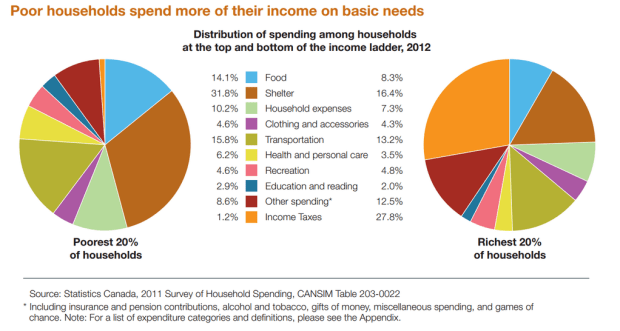
Just over a week ago, I saw this photo retweeted by Gerald Butts, who happens to be a senior advisor to Justin Trudeau (the Leader of the Liberal Party of Canada). As I’ve spent most of my adult life in the US, I’m used to hearing and writing (here, here, and here) about some of the sobering statistics in that country (approximately 50 million American live in poverty — right now!) As a result, I thought it’d be enlightening to take a closer look at some of the inequalities in Canada. This graph seemed like a good place to start.

For instance, I had no idea just how large the disparity was between the richest 20% and poorest 20%, with regard to food and shelter. Looking at the numbers, we can see that the poorest 20% spend approximately 56% (!) of their income on food and shelter. Fifty-six percent! While the richest 20% spend just 32%. I chose these categories because of Maslow’s Hierarchy of Needs. Food and shelter are some of the most basic needs we have and if the poorest 20% has to spend so much of their income on — essentially — surviving, it’s going to make it that much harder to “climb the economic ladder.” Of course, some might say it’s misleading to look at the numbers in aggregate like this.

With that being said, this holiday season, I hope you’ll remember this graph when you’re out at holiday parties and issues of politics and/or charities arise. It may add an important layer of perspective to the conversation.

US Congress: 48% Millionaires, US Population: 2.85% Millionaires

I recently saw an article in The Atlantic with the title: Does the Rise of the Super-Wealthy Require New Global Rules? It’s a provocative question based on a book by Chrystia FreelandPlutocrats. I highly recommend taking the time to read it! Anyway, while the article was good, there was something near the beginning that caught my eye and made me think:

When the 113th Congress opened in January, the number of millionaires in its ranks rose to 257 out of 535, or just over 48 percent.

My first thought — that’s a lot of millionaires in Congress, isn’t it? Forty-eight percent! Then I thought, that percentage probably doesn’t hold for the whole population of the US. Meaning, 48% of the United States probably isn’t made up of millionaires. In fact, it’s not. A study found that there are 9 million millionaires in the US. If we use the clock on the US Census Bureau, we can say that there are approximately 316 million people living in the US. So, if we divide 316 million by 9 million, we get a percentage of… 2.85%. Meaning, 2.85% of the US are millionaires. And yet, 48% of Congress are millionaires. Is something wrong here?

The US has a representative democracy. This means that a group of elected officials represent the people who elected them. Maybe it’s just me, but isn’t the keyword here representative? Do we really think that a Congress in which 48% of the body are millionaires can accurately represent a population in which only 2.85% are millionaires?

If you’re an American, this is certainly something worth thinking about today as you enjoy your holiday.

PS: Happy Independency Day!

Perception vs. Reality: Revisiting Wealth Inequality in America

This past summer, I wrote a post that shared some information about wealth inequality in the US. I was actually sharing information that had been published the summer before (in 2011). There was a telling graphic that followed as a result of the study (I’ve included it below): Average Income by Family, distributed by income group.

Keeping in mind that this study was published in 2011, so the three boxes may have shifted. If anything, I would imagine that the actual distribution (the top box) is more pronounced in its inequality and because of Occupy Wall Street and books like Chrystia Freeland‘s Plutocrats (which I’m currently reading and will probably have a post on in the near future), I would guess that people would be more aware of the wealth inequality, so the middle box would also be more pronounced in its inequality.

The reason that I decided to revisit this information is because there’s a video that’s being passed around that uses the information from this study (and this graphic) and presents it in a much more effective way. Before reading on, I’d urge you to watch it:

Now, can you see how much more effective that is in accentuating the differences between perception and reality? I especially appreciated the way the creator of the video used the an aggregate of 100 people to illustrate the differences between the percentiles. I’ve found that when numbers get really large, it can be hard for people to conceptualize the differences. For instances, if we look at the graphic above (in this post), the differences are plain to see, but there’s something about the limits of the rectangle. The representation of the quintiles don’t make for easy transferability from one quintile to the next. That is, it might be hard for to conceptualize that each of those colors is suppose to represent 20% of the population. In watching the video, though, the creator so eloquently differentiated between quintiles by taking an aggregate of 100 people and then actually showing the people from each group.

I think the video was really well done and I hope that it raises public awareness around this important issue. More than that, I hope that it motivates the public to actually want something to get done. If enough of the population pressures their legislators, we just might be able to make a change.