Are You Full: What’s in a Norm?

pablo-merchan-montes-Orz90t6o0e4-unsplashLanguage matters. Belief matters. Thoughts matter. How we speak to each other matters. How we speak to ourselves, matters. All of it. If you’re reading this, these ideas probably aren’t news to you, so I want to take this to a concrete example and then, zoom out to consider its effects.

There are many things that unite the human experience, but one that is absolutely universal — eating. We all need to take in nourishment (nearly all of us — daily) to sustain our existence. While there are examples of the human body being able to sustain itself without food for three weeks, I can’t think of anyone who would recommend doing so with any kind of regularity. Some folks will eat three times a day, some folks will eat five times a day, and some will eat more or less.

Depending upon your upbringing, where you grew up (geographically), and the kinds of events that were influencing the time (or had an influence on your lineage), you may have a particular relationship to food and eating. Some may have been trained to eat everything on their plate, so as not to ‘waste’ the food (ignoring any kinds of signals from your body). Some may haven’t been able to eat as much as they wanted because there wasn’t enough food to go around. Some may have had an abundance of food and never had to worry about either of those things.

Let’s focus on the scenario where people were trained to eat all the food on their plate. There are very good reasons as to why someone may have had this message communicated to them — (i.e. growing up in the Great Depression, there wasn’t a lot of food to go around, so if you had food, you ate it). This same way of thinking would have been passed down to the next generation and when they became parents, they would have said the same thing to their kids (even if they were living in conditions that would have seemed “rich” compared to the situation in which they grew up in when they were kids).

One step forward from this is being “full.” Have you ever been asked by someone whether you’re “full?” Have you really thought about what that means and how you’re answering? “Have you eaten so much food that you could not eat a single bite more or else you’d burst at the seams?” Is your “cup” (i.e. body) filled to the brim, such that any additional drop of water would case it to overflow? Do you really want to feel “full” after you eat? [NOTE: I’m abundantly aware that there are people out there who don’t get enough to eat and are perpetually hungry and if you happen to be one of those people reading this post, then please forgive what may seem like insensitivity. While there is obviously a problem on the one hand where people don’t get enough to eat, there is also a problem on the other hand, where people eat too much — and that’s what I’m trying to address here.]

Right, so, “are you full?” What an awful question to ask someone. A question where the norm being held up as positive is, “being full.” As a parent, I’m forced to confront commonplace words and phrases on a daily basis. Do I want my kids to develop an aggressive language for when they’ve completed a task or accomplished a goal (i.e. Yeah, I “killed” that test). Why would I want them to bring “kill” into their daily lexicon? Such a violent word. Such a misplaced word (in this context).

When it comes to eating, the question that I hone in on, “are you all done eating?” And if it’s the last ‘meal time’ of the day, “are you all done eating for today?” This has the added benefit of trying to make sure that they’re not going to emerge from their bedroom 10 minutes after you’ve put them to bed and ask for more food. Anyways, yes — “are you all done eating.” It might seem simple in that it’s still a binary question, but the inherent norm is expunged. No longer am I priming for one to feel like they’ve eaten “so” much food. Instead, the person can rely on their internal bodily signals to indicate to them whether they’re done eating “for now.”

I did say I wanted to “zoom out,” so here goes — worldwide obesity has tripled (!) since 1975. More people live in countries where people die as a result of being overweight than underweight. (Wait, what?!) Yeah, that’s right. About 40% of adults (18 and up) — globally — are overweight. Forty percent. FORTY PERCENT! How can we possibly be eating so much. [NOTE: I recognize that there’s a solid argument to be made here about what we’re eating vis-a-vis super-sizing our diets with sugar and corn, but let’s park that for now.]

Diet is absolutely important, but maybe even more important is our relationship to food. Are we eating to “get full” or are we eating to nourish ourselves? Are we eating until we’re done eating, until our body gives us those signals that tell us it’s time to stop eating, or are we trying to clean our plates and ensure nothing goes to waste?

The Quest for a Life of Leisure: Prisoner’s Dilemma in Food Production

In a conversation about “vegan food in the workplace,” I heard a thoughtful comment that reminded me of the Prisoner’s Dilemma. Before I paraphrase the comment, here’s a quick video to refresh your memory on the Prisoner’s Dilemma:

So, now that we have a better understanding of the Prisoner’s Dilemma, let’s get back to the comment. Essentially, the person was making the argument that large-scale commercial agriculture and farming is unsustainable, harmful to plants, and harmful to animals. The person was making the point that this problem stemmed from the business models/practices required to sustain them (and not the animals/plants themselves). Further to the person’s point, they explained that we also play a part in this by the way we purchase food. Regardless of whether we buy local, wild-caught food or buy large-scale commercialized food, there’s still an impact on the environment.

Upon hearing this comment, the first thing I thought of was the Prisoner’s Dilemma. Let me explain. There’s a demand for food. Consequently, businesses will satisfy that demand by supplying food. [Econ 101, amirite?] But how businesses satisfy that demand is where things get tricky. They could do so in a number of ways, but let’s simplify it into two: large-scale commercial agricultural production or small-scale local farming. If businesses were to focus on small-scale local farming, they’d be supplying food for the town (or maybe the town and some neighbouring towns). Businesses that focus on large-scale commercial agricultural production aren’t supplying food for a town, they’re supplying food for a country or – countries.

The two-by-two that I see here is that if businesses “cooperated,” they’d be supplying food for the local town(s) and “everyone” would be satisfied (consumers get food, businesses make money, environment is ‘harmed’ as little as possible, etc.). The possible hitch here is that businesses see an opportunity to make more money, so they scale up production into a major agricultural conglomerate (i.e. food for countries). That’s not to imply that this is “bad,” just that the opportunity exists and many businesses seek to seize it. In so doing, that provokes other businesses to do the same – the businesses are “betraying” each other, leading to externalities borne out by things like the environment. [NOTE: I’m aware that this example is very oversimplified and does not represent the state of food in all countries, especially where food shortages exist.]

The irony of the race-to-the-bottom is that, often times, the people running these businesses are all in it for the same thing:

An American businessman was standing at the pier of a small coastal Mexican village when a small boat with just one fisherman docked. Inside the small boat were several large yellowfin tuna. The American complimented the Mexican on the quality of his fish.

“How long it took you to catch them?” The American asked.

“Only a little while.” The Mexican replied.

“Why don’t you stay out longer and catch more fish?” The American then asked.

“I have enough to support my family’s immediate needs.” The Mexican said.

“But,” The American then asked, “What do you do with the rest of your time?”

The Mexican fisherman said, “I sleep late, fish a little, play with my children, take a siesta with my wife, Maria, stroll into the village each evening where I sip wine and play guitar with my amigos, I have a full and busy life, senor.”

The American scoffed, “I am a Harvard MBA and could help you. You should spend more time fishing and with the proceeds you buy a bigger boat, and with the proceeds from the bigger boat you could buy several boats, eventually you would have a fleet of fishing boats.”

“Instead of selling your catch to a middleman you would sell directly to the consumers, eventually opening your own can factory. You would control the product, processing and distribution. You would need to leave this small coastal fishing village and move to Mexico City, then LA and eventually NYC where you will run your expanding enterprise.”

The Mexican fisherman asked, “But senor, how long will this all take?”

To which the American replied, “15-20 years.”

“But what then, senor?”

The American laughed and said, “That’s the best part. When the time is right you would announce an IPO (Initial Public Offering) and sell your company stock to the public and become very rich, you would make millions.”

“Millions, senor? Then what?”

The American said slowly, “Then you would retire. Move to a small coastal fishing village where you would sleep late, fish a little, play with your kids, take a siesta with your wife, stroll to the village in the evenings where you could sip wine and play your guitar with your amigos…”

And maybe that life of leisure is closer than we think or, maybe, as the above parable suggests, we had that lifestyle before we “betrayed” each other in the Prisoner’s Dilemma. In an article I read recently in The Atlantic [Emphasis Added]:

The Ju/’hoansi [of Namibia] not only managed to feed themselves better than many in the industrialized world, but that they did so on the basis of only around two hours foraging a day, and cheerfully spent the rest of their time on more leisurely pursuits such as napping, playing games, and making art.

[…]

Over time, a more sophisticated picture of the Ju/’hoansi’s affluence emerged—one I saw firsthand living in southern Africa for 25 years and one I describe in my recent book. The Ju/’hoansi had an unyielding confidence in the providence of their environment and in their knowledge of how to exploit it. This meant that the Ju/’hoansi, like other hunter-gatherers, focused almost myopically on the short term—if the environment always supplied food and materials and the seasons were broadly predictable, what point was there in worrying about the future? This confidence also meant that the Ju/’hoansi did not store food for more than a few days and only expended energy on securing just enough to meet their immediate needs.

The Ju/’hoansi shared their food with one another according to a set of social prescriptions that ensured pretty much everyone, including the young, old, or disabled, got a share. As a result the Ju/’hoansi were also thoroughly egalitarian, mercilessly ribbing anyone that developed delusions of grandeur and seeing no point in accumulating wealth or formalizing systems of exchange.

NOTE: This was cross-posted.

Food is Meant to be Enjoyed: Parenting Without Borders, Part 3

It’s been almost five months since I wrote a post in this series. In fact, I looked back at the first three posts in this series and noticed that there was a rather large lag between some of the posts (Intro to Part 1 = 3+ months; Part 1 to Part 2 = ~1 month; Part 2 to Part 3 = ~5 months). I wonder if we can consider this some kind of metaphor for how it can be with parents who try to cross some things off their to do list. Anyway, my hope is that I’ll be able to post a few more parts of this series in the next month and a bit. Let’s have a quick refresher on the first three parts.

In the Introduction, we broached the idea that the way other cultures parent might be more “right” than the way that the culture in North America parents, as discussed in the book Parenting Without Borders. In Part 1, we looked at some of the different cultural thoughts around sleep. There was also that stunning example of how it’s normal for babies in Scandinavia to be found taking a nap on the terrace in the dead of winter! In Part 2, we explored “stuff” and how having more of it might not be best for our children. In Chapter 3, we’ll take a closer look at the different ways that children around the world eat.

~

One of the first things that struck me about this chapter was the aspect of neuromarketing. I’ve written about this in the past. From the book:

Food manufacturers spend enormous amounts of money to market their product to even the youngest eaters. The labels are brightly colored and appealing, and the foods are advertised directly to children on TV and the Internet. Supermarkets often put these kid-friendly foods at a child’s eye level so a child will be more likely to take them off the shelves and put them in the grocery cart when a parent’s back is turned.

Somehow, this seems… wrong. I totally understand the idea of free choice, free markets, and all that it encompasses, but is it really in our collective best interest to be pumping our kids full of sugar? More importantly, is it really in our collective best interest to allow an industry to surreptitiously convince our children that the foods they should be eating are found in the dry good aisle, rather than the produce section? Again, I totally understand that some folks are adamant about letting the ‘market’ correct failures, but it seems to me that in certain areas (healthcare being another one), there should be a bit more regulatory oversight.

On that note, I a little while back, I had what I thought was an interesting idea that incorporate some of the principles of Nudge:

The idea: a marketing campaign in which we tell people that, when they get unhealthy, their spouse or their kids will have to pay for it.

Circling back to the chapter, here’s another bit that I found startling:

It’s not just what kids eat, but how much. In the past thirty years, portion sizes have grown astronomically: a cookie today is 700 percent bigger than it was in the 1970s.

Seven hundred percent! That’s incredible. And that reminds me of one of the anecdotes I talked about when I wrote about how I stopped eating dessert:

There’s a story that I remember being told about Kate Hudson. I tried to find it just now, but Hudson recently mentioned something about a story in France that has similar keywords to the search I ran and so I’m not able to find it. It may or may not be true, but let’s just say that it is. When Hudson was young, her mother (Goldie Hawn), taught her an important lesson when it came to dessert: only take one bite. That is, when you’re served a piece of pie or a piece of cake, it’s not necessary to eat the entire piece. Instead, just take one bite of the dessert to “enjoy” the taste of the dessert and let that be it.

Can you imagine a sugar-starved kid only having one bite of their cake and leaving the rest? The stereotypical child that I’m imagining — of course — couldn’t do that, but I wonder if we move back to smaller portions (and smaller plates!) and teach our little ones about the importance of moderation, might this venture be a bit easier?

Before we close out this post, I wanted to share a couple of bits from the chapter about how food socialization of children in other parts of the world. In Japan, for instance, food is part of the education system. In the earlier grades, kids are learning about all the different uses for soybeans and by the time their in middle school, they’re already learning the basics of how to cook. I think most folks know that the school calendar is different in Japan (longer school days and longer school year), which allows for time for other learning. Rather than strictly focusing on academic instruction, Japanese students receive an education fit for the ‘whole’ of the person.

You might also find Sweden’s way of doing things refreshing — kids get to pick what they want to eat. The small catch is, the fridge is stocked with only healthy/good choices. In this way, a child in Sweden will never make the ‘wrong’ choice.

Eating in South Korea is similar to eating in Japan. One of the things I didn’t mention about Japan, but that is very important in South Korea, is that the family eats together. Everyone is eating the same things and there’s a real emphasis on a shared eating experience.

Moving west to France and Italy — food is meant to be enjoyed. A quick example from France:

School lunch in France is a class in itself. Children get one and a half to two hours to eat a leisurely, three-course lunch, followed by a recess. A typical menu for preschoolers in Versailles has children eating sliced radish and corn salad with vinaigrette dressing and black olive garnish, roasted guinea fowl, sautéed Provençal vegetables, and wheat berries, Saint-Paulin cheese, vanilla flan, and wafers.

I suspect that the meal above probably sounds better than what you had for lunch and probably sounds better than what you’re going to be having for dinner tonight.

Poorest Canadians Spend More Than Half of Income on Food & Shelter

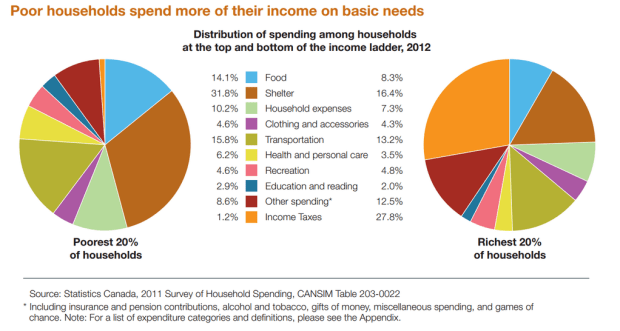
Just over a week ago, I saw this photo retweeted by Gerald Butts, who happens to be a senior advisor to Justin Trudeau (the Leader of the Liberal Party of Canada). As I’ve spent most of my adult life in the US, I’m used to hearing and writing (here, here, and here) about some of the sobering statistics in that country (approximately 50 million American live in poverty — right now!) As a result, I thought it’d be enlightening to take a closer look at some of the inequalities in Canada. This graph seemed like a good place to start.

For instance, I had no idea just how large the disparity was between the richest 20% and poorest 20%, with regard to food and shelter. Looking at the numbers, we can see that the poorest 20% spend approximately 56% (!) of their income on food and shelter. Fifty-six percent! While the richest 20% spend just 32%. I chose these categories because of Maslow’s Hierarchy of Needs. Food and shelter are some of the most basic needs we have and if the poorest 20% has to spend so much of their income on — essentially — surviving, it’s going to make it that much harder to “climb the economic ladder.” Of course, some might say it’s misleading to look at the numbers in aggregate like this.

With that being said, this holiday season, I hope you’ll remember this graph when you’re out at holiday parties and issues of politics and/or charities arise. It may add an important layer of perspective to the conversation.

Soup Scoop Crackers: A Million Dollar Idea

Are you in search of a million dollar idea? Great! I’ve got one. Soup scoop crackers. Sound crazy? Read on.

A couple of months ago, I was eating soup. There happened to be a little bit of nip in the air, so I thought I’d dive into the soup cupboard. After heating my soup on the stove, I got the crackers out of the cupboard and proceeded to sit down at the table. Upon opening the package of saltines, I then dipped my cracker in the soup and used it as a scoop to get some of the ‘stuff’ onto the cracker and into my mouth. Yum. As I sat there doing this with the remainder of my crackers, I wondered: How come there aren’t soup scoop crackers?

There are scoops for salsa and dip in the form of chips, but we don’t have this same luxury for soup. Why? Well, I thought about the way people eat soup. I’ve seen a lot of people who simply dip their cracker into the soup and then eat the cracker (almost as if the soup is warming the cracker and adding some flavor to it). I’ve also seen people who break the cracker into bits and then eat their soup with the broken crackers in it. But there’s another group of people… People like me who like to scoop the stuff out of the soup with crackers.

After I had this idea, I thought that someone must have thought of this, right? Maybe I’ve just missed these soup scoop crackers when I go shopping. It turns out, that’s not the case. I’ve done a number of google searches for crackers and I never see anything resembling a scoop cracker. Then I thought, it’s possible that I’m using the wrong terms, so let me go to the grocery store and see if there just might scoop crackers. I checked Mom’s Organic Market. I checked Whole Foods. I checked Wegmans. Nothing. Nothing. Nothing!

There doesn’t seem to exist something in the form of a scoop cracker. So, all of you entrepreneurs out there (maybe the more food-inclined ones), here’s a million dollar idea: soup scoop crackers.

The “Health Halo Effect:” Organic Labels on Food

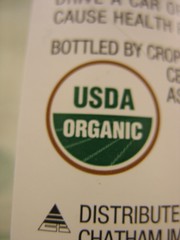
A couple of days ago I restarted that series on cognitive biases with a post about the Halo Effect. I recently came across a study that applied the Halo Effect, but specifically, to health. The study sought to see whether labeling food organic made folks think that the food was healthier. An excerpt:

115 people were recruited from a local shopping mall in Ithaca, New York to participate in this study. Participants were asked to evaluate 3 pairs of products — 2 yogurts, 2 cookies and 2 potato chip portions. One item from each food pair was labeled “organic,” while the other was labeled “regular.” The trick to this study was: all of the product pairs were organic and identical! Participants were asked to rate the taste and caloric content of each item, and how much they would be willing to pay for the items. A questionnaire also inquired about their environmental and shopping habits. Even though these foods were all the same, the “organic” label greatly influenced people’s perceptions.

It certainly seems like there’s evidence here for the “health halo effect.” Something that I wonder about, though — the placebo effect. I haven’t written about the placebo effect, but I imagine that most of you know what it means: it’s the idea that an inert substance can prove to have an effect on someone’s health. We can apply the placebo effect to situations outside of medicine.

In this instance, we might posit that the people who were eating the food labeled organic believed that it would taste better — and so it did. I don’t think that this hypothesis could be evaluated from the data from this study, but it would be an intriguing follow-up.


Sometimes, You Really Never Know What the Day Will Bring

Tonight was a bit unexpected. One event (the apartment across the hall having its floors finished) led to a series of events that caused me to end up at a place I probably wouldn’t have foreseen going to, at the start of the day. Since the smell in my apartment was unbearable, after class, I ended up on a roundabout walk looking for a place to eat.

My original plan was just to grab something quick nearby and then head to the Starbucks to catch up on things. Well, that didn’t happen. After walking for about 2 miles, I ate dinner at a local Chili’s, but not before finding a rather artsy place. From the outside, the artsy place looked like it was more a café than it was a place to eat, so that’s why I walked to the Chili’s.

After scarfing down some Shrimp tacos, I headed back to the artsy place, where it also happened to be Open Mic night! (So much for catching up on things, right?) I had a fantastic time. Sure, my plan was to catch up on things, but sometimes, you have to roll with things and let life take you where you’ve got to be. Not only did I have a great time, I’ve found a local artsy place that I can walk to whenever I’m in the mood for that kind of vibe.

Two more things I want to say:

1. The place I went to Epicure Cafe. Fantastic place. I highly recommend it. It’s not the kind of place you’d expect to find in a strip mall, but you’ll be pleasantly surprised. They are highly rated on Yelp! and were feature in Northern Virginia Magazine!

2. I had never seen someone “be” a one-man band. It was captivating and I have a lot of respect for someone who can keep track of all the different things you’d have to keep track of in order to play a one-man band — and play it well! If you’ve never seen a one-man band, here’s a great example:


The Perfect Diet – *Guaranteed!

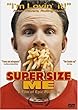
StrawberriesIn my two most recent posts in the public policy series, I’ve addressed food and healthcare. Clearly, these are both very intricately connected to diet. The food one consumes is directly related to their diet and one’s healthcare is also affected (positively/negatively) as a result of their diet. Meaning, if I eat McDonald’s for the next 30 days like Morgan Spurlock, my health will seriously deteriorate. Today, I thought I’d talk about “the perfect diet.”

With quotations, did you know, that there are over 1,000,000 returns for “the perfect diet?” I think that’s incredible. For the phrase, “the best diet,” there are over 26,000,000 returns. Diet by itself will give you nearly 600,000,000 returns. From my estimation, it would seem that this is a pretty important issue to people and rightfully so. Did you know that most cells in the human body renew themselves? Meaning, the cells that make up the skin on your arm will not be the same cells that make up the skin on your arm in 2 or 3 months (give or take). So what does that mean? Where do we get more cells? Or more accurately, where do we get the means with which to make new cells?

Food.

Food is the “fuel” of the body. Some believe they don’t even need food, only sunlight, but I won’t go into detail about that.Utilizing two Christmas gifts (the Real Food Daily Cookbook and a stellar Williams Sonoma loaf pan) I made this tempeh loaf and I'm very excited to say that it was great. Tempeh is one of those foods that I feel I should eat more of, but it can be a challenge because on the whole, I'm not super into it though I know it's a highly nutritious food that would be a good thing to work into my diet more. I think this loaf will do the trick. Yum. And with garlic green beans and mashed potatoes...a perfect meal for a cold New England winter night...except that it's been in the mid and upper 60s here. Oh well, perfect comfort meal for anytime of year.  Again, food is the fuel of the body. However, this ‘energy source’ for the body isn’t always presented and consumed in its simplest form. Meaning, the body usually needs to break down the food into parts, such that the energy can be harvested from the food and directed to the appropriate cells. It’s said that there are three main groups of food: carbohydrates (starch or sugar), fat, and protein [of course we could quibble over just how many groups there are, but this is what was written in the previous reference, so I’m going with it.] It’s these different groups of food, (and the way our body processes food), where the discussion about diets usually diverges.

Some people think you should have a low-carbohydrate diet, while others think you should have a no-carbohydrate diet. Some advocate for veganism. Some advocate for what could be seen as a “less stringent” form of veganism — vegatarianism — which has many degrees to it. Some advocate a slow-carb diet. I could go on and on with the various types of diets that are out there. I’m sure you’ve probably tried or heard about a diet that I haven’t listed.

~

I’m here to tell you today that there is a perfect diet out there for you — I promise. You may be here in search of it. I’ve been blessed with “good genes” and the motivation to stay relatively fit, which has allowed me to eat pretty much whatever I’ve wanted with gaining weight. I don’tI've been following Tim Ferriss' slow-carb diet as outlined in his book The Four Hour Body. Usually I eat chicken or fish, and occasionally steak. Always black beans or lentils, and always nutrient rich vegetables. This is a typical lunch, exactly three weeks and one day after starting (here's the corresponding blog post).  Today was one of those days when I completely forgot to take a photo specifically for Project 365. I meant to, but it slipped my mind. When I woke up on Wednesday, I realized I had forgotten. There was exactly one photo I took the entire day, and this is it. I've been sending photos of my meals to my girlfriend (who is also doing the Fit Challenge with me, although using a different diet) and that's what this photo was intended for. But... it now gets to do double-duty as my Project 365 photo of the day. mean to sound boastful and at the same time, some may be jealous of this. I think there are a number of reasons as to why my level of health (as gauged through body fat % and weight) is as good as it is, but I’ll save that for another day.

Holding my physical health constant, I’ve been able to try a number of different diets. Growing up, I was fortunate enough to have a mother who cooked a variety of cuisines (from Chinese to Indian to Mexican to Italian, etc.). As an adult, I’ve also had the good fortune of trying a couple of different diets. As you’ll note from our Sport & Performance Psychology Resources, we recommend Brendan Brazier’s books — The Thrive Diet being his book on diet, of course. For a time, I ate exclusively what was mandated through the The Thrive Diet. You’ll note that Brazier is a vegan, so all of his recipes are vegan. More recently, I experimented with Tim Ferriss’ diet from the 4-hour body. Ferriss advocates a slow-carb diet, which I mentioned in listing off diets earlier in this post.

In my experimenting with these diets, (and weighing it against how I felt when not on these diets), and then reading reports of how people (fared) with these diets, I came to realize that there’s something that I haven’t read with regard to diets (or maybe I have and just don’t remember seeing it) — it’s personal. Literally, it’s personal. One could read and try thousands of diets from Alicia Silverstone’s to Suzanne Somers’ and still never find the perfect diet. I think that this is the case because there is no perfect diet for everyone. I think Ayurveda is on the right track when they talk about one’s Dosha (or body type). Meaning, we can group certain The largest QOTSA headline crowd to date  7300 people at Queens Of The Stone Age, Lotto Arena, Antwerp, Belgium  2 March 2008  This image is CC so you can view the full size and find yourself  it also happens to be one of the largest group portraits I've ever taken, although i have larger crowdsbody types together and give them a constitution for what people with these body types should typically eat (and not eat). Of course, there are blends of the doshas, and exceptions.
The main takeaway is that there are almost 7 billion people on the Earth. To my wisdom, I would argue that there are just as many “perfect” diets out there. No one can tell you what the perfect diet is for you — only you can assess that. I would encourage you to try things out. Try diet-x or diet-y, but if you don’t feel good after trying it (giving it the appropriate amount of time, of course), then maybe that diet’s not for you. And maybe you don’t find the “perfect” diet with regard to someone else’s plan. Maybe you blend diet-j and diet-w to your new diet — and you write a book about it. When it comes to your body, you are one of the most qualified.

*Disclaimer: Because America is known for being a society of litigation, I thought it necessary to say that I, and Genuine Thriving, cannot be held responsible for your decisions based on reading this post. I am not a physician, nor do I hold any degrees in nutrition, so before making any changes to your diet, I would be remiss if I didn’t recommend you consult a physician or educated professional.

New Zealand Grows No GMOs: Food & American Public Policy, Part 4

: Economics
: Campaign Finance & Elections
: Education

The US recently unveiled their new version of the and have called it: . I think this food plate is much better than the pyramid, but I won’t get into that in this post. I’ll talk about my opinion about “diets” in an upcoming post. In this post, I’ll be talking about food policy.

One of the main clues that there is something not completely right about the food policy in the US is some of the alarming documentaries. In 2004, there was . An alarming look at what it’s like to eat strictly a diet for 30 days, with little exercise (less than 2.5 miles of movement a day). At the time, McDonald’s did not have as many healthy choices as they have on the menu today, but as is pointed out in the film, salads can actually have more calories than the burgers (if cheese and dressing are added).

In 2005, there was . This was a difficult film for me to watch. It illustrates some of the unsightly practices of industries that use animals, but since this post is about food policy, I will direct you to the part of the film that explains the unnecessary harm that humans inflict upon animals for food production. While the film advocates veganism, I’m not suggesting you take up this practice, but after watching the movie, I’d be surprised if you didn’t at least consider it.

In 2008, there was . This is probably the most poignant movie with regard to food policy. This movie breaks down the unsustainable (both economically and environmentally) practices of food corporations like , , , and . If you eat meat (and don’t buy organic), there’s a good chance that it’s from one of these companies. Most effectively, the documentary explains that the reason food production has become what it is today, is due in large part to the boom of fast food in the 1950s. An increased demand  for food put pressure on companies to make more food — faster. And so this is what we have today.

One of the things that frightens me the most about the information found in documentaries like these have to do with (or any biological patent, for that matter). Companies like Monsanto, seeds in the lab and then patent the seed they’ve created. From there, they then sue (usually, successfully) farmers who use seeds that are similar to the ones that they’ve now patented. So, these farmers who know nothing of Monsanto and their created seed are going about their business doing what they do and are then, all of a sudden, told they have to stop using the seeds they use (because they are infringing on the patent rights of Monsanto).

~

I think there’s something wrong with food policy when a company that creates a seed can legally sue (and win) against a farmer who uses the original and natural seed. The seed that came from the environment. Doesn’t that seem a little strange to you?

Like in my previous posts in this series, I don’t think there needs to be any grandiose solution to fix the problem. While the problem may be widespread (as in the other posts), the solution needn’t be overly complicated. Of course, these simple solutions aren’t necessarily as easy to implement as they are to envision. With regard to food policy, a simple solution I see is to . It may sound a bit extreme and unfeasible, but is it really feasible to continue to ingest these scientifically engineered foods? Do we really think that there are nearly as many nutrients in lab-created food as there are in “naturally-occurring” food?

European Countries that Have Banned Genetically Modified Foods in at Least One Part of the Country

Albania, Austria, Belgium, Bulgaria, Croatia, Cyprus, Czech Republic, Denmark, Estonia, Finland, France, Georgia, Germany, Greece, Hungary, Iceland, Ireland, Italy, Latvia, Lithuania, Luxembourg, Netherlands, Macedonia, Malta, Montenegro, Norway, Poland, Portugal, Romania, Russia, Serbia, Slovakia, Slovenia, Spain, Sweden, Switzerland, UK: England, UK: Scotland, and UK: Wales. (As of September 2010: )

In all, there are nearly 40 countries on that list. The site where I got that information from also has a of Europe that are at least partially GMO-free.

~

Europe is often touted as being ahead of the North America when it comes to things like these, but how about New Zealand? From :

No genetically modified crops are grown commercially in New Zealand. No fresh fruit, vegetables or meat sold in New Zealand is genetically modified.

That’s right! No genetically modified food in New Zealand! It’s possible. It’s possible to have an entire country that does not produce food that has been genetically modified. Granted, New Zealand is smaller in terms of population than much of the rest of the world ( countries ranked by population based on country’s estimates and the UN), but this is still quite an accomplishment and dare I say, example, for the rest of the world. If New Zealand can do it, we can, too!

Quotes: Passion, Produce, and Production

I’ve recently started using “” as one of my tags for posts I write. Most of the times I’ve got a quote in a post, I’ll tag it with “Quotes,” so it’ll be easy for you to find all the posts where I’ve used famous quotes. On that same note, I thought it was time for me to do a post of quotes.

Throughout high school and most (okay, all) of my undergrad, I was semi-obsessed with quotes. I thoroughly enjoyed finding concise bits of wisdom from a famous person to express myself clearly. After undergrad though, quotes just seemed to fade as a priority for me. They became less and less a focus of the things I did. Maybe that was because I was in the midst of a PhD program and found myself reading oodles of academic journal articles. Regardless of the reason why, recently, I’ve remembered the value of a short sentence that can speak “volumes.” Today, I thought I’d recount some of the quotes that I’ve come across recently that have made an impact.

One of my current favorite quotes is one that is often and maybe that’s partly why I like it so. It’s not as famous as the misattribution of , nor is it as famous as the to a Martin Luther King, Jr. quote, but I’ve seen it written many times to the wrong name. I don’t remember where I first saw the quote, but I know that I like it. From :

Do not ask yourself what the world needs. Ask yourself what makes you come alive, and then go do that. Because what the world needs is people who have come alive.

It feels like it speaks to the heart of what I think we should be doing on the planet.People should be passionate about what they do. Find your passion — fulfill your passion. I understand that sometimes people think this is not an option for them (doing their life’s passion), but I believe, there is room for us all to be doing our true passion.

Another good one that I found was at a restaurant that my partner and I were eating at this past winter. It was written on a chalkboard in pretty big letters (and the restaurant is , as they have a farm on the property). When I saw it, I thought, of course! From :

“If organic farming is the natural way, shouldn’t organic produce just be called ‘produce’ and make the pesticide-laden stuff take the burden of an adjective?” – Ymber Delecto

Doesn’t that just make sense? Too often we have a word for something and then we have to develop a modifying word to better understand the initial word. Produce was originally just produce — why do we need to call it organic produce? Another strange one on this topic, specifically in the food category, is the way we talk about sugar. Refined sugar equals bad, but unrefined sugar equals good. We have sugar to begin, but then we add the word refined (to explain that it’s been worked over), but then we need to add the prefix ‘un’ to tell us that the sugar has in fact, not been worked over. Shouldn’t it just be sugar?

One last one that I had found for a presentation I had to give recently. From :

In a truly great company, profits and cash flow become like blood and water to a healthy body: They are absolutely essential for life, but they are not the very point of life.

This comes from Collins’ book, . I think it speaks to a fundamental (pathology, if we want to invoke the documentary, ), with the way the majority of business operates today. Clearly, does not think business should be pathological. He’s been lecturing on sustainability for quite some time now.

So what about you. What are some of your favorite quotes?