Twenty Online Talks That Will Change Your Life, Part 2

Yesterday, I began going through one of The Guardian’s articles about 20 online talks that could change your life. We got through the first 10 talks yesterday. In this post, we’ll look at the last 10 talks.

11. Shaking Hands With Death – Terry Pratchett

12. The Voices in My Head – Eleanor Longden

If you have no experience with schizophrenia, Longden’s talk will certainly change that. It’s important to note, not everyone comes as ‘far’ as she did. Nonetheless, I hope her story fosters empathy within you.

13. Arithmetic, Population and Energy: Sustainability 101 – Albert Bartlett

I don’t remember when I first saw this lecture from Bartlett, but I know that it was probably one of the first lectures I watched on the internet (maybe 15 years ago?). If you’re captivated by headlines like “Crime Doubles in a Decade,” or you’re confused about inflation then you’ll learn a lot in the first half of the video. As someone who majored (second major) in sociology, I can certainly empathize with the idea of a Malthusian catastrophe. I suppose I’m putting stock in the fact that something will change before it gets to that. You may be tired of hearing that people of time X couldn’t have predicted what life would be like in time Y, but I’d say that this is a big factor in why I think we’re not hurtling toward the future that Bartlett explains. Of course, I could be wrong, but I really think that something will change before it comes to this.

14. The Coming Collapse of the Middle Class – Elizabeth Warren

15. The Secret Powers of Time – Philip Zimbardo

If you’ve ever taken PSYC 100, there’s a good chance you’ve heard of Zimbardo. If the name doesn’t sound familiar, his famous experiment will: the Stanford Prison Experiment. I remember watching the RSA Animate version of this talk a couple of years ago. Zimbardo shines a light where you might not have been looking: your relationship to time.

16. The secret to desire in a long-term relationship – Esther Perel

17. Printing a human kidney – Anthony Atala

In 2011 when this talk was given, the idea of 3D printing was brand new. To some, it may still be. I remember talking about it last year in the context of rapid technological change. If you’re still fuzzy on 3D printing, this is an enlightening place to start.

18. Do schools kill creativity? – Ken Robinson

If you’ve ever watched a TEDTalk, there’s a good chance you’ve heard of this one from Ken Robinson. As of this time last year, it was the most watched TEDTalk – ever – with almost 15,000,000 views. If you haven’t seen this one, spend the next 20 minutes doing just that.

19. Sugar: The Bitter Truth – Robert Lustig

20. Moral behavior in animals – Frans de Waal

~

If you liked this paper/series, you might want to check out some of the other papers/series I’ve posted.
Wanna Make a Name for Yourself: Answer One of These Questions

In The Guardian today, there’s an article that lists “20 big questions in science.” If you want to be famous (at least in some circles), answer one of the questions. Of course, there are some ‘answers’ to the questions already. Or maybe it’d be more accurate to say that there are some hypotheses or that there is some ‘general knowledge’ in the domain of the question. However, there don’t seem to be any definitive answers, yet.

Here are the questions with a few thoughts after some of them:

1. What is the universe made of?

2. How did life begin?

3. Are we alone in the universe?

If pressed to give an answer on number three, I’d probably say something to the effect of: given how big the universe is, mathematically speaking, isn’t it more likely that there is other life out there somewhere than isn’t?

4. What makes us human?

5. What is consciousness?

On number five, I remember reading a very intriguing article in The Atlantic this past winter that explored the question: what does it mean to be conscious? It approached this question in the context of anesthesia. If this question interests you, this is one way to delve into the topic.

6. Why do we dream?

While there are many theories on why we dream, one of my favorite ways for interpreting dreams is through Jeremy Taylor’s method. This method also outside the context of dreaming.

7. Why is there stuff?

8. Are there other universes?

9. Where do we put all the carbon?

10. How do we get more energy from the sun?

Number ten, while also making you famous, would likely also make you extremely wealthy unless you went the route of Jonas Salk and polio.

11. What’s so weird about prime numbers?

12. How do we beat bacteria?

13. Can computers keep getting faster?

14. Will we ever cure cancer?

15. When can I have a robot butler?

16. What’s at the bottom of the ocean?

On number sixteen: when you realize that 95% of the ocean is unexplored, it sort of gets you curious about what might be down there. More than that, 99% of the Earth is water. There’s a lot we don’t know about the planet we inhabit.

17. What’s at the bottom of a black hole?

18. Can we live for ever?

19. How do we solve the population problem?

20. Is time travel possible?

On number twenty: if this turns out to be true, that would make for some interesting ethical and moral dilemmas.

The Evolution of Energy Sources for Humans Is Shorter Than You Think

I’m a big proponent of clean, renewable, and sustainable energy. Our species will not survive if we continue to use energy in the same way that we do at the same pace at that we do. That’s simply a fact. However, in my thinking about this issue, it never really occurred to me just how “new” energy is to humans. That is, it never really occurred to me just how new our energy sources were.

Take this chart of energy consumption in the United States, for instance.

History of Energy Consumption in the United States

Americans only started using petroleum as an energy source around the time that Abraham Lincoln was president. That’s almost 150 years ago. Americans have “only” been using petroleum as a source of energy for the last 150 years. That means, potentially, your great-great-grandfather may have lived in a world where using petroleum as an energy source was a “new” thing.

Looking a little further along the chart and we can see that 50 years after petroleum became an energy source that Americans used (albeit scarcely), coal was far and away surpassing our usage of petroleum. About 100 years ago, coal was 12, 13, or 14 times as popular as petroleum as a source of energy. It looks as if even wood was more popular as an energy source.

Now let’s look at the last 50 years. Between the early 1900s and the 1950s, the use petroleum as an energy source skyrocketed! As did the use of natural gas as an energy source. Coal seemed to be on the decline, but still in heavy use. Fast-forwarding a little bit more and we see that petroleum is trending down (in terms of its use) as is coal, but not before coal had a big uptick between the 1950s and the early 2000s. In that timespan, nuclear power also took off as an energy source, but it appears to have leveled off in the 2000s and may even be headed for a downward spike since the 2010s.

More notably is the green line for other renewables. We don’t see its existence until the 1950s and its growth is rather slow and steady. However, in what looks like the early 2000s, it begins to trend up. Who knows — maybe we’re on the cusp of what could be an energy revolution. Maybe “other renewables” will grow in popularity and use as coal or petroleum. Maybe its a bit naive or foolhardy to expect great energy transformation from non-renewables to renewables. Evolution does take time.

My point in sharing this today is to add some perspective on just how far humanity has come in terms of its use of energy. Really, only in the last 50 to 100 years has energy consumption skyrocketed in the way that we know and understand today. Who knows what energy consumption will look like in the years to come.


Lies, Damned Lies, and Statistics: America’s Dependence on Mideast Oil

Earlier this morning, I came across a headline that was a bit shocking (to me): “Americans Support the Keystone XL Pipeline by Wide Margin.” All of the data I’d seen regarding polls of Americans showed that there certainly wasn’t a wide margin in support or against the pipeline. So, with my curiosity piqued, I clicked the article to find out that 67% (of the survey respondents) support building the pipeline. That still seemed a bit surprising, as, like I said, most polls I’d seen had stayed in the range of 45/55 or 55/45.

Upon getting to the actual survey, I scrolled to the question that led to the headline. Here’s the question that was read to survey respondents:

The President is deciding whether to build the Keystone X-L Pipeline to carry oil from Canada to the United States. Supporters of the pipeline say it will ease America’s dependence on Mideast oil and create jobs. Opponents fear the environmental impact of building a pipeline. What about you – do you support or oppose building the KeystoneX-L pipeline?

Do you see anything wrong with this question?

Let’s start with the idea that they’re telling respondents what supporters say and opponents say. If the respondent doesn’t really have a strong opinion about the question, they may prefer to identify with one group or the other (and they might even if they have a strong opinion!) One could argue that there’s a response bias present. There has been quite a bit of press about “America’s dependence on foreign oil.” So, someone might not want to oppose that viewpoint in a survey. That is, the respondent wouldn’t want to appear, (to the person conducting the survey), that they don’t think that reducing America’s dependence on foreign oil is as important as the environment.

Juxtaposing the dependence on foreign oil with environmental impact is a bit unfair. As I said in the previous paragraph, I’d bet that most people have heard/read something about the America’s dependence on foreign oil, but they probably don’t know very much about the environmental impact of oil. Now, that could be a messaging problem for the environmental movement, but there hasn’t been a compelling enough case made. (If there were, there certainly wouldn’t have been this many people who were “A-OK” with building the pipeline.)

Lastly, let’s actually examine this so called dependence on foreign oil. From the US Energy Information Administration:

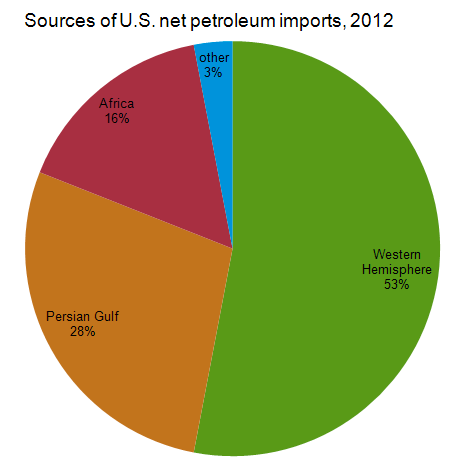
The United States relied on net imports (imports minus exports) for about 40% of the petroleum (crude oil and petroleum products) that we consumed in 2012. Just over half of these imports came from the Western Hemisphere. Our dependence on foreign petroleum has declined since peaking in 2005. [Emphasis added]

In doing the math, 60% of the petroleum (oil) that the US consumed in 2012 was produced domestically — inside the US! In doing some more math, we’re told that just over half of the imports came from the Western Hemisphere. Meaning, less than half of the imports are coming from countries outside of the Western Hemisphere. Meaning, less than half of the imports could be coming from the Mideast and we already know that only 40% of the oil consumed in the US comes from imports. In fact, this same agency tells us just how much oil is imported from Persian Gulf countries: 29%. So, 29% of the imports (40%) is how reliant the US is on Mideast oil. Again, doing the math the total US consumption of Mideast oil: 11.6%. Does 11.6% sound like dependence?

If you recall the last line of the quote from the agency: “Our dependence on foreign petroleum has declined since peaking in 2005.

The next time you read survey data, I hope you’ll remember this post and consider just how construed the results may be.

[Note: The title of this post is a quote that was popularized by Mark Twain.]

Room for Innovation in Wind Energy Industry

I was driving down the 401 in Toronto and I noticed a wind turbine setback from the highway. As I looked at it, I remembered seeing it when I used to live in Toronto over 10 years ago. That’s a long time. On one of my first trips across the USA, I drove north through the California desert. As you’d expect, there were lots of wind turbines. When I traveled through New Zealand, there were lots of wind turbines there, too.

The extent of my knowledge (at this point) of wind energy is that the energy is captured through the use of a wind turbine. And because of the structure of the turbines, there are lots of folks who oppose wind turbines. There concerns are understandable and shouldn’t easily be dismissed. That being said, I think about the abundance of wind on the planet I think that there’s gotta be room for innovation in this industry, right?

If I had to choose, my guess is that solar energy is going to be what revolutionizes energy on our planet, but while we’re still trying to perfect energy storage (batteries just won’t cut it), I have a hunch that there’s something we can do about the wind energy industry. I don’t have a grand idea to propose in this post, but there are many inventions or discoveries that come from people who weren’t working inside that industry. My guess is that I don’t have many readers who work in the wind energy industry, so it might be people like you and I who come up with an idea that revolutionizes the wind energy industry.

The next time you get a few minutes, think about the abundance of wind on the planet and how we might capture and store that energy. It just might be a million dollar idea…

Have You Tried… Rearranging Your Space?

Right now, my house is in a bit of an upheaval of sorts – I’m in the process of packing and subsequently moving from the Hawaiian Islands to the east coast (metro DC). As I went to make myself coffee this morning, I realized that the kettle was not in the same place that it was yesterday (or for the majority of the time I’ve lived here). It threw me for a second, until I realized it was on a counter across the kitchen. As I plugged the kettle in to heat up the water, I realized that this situation offered me a new perspective.

How often do you find yourself stuck in a rut? You’re at your desk and you just can’t think of where to go next. You don’t know if you should choose the first option or the second option. Maybe you have writer’s block. Maybe you’re trying to solve a really important problem, but you can’t think of an answer. In fact, all you can think of with regard to answers are all of the answers you’ve already thought of. Has this ever happened to you? What have you tried to do to rectify the situation? Have you thought of rearranging your space?

Some would say the and this is not a concept unbeknownst to the world’s religions (see: ). Have you ever noticed this? Have you ever noticed that your physical world is a mess (and so is your head space)? It doesn’t even have to be this way. As I was saying earlier, it could just be that the way that things are set-up in your environment has become stagnant. Maybe the energy in the room needs to shift (to allow the energy of your thoughts to shift) and allow you to come to a solution.

You may think it’s , but I pause and reflect anytime someone presents an idea from ancient times. In this particular instance, I think that applies. You don’t even have to believe it because it’s ancient wisdom, try it for yourself. Try rearranging your room (either intuitively or counterintuitively). Maybe put your desk in a way that your and see how it feels.

When I first sat down to write this post, I didn’t intend to use Feng Shui as a reference, but so it goes. If you like, you can totally ignore the inclusion of Feng Shui in this post. I just like to have some sort of reference for you to click on (to lend credence to what it is that I am saying), but with what I’m saying today, you can totally just try it out on your own (sans Feng Shui). Whether or not you believe in “unseen energy,” I think you’ll find that when you rearrange your space (physical), you’ll gain a new perspective on things (literally and figuratively).

The Scientific Evidence for Distant Healing: Psi Phenomena, Part 5

: The Scientific Evidence for Telepathy
: The Scientific Evidence for Clairvoyance
: The Scientific Evidence for Precognition
: The Scientific Evidence for Psychokinesis

Finally, we’ve reached the last of the “.” Today’s post will be about the scientific evidence for distant healing. I struggled with what to title this post. Within the context of the “Big 5” as coined by , he refers to this psi phenomenon as “.” I think the word psychic can be a bit of a misnomer sometimes, confuse people, or even conjure up images of a psychic (who aren’t necessarily doing the healing at a distance [that is, “regular” people can do it, too]). I think this is a disservice to the phenomenon as there’s nothing “spooky” about it. Others refer to it as “.” While this is completely accurate (nonlocal meaning that the healing is taking place because of something that isn’t “present”), it could be considered too science-y and may not be as accessible as possible. This is why I’ve settled on distant healing.

The has a great . I like it so much that I’m going to use their explanation for :

Distant healing encompasses a broad range of healing practices, many of which are based in ancient spiritual traditions. Virtually all major religions, including Buddhism, Christianity, Islam, and Hinduism, endorse and encourage the use of distant healing among their adherents.

Two of the most common distant healing practices are offering prayers for those who are ill and using forms of meditation where the practitioner holds a compassionate intention to relieve the suffering of another. Some practices focus on curing a very specific disease state while others emphasize creating a compassionate environment that can have a healing effect. Virtually all distant healing practices are concerned with alleviating the suffering and increasing the well being of others.

As part of my master’s program, I read many of the studies (on healing prayer) that this quotation is referring to. In preparing to write this post, I was initially going to cite a number of them individually, until I found an , that reviews all of the studies that I had known about (and then some). It isn’t a meta-analysis per se, like I had been able to find for some of the other posts in this , but it’s the next best thing (an aggregation).

The first two studies that Benor addresses are what he calls the ‘two best studies’ that address distant healing for human physical problems. The first is a study that was conducted to .The concluding sentence of the abstract: “These data suggest that intercessory prayer to the Judeo-Christian God has a beneficial therapeutic effect in patients admitted to a CCU [coronary care unit].” The second study that Benor addresses is a follow-up the first study called: “.” The concluding sentence from that summary: “Remote, intercessory prayer was associated with lower CCU course scores. This result suggests that prayer may be an effective adjunct to standard medical care.”

Both of these studies are more than 10 years old, but one of my favorites on this subject that is just as old comes from the of famous scientist . Elisabeth did a study in conjunction with 3 others to tests the . The conclusion: “These data support the possibility of a DH [distant healing] effect in AIDS and suggest the value of further research.”

There’s no doubt that the sheer volume of studies that have been conducted on this topic should be enough to warrant more and more research. Even the studies that demonstrate the power of our words (on or on ) could be seen as support for distant healing. , along with [two of the more prominent names in the public dissemination of information on this topic], have curated a nearly 20 pages long! (It’s nearly 30 pages, if you include their introduction and answers to some questions about the research. IONS has also compiled a that’s over 10 pages. Daniel Benor has also published a that have compiled a number of resources on this topic.

One more quote I want to share from the Benor article I mentioned earlier in this post. I think it’s a very important point and I will expand upon this when I address healthcare in my . I really implore you to take some time to ponder the implications of this quote:

One would hope that the benefits of such an inexpensive intervention would appeal to those who are concerned over the high costs of medical care.

~

If you liked this paper/series, you might want to check out some of the other papers/series I’ve posted.

Proof That Grassroots CAN Work: Germany Closing ALL Nuclear Plants by 2022

Germany has a history of being anti-nuclear. Put more accurately: the citizens of Germany have a history of being anti-nuclear. :

The anti-nuclear movement in Germany has a long history dating back to the early 1970s, when large demonstrations prevented the construction of a nuclear plant. . . an example of a local community challenging the nuclear industry through a strategy of direct action and civil disobedience. . . Anti-nuclear success at [here] inspired nuclear opposition throughout Germany, in other parts of Europe, and in North America. . . Germany’s anti-nuclear stance was strengthened [from the Chernobyl incident]. . . In September 2010, German government policy shifted back toward nuclear energy, and this generated some new anti-nuclear sentiment in Berlin and beyond. On September 18, 2010, tens of thousands of Germans surrounded Chancellor Angela Merkel’s office. In October 2010, tens of thousands of people protested in Munich. In November 2010, there were violent protests against a train carrying reprocessed nuclear waste.

The people of Germany do not want nuclear energy — they’ve made this abundantly clear in their recent history. An interesting (and somewhat inspiring) bit of protesting that wasn’t included in the introduction of this Wikipedia entry happened

A Human Chain along the Elbe River: Approximately 120,000 people formed a 120 kilometer-long chain between the nuclear power plants in Krummel and Brunsbuttel to take a stand against the federal government’s nuclear policy. At the same time around 20,000 people demonstrated in front of the Biblis Power plant in southern Hesse. Another 7,000 protesters gathered in front of an interim nuclear waste storage facility in North Rhine-Westphalia.

That is incredible. Seeing pictures of protests/marches at the National Mall can be kind of exhilarating, but a 120km chain of people — that’s quite a political statement. Forget political, that’s quite a statement in general. To be able to gather that many people together (not just in one place), but to span across a distance so great — that’s just inspiring. Moving forward to this year, after the , the Germans resolve for a nuclear-free country was reignited.

On Saturday [March 12th, the day after the Tsunami struck Japan], anti-nuclear protesters formed a 45-km (27 mile) human chain from the Baden-Wuerttemberg capital of Stuttgart to Neckarwestheim I. Between 50,000 and 60,000 demonstrators took part, according to police and organisers. [sic]

Three days after the disaster started in Japan, Chancellor Merkel announced a , during which the initial plans to extend the life of some of the older nuclear plants in the country . The next day, the Chancellor took it one step further by off the grid (temporarily). Some noted that this with the upcoming state elections.

While I’m sure that these decisions made the German citizens happy, it clearly was not enough for them. On March 26th, just two short weeks after the event in Japan, to “demand the irreversible phase out [of] nuclear power.” (Here’s a link to an , in case you don’t use Google Chrome/Translate to read the German article.) The protesting , with pockets of people protesting in different areas of the country totaling over 10,000.

… And now finally, the German citizens are getting what they asked for — . A country whose energy department will never again have to create plans and procedures for dealing with new radioactive waste. By the year 2022, Germany will have . How awesome is that? Forget for a second where you stand on nuclear energy and just take in the effect that the citizens of the country had on the policymakers of the country. The citizens of Germany did not want nuclear energy. Period. The policymakers thought that this position (of the people) may have softened and tried to open up the possibility for more nuclear power. Upon learning of this, the citizens revolted. Heeding the word of the people, the policymakers had to go back on their plans to increase nuclear energy in the country.

This is quite an amazing feat (to me). The people wanted something – desperately – and now they’re getting it. It seems similar in a way to some of the other things that have happened this year. There were the for union rights and more noteworthy, there was (and still is) the overwhelming number of . It has been quite a year for “small groups” of people, hasn’t it? It may seem a bit clichéd, (but it is most definitely not contrived); I wanted to end this post with a quote from a :

Never doubt that a small group of thoughtful, committed citizens can change the world. Indeed, it is the only thing that ever has.

With Love and Gratitude

Dr. Emoto, love and gratitude, water crystal, healing intention, power of wordsAnytime I write something to another person, I nearly always end the message with: With Love and Gratitude. I’ve been asked on a number of occasions why it is that I do this. I usually give people the abridged version (spreading joy) or something like that. I thought it would be good to have a post here explaining why it is that I use these four words to sign off on what I’ve said. Initially, I will refer you to two posts I have already written here having to do with the importance of our words & thoughts (for ourselves and for others).

Sometime during the summer of 2005, I had the chance to see the documentary, What The Bleep Do We Know!? Much of what was offered in the film was not new to me (given my unique exposure to many esoteric influences while growing up), but there was something that I found uniquely interesting about one of the clips from the movie that I’ve included here.

Dr. Emoto, Masaru Emoto, Hidden messages in water, water messages, healing intentionAfter watching the documentary, I was so happy that there was science being done to “back-up” the sorts of things that I already thought to be true. During the Fall of that same year, I was able to get a copy of Dr. Emoto‘s book: “The Hidden Messages in Water.” I didn’t want to take what the movie was telling me at face value, so I wanted to read his book. After reading his book, I was confident that there had to be something to the experiments he was doing. So this is half the story. The other half involves a piece of synchronicity.

At the same time I was reading about Emoto’s work, I happened upon an email (or maybe I stumbled onto the site, I really don’t remember exactly how it happened) regarding “The Go Gratitude Experiment.”Go Gratitude Logo The ‘experiment’ was all about Gratitude. I really enjoyed getting the “42 knew views on Gratitude” [spelling intended] and I still have the emails they came in. Some of the work by the Go Gratitude folks has shifted over to a new website (Blooming Humans), but from what I can tell, it’s essentially the same message: Gratitude matters.

After reading Emoto’s book and pairing it with the knowledge from the “Gratitude Experiment,” I was so pleased that I printed off a document containing the words “Love & Gratitude” filling the page in size 80 font and taped the words in different parts of my room. I put one on each wall, I put one on the face of the shelf just above where my computer monitor was and I even put some in my closet and drawers (why shouldn’t my clothes radiate Love & Gratitude, right?)

At first, I was a little shy signing off emails to people “With Love and Gratitude.” It didn’t necessarily feel appropriate to have the word “love” in certain kinds of emails. That word can be quite ‘charged’ for some folks, and I didn’t necessarily want to invoke those sorts of feelings when they were reading my email. Eventually, as I got into the habit of signing off emails “With Love and Gratitude” to people, it would sometimes just slip out when signing off emails that were of a more business-like nature. As this started to happen more and more,Emoto, Masaru Emoto, hidden messages in water, water crystals, love and gratitude I began to realize that my initial trepidation was unnecessary. In fact, I began to relish sending emails to people as it allowed me the chance to say what I needed to say, with love and gratitude.

Since Emoto’s work was published, there have been a number of critics, which I suppose is to be expected, and some of them even raise important points. The clincher for me is Dean Radin. I’ve spoken about Dean Radin before a number of times on here. He is a Senior Scientist at the Institute of Noetic Sciences and is the “author or coauthor of over 200 technical and popular articles, a dozen book chapters, and several books.” In 2006, Dean Radin (along with Emoto and other researchers) sought out to test the effects if distant intention on water crystal formation. They used a double-blind method (an experiment in which the experimenters and the participants both do not know which group is experimental and which is the control) and their results:

Results indicated that crystals from the treated water were given higher scores for aesthetic appeal than those from the control water (P = .001, one-tailed), lending support to the hypothesis.

A couple of years later, Radin set out to replicate the findings — again. This time, it was a triple-blind study. A triple-blind study is when the experimenters, the participants, and the evaluators, all, do not know who is receiving treatment and who is not receiving treatment. And again, their results:

Results suggested that crystal images in the intentionally treated condition were rated as aesthetically more beautiful than proximal control crystals (p = 0.03, one-tailed).

I had already believed the water crystal experiments to be true, but after reading the papers published by Radin, now I can be much more sure that they are true. So there you have it. Now you know why I sign-off my emails and comments with:

With Love and Gratitude


Dr. Emoto, love and gratitude, water crystal, healing intention, power of words

Luongo and the Canucks Need Energetic Help!

I had the chance to watch the end of the Stanley Cup Playoffs . Vancouver won the first three games of the series and Chicago has won the most recent two. The coach of the Canucks pulled a bold move in benching his starting goaltender, , for game 6. It had seemed that the recent play of Luongo versus the Blackhawks in the last two games ( and ) where Luongo had let in 10 goals on 40 shots (for a save percentage of .750 over the two games) warranted a shake-up, in the coach’s mind. Typically, a good goalie will have a save percentage somewhere above .900 (meaning, the goalie will stop 9 pucks for every 10 shots he faces). Conversely, goalies who aren’t regarded so well, usually have save percentages that are below .900. Almost no starting goalies have save percentages below .850, much less .800!

Some fans have tried to draw meaning from patterns of Luongo’s play against the Blackhawks during other years of playoff games. For instance, last year, in the , Chicago was the team that knocked Vancouver out of the playoffs, winning 4 games out of the 6. In the final three losses of the series, Luongo allowed 16 goals (: 5 goals; : 6 goals; : 5 goals). His save percentage in those three games: .821.

In the , the Blackhawks, again, were the team that eliminated the Canucks from the playoffs, winning 4 games out of the 6. In , Luongo allowed 5 goals and in the game-deciding , Luongo allowed 7 goals. The evidence would lead one to believe that Luongo might have a tough time of it when the game is on the line, but I don’t think that’s the case.

In Luongo’s international play, he has , most recently during the that were held in Vancouver. Not only were the Olympics being held in Canada, they were being held in Luongo’s home building! This would also seem to negate the argument by some that Luongo has a hard go of things playing in his home building (looking at the stats, there seem to be more games where Luongo allows more goals when playing at home than playing on the road in the series against Chicago).

Luongo is not a ‘green’ or rookie goalie by any stretch of the imagination. He’s been around the block. In fact, he’s reached some pretty important milestones. Earlier this year, he became the . At the age of 32, he’s the 6th youngest goalie to reach 300 wins. In his NHL playing career, he’s never had a season with a save percentage below .900 and his career save percentage is .919, which puts him at . Some would argue that save percentage is a useless stat given that the career save percentage leaderboard is full of goalies playing in today’s modern hockey era. When looking at career leaders for (a system developed in an effort to more accurately measure a goalie’s performance), . When looking at the single season leaders for this same stat, (including the #1 single season).

So, to say that Luongo is not a good goalie would be a fallacy in the largest way. There has to be something else at play here. You can’t even really say that Luongo doesn’t perform when the game is on the line. In probably the , against the United States in the Gold Medal Game, in Canada, in his home arena, being watched by over two-thirds of the country — — that’s a big-time game. If he was going to crumble under pressure, it would have been there (he allowed 2 goals on 36 shots, save percentage = .944).

There really must be some other reason that Luongo can’t seem to exercise his “ghosts” with regard to playing against the Blackhawks in the Stanley Cup Playoffs. I haven’t watched all of these games (either this season or the last two seasons), so I can’t really say whether or not Luongo is being supported by his defense or if he’s just letting in what some would call “easy” goals. From just collecting some data for this post, it is clear to me that something else is at play.

There has to be some sort of energetic dissonance. Let me explain a little more. A few months ago, I wrote a post that briefly touched on and how there may be beliefs at play that affect the way players perform. Additionally, I pointed to the idea that there could also be a need for some work to be done on the energetic relationship of a team. There could be dissonance on an energetic level that requires work (just like when there are psychological issues you see a therapist). However, these energetic relationships are sometimes harder to see (with the naked eye). They need to be — for lack of a better word — intuited.

between the Canucks and Blackhawks is Tuesday night in Vancouver. I have no idea how well Luongo (or the Canucks) will play. If Luongo and/or the Canucks enlist the services of someone capable of effecting change on an energetic level, I have no doubt that the Canucks will win the game (as they have seemed to have been then better team all year — for the best record in the NHL). If the team fails to recognize that there is an energetic dissonance, it is quite possible that the Blackhawks send the Canucks to early “tee-times” for the third straight year.