
Where Kindness Reigns

be-kind-1549737174ey4A few nights ago, the fifth episode of the seventh season of The Amazing Race Canada aired. If you’re not familiar with “The Amazing Race,” the idea is that teams (usually pairs) ‘race’ around cities and/or countries, while undertaking a series of tasks/activities. Every so often, some teams will be eliminated for being the last team to complete an activity (technically, arrive to a particular destination).

On the episode in question, oh wait, **SPOILERS AHEAD**

OK. On the episode in question, there were seven teams remaining. One of the tasks required the teams to dig on a beach for clams (Deep Bay, BC, for those keeping track). Each team had to find close to 100 clams in total (some of specific species). Teams’ clams were checked by a marine biologist. The task looked super-arduous, as the clams were simply sitting on top of the wet beach. No, instead, teams had to use their hands (or shovels) to dig into the sand.

Sometimes, the tasks assigned by the show can be quick (teams can be in and out in under 30 minutes). This task, however, seemed to take a long time, especially for those teams that elected to complete the tasks. Oh yeah — one more important process point. If a team decides they don’t want to “do” a task, they can take a 2-hour time penalty and skip the task. There’s certainly a risk/reward because if it takes the teams who complete the task less than 2 hours, then, effectively, having taken the penalty will significantly increase the penalized team’s chances of finishing last (and possibly being eliminated). Conversely, if even one team takes longer than 2 hours to complete the task, then the penalized team will have been ‘rewarded’ (in a sense) for electing the penalty.

Back to the beach.

So, some teams have arrived and are digging the beach. When one team, in particular arrives, they spend a nominal amount of time and then elect to take the penalty. This is a team that has already done this in other parts of the race. As soon as they make this choice, it’s clear that some of the other teams aren’t pleased. There appear to be some group norms around the Race and how a team should behave (i.e. completing tasks, not skipping through with 2-hour penalties in tow).

Fast-forward a little bit and there are two teams remaining at the beach who are left looking for a particular kind of clam that has proved elusive. All the teams that have left have either completed the task (I believe just one) or taken a penalty (the other four). The two teams still there are physically and emotionally spent. They’ve been there for over four hours completing a task where they’ve watched compatriots (mostly) elect to skip. They’ve only seen one team complete the task and both are pretty sure that there’s a good chance that one of them will be eliminated (for coming last).

Instead of what you might expect — walling off from your opponent and trying to beat them — these two teams decide to work together! They begin to look for the missing clams — together! Eventually, one of the teams strikes proverbial gold — the missing clam. They get it checked and are free to move onto the next task. Except…

They don’t. They stay. The team declares that they want to stay and help the other team finish the task. That it’s the right thing to do.

The stakes here aren’t low, either. The winners of the Race collect a hefty sum ($500k combined), an around-the-world-trip, and a new SUV. Can you imagine imagine making the “kind” choice, under the circumstances of emotional and physical exhaustion, and a substantial reward? I think many of us hope we would.

The second team eventually presents a clam that’s cleared and then both teams head off to the next task together. On the way, one of the teams — the team that was ‘helped’ — figures out the solution to the next challenge. Upon arriving, the ‘helped’ team aids the ‘helping’ team (from the previous task) and then both teams are able to move onto the last step of this part of the Race. How wonderful that the kindness from only moments ago was immediately rewarded.

The two teams arrive at the last step and finish “tied” for second place. Remarkable.

Can you imagine working in an environment where your colleagues, instead of working their tail-feathers off to finish their work and get the heck out of the door, checked in on how you were doing to see if you might need some help to finish your work and then you both could leave an hour early (rather than s/he getting to leave an hour and forty-five minutes early?

Can you imagine living in a world where kindness was the norm? Nay, the expectation? A world where everyone held doors for each other. A world where everyone was willing to give up their seat on the bus. A world where everyone smiled at each other, no matter the colour on the skin of the person looking back at them. A world where the expectation was that people were always looking for ways to help you. A world where kindness reigns.
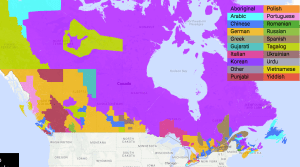
The Most Commonly Spoken Languages in Canada, Besides English and French

A couple of years ago, I came across an map that I found fascinating. It showed the most commonly spoken languages in the US (after English and Spanish). Some were fairly intuitive (French in Louisiana, Arabic in Michigan, etc.), but some forced me to think about the history (recent and past!) of a given state. For instance, I wouldn’t have guessed Chinese as the most commonly spoken language after English and Spanish in New York! I probably would have guessed Italian or Polish in thinking about the early immigrants to Ellis Island.

After seeing that post, it made me wonder what the most commonly spoken languages in Canada were (after English and French, of course). Sadly, my Google Fu kept turning up ‘snake eyes.’ It wasn’t until early last year that I saw tweet from Conrad Hackett, a demographer with the Pew Research Center, that linked to the very map I was looking for the year before. However, this map is even better, because it’s interactive!

The US map I linked to above shows the most commonly spoken language (after English/Spanish) by state. The map for Canada allows you to zoom in and look at specific areas within Canada. For instance, instead of grouping all of Ontario into one bucket, you can see some differences, depending upon which part of Ontario you’re viewing. For instance, in the Census Division (er, Census Division in Canada is kind of like “County” in the US) or York and Toronto, the most commonly spoken language after English/French is Chinese. However, in Peel, it’s Punjabi. Having lived in all three of those areas, those would have been my guesses.

However, I’ve also lived in Victoria and I’m not sure what I would have guessed. The answer is Chinese and I suppose that’s somewhat intuitive given that many immigrants from China choose BC (Vancouver or Victoria) as their place to call home). Similarly, right now, I live in Ottawa and I wouldn’t have guessed Chinese, nor would I have guessed Arabic for Gatineau (which is part of the National Capital Region).

One thing that should be immediately striking about the map is how much “Aboriginal” there is. It appears to be the account for the most land size. It’s probably not fair to group all the Aboriginal languages into one, so here’s a note on the methodology from the creators of the map:

We thought about this a lot when creating the map, and the primary reason is that there are simply not enough colours in the visual spectrum to use a distinct colour (and texture) for each language so that the map is actually visually pleasing and comprehensible. The editorial decision was made to combine the Aboriginal languages into a single colour (while retaining the distinctions and language-specific details when hovering). Why do we think this was a good decision? Almost all of the feedback we’ve received has been “Wow, I’m so happy there’s so much purple, it’s so great how much of Canada is dominated by indigenous languages!”. The purple wave is so striking, so visually stunning, and it clearly communicates the strength of the Aboriginal population across much of Canada — this effect would have been lost if we had selected different colours, and it would look just like everyone else. So we believe we struck a good balance.

One other part of the country that stands out is the Northwest Territories (near the top of the map). You probably could have given me a dozen guesses and I wouldn’t have said “Arabic” as the most commonly spoken language after English/French.


“What’s Your Background:” Cultural Differences Between Canada and the US

Growing up in the Greater Toronto Area, it was fairly common to meet people of different ethnicities and cultures. As a kid, when you’re first meeting someone — at least when I was growing up — one of the first questions (after learning someone’s name) was probably some iteration of: “What’s Your Background?”

Until I moved to mid-Michigan for university after high school, I didn’t realize that asking this question may have been a norm where I grew up and not anywhere else. I still remember when I first asked someone about their “background” when I arrived at university. They looked at me funny and so then I rattled off some possible answers, Irish, Italian, English, etc. The response I received was a stern: “I’m American.” I responded by saying I assumed that, but that I was also curious to know about their cultural heritage. The person reaffirmed that they were American.

And thus was the eye-opening experience for me — ingrained in a Canadian’s identity is that they aren’t necessarily from Canada or that they didn’t necessarily start in Canada. Canadians know that there was something before Canada.

At this point, I should clarify that it’s really not fair to make sweeping generalizations about all Americans or all Canadians. It’s probably not even fair to make generalizations about Americans from mid-Michigan or Canadians from the Greater Toronto Area. While I might hypothesize that something along the lines of what I just said in the above paragraph, my point in sharing this today is to highlight to you that there may be some “blind spots” that you’re unaware of, if you remain nestled in your own culture.

In fact, you may not even have to leave the country to notice your “blind spots.” Simply by taking up a new activity or popping into a different community, you may find that the way you think about something is vastly different from the way someone else thinks about that same thing. You may also find that your group’s “norms” are borderline blasphemous to another group (sidenote: while asking about someone’s background as a kid was normal, I learned that continuing to do this after moving to mid-Michigan was seen as ‘rude.’)

Why I Like Snow and Not for the Reasons You Might Think

I grew up in Canada. I’m Canadian. I lived in and around the Toronto area until I went off to university in Michigan. From there, I spent some time in warmer parts of the continent (California and British Columbia) and even spent some time in New Zealand and Hawaii. As I’ve spent some time away from Canada, I’ve been able to avoid “Canadian Winters.” In fact, this winter will be my first Canadian Winter in almost a decade.

As a Canadian, I can say that Canadian Winters aren’t all that bad, but I suppose that depends on where you live when you’re experiencing said Canadian Winter. Just a little while ago, Winnipeg experienced weather that was colder than Mars
and at the time, Mars was much farther from the Sun than Earth:

Folklore tells us that it can be “too cold to snow,” but a smart meteorologist will tell you that this isn’t true. Technically, it can never be too cold to snow (except when you reach absolute zero, but there are other things to worry about when this happens). However, snow can become far less likely when it’s colder and this has to do with a lack of water vapour in the cold air.

So, in my first Canadian Winter in almost a decade, I find myself elated whenever I see snow in the forecast or when I open the curtains to see it snowing. Of course, snow is quite pretty, so it’s fun to see it snowing and it can be fun to play in, but when I see it snowing, I know that it’s likely not that cold outside. I should also mention that I rarely, if ever, have to drive in said weather because I usually walk, so that may be colouring my experience. Nonetheless, it’s great to know that I won’t be needing to wear my long underwear just to walk down the street to get groceries.

How Y’all, Youse and You Guys Talk: What About Canada?

I’ve been clearing out some of the tweets that I’ve favourited over the last week or so and one of them was a fun dialect quiz from the New York Times Sunday Review. There are 25 questions that ask you the various ways you do (or do not) refer to certain things in the world around you. For instance, do you say y’all or youse or you guys (or something else) when referring to other people?

I found it relatively fun.

If you do decide to do it, though, I’d advise you to be careful in selecting an answer too quickly. There were a few questions where I clicked on one option and hit next and as the next question was loading, I noticed that there was actually an option for (none of these).

I realize that the New York Times is hosting this quiz, but I would have been interested to see where I stand in Canada. Maybe The Globe and Mail or the National Post can look into doing something similar?

I grew up in the Toronto area and have spent some time in British Columbia (and now Ottawa), but I’d be interested to see how I compare to other Canadians. Since I did grow up in Toronto, I wonder if that throws a wrench into my dialect. And, since I’ve lived in so many different places (California, Hawaii, New Zealand, Michigan, Virginia, etc.).

On the whole, it turns out that my dialect is closest to the people in Portland or Seattle. If I’m being honest, after undergraduate university, the west coast of the continent is where I’ve spent most of my adult life. I spent about a year in California and about a year in British Columbia (and about a year in Hawaii). The next closest would have been Virginia with 2 years.

Still Looking for a Christmas Present? Try These Projects on Kickstarter Canada

It’s the last weekend before Christmas, so there’s a good chance that a lot of you out there are out in the hustle and bustle trying to find last-minute gifts for friends and family. If the weather forecasts are to be believed, some of you might not be able to make it out into the madness that is last-minute shopping before Christmas. That’s great! Why? Well, that means that you’ll have to be a bit more creative with your gift ideas.

So, why don’t you make someone’s day (in addition to the person who you’re giving the gif to) by making a donation in their name to one of these projects on Kickstarter Canada. Also, you could just donate to them anyways — and not make the donation on behalf of someone else: it could be on behalf of you!

Note: I’ve only included projects that — at the time of writing this post — hadn’t reached their goal.

NASH: The Movie

“You may have heard of Steve Nash, the NBA superstar and multiple MVP winner. You may also know that he’s Canadian. A Vancouver documentary crew secured unparalleled access to Nash, and they’re in the middle of raising money for production and editing costs for the final film. Unlike many film projects, tiers of this project include a physical and digital copy of the final product, which gives potential backers a tangible reward for their donation.” (Source)

Stratus Watch

“The concept is as simple as it is unprecedented; a titanium wristwatch with a face that you can choose. You can choose from dozens of patterns and colours from the manufacturer, or design your own and submit it to them. The watches exude a clean, straightforward charm, and even the lowest funding tier gifts you one of them.” (Source)

Shot Time

“In what could easily be the ruin of many a young soul, this is a shot glass that measures the amount of liquor consumed over a period of time; a potent mix of a stopwatch and a case of acute alcohol poisoning. The consequences of such a device are best left to the imagination, but if it meets its funding goals, the consequences may become very real, very quickly. Hooray for progress?” (Source)

Canadian Black Garlic

“Exactly what it says on the tin; backers are funding the creation and shipping of various black-garlic-based condiments and seasonings. The majority of the project’s funding goal will go to securing a large batch of Canadian-grown garlic, and the rest will go into the blackening and production/packaging process. Is there anything more Canadian than authentic Northern delicacies?” (Source)

SpecShot

“Like the mirror universe version of the Shot Time, the SpecShot is a two-in-one system that scans your drinking water for contaminants and then posts the results online. This process could be equal parts fascinating and harrowing, depending on your results, but the ultimate goal is to spread awareness through hard data, and hopefully inspire some change to our water quality standards.” (Source)

Which US City Has the Worst Drivers: No Weather Variable?

A few days ago, there was an article on Slate that claimed to investigate which US city had the worst drivers. I thought the article was interesting as it’s probably something that everyone has an opinion on. That is, we all think that we know where the worst drivers in the US live. After reading the article, I was surprised — thoroughly — that there wasn’t a mention of weather.

Having grown up in Canada, (near Toronto), I am absolutely used to driving in snow and other forms of precipitation. After having lived in 4 different US states (and spending time in 31 others), I feel supremely confident in saying that not everyone is comfortable driving in forms of precipitation. While not an extraordinary revelation by any means, it still seems important. I had to read through the article a couple of times because I didn’t believe there was no mention of ice, snow, snain, or something else related. Weather absolutely affects the way that people drive and their comfort with precipitation will have certainly affect their ability to drive.

~

I’ve written before about unexpected snow in Washington, DC, but I don’t think I’ve talked about one of the conversations I’ve had with someone who’s lived in Metro DC for over a decade. She was explaining to me that, not only do you have such a wide variety of drivers in the DC area (those who’ve moved from the South or those who’ve moved from the North or those who’ve moved from the West, etc.), but you’ve also got the weather. More specifically, she was explaining that the “moderate” winters in DC make it awful for driving conditions. When the temperature hovers near freezing, the afternoon rain turns into morning ice. For those who have no experience driving in icy conditions, it can certainly cause drivers to be extra cautious (or mistakenly, not be cautious enough).

This is why I think it is important for any discussion of “the worst drivers” to include a weather variable. Sometimes, we need to be careful we’re not misappropriating the blame.

Plutocrats Author Running for Parliament in Canada

I happened to be reading through some of my old posts and noticed that I was going to write a post after I’d finished reading Plutocrats. I guess somewhere along the way it got removed from my to do list. I did write something that came to me while reading the book about looking down our noses, but nothing really about the book after that.

I think the author, Chrystia Freeland, did a really good job of bringing the issues to light and explaining them in ways that were accessible. It’s been more than a few months since I read it, a couple of the main points stuck with me.

1. It’s not just the wealthy that control the global economy, but the uber-wealthy.

Meaning, it’s not the 1% that are controlling the economy and affecting the 99% (as was the main message from Occupy Wall Street), but it’s the 0.1% who control the economy and affect the 99.9%. This may seem like splitting hairs, but Freeland offers compelling data that shows even the “wealthy” (i.e. the 1%) look like small potatoes next to the 0.1%.

2. The wealth gained by these folks wasn’t necessarily from unsightly means.

I don’t know remember if she says unethical, but some may consider it unethical. She makes the case that the uber-wealthy got that way — and continue to stay that way — because they’ve manipulated the market to funnel the wealth in their direction. She also does a little bit of debunking of the “trickle-down” economics perspective.

Overall, like I’ve said before, it’s a book that’s certainly worth reading.

~

Something that I find fascinating — Freeland was (as of a few days ago) a Managing Director and Editor of Consumer News at Thomson Reuters. As you learn from the book, this position allowed her to cultivate the contacts with people in high places to make the book that much more compelling (with stories and anecdotes).  Anyway, like I said, she had this position. She recently left it. Why? She’s running for a seat in Parliament. The Canadian Parliament (she is Canadian).

One of the most storied politicians in Canada in recent history (Bob Rae) left his seat in Toronto Centre to become the chief negotiator for the James Bay area First Nations in negotiations with the provincial government. This vacated his seat and as a result, they’ll be a by-election in the Fall (date not set, yet). Freeland has met with some of the Liberal Party of Canada leaders and decided to seek the seat.

I don’t know if she’ll win the seat (she hasn’t even won the right to represent the Liberal Party just yet), but if she does, I wouldn’t be surprised to see her become part of the “brass” very quickly. In fact, if Justin Trudeau and the Liberals can win enough seats to form a minority or majority government, I wouldn’t be surprised to see Freeland become a Cabinet Minister or at the very least, a senior advisor. Of course, the Federal election isn’t until 2015, but it’s certainly something to think about.

Canada Needs to Diversify its Export Strategy

During my last semester as an MBA student, I decided to take a class in International Relations theory. It was certainly a challenging class, especially considering I’d never had a course in political science. There was a steep learning curve in the beginning, but I learn very quickly, so I was able to stay right on track with the material. The last paper I wrote for that course had to do with Canada and NAFTA. I don’t think it’s a good idea to share the whole paper (22+ pages), but I thought I’d include pieces of the conclusion. Any hyperlinks below were added via WordPress’s “recommended links” and weren’t part of the original conclusion. Enjoy!

~

At the outset, this paper attempted to shed some light on Canada’s relationship to NAFTA. After the literature review and subsequent analysis, there certainly seems to evidence that Canada made the choice that benefitted the country the most [economically] when it signed onto NAFTA. As the [academic] literature has shown, there will continue to be calls for the three North American countries to further integrate. This certainly may help all of the countries of NAFTA, but it is hard to say that with Mexico still far behind the US and Canada, economically. In time, one would expect that Mexico could become a global economic force, but for now, there is still much work to be done. As it stands now, Canada’s main purpose for being part of NAFTA seems to be because the US is involved. As a result, one would expect that Canada would continue to be part of NAFTA and continue to strengthen its relationship with the US. If NAFTA were just an agreement between Mexico and Canada, there probably would not be a NAFTA.

After analyzing the data, one of the most important takeaways is that Canada needs to continue to diversify its exports strategy. The vast majority of Canadian exports are to the US. In the beginning, this was probably out of convenience. The US market is much larger than Canada’s and it is right there. However, as events like the global financial crisis foreshadow the possibility of similar and bigger events, it is important for countries like Canada to ensure that they are not too invested in the success of one nation. If for instance something were to happen to the US such that it pulls them [the US] down into a recession like Japan saw in the 1990s, Canada would undoubtedly be affected. Although, some may argue that if this were to happen, the whole world would probably be pulled into a recession. However, as Canada demonstrated by its resilience during the financial crisis, it is possible to mitigate the effects of a catastrophic event. This is exactly why Canada needs to continue to seek out free trade agreements with other countries. The more free trade agreements that Canada can enter into, the more insulated it will be against a possible economic collapse in the US.

Know The Rules: Bench-Clearing Brawl at the World Baseball Classic

A couple of weeks ago saw the start of the World Baseball Classic (WBC). This is only the 3rd WBC, but it’s already proving to be quite enjoyable to watch and from what the players say, quite enjoyable to play. The World Baseball Classic is akin to the World Cup (of soccer/football) where countries compete to qualify for (and play in) a tournament against other countries — in baseball. This past weekend, there was a game between Canada and Mexico that erupted into a fistfight. Now, as a baseball player of many years, I can tell you that never have I been in a fistfight on a baseball field. So how did it happen?

In the WBC, there are 4 pools with 4 teams in each pool. Each team plays each other once and the top 2 teams advance. Pretty simple, right? Well, with mathematics, there’s a high probability that there will be a tie for 2nd (or 1st!) and there will need to be tiebreakers to differentiate between teams. The first tiebreaker is head-to-head. Meaning, if Team A and Team B have the same record at the end of the pool play, the winner of the game between those two would advance to the next round. If we included a Team C in that scenario (all three Teams have the same record), then it gets dicey. Let’s also say that Team A beat Team B, Team B beat Team C, and Team C beat Team A. Our first tiebreaker doesn’t work. So, we’ve got to go to the next tiebreaker — run differential (it’s actually a bit more complicated than that, but we’ll just call it this to make it easier). Basically, run differential is just what it sounds like — the difference between the number of runs you scored and the number of runs that were scored against you.

Okay, now that we’ve got the basic understanding of the rules, we can talk about what happened this past weekend. In Pool D of the 2013 World Baseball Classic, Italy beat Mexico in the first game. In the second game, Italy mercy’ed (beat by 10 runs!) Canada. In the third game, Mexico beat the USA. At this point, the standings were: Italy 2-0, Mexico 1-1, Canada 0-1, and USA 0-1. In the fourth game, Canada was to play Mexico. Going into the game, Canada had a -10 run differential because they lost by 10 to Italy. So, if Canada won the game, they knew they were going to have win by a lot (in case that the 2nd tiebreaker came into effect).

Cut to the 9th inning of the game between Canada and the USA. At this point, Canada was winning 9-3. They had the game solidly in hand. The first batter of the inning noticed that there was an opportunity to bunt and make it to first base — so, he did. The 3rd basemen didn’t like this and instructed the pitcher to hit the next batter! Let’s take a step back for a second.

In the way that baseball is normally played (without the imposition of tiebreakers), you wouldn’t a team to try to “run up the score.” Meaning, a player wouldn’t take the advantage that the Canadian player did when he bunted — this is considered ‘bush league.’ So, when the Canadian player bunted to reach first base, the 3rd basemen suggested to the pitcher what would normally be suggested — bean him. Now, I’m not condoning this as a response, but generally, this is how things go in baseball. However, because of the tiebreaker 
rules, Canada wasn’t trying to embarrass Mexico, they were trying to even out their run differential! Herein lies the problem —
the Mexican player didn’t know the rules. After the Mexican player beaned the Canadian player, the benches cleared. When the benches cleared, a fist fight erupted.

This whole kerfuffle could have been prevented if the Mexican players knew the rules. I’m not writing this to place blame on the Mexican players for not knowing the rules. This post is meant to highlight what happens when you don’t know the rules of the game. More than that, we can broaden this to not knowing the rules of play (in business, politics, education, etc.). If you’re operating under the assumption that the rules are X, Y, Z, and the rules are actually Cup, Dog, Queen, then you’re probably going to miss something. More than that, when someone does something relating to Dog, you may get pretty upset expecting that the rules were X.

In short: Know the Rules.