Quick Thoughts: Planning Fallacy, Sci-Fi, Gendered Language, and Scarcity/Excess

glenn-carstens-peters-RLw-UC03Gwc-unsplashAs I look to breathe some life back into writing, I thought I’d take a quick peek at some of the “drafts” I had saved from when I used to write regularly. Fortunately, there aren’t too many there. In the interest of trying to start fresh, I thought I’d do a quick post addressing some of these ideas kind of in the same way that Wikipedia has stubs.

Planning Fallacy: Many years ago, I wrote about the planning fallacy as part of my series on cognitive biases (i.e. how to make decision better). Something I didn’t talk about in that post was the difference between a 7-day and 5-day workweek. Let me explain. For those that go to university, everyday is eligible for a “work” day (i.e. homework). Many things are due on Monday morning and rather than push to complete something on Friday afternoon (or night?), students will often be writing things on Sunday night. Not only am I drawing on my experience as a student, but I’ve been teaching for the last 7+ years and I can say with authority, if I give students a full week (7 days) to complete an assignment and make an assignment due at 1159p on Sunday night, 50%+ of the class will complete that assignment sometime on Sunday. I’m digressing a bit from the point. So, we get used to this “7-day workweek” to complete things. When we move into the work world, that “week” shifts from 7 days to 5 days (and even less in cases of holidays or even less than that if you take into account mandatory meetings, etc.). So, when someone estimates how much time they’ll have to complete a work product, they’re used to (primacy effect?) how they were estimating when they were a student and don’t take into account the ‘truncated’ week.

Science Fiction, Humans, and Aliens: In those sci-fi movies that have some form of alien (i.e. non-human), often times, there’ll be a scene where the humans are kept in a cage. It made me think about how humans keep some animals in cages (i.e. zoo). Maybe to a different species, we (humans) would be treated in the same way we treat animals.

Gendered Language: There was a journal article from a few years ago that caught my eye. Here’s a bit of the abstract:

The language used to describe concepts influences individuals’ cognition, affect, and behavior. A striking example comes from research on gendered language, or words that denote individuals’ gender (e.g., she, woman, daughter). Gendered language contributes to gender biases by making gender salient, treating gender as a binary category, and causing stereotypic views of gender.

Like I said yesterday, if you’ve been following me for any sort of time, this bit about our words having an effect on us shoudn’t come as a surprise. However, this journal article is strong evidence to keep in your pocket if you need to point to something evidence-based in a discussion.

The Problem of Excess: Another good journal article that I’ve been saving for over 5 (!) years. /facepalm. I still remember my first grad school economics course and the professor was explaining the fundamental principle that underlines economics — scarcity. I wanted to raise my hand and disagree on the merits, but it didn’t seem appropriate. I can see and understand how scarcity came to be the dominant theory of the day, but a part of my being just feels that that interpretation is… near-sighted. Seeing this journal article a few years after that class highlighted a different perspective. Here’s a bit of the abstract:

This article argues for a new branch of theory based not on presumptions of scarcity—which are the foundational presumptions of most existing social theory—but on those of excess. […] It then considers and rejects the idea that excess of one thing is simply scarcity of another. It discusses the mechanisms by which excess creates problems, noting three such mechanisms at the individual level (paralysis, habituation, and value contextuality) and two further mechanisms (disruption and misinheritance) at the social level. […] It closes with some brief illustrations of how familiar questions can be recast from terms of scarcity into terms of excess.

Enjoy your weekend!

Positive Stereotypes Are Pervasive and Powerful

Pop quiz: hands up — how many of you think positive stereotypes are OK?

I suspect that for many of you, your first reaction may have been, “well, yeah, they’re positive, right?” I can totally empathize with that shortcut, but consider this excellent quote from Gordon Allport, one of the “founders” of personality psychology: “People may be prejudiced in favor of others; they may think well of them without sufficient warrant,” [quote excerpted from journal article cited below].

Last year, researchers sought to summarize some of the research about positive stereotypes. There were a number of interesting findings. For instance:

Among [a] sample of Asian American students, the majority (52%) had negative reactions (e.g., feeling marginalized) to their group being considered the “model minority” compared with 26% who had positive reactions. […] Although the subjective favorability of positive stereotypes may facilitate their expression among perceivers who intend them as “compliments,” the targets of such stereotypes can feel depersonalized as if they are being acknowledged exclusively through their category membership. [Emphasis mine]

So, while it might be a ‘positive’ stereotype that Asian Americans are considered the “model minority,” it’s possible that an Asian American may feel as if they are being depersonalized when having the stereotype directed at them. That is, they may no longer feel like they’re a person, but rather that they simply belong to this category called “Asian American.”

Let’s back up for a moment.

When I talk about stereotypes in my lectures to students, one of the first things I do is explain the mechanics of a stereotype. Our brain is processing way more stimuli than we could possibly fathom. For instance, in your office right now, do you hear the hum of the lights or the sound of the fan? If you’re on the bus or in a car, do you notice the sound of the brakes? How about at home… do you still hear the creaky sounds of the floorboards or the plethora of sounds that come out of the basement/vents? I suspect the answer to many of these questions for most of you will be no and that’s because you have habituated to them. Your brain has recognized them as non-threatening and moved on to focus on other stimuli — people.

There are so many people on the planet. Really, we could say that there are over 7 billion different kinds of people, but that’s impossible for a brain that’s trying to process as much as it can. So, when you meet people, your brain is busy trying to recognize patterns that it can map onto previous people you’ve met. When everyone’s brain does this, it follows that a thing called “stereotype” emerges. That is, a stereotype is our brain’s way of trying to find a shortcut for understanding the different kinds of people we interact with during our lives.

So, in the example above about Asian Americans, somewhere along the way, someone’s brain decided Asian Americans represented what they believed was a ‘model citizen.’ Forgetting for a second whether this is valid, it’s likely that there were other people’s brains came to this conclusion and so the stereotype is perpetuated.

Just because our brain is doing this in the “background” doesn’t make it ok. As humans, there are so many biases that we have to be aware of when making decisions — our brain taking shortcuts with stereotypes is just one of them. So, what can you do?

Well, as I often say when it comes to biases — the first step is awareness. You’ve gotta recognize that you’re falling prey to stereotyping and once you recognize that you’re doing it, I urge you not to be so hard on yourself. Let’s be clear — I’m not giving you a “pass” for stereotyping, no. But the culture from which you derive can have a lasting effect on your beliefs about people (which inform whether you employ stereotypes).

One quick and easy way to awareness — if you’re ready for it — is Harvard’s Project Implicit Test. I did a quick search and I was surprised that I’ve only mentioned this one other time in the last few years on this site and it was only in passing. From their site:

Psychologists understand that people may not say what’s on their minds either because they are unwilling or because they are unable to do so. For example, if asked “How much do you smoke?” a smoker who smokes 4 packs a day may purposely report smoking only 2 packs a day because they are embarrassed to admit the correct number. Or, the smoker may simply not answer the question, regarding it as a private matter. These are examples of being unwilling to report a known answer. But it is also possible that a smoker who smokes 4 packs a day may report smoking only 2 packs because they honestly believe they only smoke about 2 packs a day. Unknowingly giving an incorrect answer is sometimes called self-deception; this illustrates being unable to give the desired answer.

The unwilling-unable distinction is like the difference between purposely hiding something from others and unconsciously hiding something from yourself. The Implicit Association Test makes it possible to penetrate both of these types of hiding. The IAT measures implicit attitudes and beliefs that people are either unwilling or unable to report.

If you’re ready for the results, I strongly suggest you take the test.

ResearchBlogging.orgCzopp, A., Kay, A., & Cheryan, S. (2015). Positive Stereotypes Are Pervasive and Powerful Perspectives on Psychological Science, 10 (4), 451-463 DOI: 10.1177/1745691615588091

The Most Common Biases in Business Decisions

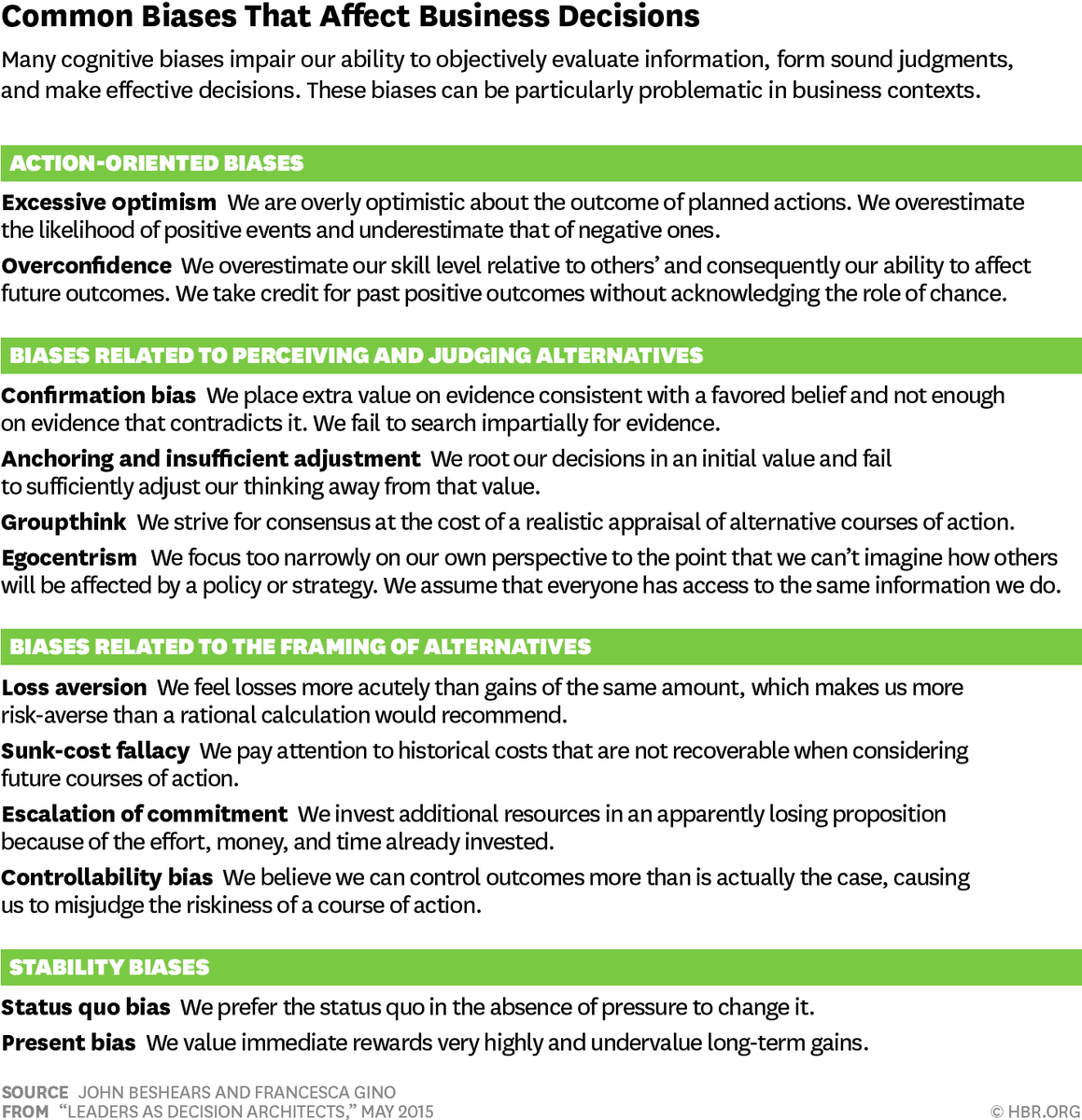
If you’ve been following me for any length of time, you’ll know that one of topics that I write about the most is cognitive biases. So, when I came across an article on the Harvard Business Review that neatly wrapped up some of the more common biases in business decisions, I just had to comment on it.

I agree with just about everything in this table (?), but I’m surprised about one thing: the endowment effect. That is, I’m surprised it’s not listed in the table. Specifically, listed under ‘stability biases’ as this is where it would fit. To refresh your memory:

In short, it means that people want more money for something than they’d be willing to pay for it. Put differently: we overvalue that which we own. You could think of a simple example of this through the course of a negotiation. When negotiation with someone, we’ll probably overvalue what we bring to the table. Someone may offer you $50 for your 25-year old keyboard (piano), but you think it’s worth at least $75. Barring any outside appraisal, the endowment effect is likely at play here.

Given the number of deal-making that takes place on a regular basis, I’m surprised that we didn’t see this as part of the table. It seems to me that in business, when money is often the thing that’s held in the highest regard (for better or for worse), you’d want to have people with the decision-making power understand that they may be overvaluing what’s theirs.

Upon further reflection, I can understand why one may not see it as a “common” bias because in today’s society, (at least in Western cultures), the common transaction is cash for stuff and not stuff for stuff (barter). If bartering were more the name of the game, then I would certainly want to see the endowment effect on that list. Either way, though, it’s certainly worth remembering that we tend to overvalue the stuff we have.

The Sunk Cost Trap on TV: Fitzgerald Grant and Olivia Pope

A few months ago on the popular TV series “Scandal,” the fictional President of the United States fell into the sunk cost trap:

We have to get Olivia back, not just because I love her, not just because having her out there is a threat to national security. There are soldiers who are never coming home because I tried to get her back. Someone’s father, someone’s husband. I have killed so many mothers’ sons trying to get her back. The flags placed on the coffins where they lay are there because they had the courage to give their lives and I did not have the courage to give Liv’s, so she has to come back because their sacrifice damn well has to mean something. They cannot have died for nothing. They cannot have gone to their death for no other reason than I asked them to.

If you’ll remember from my post about the sunk cost trap a couple of years ago:

The United States has invested much in attempting to achieve its objectives. In addition to the many millions of dollars that have been spent, many thousands of lives have been lost, and an even greater number of lives have been irreparably damaged. If the United States withdraws from Vietnam without achieving its objectives, then all of these undeniably significant sacrifices would be wasted.

Do you see the parallels?

Now, I totally get why the writers of Scandal couldn’t have the fictional President of the United States not continue to try and rescue Olivia Pope (how could there be a show without Olivia?), but I wish they didn’t have to write it in this way. In actuality, based on what he’s saying, it sounds like he’s come to the realization that sending more troops to war is a bad idea, so right there — right at the point — is when he should stop sending troops to war. Right then, he has the knowledge that continuing down the same path is the wrong thing to do, so he should stop. His rationalization for continuing is the sunk cost trap.

The thing that worries me is that by having things play out like this, it’s almost affirming that what the President is doing is the “right” thing or that it is the only choice he has. Certainly, there are plenty of other courses of actions he could have chose (many that probably wouldn’t make for good TV). Most people probably won’t find themselves in a situation where they’re forced to continue a war (or start a war, for that matter) for dubious reasons (or any reason, for that matter), but seeing stuff like this on TV, in a way, gives people an idea of how they can do things. I’d much rather popular entertainment actually err on the side of educating viewers, if it’s going to incorporate lessons of this nature.

I can already hear you yelling at me that this doesn’t make for good TV or entertainment (I know, I alluded to that earlier), but can’t we find a way to blend effective decision-making with entertainment, so that while we’re being entertained, we’re also learning something, too?

How You Probably Discriminate and Don’t Even Know It

Are you a part of a group at work, school, or recreationally? Well, then you’ve probably discriminated without even knowing it. A recent theoretical review of the literature concluded “ingroup favouritism is more potent than outgroup hostility” when it comes to discrimination in the United States. Meaning, preferential treatment to the people that are on your team contributes to discrimination more than outward displays of hostility to people not part of your team.

I should say that this ingroup favouritism doesn’t simply apply to overt teams/groups. Consider your work relationships for a moment. Let’s say that your son or daughter gets along quite well with the son or daughter of one of your subordinates. This particular subordinate missed a bunch of days of work this year because they were taking care of their child who was sick. When it comes time for performance reviews and this particular subordinate’s performance falls between two possible ratings, you give the subordinate a higher rating. However, there is another subordinate, without a child who’s friends with your child. This subordinate has also missed some work this year, but instead of giving them the higher rating, you give them the lower (of the two) ratings. By giving a higher rating to the subordinate to whom there is a connection, you’d be exhibiting ingroup favouritism. You’re not openly discriminating against the other subordinate, but you are showing preferential treatment (even if it’s inadvertently!) to one subordinate over the other.

This particular bit of research seemed especially important given Ta-Nehisi Coates’ recent essay in The Atlantic. As I grew up in a fairly multicultural environment, I like to think that I don’t let a person’s race or ethnicity factor into any decisions I make. However, I, as many others have learned from Harvard’s Project Implicit Test, the culture that I live in has had an important influence on me.

~~

There are obvious streams for this kind of research, but I was thinking about it in a broader context. As it stands, there’s the idea of ingroup and outgroup. That is, “our people” are over here and I’m going to do everything I can for them, while you’re people are over there and I’m not going to necessarily do everything that I can to help them. What if there no longer was an ingroup and an outgroup? Or maybe more specifically, what if everyone was part of your ingroup?

Consider someone like the Dalai Lama. There’s the ‘obvious’ ingroups for the Dalai Lama (Tibet, Buddhism, etc.), but I’d bet that the Dalai Lama probably thinks of all humans as his ingroup. Of course, we can’t all be the Dalai Lama, but we certainly could strive for this.

Let’s simplify this example just a little bit. Americans — is an ingroup — when you put it in context of a global stage. Americans look at themselves as an ingroup when it comes to some sort of international competition. That is, at the upcoming World Cup in June, Americans will be an ingroup, especially when there are matches against other countries. What if, instead of Americans thinking of themselves as the ingroup, they, instead, thought of the ingroup as fans of soccer (or football, depending upon where you’re from — although most Americans probably say soccer). While this is still an ‘ingroup,’ it’s certainly a broader and bigger ingroup than simply American (fans of soccer).

While not perfect, this is also on the way to expanding the ingroup to all of humanity.

ResearchBlogging.orgGreenwald AG, & Pettigrew TF (2014). With Malice Toward None and Charity for Some: Ingroup Favoritism Enables Discrimination. The American psychologist PMID: 24661244

Meditation Mitigates Effects of Cognitive Biases

There have been thousands of scholarly articles written about the myriad benefits of meditation, but the one I came across recently was one of the first that confirmed one of my previously held beliefs: meditation helps you make better decisions.

The thing that struck me most about this study were the similarities to an experiment I conducted (on intuition and decision-making) as a research assistant. I had a condition where students would meditate for a short time and then use their intuition to make decisions. The results weren’t as I, (the research assistant I was working nor the professor), had hoped. I wrote it off as the the reluctance of undergraduates to meditate, but in this study, in particular, studies 2a and 2b, the researchers used undergraduates (approximately 200 combined) and they meditated!

In the second study, the researchers had the undergraduates listen to a 15-minute audio track, which was was specifically designed for this study. In one condition, students listened to a mindfulness meditation created by a professional mindfulness-meditation instructor and in the other, the students listened to a track, again, by a professional mindfulness-meditation instructor, that continuously instructed students to think about whatever came to mind. This second condition was called the “mind-wandering” condition and previous research used a similar method as a control for mindfulness experiments.

As I already mentioned in the opening paragraph, the researchers found that increasing mindfulness (i.e. meditation) reduced the effects of cognitive biases (i.e. the sunk cost fallacy). My favourite part of this study [Emphasis added]:

It is particularly notable in this set of studies that increased resistance to the sunk-cost bias occurred after only a brief recorded mindfulness-meditation induction. Many prior mindfulness-meditation interventions have involved 8 weeks of face-to-face training (Brown & Ryan, 2003); by comparison, our 15-min recorded manipulation is substantially more practical.

Many people have gotten it into their heads that the positive effects of meditation takes weeks to manifest. Here is tangible proof that — today — meditation can help you make better decisions. Also:

We also encourage research investigating how mindfulness practice might improve other decision-making processes and outcomes.

Absolutely! I would suspect that meditation would help guard against a whole host of other cognitive biases, but it would be fantastic if there were scientific evidence to back this up. For instance, years ago when I was the president of the student body, I once tried to begin a general assembly meeting with a quick 1-minute meditation, but the maturity level just wasn’t there. Even after 10 seconds, some of the representatives couldn’t handle the silence. I take the blame for that as I probably didn’t do the method justice by properly introducing it with the research. Can you imagine, if, before every semi-major decision, you took 10, 5, 2, or even 1 minute just to sit still and clear your mind of the previous discussion. I wonder how much lost revenue there is from not taking a moment to pause and reflect before a decision is made.

I should say, I’m sure that there is certainly time between major decisions (i.e. mergers & acquisitions, although, there is fascinating research on how big of a failure those can be), but I’m thinking about the mid-level manager who makes many decisions in a day that can affect the bottomline of a company. The managers that make quick decisions about whether to go with this contract or that contract, whether to make this purchase or that purchase. Maybe that’s a good place to start with more research.

ResearchBlogging.orgA. C. Hafenbrack, Z. Kinias, & S. G. Barsade (2013). Debiasing the Mind Through Meditation: Mindfulness and the Sunk-Cost Bias Psychological Science DOI: 10.1177/0956797613503853

Best Posts of Jeremiah Stanghini’s Blog in 2013

Last year when I did a best posts series, I ended up doing three different posts. This year, since all of the posts that appear on this website originated on this website, I wouldn’t need to include any posts about Genuine Thriving. My first inclination was to do a best of 2013 and a best of all-time, but after looking at the statistics, the best of 2013 and the best of all-time are essentially — identical. As a result, I decided to just do the one post of the best posts of 2013.

Before revealing the top 6 posts along with an excerpt, there is one thing to keep in mind. On the old site, there used to be only an excerpt shown with the post. So, if someone wanted to read the whole post, they had to click the link (this was just how the theme worked). On this site, however, I specifically chose a theme where folks wouldn’t have to click a link to view the whole post (only to share or comment because those links are on the post’s page). As a result, the statistics for the most popular posts are sure to be skewed because people may have read a certain post more than another, but without them clicking the link for the post, there’s no way (that I know of) for me to know. On top of that, the theme I’ve chosen here allows the viewer to scroll (all the way to the first post!) What does that mean? When you’re on the homepage, you can continue to scroll down and more posts will load… all the way ’til you get to the first post. And in looking at the statistics of the top posts, it’s clear that “scrolling down” is far and away the most popular “post” on this site (this was true last year, too). With that in mind, here they are with an excerpt for each:

The Official Final Jeopardy Spelling Rules [UPDATED]

If you know me, you know that I’m really good at finding things on the Internet. After doing a couple of cursory google searches (Final Jeopardy RulesOfficial Final Jeopardy RulesOfficial Jeopardy Rules), I was surprised that I couldn’t find them. Sometimes, the site that hosts a document like this doesn’t do a good job of using keywords. So, I thought I’d poke around the official Jeopardy site — nothing.

After some more derivations of “Rules of Jeopardy,” I was beginning to think that maybe the rules aren’t online. I thought that maybe the contestants were handed a paper copy that they signed before going on the show and that document wasn’t online. Having never been a contestant on Jeopardy (though I’d like to be some time!) I couldn’t confirm whether this was true. However, given that it’s a game show, I’m sure they signed something before going on the show. Regardless, I didn’t have access to that document.

In The End, Everything Will Be OK – If It’s Not OK, It’s Not Yet The End

It’s no secret that I like quotes. Since converting my Facebook profile to a Facebook page, I’ve gotten into the habit of sharing a “quote of the day.” If my calculations are correct, I’ve been sharing quotes of the day for over 80 days now. As you’ll notice that I also have a quotes category, I’ve shared a number of quotes here on this site, too. And if I think back to the days of AIM (AOL Instant Manager), I often had quotes as my “away” message. And even before then, I remember really liking quotes in high school and in elementary (or grade) school. So, like I said, it’s no secret that I like quotes.

If You Want to Be Happy, Spend Your Bonus On Your Coworkers

That bonus you were looking forward to at the end of the year is “yours” and you should get to spend it on you and your family. Except, research shows that’s not the case. In fact, the research indicates that spending the money on someone other than yourself actually leads to greater happiness. More than that, it can lead to your improved performance at work.

The Confirmation Bias — What Do You Really Know: List of Biases in Judgment and Decision-Making, Part 6

Why is the confirmation bias so loathed? Well, as Nickerson points out, it may be the root cause of many disputes both on an individual and an international level. Let’s think about this for a second: let’s say that in the world of objectivity “out there,” there are any number of possibilities. In the world  of subjectivity “inside my head,” there are only the possibilities that I can imagine. Humans, on the whole, tend to fear change (there are over 600,000,000 results for that search on Google!). In order to allay those fears, I’m going to prefer information that already conforms to my previously held beliefs. As a result, when I look “out there,” I’m going to unconsciously be looking for things that are “inside my head.”

Advancing America’s Public Transportation System: High-Speed Rail in the USA

When it was first announced that the US was going to work on , I was very excited! Growing up in the , I am very familiar with the value of public transportation. I often rode a bus to and from school. As I matured and wanted to explore downtown with my friends, we’d ride the  to get there from the suburban area we lived. Beyond that, when I needed to make trips between Detroit and Toronto, I would ride the  between Toronto and Windsor instead of taking the 45 minute flight. Public transportation is a great way, in my opinion, to feel better about reducing one’s .

Three Lessons from The Hobbit: On Doing What You Can, Having Faith, and Demonstrating Leadership

Anyway, as I was watching, there were a few instances I noticed that could serve as quintessential lessons. Given that The Hobbit is a good example of the hero’s journey, it’s not surprising that there’d be great lessons to be found in the story.

What’s the Status Quo From the Other Side: List of Biases in Judgment and Decision-Making, Part 14

It’s Monday, so you know what that means — cognitive bias! When I write that, I sort of imagine a “live television audience shouting in chorus: cognitive bias!” Wouldn’t that be fun? Well, maybe it wouldn’t, but it’s kind of funny to think about. I’ve only got a couple of more biases that I’d like to mention, so let’s get right to today’s — the status quo bias.

The status quo bias, like many of the previous biases we’ve talked about, is exactly what it sounds like: a preference for the how things currently are. You may even look at this bias as some people’s inability to accept change or a fear of change, but that probably wouldn’t be completely accurate. Let’s go back to one of those journal articles we looked at in previous biases — Anomalies: The Endowment Effect, Loss Aversion, and Status Quo Bias:

A large-scale experiment on status quo bias is now being conducted (inadvertently) by the states of New Jersey and Pennsylvania. Both states now offer a choice between two types of automo­bile insurance: a cheaper policy that restricts the right to sue, and a more expensive one that maintains the unrestricted right. Mo­torists in New Jersey are offered the cheaper policy as the default option, with an opportunity to acquire an unrestricted right to sue at a higher price. Since this option was made available in 1988, 83 percent of the drivers have elected the default option. In Pennsyl­vania’s 1990 law, however, the default option is the expensive policy, with an opportunity to opt for the cheaper kind. The potential effect of this legislative framing manipulation was studied by Hershey, Johnson, Meszaros, and Robinson (1990). They asked two groups to choose between alternative policies. One group was presented with the New Jersey plan while the other was presented with the Pennsylvania plan. Of those subjects of­fered the New Jersey plan, only 23 percent elected to buy the right to sue whereas 53 percent of the subjects offered the Pennsylvania plan retained that right. On the basis of this research, the authors predict that more Pennsylvanians will elect the right to sue than New Jerseyans. Time will tell.

Another example:

One final example of a presumed status quo bias comes courtesy of the Journal of Economic Perspectives staff. Among Carl Shapiro’s comments on this column was this gem: “You may be interested to know that when the AEA was considering letting members elect to drop one of the three Association journals and get a credit, prominent economists involved in that decision clearly took the view that fewer members would choose to drop a journal if the default was presented as all three journals (rather than the default being 2 journals with an extra charge for getting all three). We’re talking economists here.”

You can see how important this bias would be for your life in making decisions. Should I sell my house (when the market’s hot) or should I hold onto it? You might be more liable to hold onto your house, even though there are economic gains to be had by selling it and, in fact, there are economic losses by keeping it!

As we’ve mentioned with some of the other biases, this bias can operate in tandem with other biases. For instance, think about the scenario I just mentioned and how that might also be similar to the endowment effect or loss aversion.

Ways for Avoiding the Status Quo Bias

1) Independent Evaluation

It really can be as easy as this. Have someone (or do it yourself) do a cost-benefit analysis on the situation/decision. In this way, you’ll be able to see the pros/cons of your decision in a new light. Of course, you may still succumb to the status quo bias, but you might be less likely to do so.

2) Role Reversal

While the independent evaluation makes “good sense” in trying to avoid this bias, doing some sort of role reversal will probably be the most effective. That is, look at the decision/situation from the other perspective. If it’s a negotiation, imagine that you’re in your negotiating partner’s shoes and you’re actually doing the trade from that side. Evaluate the deal. This may help to shake loose the status quo bias.

If you liked this post, you might like one of the other posts in this series:

WRAP — An Acronym from Decisive: List of Biases in Judgment and Decision-Making, Part 10

I recently came across a post from Farnam Street that seems like it would make a great addition to the series we’ve been exploring over the last 10 weeks (biases in judgment and decision-making). So, instead of going over another bias today, I thought I’d share the information I found and tie it back into our series. Check back next week for a new bias (it could be functional fixedness, the hindsight bias, the status quo bias, or maybe the recency/primacy effect(s)…)

The author of the Farnam Street blog summarized some of the work in Chip and Dan Heath’s new book: Decisive: How to Make Better Choices in Life and Work. Given that our series is about decision-making, this book seems like it would be absolutely on-point, with regard to the closing of each post (How to avoid *blank*).

I haven’t yet read the book, but I did want to include a brief excerpt (courtesy of Farnam Street), along with a lead-in from Farnam Street:

The Heaths came up with a process to help us overcome these villains and make better choices. “We can’t deactivate our biases, but … we can counteract them with the right discipline.” The nature of each of the four decision-making villains suggests a strategy for how to defeat it.

1. You encounter a choice. But narrow framing makes you miss options. So … Widen Your Options. How can you expand your sent of choices? …

2. You analyze your options. But the confirmation bias leads you to gather self-serving information. So … Reality-Test Your Assumptions. How can you get outside your head and collect information you can trust? …

3. You make a choice. But short-term emotion will often tempt you to make the wrong one. So … Attain Distance Before Deciding. How can you overcome short-term emotion and conflicted feelings to make better choices? …

4. Then you live with it. But you’ll often be overconfident about how the future will unfold. So … Prepare to Be Wrong. How can we plan for an uncertain future so that we give our decisions the best chance to succeed? …

There’s also a handy picture that’s included (again, courtesy of Farnam Street):

As we can see, the Heaths have offered four universal ways for avoiding biases in judgment and decision-making. If we recall some of the different ways for avoiding biases that we’ve discussed over the last 9 weeks, many of them can be collapsed into one of the categories listed above. In case you’re a bit hazy, here are some of the biases that we’ve talked about before that have a “way for avoiding” that falls into one of the categories above:

So, if you’re having trouble remembering the different ways for avoiding the biases we’ve talked about, all you have to do is remember “W-R-A-P!”

When 99% Confident Leads to Wrongness 40% of the Time: List of Biases in Judgment and Decision-Making, Part 9

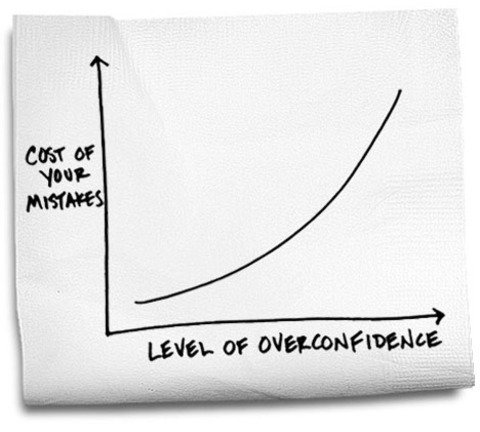
This week, we’re looking at one of my ‘favorite’ biases, in that it’s one that once you know, it can be quite comical to spot it in others (and yourself, if you still fall for it, from time to time). From Wikipedia: the overconfidence effect “is a well-established bias in which someone’s subjective confidence in their judgments is reliably greater than their objective accuracy, especially when confidence is relatively high.” That’s a bit jargon-y, so let me illustrate with a simple example.

In fact, this example comes from a lecture I heard about negotiation and talked about in one of my previous posts. In case you were wondering, the lecture comes from Professor Margaret Neale at Stanford. It was a brilliant! There was so much information packed into the lecture. I remember listening to it a few different times and still pulling out nuggets of wisdom. Anyway, I digress. The example that Prof. Neale uses is particularly on point for illustrating the overconfidence effect.

She has an empty pop bottle filled with paper clips (but not to the top). She says to the crowd that she wants them to guess how many paper clips are in the bottle. She walks up and down the aisles, so they can get a closer look, too. She instructs the crowd to write down their answer. Then, she asks them to write down a range where they could be 100% (she may say 99%, I don’t remember) sure that the number of paper clips fell in the range. Essentially, she was asking for a confidence interval. I think she also told them that she was sure there weren’t more than 1,000,000 paper clips in there. After some time, she then tells the audience how many were in there. She asks if anyone got it right (no one raises their hand). She then says something to the effect of, “For how many of you did the number of paper clips fall within the range?” There may have been about 35% of the room who raised their hand. 35%! She exclaims that this is terrible given that all of these people were 100% (or 99%) sure that the number would fall in the range. In fact, she said that in a room that size, there should have only been a handful of people who’s range wasn’t met (if the 99% figure was being used, rather than 100%). Prof. Neale then goes on to explain that this is the overconfidence effect. The audience was being asked to make an estimate of something about which they knew nothing, and then asked to rate their confidence. Knowing that they knew nothing about the topic, it would have been logical for the audience to have a large confidence interval (between 10 paper clips and 20,000 paper clips) — or even bigger!

This happens in more ways than just simply estimating the number of paper clips in a bottle. We also see this with investors. When asked, fund manager typically report having performed above-average service. In fact, 74% report having delivered above-average service, while the remaining 26% report having rendered average service.

Another place that we see the overconfidence effect show up is with the planning fallacy: “Oh yeah, I can finish that in two weeks…”

Ways for Avoiding the Overconfidence Effect

1) Know what you know (and don’t know)

The fastest way to slip into the trap of the overconfidence effect is to start making “confident” predictions about things that you don’t know about. Guessing the number of paper clips in a bottle is something that most of us have little to no expertise in. So, list a large confidence interval. If you have no experience in managing a project, it might be in your best interest not to make a prediction about how long it will take to complete the project (planning fallacy).

2) Is this person really an expert?

Sometimes, you’ll hear someone displaying a level of confidence in a given situation that makes you think they know what they’re talking about. As a result, it might bias you into believing what they are saying. It’s important to know if this person is an expert in this field, or if maybe they’re succumbing to the overconfidence effect.

From Scott Plous‘ book called The Psychology of Judgment and Decision Making: “Overconfidence has been called the most ‘pervasive and potentially catastrophic’ of all the cognitive biases to which human beings fall victim. It has been blamed for lawsuits, strikes, wars, and stock market bubbles and crashes.”

If you liked this post, you might like one of the other posts in this series: